



Substack alternatives get compared on price. The number that decides your move is somewhere else: whether the new platform lets you keep the same Stripe account. Ghost requires it. beehiiv forbids it. Patreon never had one. I read the terms and the payment documents, and that single line decides whether your paying readers survive the move.
- What actually happens when you leave
- Can your paying subscribers come with you?
- What happens to the people who pay you?
- The order of operations, and the group you have to count first
- What you own, and what you only rent
- Which alternative fits the reason you are leaving?
- Why do people actually leave Substack?
- The seven kinds of thing sold as a Substack alternative
- Hosted platforms built for writers
- Publishing systems that happen to send email
- Email services creators use as a newsletter
- Membership platforms, where the newsletter is a side effect
- Publishing where the audience is not yours
- What does free actually mean here?
- Running it yourself: what replaces the platform cut
- Assembling it from parts
- For newsrooms and publications with more than one writer
- When the publication is really a podcast
- What you give up that has nothing to do with features
- The rules you agreed to, and what they say
- Who wrote the other pages you are reading
- How we checked this
- Frequently Asked Questions
- Can I move my paying subscribers without asking them to subscribe again?
- Who cannot be migrated at all?
- What happens to my archive and my links?
- Which Substack alternative takes no cut of subscriptions?
- Is a free plan the same as a free licence?
- Will my readers notice that I moved?
- Can I move a paid podcast feed as well?
- Is self-hosting realistic for a writer?
- My Take
I spent a day inside the documents instead of the marketing pages. Nine platform help centres, two Stripe reference pages, one publisher agreement dated July 20, 2026, and the seven pages Google ranks for this search. Every quote below is on a live page as of August 28, 2026, and I have said so where a page has not been touched in years.
What actually happens when you leave
Leaving a newsletter platform is four separate moves, and only the first one is easy. You take the list. You take the archive. You take the paying relationship. You take the flow of new readers. The list is a download. The other three are where people get hurt.
Substack says the first part plainly. Its help centre reads: “Anything you publish on Substack is yours to own,” and it tells you where the button is. Settings, then Exports, then “Create new export.” No support ticket. No waiting list. That page carries the line “Updated 2 years ago.” The payments page next to it was updated three days before I read it, which tells you which half of this deal the company is still working on.
Then the trouble starts. A subscriber list is a spreadsheet of email addresses. A paying subscriber is a live billing agreement sitting inside a payment processor, and billing agreements do not move the way spreadsheets do. Every list of Substack alternatives stops at the spreadsheet. This one does not.
So the payment question comes first here, because it is the one that costs money. Then what you own against what you only rent, then the classes of product on offer, including three that no other list will show you. If you are moving a scheduling or social stack at the same time, the pricing work in our guide to the best social media scheduler follows the same method.
More Read

Can your paying subscribers come with you?
Usually yes, but only if the new platform lets you keep the Stripe account you already have. That one line separates the Substack alternatives from each other. It is the whole question. It has one of three answers, and each platform has already published its answer in its own help centre. I searched all seven guides ranking for this phrase: the words “Stripe account” appear on exactly one of them, and only as a selling point. So here it is.
First, the part every guide skips. If you take money on Substack, you already have a Stripe account and it is yours, not Substack’s. It was created when you turned on paid posts, in your name, with your bank details and your business address inside it. Substack’s own help page is titled “How do I set up my Stripe account on Substack to start receiving payments?” and it sits in your dashboard under Payments. Stripe is the company that actually charges the cards. Every platform in this guide either connects to that account, makes you open a second one, or replaces it with itself.
Ghost is the clean case. Its help page for migrating publications says: “If you are migrating from other platforms such as Substack, you’ll need to use the same Stripe account.” Read that as an instruction and it sounds like paperwork. Read it as engineering and it is the reason Ghost migrations go quietly: if the account never changes, the subscriptions never move at all. They keep billing from where they always billed.
beehiiv publishes the opposite instruction, in a box labelled Tech Note: “It is not possible to connect an existing Stripe account that was previously used outside of beehiiv’s Stripe setup. You must create a new account through beehiiv’s Stripe setup to manage your paid subscriptions.” The same page repeats it a screen later, in case you missed it. Connect Stripe to beehiiv, and “a new account is created within Stripe,” separate from any existing Stripe accounts you already hold.
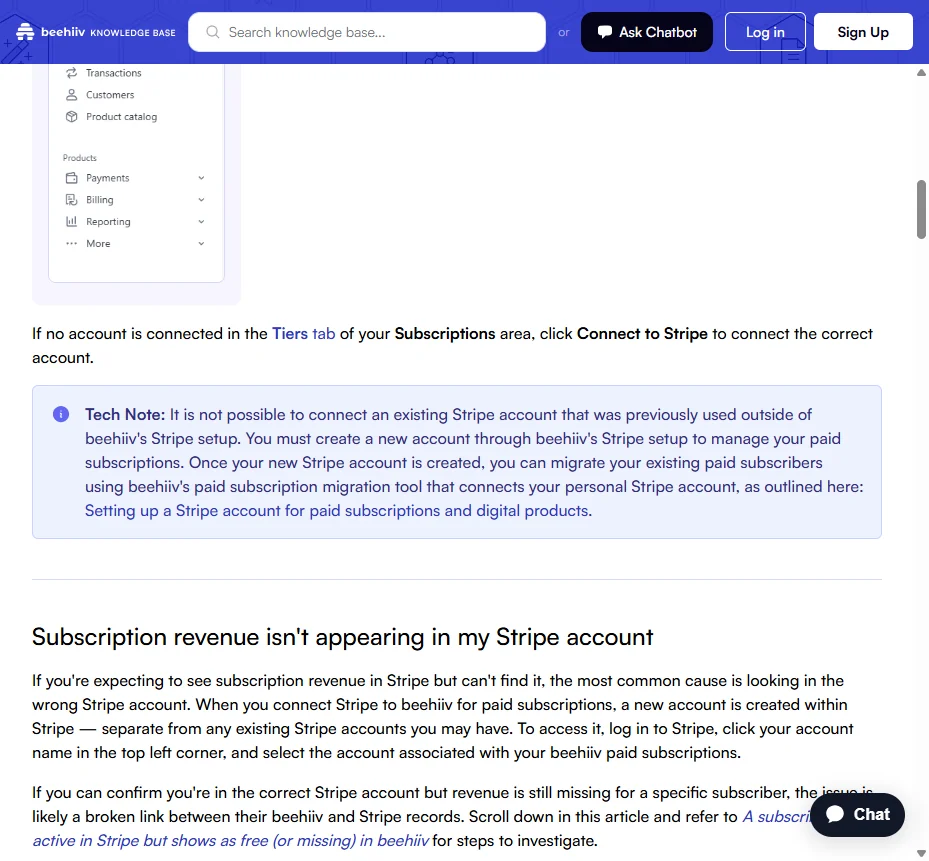
Two words in that note, “new account,” change the entire mechanics of your move. Once a second account exists, nothing is being reconnected any more. Something has to be copied between two accounts, and Stripe is very clear about what copies and what does not.
What Stripe actually copies
Stripe runs a self-serve copy tool between accounts. Its documentation describes it as a copy of “customer and payment data,” and the restriction page for platforms adds the sentence that matters: “Your platform can’t update or cancel a subscription that it didn’t create.”
So the card details survive the trip and the billing agreement does not. A new one is created on the other side in its place. The copy also needs both parties to act, because “the recipient authorizes and accepts the customer data from the sender,” and Stripe says most copies finish within 72 hours.
Now beehiiv’s own reassurance makes sense: “Migrated subscribers will see no changes in their pricing, access, or billing schedule. Subscribers will be billed on their regular renewal date and placed on a temporary trial until then to prevent double billing.” A temporary trial is what you need when the old subscription is still running and a new one has just been created. It is a careful piece of work, and it exists because the subscription had to be recreated.
The saved card travels. The live subscription gets rebuilt on the other side.
There is a third answer, and it is the worst one. Patreon’s help centre explains payment processing with a chart of who is who, and its own line reads: “Patreon = Merchant Creators create the goods, but Patreon manages the actual exchange, thus making us the merchant.” There is no writer-owned account to copy from, because the payer never had a relationship with you. Every patron has to pay again somewhere else.
Kit belongs in the second group, and reads like the first one. Its payments page says: “You’ll need a separate Kit-managed Stripe Express account for managing and receiving payments for your sales,” and its setup instructions add the qualifier “Even if you already have a Stripe account.” Its integration page, meanwhile, promises that “users coming from another platform can switch over easily, without the risk of subscriber churn.” Both sentences are live today. The promise is about the card. The account is still a new one.

One group is missing from every reassurance on this page, and beehiiv is honest about it. Its migration guide includes a sample message to send your own readers, and the sample says: “Unfortunately, this is not a Stripe based subscription that I can seamlessly migrate.” That message is for people who subscribed inside the iOS app. Apple took the payment. Apple keeps the relationship. Comped and gifted subscribers sit in the same bucket.
So the promise holds with one condition attached. If your payers used a card through Stripe, their subscription keeps running and they are not asked to do anything, though the name on their statement can change. If they paid through an app store, you are asking them to buy your work a second time. Count that group before you announce anything.
What happens to the people who pay you?
Most of them do nothing, and some of them have to pay you again. Which group a reader falls into was decided when they subscribed, not when you left. When Platformer moved to Ghost in January 2024, the announcement told the first group exactly that: “If you already subscribe to Platformer and wish to continue receiving it, you don’t need to do anything: your account will be ported over to the new platform.” That sentence is only possible in the same-account case. It is the reader-facing shape of the mechanics above.
Even in that clean case, three things change for the reader.
- The name on the card statement. The billing descriptor comes from whichever account is charging. Readers who do not recognise it dispute it, and a dispute costs you the reader and the fee.
- The app they were reading you in. Someone who followed six writers inside one reader app now gets you in an inbox instead. You did not lose them, but you lost the place where they saw you without deciding to.
- Where your email lands. New sending domain, new authentication records, new reputation. For a while your issues arrive in Promotions or in spam, and the reader thinks you stopped writing.
Tell them before you move, not after. One short issue, sent from the old platform, naming the new sender address and the descriptor they will see. Then send the first issue from the new home within a couple of days, while they still remember. The people who paid you are the asset. Treat the move as something that happens to them.
The order of operations, and the group you have to count first
Count your app store subscribers before anything else. They are the only people who cannot be moved, and their number decides whether this is an afternoon of admin or a month of asking readers for money twice. Everything after that runs in a fixed order, and doing it out of order is how publications lose people.
- Count the unmovable group. Anyone who subscribed inside the mobile app, plus comped and gifted readers. If that is a large slice of your paying list, plan a campaign for them, not a footnote.
- Find out where your archive lives. Your own domain, or the platform’s. This decides whether the move keeps your links or restarts them, and it is the one thing you cannot fix afterwards.
- Ask the destination the account question before you sign up. Can I connect the Stripe account I already have, or do I have to open a new one? The answer is in their help centre, and it changes what the rest of this list looks like.
- Export while you still have access. Settings, then Exports, then Create new export. Do this before you cancel anything, and keep the file.
- Set up the new home and connect payments. If the destination takes your existing account, this is a reconnection and your subscriptions never stop. If it needs a new one, the copy between accounts has to be authorised on both sides and Stripe says most copies finish within 72 hours. Start it on a Monday, not the day before an issue.
- Redirect the feeds. The podcast RSS redirect is done from the platform you are leaving, in the panel it labels Danger Zone. Web redirects depend on step two.
- Tell readers what will change on their statement. Send one short issue from the old platform naming the new sender address and the descriptor they will see, then send the first real issue from the new home within a couple of days.
- Keep the old publication standing until the first issue lands. Do not close the account on the day you move. Close it after you have seen an issue arrive from the new address.
The question I get asked most about step five is what happens to somebody who is six months into a year they have already paid for. In the rebuilt case, the answer is in beehiiv’s own documentation: migrated subscribers “will be billed on their regular renewal date and placed on a temporary trial until then to prevent double billing.” They keep the rest of the year they bought, and the next charge lands when it always would have. Ask your destination to confirm that in writing before you start, because it is the difference between a quiet move and a refund queue.
One more thing worth knowing before you send that notice. Substack’s own payments help page warns that the customer support details inside your Stripe account, including a phone number and an address, “may appear on subscriber receipts/invoices and card statements.” Whatever those details say today is what your readers have been seeing. Check them before they change.
What you own, and what you only rent
You own the list and, if you set it up, the domain. The archive, the paying relationship and the flow of new readers are held on terms you did not write. Owning your audience is the phrase every platform in this category uses, and it covers four separate things at once. Splitting them apart is the difference between a move that costs a weekend and a move that costs a third of your income.
The domain line is the one writers underestimate. If your publication lives on the platform’s subdomain, every link anyone ever made to your work points at a company you are leaving. Move, and the archive that took you four years to build starts again at zero. If you are choosing where a site lives for the first time, the same trap runs through website builders, and we priced it in Wix vs Squarespace and again in Squarespace pricing.
beehiiv gets credit here, and it should be said plainly, because most of this guide is harder on them. Their importer keeps the same address shape: “Because beehiiv uses the same ‘/p/’ post URL structure as Substack (e.g., news.beehiiv.com/p/name-of-post), you don’t need to configure redirects manually.” That is a real piece of engineering aimed at the exact thing that breaks.
What their importer will not take is published on the same page, in one list: “Comments will not be migrated. Video type posts will not be migrated. Podcast type posts will not be migrated. Photo gallery elements will not be migrated. Category structures will not be migrated.” Code blocks arrive as plain text. If your archive is mostly essays, you will barely notice. If it is a five-year conversation with a comment section, you are leaving the conversation behind.

Which alternative fits the reason you are leaving?
Match the product to the reason, and the shortlist gets short fast. Leaving over the company points you somewhere different from leaving over the cut, and both point somewhere different from leaving because you want a real website. Size decides nothing here. Every other guide sorts by it anyway.
One row is a trap and it is the second one. Trading a percentage for a monthly bill only pays off above a certain income, and below it you have swapped a cut you pay when you earn for a bill you pay whether you earn or not. Do that arithmetic with your own numbers before you move, and do it at the income you have now rather than the one you are planning for.
Why do people actually leave Substack?
Mostly because of what the company does, not what the product costs. Google gives that away by itself. Every question in the People Also Ask box for this search is about motive: why is everyone leaving, why do people not like it, is it politically slanted, why is everyone using it now. Not one question is about features or price, and not one page in the top ten answers them.
The visible wave of departures happened in January 2024 and it was about moderation. Casey Newton announced that Platformer was leaving for Ghost on January 11, 2024, and he wrote: “We didn’t ask Substack to solve racism. We asked it to give us an easy, low-drama place to do business, and to commit to not funding and accelerating the growth of hate movements. Ultimately we did not get either.” The day before, Ed Zitron wrote that “Substack has chosen a path of appeasement and harm, one that empowers and monetizes hate.”
Writers stayed too, and argued their case publicly at the time: that a platform cannot moderate its way out of extremism and should not try. I am not going to referee that here. What matters for a buying decision is narrower, and it is written into the agreement rather than into anyone’s opinion.
The second reason is arithmetic. Above a certain income a percentage becomes the most expensive line a writer has, and flat-fee alternatives start to win. The third is product shape: people who want a real website, custom code, courses or a shop are using a newsletter tool for a job it was not built for. The fourth is discovery, and it cuts both ways. The same box also asks why everyone is using Substack now.
If your reason is the first one, note the practical consequence. Moral deadlines are short. People announce, then move within a week, and that is exactly when the payment question decides whether the week is calm or expensive.
The seven kinds of thing sold as a Substack alternative

There is no single market here. Search for Substack alternatives and you get seven different kinds of software described as if they were interchangeable. They differ by where the operating custody sits: who holds the domain, the archive, the reader relationship and the money. Sort them that way and the choice gets much easier.
- Networked newsletter platforms. Writing, hosting, paywall, sending and a discovery network in one product. You get readers you did not earn, and you publish inside somebody’s network.
- Publishing systems that also send email. A real website first, on your domain, with the newsletter as one distribution channel. No network attached.
- Creator email services. Contacts, tags, automations and commerce. Built for selling several things to one list, not for running a publication.
- Membership and community products. Access tiers first, email second. The newsletter is a perk attached to a membership.
- Platform-owned writing networks. You publish into somebody else’s audience. There is no list to take with you, because you never had one.
- Self-hosted sending software. Open source on your own server, wired to a sending service. No cut, no landlord, and no support desk.
- Assembled stacks. A site you control, a sending API and a payment processor, joined up by you. Maximum control, and a build rather than a purchase.
Most published lists mix the first four and stop. Self-hosting gets named, though almost always as a way to deploy one hosted product rather than as its own shelf. That is a commercial pattern rather than an editorial one, and it is the same one we found when we checked who writes the rankings for AI automation tools: the categories that pay nobody a referral fee tend not to appear.
Hosted platforms built for writers
This is the shelf people mean when they say Substack alternatives. Same shape as the thing you are leaving: you write, it sends, it takes payments, and it hosts a public archive. The differences that matter are the ones already covered, so judge them on custody rather than on editor features.
beehiiv is the closest like-for-like move and the most carefully engineered import in the field. It keeps your URL shape, it walks you through redirecting a podcast feed from Substack’s own Danger Zone panel, and it tells you in advance what it will not carry. It also insists on a new Stripe account, which is the asterisk on the whole exercise. Read their migration guide first. Announce afterwards.
Ghost is the structural opposite. Its member documentation says: “All membership, customer and business data is controlled by you. Your members list can be exported any time and since subscriptions and billing takes place inside your own Stripe account, you retain full ownership of it.” It is also the product that requires the same Stripe account on the way in, which is why the well known 2024 migrations to Ghost were quiet ones. That requirement cuts the other way for anyone who never took money on Substack: there is no account to bring, so you open one at the far end like everybody else. Its own comparison page against Substack leads with zero fees, and that page is a vendor page, so read the framing accordingly.
Buttondown takes the opposite approach to effort. Its documentation offers to do the whole thing for you: “just email [email protected] with your Substack URL and we’ll handle the export, the archive import, the subscriber import, and the paid subscriptions, start to finish.” For a writer who does not want to think about DNS records and CSV columns, a staffed migration is worth more than any feature list.
Kit straddles this shelf and the next one. It is an email service with a publishing layer attached, and it is honest about the seams in its own help centre: “This app does NOT currently support refunds. If you refund someone’s money in Stripe, that will not be reflected in your Kit account.” Small sentence, real operational weight if you refund people regularly.
Publishing systems that happen to send email
Pick this class when the website is the point and the newsletter is one way people receive it. The archive lives on your domain from the first day, the permalinks are yours, and moving hosts later is a DNS change rather than an evacuation.
Ghost sits here as well as on the shelf above, and that double life explains its grip on this search. So does WordPress with a newsletter plugin, the least fashionable answer in the category and the one with the longest life expectancy. The trade is plain. You buy control and you inherit maintenance: themes, updates, backups, and a sending service you choose and pay for separately.
The lighter end of this class barely appears in published lists, so it needs naming. Minimal blogging systems that send email exist, they are cheap, they are run by very small teams, and they do exactly one job. If your publication is words in a browser and words in an inbox, that is the whole requirement.
Judge this class on one question. When you leave, does the archive keep working at the same addresses, under your control? If yes, everything else is preference.
Email services creators use as a newsletter
These are marketing email tools first. They arrive on lists of Substack alternatives because creators use them, not because they were built for publishing. They think in contacts, tags and automated sequences, and they are strong when the newsletter is one product among several: a course, a book, a consulting funnel. They are weaker at being a publication. The public archive is an afterthought, and the reading experience is an email rather than a magazine.
Kit is the obvious member of this class. MailerLite sits alongside it, with paid newsletters wired through a Stripe connection you make yourself. If you already sell several things to the same list, this shelf pays for itself. If you only publish essays, you will pay for machinery you never switch on.
Two cautions before you commit. Pricing here usually scales on total contacts, not on paying ones. A large free list that monetises lightly gets punished for its own size. And every product here bills monthly whether you publish or not. An occasional writer pays what a weekly one pays.
Membership platforms, where the newsletter is a side effect
Choose this class when what you sell is access rather than issues. Patreon, Ko-fi, Memberful and their neighbours are built around tiers, perks and a community. Email is the announcement channel, not the product. For some publications that is simply what the product is. Moving here is an upgrade rather than a retreat.
The custody question splits this shelf harder than any other. Patreon is the merchant, in its own words, and your patrons belong to that relationship. Ko-fi is the mirror image, and its own FAQ answers the question directly: “Who is the merchant of record? You are. You’re the one making the sale and receiving the payment into your own payment account.” It charges “a 5% fee per transaction” and never touches the money. Memberful takes the same position: “Memberful is not the merchant of record. There’s no intermediary holding your funds.”
Read those three sentences again if you are choosing between them. They describe the same monthly payment sitting in three different sets of legal hands. That difference does nothing for you while things go well. On the day you want out, it is the only thing that matters. Ask the question at signup.
Publishing where the audience is not yours
Publishing networks and social newsletter features belong in this guide as a filter rather than a ranking. They answer a question the rest of the field skips: do you need a list at all? If you write occasionally, will never charge, and want readers without running anything, a network is a rational choice and the rest of this page is overhead.
What you accept is that there is nothing to take with you. Followers are connections inside that network. They are not addresses you hold. The archive URLs belong to the host. Distribution is set by whatever the feed decides this month. Feeds change without asking, which is the whole subject of our work on the Instagram algorithm and on how TikTok decides who sees a post.
Most lists do include Medium, and then treat it as a competing product rather than as a different deal. The native newsletter features inside social platforms get less: the word “LinkedIn” appears on one of the seven guides, once. Keep the whole class on the table anyway. For a fair number of people who type this search, the answer is that they need no newsletter platform at all. Not every writer is a publisher.
What does free actually mean here?
Three different things, and lists of Substack alternatives use one word for all three. A free tier is a plan with limits. A zero percent cut is a bill you pay every month instead of a share you pay when you earn. A free licence is source code, and it comes with a job attached. You will not find a price ladder below, on purpose: these plans change often enough that a printed table is wrong within a quarter, and I only quote figures I read on a live page myself.
The third row has a clause in it that nobody prints. listmonk states its terms in one line on its repository: “listmonk is free and open source software licensed under AGPLv3.” Keila uses the same licence and spells out what it means for anyone running an instance: “If you run your own instance of Keila, you must make the source code of Keila (including all modifications) available to all users who interact with it.” Fine for a writer running a newsletter. Read it twice if you plan to run one for other people. That clause has teeth.

Running it yourself: what replaces the platform cut
Deliverability replaces it, and it is a real job. This is the one shelf of Substack alternatives where the software is the easy part. Self-hosted newsletter software does not send email. It hands your issue to a sending service, and from that moment the mailbox providers are judging your domain rather than the platform’s. Nobody warms an IP for you. Nobody answers the phone when Gmail stops trusting you.
Google publishes the requirements in plain language, and they are not suggestions. For anyone sending five thousand messages a day or more: “Set up SPF and DKIM email authentication for your domain,” “Set up DMARC email authentication for your sending domain,” “Keep spam rates reported in Postmaster Tools below 0.30%,” and every marketing message must “support one-click unsubscribe, and include a clearly visible unsubscribe link in the message body.”
The first day of a self-hosted newsletter
A new Amazon SES account does not start out able to mail your readers. AWS documents the sandbox plainly: “You can only send mail to verified email addresses and domains, or to the Amazon SES mailbox simulator. You can send a maximum of 200 messages per 24-hour period. You can send a maximum of 1 message per second.”
You apply to leave that sandbox, and until you do, a list of two thousand people cannot receive a single issue. Plan the move around that review. The software install is the quick part.
None of this is an argument against self-hosting. It is an argument against self-hosting by accident, which is what happens when a list recommends open source software next to a hosted product as if the two were the same kind of purchase. If you have run a server before, this shelf gives you something no hosted product can: nobody can change your terms. If you have not, the cut you were angry about was buying you a service you had not noticed.
Assembling it from parts
The far end of the same axis is not a product at all. A static site you control, a sending API, a payment processor connected directly to you, and code that joins them. It is the only arrangement where no company sits between you and the reader at any point in the chain.
It appears in no published list I could find. On the seven guides ranking for this phrase, listmonk, Sendy, Amazon SES and Postmark are named zero times between them. The reason has nothing to do with merit. Nobody earns a referral fee when a writer wires three services together. Keep it in view as the boundary of the market: it tells you what every hosted product is actually charging you for, which is integration and support rather than software.
Take this route only if you already write code. The failure mode is not a bad newsletter. It is a newsletter that stops arriving while you are busy writing the next issue. Nobody tells you. Our roundup of ChatGPT alternatives makes the same point about assembled tooling: control is real, and so is the maintenance bill.
For newsrooms and publications with more than one writer
If two or more people publish under one masthead, most of this market is the wrong shape. Newsletter platforms assume a single sender identity. What a small newsroom needs is roles, separate bylines, a draft that one person writes and another approves, and a way to attribute work for payment or for a grant report.
That class exists. Purpose-built publishing frameworks for independent and local news organisations are a real category, usually built on top of a full content system rather than on a newsletter tool, and often distributed with programme support rather than sold off a pricing page. They are missing from every list ranking for this search, including the one whose headline promises the best alternatives for journalists and then never mentions an editorial workflow.
Test any candidate with three questions. Can two people hold different permissions on the same publication? Does a post carry the name of the person who wrote it rather than the name of the account? Can a draft wait for someone else before it goes out? A tool that fails all three is a solo product with a team plan attached.
When the publication is really a podcast
Some publications are an audio feed with a written companion. For them the newsletter shelf is wrong. Private podcast platforms sell the same paid relationship in a different container, and the custody question works exactly as it does above.
Supercast answers it on its own pricing page, under the heading asking who owns the subscribers. The answer is short: “Because all your subscriber billing information is contained in your Stripe account, you can take that information with you at any time.” Same structure as Ghost, same meaning, different medium. Other products in this class run the billing themselves. Check which one you are joining before you build an audience there.
One practical note if you are leaving Substack with a podcast attached. The feed redirect is done from the old platform, not the new one. It lives in the settings panel Substack labels Danger Zone. beehiiv’s migration guide walks through it: scroll to the bottom, click the red “Redirect RSS feed” button, paste the new feed URL. Miss it and your listeners get silence. They will not write to tell you.
What you give up that has nothing to do with features
The network. Recommendations from other writers, a place in an app people already read, a feed that puts your work in front of somebody who was not looking for it. None of that is a feature you can export, and none of it follows you. It is the one part of the deal a percentage actually buys, and the one part no alternative can hand back to you.
The list is a file you can download. The flow of new readers is not.
Work out your own exposure before you decide, because it is different for every publication. Look at where your last hundred subscribers came from. If most arrived through the platform’s own surfaces, you are about to turn off a tap and you should replace it deliberately, with search, with your own site, with other people’s audiences. If most arrived from your work elsewhere, the network was never the thing keeping you there.
Established publications tend to survive this comfortably. They arrive with their own distribution and leave with it. Small publications feel it immediately, because a recommendation engine is doing a job they have not had to do themselves yet. Leaving costs new readers and saves money. Which of those matters more depends on which you have less of.
There is a second lesson underneath it. Any distribution you do not own can be adjusted without your consent, which is the pattern we have documented on the YouTube algorithm, on LinkedIn’s feed and on Facebook’s reach. A newsletter is popular with writers precisely because the inbox is the last channel nobody re-ranks.
The rules you agreed to, and what they say
Before you compare Substack alternatives, read what you already signed. The Substack Publisher Agreement was last updated on July 20, 2026, and it is worth twenty minutes of your time. Four clauses decide what leaving looks like. None of the seven guides ranking for this phrase quotes any of them, and the phrase “merchant of record” appears on none of them at all.
The first is ownership, and it is generous: “First and foremost, you own what you create.” The licence you grant covers running and marketing the service, and the agreement states that it “does not permit us to use your content to train third-party AI models.” Good clause. Better than most in this market.
The second is the payment channel, and it is the one that contradicts the marketing. “You agree to process payments from Readers only in the manner determined by us,” it says, and you “may not circumvent your payment obligations to us by soliciting payment from a Reader outside of Substack.” Meanwhile the page that sells the deal says you “Own all of your content and your subscriber list.” Both statements are true. The list is yours. The channel through which anyone pays you is not, for as long as you are there.
The third is discretion: “We may terminate this Agreement or terminate, suspend, or restrict your access to or use of Substack at any time, for any reason.” The one dispute mechanism written into the agreement covers automated classification, not removals. If an automated tool labels your work, “we will provide you an opportunity to dispute the result.” There is no equivalent sentence about losing the publication.
The fourth is the number itself. There is no pricing page. Type the address and you land on the home page. The public figure lives on the revenue calculator instead, in grey type under the button: “Writers keep 90% of their revenue minus credit card fees.” The agreement prints no percentage at all. It says only that “The Revenue Share percentage is set between you and Substack during registration of your account.”
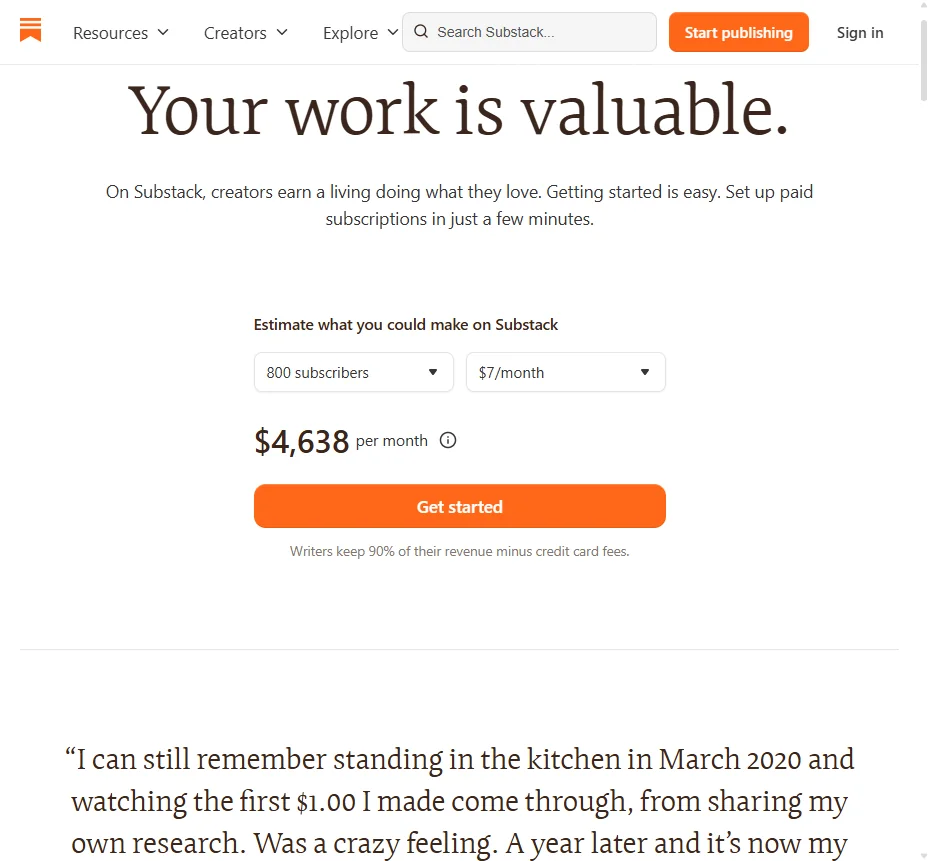
Ten percent is the figure that page implies, and it is the number the whole market quotes back. The point is narrower and it stands: the rate is a term of your individual agreement, not a published price, and the content rules can change “at our discretion and without notice,” in the words of the guidelines themselves. Read the agreement of whatever you move to as carefully. We did the same exercise with platform rules in the LinkedIn automation tools guide, and the pattern repeats.
Who wrote the other pages you are reading
Five of the seven Substack alternatives guides ranking for this search sell a product that appears in their own list. I checked every page in the top ten on August 28, 2026, and recorded who owns it. There is no independent publication in the results at all. That is one capture, on one day, across four related queries, and the same names held across all four.
The shapes vary. One vendor writes no list at all. It runs a straight comparison landing page against Substack, which at least announces what it is. One puts itself fifth out of five, which reads better than first and is still the vendor grading its own homework. One page carries 7,930 words under four headings, which is length doing the work of structure. The most complete rival runs about 5,900 words and spends a good share of them on its own product, though it says so out loud: it ranks itself third and writes that it is not a publishing platform and will not send a single email. That is more disclosure than the rest of the field manages.
One more result. Google runs a separate query for people asking about ethical alternatives, and it returns the same commercial pages. The only page in that top ten actually written about the question is a personal blog. A whole intent exists, the search engine knows about it, and the market has answered it with product marketing. That is the same gap we found in scheduling tools when we priced Calendly alternatives: the ranking is written by the people being ranked.
How we checked this
Every quote in this guide to Substack alternatives was read on a live page on August 28, 2026, and reproduced word for word. The documents were the Substack Publisher Agreement and Content Guidelines, Substack’s export and going-paid pages, Ghost’s member documentation and Stripe help page, three beehiiv support articles, two Kit help articles, Buttondown’s migration documentation, Patreon’s payment processing explainer, Ko-fi’s features page, Memberful’s payment stack post, Supercast’s pricing FAQ, two Stripe reference pages, Google’s sender guidelines and the Amazon SES production access page.
The search results were captured by hand, in the United States, across four related queries. Every competing page was measured, not estimated. The two 2024 migration quotes were read at their original sources, not in someone’s summary of them.
What we did not do matters as much. We bought nothing. Nothing here is presented as a hands-on test. We left out platform prices we could not read on a live page ourselves, and we left out subscriber loss figures that circulate as community estimates with no measurement behind them. Where a vendor claim and a payment processor document disagreed, both are quoted above and neither was smoothed over. It is the same method we used to price Jasper alternatives after that product changed shape.
Field notes
- The account question: Ghost requires the same Stripe account when you arrive from Substack; beehiiv states in writing that an existing account cannot be connected and a new one must be created; Kit requires a separate Kit-managed Stripe Express account; Patreon is the merchant, so there is no account to move.
- What copies between accounts: Stripe’s self-serve tool copies customer and payment data; a platform “can’t update or cancel a subscription that it didn’t create”; the recipient has to authorise the transfer, and most copies finish within 72 hours.
- Who never moves: app store subscribers, comped and gifted readers. beehiiv’s own sample message tells them the subscription cannot be migrated.
- What the importer drops: comments, video posts, podcast posts, photo galleries and category structures, per beehiiv’s published list. Post URLs keep the same shape, so redirects are not needed.
- The agreement: last updated July 20, 2026; termination “at any time, for any reason”; payments only “in the manner determined by us”; the revenue share percentage set individually and printed nowhere; guidelines changeable “without notice”.
- Merchant of record, in their own words: Patreon is the merchant; Ko-fi answers “You are” and charges 5% per transaction; Memberful states it is not the merchant of record.
- The field, measured August 28, 2026: seven ranking guides, five written by a vendor appearing in its own list, zero independent publications, median length 3,652 words.
- Sources: Substack Publisher Agreement and Content Guidelines; Stripe data copy and Connect subscription documentation; Ghost member and Stripe help pages; beehiiv support articles; Patreon payment processing; Google sender guidelines; Amazon SES production access.
Frequently Asked Questions
Can I move my paying subscribers without asking them to subscribe again?
Yes, if two things are true. They paid by card through Stripe, and the Substack alternative you are moving to accepts the Stripe account you already use. Ghost requires that same account, so nothing has to move. beehiiv and Kit require a new one, which means the card is copied and the subscription is recreated on the other side.
Who cannot be migrated at all?
Anyone who did not pay by card through Stripe. That means app store subscribers, plus comped and gifted readers. beehiiv publishes a sample message for exactly this group, and it says the subscription cannot be migrated. Count these people before you announce a move, because each one has to decide to pay you a second time.
What happens to my archive and my links?
It depends entirely on whose domain your publication lives on. On your own custom domain, the addresses follow you and nothing breaks. On the platform’s subdomain, every link anyone ever made points at a company you have left. beehiiv softens this by using the same post URL shape as Substack, so manual redirects are not needed.
Which Substack alternative takes no cut of subscriptions?
Several of the Substack alternatives take nothing from subscriptions, and all of them charge a monthly fee instead. Ghost markets itself on zero fees on its own comparison page. Self-hosted software takes nothing at all and charges you in server bills and deliverability work. Processor fees survive every one of these arrangements, because somebody still has to move the money.
Is a free plan the same as a free licence?
No, and mixing them up is the most common mistake in this category. A free plan is a capped product with an upgrade waiting. A free licence is source code you run yourself. listmonk and Keila are published under AGPLv3, and Keila states that anyone running an instance must make the source available to everyone who interacts with it.
Will my readers notice that I moved?
Three things change for them, even in a clean move. The name on their card statement, because the descriptor follows the account that charges. The place they read you, if they used the platform’s reader app. And where your email lands, because a new sending domain has no reputation yet. Warn them once before you go.
Can I move a paid podcast feed as well?
Yes, and the redirect is done from the platform you are leaving. In Substack it sits at the bottom of the settings panel labelled Danger Zone, where a red button redirects the RSS feed to a new address. Private podcast platforms exist for this job too, and Supercast states that subscriber billing sits in your own Stripe account.
Is self-hosting realistic for a writer?
Only if you already run servers. The software is the easy part. Google requires SPF, DKIM and DMARC on your sending domain and spam complaints below 0.30 percent, and a new Amazon SES account starts limited to 200 messages a day to verified addresses until you are approved. That approval, not the install, is your launch date.
My Take
I went looking for a feature comparison of Substack alternatives and found a question about custody instead. Every guide in this market argues about the cut. The cut is not what hurts you. What hurts you is the day you want to leave and discover that the paying relationship was never quite yours to move, and you find that out from a support article rather than from the page that sold you the plan. Ghost writes its answer down. beehiiv writes its answer down. Kit writes both answers down, on two different pages. Nobody is hiding anything. Nobody is putting it where a person deciding would see it either.
If I were moving a paid publication tomorrow, I would do three things before touching a platform. Check what fraction of my payers came through an app store, because those are the only people I will have to ask for money twice. Get my own domain in front of the archive, so the next move is a DNS change and not a demolition. Then pick on the account question and nothing else, which today means Ghost if I want the move to be invisible, beehiiv if I want the smoothest import and can accept a rebuilt subscription, and a staffed migration if I would rather somebody else did it. And if I ran a small free newsletter with no money in it, I would not move at all. The percentage of nothing is nothing, and the network is real.