

The best ChatGPT alternatives in 2026 are Claude for writing, Perplexity for research, Gemini if you live in Google apps, and DeepSeek or Meta AI if you want a capable model for free. Most people don’t need to replace ChatGPT entirely. They need the right tool for the one job it handles poorly. Here’s what I actually use, tested on real work, and where each one beats ChatGPT.
- Why People Are Leaving ChatGPT in 2026
- The Best ChatGPT Alternatives at a Glance
- Claude: Best for Writing and Careful Reasoning
- Perplexity: Best for Research You Can Trust
- Google Gemini: Best if You Live in Google Apps
- DeepSeek: Best Free Option for Power Users
- Microsoft Copilot: Best Inside Windows and Office
- Grok: Best for Real-Time and Fewer Filters
- Mistral Le Chat: Best for Privacy on a Budget
- Meta AI: Best for Zero-Setup Everyday Use
- How the ChatGPT Alternatives Score
- Which ChatGPT Alternative Should You Pick?
- Where ChatGPT Still Wins
- Frequently Asked Questions
- What is the best free alternative to ChatGPT?
- Is there a ChatGPT alternative with no message limits?
- What’s the best ChatGPT alternative for research?
- What’s the best ChatGPT alternative for coding?
- Which ChatGPT alternative is the most private?
- Do ChatGPT alternatives cost money?
- Is ChatGPT still worth paying for in 2026?
- My Take
Why People Are Leaving ChatGPT in 2026
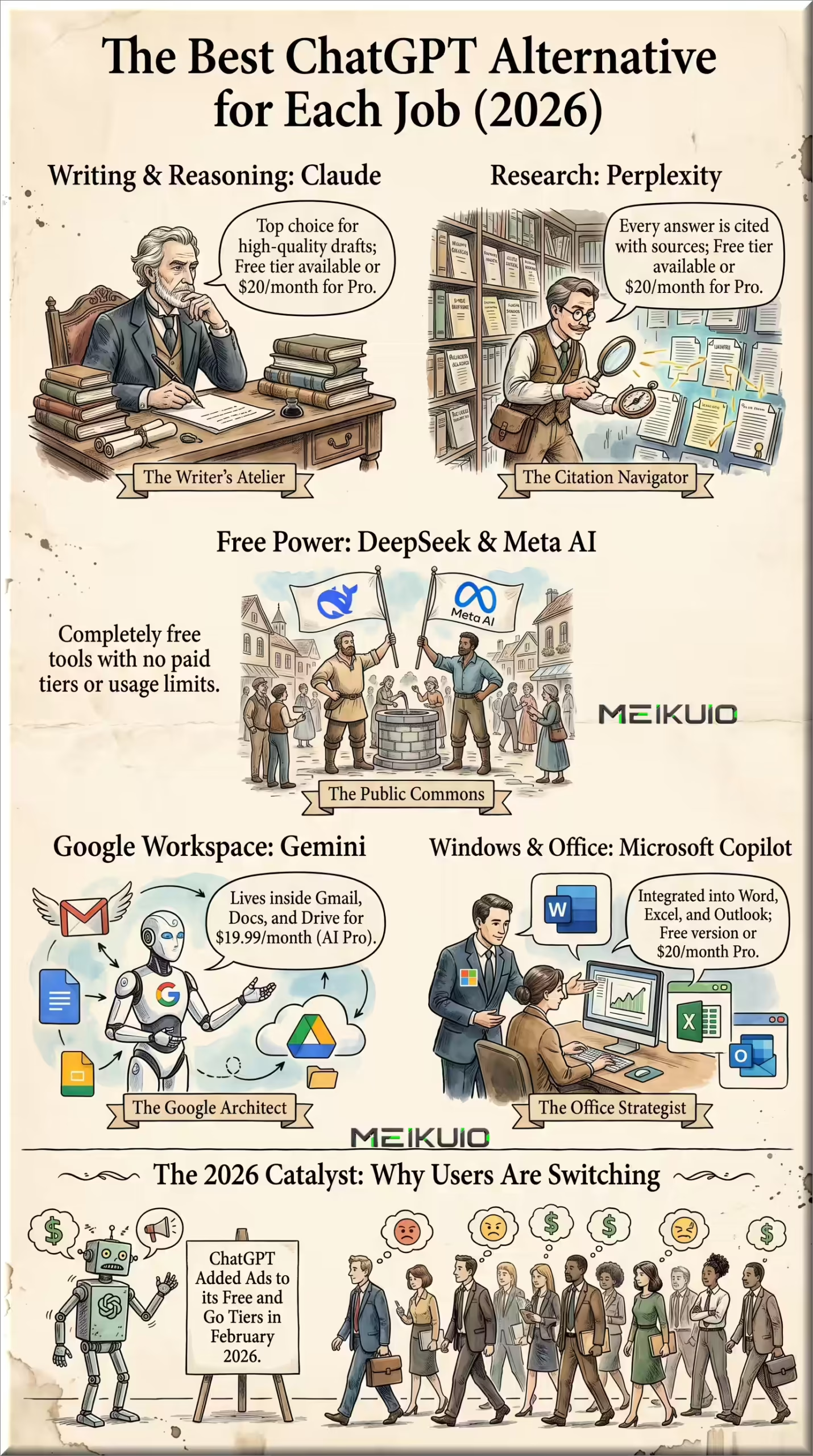
The mood shifted this year. OpenAI tightened free-tier limits in late 2025, and in February 2026 it started showing ads on the Free and Go plans. The free tier now gives you roughly ten messages every five hours before it drops you to a smaller model. On top of that, consumer chats can be used for training unless you opt out, which makes privacy-minded users nervous.
None of that makes ChatGPT bad. It just means it’s no longer the obvious default for every task. Once you’ve felt a paywall, an ad, or a rate limit at the wrong moment, a second tool starts to make sense.
The Best ChatGPT Alternatives at a Glance
Representative individual entry plans; free means no paid tier required. ChatGPT Plus comparator: 20 USD/month. Full table retains free-tier access and best use cases.
Note
Quick rule: pick the alternative that fixes your single biggest ChatGPT frustration. Sources? Perplexity. Writing? Claude. Cost? DeepSeek.
Claude: Best for Writing and Careful Reasoning
Claude is the one I reach for when the writing has to be good, not just fast. It holds an argument together across a 2,000-word draft, keeps a consistent voice, and pushes back instead of agreeing with everything. The free plan runs on Sonnet 4.6 with web search, file uploads, and Artifacts. Pro is $20 a month, the same as ChatGPT Plus, with Max tiers at $100 and $200 for heavy users.
Where it falls short: no image generation, no video, and the free limits run out fast if you write all day. In one test I handed it a long, messy chat about YouTube and Instagram monetization and asked for the gist so I wouldn’t lose the thread. It came back with six tight points that caught the actual argument, not just the keywords. Best for long-form writing, editing, and research-grade reasoning. We put the two head to head in ChatGPT vs Claude for writing, and compared it with Google’s model in Claude vs Gemini for creators.
More Read

Perplexity: Best for Research You Can Trust
If your real complaint about ChatGPT is that it makes things up, Perplexity is the fix. Every answer comes with cited sources you can click, which makes it the tool I trust for anything I’m going to publish or act on. The free plan gives unlimited quick searches plus three Pro searches a day and one deep Research run a month. Pro is $20 a month, lifts the limits, and routes you to models like GPT-5, Claude Opus, and Gemini Pro under one roof.
Where it’s weaker: it’s a search tool first, so it’s less suited to long creative drafting. Best for research, fact-checking, and any work where sources matter. If you’re wondering what the company behind it is worth, we compared the numbers in Perplexity valuation in 2026.
Google Gemini: Best if You Live in Google Apps
Gemini’s edge isn’t the model, it’s where it lives. It sits inside Gmail, Docs, Drive, and Sheets, so it can draft a reply or summarize a document without you copying anything into a chat box. The free tier is useful enough to live in, and Google AI Pro runs $19.99 a month. The Ultra tier dropped from $249.99 to $99.99 at Google I/O 2026, which tells you how hard Google is pushing to win this category.
Where it slips: in my testing it’s the most confident when it’s wrong, so check anything factual before you rely on it. Best for anyone already working inside Google Workspace all day.
DeepSeek: Best Free Option for Power Users
DeepSeek does the thing nobody else does at this level: it’s free, with no paid tier on the app or website at all. You get a strong reasoning and coding model for nothing, with only fair-use throttling, so you’ll see a “Server Busy” notice at peak hours. It’s also open-weight, which means a team can self-host it for full control of their data. The API is the cheapest at the frontier, with V4 Flash at $0.14 per million input tokens.
Where it’s weaker: the servers buckle under load, and it’s text-only. I asked it to plan a YouTube content workflow, down to which model should write the scripts. It answered fast and rated itself honestly against the field: itself for storytelling and drafts, ChatGPT for versatility, Claude for structured analysis. A solid starting point, thin enough that I’d want to push it further. Best for free power use, coding, and privacy through self-hosting. We broke the model down in DeepSeek V4 explained.
Microsoft Copilot: Best Inside Windows and Office
Copilot is the alternative most people already have and forget about. It’s built into Windows, and the free version handles chat, web search, and image generation with no subscription. If you already pay for Microsoft 365, Copilot Pro ($20 a month) drops the assistant straight into Word, Excel, and Outlook, where it actually saves time.
Where it’s weaker: outside the Microsoft world it’s an average chatbot with a familiar face. Best for Windows users and Office-heavy work. Microsoft’s own in-house models have been closing the gap fast, which we covered in Microsoft MAI vs Claude.
Grok: Best for Real-Time and Fewer Filters
Grok’s whole pitch is real-time. It’s wired into X, so it answers questions about what’s happening right now better than tools working from stale training data, and it applies fewer content filters. The free version on grok.com is rate-limited to roughly ten prompts every two hours. SuperGrok at $30 a month unlocks unlimited chat, DeepSearch, and voice, while X Premium at $8 bundles basic Grok with the platform.
Where it’s weaker: the free limits are stingy, and looser filters cut both ways. To test the real-time pitch, I asked what happened in the news today. About twelve seconds later it pulled that same day’s headlines, from the NBA finals to a Kennedy Center shake-up and severe flooding. A tool running on stale training data can’t do that. For our head-to-head testing breakdown on where the two assistants diverge, see Grok vs ChatGPT. Best for live events, X power users, and anyone who wants fewer guardrails.
Mistral Le Chat: Best for Privacy on a Budget
Mistral’s Le Chat is the value pick, and a European one, which matters if data residency does for you. Le Chat Pro is $14.99 a month, the cheapest premium plan from any major lab, and the company leans hard on privacy. There’s a free tier, and Pro adds Codestral for coding help right inside the chat.
Where it’s weaker: the model trails Claude and Gemini on the hardest reasoning tasks. Best for privacy-conscious users and anyone who wants a premium plan without the $20 ticket.
Meta AI: Best for Zero-Setup Everyday Use
Meta AI wins on zero friction. It’s already inside WhatsApp, Instagram, and Messenger, it’s completely free with no usage limits, and it handles image generation and web search out of the box. For casual questions and quick image edits, it’s the path of least resistance for more than a billion people who never install a thing.
Where it’s weaker: it’s built for casual use, not deep work, and privacy isn’t its strong suit. Best for everyday questions in the apps you already have open.
How the ChatGPT Alternatives Score
Existing subjective author scores on a five-point scale, not invented measurements. Evaluation covers reasoning, free-tier generosity and value; individual trade-offs remain in the full table.
A few immediate patterns stand out from the testing: Mistral offers the cheapest premium tier at $14.99 a month, while DeepSeek and Meta AI deliver capable frontier reasoning at no cost. For sourced research, Perplexity remains unmatched. If you want live, plan-by-plan numbers across every frontier model, see our dedicated AI pricing breakdown.
Which ChatGPT Alternative Should You Pick?
- Choose Claude if writing quality and reasoning matter most.
- Choose Perplexity if you need answers with sources you can verify.
- Choose Gemini if you work inside Gmail, Docs, and Drive all day.
- Choose DeepSeek if you want a capable model for free, or need to self-host.
- Choose Copilot if you’re on Windows and live in Office.
- Choose Grok if you want real-time answers and fewer filters.
- Choose Mistral if you want a premium plan under $15 with strong privacy.
- Choose Meta AI if you just want quick answers where you already chat.
Where ChatGPT Still Wins
None of this means dumping ChatGPT. It’s still the most well-rounded option, and a few things keep it ahead. Its ecosystem is the deepest, with custom GPTs, image and video generation, advanced voice, and the widest third-party support. It’s the default that most people, tutorials, and tools assume you’re using. And for general work where you don’t care about citations or app integration, it’s still excellent.
So the honest move in 2026 is rarely a clean break. Keep ChatGPT for general work, and add one or two tools that beat it where you spend the most time.
Field notes
- The field: Eight frontier alternatives tested against ChatGPT (GPT-5.5 / GPT-5 mini) across writing, coding, search grounding, and everyday workflows.
- Pricing floor: DeepSeek and Meta AI provide completely free consumer access; Mistral Le Chat starts at $14.99/mo; Claude Pro, Perplexity Pro, Copilot Pro, and Gemini Advanced align at $20/mo; SuperGrok runs $30/mo.
- Source grounding: Perplexity cites clickable primary sources on every query; ChatGPT Free and Go search the web but withhold sources when uncertain.
- Ad rollout: ChatGPT Free and Go carry sponsored ads in the US, UK, Canada, Australia, and New Zealand; all eight alternatives remain ad-free on web and mobile.
- Data privacy: Mistral Le Chat hosts data within the EU under GDPR compliance; Claude and Copilot offer enterprise SOC 2 and zero-data-retention options.
- Sources: Anthropic, Perplexity AI, Mistral, xAI, Google DeepMind, OpenAI rate cards, and live testing in June 2026. See our AI pricing comparison for live tier details.
Frequently Asked Questions
What is the best free alternative to ChatGPT?
DeepSeek and Meta AI are the strongest fully free options, with no paid tier required. Google Gemini’s free plan is also generous and better integrated if you use Google apps.
Is there a ChatGPT alternative with no message limits?
DeepSeek’s app and website have no paid tier and only fair-use throttling, and Meta AI sets no usage limits for consumers. Both are free, though heavy reasoning is faster on paid tools.
What’s the best ChatGPT alternative for research?
Perplexity, because every answer ships with cited sources you can open and check. That makes it the safest choice for anything you’ll publish or make decisions on.
What’s the best ChatGPT alternative for coding?
DeepSeek offers a capable coding model for free, with the cheapest API at the frontier. Claude is the stronger pick for complex refactoring and longer codebases.
Which ChatGPT alternative is the most private?
Mistral leans hardest on privacy among the hosted tools, and self-hosted DeepSeek gives you full control of your data. Claude’s business and API tiers also don’t train on your inputs.
Do ChatGPT alternatives cost money?
Most have a real free tier. Premium plans run from $14.99 (Mistral) to $20 a month (Claude, Perplexity, Copilot). DeepSeek and Meta AI stay free. Compare them in our AI pricing comparison.
Is ChatGPT still worth paying for in 2026?
Yes, if you want one well-rounded tool with the deepest ecosystem. The case for switching gets stronger when one specific job, like research or writing, is most of what you do.
My Take
After running all of these, I settled on three tools instead of one: Claude for writing, Perplexity for anything I’ll publish, and ChatGPT for the messy in-between. DeepSeek lives on my phone because it’s free and good enough for quick questions. If you only add one tool this month, make it the one that fixes your single biggest frustration: Perplexity if ChatGPT invents facts, Claude if the writing feels flat, DeepSeek if you’re just tired of paying.
You don’t owe any single company your whole workflow.