



Most Jasper alternatives lists compare prices for a writing tool that Jasper stopped selling. I signed up on August 13, 2026, and read the checkout instead: the “free” 7-day trial is set to bill $708 in one charge on day eight. Before you pick a replacement, you should know what you are actually replacing, because the answer changed.
- What Jasper sells now
- What a year actually costs
- The trial that bills $708
- Start with why you’re leaving
- The five classes, and who left the category
- The seven candidates, checked against their own pages
- Writer: the governance pick, if you can get a price
- Typeface: enterprise brand content, sales-led by design
- Anyword: performance copy with a published ladder
- Copy.ai: one cheap plan, then a cliff
- Writesonic: now a search visibility platform
- Frase: writing plus SEO, with both prices printed
- Brandwell: the one that left while nobody was looking
- I just want to write
- If you left for answer-engine visibility
- The free layer question
- Privacy depends on which contract you’re on
- Before you cancel: the exit mechanics
- What nobody can check without paying
- How this field is built
- How I checked all this
- Frequently Asked Questions
- What is the best alternative to Jasper in 2026?
- How much does Jasper actually cost per year?
- Does the Jasper free trial charge you automatically?
- Is there a free version of Jasper?
- Does Jasper train AI models on my text?
- Why do Jasper alternatives lists show prices that seem wrong?
- What replaced the cheap AI writing tools?
- Is Jasper AI worth it compared to ChatGPT?
- Can I get a refund if I cancel Jasper?
- My Take
What Jasper sells now
Jasper’s homepage headline is “Put AI agents to work for marketing.” I counted the words on its two main commercial pages on August 13, 2026. The word “writer” appears zero times on the homepage and zero times on the pricing page. “Marketing” appears 47 times and 39 times. “Copywriting” is gone entirely. The rest of the homepage vocabulary tells the same story: “brand” 36 times, “content” 31, “agent” 22, “GEO” 13. That is the word cloud of a marketing operations vendor, not a writing tool.
That is not a rebrand. The company name is the same, Jasper AI, Inc., a Delaware corporation, per its own Terms of Service. What changed is the product class. Jasper now sells a marketing execution platform: agents that run workflows, brand governance rules, and a module that measures how often AI answer engines like ChatGPT cite your brand. The single-writer product that made it famous in 2021 is not on the menu.
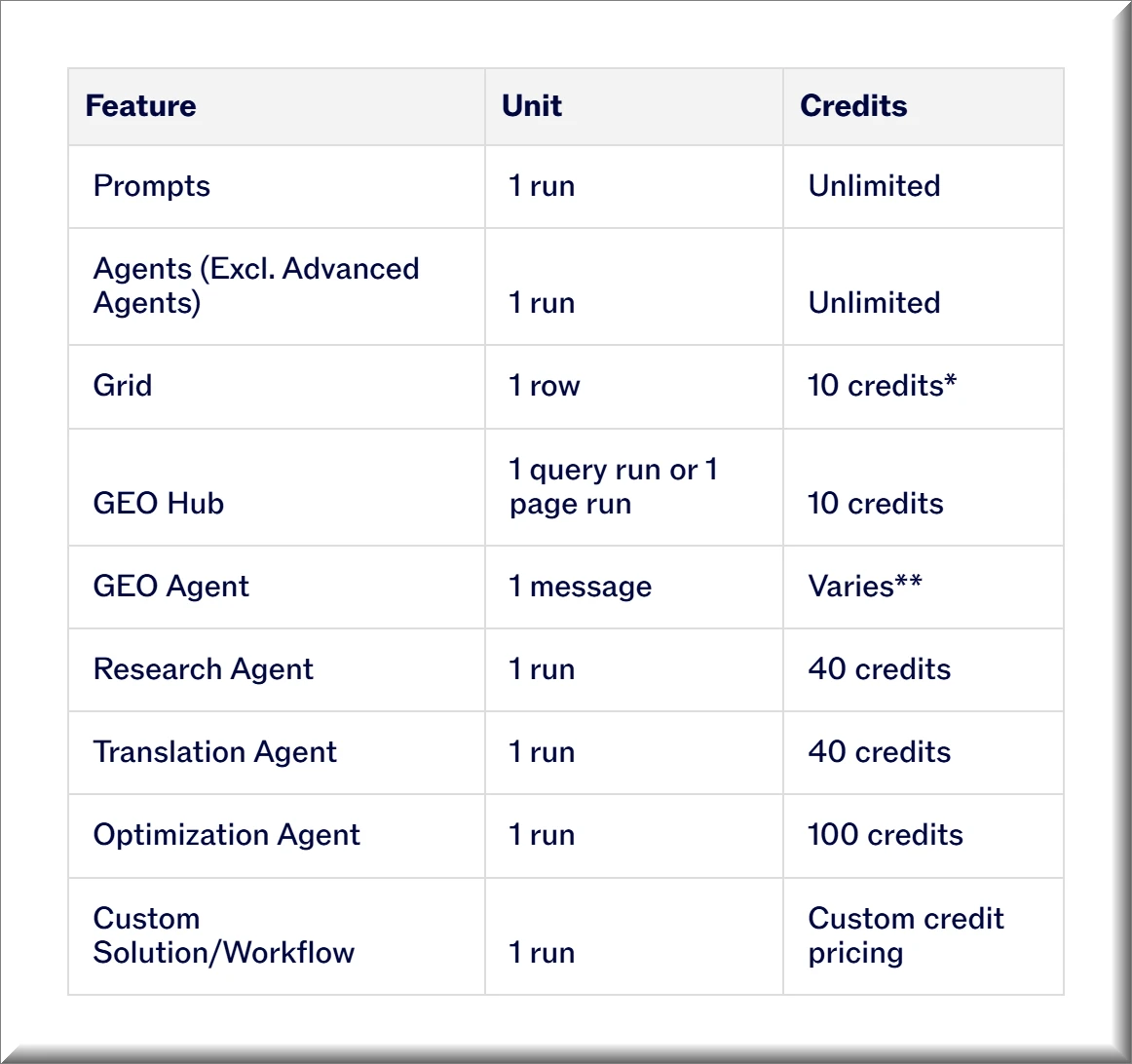
The clearest evidence is the company’s own price list for usage. Its credits rate card, updated June 9, 2026, meters its bulk-content Grid at 10 credits a row, a research agent run at 40, an optimization agent run at 100, and an AI-search visibility report, which Jasper calls GEO, at 10. Plain prompts and standard agents are marked Unlimited. Read that again from the seller’s side: the features it bothers to meter are the marketing operations, and the writing is given away inside them. A vendor’s tariff sheet is the most honest statement of what it thinks it sells, and this one does not think it sells writing.
The word “writer” appears zero times on Jasper’s homepage. “Marketing” appears 47 times.
This matters for your search because the lists ranking for Jasper alternatives mostly describe the 2021 product. I audited the entire first page of results, and I will show you that count later. First, the money.
What a year actually costs
Jasper publishes two plans. Pro costs $59 per seat per month if you commit to a year, or $69 per seat per month billed monthly. Business has no published price at all, just a “Contact Sales” button. Prices checked live on August 13, 2026, and they match what I found when I reviewed Jasper AI pricing in detail back in June.
Pro includes one seat. The plan ladder has nothing between $708 per year for one person and a custom enterprise contract, so the moment a second person needs access, you are on a sales call. That cliff is the single most common reason people in forums give for looking up Jasper alternatives in the first place.
Pro includes one seat. Annual: 59 USD/seat/month, 708 USD charged after the seven-day trial. Monthly: 69 USD/seat/month, cancellation effective next month. A second person requires Business and a custom Order Form. Pricing page claims about 20% saving; checkout claims 14%. The actual difference is 120 USD, about 14.5%; a 20% saving would be approximately 662 USD, which no screen offers. No card was entered.
Two contract details change what these numbers mean in year two. On the self-serve plan, the subscription renews automatically every month. A cancellation submitted through settings or by email takes effect the following month, so the month you cancel in is a month you pay for. And nothing in the self-serve terms caps what renewal costs. The Business agreement, by contrast, caps renewal increases at 5 percent a year or the inflation index, whichever is greater, with 30 days written notice. The cheaper your plan, the fewer promises the paperwork makes about your second year, and that pattern repeats through this entire article.
The trial that bills $708
Here is what I saw when I created an account. The signup form asks for no card. Then the app shows a plan picker with an “Annually (save 20%)” toggle already switched on. One click later, the billing screen asks for a card and prints the real terms: “$59 / seat / month, Billed annually starting August 20, 2026. Due after trial ends: 708 $. Due today (7 days free): 0 $.”
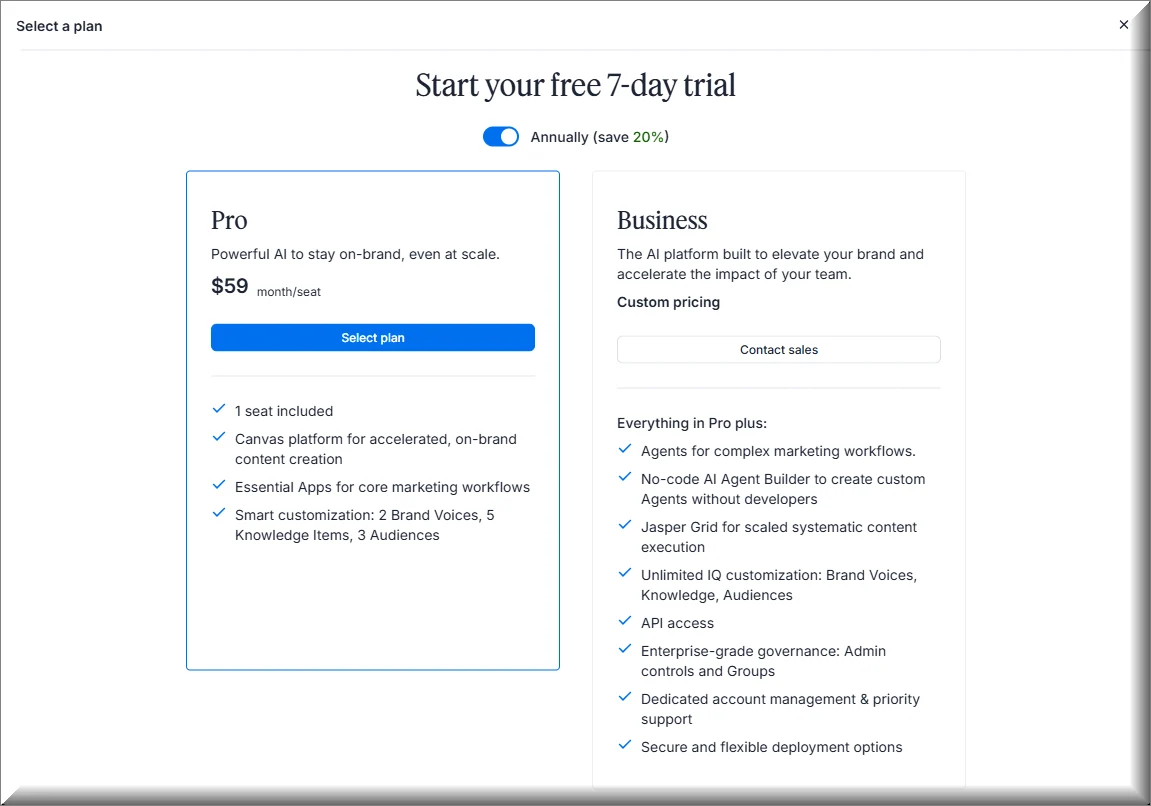
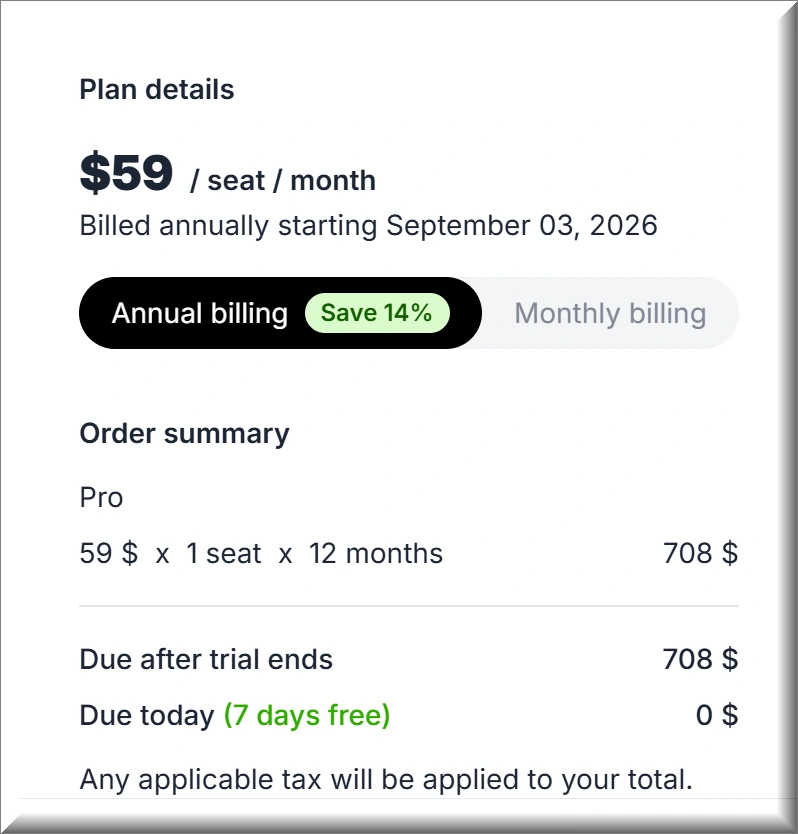
Look at two things on that screen. First, the default is the annual plan, so the trial you start with one click converts into a 12-month commitment charged in full, not into a $59 month. The annual toggle came preselected on both screens I passed, the plan picker and the checkout, so the monthly option exists only for people who notice the switch. Second, the discount arithmetic does not match the marketing. The pricing page says “Save ~20%” for yearly billing. The checkout says “Save 14%.” The checkout is right: $828 minus $708 is $120, which is 14.5 percent. A 20 percent saving would price the year at $662, and no such price exists.
More Read

A smaller detail from the same signup says a lot about who this product is for now. The onboarding form asks for your company size. The smallest option in the list is “200 and below.” A tool the ranking lists still recommend to freelancers cannot, in its own form, tell one person from a company of two hundred.
The Federal Trade Commission calls this pattern a negative option: the absence of action counts as consent to be charged. Its Negative Option Rule dockets note more than 100,000 consumer complaints about these practices in the past five years, and the agency opened a fresh rulemaking round in March 2026. I am not claiming Jasper breaks any rule. I am saying the two screens disagree with each other, and only one of them is shown before you enter a card. The same day-one honesty test caught the Motion app charging $348 as one invoice behind a $19 sticker, so this pattern is not unique to Jasper.
Start with why you’re leaving
“Best Jasper alternatives” is a broken question in 2026, because the product sits in a different category than the one most lists rank. The useful question is what you were paying Jasper to do. Five reasons cover nearly everyone who cancels, and each reason points at a different class of replacement. Match your row first, then read the cards; a ranked list of Jasper alternatives only makes sense inside one row at a time.
Price is one reason among five, not the whole story. But notice what the table implies: there is no single list of Jasper alternatives that serves all five rows, because the rows live in different markets with different price floors. Any page that hands you one ranked list for all of them is compressing five decisions into one, and the compression always hides the expensive rows.
The five classes, and who left the category
While checking prices for this piece, I found something the replacement lists have not caught up with. The migration Jasper made is not one company’s pivot. It is the whole class moving.
Writesonic’s pricing page now titles itself “AI Search Visibility Platform,” with plans at $79, $199, and $399 per month billed annually. Brandwell built its name as a long-form blog writer. It greeted me with “We Reveal Every Active Buyer in Your Market.” The writing app has been demoted to one line in a submenu, and the pricing URL now redirects to the homepage. Copy.ai’s homepage sells go-to-market automation, and its own blog is the place you learn the cheap plans changed. Of seven vendors I checked, three have left writing as their main business, two more still sell writing but publish no price at all, and only two, Anyword and Frase, still sell writing as the main product with a number on the page. Copy.ai keeps a priced side door, which its card explains.
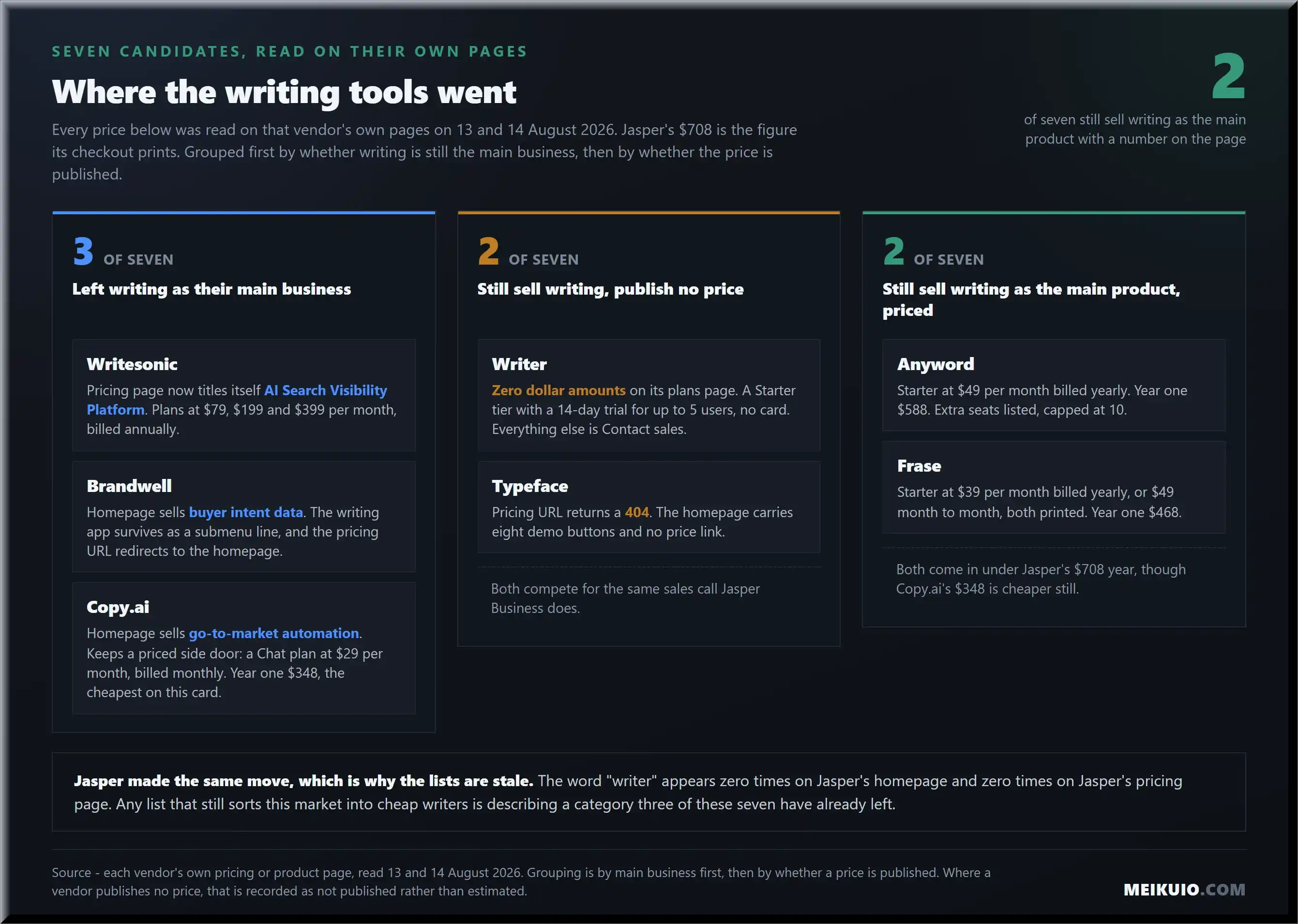
So the market you are shopping in has five real classes. Drafting workbenches that still write for a listed price. Enterprise governance platforms priced by sales call. Answer-engine visibility trackers. Build-it-yourself automation on raw model APIs. And the general assistants everyone already has. The cards below run through the named vendors across the first three of those classes, then I deal with the remaining two, because they answer different rows of the table above.
One more class sits above all of these, and no Jasper alternatives list I audited mentions it: the suites large companies already pay for. Adobe’s GenStudio, HubSpot’s Content Hub, and Salesforce’s Marketing Cloud all ship generative content features inside marketing stacks that enterprise teams already own. If your company runs one of those, the honest first question is not which Jasper replacement to buy but whether you are already paying for the capability twice. Their generative features are typically sold or metered separately, Adobe’s run on their own credit system, so the answer takes one internal email to your platform admin rather than a demo call with a new vendor. Ask it first.
The seven candidates, checked against their own pages
Every price below was read on the vendor’s own pricing page on August 13 to 14, 2026. Where a vendor publishes no price, I say so instead of guessing. That one habit separates this list of Jasper alternatives from most of the field, as the audit section will show.
Fairness note on the one competitor claim I could test: Writesonic’s article says Jasper requires payment details up front to access the trial. On substance it is right, I hit the card wall myself. So the vendors writing these lists do know true things about each other; the audit below is about what they leave out, not about lying.
Writer: the governance pick, if you can get a price
Writer is the closest thing to what Jasper Business sells: brand rules, compliance, team controls, plus its own Palmyra model family that enterprises can self-host. That last part separates it from every other card here: your text can stay inside your own cloud instead of passing through a third-party wrapper.
The catch is the same one Jasper Business has: there are zero dollar amounts on Writer’s plans page. A Starter tier offers a 14-day trial for up to 5 users, no credit card required. Everything else is “Contact sales.” If your procurement process requires a public list price, this class does not offer one. Know that before you book demos.
Best for: a regulated or brand-sensitive team of ten or more writers replacing Jasper Business, especially where legal wants the model hosted inside your own perimeter. Skip it if: you are under five people, because you will be evaluating an enterprise sales process for a problem a 49-dollar tool solves. What I could not verify from outside: whether the brand-rule enforcement blocks an off-brand export or merely flags it; Writer’s public documentation describes guardrails and flags, and I found no published line promising a hard stop. That distinction, advice versus enforcement, is the whole reason this class charges enterprise money, so make it the first question of the demo.
Typeface: enterprise brand content, sales-led by design
Typeface calls itself an “Enterprise Marketing AI Platform for Agentic Workflows,” which tells you it is chasing the same buyer Jasper Business is. Its pricing URL returns a 404, its homepage carries eight demo buttons and no price link. For a marketing department replacing Jasper Business wholesale, it belongs on the demo shortlist. For anyone smaller, there is nothing here to buy off the shelf.
Best for: brand and campaign teams that generate visual assets alongside copy, since imagery is where Typeface differentiates from the writing-first platforms. Skip it if: you need a price this quarter without a procurement cycle. One thing to carry into the call: the number you eventually negotiate is invisible to every published comparison. Any list that scores Typeface against tools like Anyword on “value” is comparing a number it has never seen.
Anyword: performance copy with a published ladder
Anyword still does the thing this category was born for: marketing copy, scored against performance data. Starter runs $49 per month billed yearly, Data-Driven $99, Business is custom, with a 7-day trial. Extra seats are listed at $49 to $59 per month, capped at 10 seats, and that published multi-seat ladder is exactly what Jasper Pro lacks. Entry cost for a year: $588, which undercuts Jasper’s $708 while actually publishing what a second seat costs.
Best for: performance marketers who write ads and landing pages and want the predictive scoring layer, which is Anyword’s actual specialty rather than a bolt-on. Skip it if: your work is long-form articles, where the performance-data angle matters less and Frase’s editor is stronger for less money. Watch one thing at checkout. The prices on the page are the yearly-billing figures, and monthly costs more. Jasper uses the same display convention; Anyword at least prints “Billed yearly” next to the number instead of hiding it behind a toggle.
Copy.ai: one cheap plan, then a cliff
Copy.ai sells a Chat plan at $29 per month, billed monthly, checked live on August 14, 2026. The next price printed on the same pricing surface is $1,000 per month for the enterprise tier, a gap of 34 times with nothing in between, which I measured in detail earlier this week. The homepage sells go-to-market automation, and words like “copywriting” have vanished from it. For writers looking to replace the original drafting plan that disappeared in that pivot, our comparison of Copy.ai alternatives in 2026 tests the surviving budget options. As a cheap seat for drafting, $29 with no annual lock is useful. No other card on this page can say that. I read the full enterprise ladder this week: $1,000, then $2,000, then $3,000 per month. So Jasper vs Copy.ai splits by seat count. One seat, and Copy.ai wins on billing freedom. A growing team climbs a ladder with the same shape as the thing it is escaping, only steeper.
Best for: a single marketer who wants a monthly-billed seat with named frontier models underneath, since the pricing page itself advertises access to OpenAI, Anthropic, and Gemini models. Skip it if: you expect to add seats gradually, because there is no published middle rung to add them onto. One structural note: of the seven candidates here, Copy.ai is the only one whose cheapest plan bills monthly by default with no annual toggle preselected, which, after the checkout I walked through above, reads as a feature.
Writesonic: now a search visibility platform
Writesonic pivoted to enterprise once already, which I documented in my Writesonic review, and it has since pivoted again: the pricing page now sells “AI Search Visibility” at $79, $199, and $399 per month billed annually. Entry cost for a year is $948, which turns Writesonic vs Jasper into a price reversal: the alternative now costs $240 more than the product it replaces. If you want GEO tracking with content tooling attached, it is a real candidate. If you came looking for the cheap writer people remember, that product does not exist here anymore.
Best for: an SEO-led team that wants one invoice covering both content production and AI-search tracking, at prices it can actually read before the call. Skip it if: your budget ceiling is under 80 dollars a month, because the entry tier already starts above it. And hold this thought for the audit section: the same company’s blog post ranks on the first page of results for this exact search, still framing the decision around writer-era pricing its own product pages have abandoned.
Writesonic’s own blog ranks on page one for this search while recommending a Jasper plan that no longer exists.
Frase: writing plus SEO, with both prices printed
Frase couples a drafting editor to search optimization, which is the combination people used to duct-tape together with Jasper plus a separate SEO tool; if you are weighing standalone optimization platforms rather than an all-in-one assistant, our benchmark of the best Surfer SEO alternatives in 2026 compares their content scores and output quality. Starter is $39 per month billed yearly or $49 month to month, Team $103 or $129, Agency $239 or $299, with extra seats at $29. Note the disclosure style: yearly and monthly prices printed side by side on every card. That is the exact honesty the Jasper checkout lacks, and it is why Frase gets my price-transparency point for this whole list.
One ownership fact: Frase’s privacy policy states it is “wholly owned by Copysmith AI, Inc.” Its page footer now reads “The content operating system for AI search,” so even the honest writing tool is drifting toward the visibility market. Entry year: $468, the cheapest annual writing-plus-SEO path on this page.
Best for: bloggers and content teams whose deliverable is ranked articles, which is the row of the reasons table where Jasper users most often actually live. Skip it if: you need brand governance across departments; Frase optimizes documents, it does not police voice. The Starter tier’s stated limits fit a solo publisher. The Team tier’s $103 a month buys three seats, about $34 a seat, against Jasper’s $59 for one.
Brandwell: the one that left while nobody was looking
Brandwell earns a card as a warning label. Older Jasper alternatives lists still recommend it as a long-form blog writer. Its homepage today says “See Who is Considering Your Competitors Right Now” and sells buyer intent data; the writing app survives as a submenu line called WriteWell, and the pricing page redirects to the homepage. If a list you are reading recommends Brandwell for blogging without mentioning any of this, that tells you when the list was actually written.
I am keeping the card anyway because it teaches the test you should run on every recommendation in every list, including mine: open the vendor’s homepage yourself before you trust a category label. It takes thirty seconds, and in this market the label is wrong often enough that three of my seven candidates would have failed a list written six months ago.
Here is the whole card section as one money table, because no page in this field prints year-one costs side by side. Monthly-billed plans are shown as twelve months without a lock-in; sales-led vendors are shown as what they are.
Prices as of August 13 to 14, 2026, from each vendor’s own page. The pattern to notice: the only plan on this table that both bills monthly and costs under $30 is also the one whose vendor stopped selling writing as its main business. The stable, priced, writing-first middle of this market is thin, and that is the honest headline of the whole comparison.
I just want to write
The most common sentence in the Reddit and Quora threads that rank for this query is some version of “I just need it to write posts.” If that is you, the honest answer is short. You may not need this product category at all.
A $20 general assistant subscription, ChatGPT, Claude, or Gemini at their standard paid tiers, drafts, rewrites, and edits without templates, seat mathematics, or credits. The ChatGPT vs Claude writing comparison I ran covers which one drafts better for which job, and if your work spans images and video alongside text, the Claude vs Gemini for creators test maps that side. What you give up is the marketing scaffolding: brand voice enforcement, campaign workflows, team review. For one person writing a blog, that scaffolding is exactly the part you were paying $708 for and not using.
The one real loss for a solo writer is brand memory. An assistant will not remember your banned words and your tone rules unless you paste them in, so build a one-page style prompt once and reuse it. That is an afternoon of work replacing the feature Jasper charges $708 a year to enforce, and for one voice, yours, it is enough. The economics only flip when there are several writers whose drift you cannot personally review, and that is the honest boundary of this advice.
Jasper’s own tariff sheet quietly agrees. On its credits rate card, plain prompts and standard agents are marked Unlimited, while the metered lines are GEO reports, research runs, and optimization agents. The vendor charges for everything except the writing, which is its way of telling you the writing is not the product anymore.
If you left for answer-engine visibility
The fifth row of the reasons table is the strange one: people who want the thing Jasper sells now, tracking how ChatGPT, Perplexity, and Google’s AI answers talk about their brand. That market is young. It is also the only part of this article with no prices, for a reason. The numbers I could find for the smaller vendors live in competitors’ blog posts, not on the vendors’ own pages. That fails the standard the rest of this page holds.
What I can verify: the class exists and is selling. Profound gates access behind sales contact. Peec AI, Scrunch, and Otterly sell self-serve. Yext and seoClarity bolt answer-engine modules onto older platforms. Writesonic, covered above, now leads with this exact pitch at published prices. Teams willing to query the underlying search data directly can skip recurring software retainers by pulling raw feeds, as detailed in our DataForSEO review. If this is your reason for leaving, shortlist by one question first: does the tool track the answer engines your buyers actually use, or just one of them? Then get the price in writing, because half this market does not publish one.
And a calibration before you spend here: this market is young enough that the tools are still proving their measurement is stable week to week. Jasper’s own GEO agent prices its runs in credits that vary “based on the complexity of the message,” in its rate card’s words, which is a vendor telling you the unit of work is not standardized yet. Buying visibility tracking in 2026 is a reasonable bet, and it is a bet, which is a different purchase than a writing seat, so fence the budget accordingly.
The free layer question
Jasper has no free tier, only the 7-day trial with a card, and the paid alternatives above lead with trials too, 7 days at Anyword, 14 at Writer. Before paying anyone, be precise about what the free layers already cover. They moved fast while the writing tools were pivoting. I tested the free tiers head to head in DeepSeek vs Claude and priced the paid tiers people actually use in Grok vs ChatGPT; the free tiers of the general assistants are mapped in my ChatGPT alternatives test.
Read the second row carefully before dismissing the paid class. If brand consistency across ten writers is your job, the free layer does not do your job. If you are one writer, the first row is most of what you bought. And if you are a team of two to nine with a hard brand-voice requirement, notice that this market has a hole where your product should be: the priced tools do not enforce voice, and the enforcing tools sell by sales call. The practical move is Writer’s Starter trial, 14 days for up to 5 users with no card, run as a working test while you decide whether the enterprise conversation is worth having.
The trial calendars also differ in one way worth sequencing. Writer’s 14 days start without a card. Jasper’s 7 days start with your card on file and a $708 conversion scheduled for day eight. If you plan to test several tools, run the no-card trials first, so the only countdown you carry is the one attached to a payment method.
Privacy depends on which contract you’re on
I read Jasper’s two customer contracts side by side, and they disagree about your text. The Business contract, the SaaS Agreement, version 5, effective June 12, 2025, has a clause literally titled Non-Training of Models: Jasper shall not use, nor permit a third party to use, customer content to train AI models. The self-serve Terms of Service, version 4.1, effective May 30, 2025, point the other way: the license you grant covers “modifying, improving, and enhancing artificial intelligence models.”
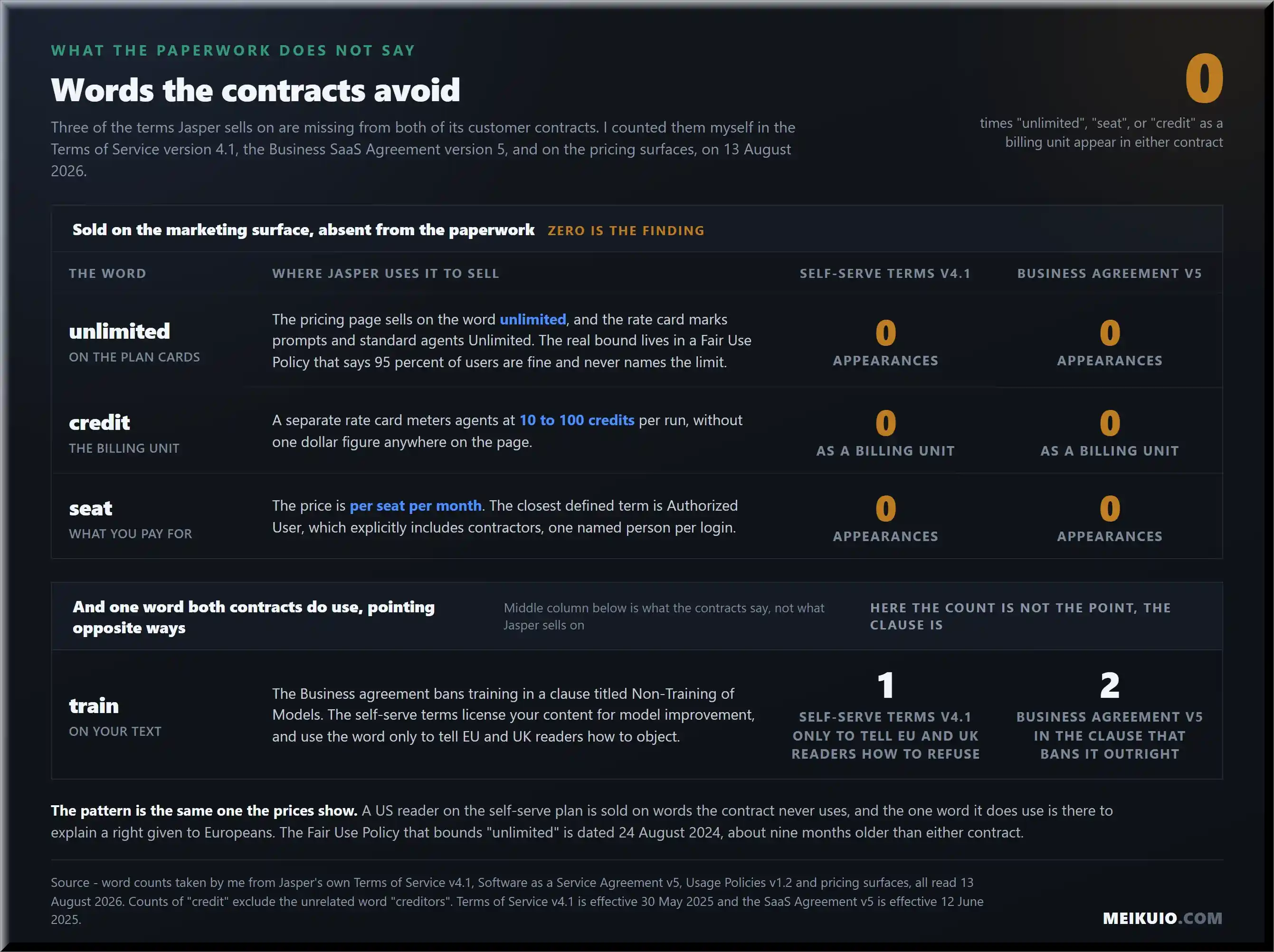
Count the pattern: the less you pay, the fewer protections the paperwork gives you. A US reader on the $708 plan has no named path to refuse training and no cap on next year’s price. The Business customer gets both. Word frequency tells the same story: “train” appears twice in the Business agreement, in the clause banning it, and once in the consumer terms, in the paragraph telling Europeans how to object.
The same asymmetry shows up in words the contracts avoid. “Unlimited” is on the pricing page. It appears zero times in either contract. The real boundary lives in a Fair Use Policy, a section inside the Usage Policies document, that sets “outer-bound” parameters at Jasper’s sole discretion, says 95 percent of users fall within them, and publishes no number. Exceeding them can mean throttling “with or without warning” or extra charges “as may be set forth in an applicable Order Form,” a document a self-serve subscriber does not have. That policy is dated August 24, 2024, about nine months older than either contract and older than the agent features it now governs.
“Credit” as a billing unit appears zero times in either contract, while the separate rate card meters agents at 10 to 100 credits per run without one dollar figure on the page. “Seat” is on the invoice and in neither contract; the closest defined term is Authorized User, which explicitly includes employees, consultants, contractors, and agents, one named person per login. So the contract is friendlier to contractors than the price sheet is: the person is allowed, the seat still costs $59 a month.
Before you cancel: the exit mechanics
Whichever replacement you pick, leaving Jasper has its own rules. Thirty seconds here can save you a billing cycle. Everything below is from the self-serve Terms of Service, version 4.1, read on August 13, 2026.
During the trial, cancellation may take effect immediately, so cancel with a day to spare rather than on the morning the billing date names. After the trial converts, the subscription renews until you cancel through your settings page or by writing to the billing address in the terms. The cancellation becomes effective in the month following your notice. There are no refunds for cancellation, in the contract’s own words, so on the annual plan a mistimed cancellation does not claw back the $708, it only stops the next one. If the charge has already landed, what remains is the vendor’s support desk and your card issuer’s dispute process, and the contract promises you nothing on either path. If you paid monthly, the worst case is one extra $69 cycle.
Two more exit chores. Export anything you built inside brand voice settings and knowledge assets while your seat is still active. And check who else signed in with your credentials, because the usage rules tie the account to one named person. None of this is unusual for SaaS. What is unusual is how few of the pages recommending Jasper alternatives mention that the exit has a calendar, and the calendar costs money if you read it late.
One class gets a paragraph even though I will not rank it: raw model APIs wired together with automation tools, or local models on your own hardware. Jasper itself validates the approach. Its sub-processor list, the public register of third parties that process customer data, names Anthropic, Cohere, Google Gemini, and OpenAI as the models underneath, and it sells its own API and MCP access. You can rent the same engines directly. I priced that pattern for teams in my AI automation tools breakdown, and the billing logic is the same one that hit developers in the GitHub Copilot pricing change: metered usage is cheap until the day it is not.
Be honest about what you give up. No brand governance, no support contract, no interface your intern already knows, and someone on your side now owns uptime and prompt quality. The privacy ceiling is real, text on your own machine beats any vendor promise, but you pay for it in engineering hours. If nobody on the team wants to own that, this class is not your answer, whatever the per-token math says.
What nobody can check without paying
A fairness note about every list in this market, including mine. Some qualities of these products are visible from outside: published prices, contract text, trial terms, integration docs. Others are only measurable after you pay and run the tool for weeks: whether brand-voice enforcement actually holds under pressure, which model your request really routes to, how deep the document context goes before it degrades.
I verify the first kind on live pages and label the second kind as unverifiable, because I did not buy seven subscriptions. Most lists in this field quietly write confident sentences about the second kind anyway. When you see a page rate ten tools on “output quality” with no methodology, you now know which kind of claim you are reading.
Bring-your-own-key support and compliance certifications are the clearest case. For most vendors on this page, the public trail for both simply ends at not published. Not published is not a no, and a list that fills that cell with a confident answer either bought access or guessed. I label it what it is, and the demo call is where you turn that label into a fact.
How this field is built
I opened the entire first page of US results for this query on August 13, 2026, and counted. Of nine organic positions, four are vendors that sell a competing product, one is a software directory, two are forum threads, one is a video, one is a blog. Independent media: zero. Above the organic results sit at least four ads, one of which bought the headline “vs Jasper” outright. That ad density is what this keyword’s cost per click buys; keyword tools price it around 165 dollars, among the most expensive clicks in software.
Then I opened each ranking article, the nine positions minus the two forums and the video, six pages in all, and checked what each one knows. The strongest of the six, a vendor page from eesel, does print both current Jasper prices and even names the credit metering; it also ranks a competitor’s product first, which at least is not its own. Another vendor page, from AirOps, gets to “around $59 per user” and stops. The remaining four never print Jasper’s current price at all. One page has been ranking since July 2025 without an update visible; another circles price and cost across 3,337 words and never once attaches a number to any of it. The two forum threads in the top ten are old enough that the product they discuss has since changed shape. Google ranks them anyway. That says something about how little the commercial pages are trusted.
Counts of pages, not mentions or a fixed page order. Four of six are competing vendors. Two forum threads and one video were excluded. One page prints a retired price six times and the current price zero times. One price-free page runs 3,337 words. The first five rows indicate useful coverage; the last two indicate failures.
Four of those seven checks are failed by all six pages. The detail that stays with me: one page prints a dead Jasper price six times and the current price zero times. Another spends 3,337 words on a buying decision and includes zero dollar amounts, while talking about price and cost throughout. I have run this same audit on Calendly alternatives and SurveyMonkey alternatives, and this field is the weakest of the three, which is what happens when most of the ranking pages are also stores.
The quiet part, said plainly: I found no evidence the field is stupid, only that it is conflicted. The two searches tell it best. Results for “jasper ai review” belong to real users, Trustpilot, Reddit, a two-year owner’s writeup. Results for Jasper alternatives belong to vendors ranking themselves first. Same product, two different worlds, zero overlapping pages between the two sets when I compared them URL by URL.
How I checked all this
Every Jasper number comes from its live pricing page, its checkout screens behind a fresh account, or its legal documents, read on August 13 to 14, 2026. The documents: Terms of Service version 4.1, SaaS Agreement version 5, Usage Policies version 1.2, and the sub-processor list version 4. Every price for the Jasper alternatives above comes from that vendor’s own pricing page read the same days. I created the Jasper account myself, stopped at the payment screen, and entered no card. Where a number was not published, I wrote that instead of borrowing one from another blog. No vendor paid for placement, and the ranking logic is the reasons table above, not a score I invented.
Field notes
- The price: Jasper Pro is $59 per seat per month billed annually and $69 billed monthly, one seat included; the Business tier publishes no price at all.
- The trial: 7 days, card required, defaults to the annual plan, and the checkout states $708 due in one charge after the trial ends.
- The discount gap: the pricing page advertises a saving of about 20 percent for yearly billing; the checkout says 14 percent, and $828 minus $708 is $120, or 14.49 percent.
- Unpublished limits: the fair use cap carries no published number, and credits are defined only on a rate card, never inside either customer contract.
- The models underneath: Jasper’s own sub-processor list names Anthropic, Cohere, Google Gemini and OpenAI.
- Sources: Jasper’s live pricing page and checkout screens, read behind an account I created myself on August 13 to 14, 2026, plus Terms of Service v4.1, SaaS Agreement v5, Usage Policies v1.2 and sub-processor list v4.
Frequently Asked Questions
What is the best alternative to Jasper in 2026?
There is no single best one, because Jasper alternatives now span five product classes. For one writer, a 20-dollar general assistant covers most of it. For writing plus SEO at a published price, Frase at 39 dollars a month billed yearly is the cheapest verified path. For enterprise governance, Writer and Typeface compete for the same sales call Jasper Business does.
How much does Jasper actually cost per year?
708 dollars for one seat on the annual plan, charged as a single payment, or 828 dollars if you pay 69 dollars monthly. The Business tier has no published price. Checked live on August 13, 2026.
Does the Jasper free trial charge you automatically?
Yes, unless you cancel within 7 days. The trial requires a card, defaults to the annual plan, and the checkout states 708 dollars due after the trial ends. The screen shows the billing date before you confirm, so read it there.
Is there a free version of Jasper?
No. There is only the 7-day trial with a card on file. The word “free” does appear on Jasper’s checkout, in the line “Due today (7 days free): $0”, but the same screen prints $708 due after the trial ends, which is not what free normally means. If you need a permanently free layer for drafting, that exists in the general assistants, not here.
Does Jasper train AI models on my text?
It depends on your contract. The Business agreement forbids it in a dedicated clause. The self-serve terms license your content for model improvement, and only EU and UK users are given a named way to object. US self-serve users get no equivalent paragraph.
Why do Jasper alternatives lists show prices that seem wrong?
Because most are written by competing vendors and updated slowly. In my audit of the six ranking articles, none printed Jasper’s real annual cost, and one of them printed a plan that no longer exists, six times, without printing the current one once.
What replaced the cheap AI writing tools?
Mostly the general assistants underneath them. The dedicated tools moved upmarket: of seven vendors I checked, three now sell marketing or visibility platforms as their main business, and two of the rest publish no price at all. The 10-to-20-dollar writing app tier has largely been absorbed by ChatGPT, Claude, and Gemini subscriptions.
Is Jasper AI worth it compared to ChatGPT?
Only if you need the marketing layer: enforced brand voice, campaign workflows, team governance, and AI-search tracking. Jasper vs ChatGPT is not a model contest anyway; Jasper’s own sub-processor list names OpenAI, Anthropic, and Google Gemini as the engines underneath, so you are choosing the scaffolding, not the intelligence. For drafting alone, you would be paying 708 dollars a year for scaffolding a 20-dollar subscription does not need. Jasper’s own rate card meters the marketing features and leaves plain writing unlimited, which shows where the vendor thinks the value is.
Can I get a refund if I cancel Jasper?
The self-serve terms say plainly that there are no refunds for cancellation. The Business agreement is also non-refundable but carves out exceptions for warranty failures and infringement claims. Cancel before the trial converts if you are not staying.
My Take
If I had to hand one replacement to one person, it depends on a single question I would ask them: do you sell content, or do you sell something else and write about it? The second group, which is most people, should take a general assistant at twenty dollars a month, spend one afternoon building a style prompt, and keep the difference, 708 against 240 a year. The first group should put Frase on a card at 49 a month, month to month, and only switch to the 39 annual rate once the tool has earned it. It is the only tool on this page that both still sells writing and prints its yearly and monthly price side by side, and disclosure habits usually predict how a vendor will treat you later.
Who I would not hand any of this to: a team about to sign an annual plan this week to hit a deadline. Nearly every headline price in this market is the annual-commitment figure, and on the one checkout I walked through myself, the difference between clicking through and reading the order summary was 708 dollars. Take the monthly price for one cycle, prove the tool earns its seat, then take the annual discount with your eyes open. It will still be there in thirty days, whatever the banner says it is.