



If you use GitHub Copilot only for autocomplete, ignore the panic. Your bill didn’t change. Code completions stay unlimited and free. But if you lean on Copilot’s agent for multi-file work, June 1 quietly reset the rules – and some developers are watching projected bills jump from $29 to $750, or $50 to $3,000.
- Quick Verdict
- What changed on June 1
- Who actually got hit
- What this means for your wallet
- The alternatives that actually make sense
- What to do this week
- Frequently Asked Questions
- Did GitHub Copilot raise its subscription price?
- Will I pay more if I only use autocomplete?
- What is the new Copilot Max plan?
- What happened to the fallback model?
- How much is a GitHub AI Credit?
- Is Cursor cheaper than Copilot now?
- Should small teams switch away from Copilot?
- My Take
On June 1, 2026, GitHub retired flat-rate billing and switched every Copilot plan to usage-based “AI Credits.” One AI Credit equals $0.01, and credits burn based on tokens processed – input, output, and cached – at each model’s published API rate. The base subscription prices didn’t move. What moved is everything you do beyond autocomplete.
Here’s who actually got hit, who didn’t, and what makes sense if your workflow no longer fits the new math.
Quick Verdict
What changed on June 1
GitHub replaced its old “premium request” counter with a credit pool. Every paid tier now includes a monthly credit allowance: Copilot Pro at $10/month includes $10 in base credits, Pro+ at $39/month includes $39, and the new Max tier at $100/month includes $100. Each plan also carries a “flex” allotment on top – extra metered usage that brings the effective ceiling to roughly $15, $70, and $200 respectively. Code completions stay outside all of it: unlimited and unmetered on every paid plan.
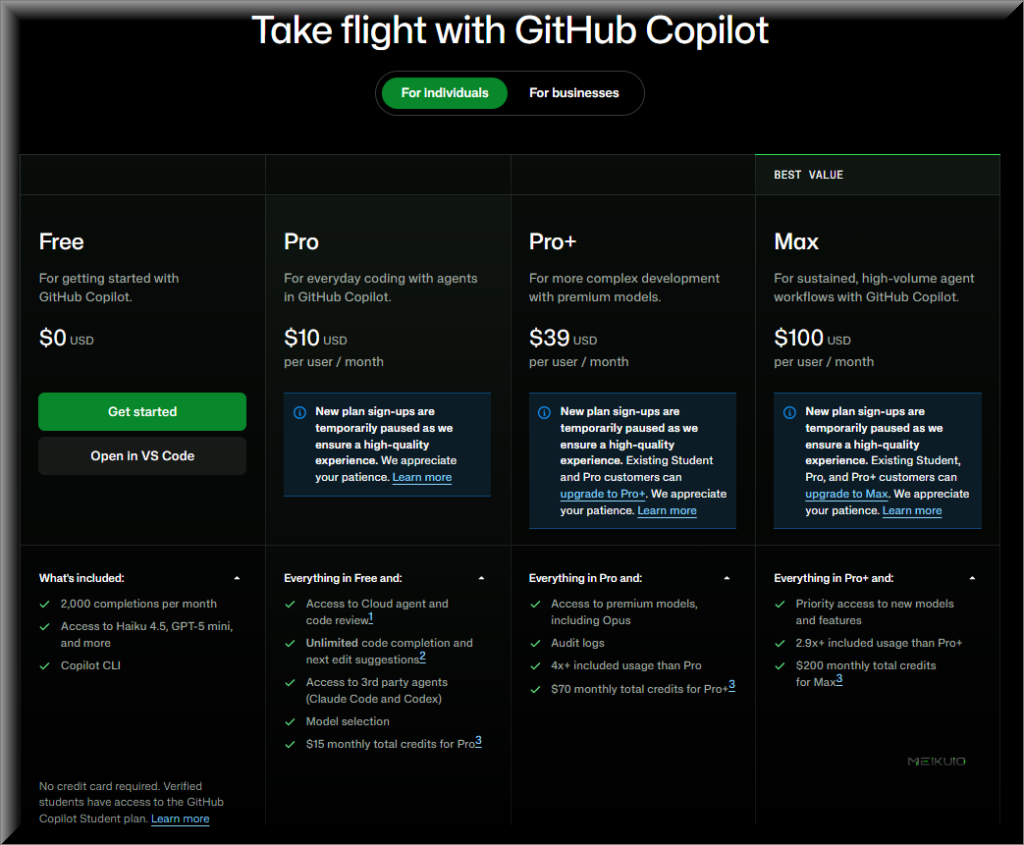
Three things matter more than the headline:
The fallback is gone. Before June 1, when you burned through your premium requests, Copilot quietly dropped you to a cheaper model so you could keep working. That safety net no longer exists – once your credits run out, you either set a paid budget to continue, switch to a lighter model, or wait for the next cycle.
More Read

Code review now bills twice. When Copilot reviews a pull request, it runs on GitHub Actions infrastructure – so starting June 1, each review consumes both AI Credits for tokens and GitHub Actions minutes from your monthly allotment. Teams running automated reviews on every PR get charged on two meters at once.
There’s a new top tier – and sign-ups are paused. GitHub added a Max plan at $100/month aimed at sustained, high-volume agent work, and labeled it “best value” for heavy users. At the same time, new sign-ups for Pro, Pro+, and Max are temporarily paused – existing customers can upgrade between tiers, but fresh subscriptions are on hold while GitHub manages the transition.
Who actually got hit
This is the part most coverage skips. The change is brutal for one group and irrelevant to another.
You’re fine if: you use Copilot mainly for inline suggestions and Next Edit Suggestions. Those original core features remain unlimited and unmetered. Most developers who adopted Copilot in 2023 – 2024 fall here. Nothing changed for you.
You’re exposed if: you run agent mode, long chat sessions, or large-context refactors. This is where tokens stack fast. TechCrunch reported developers flooding Reddit and X with complaints – one estimated their company’s bill would climb from $29 to $750 a month, another from $50 to $3,000. Power users running agentic sessions are projecting 10x to 50x increases.
The uncomfortable subtext: this wasn’t only a pricing strategy. Internal Microsoft documents obtained by journalist Ed Zitron showed the week-over-week cost of running Copilot had nearly doubled since January 2026 – which made the transition more urgent than a tidy product roadmap would suggest. Agentic AI is expensive to serve, and the bill is now landing on the user.
What this means for your wallet
If you’re a monthly Pro user at $10, you now get $10 of base credits plus a small flex allotment, consumed at each model’s published API rate. Light agent use? You’ll likely stay inside the allowance. Heavy agent use? You’ll hit zero before the month ends and face a decision: set a paid budget to keep going, drop to a lighter model, or move up to Pro+ or Max.
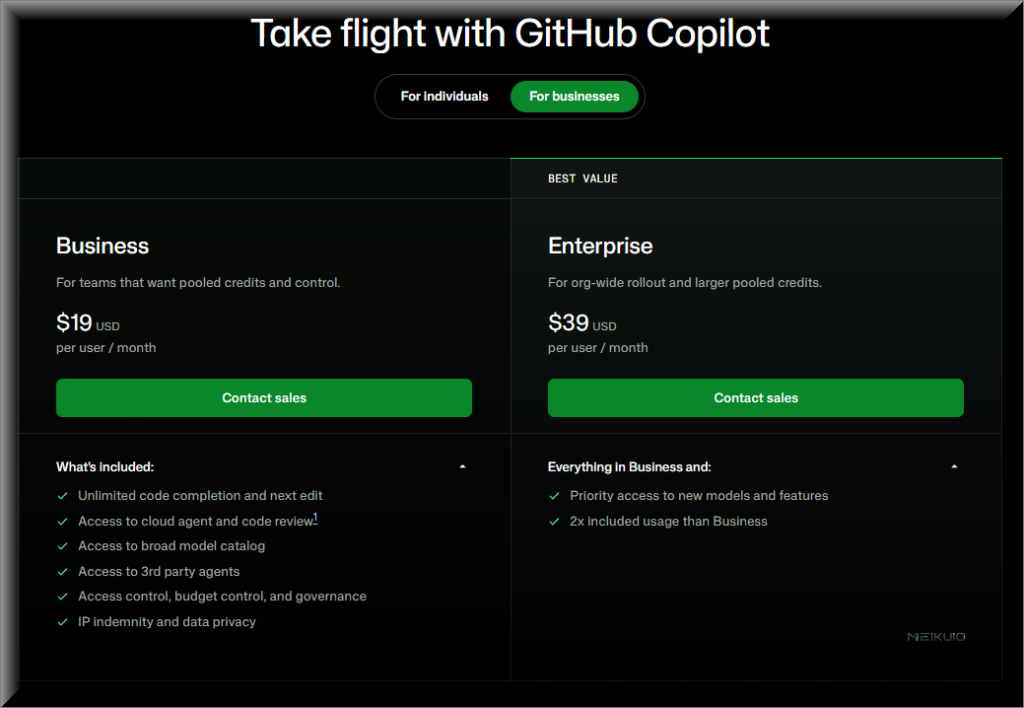
There’s a real cushion for organizations. Business at $19/user and Enterprise at $39/user also get temporary promotional credits – an extra $30/month for Business and $70/month for Enterprise – through June, July, and August 2026 to soften the landing. Pooled usage lets unused credits from light users offset heavy users in the same org. Solo developers get none of that.
The alternatives that actually make sense
Switching tools mid-project is a real cost, so don’t move on principle. Move only if the new math doesn’t work for you. Here’s how the main options compare for someone reassessing Copilot in 2026.
If you mostly want autocomplete back the way it was: stay on Copilot Pro. You’re not the one paying more. Set a budget cap and move on.
If you run agent mode all day: you now have two real options. GitHub’s own Max tier at $100/month is built for sustained agent workflows and keeps you inside the GitHub ecosystem. Or look at Claude Code – Pro is $20/month with access to both Sonnet and Opus, Max 5x is $100, and Max 20x is $200 where rate limits stop being a practical concern for full-day work. Claude Code’s flat subscription amortizes well for consistent daily use, but there’s no free tier and the budget is pooled with your regular Claude chat usage. If you’re weighing model capabilities before picking a coding assistant, comparing ChatGPT vs Claude for everyday work and analyzing emerging architectures like DeepSeek-V4 provides crucial context on inference costs and coding efficiency.
If you want a Copilot-like editor with deeper codebase awareness: Cursor is the default choice. It spans Hobby at $0, Pro at $20, Pro+ at $60, and Ultra at $200. Fair warning – Cursor also runs on a credit pool, so your real cost depends on which models you use and how heavily. The honest move is to start on Pro and watch the usage dashboard for a month before upgrading.
If you want Cursor’s feel at Cursor’s price with a different backend: Windsurf’s March 2026 overhaul moved its Pro plan to $20/month, putting it level with Cursor at every tier.
The pattern worth noticing: the whole industry is moving to usage-based pricing. OpenAI, Anthropic, and Google already charge API customers by token consumption. Copilot is the most visible app-layer tool to pass that model straight through to individual users. It won’t be the last. Picking an alternative that’s also credit-based doesn’t escape the trend – it just resets the meter. AI app builders went the same way: most of the Lovable alternatives I tested meter work in credits, tokens or messages, each at its own rate.
What to do this week
- Open your Billing Overview on github.com and check projected credit consumption before you assume anything.
- Set a budget cap if you’re an individual – it prevents a runaway bill in a single heavy session.
- If you’re an admin, turn on pooled usage and set org-level caps before someone burns the shared pool.
- Don’t switch on emotion. Track one real month of usage, then decide whether the new cost actually exceeds a $20 alternative – or whether Copilot’s own Max tier solves it.
Field notes
- Effective date: June 1, 2026 transition from flat-rate request buckets to metered AI Credits.
- Credit unit cost: $0.01 per AI Credit, burned per token processed at each model’s published API rate.
- Tier pricing: Free ($0), Pro ($10/mo with $10 credits), Pro+ ($39/mo with $39 credits), Max ($100/mo with $100 credits).
- Enterprise rates: Business ($19/user/mo) and Enterprise ($39/user/mo) include temporary promotional credits through August 2026.
- Free core: Code completions and Next Edit Suggestions remain unlimited and unmetered across all plans.
- Policy shifts: Automatic fallback model removed; PR code reviews consume both AI credits and GitHub Actions minutes.
- Sources: GitHub Copilot Pricing Documentation (June 2026), Microsoft Internal Cost Disclosures.
Frequently Asked Questions
Did GitHub Copilot raise its subscription price?
No. Base subscription prices stayed the same – Pro is $10, Pro+ is $39. What changed is that premium features beyond autocomplete are now metered by token usage instead of a flat request count, and GitHub added a new $100 Max tier on top.
Will I pay more if I only use autocomplete?
No. Code completions and Next Edit Suggestions remain unlimited and are not metered. If that’s your main use, your cost is unchanged.
What is the new Copilot Max plan?
Max is a $100/month individual tier built for sustained, high-volume agent workflows. It includes $100 in base AI Credits plus a flex allotment, and GitHub labels it the best-value option for heavy agent users.
What happened to the fallback model?
It’s gone. Previously Copilot dropped you to a cheaper model when you ran out of premium requests; now, once credits are exhausted, you set a paid budget to continue, switch to a lighter model, or wait for the next cycle.
How much is a GitHub AI Credit?
One credit equals $0.01, and credits are consumed based on input, output, and cached tokens at the model’s published API rate.
Is Cursor cheaper than Copilot now?
Not necessarily. Cursor Pro is $20 vs Copilot Pro at $10, but Cursor also uses a credit pool where real cost depends on model and usage. For heavy agent work, a flat-rate tier like Copilot Max or Claude Code Max can end up more predictable than either.
Should small teams switch away from Copilot?
Only after measuring. Business and Enterprise tiers get promotional credits through August 2026, so the real pain may not show until fall. Track a full billing cycle before committing to a migration.
My Take
I’ve watched a dozen tools make this exact move, and Copilot’s version is more honest than most – completions really do stay free, and the new Max tier means heavy users aren’t forced out. But the quiet removal of the fallback model is the part that bothers me. That safety net was the difference between “my tool slowed down” and “my tool stopped.” Losing it mid-project, with no warning, is how you lose trust even when the price technically didn’t change. My advice: don’t rage-quit, but don’t stay loyal either. Track one real billing cycle, then let the number decide. If you’re a casual user, this whole story isn’t about you. If you live in agent mode, the honest question isn’t “Copilot or not” – it’s “which credit pool burns slowest for the way I actually work.”