


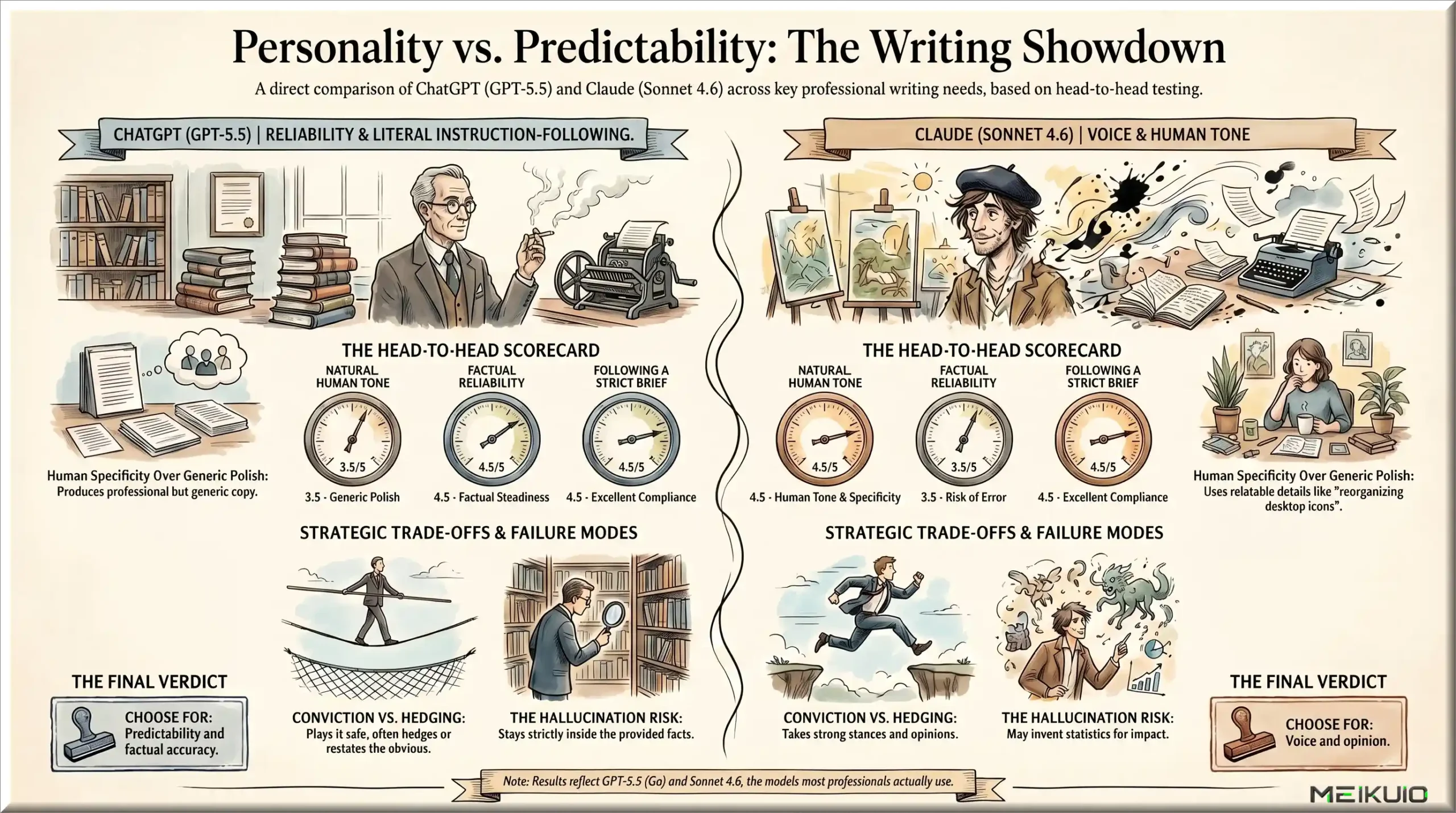
ChatGPT vs Claude for writing comes down to a single trade-off. Claude writes with more personality and a sharper point of view. ChatGPT is steadier, follows your instructions more literally, and is less likely to invent a fact. I ran both through the same blog, marketing, and long-form prompts on their everyday plans – and the gap shows up in different places than you’d expect.
Quick verdict
The short version: Claude is the better writer, ChatGPT is the more reliable assistant. If you want drafts that already sound human, lean Claude. If you want output that stays strictly on-brief and never embellishes, lean ChatGPT.
How I tested ChatGPT and Claude
I gave each tool the exact same three prompts, word for word, and compared what came back. To keep it fair, I used the everyday models most writers actually pay for – not the $100 – $200 reasoning tiers. On ChatGPT that meant GPT-5.5; on Claude, Sonnet 4.6. Both ran in their desktop apps, and speed never came into it: both answered fast enough that waiting was never a factor.
Each prompt targeted a different writing job. Want to see the difference for yourself? Copy the three prompts below and run them on whatever plan you’re on – free or paid – then compare what comes back.
Prompt 1 – tone and human feel: “Write a 150-word intro for a blog post titled ‘How to Stop Procrastinating When You Work From Home.’ Make it engaging, conversational, and avoid clichés. Don’t use phrases like ‘in today’s fast-paced world.'”
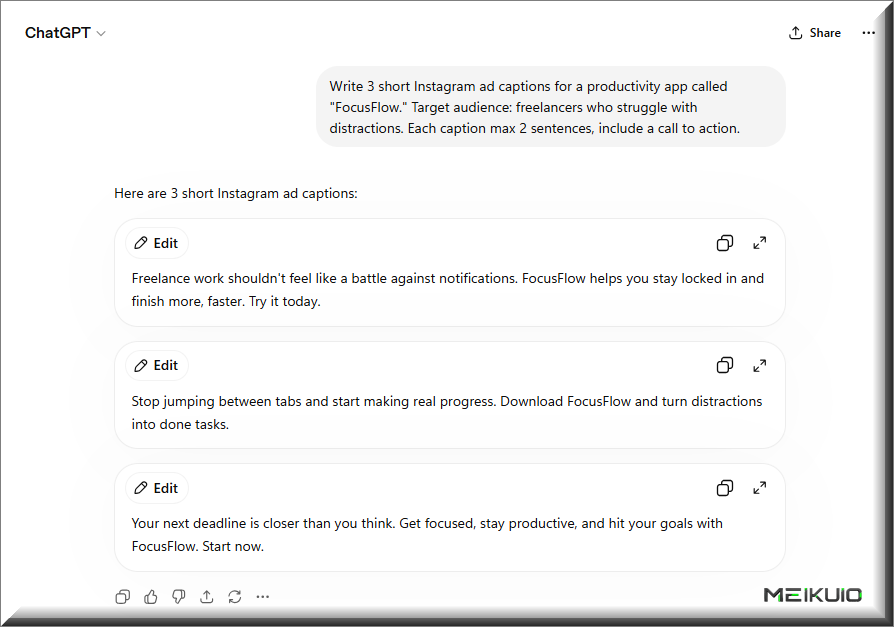
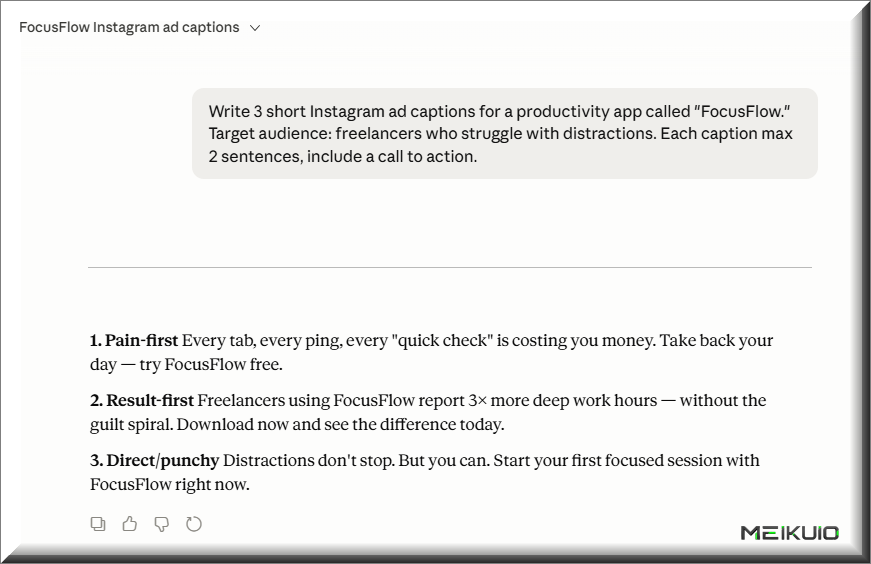
Prompt 2 – marketing copy: “Write 3 short Instagram ad captions for a productivity app called ‘FocusFlow.’ Target audience: freelancers who struggle with distractions. Each caption max 2 sentences, include a call to action.”
Prompt 3 – following instructions: “Write a 400-word section explaining the Pomodoro Technique. Use exactly 3 subheadings, include one numbered list of steps, and end with a single practical tip. Keep the tone practical, not academic.”
Blog posts and articles
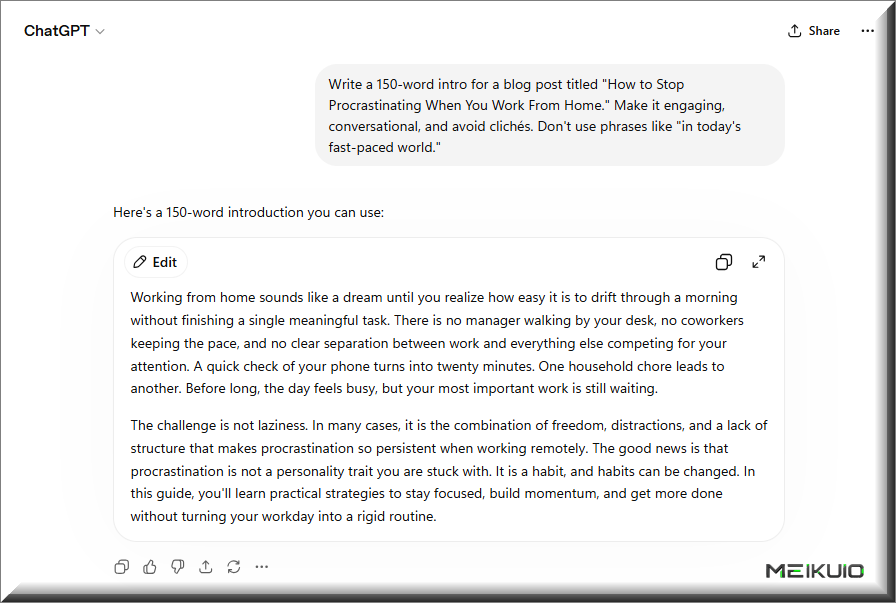
This is where Claude pulled ahead first. Asked for a blog intro, ChatGPT opened with a competent, friendly line: “Working from home sounds like a dream until you realize how easy it is to drift through a morning.” Accurate, readable, and a little generic – the kind of opening you’ve read a hundred times.
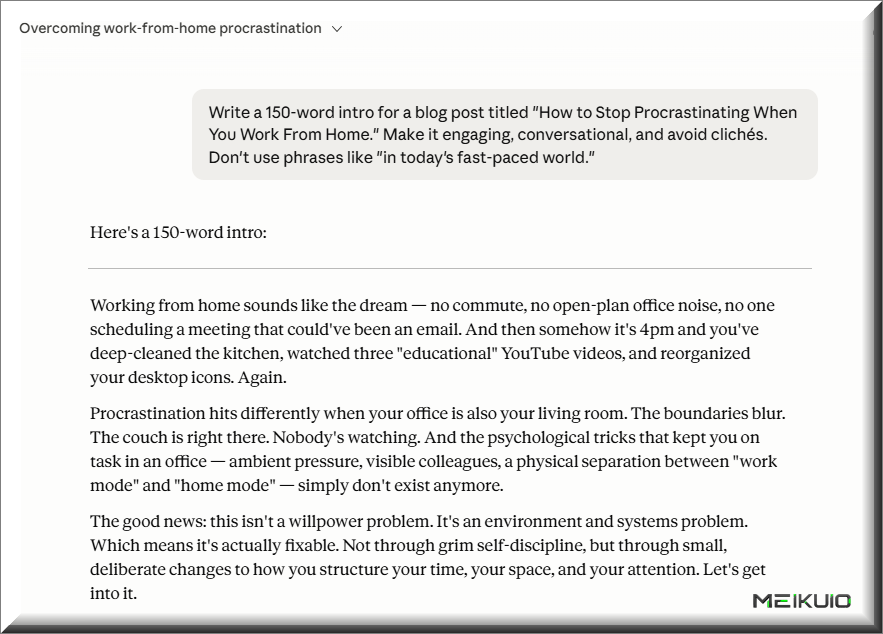
Claude went for specifics. Its intro landed on “it’s 4pm and you’ve deep-cleaned the kitchen, watched three ‘educational’ YouTube videos, and reorganized your desktop icons. Again.” That last word – “Again.” – is the kind of detail a person writes, not a template.
More Read

The structure differed too: ChatGPT delivered two smooth, even paragraphs, while Claude broke its intro into three shorter ones and leaned on one-line punches like “The couch is right there. Nobody’s watching.” ChatGPT’s version was solid but closed on a stock promise about what “you’ll learn in this guide.” Claude reframed the whole problem instead – calling procrastination an environment-and-systems issue rather than a willpower one – which hands the piece an angle instead of just a setup. For blog writing where voice matters, Claude’s drafts need less rewriting to sound like a human wrote them.
Marketing copy
Here the two tools split, and it’s the most useful comparison in this test. Both wrote three Instagram captions for a fictional focus app aimed at freelancers. ChatGPT’s were clean and ready to publish – but the calls to action were the kind you forget instantly: “Try it today,” “Start now.”
Claude did something the prompt never asked for: it organized the three captions by strategy – pain-first, result-first, and direct. The language was sharper and tuned to the reader (“every ‘quick check’ is costing you money,” “without the guilt spiral”). For a marketer, that framing is genuinely handy.
But Claude also did the one thing you have to watch for. One caption claimed users get “3× more deep work hours” – a statistic it invented out of thin air for an app that doesn’t exist. I nearly dropped it straight into a brief before I clicked that the number came from nowhere. For a real campaign, that’s a claim you’d have to delete or back up with data. That’s the trade-off in a single line: Claude reaches further, and occasionally reaches past the facts. ChatGPT stayed safely inside what it actually knew.
Long-form and following instructions
The last prompt was deliberately rigid: a 400-word Pomodoro explainer with exactly three subheadings, one numbered list, and a single practical tip at the end. Both tools hit every requirement. No format slips, no missing pieces.
The difference was in approach, and you could see it in the section titles. ChatGPT labelled its three subheadings exactly as you’d expect: “What Is the Pomodoro Technique?”, “How the Method Works,” and “Benefits in Daily Work.” Claude kept the first two similar but turned the third into “Common Mistakes That Kill the Results” – a section that helps the reader instead of restating the obvious. The tools diverged on tone, too: ChatGPT hedged, suggesting you adapt the timer to 30- or 45-minute sessions, while Claude drew a hard line – “a pomodoro is either complete or it isn’t.” Same format, more opinion.
Worth saying plainly: when precise instruction-following matters – a brief with hard constraints, a format you can’t deviate from – ChatGPT is every bit as dependable, and its neutral tone is sometimes exactly what you want. This round was a draw on format, with a slight edge to Claude on usefulness.
Pricing: ChatGPT vs Claude
For writers, only a few tiers actually matter. Here’s how they line up.
Two things stand out. First, Claude’s free plan has no ads and keeps memory across conversations, while ChatGPT’s US free plan now shows ads and caps how much text you can feed it at once (roughly 12 pages). Neither free tier runs its company’s top model – you get a capable mid-tier on both. Second, on paid plans Claude Pro is slightly cheaper at $17/month on the annual rate, versus ChatGPT Plus at $20 – though ChatGPT’s lineup is broader, and more confusing, with two separate “Pro” tiers at $100 and $200.
The bottom line for each tool
Which should you use?
After this test, the honest answer isn’t “one is better” – it’s that they’re better at different jobs.
Choose Claude if you…
- Want drafts that already sound human and need less editing for tone
- Write blog posts, newsletters, or anything where voice and point of view matter
- Value a free plan with no ads and memory across chats
Choose ChatGPT if you…
- Need output that stays strictly on-brief and inside the facts
- Write to rigid formats or feed it data you can’t afford to have embellished
- Want the broader ecosystem, including image generation and a wider range of plans
One more thing worth knowing: both are general assistants, not writing tools built for a single job. If you’re producing marketing copy or SEO content at volume, a purpose-built writer often saves more time than either chatbot – that’s the case for tools like Jasper (see our Jasper pricing breakdown) or a dedicated SEO writer like Writesonic (our Writesonic review).
And which app simply feels nicer to use? That mostly comes down to habit. The more you work in one, the more the other starts to feel foreign – which is worth saying plainly, because it’s not a real point of difference between them.
Frequently asked questions
Is Claude better than ChatGPT for writing?
For tone and voice, Claude usually produces more human-sounding drafts with less editing. For strict instruction-following and factual reliability, ChatGPT has the edge. The better tool depends on whether you value personality or predictability.
Is Claude free to use?
Yes. Claude’s free plan costs nothing, runs on Sonnet 4.6, includes memory across conversations, and shows no ads. The top model, Opus 4.8, requires a paid plan.
Does ChatGPT show ads now?
On the free and Go tiers in the US, yes – ads began appearing below responses in 2026. Paid plans, from Plus upward, remain ad-free.
Which is cheaper, ChatGPT or Claude?
At the entry paid level, Claude Pro is slightly cheaper at $17/month billed annually, versus ChatGPT Plus at $20/month. Both offer free plans, and both have higher tiers starting around $100/month.
Can ChatGPT and Claude write long articles?
Both can. On paid plans each handles long-form drafting well, though ChatGPT publishes clearer limits on how much text you can input at once. For very long documents, the paid tiers of either tool are far more comfortable than the free versions.
Which AI writes more like a human?
In my testing, Claude. It leans on concrete details and varied sentence rhythm, while ChatGPT tends toward smoother but more generic phrasing. The difference is clearest in openings and casual, conversational copy.