



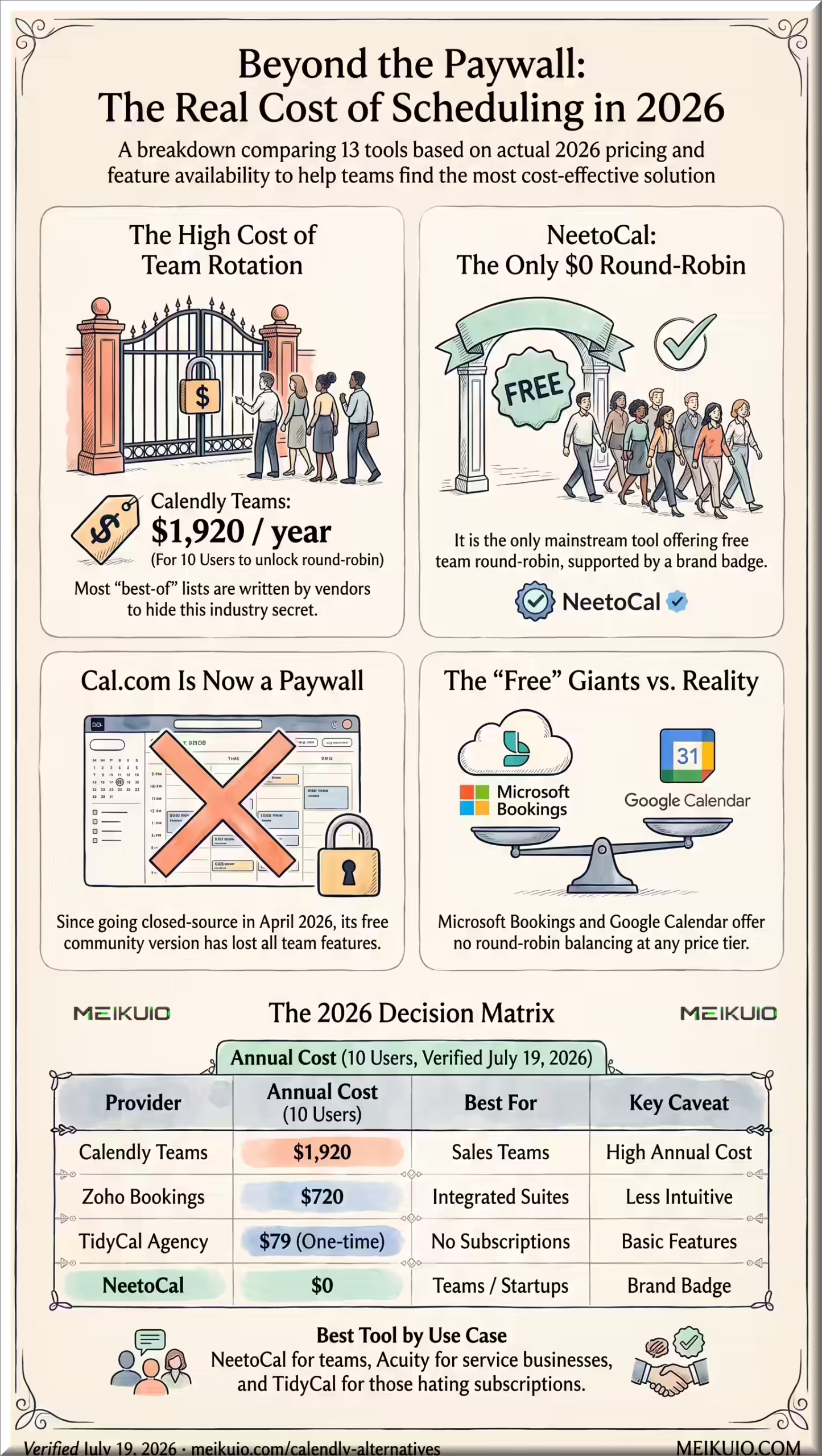
Most Calendly alternatives rankings share a problem they never mention: they’re written by scheduling vendors ranking themselves. This one isn’t. After checking 13 tools against their own pricing pages, three stand out: NeetoCal (the only free team round-robin), Zoho Bookings (cheapest paid round-robin at $6 per user), and TidyCal ($79 once, no subscription).
- Who writes “Calendly alternatives” lists? Mostly the alternatives
- What does Calendly’s free plan actually give you?
- How much does team round-robin cost in 2026?
- The best Calendly alternatives in 2026, ranked
- 1. NeetoCal: the only free team round-robin, with one string attached
- 2. Cal.com: best free solo tool, and a warning about “open source”
- 3. Zoho Bookings: cheapest true round-robin you can pay for
- 4. TidyCal: $79 once, if you can live with “round-robin, roughly”
- 5. Acuity Scheduling: built for businesses that sell appointments
- 6. Microsoft Bookings and Google Calendar: free because you already paid
- 7. OnceHub: the routing specialist the lists skip
- What each free plan really allows
- Which Calendly alternative should you pick?
- When Calendly is still the right call
- FAQ
- Is there a truly free Calendly alternative?
- Is Cal.com still open source in 2026?
- Can I get round-robin scheduling for free?
- What’s the cheapest Calendly alternative for a team?
- Do Calendly alternatives import my existing setup?
- What does Calendly actually cost in 2026?
- My Take
Note
No scheduling vendor paid for placement or ranking on this page. All prices were checked against official pricing pages on July 19, 2026.
Who writes “Calendly alternatives” lists? Mostly the alternatives
Search for Calendly alternatives and count who ranks first on each result. Lunacal’s “10 best alternatives” puts Lunacal at number one. Zencal’s “5 best” opens with Zencal. YouCanBook.me publishes an 11-tool list; guess who leads it. Zeeg crowns Zeeg, FluentBooking crowns FluentBooking, and Cal.com runs an entire blog series where Cal.com wins every comparison. Calendly itself operates a “compare” page grading its own competitors, which is a bit like a restaurant reviewing the place across the street.
My favorite example is HubSpot. Its marketing blog promises free scheduling with round-robin for unlimited users. Its own pricing page says the free tier allows two users and one personal link, with round-robin starting on paid Sales Hub plans. When a vendor’s blog contradicts the vendor’s checkout page, believe the checkout page.
I found the same pattern when I ranked Zendesk alternatives: help desk vendors writing help desk rankings. Scheduling is worse, because the products are simpler and the SEO stakes are higher. So this list ranks by the one thing vendors can’t spin: what each free plan gives you, verified on their pricing pages. It’s the same rule behind our ChatGPT alternatives roundup: rank by what users get, not by who’s selling.
What does Calendly’s free plan actually give you?
One event type. That’s the number that matters. Calendly’s free plan allows unlimited meetings, but only one active event type: one duration, one set of questions, one buffer rule. Want a 15-minute intro call and a 60-minute consult? That’s two event types, so that’s a paid plan. You also get one connected calendar, no payment collection, and a “Powered by Calendly” badge you can’t remove.
Standard, at $10 per seat per month billed annually ($12 monthly), unlocks unlimited event types, six calendars, and Stripe or PayPal payments. What it doesn’t unlock is the feature growing teams upgrade for: round-robin distribution, where incoming bookings rotate across your reps. Round-robin and routing forms sit on Teams, at $16 per seat per month annually, $20 monthly. Routing based on Salesforce or HubSpot record lookups sits higher still, on Enterprise, which starts at $15,000 per year.
The math that sends teams shopping: the one feature a sales team needs (round-robin) sits two tiers up. Ten reps on Calendly Teams cost $1,920 a year. The cheapest verified alternative with true round-robin costs $720. One tool does it for $0.
None of this is hidden, exactly. It’s just never in the vendor lists, because most of the vendors writing them paywall the same features. Here’s how one small-business owner put it after auditing a year of software spend:
Sat down and went through every single subscription and direct debit… mailchimp 45, slack 25, notion 32, zapier 49, calendly 16… For calendly, use tidycal.
Small-business owner on r/smallbusiness, software subscription audit thread, 2025
How much does team round-robin cost in 2026?
Round-robin is where scheduling pricing gets honest, so I priced it across every tool for a 10-person team on annual billing. The spread is wider than any feature difference justifies. Calendly Teams: $1,920 a year. YouCanBook.me: $1,944. Zeeg Business: about $2,195 at current exchange rates. Cal.com Teams: $1,440. SavvyCal Basic: $1,200. Zoho Bookings Basic: $720. TidyCal Agency: $79, once, though its “round-robin” assigns by priority with random tie-breaks rather than strict rotation. And NeetoCal: $0, with a branding badge, or $300 a year for the whole team without one.
Two tools never make the list: Microsoft Bookings assigns staff randomly and, in Microsoft’s own words, there’s “no way to ensure equal distribution.” Google Calendar’s co-host feature books everyone at once, which is collective scheduling, a different thing.
TidyCal Agency costs 79 USD once; it uses priority-based assignment rather than strict rotation, so it is outside this annual-price series. NeetoCal is free; removing its badge optionally costs 300 USD a year. Microsoft Bookings and Google Calendar offer no round-robin at any price.
The best Calendly alternatives in 2026, ranked
Ranked by how much of the paywalled stuff each tool gives you for free or nearly free, with the fine print stated out loud.
1. NeetoCal: the only free team round-robin, with one string attached
NeetoCal’s free plan reads like a pricing-page typo: unlimited event types, unlimited bookings, unlimited team members, round-robin with priority weighting, form-based routing, payments through Stripe, PayPal, or Razorpay with no platform cut, even a custom domain. The paid plan, $5 per user per month or $30 per user per year, changes exactly one thing: it removes the Neeto badge from your booking pages.
More Read

The caveats: NeetoCal is young, built by BigBinary as part of its Neeto suite, and the free tier is this generous because it’s an acquisition funnel for the rest of that suite. Your invitees will see an unfamiliar brand on the booking page.
2. Cal.com: best free solo tool, and a warning about “open source”
For one person, Cal.com’s hosted free plan beats Calendly’s outright: unlimited event types, unlimited calendar connections, Stripe and PayPal payments, two-way Salesforce and HubSpot sync, and one-click import of your Calendly events. Teams pay $12 per user per month for round-robin and routing. But the “just self-host the open-source version for free” advice you’ll find in most rankings died in April 2026, when Cal.com took its main product closed-source, citing AI-driven vulnerability hunting. The community version, renamed Cal.diy under an MIT license, had Teams, round-robin, routing forms, and workflows removed, and its own docs recommend it for personal, non-production use. Running it yourself costs around $29 a month in server and backups anyway. Self-hosting no longer gets a team around the paywall.
3. Zoho Bookings: cheapest true round-robin you can pay for
Zoho Bookings does strict, verified round-robin at $6 per staff member per month billed annually, roughly a third of Calendly’s price for the same feature. The free tier is thin (one staff member, one service), and payment collection needs the $9 Premium tier, but the paid math is the point here: a 10-person sales team runs $720 a year against Calendly’s $1,920. It syncs with Zoho, Google, and Microsoft 365 calendars, and if you already live in the Zoho ecosystem it’s the obvious pick. The interface won’t win design awards. Your finance person won’t care.
4. TidyCal: $79 once, if you can live with “round-robin, roughly”
TidyCal, built by AppSumo, sells lifetime access instead of subscriptions: $29 one-time for individuals, $79 one-time for the Agency tier with team pages and collective booking. Even the free plan allows unlimited booking types and bookings with Stripe and PayPal, which embarrasses Calendly’s single event type.
Two flags. First, TidyCal’s help docs describe its round-robin as priority-based with random tie-breaking, so reps won’t rotate in strict order. Second, the Agency license belongs to the purchaser; teammates who want their own multi-calendar setups need their own licenses, and SMS reminders only cover the US and Canada. For a solo consultant or a small agency that mostly needs shared booking pages, $79 once against $192 per seat per year is hard to argue with.
5. Acuity Scheduling: built for businesses that sell appointments
Acuity has no free tier at all. Squarespace owns it now, and the old plan names you’ll see in most rankings (Emerging, Growing) were retired. Current plans run flat, not per-seat: Starter at $16 a month billed annually with one calendar, Standard at $27 with six calendars and round-robin via calendar pooling, Premium at $49 with thirty-six. Flat pricing flips the math: six people on Acuity Standard cost $324 a year, while six Calendly Teams seats cost $1,152. What you’re really buying is the service-business toolkit: intake forms with conditional logic, packages, memberships, coupons, and payments through Stripe, Square, or PayPal. For coaches, clinics, and studios, this is the specialist option.
6. Microsoft Bookings and Google Calendar: free because you already paid
If your company pays for Microsoft 365 or Google Workspace, you may already own a scheduler. Bookings ships with most business Microsoft 365 plans and handles shared booking pages for teams; Google Calendar’s appointment schedules give every Workspace user a booking page, and personal Gmail accounts get one free page to try. Know the ceilings before you commit. Neither tool does round-robin at any price: Bookings assigns randomly, Google books co-hosts collectively. Bookings has no payment support at all; Google takes payments only through Stripe on paid Workspace tiers. As a replacement for a $10 Calendly Standard seat, either is a clean downgrade-free swap. As a replacement for Teams-tier routing, neither qualifies.
7. OnceHub: the routing specialist the lists skip
Almost no vendor list mentions OnceHub, possibly because it competes on the feature the big players reserve for enterprise deals: routing. Its Route plan, $19 per user per month, combines conditional routing forms with round-robin, deciding which rep gets the meeting based on what the prospect answers. Price that against the alternatives: Calendly puts CRM-lookup routing on Enterprise (from $15,000 a year), and HubSpot’s lead-form routing lives on Enterprise at $150 per user per month plus a published $3,500 onboarding fee. A free tier covers one user with one booking link. If your problem is “qualify and route leads without an enterprise contract,” this is the shortlist of one.
What each free plan really allows
The column that separates the field is the last one. Most Calendly alternatives will happily give one person a booking link. Exactly one gives a team its core feature without a paid tier. If your scheduling bottleneck goes beyond booking links to dynamic task management and daily time blocking, our hands-on Motion app review in 2026 tests how an AI calendar handles an overbooked day.
Which Calendly alternative should you pick?
- If you’re a solo freelancer who needs a free booking link, take Cal.com’s hosted free plan for the payments and Calendly import, or NeetoCal if you want several event types and don’t mind the badge.
- If you run a small sales team that needs round-robin, start with NeetoCal free and budget $30 per user per year to de-brand it. If you’d rather pay an established vendor, Zoho Bookings at $6 per user is a third of Calendly’s price.
- If you sell appointments as the product (sessions, classes, treatments), Acuity Standard at $27 flat handles intake, packages, and payments in one place.
- If you hate subscriptions, TidyCal’s $79 lifetime Agency tier is the escape hatch, priority-based round-robin and all.
- If you already pay for Microsoft 365 or Google Workspace and only need basic booking, use what you own; just know round-robin will never arrive.
- If lead qualification and routing are the whole point, OnceHub Route at $19 per user undercuts every enterprise routing tier by an order of magnitude.
Whichever of these Calendly alternatives you choose, know what switching costs: Calendly links break the day you leave (there’s no forwarding), embedded widgets need re-embedding, and booked meetings don’t transfer. Cal.com and TidyCal soften it with one-click imports of your event types. And once the scheduler is wired into the rest of your stack, connect it properly; we covered that market the same way in our AI automation tools breakdown. If what you’re really after is software that reschedules your day by itself, that’s a different category with different failure modes; see what’s real in our review of AI agent examples in production. We priced eight of them, from Motion to Trevor AI, and checked what each one promises in writing for the day you cancel: see the best AI scheduling assistant comparison.
When Calendly is still the right call
A neutral list of Calendly alternatives owes you the reverse case. Calendly remains the scheduling brand your invitees recognize, and that matters more than it should: an unfamiliar booking domain adds a beat of hesitation to every external meeting request, which is exactly where you don’t want friction. Its integration catalog is broader than anything above, its uptime record is long, and past 30 seats the tiered pricing drops to $14.50 and then lower, narrowing the gap the small-team math exposes. There’s also vendor risk to price in: Calendly has a decade of enterprise contracts and compliance reviews behind it, while several tools above are young enough that their support quality and pricing haven’t yet survived a bad quarter. If you’re on Standard, happy, and nobody’s asking for round-robin, switching buys you little beyond a smaller invoice. The exact same incumbent dynamic governs closing documents, where our comparison of DocuSign alternatives in 2026 tests whether brand recognition justifies paying five times more for signatures.
FAQ
Is there a truly free Calendly alternative?
Yes. NeetoCal’s free plan includes unlimited event types, unlimited team members, round-robin, routing, and payment collection, with a Neeto badge as the only real limitation. For solo use, Cal.com’s hosted free plan and TidyCal’s free tier both allow unlimited event types, which already beats Calendly’s single free event type.
Is Cal.com still open source in 2026?
No, not the product most people mean. In April 2026 Cal.com moved its main codebase to a proprietary license, citing AI-assisted vulnerability discovery. A community version called Cal.diy continues under an MIT license, but it ships without Teams, round-robin, routing forms, or workflows, and its documentation recommends it for personal, non-production use.
Can I get round-robin scheduling for free?
From one mainstream tool: NeetoCal. Every other scheduler paywalls round-robin, from Zoho’s $6 per user to Calendly’s $16 per seat, and two never offer it: Microsoft Bookings assigns staff randomly without balancing, and Google Calendar only books all co-hosts together.
What’s the cheapest Calendly alternative for a team?
For 10 people needing round-robin on annual billing: NeetoCal at $0 to $300, TidyCal Agency at $79 one-time with its priority-based caveat, then Zoho Bookings at $720 as the cheapest strict-rotation subscription. Calendly Teams runs $1,920 for the same headcount.
Do Calendly alternatives import my existing setup?
Cal.com and TidyCal offer one-click imports of Calendly event types, and Cal.com has offered to cover the remainder of a switching team’s Calendly contract. No tool preserves your links: Calendly URLs stop working when you leave, and scheduled meetings stay in the old account, so time the switch for a quiet week.
What does Calendly actually cost in 2026?
Free covers one event type and one calendar. Standard is $10 per seat per month billed annually ($12 monthly). Teams, which adds round-robin and routing forms, is $16 annually ($20 monthly), with per-seat discounts starting past 30 seats. Enterprise starts at $15,000 per year. Monthly billing runs about 20% above the advertised annual rates. The gap between headline price and the tier that has your feature isn’t unique to scheduling; we track the same pattern for AI models in our AI pricing comparison.
My Take
Scheduling links are a solved problem; scheduling pricing is a shell game. Every vendor in this market knows round-robin is what teams upgrade for, so that’s where everyone hides the paywall, and the “alternatives” content they publish exists to move you from someone else’s paywall to theirs. NeetoCal wins my recommendation today because its paywall is somewhere else (the badge), but I’d re-check that pricing page in six months. Free tiers built for land-grabs have a way of shrinking once the land is grabbed. Whatever you pick, price the tier with the feature you need, never the headline.