



The best whole house water filter is one you can find in a certification registry, and most of the models you have been reading about are not in any of them. I searched three public databases on August 22, 2026. Whole home water filter systems certified for lead exist: eight models, from five companies, in one registry.
- What is a whole house water filter?
- The one line on the box that decides everything
- How many whole house filters are certified to remove lead?
- The whole house systems that are actually certified
- Why the filter at your front door cannot fix all of the lead
- How to check a filter in the registries, in two minutes
- “Tested to” is not “certified to”
- Before you buy anything, read the report you already paid for
- If you are on city water
- If you are on a private well
- PFAS: what is actually certified for a whole house
- What the guides recommend, and what the registries list
- The best whole house water filters, by the problem you have
- Best for lead and PFAS together: Aquasana OptimH2O, model EQ-OPTM
- Best PFAS breadth: Culligan Aquasential Whole Home PFAS Water Filter
- Best certified system you can buy without a dealer: Aquasana HealthShield, model WH-HS
- Best for well water with arsenic: Culligan arsenic filters, 12, 14 and 16 inch
- Best for a builder or plumber specifying parts: Enpress CTA series and Pentair Floplus Protect
- The one everybody recommends: Aquasana Rhino
- Salt-free softeners and electronic descalers
- What actually breaks, and what it does to your shower
- The fine print you own afterwards
- When the answer is under the sink
- Certified system, or certified parts?
- Test your water before you shop for a whole house water filter
- The dealer at your door
- What it costs to own, not what it costs to buy
- How to choose, in five steps
- Frequently Asked Questions
- What is the best whole house water filter for lead?
- Is a whole home water filter worth it?
- How do I check whether a water filter is really certified?
- What is the difference between NSF/ANSI 42 and NSF/ANSI 53?
- Do salt-free water softeners actually work?
- Will a whole house filter remove PFAS?
- Why do the top-rated brands not appear in certification registries?
- How much water pressure will I lose?
- My Take
Not one of those eight is named in the buyer’s guides ranking above this page. I checked all five of them for every model number. And the brand those guides recommend most often does not appear in any of the three registries a shopper can search.
If you already know what your problem is, jump to it. Chlorine or a smell in the shower is a city water problem. Staining, iron or sulphur is a well problem. Lead and PFAS are health claims, and the certificate matters more than the brand. Scale on the kettle is a softener question, not a filter question. And if your reason for buying is drinking water alone, the cheapest correct answer is probably under the sink.
What is a whole house water filter?
A whole house water filter is a treatment system plumbed into the main line where water enters your house, so every tap, shower and appliance downstream gets treated water. The industry calls this point of entry, or POE. A filter under your kitchen sink is point of use, or POU. That single distinction decides almost everything that follows, including which certificates a whole home water filter can hold and which contaminants it can reach.
Point of entry means one box, installed once, treating a few gallons per minute against whatever the house is drawing. Point of use means a small cartridge treating a slow trickle at one faucet. The second one is easier to certify and easier to prove. Keep that in mind when a product page shows you a certification mark.
The one line on the box that decides everything
Water treatment certification runs on a numbered ladder of NSF/ANSI standards. The numbers are not decoration. Each one covers a different promise, and a product certified to one of them has proven nothing about the others. This is the whole game, and it takes about two minutes to learn.
Two rows in that table do most of the damage in real shopping. A product certified to NSF/ANSI 42 has proven it improves taste. That is a real result and it is not a health claim. And a product listed only under NSF/ANSI 61 has proven that its plastic does not poison you, which tells you nothing about what comes out the other end.
One brand makes this concrete. nuvoH2O appears in the NSF database twice. Both listings are filed under COMPONENTS: Filter Housings, and the registry prints its own footnote next to them: “Conforms to the material and structural integrity requirements only.” The housings are certified. Nothing about softening is.
Certified to NSF/ANSI 42 means the water tastes better. It is not a health claim, and half the category is sold as if it were.
How many whole house filters are certified to remove lead?
Across the three certification registries a shopper can actually search, eight whole house models from five companies carry a lead reduction claim under NSF/ANSI 53, and all eight sit in one registry. Search the other two for the same thing and you get nothing. I ran these counts myself on August 22, 2026, the date NSF prints at the top of every results page it serves.
Here is what NSF’s own database returns when you filter by product type Point-of-Entry.
Those four NSF listings at point of entry belong to one company, Aquion, under the RainSoft brand, and the only claim attached to them is VOC reduction. Read the table again with that in mind. In the database the federal government points you to first, the number of whole house systems certified to reduce lead is zero. Counting every other product type in that same database, from under-sink units to pitchers to replacement cartridges, the number is 1,008.
That is not the end of the story, and I nearly published it as if it were.
The correction that changed this article
After counting NSF and WQA, I had written that no whole house system is certified for lead. Then I enumerated the third registry, IAPMO R&T, and it was not true. Five companies hold lead claims there at point of entry. The interesting fact was never that certified systems do not exist. It is that they exist in one registry out of five, and the one the government lists first is not it.
The whole house systems that are actually certified
This table does not exist anywhere else that I could find, so here is how I built it. IAPMO R&T lists 145 files under NSF/ANSI 53. I pulled the certificate for each one that its directory serves publicly, 124 of them, and kept only the files where the product type field inside the certificate says Point-of-Entry. Eight certificate files came back with that product type, held by seven companies, and those files carry more than lead between them. The remaining 21 files point to an older records platform whose pages I did not enumerate, so treat this as a floor, not a ceiling.
Read the fourth column, not the first. A system on that list is certified for the contaminants named beside it and nothing else. Enpress holds lead, cysts and PFOA/PFOS on one file and arsenic on another, which means the arsenic version and the lead version are not the same machine. Pentair’s two models carry five perfluorinated compounds and no lead claim at all.
More Read

One more thing about that table. It holds twelve rows. I took fourteen model strings out of them, the ones a shopper could actually type, and searched all five guides ranking on page one for each. Seventy checks, zero hits. Not one of these systems is named anywhere in the field.
Why the filter at your front door cannot fix all of the lead
Lead does not usually arrive with your water. It gets in on the way to your tap. EPA states it plainly: “The most common sources of lead in drinking water are lead pipes, faucets, and fixtures.” And more specifically: “In homes with lead pipes that connect the home to the water main, also known as lead services lines, these pipes are typically the most significant source of lead in the water. Among homes without lead service lines, the most common problem is with brass or chrome-plated brass faucets and plumbing with lead solder.”
Draw the plumbing in your head. The service line comes in from the street. Your whole house filter sits right where it enters. Then thirty or eighty feet of the home’s own copper, solder and brass carry that water to the kitchen. A barrier at the front door catches what is in the service line. It cannot catch what dissolves out of the pipe after it.
That explains something the registries would otherwise leave unexplained. The federal government’s own consumer guide for finding a lead filter is titled “A Consumer Tool for Identifying Point-of-Use and Pitcher Filters Certified to Reduce Lead in Drinking Water,” document EPA/600/F-24/143, published June 2024. Whole house systems are not in it as a category. Not dismissed. Absent.
So the honest version is narrower than either side of the argument. A certified whole house lead filter is real and it does a real job on the water entering the house. It is not a solution to old plumbing inside the house. If lead is your reason for buying, the barrier the government points you toward sits at the tap, and it costs a fraction of what a whole house system costs. We looked at the same pattern in what the law already covers for free, where the paid product turns out to be narrower than the promise around it.
How to check a filter in the registries, in two minutes
EPA names five certification bodies in EPA/600/F-24/143 and prints the web address of each directory in the document itself: NSF, IAPMO R&T, WQA, UL Solutions and CSA Group. There is no combined index. A product certified by one of them appears in that one and nowhere else, which is why a single search tells you almost nothing.
The three you can actually search are info.nsf.org/Certified/DWTU, find.wqa.org and pld.iapmo.org. Type them in yourself rather than following a link from a seller. Every count in this article came out of those three.
- Get the model number off the spec sheet, not the marketing name. Aquasana sells a line called HealthShield; the registry knows it as WH-HS.
- Search NSF’s drinking water treatment unit directory by manufacturer, then by trade name. Do both. Searching NSF for 3M by company name returns nothing; searching by the trade name Aqua-Pure returns a listing.
- Repeat at WQA and at IAPMO. IAPMO makes you pick a search category first, and Standard is the one you want.
- Open the certificate, not the search result. The result row says “Water Treatment Product – Health Effects” for everything. The certificate carries the product type and the actual reduction claims, model by model.
- Check that the product type line says Point-of-Entry. If it says Plumbed-In or Point-of-Use, the certificate belongs to an under-sink unit, whatever the box in the basement looks like.
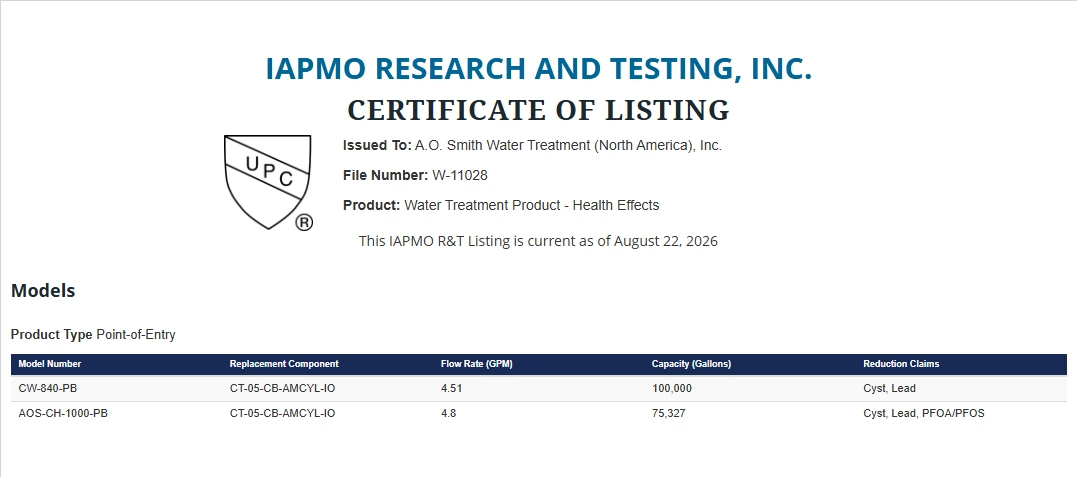
This is what that check looks like on the actual certificate: Point-of-Entry, W-11028, lead named directly.
Two of the five directories will not let you do this. UL’s public Product iQ describes itself as an “abridged site without login” and shows no search field at all. CSA’s search form runs, accepts the terms and returns nothing for any water treatment keyword I entered, and its product area list has no drinking water category, the closest being Plumbing Products. I could not enumerate either one. That is a limit on my count, and it is also worth saying plainly: the check takes two minutes in the three directories that work, and it cannot be completed in the other two at all.
Note
Absence of a listing is a fact about a database on a date, not a fact about a product. When this article says a brand does not appear, it means it did not appear in the three directories I could enumerate on August 22, 2026. UL, CSA and 21 older IAPMO files sit outside that count.
“Tested to” is not “certified to”
EPA prints the exact sentence a certified product is supposed to carry: “Tested and Certified by (certification body) against NSF/ANSI Standards 42 and 53 for the claims specified on the Performance Data Sheet.” Two things in it matter. A body is named. And the claims live on a separate sheet, not in the sentence.
Certification means a body evaluated the product, audits the factory that makes it, and keeps it in a public listing you can go and check today. “Tested to NSF/ANSI standards” is a manufacturer’s sentence about a test. It names no body, implies no audit and leaves no listing behind.
I looked for a rule that forbids the second phrase and did not find one. No statute names it. What restrains it is general advertising law and the fact that only a certified product may carry a body’s registered mark. So the phrase is not illegal. It is just empty, and the way to tell the difference is the same two minutes in a registry.
Before you buy anything, read the report you already paid for
If you get a water bill, your utility owes you an annual water quality report and federal rules set the deadline. Under 40 CFR Part 141 Subpart O, community water systems must deliver these reports by July 1 each year, and the rule says they “must contain information on the quality of the water delivered by the systems and characterize the risks (if any) from exposure to contaminants detected in the drinking water.”
You want three things from it. What the utility uses as a residual disinfectant, free chlorine or chloramine. Whether anything was detected above its limit, and what. And how hard the water is. Those three answers decide whether you need a filter, a softener, both or neither, and they cost nothing.
The report has one hard edge worth knowing. It describes water delivered by the system. It is silent about what happens in the pipes inside your house, which is exactly where the lead problem lives. If that is your worry, the report will not answer it and neither will a filter at the front door.
If you are on city water
City water arrives disinfected, and the disinfectant is the thing most buyers are actually trying to remove. Which one your utility uses changes the machine you need. EPA puts the scale of it simply: “More than one in five Americans uses drinking water treated with chloramines.”
Free chlorine comes off standard activated carbon easily. Monochloramine does not. Industry technical writing puts the gap at two to four times more contact time through conventional granular carbon, which in practice means either a much larger media bed or catalytic carbon built for the job. A carbon tank sized for chlorine, installed on chloraminated water, exhausts early and quietly. Nothing warns you. The water simply starts smelling again.
So the sequence for a city house is: read the report, find the disinfectant, then buy for that disinfectant. If the report says chloramine and the product page says “reduces chlorine,” those are not the same sentence.
And here the registry has an answer nobody prints. NSF lists 50 point of entry products with a chlorine reduction claim, from 13 manufacturers, among them A.O. Smith, Aquion under the RainSoft brand, EcoWater, GE Appliances, Pentair Residential Filtration and Whirlpool. Ask for chloramine at point of entry and the same database returns “No Matching Products Found.” Not one, against 216 listings once you allow every other product type.
More than one in five Americans is on chloraminated water, and the whole house shelf has nothing certified for it. If that is your utility, you are buying on the manufacturer’s word about catalytic carbon, and you should know that before you spend rather than after.
Hardness is a separate purchase and a separate machine. Softening runs on cation exchange, which swaps calcium and magnesium for sodium. It does not remove chlorine, chemicals or lead. Carbon filtration removes chlorine and organics and does nothing at all about scale. Marketing blurs these into “conditioning” and buyers end up with one when they wanted the other. If your complaint is spots on glassware and scale in the water heater, no carbon filter on the market will fix it.
If you are on a private well
Nobody tests your well but you. The federal rules that produce those annual reports apply to community water systems, and a private well is not one. There is no report coming, no limit being enforced and no one to call when something changes.
Clear water is not a test result. Arsenic, nitrate and coliform bacteria carry no colour, no smell and no taste, which is why the laboratory panel below exists and why “our water has always been fine” is not information about arsenic.
Well water also fails in an order. Iron and manganese have to be oxidised into solids before any filter can catch them, and how fast that happens depends on pH. Acidic water slows it down, so an aeration or neutralising stage has to come before the filter or the filter is decorative. Iron related bacteria will blind a carbon bed or a resin bed with biological slime in weeks. Sediment that would be a nuisance on city water will blind an expensive media tank on a well.
Which is why single box answers usually do not survive on a well, and the certified equipment reflects that. Culligan’s arsenic filters are listed at IAPMO as their own line with their own claim, trivalent and pentavalent arsenic, and nothing else. Enpress files arsenic separately from its lead and PFOA/PFOS models. Buying “the well water one” from a brand that sells a single unit for all of it is a guess.
Test first. A certified laboratory panel covering hardness, pH, iron, manganese, hydrogen sulfide, nitrate, arsenic and coliform bacteria tells you which of those stages you need and in what order. Everything else is shopping in the dark, and the same discipline we used when we counted the coverage ourselves instead of trusting a marketing number applies here.
PFAS: what is actually certified for a whole house
PFAS is the reason this category is growing, and it is the claim with the shortest list behind it. Across the registries I could search, whole house systems certified for perfluorinated compounds come down to a handful of names.
At IAPMO: Aquasana EQ-OPTM, A.O. Smith AOS-CH-1000-PB, Chandler Systems FC-40P, the Enpress CTA series and Water Tech Industries INF-PRO1 all carry PFOA and PFOS alongside lead. Pentair’s Floplus Protect 20BB and UltreFlo Protect carry five compounds, PFOA, PFOS, PFHpA, PFHxS and PFNA, and no lead claim. At WQA: Aquasana WH-HS and A.O. Smith AOS-HS-1200 for PFOA and PFOS, plus Culligan’s Aquasential Whole Home PFAS Water Filter across six listings for Total PFAS. At NSF: nothing at point of entry, for any of them.
Aquasana states its own position on the HealthShield product page: “WQA tested and certified to NSF/ANSI Standards 53 and 401.” The model number printed on that same page is WH-HS. That is exactly the string in the WQA registry, and it is why the check works when you use the model number instead of the brand.
The regulation behind all this moved recently and is still moving, so treat the dates carefully. The federal PFAS drinking water rule set limits for PFOA and PFOS at 4.0 parts per trillion. In 2026 EPA proposed extending utility compliance deadlines to 2031 and proposed rescinding the regulation for four other PFAS compounds. Those are proposals, not finished rules. The limits for PFOA and PFOS stand while that plays out.
What a PFAS claim covers, and what it does not
PFOA and PFOS are two compounds out of thousands. A listing that says PFOA/PFOS has been tested against those two. A listing that says Total PFAS has been tested against a defined group, which is broader and rarer. Culligan holds the Total PFAS listing at WQA; most of the others hold the two compound version. Both are real. They are not the same promise, and no product page I read spells out the difference.
What the guides recommend, and what the registries list
I opened the pages Google ranks for this term and counted words in them. Not impressions of them. Counts.
Bob Vila is the interesting one, because it teaches the right test and then does not apply it. The page explains the standards ladder correctly. It says NSF/ANSI 53 filters “remove harmful contaminants like lead, cryptosporidium, volatile organic compounds (VOCs), and chromium.” It tells the reader it used “NSF or ANSI certification to find the top products available.” Then it describes every one of its picks as removing lead, in vendor language, and not one of them holds a lead certification in any registry I could search.
Quality Water Lab spends about 11,500 words on the category, mentions NSF/ANSI 42 a dozen times and NSF/ANSI 53 once, and recommends the Aquasana EQ-1000. The Aquasana model with a lead and PFOA/PFOS certification is EQ-OPTM. Same brand, different box, different certificate. The string EQ-OPTM does not appear on that page.
Then there is the brand nobody can check. SpringWell is a fixture of these lists. It returns nothing at NSF, by company name and by trade name. Nothing at IAPMO. Nothing at WQA. That does not mean the equipment is bad, and it does not mean no certificate exists somewhere I could not look. It means the one check a buyer is told to perform cannot be performed on it.
To be fair to the field: BOS prints “No NSF/ANSI Certifications or Third-Party Testing for Contaminant Reduction” against most of its own picks. It is the only page that says the quiet part. It still recommends them and it still does not tell you where the certified ones live. This is the same shape of problem we found when every list is written by one of them, except here nobody is even selling the thing, and the result is the same.
One number puts the gap in a sentence. Across five guides totalling more than 33,000 words, the word IAPMO appears zero times. That is the registry holding every whole house lead certification in this article.
IAPMO’s eight models come from five companies. NSF lists 1,008 lead-certified products of other types, but zero at point of entry; that separate population is not added to this series.
NSF and WQA return zero at point of entry. All eight models sit at IAPMO, the registry none of the five guides checked.
The best whole house water filters, by the problem you have
These whole house water filter picks are not ranked by how they felt in my house. I did not install any of them. They are ranked by what a certification body has put in a public listing, which is the only thing about this category anyone can check from outside. Every claim below is copied from a registry entry, and prices come from the vendor’s own page on August 22, 2026.
Best for lead and PFAS together: Aquasana OptimH2O, model EQ-OPTM
A carbon block system for the main line, claimed for the two contaminants most people come into this category worrying about. The certificate is IAPMO file WP-10707, NSF/ANSI 53, product type Point-of-Entry, and the claims printed on it are Lead, Cyst and PFOA/PFOS. That is the shortest route to a whole house lead claim you can check yourself.
It suits a house on treated municipal water where the service line is the worry. It does not soften water, and it cannot touch what leaches out of your own pipes downstream of it. You will be replacing cartridges on the manufacturer’s schedule rather than the water’s.
Best PFAS breadth: Culligan Aquasential Whole Home PFAS Water Filter
A tank system installed and serviced through Culligan’s franchise network, and the only whole house line I found carrying a Total PFAS claim rather than the two compound version. WQA lists it six times, covering fiberglass and Quadra-Hull vessels in indoor and outdoor configurations, all under NSF/ANSI 53.
It suits a household in a PFAS affected area that wants the widest certified claim on the market. It carries no lead claim at all. And what you are really buying is the service agreement, so price that, not the tank.
Best certified system you can buy without a dealer: Aquasana HealthShield, model WH-HS
Aquasana’s newest whole house line, sold direct at 2,099 US dollars against a listed MSRP of 4,198. The product page states its own position: “WQA tested and certified to NSF/ANSI Standards 53 and 401.” WQA’s directory lists WH-HS at point of entry for PFOA and PFOS. The 401 half of the vendor sentence I could not match to a printed claim, so take the PFAS part as the checkable one.
It suits a buyer who wants PFAS coverage plus the emerging compounds standard and does not want a franchise contract. No lead claim appears in the listing I found. And it costs double the model this brand is most often recommended for.
Best for well water with arsenic: Culligan arsenic filters, 12, 14 and 16 inch
A single purpose media vessel in indoor and outdoor versions, listed at IAPMO under file W-9334 at point of entry for trivalent and pentavalent arsenic up to 100 parts per billion.
Buy it if a laboratory panel came back with arsenic, and not otherwise. The certificate covers arsenic and nothing else, with no lead, PFAS or chlorine claim anywhere on it. Budget for media replacement and for whatever pre-treatment your pH turns out to demand.
Best for a builder or plumber specifying parts: Enpress CTA series and Pentair Floplus Protect
Cartridge tanks and large format cartridge systems that reach houses through trade channels rather than a shopping cart. Enpress sits on IAPMO file W-9981 with Cyst, Lead and PFOA/PFOS across the CTA0838, CTA0840 and CTA0842 sizes, plus a separate arsenic listing. Pentair sits on file W-13717 with Floplus Protect 20BB and UltreFlo Protect, carrying five perfluorinated compounds and no lead claim.
These suit anyone whose installer specifies components instead of boxes. Neither arrives with a consumer brand or a consumer warranty behind it. Whatever the installer sets up is what you will be maintaining, so ask before you sign.
The one everybody recommends: Aquasana Rhino
The most recommended whole house filter on page one of Google, listed at 999 US dollars on sale against a 1,998 MSRP. Search NSF’s directory for the trade name Rhino and it returns nothing. Aquasana’s certified point of entry listings sit on other models in the same catalogue.
It suits a household whose complaint is chlorine, taste and smell, and who is not buying for lead or PFAS. I found no health effects claim attached to it. You maintain cartridges. You also live with knowing that the health claims this brand does hold sit on other models, and that one of them is no longer sold as a system.
Aquasana holds an active lead certificate on a whole house model its own shop no longer sells as a system. Search the site for it and you get replacement cartridges.
I checked that on Aquasana’s own shop on August 22, 2026. The catalogue of whole house systems lists Rhino, Max Flow and HealthShield. Searching the site for OptimH2O returns replacement filters and nothing else, while the IAPMO certificate carrying its lead claim is current as of that same day. The certificate outlived the listing.
None of that is an accusation about anyone’s motives. A cheaper model wins best value slots in every category on earth, and catalogues get pruned. It is a warning about what the word “best” is doing in those sentences, and the same caution applies wherever the reviewers ranking above a page get paid by the thing they rank. Read the claim column, then decide.
No model claims all six reductions. The claim column, not the ranking, is what decides which one you need.
Salt-free softeners and electronic descalers
There is a class of product in this category that no standard covers. NSF/ANSI 44 is written for cation exchange softeners, and its scope says so: the systems it addresses are “manual, auto-initiated, and demand-initiated regeneration (DIR) residential cation exchange water softeners.” Industry technical writing states the exclusion directly: physical and magnetic water conditioning systems fall outside NSF/ANSI 44 because the standard is limited to cation exchange.
So I went looking for the standard they could be certified against instead. There is not one. NSF publishes standards numbered 42, 44, 53, 55, 58, 244 and 401 for this category, and none of them covers scale prevention by magnetic, electronic or capacitive means. Then I checked the registries for the brands. Eddy, ScaleBlaster, Yarna, Calmat and Flow-Tech return nothing at NSF and nothing at IAPMO.
That is not the same as saying they do nothing. It is saying there is no test they can pass, so there is no way for you to check, and no third party has taken responsibility for the claim. Buy one on that basis or do not buy one. Just do not buy one believing a certificate exists. The claim on the page is not evidence, which is the same reason the free detectors had to be checked one by one before anyone could say which ones worked.
Template assisted crystallisation conditioners sit in the same regulatory hole for a different reason. They do change how scale forms. They do not remove hardness minerals, so a hardness test after installation reads the same as before. If your goal is a number going down on a test, only ion exchange does that.
Note
Searching NSF for HydroFLOW returns 48 products under a company called Hydro Flow Filtration Systems. Those are cartridges, certified to NSF/ANSI 42. It is a name collision, not a certification for an electronic conditioner. Registries are full of traps like this, which is why the model number matters more than the brand.
What actually breaks, and what it does to your shower
Every whole house water filter comparison table prints a flow rate in gallons per minute. Almost none of them prints how much media the water passes through, and that second number is the one that decides whether the filter works.
Think of it as time, not speed. Carbon does not grab a contaminant on contact; the water has to sit against the media long enough for the reaction to happen. Push more gallons per minute through the same tank and each gallon spends less time in there. Past a point, the contaminant goes straight through, and the tank keeps working exactly as long as the label said it would, in gallons. It just stops working on the thing you bought it for.
You can see this in the certified listings, which is why they are useful for something beyond the claim. A.O. Smith’s AOS-CH-1000-PB is listed at 4.8 gallons per minute and 75,327 gallons of capacity. The CW-840-PB on the same file is 4.51 gallons per minute and 100,000 gallons. Those are the numbers the certification was granted against. A product page promising 15 or 20 gallons per minute is describing plumbing, not treatment.
Now the shower. Two showers plus a dishwasher will ask for more than five gallons per minute in most houses. If your system was certified at 4.8, running it above that does not trip an alarm. Pressure sags a little, the water still looks fine, and the contact time quietly falls below what the test assumed. No alarm sounds, because nothing in the box measures it. That is the failure mode of this category, and it is invisible by design.
The other failures are physical and owners describe them constantly: cracked plastic sumps after a pressure spike, seeping heads, a basement floor to mop. So I went to the federal recall database to see how often that ends in a recall. It does not. Searching CPSC recalls for water filters, filtration, softeners, filter housings and water treatment returns no recall of a residential whole house filter housing for bursting or flooding. The nearest entries are VIQUA solenoid valve kits for ultraviolet systems in October 2019, recalled for shock hazard, and Sears filter cartridges in 1997.
Both things are true at once. Owners report floods and the recall register is empty. That gap is worth more than either fact alone: this equipment sits on your main line at house pressure, and almost nothing about it is regulated for safety the way a device that needs federal approval to be sold is. Put a shutoff valve and a pan under it. Nobody is coming to recall it for you.
Backwashing systems add a second problem that has nothing to do with water quality. They flush to a drain on a schedule, and on a septic system that is a recurring hydraulic load the drainfield was not sized for. Ask before you install, not after.
The fine print you own afterwards
Three things in the paperwork outlast the purchase of a whole house water filter, and none of them appear in a comparison table.
The first is the warranty condition. Plenty of manufacturers state that coverage depends on professional installation. Federal law puts a limit on that. Under 15 U.S.C. 2302(c), as interpreted by 16 CFR 700.10, the rule “prohibits tying arrangements that condition coverage under a written warranty on the consumer’s use of an article or service identified by brand, trade, or corporate name unless that article or service is provided without charge to the consumer.” If the installation is not free, a blanket requirement to use it is on shaky ground. That is not legal advice, and it is a sentence worth having in front of you when a dealer explains why your warranty lapsed.
The second is where the salt goes. A self regenerating softener discharges brine, and some places restrict it. California Health and Safety Code section 116786 lets a local agency limit or prohibit the installation of residential softening appliances that discharge to the community sewer, provided the agency makes and publishes specific findings. The same section keeps such an ordinance prospective: it “shall be prospective in nature and may not require the removal of residential water softening or conditioning appliances that are installed before the effective date.” One state, documented. Others may have rules of their own, and I did not confirm them, so check locally before you buy a softener.
The third is the cartridge. A proprietary housing means one supplier for the life of the system. A standard large diameter sump means any cartridge that fits. That difference shows up years later, when the brand discontinues a line, and it is the same lock-in logic we traced through the fine print on subscriptions. Ask which one you are buying before the installer leaves.
When the answer is under the sink
Here is the comparison nobody in this category wants to draw. In NSF’s database, products of every type other than point of entry carry 1,008 lead reduction listings between them, most of them the small units that sit at a tap. At point of entry, in that same database, the count is zero. For PFOA and PFOS the split is 60 against zero. For Total PFAS, 49 against zero.
Point of use also solves a problem point of entry structurally cannot. If lead is dissolving out of your own solder and brass, the only barrier standing between that and your glass is one at the tap. That is why the federal consumer tool is titled for point of use and pitcher filters, and why Consumer Reports, which rates 40 models across five point of use categories, rates no whole house systems at all.
What point of use cannot do is everything else you are buying a whole house system for. It does not stop chlorine vapour in a hot shower. It does not protect a water heater from scale. It does nothing for the washing machine, the ice maker on the far side of the house, or the rust stains in the guest bathroom. Those are real problems and they are point of entry problems, and a buyer’s guide written for people who hate hype should say so plainly rather than pretend one product covers both jobs.
And if you rent, the whole house question is not yours to answer. You do not own the main line and you will not be plumbing into it. Everything you can do sits at the tap, and that is the side of the database with 1,008 lead listings on it.
So the honest answer for many households is both, and for some it is neither. Read the utility report first. If the only complaint is drinking water, the certified answer costs a fraction of the certified whole house answer, and there are a thousand of them to choose from. If the complaint is the house, buy for the house and stop expecting the drinking water problem to be solved on the way in.
Certified system, or certified parts?
There is a second trap inside the registries themselves, and it catches people who did everything right. You look up a brand, you find it, you stop. What you may have found is a component.
NSF’s directory keeps separate product types for whole assemblies and for the pieces inside them. Alongside Point-of-Entry you will find entries filed as COMPONENT: Filter Housing, Point-of-Entry, Component: Filter Cartridge, and COMPONENTS: Media, Carbon, Point-of-Entry. A manufacturer whose only listing sits in one of those categories has certified a part. The finished whole house water filter that part goes into has not been evaluated as a system.
nuvoH2O is the clean example because the registry says it out loud. Its two NSF entries are filed under COMPONENTS: Filter Housings, and the footnote attached to them reads “Conforms to the material and structural integrity requirements only.” That is a statement about plastic under pressure. It is a legitimate certification and it is not a treatment claim, and a shopper who sees the NSF mark on that box and stops reading will assume it is.
The same distinction runs through the lead free marks. NSF/ANSI 372 and Section 1417 of the Safe Drinking Water Act govern how much lead a plumbing product may contain in its own wetted surfaces. A. O. Smith and Chandler Systems both hold listings of that kind at IAPMO, separate from their treatment files. Lead free means the fitting will not add lead to your water. It does not mean the fitting removes any.
So when you open a certificate, read three lines before anything else: the standard, the product type and the claims. Standard tells you which promise. Product type tells you whether it is the system or a piece of it. Claims tell you what was actually measured. Everything else on the page is address and boilerplate.
Test your water before you shop for a whole house water filter
Almost every guide in this category opens with products. That order is backwards, because the same box is either the right answer or a waste of two thousand dollars depending on a test that costs a fraction of it.
On city water, start with the report your utility must publish. It gives you the residual disinfectant, the detections and the hardness, and it costs nothing. What it will not give you is anything about your own plumbing, so if the house is old enough to have lead solder or brass fittings, add a tap sample for lead. Utilities and state programmes often help with that, and a certified laboratory panel gives you a document rather than a colour change in a demonstration jar.
On a well, nothing arrives by default. Order a panel that covers hardness, pH, iron, manganese, hydrogen sulfide, nitrate, arsenic, total dissolved solids and coliform bacteria, and take the sample the way the lab instructs rather than the way that is convenient. Iron and bacteria results in particular change with how the sample was drawn.
Then read the result as a shopping list in order. Sediment first, because it blinds everything downstream. Then pH and oxidation, because iron and manganese cannot be filtered until they are solid. Then the health claim you actually need, whether that is lead, arsenic or PFAS. Then hardness, which is a different machine entirely. A whole house water filter bought before that list exists is a guess with a delivery date.
One more reason to test first. A certified system carries claims for named contaminants at a named flow rate, and the certificate is only meaningful against water that contains those contaminants. Buying arsenic treatment for water with no arsenic in it is not a safety margin. It is an expense with a maintenance schedule.
The dealer at your door
Half the whole home water filter market never appears in a shopping cart. Culligan, Kinetico, RainSoft, EcoWater, Puronics and Hague sell through local franchises, and the transaction starts with a free in-home water test rather than a product page. That channel deserves its own paragraph, because everything this article says about checking a model number gets harder when there is no model number on a website to check.
Start with what the registries say about them, since that part is checkable. Culligan holds real point of entry listings: arsenic filters at IAPMO under file W-9334, and the Aquasential Whole Home PFAS Water Filter at WQA across six vessel configurations with a Total PFAS claim. RainSoft holds the only NSF/ANSI 53 point of entry listings in the entire NSF directory, four models under Aquion, and the claim on all four is VOC. Not lead. Not PFAS. VOC.
Read that twice, because it is the sharpest example in this article of why the claim column matters more than the brand. The brand with the strongest position in NSF’s database is certified for a contaminant group most buyers have never heard of, and holds nothing for the two they came in worrying about.
The in-home test itself is the part to think about before you agree to it. A demonstration that turns your tap water cloudy or coloured is chemistry, not a laboratory result. It is not the same thing as the panel a certified lab runs, and it produces no document you can take to a second opinion. If you want a number you can act on, pay for the panel and own the result. If a company offers to test for free, let them, and then compare their reading against the report your utility already published.
Then there is what you sign. Dealer systems tend to arrive with a service agreement, a financing term, or both, and the equipment often uses a proprietary valve head and cartridge, which means the only company that can service it is the one that sold it. That is not automatically a bad deal. On a well with iron bacteria and a pH problem, having one company own the whole chain is worth something real. It just needs pricing over the life of the contract, not the month of the install, the same arithmetic that decides whether a subscription is worth paying for once the introductory year ends.
Three questions before a dealer leaves your kitchen. Which certification body listed this exact model, and under which file number. What does servicing cost per year after the first, and who else is allowed to do it. And what happens to the agreement if I sell the house.
What it costs to own, not what it costs to buy
Every whole house water filter price is a first payment. The system goes in once and then it eats cartridges, salt, media, water and occasionally a plumber, for as long as you live there.
Aquasana’s own catalogue shows how wide the range is inside a single brand. On August 22, 2026 its Rhino line lists at 999 US dollars on sale against a 1,998 MSRP, Max Flow at 1,399 against 2,798, and HealthShield at 2,099 against 4,198. Add the salt-free conditioner upgrade and the page adds 774 dollars. Add ultraviolet and it adds 799. Between the model the guides recommend and the model with a health effects certificate sits 1,100 dollars, and that gap buys PFOA and PFOS, not lead.
Then the running costs. The certified listings earn their keep a second time here, because the capacity number on a certificate is a real number: A.O. Smith’s CW-840-PB is listed at 100,000 gallons, the AOS-CH-1000-PB at 75,327. EPA puts average household use at “more than 300 gallons of water per day at home.” Divide it out and the 75,327 gallon rating is about eight months of that household, not the three years a marketing page might imply by quoting a bigger number for a different model.
Do that arithmetic before you buy, not after the second cartridge. Take the certified capacity, divide by your daily use, and you have the replacement interval the certification actually assumed. Anything the vendor promises beyond that is describing a different duty cycle than the one the laboratory ran.
Consumables have prices you can look up before you buy, and almost no guide prints them. On Aquasana’s own replacement page on August 22, 2026, a post-filter replacement is 36.99 US dollars, a three pack of 20 inch pre-filters is 36.99, the 10 inch three pack is 24.99, and the bundle of both is 73.49. Change the pre and post filters four times a year at that bundle price and the consumables alone come to 294 dollars, before the main tank is touched.
Softeners add salt and water. A regenerating unit consumes both on a schedule, sends the brine to a drain, and on a septic system that discharge is a load the drainfield never asked for. Ultraviolet adds electricity and an annual lamp. Backwashing media tanks add water you pay for twice, once coming in and once going down the sewer.
None of this makes the category a bad purchase. It makes the comparison table on most pages misleading, because it compares the one number that is easiest to compare and skips the four that decide what you spend over a decade. We ran into the identical problem pricing hardware whose real cost lands after the box is open, and the answer is the same: price the years, not the day.
Approximate months reproduced from the source graphic, at 300 gallons/day. Certified capacities: 75,327 and 100,000 gallons; flow rates 4.8 and 4.51 gpm. First model: lead, cyst, PFOA/PFOS; second: cyst, lead. Household demand is an illustration, not a guaranteed cartridge replacement interval.
The same certificate read two ways: eight months against average use, the number a shelf-life claim skips.
How to choose, in five steps
- Find out what is in your water. City supply: pull this year’s utility report and read the disinfectant, the detections and the hardness. Private well: pay for a laboratory panel covering hardness, pH, iron, manganese, hydrogen sulfide, nitrate, arsenic and coliform.
- Decide which problem you are solving, and name it in one word. Taste. Scale. Iron. Lead. PFAS. Bacteria. A system certified for one of those has proven nothing about the rest.
- Decide where the barrier belongs. Anything that leaches from your own pipes gets solved at the tap. Anything about the house gets solved at the main.
- Take the model number and check it in NSF, WQA and IAPMO. Open the certificate, confirm the product type says Point-of-Entry and read the claims list. If the model is not in any of them, that is your answer about what has been proven, not about whether the box works.
- Check the ownership terms before you pay: flow rate and capacity as certified, cartridge type, warranty conditions, drain and electrical requirements, and any local rule on brine discharge.
That sequence costs one evening. No vendor and no ranking can do it for you. It is the same discipline that separates a real product from a marketing page in every category we have taken apart, from a federal blocklist deciding what is legal to sell to the discontinued products every list still recommends.
Field notes
- The registries: EPA names five certification bodies, and three publish a directory a shopper can enumerate. NSF returns 1 manufacturer and 4 products for NSF/ANSI 53 at point of entry, all VOC only; IAPMO returns 8 files across 7 companies; WQA returns 3 companies. UL Solutions prints “abridged site without login” and offers no search box on its public version. CSA Group’s form accepted every water term I tried and returned an empty result set each time.
- Lead at point of entry: 0 listings at NSF, 0 at WQA, 8 models from 5 companies at IAPMO. Across all other product types the same NSF database holds 1,008 listings with a lead claim.
- The field: five guides ranking for this term run 3,844 to about 11,500 words. The word IAPMO appears zero times in all five. Bob Vila explains the NSF/ANSI ladder correctly and then describes every one of its picks as removing lead.
- Missing from every registry: SpringWell, the most frequently recommended brand in the category, returns nothing at NSF by company or trade name, nothing at IAPMO and nothing at WQA.
- Independent testing: Consumer Reports rates five point of use categories, 40 models in total, and no whole house systems.
- Recalls: the federal recall database contains no recall of a residential whole house filter housing for bursting or flooding. The nearest water treatment entries are VIQUA solenoid valve kits in 2019 and Sears cartridges in 1997.
- Sources: NSF, WQA and IAPMO product listing directories, all queried August 22, 2026; EPA/600/F-24/143; 40 CFR Part 141 Subpart O; EPA/600/R-98/044; CPSC recall database.
Frequently Asked Questions
What is the best whole house water filter for lead?
Of the systems listed at point of entry with a lead claim under NSF/ANSI 53, the Aquasana EQ-OPTM, A.O. Smith AOS-CH-1000-PB and CW-840-PB, Chandler Systems FC-40P, the Enpress CTA series and Water Tech Industries INF-PRO1 all hold one, all in IAPMO’s directory. Before you buy any of them for lead, understand the limit: a filter at the main cannot remove lead that dissolves out of your home’s own pipes downstream of it. For that, the federal guidance points at a certified filter on the tap.
Is a whole home water filter worth it?
It depends entirely on which problem you have. For chlorine smell in the shower, scale in the water heater, iron staining or sediment from a well, a whole home water filter is the right tool and nothing at the tap replaces it. For lead or PFAS in drinking water specifically, a certified point of use filter costs far less and there are hundreds more of them to choose from. Read your utility’s annual report before deciding, because it answers the question for free.
How do I check whether a water filter is really certified?
Take the model number, not the brand name, and search it in the public directories run by NSF, WQA and IAPMO R&T. EPA names five certification bodies in total, adding UL Solutions and CSA Group, and prints all five addresses in its consumer tool. Open the certificate rather than the search result, confirm the product type says Point-of-Entry, then read the reduction claims. A certificate with no claim listed for your contaminant does not cover it.
What is the difference between NSF/ANSI 42 and NSF/ANSI 53?
NSF/ANSI 42 covers aesthetic effects: chlorine, taste, odour and visible particles. NSF/ANSI 53 covers health effects, and each contaminant is certified separately, so a system can hold 53 for cysts and not for lead. Most whole house systems in the NSF directory are certified to 42. At point of entry, NSF lists 54 products under 42 and four under 53, and those four carry a VOC claim only, not lead and not PFAS.
Do salt-free water softeners actually work?
They do not remove hardness, so a water test after installation reads the same as before. Template assisted crystallisation changes how scale forms without taking calcium and magnesium out. Electronic and magnetic descalers are a separate case: NSF/ANSI 44 is written for cation exchange softeners and excludes physical and magnetic conditioners, and no US standard exists that would let one be certified for scale reduction. Eddy, ScaleBlaster, Yarna, Calmat and Flow-Tech return nothing in the NSF or IAPMO directories.
Will a whole house filter remove PFAS?
Some are certified to. At IAPMO, Aquasana EQ-OPTM, A.O. Smith AOS-CH-1000-PB, Chandler FC-40P, the Enpress CTA series and Water Tech INF-PRO1 carry PFOA and PFOS, and Pentair’s Floplus Protect 20BB and UltreFlo Protect carry five perfluorinated compounds. At WQA, Aquasana WH-HS and A.O. Smith AOS-HS-1200 carry PFOA and PFOS, and Culligan’s Aquasential Whole Home PFAS Water Filter carries Total PFAS. Check which version a listing names, because PFOA and PFOS are two compounds and Total PFAS is a defined group.
Why do the top-rated brands not appear in certification registries?
Certification is voluntary, and there is no federal requirement for a home water treatment device to be tested or certified at all. Some brands certify components rather than complete systems, some certify with a body whose directory is not publicly searchable, and some do not certify. What a missing listing tells you is that the standard check cannot be completed on that model, not that the equipment fails. SpringWell, the brand these guides recommend most often, returns nothing in the three directories that can be enumerated.
How much water pressure will I lose?
No manufacturer I read publishes a pressure drop figure in psi, and no certification requires one, so nobody can tell you the number for your house. What you can check is the flow rate the certification was granted at. A.O. Smith’s certified point of entry models are listed at 4.51 and 4.8 gallons per minute. Two showers and an appliance can exceed that in a normal house, and running above the certified rate does not stop the system working, it shortens the contact time the test assumed. The water keeps flowing and the treatment quietly stops matching the certificate.
My Take
I started this looking for a list and found a filing problem. The certified equipment exists. It is scattered across databases that do not talk to each other, listed under model numbers no shopper has ever seen, and the first directory the government sends you to holds none of it. A category where the correct answer requires opening three websites and reading a PDF is a category where nobody is going to get the correct answer.
What I would do in your house: read the utility report, which is free and already yours. If the answer is chlorine, scale or iron, buy for that and do not pay extra for health claims you do not need. If the answer is lead, put a certified filter on the tap you drink from and treat the whole house question as a separate, later decision. And if a system you are about to spend two thousand dollars on cannot be found in any registry by model number, that is not a reason to panic. It is a reason to ask the seller which body certified it, and to notice how long the answer takes. Rankings written by a vendor ranking itself never survive that question either.