



The best credit monitoring service in 2026 depends on which of three jobs you are hiring it for. For a mortgage, myFICO is the only one showing the scores a lender pulls. For everyday alerts, Capital One CreditWise gives you a real FICO Score 8 free. For full three-bureau coverage, the honest answer is a stack of free tools, not one paid product.
- What is credit monitoring, and what are you actually buying?
- How we ranked these services
- The best credit monitoring services in 2026
- Best free credit monitoring: Capital One CreditWise
- Best free three-bureau coverage: a stack, not a product
- Best free daily refresh: TransUnion Credit Essentials
- Best free FICO from a bureau: Experian’s free account
- Best for a mortgage: myFICO Premier
- Best paid three-bureau monitoring: Experian IdentityWorks Premium
- Best if you want insurance on top: IdentityForce UltraSecure+Credit
- The identity suites: already reviewed, one line each
- Other services we checked
- Which bureau does each free tool actually read?
- The monitoring covers three bureaus. The lock covers one.
- What has to go right before monitoring even starts
- How fast can a credit alert actually be?
- Credit lock vs credit freeze: what you give up for convenience
- The score you see is not the score a lender pulls
- What credit monitoring cannot see at all
- What “free” actually costs
- Who should pay for credit monitoring, and who should not
- Who is ranking these services for you?
- Frequently asked questions
- What is the best credit monitoring service in 2026?
- Is it worth paying for credit monitoring?
- What is the difference between a credit freeze and credit monitoring?
- Is Credit Karma really free and accurate?
- Does checking your credit score through a monitoring app hurt your credit?
- Which credit monitoring service covers all three bureaus?
- How fast are credit monitoring alerts?
- Do I still need credit monitoring if my credit is frozen?
- Does a credit freeze hurt your credit score?
- How do I get free credit monitoring after a data breach?
- My Take
That answer comes from reading the fine print rather than the feature grids. I went through the footnotes, terms, and vendor filings behind every major service, the same way I read the insurance policies for this site’s identity theft protection coverage. The footnotes contradict the marketing in four places: who is actually being monitored on day one, how fast an alert can arrive, which bureau the lock covers, and which score you are shown. Each one changes the ranking. Every price and quote in this article was checked against the vendor’s own live page in late July 2026.
What is credit monitoring, and what are you actually buying?
Credit monitoring is a service that watches your credit files at the three nationwide bureaus, Equifax, Experian, and TransUnion, and sends an alert when something changes: a new inquiry, a new account, a changed balance, a new address. That is the whole product. It does not block anything, it does not fix anything, and it does not always watch all three bureaus. It tells you fraud happened. Afterward.
The market sells four different things under that one label, and the sales page rarely says which one you are getting. A credit report is the underlying file at each bureau, free every week at AnnualCreditReport.com since the pandemic-era program was made permanent. A credit score is a number computed from that file, and the version you are shown is usually not the version a lender pulls. A credit lock is an on-off switch for your file, sold as a subscription feature. And monitoring is the alert layer on top. Most buyers think the bundle means protection. It means notification.
How we ranked these services
Five questions, applied to every product. Which bureaus does it actually monitor, in its own footnotes rather than its feature grid. Whose data feeds the score, and which score model. What has to go right before monitoring even starts. What the price becomes after the promo period. And what the fine print takes back.
The material behind this comes from the vendors themselves: pricing pages and footnotes read on July 31, 2026, the terms of service where the gates live, and one document nobody in these rankings seems to have opened, the 581-page scheme booklet Aura filed when it listed on the Australian stock exchange in July 2026. I also lean on the line-by-line reviews this site has already published on LifeLock, Aura, Identity Guard, and Allstate Identity Protection. Nobody here paid for placement. There are no affiliate links on this page.
More Read

The best credit monitoring services in 2026
Best free credit monitoring: Capital One CreditWise
CreditWise’s page says it plainly: “The credit score provided in CreditWise is a FICO® Score 8 based on TransUnion data.” That makes it the only free tool in this list showing a genuine FICO score while also alerting on two bureaus, TransUnion and Experian. You do not need a Capital One card. Anyone over 18 with a Social Security number and a TransUnion file can enroll.
Two catches, both printed by Capital One itself. The tool “depends on our ability to obtain your credit history from TransUnion,” so a thin file means no CreditWise. And the same page warns the FICO Score 8 “may not be the same score model used by your lender or creditor.” That warning follows you through this entire article. Equifax, the third bureau, stays dark; CreditWise never sees it.
Best free three-bureau coverage: a stack, not a product
No single free tool watches all three bureaus. Three of them together do. CreditWise covers TransUnion and Experian alerts. Credit Karma reads Equifax and TransUnion, with scores “from Equifax and TransUnion” by its own description. Equifax Core Credit adds a monthly Equifax report and score, no card required. Enroll in all three and every bureau has at least one free set of eyes on it, which is more coverage than several paid plans manage in their first week, thanks to the activation lags covered below.
The cost is not zero. It is three accounts, three privacy policies, and your data feeding three recommendation engines. The section on what free actually costs covers who pays for this.
Best free daily refresh: TransUnion Credit Essentials
TransUnion’s own free tier is the quiet workhorse of this list. Credit Essentials refreshes your TransUnion report and VantageScore 3.0 daily, sends alerts on critical changes, and requires no credit card. Daily is the operative word; Equifax’s free product updates monthly, and Discover’s refreshes every 30 days. For watching one bureau closely, nothing free moves faster.
The limits are printed in TransUnion’s own FAQ. It watches TransUnion only. It “does not offer identity monitoring services.” And the page that sells it now sells nothing else: when I read TransUnion’s consumer monitoring page in late July 2026, the paid tier that older reviews list had vanished from it entirely. The bureau’s consumer play is now free data funded by card offers, and the FAQ says exactly that. More in the section on what free costs.
Best free FICO from a bureau: Experian’s free account
Experian’s free account shows a FICO Score 8 calculated on your Experian file, with monitoring and alerts on that same file, “No credit card required.” As a second stack component it pairs well with CreditWise, because between them you get FICO numbers from two different bureaus for nothing.
Know what the account is for, though. It is the top of the funnel that ends at IdentityWorks Premium, $24.99 a month, and the upgrade prompts are constant. The 2017 consent orders from the Consumer Financial Protection Bureau, the CFPB, against TransUnion and Equifax were about exactly this pattern, free scores rolling into subscriptions without clear consent, and they required express informed consent and an easy way out. The funnel is legal. It is still a funnel, and you are walking into it with your SSN.
Best for a mortgage: myFICO Premier
myFICO Premier costs $39.95 a month and is the one subscription here with a defensible reason to exist: it shows the FICO Score 2, 4, and 5 numbers mortgage lenders pull, and its simulator works on those versions. If a home loan is months away, a short Premier subscription shows you the numbers underwriting will see. Cancel after.
Watch the tier below it. Advanced costs $29.95 a month for three-bureau coverage, and the plan card states your reports refresh “every 3 months.” Thirty dollars a month for quarterly updates. Monthly refreshes start at $39.95. Even here, the footer carries the same confession as everyone else’s: “Your lender or insurer may use a different FICO® Score than the versions you receive from myFICO, or another type of credit score altogether.” The free myFICO tier, one bureau, Equifax, no card required, is a reasonable pick on its own.
Best paid three-bureau monitoring: Experian IdentityWorks Premium
IdentityWorks Premium runs $24.99 a month after a 7-day trial that requires a credit card. For that you get three-bureau monitoring, Experian’s CreditLock, and up to $1 million in identity theft insurance. It is the most complete pure credit product on this list, and it carries the sharpest footnote. Experian’s own trial terms state that monitoring with Experian starts within 48 hours, while “Monitoring with Equifax® and TransUnion® takes approximately 4 days to begin, though in some cases cannot be initiated during your trial period.”
Read that again. The trial is seven days. Two of the three bureaus take about four, and sometimes do not switch on before the trial ends. You can spend the entire evaluation window evaluating a third of the product, then get billed for the rest. The lock, meanwhile, covers the Experian file only. And the company selling this subscription is currently in federal litigation with the CFPB over how it investigates credit report errors, a suit that survived two motions to dismiss and moved into discovery in late 2025. The full lock-versus-freeze problem gets its own section below.
Best if you want insurance on top: IdentityForce UltraSecure+Credit
IdentityForce charges $34.90 a month, or $349.90 a year, for UltraSecure+Credit, and its $2 million identity theft insurance policy is twice the market’s standard headline. The credit side gives you daily reports and scores from TransUnion; the three-bureau monitoring is real but confirmed only in a footnote, not on the plan card. The product is solid. The ownership is the interesting part.
IdentityForce belongs to Sontiq, and Sontiq has operated as a subsidiary of TransUnion since December 2021. The “independent alternative” to bureau monitoring is a bureau’s monitoring, one corporate layer down. That daily TransUnion report is the parent company reading its own file to you. The alerts are no worse for it. But the word independent is doing a lot of quiet work on that sales page.
The identity suites: already reviewed, one line each
Four products sell credit monitoring inside a larger identity bundle, and this site has read each one’s policy line by line. LifeLock monitors up to three bureaus but its entry tier watches two, and its headline “$1.05 million coverage” is $1 million earmarked for lawyers over $50,000 that can actually reach your pocket. Aura bundles the widest toolset and hides its renewal price. Identity Guard gates its best features behind the Ultra tier. Allstate Identity Protection monitors only TransUnion on its cheaper plans. If you want the head-to-head, the Identity Guard vs LifeLock comparison covers the two most searched.
Other services we checked
PrivacyGuard sells three tiers at $9.99, $19.99, and $24.99 a month, and its homepage in late July 2026 still wore a CNET badge dated 2021 above fraud statistics from 2020. Equifax Complete costs $9.95 a month to monitor one bureau, the same bureau its free Core Credit product watches for nothing, with insurance capped at $500,000, half the industry’s usual headline, and “no partial month refunds.” TransUnion’s own monitoring page now sells only a free tier, Credit Essentials; the paid product earlier reviews list was nowhere on the page when I read it. IDShield served a block page instead of a price list on both of our attempts to read it, days apart, so it stays unranked. I will not rank what I cannot read.
Which bureau does each free tool actually read?
The free tools get recommended as if they were interchangeable. They are not. Each one reads specific bureaus with a specific score model, and the differences decide what you can catch. Here is the map, from each tool’s own pages.
Two details from that table do real work. Four free tools now show a genuine FICO Score 8, which was not true two years ago; CreditWise switched over from VantageScore in 2025. And no free tool reads all three bureaus, which is why the stack beats any single signup. One oddity worth knowing: Discover is now a division of Capital One, yet Discover’s tool reads TransUnion for the score while its sibling CreditWise alerts on TransUnion and Experian. Same company, two different windows.
The monitoring covers three bureaus. The lock covers one.
Every big name in this market sells a credit lock beside monitoring that reaches three bureaus on its main tiers, and in every case I have read, the lock covers exactly one bureau. Which bureau changes by vendor. LifeLock’s lock is TransUnion. Aura’s is Experian. Identity Guard’s is Experian, and only on its top Ultra tier. The two biggest rivals lock different files, and neither says so where you buy.
LifeLock is the cleanest example of the disclosure gap. On its plans page, the feature is called “Credit & Payday Loan Lock” in the comparison grid and “Identity Lock” in the footnotes, and the page does not name a bureau anywhere. I searched the text: the word TransUnion appears zero times. To learn which file the lock covers, you leave the checkout and find a separate Norton feature page, which says it lets you “lock and unlock your TransUnion credit file.” The other two of the three bureaus its monitoring watches stay lockable only by you, manually, at each bureau.
So the pitch is watch three, block one. Monitoring sees all your files while the paid lock guards a third of them. If the thief’s lender happens to pull one of the other two bureaus, the lock you paid for was never in the conversation. The free freeze, covered next, does not have this problem, because you place it at all three bureaus yourself.
What has to go right before monitoring even starts
Buying the plan is not the same as being monitored. Three vendors, three versions of the same catch, each printed in the vendor’s own footnotes.
LifeLock’s is the bluntest, capital letters theirs: your identity must be verified with Equifax, and Equifax must locate a sufficient credit file, or “IF EITHER OF THE FOREGOING REQUIREMENTS ARE NOT MET YOU WILL NOT RECEIVE CREDIT FEATURES FROM ANY BUREAU.” One bureau is the gatekeeper for all three. Fail its check and the credit side of the product you just bought is empty, even if Experian and TransUnion know exactly who you are. The same footnote adds that monitoring from Experian and TransUnion “will take several days to begin.”
Experian’s version is the trial problem from the ranking above: 48 hours for its own bureau, about 4 days for the other two, sometimes not within the trial at all. Aura’s version is quieter, one line under the plan cards: “Full access to plan features depends on identity verification and credit eligibility.” Even free CreditWise carries one: the tool exists only if Capital One can pull your TransUnion history. None of this is scandal. All of it is the gap between the day you pay and the day the watching starts, and no vendor puts it on the pricing card.
By Experian’s own footnote, a 7-day trial can end before two of the three bureaus switch on.
How fast can a credit alert actually be?
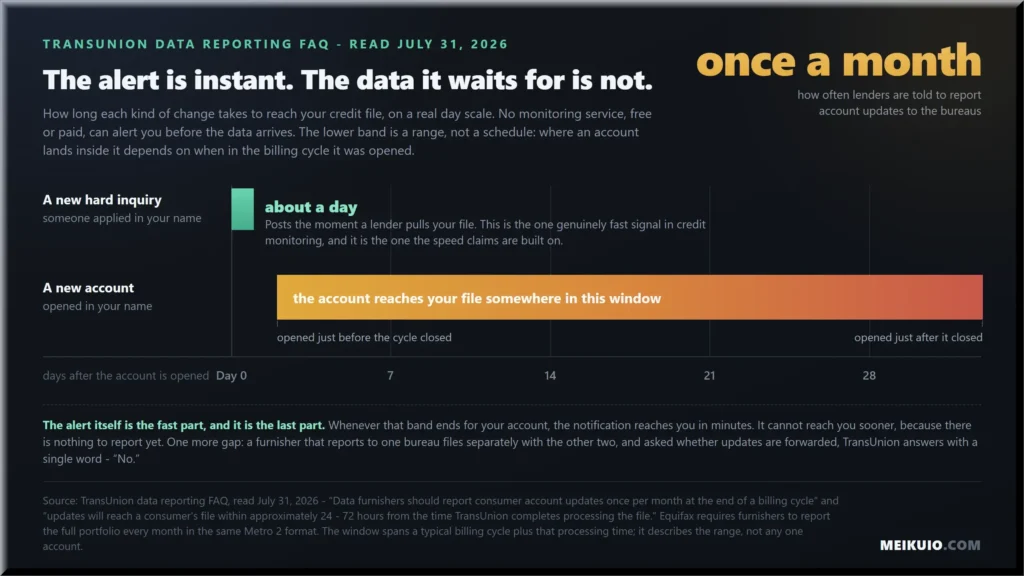
Alert speed is the loudest claim in this market, so I went to the one place that publishes the real number: the instructions bureaus give the banks that feed them. TransUnion’s data reporting FAQ tells lenders, word for word, “Data furnishers should report consumer account updates once per month at the end of a billing cycle.” Equifax requires furnishers to report their full portfolio every month in the same industry format, Metro 2, the standard file layout every furnisher uses. Once a file arrives, TransUnion tells furnishers the update reaches the consumer’s file “within approximately 24 – 72 hours” of processing.
Now the math on a fraudulent account. The thief opens a card on day one. The lender reports it at the end of its billing cycle, up to a month later. The bureau processes it within about three days. Only then does any monitoring service, free or $40 a month, have anything to alert you about. The alert itself can be instant. The data it waits for is monthly.
The alert is real time. The data underneath it is monthly.
Hard inquiries are the exception, and the vendors know it. An inquiry posts when a lender pulls your file, so inquiry alerts genuinely can land within a day or so, and Equifax markets “near-real time” specifically on inquiry alerts. Aura’s pricing page promises “the fastest, near real-time alerts of inquiries into your credit files.” Read the wording: the speed claim covers inquiry alerts, the one data type that already moves fast for everyone. And the “fastest” part carries a footnote naming a 2025 mystery shopper study by ath Power Consulting, followed by this sentence: “ath Power Consulting was compensated by Aura to conduct this study.” A review site’s stopwatch test claiming four-minute alerts is timing the notification layer. The account data underneath still moves once a month. One more structural gap: a furnisher that reports to one bureau must file separately with the other two. TransUnion’s FAQ answers the forwarding question with one word: “No.” Bureaus do not sync. That is why one file can show a fraud the other two have not heard of, and why single-bureau monitoring is a keyhole.
Credit lock vs credit freeze: what you give up for convenience
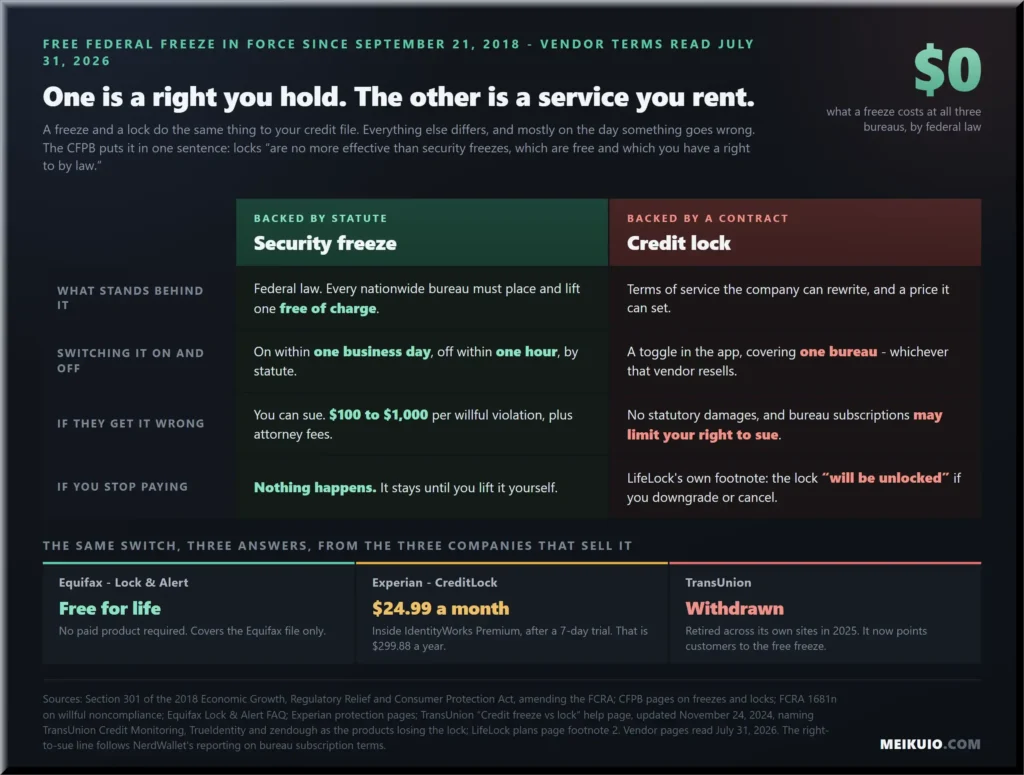
A security freeze is a federal right. Since September 21, 2018, every nationwide bureau must place and lift one free of charge, on statutory deadlines: placed within one business day of a phone or online request, lifted within one hour of an online request. Miss those deadlines and the Fair Credit Reporting Act gives you a private right of action, with statutory damages of $100 to $1,000 per willful violation. The CFPB’s published position on the paid alternative is one sentence long: credit locks “are no more effective than security freezes, which are free and which you have a right to by law.”
A credit lock is a contract. Its terms live in a terms-of-service document the company can rewrite, and what it gives you is an app toggle instead of a statute. The difference stopped being theoretical in 2025, when TransUnion retired its own consumer lock. Its help page names the products that lost it, TransUnion Credit Monitoring, TrueIdentity, and zendough, and walks remaining holders through replacing the lock with a freeze. The bureau that built the toggle now steers its own customers to the statutory tool, while it keeps supplying the lock wholesale to subscription products like LifeLock’s. And LifeLock’s footnote adds the subscription clause: the lock “will be unlocked if your subscription is downgraded or canceled.” Stop paying, and the switch flips itself. A freeze stays until you lift it, for free, forever.
Same switch, three answers: free, $299.88 a year, and discontinued. One more line worth carrying with you, from NerdWallet’s coverage of bureau subscriptions: bureau-sold monitoring products “may limit your right to sue them, even if they are the ones that exposed your financial data.” Arbitration clauses ride along with the app. The freeze carries none, because you never signed terms to get your rights.
The score you see is not the score a lender pulls
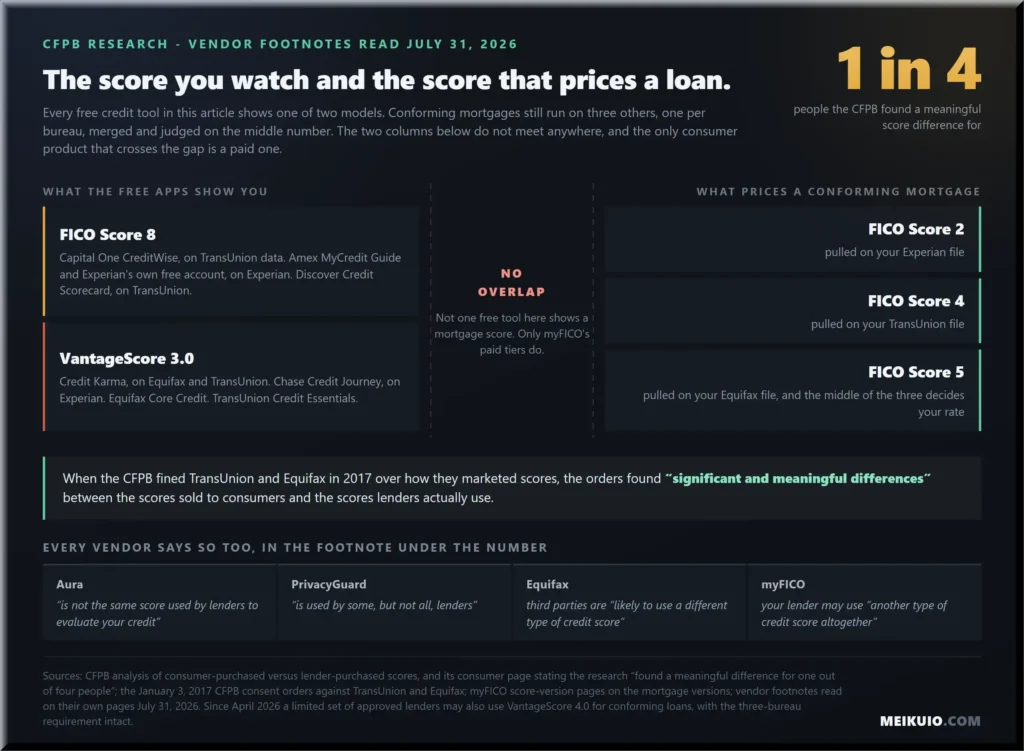
Mortgage underwriting still runs on FICO Scores 2, 4, and 5, one per bureau, merged into a tri-merge report, with the middle score deciding your rate. The rules are moving, slowly. In July 2025 the Federal Housing Finance Agency announced Fannie Mae and Freddie Mac would accept VantageScore 4.0 and keep the three-bureau requirement, scrapping an earlier two-bureau plan, and since April 2026 a limited set of approved lenders can actually use it. FICO 10T is validated and waiting. None of that helps you today. The free tools show you FICO Score 8 or VantageScore 3.0, and not one consumer product in this article shows FICO 2, 4, or 5 outside myFICO’s paid tiers. Auto and card lenders choose their own bureau and score model and do not publish the choice, which is one more reason three-bureau coverage beats obsessing over any single number. The score you track for months and the score that prices your loan are different numbers from different models, sometimes computed from different bureaus.
How big is the gap? The CFPB, in plain terms: for most people the educational score, the kind the apps show, is close, but its research “found a meaningful difference for one out of four people.” When it fined TransUnion and Equifax in 2017 over score marketing, the orders described “significant and meaningful differences” between the scores sold to consumers and the scores lenders used. The vendors themselves concede the point in their footnotes. Aura: the score “is not the same score used by lenders to evaluate your credit.” PrivacyGuard: its VantageScore “is used by some, but not all, lenders.” Equifax: third parties “are likely to use a different type of credit score.” Even myFICO, which sells the real thing, warns your lender may use “another type of credit score altogether.” Every vendor knows. The footnote is where they say it.
If a mortgage is next?
Skip the general-purpose apps for this one job. The scores that price most mortgages are FICO 2, 4, and 5, and the only consumer product here that shows them is myFICO’s paid tier. Check those numbers two or three months before you apply, fix what they show, then cancel.
What credit monitoring cannot see at all
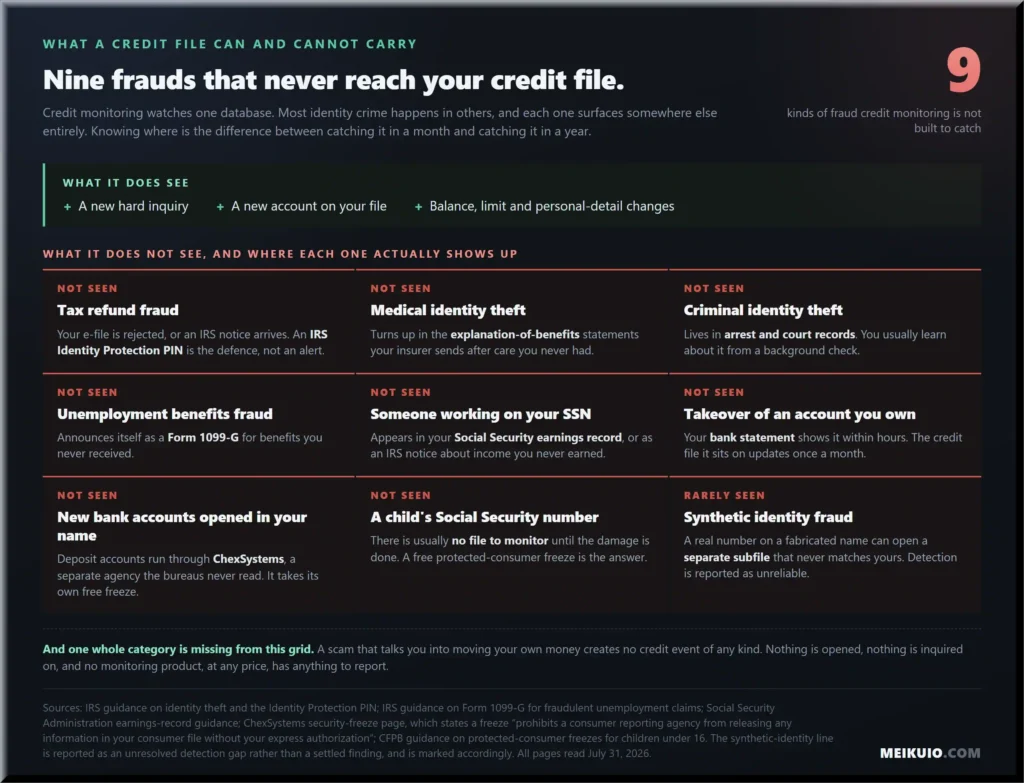
Credit monitoring watches credit files. A long list of expensive problems never touches one. Tax refund fraud surfaces at the IRS, as a rejected e-file, and the defense is an IRS Identity Protection PIN, not an alert. Medical identity theft shows up in your insurer’s explanation-of-benefits statements. Criminal identity theft lives in court records. Unemployment fraud announces itself as a 1099-G for benefits you never saw. Someone working under your Social Security number appears in your SSA earnings record. A takeover of an account you already own is your bank’s fraud system’s job; the fraudulent charges hit your statement within hours, while the credit file monitoring watches updates once a month. And scams that talk you into moving money yourself, the kind we covered in the AI voice scam and deepfake guides, never generate a credit event at all.
Two blind spots deserve their own line. New bank accounts run through ChexSystems, a separate reporting agency the credit bureaus never see. It takes its own freeze, and ChexSystems describes that freeze in the same statutory language as the big three: it “prohibits a consumer reporting agency from releasing any information in your consumer file without your express authorization.” And a child’s clean SSN can be misused for years before any file exists to monitor; the free protected-consumer freeze for kids under 16 is covered in our guide to what the law already protects. Monitoring is a window onto one database. Most identity crime happens in other databases.
What “free” actually costs
Free monitoring is an advertising business, and the vendors say so in writing. Credit Karma’s disclosure: “It is this compensation that enables Credit Karma to provide you with services like free access to your credit scores.” The compensation is referral fees when you take a card or loan the app recommends, recommendations computed from the credit file you handed it. CreditWise and Credit Journey work the same way for Capital One and Chase, surfacing their own offers beside your score.
The bureaus have joined the model. TransUnion’s free Credit Essentials FAQ describes “access to a network of third-party financial offers, such as credit card, based on a consumer’s credit profile.” That sentence is Credit Karma’s business model, written by a credit bureau about its own free product. Amex is the same shape: MyCredit Guide enrollees “may receive prequalified offers” for American Express products. Experian’s free account feeds its $24.99 subscription funnel. Every free tool in the table is one of two machines, an offer engine or an upsell ramp, and several are both.
You pay with targeting. For a score check, that trade is usually fine. Just know you are the inventory, not the customer, and that the data you handed over to watch your credit is the same data deciding which loans chase you.
Who should pay for credit monitoring, and who should not
Three situations, three different answers. If a mortgage is coming, pay myFICO for two or three months, read the mortgage scores, cancel. That is the one clean case for a subscription. If a breach letter arrived, and after the past two years of breaches it probably did, freeze all three bureaus first, then stack the free tools; the freeze blocks what monitoring can only report, and our full breakdown of whether paid protection is worth it runs the numbers on everything past that. If identity theft is already happening to you, monitoring is the wrong shelf entirely; you need the restoration services and insurance the identity suites sell, which is a different purchase we scored separately in the LifeLock review.
If a breach letter just arrived?
Freeze first, read the letter second. A freeze at all three bureaus blocks the new-account fraud the breach made possible, and it is free by federal law. The monitoring the company offers you as an apology is real but temporary, and its bureau coverage varies by settlement, so check that line before you rely on it. Take it, it costs nothing, but do not let it substitute for the freeze. And if the letter traces back to the 2017 Equifax breach, its settlement still entitles every affected consumer to free identity restoration help through January 11, 2029, no claim form needed.
Everyone else is the everyone-else case. The free stack watches all three bureaus for nothing (and for checking exposed credentials from public breaches, free services like Have I Been Pwned alternatives cover the data dump side). The paid products add speed the data cycle cannot deliver, locks that cover one file, and insurance that mostly reimburses out-of-pocket expenses rather than stolen money. And when an alert does fire, the follow-up is free too: IdentityTheft.gov generates the dispute letters and a recovery plan at no charge. Read the footnotes before the feature grid. The footnotes are where this industry keeps its facts.
Who is ranking these services for you?
One last thing I checked: the shelf itself. Of the pages ranking for this search, not one is disinterested. Money.com’s rankings run under the disclosure “We research all brands listed and may earn a fee from our partners. Research and financial considerations may influence how brands are displayed.” Two of the ranking sites, SafeHome.org and Security.org, belong to the same owner, Centerfield Media, and both crown LifeLock. The sellers rank on the shelf themselves: LifeLock’s own credit monitoring explainer sat in the results we pulled for this exact query, and Experian’s product page owns the free-credit-monitoring variant. The Federal Trade Commission and the CFPB, the two sources with no product to sell, appeared nowhere in the results we saw. This page makes its own no-affiliate claim, and you have only my word for that; the defense I can offer is that every quote here is named and dated, so you can check me.
Every page ranking for this search either earns a commission on the answer or sells the product itself.
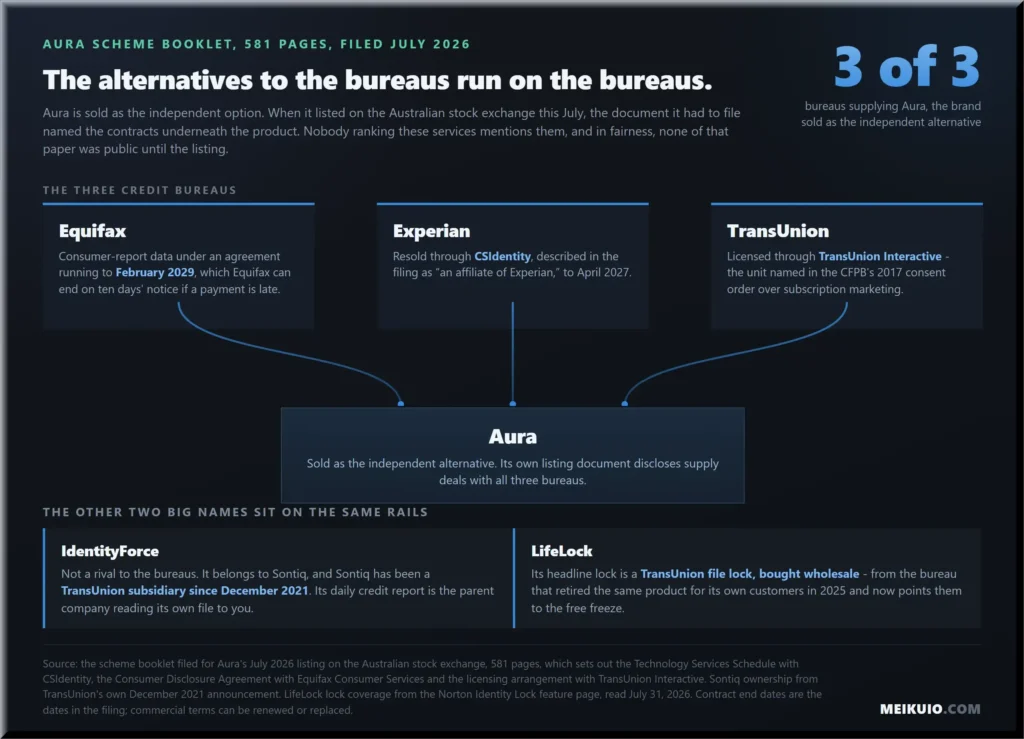
And the products being ranked are less separate from the bureaus than the shelf suggests. IdentityForce is TransUnion’s subsidiary. Aura went public in July 2026, and the 581-page listing document it filed discloses the rails: a reseller agreement with CSIdentity, “an affiliate of Experian,” through April 2027; a data agreement with Equifax through February 2029 that Equifax can terminate on ten days’ notice if a payment is late; a licensing agreement with TransUnion Interactive, the same TransUnion unit named in the CFPB’s 2017 consent order over subscription marketing. The alternatives to the bureaus are, on paper, distribution channels for the bureaus. Nobody ranking them mentions it, and in fairness, none of that paper was public until the listing.
Frequently asked questions
What is the best credit monitoring service in 2026?
For a mortgage, myFICO Premier, because it shows the FICO 2, 4, and 5 scores lenders pull. For free monitoring, Capital One CreditWise, a real FICO Score 8 with alerts on two bureaus. For three-bureau coverage without paying, stack CreditWise, Credit Karma, and Equifax Core Credit. No single product wins all three jobs.
Is it worth paying for credit monitoring?
Usually no, unless a mortgage is close or you need the restoration help bundled with identity suites. The free stack covers all three bureaus, and a free security freeze blocks what monitoring only reports. We ran the full worth-it math, including the insurance fine print, in a separate guide.
What is the difference between a credit freeze and credit monitoring?
A freeze blocks new-credit access to your file before anything happens, free, at all three bureaus, backed by federal deadlines. Monitoring alerts you after a change has already been recorded. One is a lock on the door, the other is a camera pointed at it. They stack; the freeze comes first.
Is Credit Karma really free and accurate?
Free, yes, paid for by referral fees on the offers it shows you, as its own disclosure states. Accurate, within its lane: real VantageScore 3.0 numbers from Equifax and TransUnion. But lenders mostly pull FICO models, so treat its number as a trend line, not the figure underwriting will see.
Does checking your credit score through a monitoring app hurt your credit?
No. Checking your own score is a soft inquiry, and soft inquiries never move a score, no matter how often you look. The pulls that can cost points are hard inquiries, the kind a lender makes when you apply for credit. Those are the ones monitoring alerts you about.
Which credit monitoring service covers all three bureaus?
Paid: Experian IdentityWorks Premium, IdentityForce UltraSecure+Credit, and myFICO’s Advanced tier and up all monitor three bureaus, with the activation lags covered above and one caveat: myFICO Advanced refreshes reports only quarterly. Free: no single tool does; the CreditWise plus Credit Karma plus Equifax Core Credit stack reaches all three at zero cost.
How fast are credit monitoring alerts?
Inquiry alerts can arrive within about a day, because inquiries post when a lender pulls your file. New-account alerts wait on the lender’s reporting cycle, which the bureaus themselves describe as once a month, plus 24 to 72 hours of processing. The push notification is instant. The data rarely is.
Do I still need credit monitoring if my credit is frozen?
Less than the vendors suggest. With all three bureaus frozen, new-credit pulls are blocked, which removes most of what paid monitoring exists to catch. What is left, file errors and the slow monthly updates on accounts you already hold, the free tools cover. Freeze plus free stack is the strongest combination on this page, and it costs nothing. Keep the free alerts as a tripwire behind the freeze.
Does a credit freeze hurt your credit score?
No. TransUnion’s own freeze page says you can place one “with no impact to your credit score,” and the same holds at Equifax and Experian. A freeze does not block your own score checks or the companies you already have accounts with. It blocks new creditors from pulling your file, which is exactly the pull a thief’s application needs.
How do I get free credit monitoring after a data breach?
The breach notice usually includes an enrollment code for one or two years of monitoring, paid for by the breached company. Take it, but read which bureaus it covers, because settlement offers are often narrower than they sound. Then place the free freezes anyway. The 2017 Equifax settlement also gives every affected consumer free identity restoration help through January 11, 2029, with no claim form.
My Take
The paid tier of this industry sells three promises: speed the monthly reporting cycle cannot deliver, a lock that covers one bureau out of three, and independence that dissolves in the vendors’ own filings. I read every footnote so you do not have to, and the footnotes agree with each other: the alert layer is real, and it is thinner than the price says.
If it were my money: freeze all three bureaus tonight, stack the free tools tomorrow, and let myFICO have $40 for exactly the months a mortgage application is on the table. Past that, the subscription is paying for a camera pointed at a door you could have locked for free.