
The best wifi router for most homes in 2026 is still whichever one covers the house at a price you accept. Nothing on the shelf became illegal this year. What changed on March 23 is narrower and stranger: the FCC stopped granting authorization to new foreign-produced routers unless the maker holds a specific exemption. Most of the brands topping the buying guides do not hold one, and those guides do not mention it.
- What changed for router buyers on March 23, 2026
- Is my current router now illegal?
- Will it still get security updates?
- How to check any router yourself in two minutes
- What I found when I ran the top picks through the FCC database
- Who has been approved so far, and what the list gives away
- What “produced in a foreign country” actually means
- What the security advisories actually say
- What actually puts a home Wi-Fi router at risk
- So which Wi-Fi router should you actually buy right now
- What I would watch next
- Frequently Asked Questions
- What is the best wifi router to buy in 2026?
- Is my TP-Link router banned?
- Can stores still sell TP-Link and Asus routers?
- Will my router stop getting security updates?
- Is this a ban on Chinese routers?
- How do I check whether a specific router is affected?
- Does this apply to the router my internet provider rents me?
- What happens when a conditional approval expires?
- Does this affect my phone’s hotspot?
- Are mesh systems and Wi-Fi extenders covered too?
- My Take
I have not tested these routers. I checked their paperwork. Every model recommended on the first page of Google went through the FCC’s own authorization database, and the results are not what the rankings suggest.
Key facts, checked August 1, 2026
What changed for router buyers on March 23, 2026
The FCC’s Covered List now carries one line about routers, and it reads: “Routers produced in a foreign country, except routers which have been granted a Conditional Approval by DoW or DHS.” That line went on the list on March 23, 2026, in a public notice numbered DA 26-278, three days after a White House convened interagency body sent the Commission its determination.
The Covered List is not a shopping ban. It is a gate on paperwork. Equipment on the list cannot receive an FCC equipment authorization, and in the Commission’s words, “Most electronic devices require FCC equipment authorization prior to importation, marketing, or sale in the U.S.” So a model that has not been authorized cannot legally be imported or sold here. A model that was authorized before the gate closed is untouched. We followed the same gate into cellular trail cameras, where the FCC ID printed in a manual points to the company behind the cellular module.
The FCC says this plainly: “Being added to the Covered List today does not prohibit the import, sale, or use of any existing device models the FCC previously authorized.” So the rule splits into two halves that get confused constantly. One half governs the future catalogue. The other governs your living room, and it leaves it alone.
Routers are not the first thing in your house to land on this list. The FCC did the same to foreign-made drones, and anyone shopping for a beginner drone after that ran into the same split: existing models still for sale, new arrivals stuck at the gate.
More Read

The Commission also makes clear it did not decide this on its own. Under the Secure and Trusted Communications Networks Act of 2019, it can only update the list when a national security authority directs it to, and it says so directly: it “cannot update this list on its own and is required to implement determinations that are made by our national security agency experts.” The stated risks are a supply chain vulnerability that could disrupt the economy and critical infrastructure, and a cybersecurity risk that could be used to disrupt that infrastructure and harm people directly.
Is my current router now illegal?
No. The FCC answers this one in a single word. Its router FAQ asks, “Are there any restrictions on consumers’ ability to use covered routers?” and the answer printed underneath is “No.”
The same page goes further for anyone still nervous. “Consumers currently using covered routers in small and home offices do not need to do anything” (setting up a modern workspace with a solid standing desk and your existing router remains completely unaffected). And on buying: “Consumers will continue to be able to purchase previously authorized routers.” There is no amnesty deadline, no registration, no trade-in window. Nothing in the notice sets a date after which a previously authorized model stops being legal to sell, and I looked for one.
The confusion is understandable, because the press covered this as a ban and a ban sounds like something that reaches into your house. This one does not. It reaches into the certification queue.
Will it still get security updates?
Yes, and there is a date attached that you should know. It is also the part the guides get least right, including the single one among them that raises the rule.
Putting a device class on the Covered List would normally block even routine firmware updates, because those updates are permissive changes under 47 CFR 2.932(b) and 2.1043(b). So on the same day the routers line was added, the FCC’s Office of Engineering and Technology issued a waiver, DA 26-286, saying that “All routers authorized for use in the United States may continue to receive software and firmware updates that mitigate harm to U.S. consumers at least until March 1, 2027.” It spells out what that covers: updates “such as those that patch vulnerabilities and facilitate compatibility with different operating systems.”
Then on May 8 the FCC extended it. Notice DA 26-454 pushes the same protection to “at least January 1, 2029” and widens it to Class II permissive changes as well. So the honest answer has three parts. Updates are protected right now. They are protected through at least January 1, 2029. What happens after that depends on whether the waiver gets extended a second time, and it has already been extended once.
CNET, the one guide among the six I could read that mentions any of this, tells readers there is “a risk that they won’t be able to receive software and firmware updates after Jan. 1, 2029.” That date is real and it comes from the waiver. What the note leaves out is the first half: the same document is the reason your Wi-Fi router is getting patched today.
Two limits on that, and both matter more than the date itself. The waiver removes a legal barrier, it does not oblige anyone to write code, so a model the manufacturer has already retired stays retired no matter what the FCC permits. And if the waiver is not extended a third time, the block it lifted simply returns: firmware updates count as permissive changes, and covered equipment cannot receive those without a waiver. So the plain answer to what happens in January 2029 is that it depends on a decision nobody has made yet.
How to check any router yourself in two minutes
There is no published list of banned Wi-Fi routers. I want to be exact about this, because it changes what a shopper can do. The FCC was asked whether such a list exists and answered: “No. The addition to the Covered List reflects the National Security Determination received by the Commission… The National Security Determination, and the Covered List addition, do not specify routers by make or model.”
What the FCC points to instead is the label on the box. Its own wording: foreign-produced routers “that have previously received FCC authorization (as shown by the FCC ID on the device) may continue to be imported, sold, and used in the U.S.” That makes the FCC ID the one thing a buyer can actually verify, and the database behind it is free and public. We used the same database to check which of the best-selling radios on Amazon are really license-free, in our walkie-talkie guide.
- Find the FCC ID. It is printed on the underside of the router and on the retail box, and it looks like 2BH7FBE550V2. It splits into two parts: a grantee code identifying the company, then a product code. In that example the grantee code is 2BH7F and the product code is BE550V2, which is how the database accepted it when I ran the search.
- Open the FCC Equipment Authorization Search at apps.fcc.gov. Searching by applicant name works too, and it is easier if you do not have the box in front of you.
- Enter the grantee code and product code in their two fields, or type the brand into Applicant Name and set a date range. Set the records-per-page box to 100, because it defaults to 10 and quietly hides the rest.
- Read the Date of Grant. That is the day the model became authorized to be marketed and imported. A grant dated before March 23, 2026 means the model belongs to the previously authorized group that stays legal to sell.
- Open the grant itself for the Notes field. That is where the FCC prints what the thing actually is, in plain words like “BE9300 Tri-Band Wi-Fi 7 Router” or “Tapo Doorbell Pro.”
Two warnings about the method, because I ran into both. A single device gets a separate row for every frequency band it uses, so a result of 93 rows collapsed to 22 actual products once I removed the duplicates. Count rows and you will overstate everything by roughly four to one. And the product code is not the marketing name: searching the product code ARCHER returns nothing at all, because TP-Link does not encode its model names that way.
The database also will not tell you where a unit was assembled, whether the firmware is still supported, or whether a model sits on the Covered List. Covered status lives on a separate page and grants are not annotated with it. What it gives you is a date, and right now the date is the thing that matters.
What I found when I ran the top picks through the FCC database
I searched the FCC’s authorization database for TP-Link, covering March 23 through August 1, 2026. It returned 93 records, which resolve to 22 separate products. Every one of them cleared. The company’s certification pipeline is not frozen.
None of the 22 is a consumer Wi-Fi router. They are Omada access points from the business line, network switches, USB adapters, a range extender, a bridge, and Tapo cameras. One entry looked like it might be a Deco mesh unit, so I opened the grant. FCC ID 2BH7FD260, granted May 8, 2026, and the Notes field says “Tapo Doorbell Pro.” A video doorbell. The smart home gadgets keep clearing without trouble, because none of them meet the definition of a Wi-Fi router.
Then I ran the same search on the 81 days before the rule, January 1 through March 22. That window returned 122 records, and the consumer Wi-Fi routers are right there: Archer AX56, the WR series, and several bare BE codes from the Deco mesh line. The pattern changes exactly where the rule does.
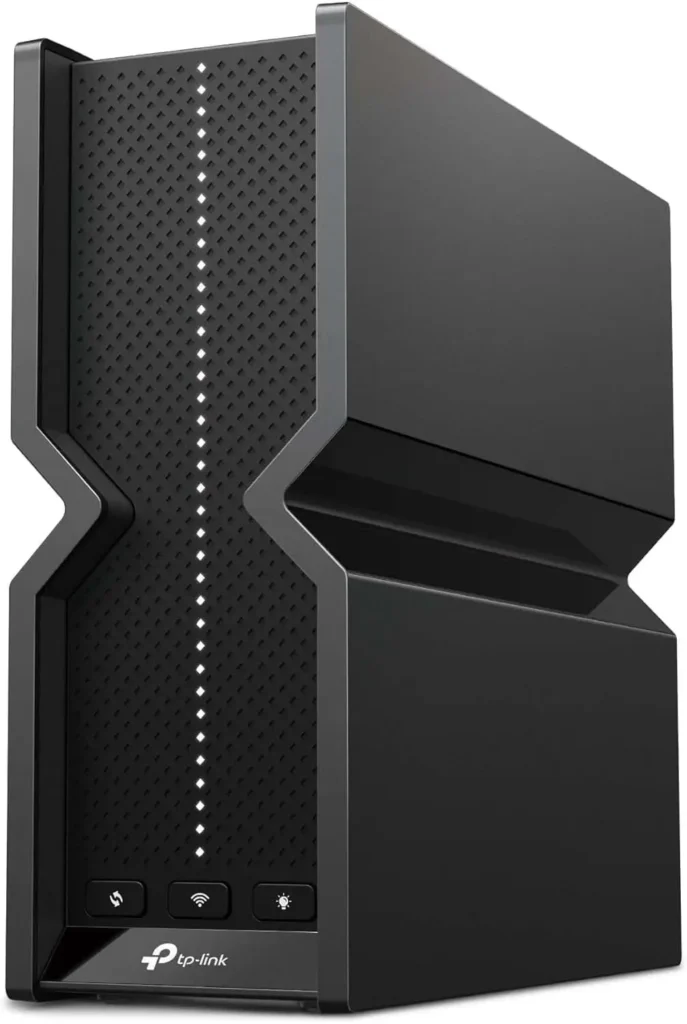
The last one is worth its own line. FCC ID 2BH7FBE550V2, application dated March 4, granted March 20, 2026. The Notes field reads “BE9300 Tri-Band Wi-Fi 7 Router.” TP-Link’s own product page is titled “Archer BE550 | BE9300 Tri-Band Wi-Fi 7 Router,” so the grant and the marketing name line up exactly. That is the Archer BE550. It cleared the FCC three days before the category closed behind it.
March 20 is also the date on the determination the FCC received. I am not suggesting anyone knew anything. The application went in on March 4 and the timing is what it is.
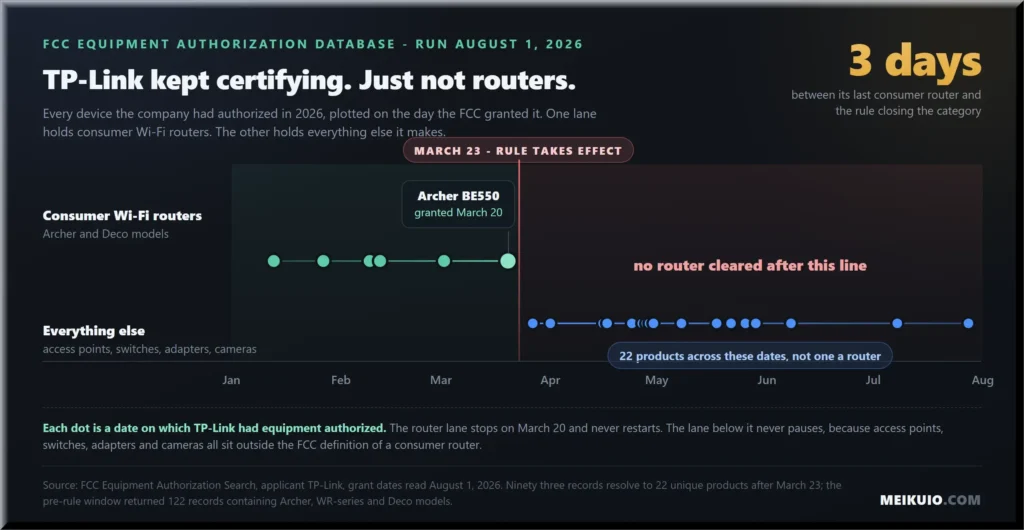
The last consumer router TP-Link cleared was granted three days before the gate closed.
One more detail from the same records. Three TP-Link entities file with the FCC: TP-Link Systems Inc. in Irvine, California, TP-Link Corporation Limited in Hong Kong, and TP-LINK CORPORATION PTE. LTD. in Singapore, each with its own grantee code. In this window the American entity filed all the new equipment. The Hong Kong and Singapore entities filed only permissive changes to gear that was already authorized.
The control test: brands with an exemption, and brands without one
A pattern in one company’s filings proves very little on its own, so I ran the identical query on three more brands.
Netgear’s approval took effect on April 14. Two days later it cleared a new consumer Orbi unit. eero’s approval took effect on April 22, and on July 13 it cleared a device the FCC grant describes in two words: “Wireless Router.” Meanwhile the two brands without an exemption cleared 36 products between them and not one was a Wi-Fi router for your house.

Same date range and one query per applicant. Non-router products: access points, switches, adapters, cameras and laptop modules. Netgear Orbi cleared two days after approval; eero Wireless Router granted July 13. Linksys excluded because its last filing predates the rule by seven months.
I checked Linksys as well and left it out of the table on purpose. It shows zero filings after March 23, which looks damning until you look further back: its last record is dated August 5, 2025, seven months before the rule existed. Whatever stopped Linksys filing, it was not this.
An absent filing is not proof of intent, either. Companies can be waiting on applications, and reporting says TP-Link has one pending. What the database shows is what got authorized and when. That is all I am claiming, and it is enough.
Who has been approved so far, and what the list gives away
The exemptions are called Conditional Approvals, granted by the Department of War or Homeland Security, and the FCC publishes them on the Covered List page. When CNET wrote its note on May 13, there were two: Netgear and eero. When I checked the page on August 1 it carried entries for 17 companies, last updated July 27.
Read the names and the shape of this becomes obvious. Netgear, eero and Gryphon are the mainstream brands you can walk into a store and buy. Two more sit at the edges of retail: Miri makes a travel router, and SpaceX ships Starlink hardware to its own subscribers. The remaining twelve are Adtran, Calix, Nokia, Sagemcom, Alpha Networks, Arcadyan, Hitron, Vantiva, Gemtek, Sercomm, Humax and Askey, and every one of them is a gateway or OEM supplier. Arcadyan’s entry reads like an inventory of the boxes T-Mobile, AT&T and Verizon hand their subscribers.
Three mainstream retail brands out of seventeen. The relief is flowing to the Wi-Fi router your provider gives you, not the one you choose.
Retail: Netgear, eero including Amazon Leo, Gryphon. Edge: Miri and SpaceX. Provider: Adtran, Calix, Nokia, Sagemcom, Alpha Networks, Arcadyan, Hitron, Vantiva, Gemtek, Sercomm, Humax, Askey. Arcadyan supplies T-Mobile, AT&T and Verizon. TP-Link, Asus, Linksys, D-Link and Google absent. Approvals expire October 2027–February 2028; renewal requires manufacturing progress in the US.
Two things stand out reading down the dates. The windows all run roughly 17 to 18 months, and they ratchet forward with the grant date, so April approvals expire in October 2027 while late July ones run into 2028. And the list is still moving. It gained SpaceX on July 27 and it will have changed again by the time you read this, which is why any article quoting a count needs to say when it looked.
Note
I read this list on August 1, 2026. It has gained companies almost every week since March, so treat the count as a snapshot and check the Covered List page before acting on it. The page is public and the Conditional Approvals tab is the one you want.
The application requirements explain why. Annex A of the determination asks for country of origin for every component and for the design, the locations of manufacturing, final assembly and testing, the origin of the onboard software and firmware, and then this: “A detailed, time-bound plan to establish or expand manufacturing in the United States.” Approvals run “for periods of up to 18 months,” and the holder has to report on its onshoring progress to the granting agency once a quarter. A company that already builds infrastructure hardware to carrier contracts can write that plan. A consumer brand competing on price has a harder time.
Not on the list anywhere: TP-Link, Asus, Linksys, D-Link and Google. I checked the full section by text search rather than by eye, and confirmed it against the notice itself.
One thing the expiry dates do not mean. Netgear’s approval runs to October 1, 2027 and eero’s to October 31, 2027, and those are not dates when the products leave shelves. The FCC was asked precisely this and answered that after the end date a device “can no longer receive FCC equipment authorization,” but if it was authorized inside the window, “there are no restrictions on the ability to import, market, or sell the device(s) after that date.” The deadline is on paperwork, not on inventory.
What “produced in a foreign country” actually means
Most coverage of this rule calls it a TP-Link ban or a China ban. The FCC’s own FAQ takes both framings apart.
Production, in the determination’s words, “generally includes any major stage of the process through which the device is made including manufacturing, assembly, design, and development.” So the FAQ asks the obvious follow-up, whether a Wi-Fi router designed in the US but built abroad is covered, and whether one designed abroad but built in the US is covered. The answer printed there is four words: “Both types of routers are ‘covered.'”
And on nationality: “The nationality of the entity or entities producing routers is not relevant to whether such routers are considered to be ‘produced in a foreign country.'” An American company building in Vietnam is in scope. A Chinese company building in Vietnam is in scope on the same terms.
Which matters, because nobody makes these things here. Consumer Reports reported in May that no major consumer Wi-Fi router manufacturer produces domestically, and that even Netgear, an American company, manufactures in Vietnam and Taiwan. Buy American is not an option a shopper can exercise in this category. That is also why every approval comes attached to a plan to build manufacturing that does not exist yet.
The definition of a Wi-Fi router here comes from NIST Internal Report 8425A: “consumer-grade networking devices that are primarily intended for residential use and can be installed by the customer.” The FCC prints a table of what is in and out. In: retail routers you install yourself, mobile hotspot devices for home use, residential 5G home internet gear, and gateways that combine a modem and a router. Out: enterprise and industrial equipment, optical network terminals, phones with hotspot features, and routers installed by a professional or an ISP.
Those last two entries look like they collide, since the box your provider installs is often a combined modem and router. The FCC settles it in a separate answer: yes, “ISP-provided residential gateways that combine modem and router functions in a single device fall within the scope of the determination.” Combine the two functions in one box and it is covered no matter who carried it into the house. A plain router that a technician sets up beside your existing modem is the case that falls outside.
What the security advisories actually say
The determination names the Volt, Flax and Salt Typhoon campaigns, so I went and read the advisory those campaigns are documented in.
CISA advisory AA24-038A describes how the attackers hide their traffic: “The proxy is typically composed of virtual private servers (VPSs) or small office/home office (SOHO) routers. Recently, Volt Typhoon actors used Cisco and NETGEAR end-of-life SOHO routers implanted with KV Botnet malware to support their operations.”
Read the names in that sentence. Cisco and NETGEAR, one American company and one American company that now holds a conditional approval. The devices were end-of-life, meaning past the point where anyone was patching them, and they were implanted with malware, meaning someone broke in. I searched the full advisory for the word backdoor. It does not appear. TP-Link is not mentioned in it either, not once.
None of that makes the supply chain argument wrong. A risk that has not been exploited yet is still a risk, and that is the case the determination is making. But the documented attacks describe old routers nobody was updating, which is a different problem with a different fix. The device most exposed in your home is the one in the hallway running firmware from three years ago.
What actually puts a home Wi-Fi router at risk
Since the advisory points at end-of-life hardware, it is worth saying what that means for the box you already own, because this part is inside your control and the certification argument is not.
End of life is a vendor decision, not a legal one. It is the date the manufacturer stops writing firmware for a model. After it, a vulnerability found in your Wi-Fi router does not get patched, and the device keeps working perfectly while quietly becoming a liability. That is the state the routers in the Volt Typhoon advisory were in. Not exotic. Just old and unattended.
If your router is already past its support date?
The FCC waiver does nothing for you. It removes a legal barrier to shipping updates, but a manufacturer that retired your Wi-Fi router years ago is not going to start writing code again because a regulator allowed it. Check the end-of-support date on the vendor’s page first. If it has passed, replacing the box is a security decision you should make regardless of what any list says, and it is the one decision in this article that actually changes your risk.
Four things to do this week, none of which cost anything:
- Look up your model’s end-of-life or end-of-support date on the manufacturer’s own support page. If that date has passed, replacement is a real security decision, and it has nothing to do with the Covered List.
- Turn on automatic firmware updates if the model offers them. The FCC’s waiver exists precisely so these keep arriving; leaving them switched off wastes it.
- Change the admin password if it is still the one printed on the sticker, and check whether remote management or remote administration is enabled. On most home routers it should be off.
- Note that the advisory describes devices compromised through unpatched flaws and weak credentials, not through anything the factory installed. The fix follows the problem.
This is the unglamorous part of Wi-Fi router security and it is where the actual documented incidents happened. A rule about who may certify future hardware does nothing for a six-year-old Wi-Fi router running firmware from 2021. That one is on you, and it takes an evening.
So which Wi-Fi router should you actually buy right now
Nothing here says stop buying routers. It says the shelf is going to look different in a year, and which side of that you want to be on depends on how you buy.
Start with what the rankings are actually recommending. Here are the top picks from the guides that own this search, with the one column none of them print.
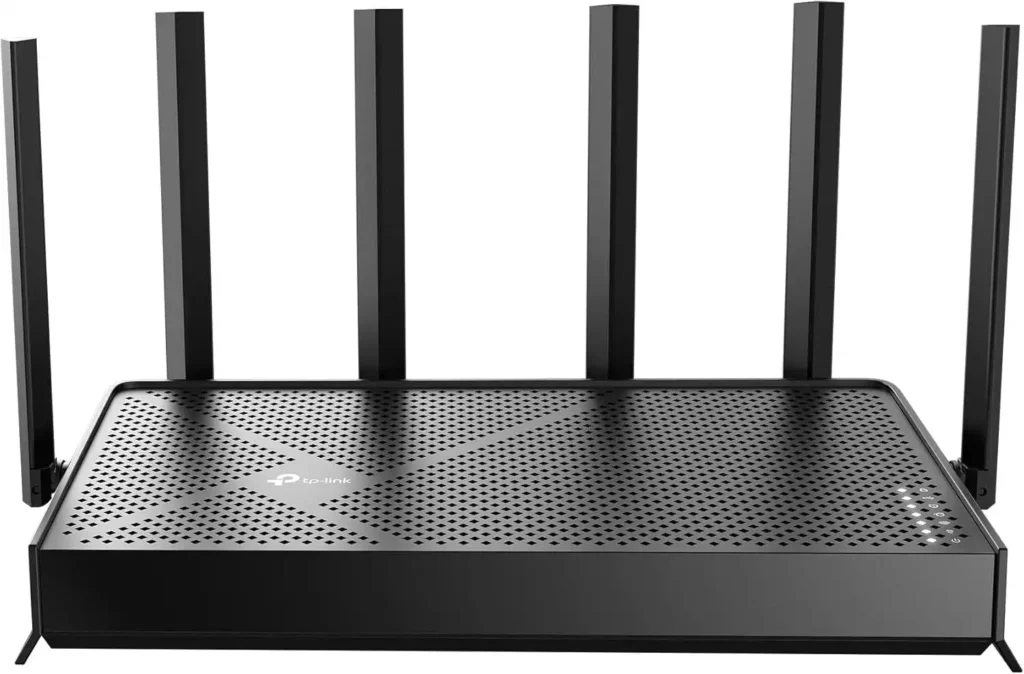
Read that column plainly, because it is easy to over-read. It does not say those routers are unsafe, unavailable or unlawful. Every one of them is legal to buy today and will keep getting patched. It says which brands can still put a new model through the FCC without asking a federal agency first, and that is a question about 2027 and 2028, not about this weekend.
Look where the CNET entry sits. The same page that warns readers about non-exempt brands losing update support gave its 2026 Editors’ Choice to the Archer BE550, a Wi-Fi router whose FCC grant is dated three days before the rule. Both of those things are on the same page, and neither mentions the other.
If you want names rather than a framework, the labs do converge, and I will pass their verdicts on with the caveat that they are theirs. TP-Link owns the value end: the Archer BE550 at CNET, the BE9700 at Tom’s Hardware, the BE900 at RTINGS. Netgear owns the premium end with the Nighthawk RS700S and the Orbi 870 and 970 mesh kits. Asus takes the range slot with the RT-BE96U and the RT-AX86U Pro, and CNET puts the Linksys Velop Pro 6E in the gaming spot. I did not test any of them, so I am not ranking them and I will not pretend otherwise. What I can add is the part they left out: of those brands, only Netgear can currently certify the model that replaces the one you buy.
If you need a Wi-Fi router this week. Buy whatever fits your home and your money. Anything sold in a US store today was authorized before the gate closed, it is legal to buy and legal to use, and it will keep getting security patches under a waiver that currently runs to January 1, 2029. Check the FCC ID if you want the certainty, and it takes two minutes.
If you keep hardware for five or more years. Weight your choice toward a brand holding a conditional approval, which today means Netgear, eero or Gryphon. Not because their current hardware is safer, but because they are the ones who can still put new models and new firmware through the process without asking anyone. Long ownership is a bet on the vendor still being in the room.
If your internet provider offers you their box. That gear is the best-covered category in the whole list. Arcadyan, Calix, Sagemcom, Nokia, Hitron, Adtran and Vantiva all hold approvals, and their hardware is what carriers ship. The tradeoff is the usual one: rental fees and less control.
If you were about to buy a model you saw in a roundup. Look up its FCC ID before you order, especially if the guide has not been updated since March. A grant date before March 23, 2026 tells you the model is in the previously authorized group. It does not tell you the vendor will keep shipping successors.
What I would not do is panic-buy, and Consumer Reports came to the same conclusion. There is no cutoff date on selling authorized stock and no restriction on using it.
What I would watch next
- The approvals page itself. It grew from two companies in May to 17 by late July, and Starlink was added five days before I checked. Anyone writing about this without a date on their claim is writing about May.
- Whether TP-Link or Asus appears on it. Both are absent today and both are heavily recommended today. That gap either closes or gets wider.
- The firmware waiver. It moved once already, from March 1, 2027 to January 1, 2029. Whether it moves again decides how long older hardware keeps getting patched.
- The expiry dates creeping forward. April approvals end in October 2027, late-July approvals in January and February 2028. Renewals require onshoring progress, and that is where these promises get tested.
Everything above was checked on August 1, 2026.
Frequently Asked Questions
What is the best wifi router to buy in 2026?
The best wifi router for most homes is whichever model covers the space at a price you accept, because everything sold in a US store today was authorized before the March 23 rule and stays legal to buy, use and update. If you replace hardware every few years, that is the whole answer. If you keep a Wi-Fi router for five years or longer, lean toward a brand that holds a conditional approval, which today means Netgear, eero or Gryphon, since those are the makers who can still certify new models and successors without a federal sign-off first.
Is my TP-Link router banned?
No. Your router is legal to own, legal to use, and there is nothing you need to do. The FCC’s answer to whether there are restrictions on using covered routers is one word: “No.” What the rule blocks is authorization for new models, which is a question about future products, not the one on your shelf.
Can stores still sell TP-Link and Asus routers?
Yes, if the model was authorized before March 23, 2026, and essentially everything on shelves was. The FCC states that models previously authorized may “continue to be imported, sold, and used in the U.S.” No sell-through deadline has been set.
Will my router stop getting security updates?
Not before January 1, 2029, and possibly not then. A waiver issued the same day as the rule allows covered routers to keep receiving updates that “mitigate harm to U.S. consumers,” and a second notice in May extended that to at least the start of 2029. Whether it runs past that date depends on another extension. Separately, no waiver obliges a manufacturer to keep writing firmware for a model it has already retired.
Is this a ban on Chinese routers?
No, and the FAQ is blunt about it. Nationality of the producer is “not relevant,” and a Wi-Fi router designed in the US but manufactured abroad is covered exactly the same way. Since no major consumer Wi-Fi router is manufactured in the United States, the rule reaches nearly the entire category.
How do I check whether a specific router is affected?
Find the FCC ID on the box or the underside of the unit and look it up in the FCC Equipment Authorization Search. If the Date of Grant is before March 23, 2026, the model was authorized under the old rules. There is no published list of banned models, so this is the only check available to a buyer.
Does this apply to the router my internet provider rents me?
Yes. The FCC addressed this case directly: ISP-provided gateways that combine modem and router functions in one device “fall within the scope of the determination.” Who installed it makes no difference once the two functions share a box. The exception is a standalone router a technician sets up next to your own modem, which sits outside the definition. In practice this is the best-covered corner of the market anyway, since Arcadyan, Calix, Sagemcom, Nokia, Hitron, Adtran and Vantiva all hold approvals and their hardware is what carriers ship.
What happens when a conditional approval expires?
The company can no longer get new models authorized under it. Products authorized during the window stay sellable with no restriction, in the FCC’s own words. Approvals last up to 18 months and renewal depends on showing progress on a US manufacturing plan, with a status report to the granting agency every quarter.
Does this affect my phone’s hotspot?
No. The FCC’s own table puts “mobile phones with hotspot features” outside the definition, so whatever phone you carry is unaffected. Standalone mobile hotspot devices sold for home use are a different matter and do fall inside it.
Are mesh systems and Wi-Fi extenders covered too?
Mesh systems are, since they are consumer networking devices you install yourself. Extenders and USB adapters sit outside the router definition, which is visible in the filings: TP-Link cleared a range extender and two adapters after March 23 while clearing no routers at all.
My Take
The thing that bothers me is not the rule. It is that five of the six buying guides I could read never mention it, while two of those five put a TP-Link model at the top and name the brand more than thirty times each. A reader following that advice is not being lied to. They are being handed a recommendation assembled under conditions that no longer exist, by a page that was updated in June and still describes March. The FCC put the check behind a free public form and told everyone the FCC ID is how you verify a Wi-Fi router. Nobody looked.
If it were my money, I would buy the Wi-Fi router I actually need this week and not think about it again. The one on the shelf is legal, it gets patched until at least 2029, and a rule about certification paperwork is a poor reason to spend more than a home network requires. The one place I would change my mind is if I planned to keep the thing for five years or more, in which case I would look at who holds an approval, because that is a question about who can still ship you a replacement and a firmware update in 2028. And before ordering anything a roundup recommended, I would spend the two minutes on the FCC ID. Not because the router is dangerous. Because it costs two minutes and the people ranking these products did not bother.