

The best walkie talkies for most people in 2026 are the Rocky Talkie Mountain Radio, which needs no license, and, with a $35 FCC license, the Rocky Talkie Expedition Radio. That license line matters more than any mile figure on the box. I checked every pick against its FCC grant or manual, then against what independent testers found.
- Which walkie-talkie should you buy?
- Do you need a license for a walkie-talkie?
- What’s really sold as “FRS” on Amazon
- How we picked and checked these radios
- The best walkie-talkies and two-way radios in 2026
- Rocky Talkie Mountain Radio: best license-free walkie-talkie for the backcountry
- Rocky Talkie Expedition Radio: best GMRS radio
- Retevis RT22: best value for a group
- Midland T71VP3: best for families who want AA backup
- Motorola Talkabout T605 H2O: best for water
- BCA BC Link Mini: best pocket radio for skiers
- Midland GXT67 Pro: GMRS alternative for wet trips
- DeWalt DXFRS800: best for job sites
- How far can a walkie-talkie really reach?
- Do privacy codes make a walkie-talkie private?
- What do the numbers on a walkie-talkie box mean?
- Do “nationwide” walkie-talkies need a plan?
- Do you need a radio at all?
- Which walkie-talkie for your trip
- Backcountry and ski touring
- Families and cruises
- Hunting
- Overland convoys
- A power outage kit
- Kids’ walkie-talkies
- Frequently Asked Questions
- Do I need a license for walkie-talkies?
- How much does a GMRS license cost, and who does it cover?
- What is the difference between FRS and GMRS radios?
- What walkie-talkie has the longest range?
- How far can a walkie-talkie actually reach in the woods?
- Can FRS and GMRS radios talk to each other?
- Is it legal to use a Baofeng radio on GMRS channels?
- Are Midland or Cobra walkie-talkies better?
- Can you bring walkie-talkies on a cruise?
- My Take
Which walkie-talkie should you buy?
Start with one question: will you get a license? The best walkie talkies split along that line before anything else, and the box doesn’t always tell you which side you’re on. If you won’t, buy an FRS radio, the license-free kind sold under the Family Radio Service rules. If you’ll pay $35 for a license in the General Mobile Radio Service, or GMRS, buy a GMRS radio. You get more power, swappable antennas on some models, and repeaters, the hilltop relay stations that carry a signal much farther.
Then match the radio to the trip:
- If you hike, ski or climb and want no paperwork, get the Rocky Talkie Mountain Radio.
- If you’ll get the GMRS license, get the Rocky Talkie Expedition Radio. The Midland GXT67 Pro is the other GMRS handheld that cleared our bar.
- If you need a pack of radios for kids or volunteers at an event, get the Retevis RT22. For family camping, get the Midland T71VP3, which also runs on AA batteries.
- If the radio might end up in a lake, get the Motorola Talkabout T605 H2O. For a jacket pocket on a ski tour, the BCA BC Link Mini. For a job site, the DeWalt DXFRS800.
FRS radios need no license in the US. GMRS radios need a $35 FCC license good for ten years.
Every pick is either FRS or GMRS. Ham radios, which need a license you earn by passing an exam, aren’t on the list, though four of them sit in Amazon’s best-seller list for FRS radios. The range column is what OutdoorGearLab measured with a clear line of sight, meaning the two people could see each other. Trees and ridges cut that number hard, and a car roof cuts it more. If two radios on this list look alike, the License column is the tiebreaker that matters: it decides who may use the radio, how far you can push it and whether a repeater is ever an option.
Do you need a license for a walkie-talkie?
Not for an FRS radio. FCC rules let people operate the Personal Radio Services “without individual licenses” unless a service’s own rules require one, and FRS has no such requirement. GMRS does. Ham radio needs an exam. The box usually names the service, and the FCC grant always does. That’s the whole FRS vs GMRS question for most buyers.
FRS gets 22 channels. The rule caps power at 2.0 watts of effective radiated power on channels 1 to 7 and 15 to 22, and at 0.5 watts on channels 8 to 14. Effective radiated power, or ERP, is the power that leaves the antenna, not what the transmitter produces inside the case. The antenna is fixed by rule too: it “must be a non-removable integral part of the FRS transmitter type.” That’s why a certified FRS radio can’t have a screw-on antenna.
More Read

GMRS is the licensed sibling, and its rule is one sentence: “A valid individual license is required to operate a GMRS station.” You must be 18 to apply. The FCC’s fee table lists $35 for a new GMRS license and $35 to renew, and the license runs ten years from the date of grant. There’s no exam.
The license also covers more people than most buyers expect. The rule defines immediate family as “the licensee’s spouse, children, grandchildren, stepchildren, parents, grandparents, stepparents, brothers, sisters, aunts, uncles, nieces, nephews, and in-laws.” The FCC’s GMRS page adds that “any family member, regardless of age, can operate GMRS stations and units within the licensed system.” Friends aren’t on the list, and a friend under 18 can’t apply for a license of their own. Hand that friend an FRS radio, which talks to your GMRS radios on the shared channels. Sellers stretch the word family all the time; I found the same gap in identity theft protection for families. Here the regulation spells it out.
All 22 FRS channels are “also allotted to the General Mobile Radio Service (GMRS) on a shared basis.” An FRS radio and a GMRS radio on the same channel, set to the same privacy code or to none, hear each other. The GMRS radio still needs its license, even when the only person you’re calling holds an FRS radio, because the license attaches to operating a GMRS station. And since September 30, 2019, nobody may make, import or sell a radio that works under both sets of rules. Every radio that can legally be sold today is one or the other, and the grant says which. These are US rules, too: Rocky Talkie’s Expedition page warns that its GMRS radio is “not legal for use outside the US,” so check local rules before you pack radios for Canada or Europe.
The license buys capability FRS can’t have. GMRS allows mobile, base and repeater stations up to 50 watts of output. A GMRS handheld can talk through a repeater, which listens on one channel and retransmits on another. FRS radios can’t do that at all: handhelds reach repeaters on the 467 MHz main channels, which the rule reserves for talking through a repeater, and FRS has none of them. The license also brings one chore. A GMRS station says its FCC call sign after a transmission or a series of them, and at least once every 15 minutes during long ones.
How to get a GMRS license
A GMRS license costs $35, lasts ten years, needs no exam and covers the licensee’s immediate family. Rocky Talkie’s manual sums it up better than most guides: the license “costs $35.00, does not require a test, and covers your immediate family.” The application runs through the FCC’s own systems, in four steps:
- Register in CORES, the FCC’s registration system, to get an FCC Registration Number, or FRN.
- Log in to the Universal Licensing System, ULS, and start a new license application.
- Choose the radio service code ZA, the General Mobile Radio Service.
- Pay the $35 fee. Your call sign comes with the license grant, and until it arrives the GMRS radio stays on receive.
Step three is where people stall. A Bronco6G forum member posted in December 2023 that they had “Registered my FRN but can’t figure out how to get to callsign / licensing?” Once they found it, the verdict was short: “OF COURSE GMRS would start with Z.” The paperwork is the easy part of this hobby. Every category I cover has its own version of the rules nobody explains before you buy, and for radios it’s this code.
MURS, CB, marine VHF and business radios
MURS, the Multi-Use Radio Service, is another license-free option, and none of the 16 search-result pages we audited mentions it. It has five VHF channels and a 2-watt limit, plus a flat ban: “MURS stations must not be operated as repeater stations or signal boosters.” MURS sits on different frequencies from FRS and GMRS, so a MURS radio can’t talk to either. None of the eight picks is a MURS radio.
CB needs no license either. The rule limits it to 4 watts on AM or FM and 12 watts peak on single sideband, and in practice it’s a vehicle radio. Marine VHF handhelds are for boats: a handheld that belongs to a ship “may be used from shore only adjacent to the waterway (such as on a dock or beach) where the ship is located,” at one watt. On a hiking trail it’s the wrong radio.
Business radios run under Part 90 of the FCC rules, where the business holds the license. Keep Part 90 in mind. It’s printed on the grant of the best-selling “FRS” radio on Amazon.
What’s really sold as “FRS” on Amazon
On October 18, 2026, at 11:20 UTC, I opened Amazon’s best-seller list for “Portable FRS Two-Way Radios” and read all 30 listings. By their titles, 15 are FRS radios, three are GMRS radios, four call themselves ham radios, seven name no radio service at all, and one isn’t a radio. Then we checked the FCC grant behind each one.
The top seller is the one to read slowly. Listings #1, #2 and #10 are pxton PX-888S packs, and they print FCC ID 2AX68PX-888S. I opened that grant. It’s issued under Part 90, the business radio rules, for 400 to 470 MHz at 1.8 watts, and the FCC equipment class reads “Licensed Non-Broadcast Transmitter Held to Face.” The grant adds that the transmitter “must be restricted to work related operations in an Occupational/Controlled RF exposure Environment.” None of the three titles names a radio service.
On October 18, 2026, the top-selling radio in Amazon’s FRS category carried an FCC grant for business radio.
Nothing here says the radio is fake. The grant says what it was certified as: a licensed transmitter for work use. A family that bought it for a camping trip bought equipment certified for someone’s business, from a shelf with “FRS” in its name. Project Farm included a PXTON pack in its “Cheap vs Premium Walkie Talkies!” test, so the radio itself is no secret. The label on the shelf is the problem.
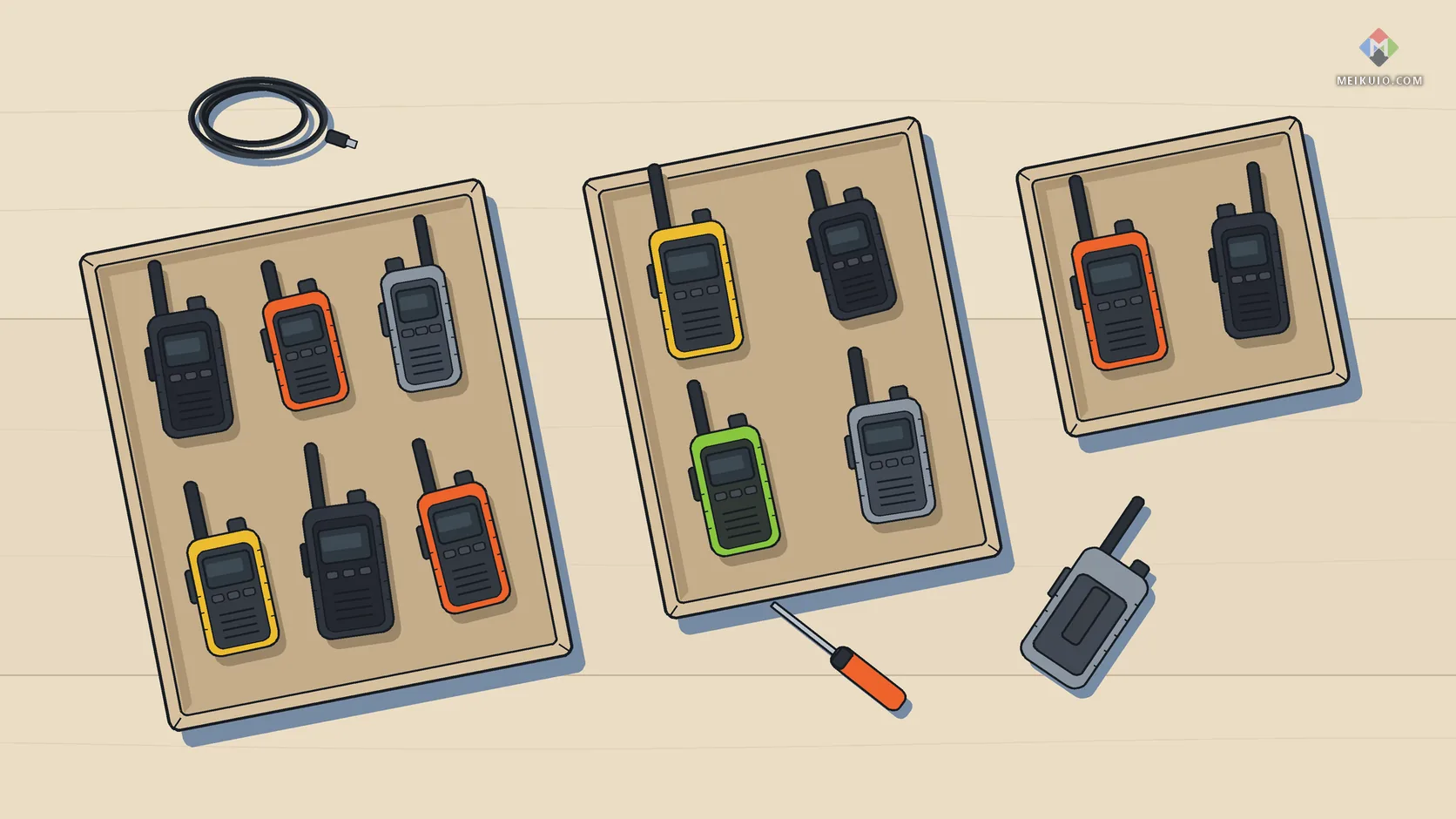
Four listings call themselves ham radios, meaning amateur radio, which needs an exam-based license to transmit. The FCC’s 2018 enforcement advisory on these radios, DA 18-980, draws the line. A radio that works only on amateur bands needs no equipment certification, but “If a two-way VHF/UHF radio is capable of operating outside of the amateur frequency bands, it cannot be imported, advertised, sold, or operated within the United States without an FCC equipment certification.” For three of the four ham listings, the only FCC records we found were receiver grants, which cover a radio’s receiving side and don’t authorize it to transmit.
Three listings are GMRS radios: Midland’s GXT1000VP4 at #4 and two Baofengs, the GM32 at #16 and the UV-5G Plus at #30, both with Part 95E grants. They need the $35 license. Their titles say GMRS. Whether a buyer knows what that word commits them to is another matter.
Sorted by grant, the 30 look like this. In 18 listings the grant matched the service named in the title. Three named no service and turned out to be the pxton business radio. Four were the ham radios. Four had no FCC ID we could tie to the listing. One wasn’t a radio. Treat this count as one day’s snapshot of a list that changes constantly.
You can run the same check on any radio. Find the FCC ID on the label, the box or the listing, look it up in the FCC’s Equipment Authorization Search on fcc.gov, and read the rule part on the grant. The first part of an FCC ID is the grantee code, the company that holds the grant, and it’s often the factory rather than the brand on the box. The rule parts: 95B is FRS, 95E is GMRS, 90 is business radio. For Wi-Fi routers, I walked through how to look up any device’s FCC ID, and radios work the same way.
Soon you won’t have to dig. Under the FCC’s 2026 marketplace rule, online marketplaces will have to show a valid FCC ID at the point of sale. Compliance is due March 1, 2027, for marketplaces with physical access to or title over the products, and June 1, 2027, for the rest. The FCC has reshaped shelves before; its Covered List changed which beginner drones you can buy in the US.
If you already own one of these
Look up the FCC ID before your next trip. If the grant says 95B, it’s an FRS radio and you’re set. If it says 95E, it’s GMRS and you need the $35 license to transmit. If it says Part 90, it was certified as a business radio that an organization licenses for work use, never as FRS, so I’d return it if you still can and buy an FRS radio for the family. If it’s a ham radio, you need an amateur license to transmit with it. If you can’t find an FCC ID anywhere on it, you can’t show what it was certified as, and I’d retire it from the family kit.
In the enforcement cases we found, the FCC went after sellers. It cited Amcrest, selling as Baofengradio.us, in 2018 over Baofeng UV-5R radios. It cited Rugged Radios in 2020 over six models, including a handheld pre-programmed with a Part 95 personal-radio frequency “despite having a certification to operate only in Private Land Mobile Radio Service frequencies,” the FCC’s name for the Part 90 business channels. In 2022 it cited Ride208, which told the FCC it “had sold 1180 units between March 2020 and March 2021.” A citation is a formal warning. The Rugged Radios citation says the company “may be liable for significant fines up to $20,489 per day for each unauthorized model marketed” if it keeps going.
Individuals show up when they get in the way of public safety. In January 2025 the FCC confirmed a $34,000 penalty against a licensed ham operator in Idaho who transmitted on a U.S. Forest Service frequency during 2021 fire suppression and interfered with communications to firefighting aircraft. A 2022 forum post claims the FCC “has, to date, never gone after anyone for simply violating the license requirement.” Our search of FCC enforcement records from 2018 to October 2026 found no action against a recreational user only for using GMRS without a license. That’s the edge of a search, not a promise. The FCC can act on any transmission made without authorization, and the rule requires the license either way.
How we picked and checked these radios
I didn’t buy or field-test any of these radios. I read the documents behind them and the work of people who did test them. To narrow the best walkie talkies to eight, I started from the radios the tested guides agree on, then dropped anything I couldn’t tie to a radio service on paper. Every pick had to clear two bars. The first was at least two independent reviews from OutdoorGearLab, GearJunkie, Paddling Magazine, TruePrepper or Project Farm. Project Farm’s November 2025 video compared radios “for range, clarity, loudness, push-to-talk latency, and durability.” The second was a document: the radio’s FCC grant where I could tie one to the model, or the maker’s manual and product page where I couldn’t.
Range figures are the testers’ own, with their names on them. Power figures come from FCC grants, because the number on the box and the number on the grant often differ. I quote range claims with the maker’s own fine print next to them. Where we matched a grant to a radio by model association rather than an exact model number, the card says so. Two picks, the BC Link Mini and the T71VP3, have thinner paper trails, and their cards say exactly what’s missing. I used the same habit for standing desks: checking a claim against the standard instead of the ad copy.
Picks are FRS or GMRS only. Ham radios need an exam, and they come up with the Amazon shelf. Cellular “nationwide” radios work only where phones work, and they get their own section. Some well-reviewed radios missed the list on the two-review rule alone, including Cobra’s ACXT1035R FLT and BCA’s BC Link 2.0, each recommended by only one of the reviews we used.
The best walkie-talkies and two-way radios in 2026
Eight radios cleared both bars, and they’re the best walkie talkies I can stand behind on paper: six FRS radios that need no license and two GMRS radios that do. Each card names the service the documents show, or says where they run out, what the testers found, and the one thing I’d want to know before paying.
Rocky Talkie Mountain Radio: best license-free walkie-talkie for the backcountry
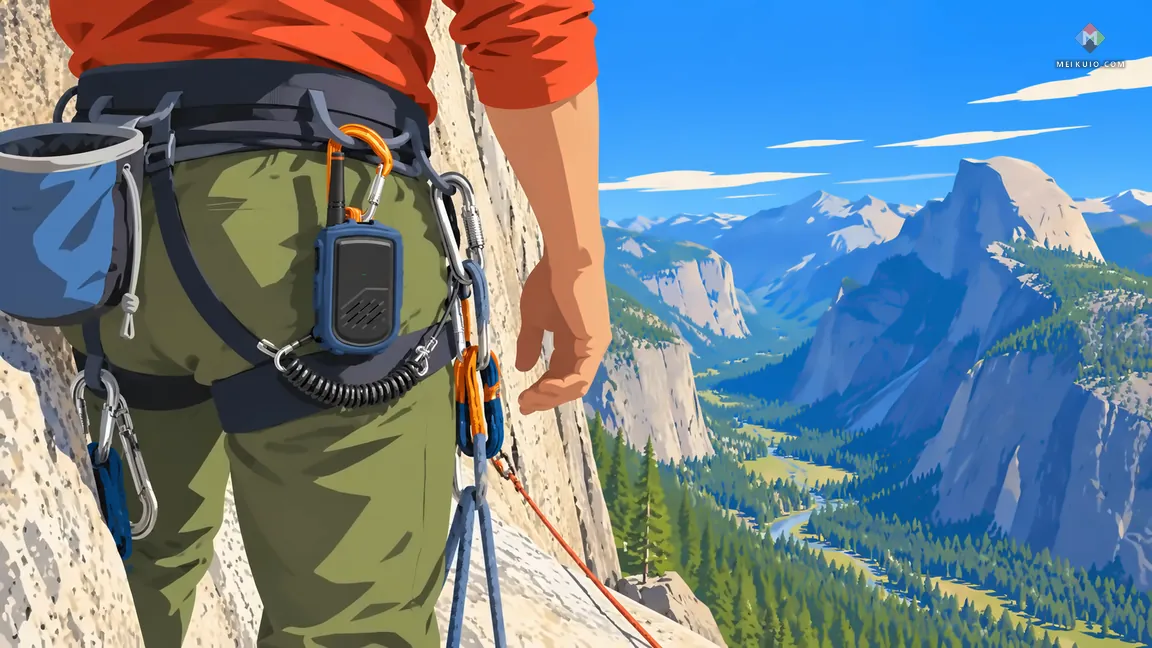
The Mountain Radio’s manual says “Radio Service FRS (no license required),” and its FCC grant agrees: Part 95B, granted December 29, 2022. Rocky Talkie’s page lists “Maximum Power 2 Watts.” The grant lists 1.524 watts ERP on its 462 MHz channels. Both can be true: a transmitter’s output and the ERP that leaves its fixed antenna are different measurements, and the FRS cap is written in ERP.
OutdoorGearLab measured 7.7 miles between two people with a clear line of sight. The box says “Line-of-Sight: 35+ miles.” Rocky Talkie’s own fine print is more useful than its headline: “Mountains: 1 to 5 miles,” “Forest/Hills: 0.5 to 3 miles,” “City: Up to 1 mile.” Plan on the fine print.
It’s built for people who drop things off ledges. The page lists a “shatterproof screen,” a climbing-rated carabiner and a “metal-reinforced back-up leash,” plus a rechargeable 1550 mAh lithium-ion battery and USB-C charging. OutdoorGearLab gave it its award for outdoor adventures, and GearJunkie put it among its award winners too.
The catch is water. It’s rated “IP56 (Splashproof/Snowproof, not submersible).” Snow and rain are fine; a dunk in a creek isn’t. And as an FRS radio it can’t use repeaters or take a longer antenna. You get what’s in the box, forever.
Rocky Talkie Expedition Radio: best GMRS radio

This is the Mountain Radio’s licensed sibling. Older reviews call it the 5 Watt Radio, and Rocky Talkie’s old product link now lands on the Expedition page. Its FCC grant, from June 7, 2023, is Part 95E with the note “GMRS RADIO WITH NOAA,” at up to 4.487 watts ERP. The manual is upfront about the license, which “costs $35.00, does not require a test, and covers your immediate family.”
OutdoorGearLab measured 10.4 miles line of sight, against 7.7 for the Mountain Radio. Rocky Talkie’s fine print says “Mountains: 2 to 8 miles.” The box says “Line-of-Sight: 35+ miles,” the same headline the Mountain Radio carries with about a third of the power. That tells you how much the headline is worth.
On this radio, the license pays for hardware. Rocky Talkie lists it as “GMRS Repeater capable,” with a “7.5cm antenna (pre-installed)” and a “17cm antenna option,” NOAA weather channels with alert monitoring, and “IP67 (1 Meter Submersion).” Rocky Talkie says the 1800 mAh battery “delivers 4–6 days of use on a single charge, even in frigid conditions.” That figure is the maker’s claim. Four outlets name it among their picks: OutdoorGearLab, GearJunkie, TruePrepper and Paddling Magazine, which made it its top pick.
The minus is the paperwork: $35, an FCC account and a call sign you say after transmissions and every 15 minutes on long ones. It still talks to FRS radios on the shared channels, so a mixed group works. If your partner already owns a Mountain Radio, this is the upgrade that stays compatible.
Retevis RT22: best value for a group

Retevis sells the RT22 the way business radios are sold: in packs, preset, ready to hand out. Its page says the radios are “programmed to the same frequency and CTCSS before shipment,” so a pack works out of the box. The FCC grant is Part 95B FRS at 1.08 watts ERP, the lowest of the picks I could document.
Of the picks I chart in the range section, Retevis is the one maker whose range figure survives a tester; the Rocky Talkie and Motorola radios print a 35-mile headline the testers never came near. Its page says “Generally speaking, it will reach to 0.5-2 miles,” and adds that range “will be affected by the environment and terrain.” OutdoorGearLab measured 4 miles line of sight and named it the best value two-pack. Project Farm bought it for its side-by-side test.
The RT22 has 16 channels rather than all 22 FRS channels, a 1000 mAh lithium-ion battery, USB-C charging and VOX, the voice-activated hands-free mode. Its minus is the other side of the value: the lowest power, the shortest measured range of the picks, and no water rating on the Retevis page I read. It’s the radio for kids at a campsite or volunteers at an event, on a dry day.
Midland T71VP3: best for families who want AA backup

Midland calls the T71 the “big brother” of FRS radios with an “extended 38-mile range.” Read Midland’s own Q&A on the same page instead. Battery life “is around 5 hours at 90-5-5 when being used on Hi power,” and 90-5-5 means 90% of the time on standby, 5% transmitting and 5% receiving. Five hours is a short day hike, not a weekend.
The save is in the next line: “Alternatively, you can also use 3 AA alkaline batteries in this radio.” For a family kit or a power outage, a radio that runs on store-bought AAs is worth more than a bigger number on the box. GearJunkie named it its best pick for the money, Project Farm included it in its test, and Midland’s page calls it license-free, which matches FRS.
One gap in the documents: I couldn’t find an FCC ID filed under “T71” among Midland’s grants. The closest family grant belongs to a sibling model, and I won’t print a power figure I can’t tie to this radio. Check the FCC ID on the label when the radios arrive; Midland’s grants sit under its own grantee code, MMA.
Motorola Talkabout T605 H2O: best for water

Motorola makes one promise that matters on a boat: the T605 is “IP67 waterproof,” and the radio “floats with included NiMH battery.” Read the next sentence too: “It may not float with some AA batteries.” If it does go over the side, a “Water-activated flashlight” turns on so you can find it.
Its range claim comes with a footnote that tells the truth: “Mountain to valley – up to 35 miles, open water – up to 6 miles, neighborhood – up to 2 miles.” OutdoorGearLab measured 6.0 miles line of sight and named it the best radio for water sports. Project Farm tested it too.
The FCC grant we matched to the model, issued to Motorola Solutions in November 2020, is Part 95B FRS at 1.5 watts, and it spells out the unit: “Output power listed is ERP.” The radio adds NOAA weather alerts, and the dual pack ships with four 800 mAh NiMH batteries. The minus: the float depends on the battery, and those packs are small. Keep the included NiMH packs in it on the water, and carry the spares.
BCA BC Link Mini: best pocket radio for skiers

Backcountry Access builds avalanche gear, and the BC Link Mini is its small radio for ski tours. OutdoorGearLab gave it its pocket-sized award and measured 6.3 miles line of sight. Paddling Magazine named it its most compact pick. Both treat it as an FRS radio.
The documents have a gap here. The FCC grant I found under BCA’s grantee code for the Mini, dated November 22, 2023, covers only a Part 15 Class B digital device, with the note “FRS Radio.” I found no Part 95B transmitter record under BCA’s code. That doesn’t rule one out, since radios are often certified under the factory’s code rather than the brand’s. It means I can’t show you a power figure, and for everything else I’m leaning on the testers.
Pick it for size, on the testers’ word. If you want the documents lined up first, the Mountain Radio covers the same ski day.
Midland GXT67 Pro: GMRS alternative for wet trips
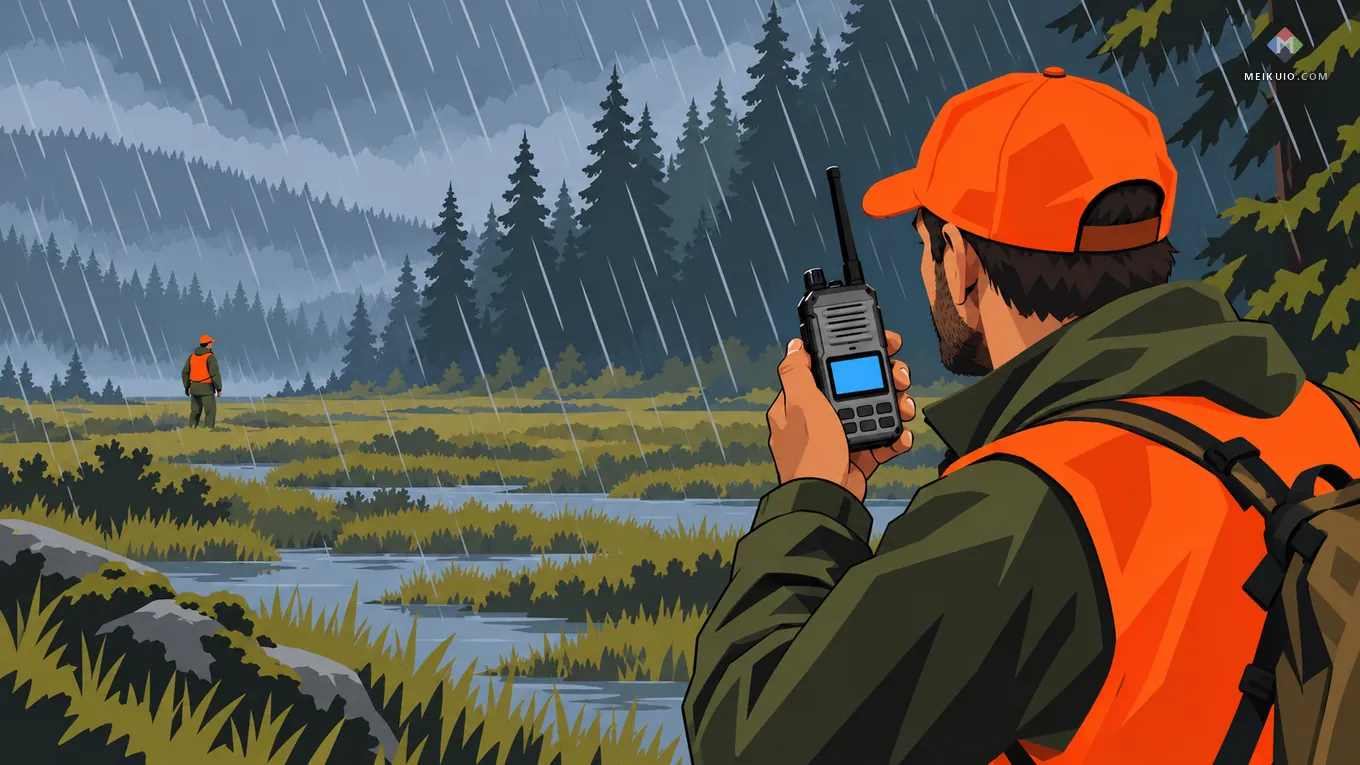
The GXT67 Pro is Midland’s 5-watt GMRS handheld, and its manual says “FCC LICENSE REQUIRED FOR GMRS OPERATION.” The grant for FCC ID MMAGXT67, dated October 30, 2023, is Part 95E at 4.875 to 4.955 watts ERP on the main channels and 0.483 watts on the 467 MHz interstitial channels, under the rule’s 0.5-watt cap for handhelds there.
Midland lists it as “IP67 waterproof and dustproof” and “Repeater Capable,” with “Up to 4 days of battery life.” Paddling Magazine and GearJunkie both reviewed it. Between the two GMRS picks, the Expedition has more tester votes and the only measured range. Pick the GXT67 Pro if it’s the one you can get, or if your group already runs Midland radios.
The minus sits in Midland’s own product FAQ, which asks, “Why is the battery not customer-replaceable?” That’s the trade for a sealed radio. When the battery wears out, you can’t swap in a fresh one yourself.
DeWalt DXFRS800: best for job sites
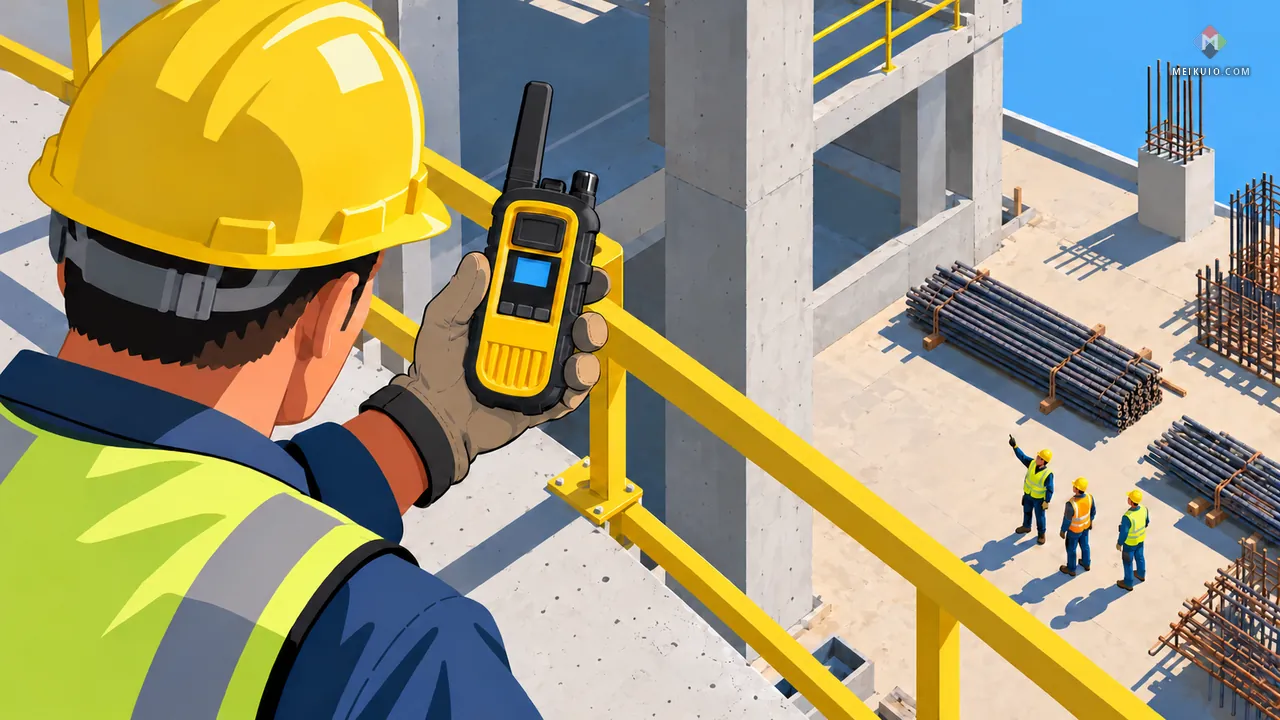
DeWalt’s Amazon listing, #22 on the FRS best-seller list when I read it, calls it “FRS Walkie Talkies Long Range, 2W, IP67 Waterproof.” The FCC grant we matched to the model is Part 95B FRS at 1.884 watts ERP, the closest of the picks to the FRS cap of 2.0 watts ERP. The rule caps ERP, and the “2W” on the listing doesn’t say whether it means ERP or transmitter output.
It’s a tool-brand radio for a tool-brand job: dust, weather and a crew spread across the floors of a building. Project Farm put it through the same range, clarity, loudness, latency and durability tests as the others, and GearJunkie reviewed it. No mile figure on any box describes the inside of a parking garage, so test the radio on your own site before you rely on it.
The limit is the FRS one. Its antenna is fixed and it can’t reach a repeater, so on a sprawling site the radio you carry is the whole system. If that isn’t enough, the next step is a licensed business radio setup, not a bigger walkie-talkie.
A few other radios come up in this guide. OutdoorGearLab’s licensed ham pick, the BaoFeng BF-F8HP, measured “20+ miles” line of sight, but it needs an amateur license and an exam. Midland’s T10 is a beginner radio covered under kids’ radios below, and Midland’s MXT275 is a car radio that comes up in the range section.
How far can a walkie-talkie really reach?
Plan on 1 to 5 miles in the mountains from a good FRS radio, and half a mile to 3 miles in forest or hills. That’s the makers’ own fine print. Rocky Talkie prints “Mountains: 1 to 5 miles” and “Forest/Hills: 0.5 to 3 miles” for its FRS radio, and Midland says its GMRS GXT1000VP4, sold with a “36 Mile Range” headline, “averages 1/2-2 miles in normal conditions.”
The FCC’s GMRS page is plainer than any box: “A GMRS user can expect a communications range of one to twenty-five miles depending on station class, terrain, and repeater use.” Station class means a handheld, a car radio or a base station. The FCC ties the spread to station class, terrain and repeaters, so the 25-mile end isn’t describing a handheld in the woods.
Line of sight is the whole game. These radios work on UHF, and their signals travel close to straight lines, so a ridge or a building between two people blocks most of what a few watts can do. The order that matters is terrain first, then the antenna, then whether you can reach a repeater. Transmit power comes last. OutdoorGearLab, which measured every radio on its list, put it in one line: “Few of them live up to marketed claims, but there are still big differences between them.”
Terrain decides walkie-talkie range first, then the antenna, then repeater access, and transmit power comes last.
Put the box claims next to the measurements and a pattern shows. Every radio OutdoorGearLab measured against a 35-mile box claim reached less than a third of that distance. Of the four radios in the chart, only the Retevis RT22 is sold without a big mile number. Its maker’s page says “0.5-2 miles,” and the radio beat that in the field. A mile figure on a box is a best case under ideal conditions. That’s the usual gap between what the label is allowed to say and what you get, and it isn’t a planning number.
If you want a long range walkie-talkie, then, don’t shop by the box. Shop by service and setup. One Hacker News commenter put woods range this way: “You’d be lucky to get 1/2 mile of range.”
You can add range without breaking a rule. Get higher, because height does more than any setting. Step out of the car and away from buildings. Hold the radio upright with the antenna vertical, at head height rather than on your belt. Use the high power setting when it counts; Motorola calls its version Push-To-Talk Power Boost and says it lets you “extend the transmission range by increasing the transmitter power output while saving battery life when no power boost is necessary.” Even the best walkie talkies obey the same physics, so these habits matter more than the model.
Why a repeater beats more watts
A repeater is a GMRS station on a hilltop, a tower or a building. It receives your handheld on one channel and retransmits on another, with up to 50 watts of output, from a spot that can see both of you. That height does what extra handheld watts can’t. A JL Wrangler forum member described a mobile radio working through a repeater “out to ~ 50 miles” in open desert in 2023.
FRS radios can’t use repeaters at all. You need a GMRS radio that lists repeater capability, the license, and a repeater in range. Of the picks, the Expedition Radio and the GXT67 Pro list it.

Why a handheld goes quiet inside a car
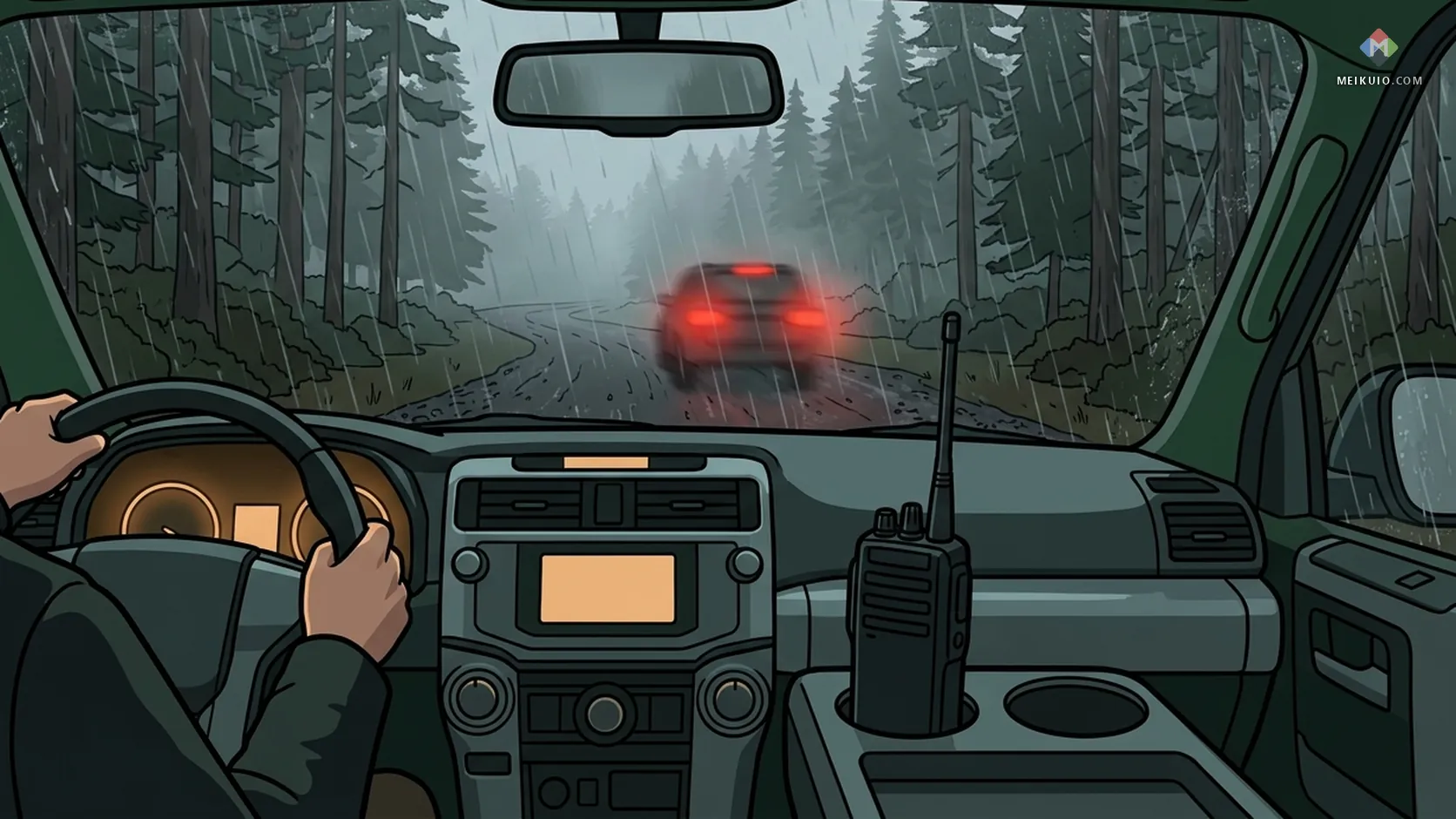
Put a handheld inside a vehicle and it loses most of its reach. A Jeep owner on the Jeep Gladiator Forum explained why in 2020: “your Jeep (and any vehicle, really) is basically a faraday cage and will kill your range on a handheld.” The same post compared a handheld with a 15-watt mobile radio and a fender-mounted antenna: “Where my top of the line handheld Midlands couldn’t hear the front of the group less than a mile away in hilly, on-road terrain, I could hit someone waiting for us 7 miles up the mountain.”
For a convoy, that’s the case for a GMRS mobile radio with an outside antenna, such as Midland’s MXT275, whose manual carries the same license notice as the GMRS handhelds. It isn’t ranked here because none of the testers on our list reviewed it. If you keep a handheld, hold it out the window or get it near the glass; a radio in a cup holder is talking to the inside of the car.
Do privacy codes make a walkie-talkie private?
No. A privacy code is a sub-audible tone or code your radio adds to each transmission. A radio set to the same code opens its speaker; a radio set to a different code stays silent. A privacy code decides only what your own radio plays; anyone on the channel with codes switched off still hears you. Midland says so on its own T71 page: privacy codes “won’t prevent others from hearing your conversations.”
Cobra’s walkie-talkie page tells buyers to “Combine 22 channels and 121 privacy codes to secure your conversations.” The codes filter what you hear. They don’t secure anything you say. The tones have technical names, CTCSS and DCS, and they do help on a busy channel at a ski area or a campground by keeping other groups’ chatter out of your speaker. That’s the honest selling point, and it’s about convenience. Of the 16 search-result pages we audited for this guide, only two explained privacy codes correctly.
GMRS goes further and bans “Coded messages or messages with hidden meanings,” with ten-codes the one allowed exception. So treat every channel as a party line, on a cheap pack or on the best walkie talkies money buys. If a conversation needs to stay private, a walkie-talkie is the wrong tool.
What do the numbers on a walkie-talkie box mean?
Most of them describe the best case, and a few describe nothing you can use. This is how I read a box, line by line, with the radios in this guide as examples:
- “22 channels” is simply the FRS allotment, so every full FRS radio has the same ones, and the RT22’s 16 are a subset. Channels 8 to 14 are the low-power ones, capped at 0.5 watts ERP. If your group can’t hear you, check whether you’re on one of them.
- “2 watts” on an FRS box doesn’t say whether it means transmitter output or ERP. The FRS cap is 2.0 watts ERP, measured at the antenna, and the grants for the FRS picks list 1.08 to 1.884 watts. A box that says “5 watts” isn’t an FRS radio; it’s GMRS, ham or business radio, each with a license attached.
- “Up to 35 miles” is a mountain-to-valley best case, and Motorola’s footnote says so. Read the footnote under any mile figure; on the Motorola and Rocky Talkie boxes, the footnote is the useful part.
- “121 privacy codes” means 121 filters, not privacy. Midland’s T71 has 121 of them, and Midland says they “won’t prevent others from hearing your conversations.”
- “IP67” means dust-tight and rated for a dunk; Motorola’s own wording is “submersion of up to 1m for 30 minutes.” IP56, the Mountain Radio’s rating, covers splashes and snow and is “not submersible.”
- “NOAA” means the radio can receive National Weather Service broadcasts and, on some models, sound an alert. It can’t call anyone for help.
- “VOX” is voice-activated transmit, for hands-free use on a ladder or a bike. It also transmits every cough.
- Battery hours depend on the test. Midland rates the T71 at “90-5-5,” meaning 90% on standby, 5% transmitting and 5% receiving, and a chatty group talks a lot more than 5% of the time.
- The FCC ID is the one line on the box you can verify yourself. Look it up before you trust anything else printed there.
Do “nationwide” walkie-talkies need a plan?
The one I checked does, after the first year, and these radios work only where a phone would. These radios send push-to-talk over the cellular network. Rapid Radios, which ran a sponsored result when I searched “best walkie talkies,” says “there are no monthly fees!” Read the next two sentences of its FAQ: “The first 12 months of nationwide LTE service are completely included with your radio purchase. After your first year, renewing your SIM service is just $50 annually per radio.”
Its terms of service, last updated July 6, 2026, say “the radio will work only where there is cellular coverage.” Its FAQ also says “No FCC license is required,” and that part is accurate. You’re a cellular customer, not a radio operator. Rapid Radios’ nationwide radios cost $50 a year per radio after the first year and work only with cell coverage.
A Trail & Kale review put the trade plainly: “If you lose signal, or you’re in deep woods / true backcountry with no coverage, Rapid Radios do nothing.” The same review notes that “No fees” reads like “no ongoing cost,” but the yearly charge has to be renewed or the device becomes useless.
Do the math for a family. Four radios at $50 a year each is $200 a year from the second year on, for radios that stop working where you most need one. It’s the same question as any car feature sold by subscription: what you’re actually renting. Here it’s cell coverage with a push-to-talk button. The deciding question is distance. Cars driving together are a radio job. A family spread across a city, or people hundreds of miles apart, is a cellular job, and that’s where a nationwide radio can be worth it. In the backcountry, buy a radio.
Before buying one, open a coverage map for the places you’ll actually go. When one radio in the group loses signal, it simply drops out of the conversation. The industry name is push-to-talk over cellular, or PoC. These radios compete with the phone already in your pocket more than with the best walkie talkies on this list.
Do you need a radio at all?
Maybe not. Even the best walkie talkies do one job well: instant voice between people a few miles apart, with no network and no bill. If your real need is different, a different device fits better.
- To call for rescue from anywhere, carry a satellite messenger or a phone with satellite messaging. A walkie-talkie reaches only other radios in range, which may be nobody who can send help. The two devices solve different problems, and plenty of backcountry groups carry both.
- For text across a spread-out group with no cell service, Meshtastic, open-source firmware for small LoRa radios, relays messages from device to device. It’s text, not voice, and someone in the group has to set it up before the trip.
- For riders, motorcycle helmet intercoms from Cardo and Sena connect the group without a handheld in anyone’s glove.
- Push-to-talk apps on phones work wherever data works, which is the same limit the “nationwide” radios have, and they drain the phone you may need later.
A NOAA weather radio is a receiver. It hears alerts but can’t call anyone. Several picks here, such as the Expedition Radio and the T605, have NOAA weather channels, which cover the alert part on a trip. If you’re shopping for gadgets beyond radios, my list of AI gadgets worth buying covers the ones I’d actually spend money on.
Which walkie-talkie for your trip
The best walkie talkies for a ski tour and for a cruise aren’t the same radios. Terrain, water and the ship’s rules decide.
Backcountry and ski touring
Take the Mountain Radio if nobody in the group will get a license, or the Expedition Radio if one of you will. The BC Link Mini wins on size. Agree on a channel and a privacy code before you leave the car, because changing settings with gloves on a ridge is where groups lose each other.
Families and cruises
For a family on land, a multi-pack of FRS radios does it: the T71VP3 for camping with AA backup, the RT22 for a preset pack at an event. For a cruise, check the line first. The rules differ, and ships are steel boxes.
Royal Caribbean allows two-way radios only if they’re “limited to a maximum range of ten (10) miles, a power output of five (5) watts, internal voice communication only, and no external antenna,” and bans ham radios. Taken literally, that rule puts a box that promises 35 miles over the limit, and it doesn’t say whether a longer screw-on antenna counts as external, so ask before you pack. Norwegian Cruise Line lists “Walkie-talkies” among the items you can’t bring on board. Carnival’s safety page says “All speakers (including Bluetooth, portable, and wireless types) and radios are prohibited” in a sentence about hearing public announcements; it doesn’t name walkie-talkies, so ask. Disney Cruise Line’s prohibited list names ham radios and doesn’t name walkie-talkies, so ask there too.
On board, don’t expect much. A Cruise Addicts member wrote back in 2009, “Communications via radio onboard are spotty….especially on lower decks.” Steel decks get in the way much as ridges do.
Hunting
FRS covers most hunting parties. If you want GMRS power for a spread-out group, remember the license covers the licensee’s family. Friends in your camp who transmit on GMRS need their own license. Hunting gear has its own fine print beyond radios, including where you’re allowed to use a trail camera.
Overland convoys
Put a GMRS mobile radio with an outside antenna in the lead vehicle and the last one at least, and keep handhelds for spotting outside the car. Every driver who transmits on GMRS needs to be covered by a license, their own or a family member’s. If your route passes a GMRS repeater, the license pays for itself in range. A convoy of handhelds inside closed cars is the setup that fails first.
A power outage kit
Pick radios that run on AA batteries, like the T71VP3, and store the batteries with them. A radio that needs USB charging is only as good as your power bank. Radios are one line of an outage plan. Water is a bigger one, and I covered what a whole-house water filter does and doesn’t fix.
Kids’ walkie-talkies
Kids’ radios are FRS radios under the same rules: no license, fixed antenna, the same 22 channels everyone else uses. Midland’s T10, a simple beginner radio, was in Project Farm’s test. If a parent holds a GMRS license, the FCC says any family member “regardless of age” can operate within it, so a child can use the family’s GMRS radios too.
Field notes
- The shelf: of Amazon’s 30 best-selling “Portable FRS Two-Way Radios” on October 18, 2026, listings #1, #2 and #10 carried a Part 90 business radio grant; four were ham radios; three were GMRS radios.
- The license: GMRS costs $35 for ten years, renewal $35, no exam, applicants 18 or older; it covers the licensee’s immediate family as the rule lists it. FRS, MURS and CB need no license.
- Power on paper: the FRS cap is 2.0 watts ERP; the picks’ FRS grants list 1.08 to 1.884 watts ERP, and the GMRS grants up to 4.955 watts ERP.
- Range: box headlines of 35 miles or more; OutdoorGearLab measured 4 to 10.4 miles line of sight across five picks; makers’ own fine print runs from half a mile to 8 miles.
- Enforcement: FCC citations against radio sellers in 2018, 2020 and 2022; a $34,000 penalty in 2025 against a ham who interfered with wildfire communications; no case found against a recreational user only for skipping the GMRS license.
- Nationwide radios: first year of service included, then $50 per radio per year at Rapid Radios, and only where there’s cell coverage.
- Sources: 47 CFR Parts 95 and 97 and section 80.115 (eCFR, up to date as of October 15, 2026); FCC equipment authorization grants; FCC fee table; FCC GMRS page; FCC DA 18-980, DA 18-801, DA 20-1395, DA 22-1085 and FCC 24-134; FCC 26-50; makers’ product pages and manuals; OutdoorGearLab measurements.
Frequently Asked Questions
Do I need a license for walkie-talkies?
Not for FRS radios, the license-free kind. GMRS radios need a $35 FCC license, and ham radios need an exam-based amateur license. Check the radio’s FCC grant: Part 95B means FRS, 95E means GMRS, and Part 90 means a licensed business radio.
How much does a GMRS license cost, and who does it cover?
A GMRS license costs $35, lasts ten years and renews for $35, with no exam; you must be 18 to apply. It covers the licensee’s immediate family as the FCC rule lists it, from spouse and children to aunts, uncles and in-laws, at any age. Friends aren’t covered.
What is the difference between FRS and GMRS radios?
FRS is license-free, capped at 2 watts ERP, with a fixed antenna and no repeaters. GMRS needs a $35 license and allows more power, swappable antennas on some radios and repeater access. They share all 22 FRS channels, so the two can talk to each other.
What walkie-talkie has the longest range?
Of the radios OutdoorGearLab measured for its list of the best walkie talkies, the ham radio BaoFeng BF-F8HP reached “20+ miles” line of sight and the GMRS Rocky Talkie Expedition Radio 10.4 miles. Among license-free FRS radios, the Mountain Radio measured 7.7 miles. Terrain cuts all of these.
How far can a walkie-talkie actually reach in the woods?
Plan on half a mile to about 3 miles. Rocky Talkie lists “Forest/Hills: 0.5 to 3 miles” for its FRS radio, and Midland says its GMRS GXT1000VP4 “averages 1/2-2 miles in normal conditions.” Trees and hills block the signal; open ground and height extend it.
Can FRS and GMRS radios talk to each other?
Yes. FRS and GMRS radios share all 22 FRS channels, so the two talk when both use the same channel and the same privacy code, or no code. The person on the GMRS radio still needs the license, and FRS radios can’t transmit through GMRS repeaters.
Is it legal to use a Baofeng radio on GMRS channels?
Only with a radio certified for GMRS and a GMRS license. Some Baofeng models, such as the GM32 and UV-5G Plus, carry Part 95E GMRS grants. Ham-labeled models like the UV-5R are a different category. Look up the FCC ID and read the rule part before you transmit.
Are Midland or Cobra walkie-talkies better?
Neither brand wins by name, so judge the model. Two Midland radios made our picks; no Cobra model cleared our two-review bar. Check both brands’ fine print: Midland admits its GXT1000VP4 averages 1/2 to 2 miles, and Cobra says privacy codes “secure your conversations,” which they don’t.
Can you bring walkie-talkies on a cruise?
It depends on the line. Royal Caribbean allows radios limited to 10 miles and 5 watts with no external antenna, so a box promising 35 miles may fail. Norwegian lists walkie-talkies as items you can’t bring. Disney bans ham radios. Ask your line before you pack.
My Take
Buy the license-free radio unless you know why you need GMRS. For most families, hikers and skiers, the best walkie talkies are FRS radios like the Rocky Talkie Mountain Radio or the Midland T71VP3, and the honest range is in the maker’s fine print, not the headline. The bigger risk on this shelf is a radio whose own FCC grant contradicts its store category. Nobody prints that on the box.
Here’s what I’d do. I’d buy FRS radios that take AA batteries for the family kit, look up the FCC ID on every radio that arrives, and send back any radio that doesn’t carry one. If we started convoying or spending long days in the mountains, I’d pay the $35, get the Expedition Radio and put a mobile radio with an outside antenna in the car. And I’d stop believing any headline with “miles” in it until somebody I can name has measured it.