




Is LifeLock worth it in 2026? For most people, no. The crime everyone pictures, a stranger opening a credit card in your name, is blocked by a credit freeze that costs nothing under federal law. What LifeLock actually sells is monitoring, insurance paperwork, and a phone number to call when things go wrong. Whether that bundle deserves $125 to $350 a year depends on which of those you’d genuinely use.
- What LifeLock does, and what it can’t
- What LifeLock costs in 2026
- The million-dollar insurance is a policy, not a shield
- Almost every LifeLock review is written by someone selling an alternative
- The FTC has fined LifeLock twice over the promises it makes
- LifeLock vs a credit freeze: what the free option blocks
- Who LifeLock is actually worth it for
- The alternatives worth pricing against it
- How to cancel LifeLock
- Frequently asked questions
- Is LifeLock worth it in 2026?
- How much does LifeLock cost per month in 2026?
- Does LifeLock actually prevent identity theft?
- Is a credit freeze better than LifeLock?
- What does LifeLock’s insurance cover?
- Can you cancel LifeLock and get a refund?
- Is Aura or Identity Guard a better deal than LifeLock?
- My Take
What LifeLock does, and what it can’t
LifeLock is a detection and reimbursement service owned by Gen Digital, the company behind Norton. It watches your credit files, scans dark web markets and data broker sites for your details, and sends an alert when something matching your identity shows up. If fraud happens anyway, it assigns a restoration specialist and processes an insurance claim.
Notice what’s missing from that list: prevention. LifeLock’s own page says so, in the fine print most reviews skip: “No one can prevent all cybercrime or prevent all identity theft.” The footnote on its credit lock feature goes further, admitting the lock “cannot prevent all account takeovers, unauthorized account openings, or credit file inquiries.” The product tells you fraud happened. It doesn’t stop the fraud from happening.
There’s also a structural blind spot the marketing never mentions. The fastest-growing form of identity crime right now is synthetic fraud, where a criminal pairs your real Social Security number with a fabricated name and address, then patiently builds credit under that invented person. Monitoring services watch files tied to your name. A file opened under your SSN but a different name is invisible to them, and since no real victim exists to check that file, the scheme surfaces only when the fraudster maxes everything out and disappears. Generative AI now automates this at scale, the same way it industrialized the voice-cloning scams we’ve covered before.
LifeLock’s 2026 answer to the AI wave is “Genie Scam Protection Pro,” an assistant that reads suspicious texts and websites for you, plus a new synthetic-identity alert on higher tiers. Useful features, but read them for what they are: more detection, after the fact. The deepfake calling your bank while pretending to be you is a problem detection tools on the bank’s side have to solve, not a consumer subscription.
What LifeLock costs in 2026
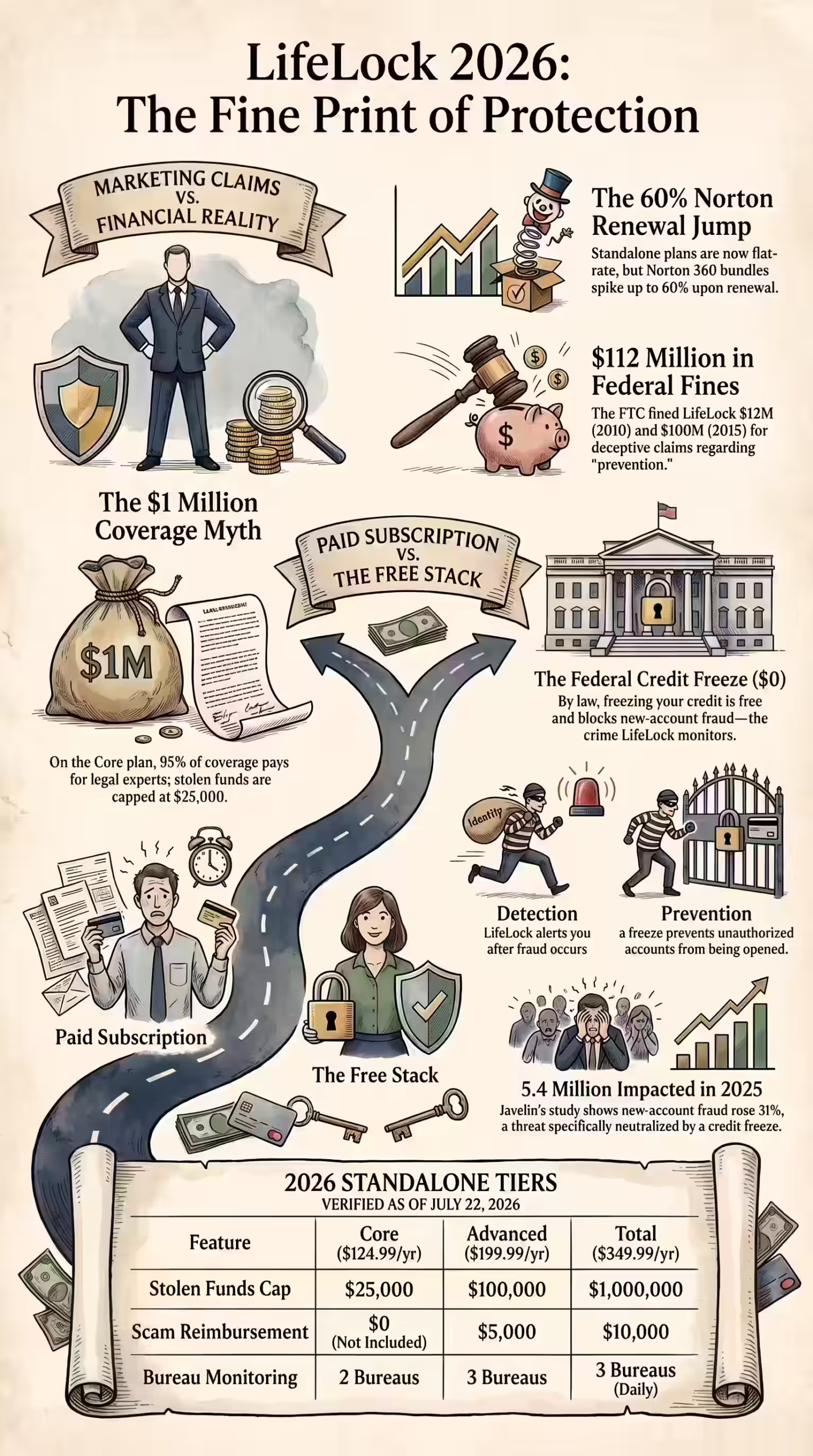
LifeLock rebuilt its lineup on February 11, 2026. The old Standard, Advantage, and Ultimate Plus tiers are gone, replaced by Core, Advanced, and Total. The rebuild killed the most complained-about thing in LifeLock’s history: the cheap first year that quietly doubled at renewal. Standalone plans now run $12.49, $19.99, or $34.99 a month, which works out to $124.99, $199.99, or $349.99 a year, and the price you sign at is the price you renew at. Prices checked July 22, 2026.
Look at the last two rows. February’s rebuild left the Norton bundles untouched. Buy LifeLock through one of them and you still get the discounted first year followed by a jump: Select climbs 60% at renewal, Ultimate Plus climbs 22%. And here’s the detail nobody in the current search results has flagged: at renewal, the Select bundle costs $35 more per year than standalone Core while monitoring half as many credit bureaus. You pay extra to lose a bureau and gain an antivirus.
One more cohort matters. Subscribers who joined before February 2026 report they weren’t moved to the flat model automatically. Consumer accounts describe legacy plans still renewing at the old inflated rates, $500 to $1,000 a year for family tiers, unless the subscriber calls in and asks to switch. A ConsumerAffairs reviewer in June 2026 described paying $1,000 a year, four months after the flat pricing supposedly fixed this. If you’re a longtime member, check which plan your renewal bills against.
The static picture rounded these prices to whole dollars; the source article and full table preserve cents. Standalone Core, Advanced and Total renew at the sign-up price. Norton 360 bundles retain introductory discounts; the displayed rounded jumps were 60% and 22%.
The million-dollar insurance is a policy, not a shield
Every LifeLock plan advertises seven-figure protection. Core’s headline reads “up to $1.05 million coverage.” Here’s how that number breaks down, straight from the plan card: $1 million of it covers lawyers and experts LifeLock retains on your behalf. The part that reimburses stolen money is capped at $25,000, and personal expenses at another $25,000. On the cheapest plan, 95% of the advertised figure is legal services you’ll hopefully never need, not compensation you’d receive. Total’s $3 million headline splits more evenly: $1 million each for stolen funds, personal expenses, and legal costs.
More Read

Note
On LifeLock Core, the advertised “$1,050,000 coverage” pays at most $25,000 for money actually stolen from you. The other $1 million is for lawyers and experts
The insurance itself is real, but it’s insurance, with everything that word implies. The identity theft policy is underwritten by United Specialty Insurance Company (State National for New York residents), while the newer scam-reimbursement benefit runs through HSB Specialty. Gen Digital states it is “not a licensed insurance producer.” The Evidence of Coverage says openly that it “does not state all the terms, conditions, and exclusions of the Master Policy,” and the terms it does publish include limits as specific as one handbag and one wallet per theft. How often claims get paid is anyone’s guess: neither LifeLock nor Gen Digital publishes claim approval rates or payout totals anywhere we could find.
“Despite doing everything instructed (including obtaining a police report), the bank refused to speak with the recovery team for six months. The bank ultimately blamed me for the incident, and they refused to assist further and denied my insurance claim.”
LifeLock customer review, ConsumerAffairs, May 2026
Two more traps hide in the tier structure. Scam reimbursement, the thing LifeLock’s AI-era marketing leans on hardest, doesn’t exist on Core at all: the plan card literally crosses it out. Advanced gets $5,000, Total gets $10,000, and on family plans that scam allowance is shared per family, not per person. Meanwhile home title monitoring, 401(k) alerts, and bank account takeover alerts, the features aimed at the people with the most to lose, appear only on Total at $349.99 a year.
Almost every LifeLock review is written by someone selling an alternative
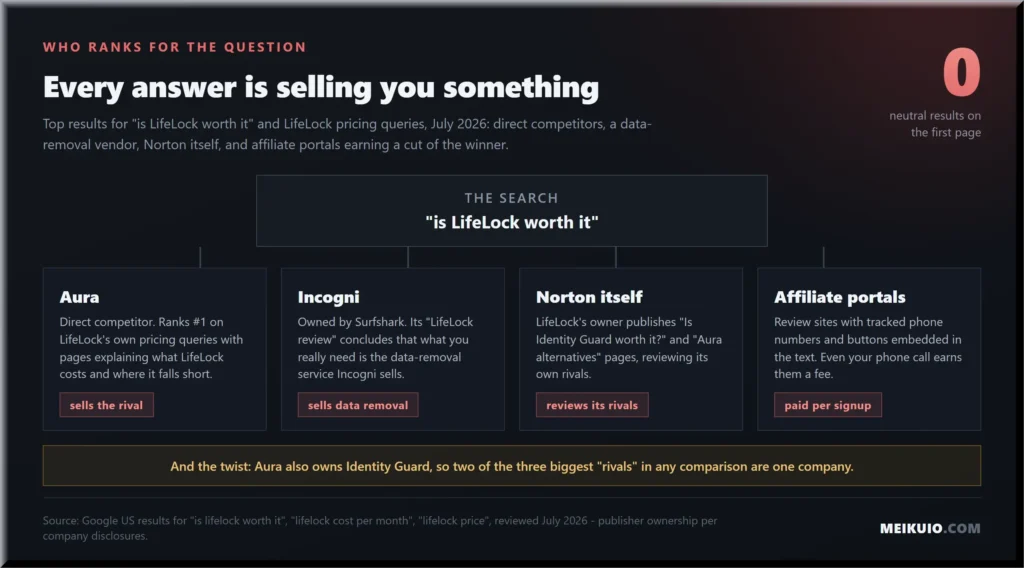
Search “is LifeLock worth it” and study who answers. The top result for LifeLock’s own pricing queries is Aura, a direct competitor (we’ve tested the full field of LifeLock alternatives separately), running detailed explainers on how much LifeLock costs and where it disappoints. Incogni, a data-removal service owned by Surfshark, publishes its own LifeLock review that concludes you should consider data removal. Norton fires back in kind: its blog runs pages titled “Is Identity Guard worth it?” and “Aura alternatives,” built to look like neutral reviews of its rivals. We documented this same pattern when we priced e-signature tools and survey software: the vendor mirror, where every “review” in sight is a competitor’s landing page wearing a costume.
The consolidation makes it stranger. Aura and Identity Guard, which read like two independent options, share the same parent company. So when a comparison site weighs LifeLock against Aura against Identity Guard, two of the three “choices” bill to the same owner. The rest of the results are affiliate review portals that earn a commission on the winner, some embedding tracked phone numbers directly in the article text so even your phone call pays them. Their disclosures exist, in small print, usually at the very top or bottom of the page.
We have no affiliate relationship with any product on this page, which goes a long way toward explaining why our conclusion sounds different from the first page of Google.
The FTC has fined LifeLock twice over the promises it makes
LifeLock’s founding-era marketing was so confident that its CEO printed his real Social Security number on the side of a truck. In 2010, the FTC and 35 state attorneys general made the company pay $12 million over ads promising to “prevent” identity theft, protection the agency said was so limited “you could drive a truck through it.” The order that followed banned deceptive claims and required an audited data security program.
Five years later the FTC came back, alleging LifeLock had broken that order on four counts: it failed to maintain the required security program, falsely advertised bank-grade safeguards, falsely promised alerts “as soon as” trouble appeared, and skipped record-keeping duties. The December 2015 settlement cost $100 million, the largest order-enforcement award in FTC history at that point. When the checks finally reached wronged customers in 2019, over a million of them averaged about $29 each.
“The fact that consumers paid LifeLock for help in protecting their sensitive personal information makes the charges in this case particularly troubling.”
FTC Chairwoman Edith Ramirez, December 2015
Fairness requires saying the rest: those cases concerned the product and the promises of a decade ago. Today’s LifeLock is a different service with visibly more careful wording, and no FTC action against it has surfaced since 2015. But the history answers a question every buyer should ask about this category: what happens when the promise on the box outruns the product? Here, twice, the answer cost $112 million. The speed promise that triggered the second fine, “as soon as,” has quietly vanished from LifeLock’s current marketing. What you get instead is “monitors hundreds of millions of data points a second,” which sounds impressive and commits to nothing.
LifeLock vs a credit freeze: what the free option blocks
Since 2018, federal law (the Economic Growth, Regulatory Relief, and Consumer Protection Act) has required Equifax, Experian, and TransUnion to freeze and unfreeze your credit for free. A freeze blocks anyone, including you, from opening new credit in your name until you lift it, and federal law gives the bureaus one hour to lift it after an online request. It doesn’t touch your credit score. It never expires. Parents can freeze a child’s file the same way, at no cost.
The agency that fined LifeLock $100 million tells consumers, in a September 2025 alert, that “a great place to start is freezing your credit.” The Government Accountability Office reached the same conclusion from the other direction, reporting that commercial monitoring services notify you after fraud occurs rather than stopping it. And the CFPB has addressed the “credit lock” features that subscriptions sell as premium conveniences: they offer no more security than the free statutory freeze. LifeLock’s lock has one extra property the freeze lacks, though. Cancel your subscription and it switches off.
The freeze’s limits are real and worth naming. It does nothing about charges on cards you already hold, tax refund fraud, medical identity theft, or crimes committed under your name. That’s the honest case for paid monitoring: coverage of the fraud a freeze can’t reach, plus a human to run the cleanup. The numbers say that gap matters less than the marketing implies. Javelin’s 2026 Identity Fraud Study counted 5.4 million Americans hit by new-account fraud in 2025, up 31% in a year, and new-account fraud is precisely the crime the free freeze shuts down.
Consumer groups have quietly assembled a full free defense stack that goes beyond the three bureaus, and no ranking review mentions it: freeze your banking history file at ChexSystems so no one opens checking accounts in your name, request a free IRS Identity Protection PIN so no one files your taxes, lock your E-Verify record so no one gets hired as you, and pull your free credit reports weekly at AnnualCreditReport.com. Total cost: zero. Time: one afternoon.
Total: 349.99 × 3. Ultimate Plus: 299.99 + 2 × 364.99. Advanced: 199.99 × 3. Core: 124.99 × 3. Free stack: freezes at all three bureaus and ChexSystems, IRS IP PIN, E-Verify lock and weekly credit reports. Free measures prevent new-account fraud; subscriptions detect, insure and restore. The article cites 5.4M Americans affected by new-account fraud in 2025.
Who LifeLock is actually worth it for
Strip away the fear marketing and a few genuine customer profiles remain. The broader question of is identity theft protection worth it begins with what federal law already covers for free. Deciding whether to buy a commercial plan comes down to which of these four people you are.
You’ve already been hit, or your data just leaked. The restoration specialist is LifeLock’s most defensible feature. Identity cleanup is a bureaucratic slog across banks, bureaus, and agencies, and having a person paid to chase it saves real hours, when the third parties cooperate. The ConsumerAffairs case above shows the ceiling: LifeLock can’t force your bank to talk to its recovery team. Worth considering for a year or two. Also worth knowing: if a company that leaked your data offers you free monitoring, LifeLock’s own refund policy lets you claim a pro-rated refund and use that instead.
You want someone watching so you don’t have to. This is the convenience buyer, often older, often managing accounts for two people. One Trustpilot reviewer, a self-described non-tech-savvy senior, wrote that the alerts “make us feel in control and comfortable.” That is a legitimate product, peace of mind as a service. Advanced at $199.99 is the sane tier for it; just know that what you’re buying is reassurance and cleanup, not a wall.
You have a complex financial life. 401(k) alerts, home title monitoring, and bank takeover alerts exist only on Total. If you hold property and investments, that’s the only tier doing anything the free stack can’t approximate, and at $349.99 a year you should price it against an hour with your bank’s own fraud controls first.
You’re protecting kids. A child’s SSN is prime synthetic-fraud raw material precisely because nobody checks a child’s credit for years. But the strongest single move here is free: freeze the child’s file at all three bureaus. The family plan’s per-adult feature list and shared $5,000 scam allowance make it a weaker deal than its price suggests.
The alternatives worth pricing against it
If you’ve decided to pay for monitoring, LifeLock isn’t the only counter. Aura runs about $12 a month billed annually with three-bureau monitoring on every plan and flat renewal pricing, and its insurance tops out at $1 million per adult versus Total’s $3 million headline. Identity Guard starts cheaper at $7.99, but its entry plan skips credit monitoring entirely, which is the thing you came for. IDShield ($14.95 to $19.95) staffs restoration with licensed private investigators. Allstate Identity Protection mostly lives inside employer benefits packages, where it’s often free to you; check before buying anything. Experian IdentityWorks leans on the bureau’s own data at $24.99 and up.
Whichever you compare, remember the “best of” lists ranking them usually earn a cut of the winner. The cheapest strong option remains the free stack from the previous section, possibly topped with a $0 employer benefit you already have.
How to cancel LifeLock
Cancellation runs through my.norton.com, the LifeLock member portal, or phone (1-800-416-0599); the company itself calls live chat the fastest route. Annual plans carry a 60-day money-back guarantee, and each renewal opens a fresh 60-day refund window from the day you’re charged. Monthly plans give you 14 days. Two timing details matter: renewal charges can post up to 35 days before your actual renewal date, so set a calendar reminder 40 days out, and the FTC’s “click-to-cancel” rule that would have forced simple online cancellation was struck down by a federal appeals court in July 2025, so the retention chat queue is perfectly legal. Subscribers report waits of 10 to 20 minutes and persistent save-the-sale scripts, a pattern we also documented in subscription apps that quietly renew.
Frequently asked questions
Is LifeLock worth it in 2026?
For most people, no: the free credit freeze already blocks new-account fraud, which is the crime driving the fear. LifeLock earns its fee only if you specifically want its restoration service and insurance, and even then the Advanced tier makes more sense than Core, whose stolen-funds cap is $25,000.
How much does LifeLock cost per month in 2026?
Standalone plans cost $12.49 (Core), $19.99 (Advanced), or $34.99 (Total) per month, with annual billing about 16% cheaper. Since the February 2026 pricing rebuild, standalone renewal prices match sign-up prices. The Norton 360 bundles still discount the first year, then rise 22% to 60% at renewal. Norton 360 plans without LifeLock also discount the first year; my McAfee vs Norton comparison lists what they renew at.
Does LifeLock actually prevent identity theft?
No, and its own disclaimer says as much: “No one can prevent all cybercrime or prevent all identity theft.” LifeLock detects suspicious activity and alerts you after it happens, then helps with recovery and reimbursement. The only consumer tool that blocks new-account fraud outright is a credit freeze, which is free.
Is a credit freeze better than LifeLock?
For stopping new accounts, yes: a freeze blocks them outright, costs nothing, and never expires. It won’t catch misuse of accounts you already have, tax fraud, or medical identity theft. LifeLock covers some of that gap with alerts, restoration help, and insurance, which is the part you’re paying for.
What does LifeLock’s insurance cover?
Each tier includes up to $1 million for lawyers and experts. Reimbursement of stolen funds is capped separately: $25,000 on Core, $100,000 on Advanced, $1 million on Total. Policies are underwritten by United Specialty and HSB Specialty, and neither LifeLock nor Gen Digital publishes claim approval rates.
Can you cancel LifeLock and get a refund?
Yes. Annual memberships have a 60-day money-back window from purchase, and each renewal charge starts a new 60-day window. Monthly plans allow 14 days. Charges can post up to 35 days before your renewal date, so check your statement early if you’re planning to leave.
Is Aura or Identity Guard a better deal than LifeLock?
Aura undercuts LifeLock at about $12 a month with three-bureau monitoring on every tier, though its insurance caps lower. Identity Guard’s $7.99 entry plan omits credit monitoring. Note that Aura owns Identity Guard, so two of the three biggest “rivals” answer to one company. Compare renewal prices, not first-year prices.
My Take
I spent two decades reading security marketing, and LifeLock’s 2026 refresh is genuinely better behaved than its past: flat renewals, a real refund window, quieter promises. I still wouldn’t pay for Core. Freeze your credit at the three bureaus, ChexSystems, and E-Verify, grab the IRS PIN, and you’ve out-defended a $125 subscription in one afternoon, for free. If you want the concierge cleanup and the insurance, buy Advanced with clear eyes about what the million-dollar number means. Just never buy it instead of the freeze. Buy it, if at all, on top of one.