

How does ChatGPT work? Every prompt is cut into tokens, handed to a router that picks one of several models, and run through a transformer network that predicts the reply one token at a time, with web search and other tools pulled in when needed. Half of that machinery did not exist in 2022, and most guides still describe the half that did.
- What does GPT stand for?
- What is ChatGPT, actually?
- What happens when you press Enter
- What is a token in AI?
- How is ChatGPT trained?
- Where does ChatGPT get its information?
- How is ChatGPT different from a search engine?
- The router: why you no longer have to pick a model
- What “thinking” means: reasoning models
- What is a context window?
- ChatGPT memory: three different things with one name
- Does ChatGPT train on your data?
- How many parameters does ChatGPT have?
- Why does ChatGPT make things up?
- What one answer costs
- What the guides get wrong
- When to trust it, and when not
- Frequently Asked Questions
- Does ChatGPT understand what it’s saying?
- Why does ChatGPT give different answers to the same question?
- Can ChatGPT access the internet?
- Who can see what you type into ChatGPT?
- How long does ChatGPT keep conversations?
- What shouldn’t you tell ChatGPT?
- Is ChatGPT safe to use?
- Why are people leaving ChatGPT?
- Is ChatGPT Work different from ChatGPT?
- My Take
You are reading this because you rely on the thing daily and want to know what actually happens to the words you type. The explanations that rank for this question mostly describe the 2022 product: one model, one chat window, “it predicts the next word.” That is still the engine, but the machine around the engine has been rebuilt twice since. The honest answer to “how does ChatGPT work” now has six steps, not three. This article traces every claim to a named OpenAI document with a date, from the 2017 transformer paper to the GPT-5 System Card, because the gap between what the documents say and what the guides repeat is exactly where the surprises live.
What does GPT stand for?
GPT stands for Generative Pre-trained Transformer. Generative means the model produces new text rather than retrieving stored text. Pre-trained means it first learns from a huge body of existing writing before any fine-tuning. Transformer is the neural network architecture, introduced by Google researchers in 2017, that made models of this scale practical.
Each of those three words has a paper behind it. The transformer comes from “Attention Is All You Need” (Vaswani et al., June 2017), which proposed an architecture “based solely on attention mechanisms, dispensing with recurrence and convolutions entirely.” In plain terms, the model weighs every word in the input against every other word at once, instead of reading left to right, which is what lets it be trained on enormous amounts of text in parallel.
Attention, the mechanism in the paper’s title, is easier to picture than its name suggests. For every token it processes, the model scores how relevant every other token in the context is, and lets the strong connections shape the meaning. In “the bank approved the loan,” attention is what ties “bank” to “loan” rather than to rivers. Stack that scoring across dozens of layers and many parallel attention heads, and word soup becomes structure: grammar, references, tone, the thread of an argument. That one trick, applied at scale, is most of what people mean by the model “understanding” context.
The “generative pre-training” half comes from OpenAI’s own 2018 paper, which showed that “large gains” come from “generative pre-training of a language model on a diverse corpus of unlabeled text, followed by discriminative fine-tuning.” That two-stage recipe, learn language first and manners second, is still the shape of the whole system in 2026.

Spelling out the acronym is the first half of answering how does ChatGPT work, and it settles one point early: nothing in “generative pre-trained transformer” says database, search index or fact store. All three words describe a machine for producing likely text. Everything the product has bolted on since 2022, the tools, the router, the memory, exists to compensate for what those three words leave out.
What is ChatGPT, actually?
ChatGPT is a chat application built by OpenAI on top of its GPT models. The distinction matters, because the product and the model stopped being the same thing years ago. In November 2022, ChatGPT was a thin conversational layer over a single fine-tuned model. In September 2026, it is a system: a family of models, a router that picks between them, a memory layer, a set of tools that browse and run code, and an agent mode that carries out multi-step tasks.
That growth explains why so many descriptions of it disagree. A page written in 2023 describes a frozen text predictor with a knowledge cutoff. A page written in 2026 describes something closer to a switchboard connected to the live web. Both are describing real layers of the same product, and neither is complete alone. The corporate structure behind it has its own moving parts, which is a separate story we cover in who actually owns ChatGPT.
The layers arrived one at a time, so your mental model probably matches whatever year you formed it. Tool use came first, with browsing and code execution growing from experiments into defaults. Account-level memory followed, turning a stateless chat into a product that recognizes you. Reasoning models arrived in 2024 and 2025 and split answers into visible replies and hidden work. Agent capabilities came through 2025, letting the system operate a browser and complete tasks rather than describe them. By 2026 the chat window is the smallest part of what you are using.
One naming note before the mechanics, because Google now mixes the two: OpenAI also sells a product called “ChatGPT Work,” a delegation mode for completing whole tasks. This article is about how the underlying system works, and the product name question is answered in the FAQ below.
What happens when you press Enter
Here is how ChatGPT works in 2026, step by step, from the moment you submit a prompt to the moment the answer stops streaming. The first and fifth steps are the 2022 story every guide tells. The steps in between are what changed.
- Your text is split into tokens, small chunks of characters that the model can process, and each token becomes a number.
- A router decides which model should answer. OpenAI’s GPT-5 System Card (August 7, 2025) describes “a real-time router that quickly decides which model to use based on conversation type, complexity, tool needs, and explicit intent.”
- If the request is hard, a reasoning model works through it first, producing internal reasoning tokens you never see.
- If the request needs current facts or actions, tools fire: web search, code execution, file reading, image generation. The results are converted into tokens and added to the working context.
- The chosen model then generates the reply one token at a time, each token picked from a probability distribution over what should come next, with a controlled amount of randomness.
- Safety systems screen the exchange, the answer streams back to you, and everything in the conversation becomes context for the next turn.
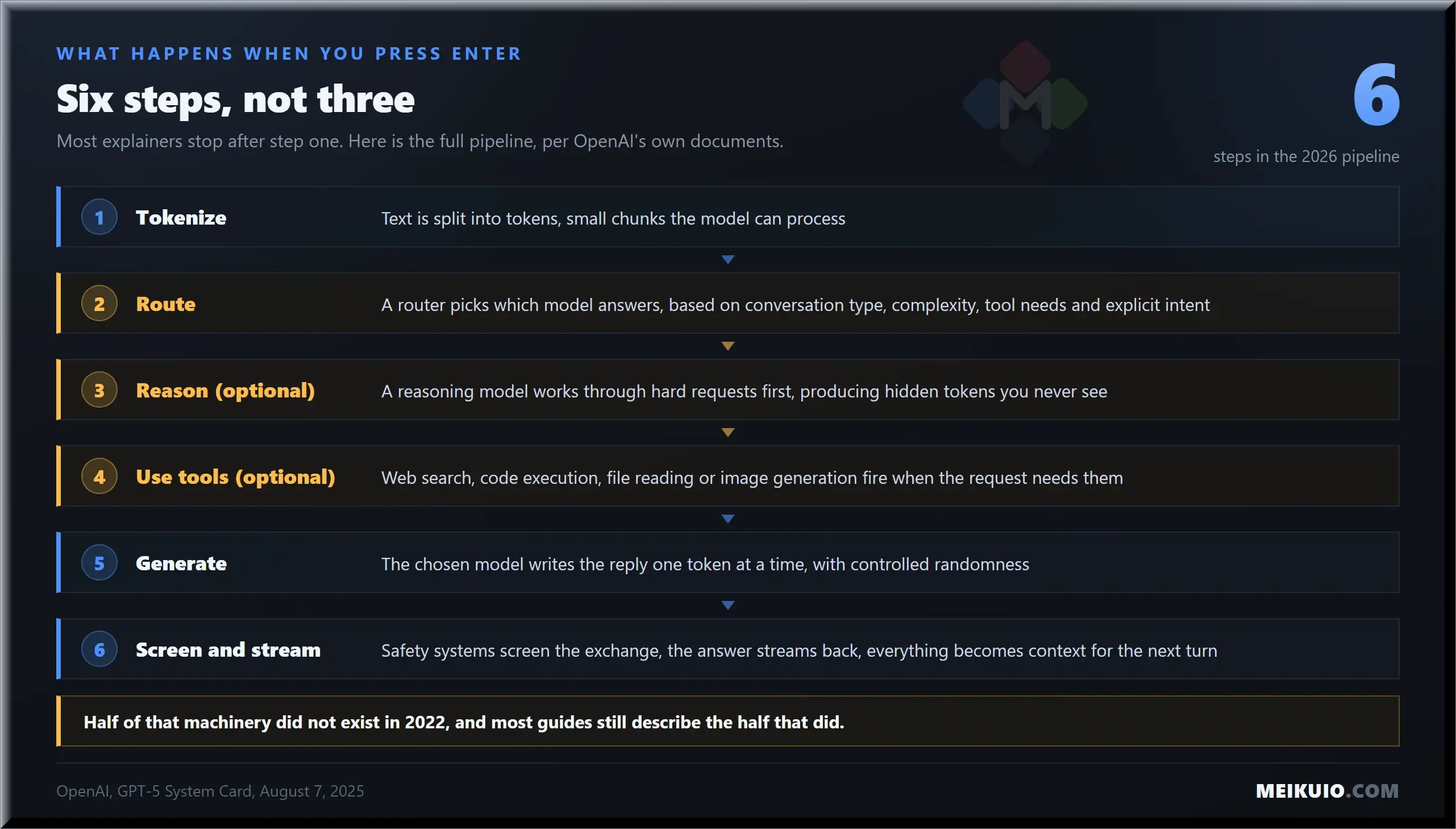
The same pipeline now handles more than text. Voice conversations, images and files all get converted into tokens and processed by the same machinery, which is how ChatGPT’s real-time voice mode can listen and talk in one flow. Different doors into the building, same corridors inside.
Step five deserves one more sentence, because it carries the property people find strangest. The model does not select the single most probable token every time; generation includes a controlled amount of randomness, which is why the same prompt produces different wordings on different days. That randomness is a feature, not noise. Fully deterministic output would be repetitive and brittle, so the system trades a little consistency for range, and your follow-up questions inherit the path the dice took.
Back in 2022, “how does ChatGPT work” had a one-model answer: tokens in, one frozen network, prediction out. Steps two through four are the difference between that product and this one, and they are precisely the steps the top-ranking explanations compress into a sentence or skip. The engine still predicts. The machine now decides which engine, whether to think first, and what to go read before answering.
What is a token in AI?
A token is the unit of text an AI model actually reads and writes. OpenAI’s own token guide puts it precisely: “A token can represent a character, part of a word, a whole word, or punctuation.” The model never sees your sentence as a sentence. It sees a sequence of numbered chunks, and it answers in chunks too.
OpenAI publishes working estimates for English: one token is roughly 4 characters, or about three quarters of a word, and the same guide warns these are “estimates, not exact counts.” A 1,000-word article runs to roughly 1,300 tokens. Other languages cost more. The page adds that “other languages can have different relationships between characters, words, and tokens,” and in practice most non-English text costs more tokens per word, so non-English users burn through limits faster for the same amount of meaning.
Tokens exist because neural networks compute on numbers, not letters. The tokenizer holds a fixed vocabulary of chunks, each mapped to an ID, and each ID becomes a list of numbers the network can multiply. Common words earn their own token; rare words get sliced into fragments. That slicing explains a family of small oddities, garbled rare names and miscounted letters among them: the model never saw the word as letters in the first place, only as chunk IDs. Ask it to count the letters in a word and you are asking about objects it does not directly perceive.
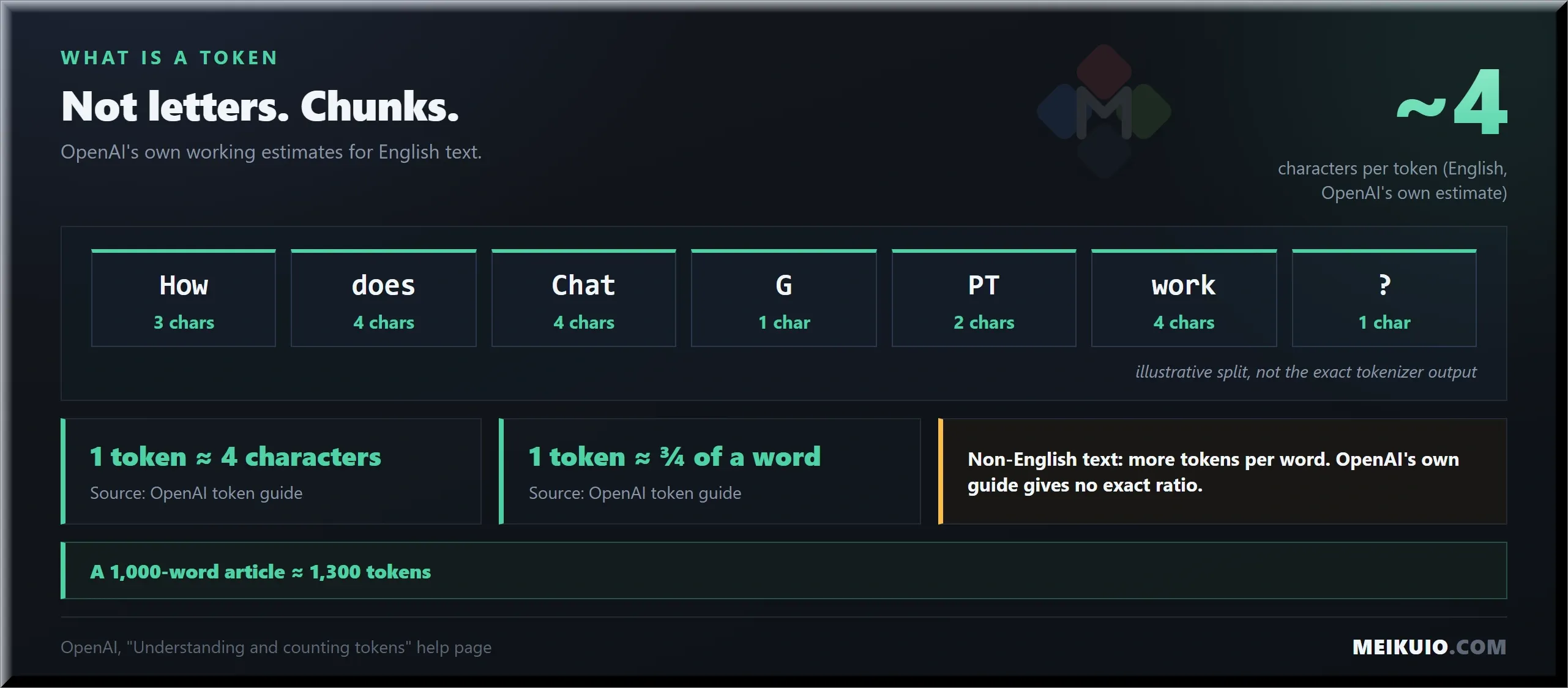
Tokens are also the unit the industry bills, meters and measures itself in. Usage limits count tokens, context windows are sized in tokens, and market analysts now measure model adoption in enterprise token traffic rather than user counts. When a plan feels like it ran out too fast, the honest explanation is almost always sitting in token arithmetic.

How is ChatGPT trained?
ChatGPT is trained in two phases: pre-training, where the model learns language from a massive text corpus, and alignment, where humans teach it to be a useful assistant. The scale of the first phase is public for older models. The GPT-3 paper (Brown et al., 2020) states the model was trained on “a total of 300 billion tokens” of text.
The same paper names the mix: a filtered version of Common Crawl, a curated web-text corpus, “two internet-based books corpora (Books1 and Books2) and English-language Wikipedia.” Later models added licensed data, code and multimodal material, with the exact recipes undisclosed after 2020. Two properties of that diet shape everything downstream. The corpus skews English, so other languages get thinner coverage and costlier tokens. And the web contains contradictions, satire and errors, which the model absorbs as patterns with no provenance attached.
The alignment phase has an exact, documented recipe. The InstructGPT paper (Ouyang et al., March 2022) names three steps, and this is the diagram nearly every explainer redraws:
- Supervised fine-tuning. Human trainers write model answers to example prompts, and the model learns to imitate them.
- Reward model training. Trainers rank several model outputs from best to worst, and a separate model learns to predict those rankings.
- Reinforcement learning. The main model is optimized against that reward model, using an algorithm called PPO, so that answers humans prefer become more likely.
Most guides answering how does ChatGPT work stop at this diagram, and it is genuinely the documented recipe. What the diagram hides is the asymmetry of scale: pre-training consumes almost all the data and compute and produces raw capability, while the three alignment steps are a comparatively thin layer of human preference on top. The assistant personality you talk to is that thin layer. The knowledge underneath it is the corpus.
The connection to ChatGPT is on the record and still live on OpenAI’s announcement page: “We trained this model using Reinforcement Learning from Human Feedback (RLHF), using the same methods as InstructGPT, but with slight differences in the data collection setup.” The industry has added newer alignment techniques since, but this pipeline is the documented origin, and reinforcement learning now also trains the hidden reasoning steps of newer models. For a sense of what a 2026-scale pre-training run looks like, Microsoft reports its own MAI models were trained on 30 trillion licensed tokens, a hundred times the GPT-3 figure.
What training produces is worth being precise about, because it settles a common fear. OpenAI’s developer help page states the model learns “not by memorizing sentences, but by updating its internal parameters” and that it “does not retain copies of the sentences, images, or audio it processes during training.” The same page says ChatGPT “does not ‘copy and paste’ from its training data” and compares it to a teacher who explains ideas after years of study rather than reciting a textbook. The output is a new arrangement of patterns, which is also why the model can be fluently, confidently wrong.
Where does ChatGPT get its information?
ChatGPT draws on two separate sources: patterns learned from its training data, frozen at a cutoff date, and live information fetched by its search tools while you wait. Anything it “knows” without searching comes from the first source. Anything about this week comes from the second, or it is a guess.
The frozen half explains the famous knowledge cutoff. Training runs end months before a model ships, so the weights carry a snapshot of the world with a hard edge. The live half works differently: when the model decides your question needs current facts, it runs a web search, and the results are tokenized and inserted into the conversation context, where the model reads them like part of your prompt. The answer is generated fresh from both.
Neither half is a database lookup. The model does not open a file of verified facts, and there is no record it consults to check itself. It computes the most probable continuation given everything in its context, so a search-backed answer about live news can still misread what it found. That failure pattern shows up in every chatbot that browses, and it is one of the axes where ChatGPT and Grok split real-time tasks differently.
Half the pages ranking for how does ChatGPT work still describe only the frozen half, which made sense when it was the whole story. It stopped being the whole story the day search tools shipped. A complete answer in 2026 names both sources and the seam between them, because the seam is where the model either checked or guessed, and nothing in the reply’s tone tells you which.
Here is the part that shows how stale this topic’s sources run. OpenAI’s own indexed help article “What is ChatGPT?” still stated, when we checked it on September 2, 2026: “ChatGPT is fine-tuned from GPT-3.5” and “ChatGPT is not connected to the internet” with “limited knowledge of world and events after 2021.” Every sentence of that described the December 2022 product. When the vendor’s own top-ranking page is four years behind its shipping product, the state of third-party guides follows naturally.
How is ChatGPT different from a search engine?
A search engine retrieves and ranks pages that already exist; ChatGPT generates new text that never existed anywhere. Google answers with a list of places where your answer might live. ChatGPT answers with the answer itself, composed on the spot, sometimes after reading search results and sometimes from training patterns alone.
The differences that matter follow from that split. Search fails by missing: the page you needed was not in the results, and you can see that it was not. Generation fails by fabricating: the answer reads complete, and nothing on the surface marks the invented part. Search shows its sources by construction, while ChatGPT has to be asked for them and can invent those too. And synthesis flips the other way, because no results page will merge three documents into one coherent summary, which is the job generation does best.
The two categories are also converging from both ends. Google now generates answers above its results with AI Overviews, and ChatGPT now searches the web before generating. The distinction that survives the convergence is the one worth remembering: retrieved text existed before you asked, generated text did not, and only the first kind can be checked against where it came from.

The router: why you no longer have to pick a model
No 2022 answer to how does ChatGPT work mentions a router, because there was nothing to route. That has become the single biggest change: you no longer talk to one model. The GPT-5 System Card, published August 7, 2025, describes the product as “a unified system with a smart and fast model that answers most questions, a deeper reasoning model for harder problems, and a real-time router that quickly decides which model to use.”
The router is itself a trained system, and OpenAI names its training signals: it is “continuously trained on real signals, including when users switch models, preference rates for responses, and measured correctness.” Manual choice survives, and the card’s own wording proves it: the router learns from “when users switch models,” which only happens because the model picker still exists. OpenAI’s deployment notes for GPT-5.6 even describe an effort slider for Plus and Pro accounts. Say “think hard about this” in a prompt and you have signaled explicit intent, one of the routing inputs the card lists. What OpenAI does not publish anywhere is the thresholds, so there is no documented way to know in advance which model will take your question. Two people asking the same thing can get different machinery.
The card also answers a question users kept asking about quality drops late in the day: “Once usage limits are reached, a mini version of each model handles remaining queries.” Degradation under limits is documented behavior, and where those limits sit depends on what each ChatGPT plan costs and includes, which we track separately.
As of September 2026 the flagship family behind the product is GPT-5.6, launched in July 2026 in three sizes named Sol, Terra and Luna, with OpenAI’s release page announcing “the GPT-5.6 family of models for general availability” and its deployment updates describing GPT-5.6 models as ChatGPT’s defaults since August 2026. The same release introduced a multi-agent mode, in beta, that lets the system “run concurrent subagents and synthesize their work in a single request.” The direction of travel is clear: more models under the hood, less choice on the surface.
What “thinking” means: reasoning models
When ChatGPT shows a “thinking” state, a reasoning model is generating tokens you will never read. OpenAI’s token guide describes these as “internal reasoning tokens that aren’t shown as answer text,” and its developer documentation adds that “they still occupy space in the model’s context window and are billed as output tokens.” The thinking is real computation in the same currency as the answer, just hidden.
Mechanically, the model works the problem through intermediate steps, drafts of logic that reinforcement learning has trained it to produce, then writes the visible reply informed by them. This is why reasoning answers arrive slower and why they hold up better on math, code and multi-step questions. OpenAI’s developer guidance even notes that prompting these models to think step by step is unnecessary, because stepwise work is what they are trained to do internally.
For you, the practical meaning is a trade. Routed to a fast model, you get speed and occasionally shallow reasoning. Routed to a reasoning model, you wait longer, consume more of your usage allowance, and get an answer that survived an internal draft. The router makes that trade for you, on signals it does not disclose.
The routing shows up in ordinary use once you know to look. A request to rephrase an email comes back in seconds from a fast model. A tax scenario with three conditions, or a debugging question with a stack trace, triggers the visible thinking state and a slower, more structured reply. Between those poles sits a wide band where either model could plausibly take the call, and that band is where response quality feels inconsistent from day to day.
What is a context window?
The context window is the model’s working memory, and OpenAI defines it in one sentence: “The context window is the maximum number of tokens that can be used in a single request.” That maximum covers your input, the model’s output, and any hidden reasoning tokens, all counted together against one ceiling.
Everything the model appears to remember inside a conversation lives here: your earlier messages, its earlier answers, fetched search results, file contents, injected memory notes. When a long conversation starts “forgetting” its own beginning, the mechanical cause is usually that the beginning no longer fits in the window. Nothing was deleted from any record. The record simply is the window, and it is finite.
How big the window is depends on the model and plan, and OpenAI publishes no single table of per-plan sizes for the ChatGPT interface, so treat any specific figure you read as dated to a document. Sizes across models and tiers change often enough that we keep them in our model context sizes and limits tracker instead of printing them here. For scale, the frontier field already includes a model with a 1M-token context, roughly a dozen novels of working memory in one request.
Because input, output and reasoning share one budget, the window fails in combinations that surprise people. Paste a long contract and the questions about it start with most of the window already spent. Ask a reasoning model for deep analysis on top and the hidden tokens claim their share too. The symptom is an answer that covers the end of your document thoroughly and treats the beginning like a rumor. Splitting long material into separate conversations is not superstition; it is budget management.

ChatGPT memory: three different things with one name
Memory is where how does ChatGPT work stops being an engineering question and becomes a privacy one. “Memory” is the most misunderstood word in the entire product, because it names three unrelated mechanisms. The anxiety this causes is predictable: a user sees ChatGPT recall a detail from last month and concludes their words are baked into the neural network for strangers to extract. What actually happened is far more mundane, and the three layers separate cleanly.
The middle layer is the one worth reading OpenAI’s Memory FAQ about, because its behavior is not what intuition suggests. The page states: “The ‘notepad’ of your saved memories is stored separately from your chat history. This means even if you delete a chat, any saved memories from it can still be used in future conversations.” Deleting a conversation does not delete what was remembered from it, and OpenAI adds it “may retain a log of deleted Saved Memories for up to 30 days” for safety and debugging.
Two more findings from the same document. The memory system was recently rebuilt, with OpenAI writing that “the previous saved memories system often became stale and relied on users to manually manage updates,” so descriptions of memory from before the redesign are describing the old machine. And Temporary Chat sits outside all of it: those conversations neither read nor update memory. The bottom layer, meanwhile, is where the instant-learning myth dies. Correcting ChatGPT in a chat does not update the model. Weights change in training runs, offline, or not at all.
The account layer itself has two mechanisms with different behavior. Saved memories are explicit notes, kept until you delete them, and viewable as a list in Settings. Chat-history references are looser: per OpenAI’s memory documentation, what the system draws from past conversations can shift over time as it updates what seems helpful to remember, so this layer is not a fixed record you can audit line by line. If a precise inventory of what the product knows about you matters, the saved-memories list is the auditable part, and the rest is best treated as a moving summary.
Does ChatGPT train on your data?
By default, yes, on personal plans. OpenAI’s help center states it plainly: “If you are on a ChatGPT Plus, ChatGPT Pro or ChatGPT Free plan on a personal workspace, data sharing is enabled for you by default.” Your conversations can be used to train future models unless you switch that off. Business and enterprise workspaces run under the opposite default, with customer content excluded from training.
The switch has an exact address and an unglamorous name. The same help article gives the path: “navigate to Your Profile > Settings > Data Controls > Improve the model for everyone > Switch off the toggle. Once you opt out, new conversations will not be used to train our models.” Note the word new. The toggle is not retroactive, and it applies to Voice mode as a separate control on the same screen.
Deletion has its own documented clock. OpenAI’s retention policy says a deleted chat is “scheduled for permanent deletion from OpenAI systems within 30 days,” with two named exceptions: chats already de-identified, and data OpenAI “must retain longer for security or legal obligations.” That second exception is not theoretical: a court preservation order in The New York Times copyright case is exactly the kind of legal hold the policy reserves room for. Temporary Chats are on the same 30-day clock automatically, “even without manual deletion.”
Two boundary cases round out the picture. Workspace accounts flip the default: for ChatGPT Business, Enterprise, Edu and the API, OpenAI’s help pages state that “by default, we don’t use provided inputs and outputs” for training, so the same product carries different risk depending on which login you use. And the “already de-identified” exception in the deletion policy means content stripped of its link to you can persist past the 30-day purge in aggregate form. The policy deletes you from the data faster than it deletes the data.
Before you paste anything sensitive
Three settings decide what happens to a pasted document, and they live in different menus. The training toggle (“Improve the model for everyone”) controls future model training, not storage. Deleting the chat starts the 30-day purge clock but leaves saved memories intact. Temporary Chat is the only mode that skips memory and auto-deletes on its own. For client data or anything under NDA, the safe order is: Temporary Chat, training toggle off, and nothing pasted that you could not defend pasting.
How many parameters does ChatGPT have?
Parameter count used to be the headline stat in every how does ChatGPT work explainer, so here is the honest 2026 status: nobody outside OpenAI knows, and that is the documented answer, not an evasion. The last parameter count OpenAI ever published for a flagship model is 175 billion, for GPT-3, in 2020. Every number you have seen for later models is an estimate or a leak, and the company’s own reports say the silence is deliberate.
The last parameter count OpenAI ever published is 175 billion, and it is six years old.
The disclosure record is short. OpenAI’s 2019 blog announced GPT-2 as “a large transformer-based language model with 1.5 billion parameters.” The GPT-3 paper declared “an autoregressive language model with 175 billion parameters.” Then the door closed. The GPT-4 Technical Report says, in its own words: “Given both the competitive landscape and the safety implications of large-scale models like GPT-4, this report contains no further details about the architecture (including model size), hardware, training compute, dataset construction, training method, or similar.” No official count exists for GPT-4, GPT-4o, the o-series, GPT-5 or the current GPT-5.6 family.
Billions of parameters. Null means no official parameter count in the reviewed record, not zero or a rumoured estimate. Last disclosed count in this source record: GPT-3, 175B in 2020.
Parameter count also stopped being the yardstick that matters. Routing, reasoning tokens, tool access and training data quality now separate models more than raw size, which is partly why open-weight rivals that do publish their specs, like the openly documented DeepSeek V4, compete with closed models whose size is a secret. If a page tells you ChatGPT “has 1.8 trillion parameters,” it is repeating an unverified leak that OpenAI has never confirmed.
Why does ChatGPT make things up?
No answer to how does ChatGPT work is complete without the failure mode, and OpenAI’s own researchers published the clearest account of it in September 2025. Their paper “Why Language Models Hallucinate” (Kalai, Nachum, Vempala and Zhang, September 2025) argues that “language models hallucinate because the training and evaluation procedures reward guessing over acknowledging uncertainty.” Trained on tests where a wrong guess scores better than a blank, the model learns to be a confident test-taker. The paper adds that such errors are statistically ordinary, calling them “errors in binary classification” rather than a mystery.
That mechanism explains the texture of the failures. A fabricated citation has the exact rhythm of a real one because rhythm is what the model learned. Nothing inside checks the reference against a library, so a plausible-sounding invention and a memorized fact are generated by the same motion. The confidence is not deception. It is the absence of a machinery for doubt, papered over by fluent syntax.
The rates are measured and, with caveats, improving. The GPT-5 System Card reports gpt-5-main’s hallucination rate as “26% smaller than GPT-4o,” and states that “gpt-5-thinking has a hallucination rate 65% smaller than OpenAI o3,” measured on factuality benchmarks including LongFact and FActScore; both figures are relative reductions, not percentage points. Read every such number with its benchmark and browsing setting attached, because OpenAI’s own methodology shifts between releases. There is no setting that turns this off, because guessing is a property of the generation method rather than a bug in it. The practical defense stays the same regardless: for anything that matters, ask for sources and check that they exist.
Browsing narrows the problem without closing it. A search-backed answer is grounded in fetched text, but the model still summarizes that text with the same probability machinery, and a misread source produces a confident, citable, wrong sentence. The failure moved up a level rather than disappearing. What did measurably improve is the frequency, which is why the benchmark numbers above come split by browsing mode: the same model scores differently with and without the crutch.

What one answer costs
The last mechanical fact about ChatGPT is physical: every answer is computed in a data center that draws power and evaporates water for cooling. What that costs per answer is genuinely contested, and the three most-cited official numbers measure three different things.
Official numbers for the water behind one answer disagree by two orders of magnitude.
The gap between a fifteenth of a teaspoon and a share of a bottle is not somebody lying. The estimates draw different boundaries: whether you count only the water evaporated at the data center, or also the water spent generating the electricity, and whether the model economics are 2023’s or 2026’s. Averaging them would manufacture a fake number. The honest reading is that the per-answer cost is small, the fleet-level cost is large and growing, and the full accounting deserves its own article, which is coming in this series.
The direction of the two curves is the useful takeaway. Per-unit efficiency keeps improving, with Microsoft reporting fleet water intensity down from 0.30 to 0.27 liters per kilowatt-hour in a year. Total consumption keeps growing anyway, because query volume grows faster than efficiency improves. Both facts are true at once, which is exactly why one side of this debate quotes teaspoons and the other quotes reservoirs.
What the guides get wrong
The search results for how does ChatGPT work sit on top of forums full of the same four misreadings, week after week, and each one dissolves against a mechanism covered above. The first is the database belief, that ChatGPT searches a store of verified documents. Commenters in the ELI5 thread on this exact question keep correcting it the same way: the model is not finding an answer anywhere, it is predicting the likeliest next word, over and over. There is no lookup step to trust in the first place.
The second is instant learning, the belief that correcting the model teaches it for the next user. Weights change in offline training runs only; your correction lives in your context window and, at most, in account memory. The third is intent, reading confident errors as lying or moods as feelings. The persona is trained framing on top of probability: hidden instructions tell the model what character it is completing text for, alignment training rewards staying in that character, and the model predicts accordingly. Change the framing, through custom instructions for example, and the “personality” changes with it, which no amount of genuine feeling would survive. The confident wrongness, meanwhile, is a scoring artifact, per OpenAI’s own hallucination paper.
The fourth is the collage belief, that answers are stitched from copied passages, which is the fear behind most plagiarism questions. Training updates parameters and, per OpenAI’s documentation, retains no copies to stitch. What generation produces is new text in learned patterns, which is exactly why AI detectors catch style rather than theft, and why they misfire as often as they do.
When to trust it, and when not
The mechanics above translate directly into a usage decision, and it is worth making once, deliberately, rather than per prompt. ChatGPT is structurally strong where patterns carry the work and you hold the ground truth: drafting and rewriting, summarizing documents you supply, brainstorming options, explaining established concepts, scaffolding code you will run and test. In each of those, a hallucination costs you a correction, and the correction is cheap.
It is structurally weak where you cannot verify the output and the cost of wrong is real: exact citations and quotes, fresh facts without browsing on, arithmetic without tools, legal and medical specifics, and anything where “sounds right” is the failure mode itself. Those uses do not need a better prompt. They need the model’s output treated as a draft for checking, or a different tool entirely. And whatever the use, the data settings from the section above come first, because they are the only part of this system that is entirely your decision.
That, in the end, is the working answer to how does ChatGPT work: a probability engine wrapped in a router, tools, memory and defaults, documented in pieces across papers and help pages that few people read together. The engine explains the fluency. The wrapper explains the behavior. And the documents, dated and quotable, explain more of both than any summary, this one included.
Field notes
- The pipeline: tokens, then a router choosing among models, then token-by-token generation with tools on demand; routing signals are named in the GPT-5 System Card (August 7, 2025), routing thresholds are not published anywhere.
- Disclosure boundary: the last official parameter count is 175 billion (GPT-3, 2020); the GPT-4 Technical Report explicitly declines architecture details, and no later flagship has a published size.
- Your data: training on personal-plan conversations is on by default, the opt-out toggle is named “Improve the model for everyone”; deleted chats purge within 30 days with de-identification and legal-hold exceptions; saved memories survive chat deletion.
- Tokens: roughly 4 characters or three quarters of an English word each, by OpenAI’s own estimates; input, output and hidden reasoning tokens all count against one context window.
- Cost of one answer: 0.34 watt-hours and a fifteenth of a teaspoon of water per Altman (June 2025) against a 500ml bottle per 10-50 responses in the 2023 UC Riverside study; the boundaries differ, the numbers do not reconcile.
- Sources: Vaswani et al. 2017; OpenAI papers on GPT-1, GPT-3 and InstructGPT; GPT-4 Technical Report; GPT-5 System Card; Kalai et al. 2025; Li et al. 2023; OpenAI Help Center pages on tokens, data controls, retention and memory; Microsoft datacenter efficiency reporting. All checked live on September 2, 2026.
Frequently Asked Questions
Does ChatGPT understand what it’s saying?
Not in the human sense. The model computes which token most probably comes next, given its training and your context, and produces fluent language without any inner model of truth. That is why it can explain a concept brilliantly and misstate a basic fact in the same reply. Treat the fluency as a skill of form, and verify the substance separately when it matters.
Why does ChatGPT give different answers to the same question?
Three mechanisms stack. Generation includes deliberate randomness, so the same prompt legitimately produces different wordings. The router may hand your question to a different model than last time, and OpenAI does not publish its thresholds. And your context differs between sessions: memory notes, earlier messages and fetched search results all change what the model conditions on. Identical inputs are rarer than they look.
Can ChatGPT access the internet?
Yes, through its search and browsing tools, which fetch pages and feed the results into the conversation context. The model itself remains frozen, with a training cutoff, and browsing is the bridge across that gap. When the tools do not engage, answers about recent events come from stale weights, which is where confident outdated answers come from.
Who can see what you type into ChatGPT?
On personal plans, your conversations can be used for model training by default until you switch off “Improve the model for everyone” in Data Controls, and OpenAI’s policies reserve retention for security and legal obligations. Deleted chats are scheduled for permanent deletion within 30 days, with those exceptions. The operational answer: assume anything pasted could in principle be reviewed, and keep client data out.
How long does ChatGPT keep conversations?
By default, until you delete them. Once you do, the chat leaves your account immediately and is “scheduled for permanent deletion from OpenAI systems within 30 days,” unless it was already de-identified or falls under a security or legal hold. Temporary Chats auto-delete on the same 30-day clock without any action from you. Saved memories are separate and survive chat deletion until you remove them in Settings.
What shouldn’t you tell ChatGPT?
Anything you could not defend having reviewed by a stranger: passwords and keys, client identities, unreleased financials, medical details you want contained, anything under NDA. The reasons are mechanical, covered above: personal-plan training is on by default, memory outlives individual chats, and legal holds can suspend deletion. Temporary Chat with the training toggle off narrows the exposure, and not pasting narrows it to zero.
Is ChatGPT safe to use?
Safe enough for drafting, learning and brainstorming, with two managed risks. The data risk you control in settings, as described above. The accuracy risk you control by workflow: the system rewards confident output, so citations, numbers and fresh claims need checking before anyone acts on them. Used as a drafting partner with verification, it is a productivity tool. Used as an oracle, it will eventually embarrass you.
Why are people leaving ChatGPT?
The reasons that recur in Reddit threads and user forums map to the mechanics: opaque routing that changes answer quality without notice, usage limits that hand conversations to mini models, memory behavior people did not expect, and hallucinations in work that got checked. Competition also matured. Several rivals now match or beat it on specific jobs, and we compare the serious ones in our guide to ChatGPT alternatives worth switching to.
Is ChatGPT Work different from ChatGPT?
Yes, it is a distinct mode, and OpenAI’s own documentation draws the line: “ChatGPT Work is a way to delegate real work to ChatGPT,” with Chat for answers and drafts and Work for completed tasks with reviewable results. Under the hood it runs the same pipeline described in this article, with the agent and tool layers doing more of the lifting. If your search results fill with “ChatGPT Work” tutorials, that is the product name, not a description of mechanics.
My Take
I have rolled AI tools into enough team workflows to know that the mechanics section nobody reads is where the costs hide. The 2022 explanation of ChatGPT is not wrong, it is incomplete in the three places that touch you: a router now decides which model you get, a memory layer outlives your deleted chats, and a training default is set to on until you find one specific toggle. None of that is in the autocomplete story, and all of it is in OpenAI’s own documents, dated and quotable.
What I would actually do, in order: open Data Controls today and decide the training toggle deliberately, once, for every account your team runs. Open the Memory panel and read what the product has saved about you, because that list is the real privacy surface. Then keep using it for what the architecture is good at, drafts and structure and summaries of things you provide, and route anything with a citation, a number or a deadline through a checking step. The tool is worth having. The defaults are not worth keeping.