

For most people the honest answer is both, split by job: Grok is the better pick for real-time news and anything happening on X right now, while ChatGPT is steadier for coding, polished writing, and tasks where you want every claim backed by a clickable source. I ran both on the plans normal people actually pay for, free Grok and ChatGPT Go at $8 a month, not the $200 tiers most comparisons quietly test on. The split held up, with one twist nobody mentions: ChatGPT now shows ads unless you pay.
- Grok vs ChatGPT: The Quick Verdict
- The Thing Most Comparisons Skip: ChatGPT Now Has Ads
- “Free ChatGPT” increasingly means ad-supported ChatGPT, and that reframes the entire budget math.
- Pricing: Every Plan, Both Sides
- Real-Time News and Live Data: Grok, and It’s Not Close
- Research and Fact-Checking: A Tie With a Tell
- Coding: ChatGPT, and Grok Says So Too
- I Asked Grok to Critique Itself. It Was Honest.
- Writing, Tone, and Images
- Key Facts: Grok vs ChatGPT (June 2026)
- Which One Should You Pick?
- Frequently Asked Questions
- Is Grok better than ChatGPT?
- Is Grok free? How many messages do you get?
- Does ChatGPT really show ads now?
- Which is better for coding, Grok or ChatGPT?
- Is ChatGPT Go worth it over the free plan?
- Which is better for real-time information?
- My Take
Grok vs ChatGPT: The Quick Verdict
Both run current models as of June 2026: Grok 4.3 (launched April 30) and ChatGPT’s GPT-5.5 (April 23). Here’s who takes each job, tested on the cheap tiers.
Neither is the single smartest model you can buy in mid-2026, for the record. That title sits with Anthropic’s Claude Opus 4.8 on most independent benchmarks (we explored the team behind it in who owns Claude). This is a comparison of two specific assistants and the tiers normal people live on, not a hunt for the top of the leaderboard.
The Thing Most Comparisons Skip: ChatGPT Now Has Ads
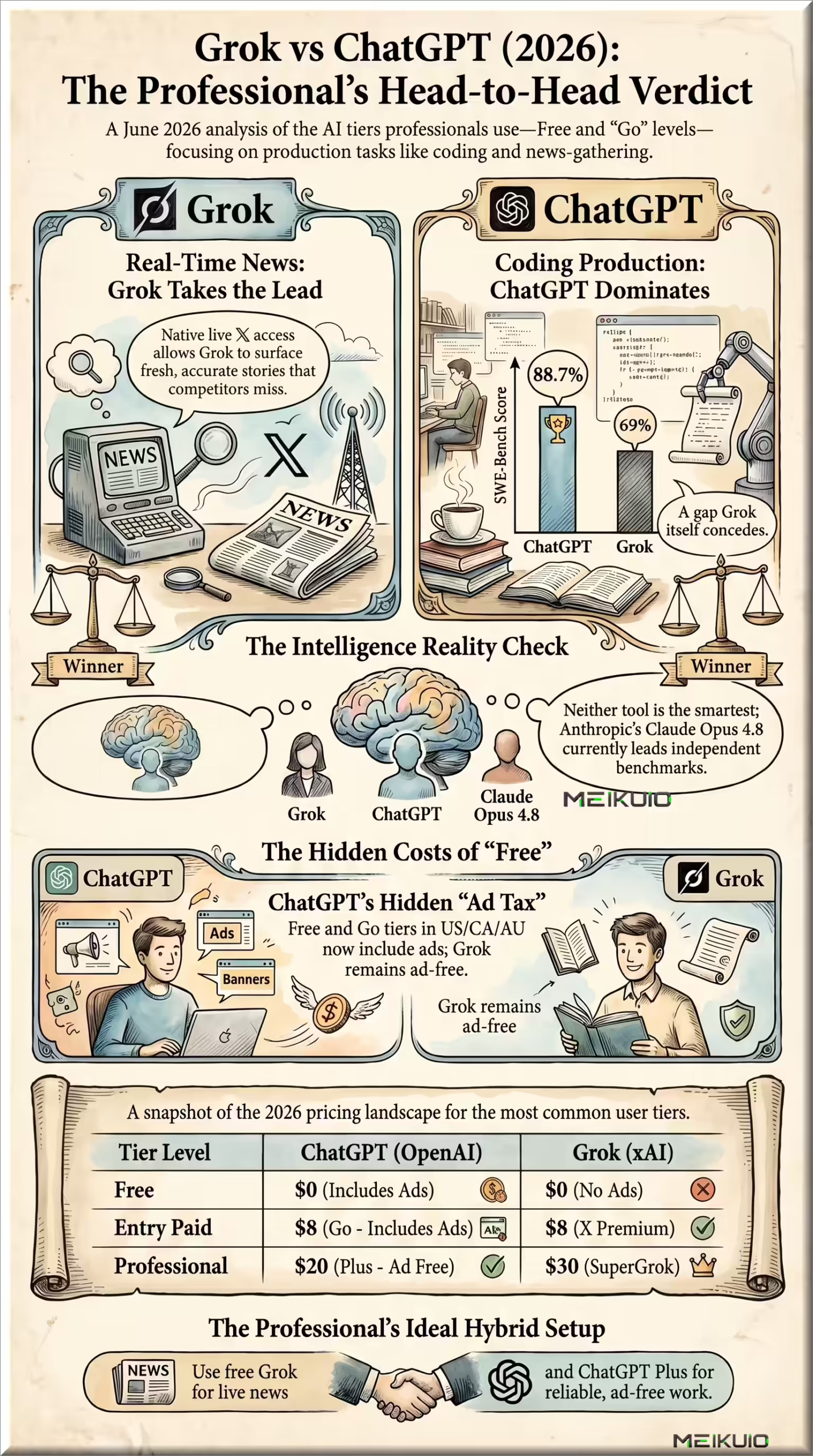
Start here, because it changes what “free ChatGPT” even means. OpenAI began showing ads inside ChatGPT on the Free and Go tiers, first in the US on February 9, 2026, then across Australia, New Zealand, and Canada in mid-April, and the UK in early June. Two of our three core regions are already in the rollout. The ads are labeled sponsored and sit separate from the model’s answers, and OpenAI says your chat content isn’t shared with advertisers. Plus, Pro, Business, and Enterprise stay ad-free.
“Free ChatGPT” increasingly means ad-supported ChatGPT, and that reframes the entire budget math.
I’m on ChatGPT Go and haven’t seen an ad yet from where I am, which tells you the rollout is regional and staged rather than flipped on everywhere at once. But if you’re a free or Go user in the US, Canada, or Australia, you’re either seeing ads now or about to. Grok’s free tier carries no ads in the chat. That doesn’t make Grok automatically better, but it reframes the budget question: “free ChatGPT” increasingly means “ad-supported ChatGPT,” and that’s worth knowing before you pick a default.
Pricing: Every Plan, Both Sides
The lazy comparison pits SuperGrok ($30) against ChatGPT Plus ($20) and stops there. That skips the tiers most people actually start on. Here is the full ladder, in USD as of June 2026.
Free ChatGPT and Go show advertising in the source markets US, CA, AU, NZ and UK. Grok’s budget tier is ad-free. Plan names and allocations remain in the full existing table; this graph uses a linear price axis, replacing the old square-root display.
What the free tiers actually give you matters more than the $0. Free Grok runs the older Grok model with a tight cap, roughly 10 messages per two-hour rolling window, and image and video generation are mostly locked behind paid tiers. ChatGPT Free runs GPT-5.5 but throttles you to about 10 messages every five hours before dropping to a mini model, plus ads. In my own use both free tiers run out fast, and the daily caps stop you on any long session. Neither cheap tier is built for sustained work, and that’s the honest baseline.
ChatGPT Go at $8 lifts the ceiling to around 160 GPT-5.5 messages per three hours, which is the real step up from free, though it still doesn’t include Deep Research or full agent features (those start at Plus). Grok’s $30 SuperGrok is the tier that unlocks the full Grok 4 series, higher limits, and image and video generation. If you want exact, current per-model pricing for either, I keep a live breakdown on the AI pricing comparison page.
Real-Time News and Live Data: Grok, and It’s Not Close
This is Grok’s home turf, and it earns it. Grok has native, live access to X and the web, so it answers from what’s posted right now instead of a training cutoff. I gave both the same test: name the three biggest AI news stories from the past seven days, with a source for each, and skip anything you can’t verify.
Free Grok returned three real, correctly dated stories: OpenAI’s confidential IPO filing, Anthropic’s launch of Claude Fable 5, and the US government’s export-control order that forced Anthropic to suspend Fable 5 and Mythos 5 days later. I checked every one against live sources, including my own explainer on DeepSeek V4 for context on the wider model field. All three held up. I went in skeptical, half expecting it to invent something, but the freshness was legit, fresher than my own read of the week. The catch: Grok named outlets loosely (“TechCrunch, CNBC, BBC”) rather than handing me clickable links.
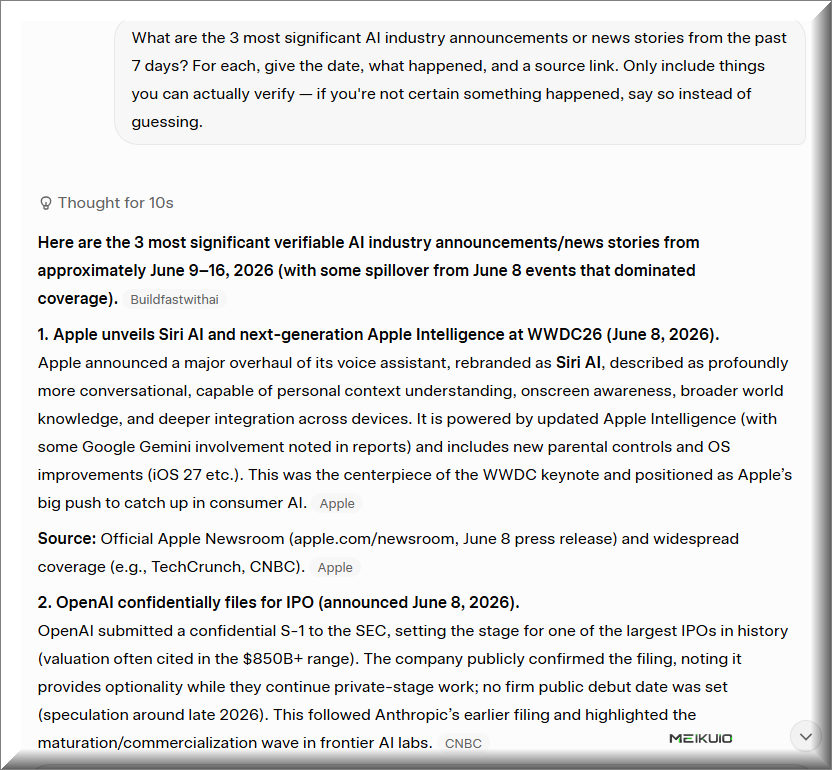
ChatGPT Go surprised me here. The old line that ChatGPT can’t do real-time is out of date. It also returned three real, current stories, two of them the same Anthropic items Grok caught, plus a $35 billion Apollo and Blackstone compute deal with Broadcom that Grok missed. And it gave precise, clickable primary-source links for each. The twist: ChatGPT deliberately left out the OpenAI IPO, explaining it couldn’t confirm a primary source within the window and would rather skip it than guess. That story was true. So ChatGPT was the more careful one, and being careful cost it a real headline.
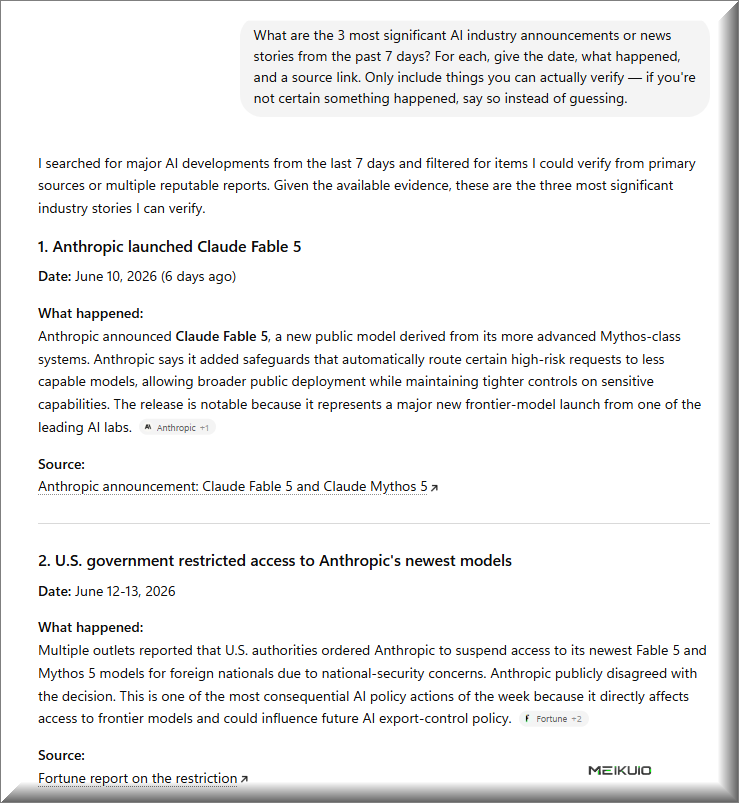
That’s the difference that matters, more than naming a winner. Grok casts the wider net and sounds sure; ChatGPT links cleaner sources and would rather stay silent than risk a miss. Two different definitions of trustworthy. For breaking news and the pulse of right now, Grok. For news you’ll cite or forward where every link has to hold, ChatGPT.
Research and Fact-Checking: A Tie With a Tell
Research is what I lean on these tools for most, so I ran a second test: list the exact current pricing for every SuperGrok and ChatGPT plan, with a source per number, and say so if you’re unsure. Both got the prices right. The difference was in how they handled doubt.
ChatGPT flagged its own soft spots without being asked: it told me which two prices it was least sure about and why, and pointed at real pricing pages. Grok delivered the same correct numbers but with a confident “no major discrepancies found,” no hedging, and looser sourcing. It also skipped the short summary I asked for on the first try and only produced it when I asked again. Small thing, but it’s the texture of using each one.
More Read

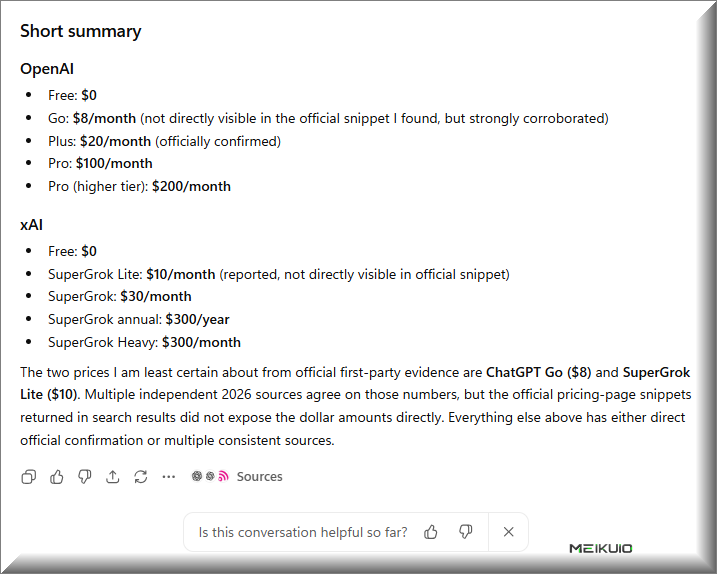
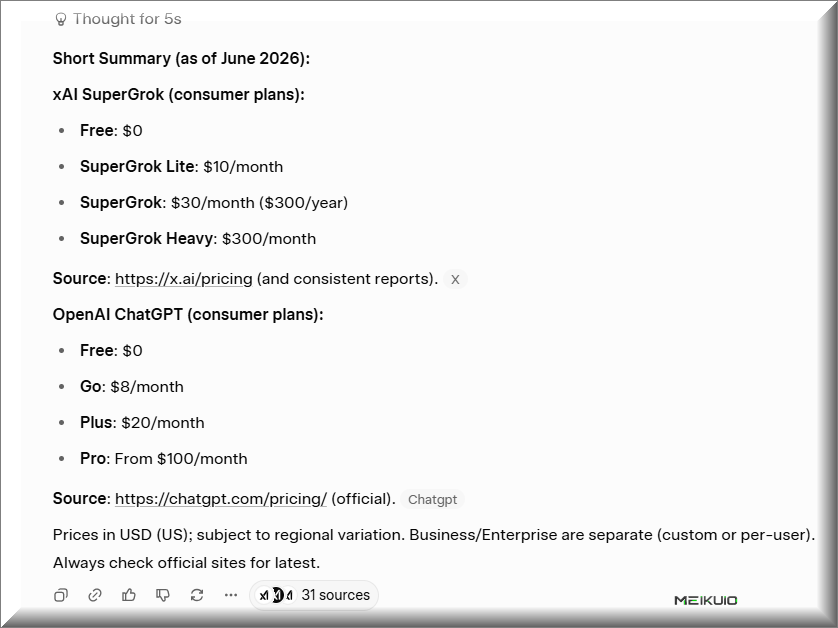
Neither was wrong. But for fact work I want a tool that shows where it’s standing on solid ground and where it’s reaching, and ChatGPT did that better. Grok’s confidence is great when it’s right and a trap when it isn’t, and on a fact-check you can’t always tell which you’re getting. If you cross-check everything anyway, Grok’s speed and reach win. If you want the model to flag its own uncertainty, ChatGPT.
Coding: ChatGPT, and Grok Says So Too
If you write code, ChatGPT is the safer default. GPT-5.5 hits about 88.7% on SWE-Bench Verified, the most-cited real-world coding benchmark, against Grok 4’s roughly 69% (see our benchmark breakdown in the best AI coding tools guide). On Terminal-Bench 2.0, which tests multi-step command-line work, GPT-5.5 scores 82.7%. Engineers OpenAI quoted weren’t subtle about it. One at NVIDIA said “losing access to GPT-5.5 feels like I’ve had a limb amputated,” and Dan Shipper of Every called it “the first coding model I’ve used that has serious conceptual clarity.”
The fair caveat: xAI hasn’t published standardized SWE-Bench scores for Grok 4.3, so the Grok number is from the prior version and independent testing, not a head-to-head xAI claims. But the direction is clear, and Grok doesn’t dispute it. When I asked Grok point-blank what ChatGPT does better, coding was the first thing it gave up.
I Asked Grok to Critique Itself. It Was Honest.
The most useful answer in this whole comparison came from Grok, about its own weaknesses. I asked it directly what it does better than ChatGPT and where it falls short. On its strengths it was predictable: “I have native, real-time access to X (Twitter) data, that’s my biggest unique strength,” plus a “less filtered, more truth-seeking style” with fewer refusals. Fair enough, and my tests back the real-time part.
What stood out was the candor about its limits:
“ChatGPT often produces more consistent, well-formatted, professional writing, lower hallucination rates in broad tasks, and better ecosystem integrations. It’s frequently preferred for coding production work, long-form synthesis, and business use.” Its own verdict: “Choose me for real-time X/social intelligence, unfiltered exploration, and fun/technical digging. ChatGPT wins for polished, reliable, enterprise-grade workflows. Many people use both depending on the task.”
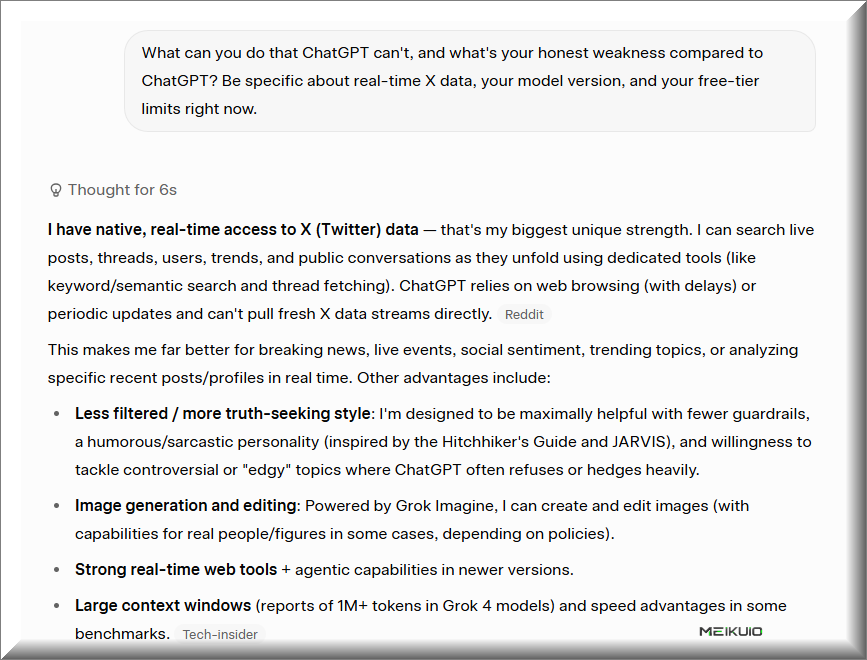
When a tool concedes coding, polish, and reliability to its rival on the record, that is worth more than any benchmark.
When a tool concedes coding, polish, and reliability to its rival on the record, that’s worth more than any benchmark chart. It also matches exactly what I saw in use.
Writing, Tone, and Images
For writing the divide is personality versus polish. ChatGPT produces cleaner structure, more consistent formatting, and copy that needs less cleanup for professional use. Grok writes looser and more conversational, with a sarcastic streak it’ll happily lean into, and it engages edgy or controversial prompts ChatGPT tends to refuse or wrap in disclaimers. For a client deliverable, ChatGPT. For a punchy post with attitude, or a topic ChatGPT keeps dodging, Grok.
On images and multimodal voice, Grok’s Imagine engine leans into photorealistic faces and a looser content policy, including renderings of real people that ChatGPT won’t touch, and it does image and video in the same thread (up to 2K, 15-second clips). On the spoken side, OpenAI expanded natural conversation with GPT-Live, while ChatGPT’s image generation is more careful and better at packing accurate text into a picture. Different tools for different risk appetites. If image and video generation is your main use, the Claude vs Gemini comparison for creators covers that ground in more depth.
Key Facts: Grok vs ChatGPT (June 2026)
Which One Should You Pick?
Choose Grok if you:
- Live on X or track breaking news, trends, and public sentiment in real time.
- Want fewer refusals and a more conversational, unfiltered assistant.
- Build on the API and care about cost, where Grok is roughly four to twelve times cheaper.
- Want image and video generation with a looser content policy.
Choose ChatGPT if you:
- Write or debug code, or need long-form work that holds together.
- Want research where every claim comes with a source you can click.
- Value a model that flags its own uncertainty instead of bluffing.
- Will pay $20 for Plus to skip the ads now on Free and Go.
The cleanest setup is free Grok for live news plus ChatGPT Go or Plus for everything else. Two tools, about $8 to $20 a month, and you’ve covered both jobs without paying for a $300 tier you’ll never max out. For how these two fit next to the rest of the field, see my roundup of ChatGPT alternatives worth switching to and the head-to-head on ChatGPT vs Claude for writing.
Field notes
- The lineup: Grok 4.3 (xAI, April 30, 2026) tested against GPT-5.5 (OpenAI, April 23, 2026) across free, Go ($8/mo), Plus ($20/mo), and SuperGrok ($30/mo) tiers.
- Coding benchmark: GPT-5.5 reaches ~88.7% on SWE-Bench Verified and 82.7% on Terminal-Bench 2.0; Grok 4 records ~69% (independent testing).
- Ad rollout: OpenAI ads live on Free and Go tiers across the US (Feb 9, 2026), Canada, Australia, NZ (April 2026), and the UK (June 2026); Plus ($20) remains ad-free.
- API pricing: Grok API runs $1.25/M input and $2.50/M output; GPT-5.5 runs $5.00/M input and $30.00/M output (4x to 12x price delta).
- Real-time retrieval: Grok features native real-time X and web crawling; ChatGPT Go uses search grounding with strict primary-source validation.
- Sources: OpenAI documentation, xAI rate cards, SWE-Bench Verified leaderboard, live testing in June 2026.
Frequently Asked Questions
Is Grok better than ChatGPT?
It depends on the job. Grok is better for real-time news, X data, and unfiltered answers. ChatGPT is better for coding, polished writing, and sourced research. In my tests neither was the all-around winner, and Grok itself concedes coding and reliability to ChatGPT.
Is Grok free? How many messages do you get?
Yes, Grok has a free tier on X and grok.com, but it’s tight, around 10 messages per two-hour rolling window on the older model, with image and video generation mostly locked. For the full Grok 4 series and higher limits you need SuperGrok at $30 a month.
Does ChatGPT really show ads now?
Yes, on the Free and Go tiers. OpenAI started in the US in February 2026 and rolled ads out to Canada, Australia, and New Zealand in April, and the UK in June. They’re labeled sponsored and kept separate from answers. Plus, Pro, Business, and Enterprise stay ad-free.
Which is better for coding, Grok or ChatGPT?
ChatGPT. GPT-5.5 scores around 88.7% on SWE-Bench Verified versus Grok’s roughly 69%, and it’s the model engineers reach for on production work. Grok is competitive and cheaper on the API, but for serious coding ChatGPT leads.
Is ChatGPT Go worth it over the free plan?
If you hit the free limits often, yes. Go lifts you to about 160 GPT-5.5 messages per three hours for $8, a real jump from free. But it still shows ads and skips Deep Research and full agent features, which start at Plus ($20). If ads bother you, Plus is the cleaner pick.
Which is better for real-time information?
Grok, for breadth and speed, thanks to native live X access. But on my test ChatGPT Go also surfaced accurate same-week news with cleaner source links, so the gap is smaller than it used to be. Grok casts the wider net; ChatGPT backs each claim with a link.
My Take
I came in expecting to catch Grok bluffing and ended up impressed. On a week of real AI news it pulled three accurate stories I had to verify against live sources, and it beat my own sense of the week. That real-time edge is the realest thing it has, and it’s why I’d keep free Grok open in a tab.
The moment I need code, a clean draft, or research where the links have to hold, I’m in ChatGPT, and Grok told me as much when I asked it to be honest. The ads on Free and Go nudge me toward paying for Plus rather than living on Go. The right answer isn’t one of them: it’s free Grok for the pulse of now, ChatGPT for the work, and a bit of skepticism pointed at whichever one sounds most certain.