

AI chip stocks are easy to name and hard to define. Five sources, counted on the same day, put the number of AI chip companies at 6, 26, 65, 86 and 117. The list you buy from decides what you end up owning, and most lists never print the rule that let a company onto them.
- What counts as an AI chip stock, and who decides
- What you own when you buy the popular list
- The people who classify companies for a living tried this and stopped
- The chain, layer by layer, and which layers you can actually own
- What the filings show that no list shows
- Why customer concentration is the number the lists skip
- The category moved in 2026, and the lists moved with it
- The AI chip stocks you cannot actually buy
- Called chip stocks, but they make no chips
- Where Nvidia sits, and what would move it
- Export controls and the part of the chain nobody can move
- Funds with the same label hold different companies
- Memory is in, bulk storage is arguable, and that boundary decides your list
- The answer above the search results is not a fixed thing
- Four names that trip people up
- How to read any AI chip stocks list before you trust it
- Frequently Asked Questions
- What counts as an AI chip stock?
- Is there an official AI chip category for investors?
- Why do published AI chip stock lists disagree so much?
- What is the difference between a foundry and a fabless company?
- Do memory makers belong in an AI chip list?
- Can I buy shares in private AI chip companies?
- Are AI chip ETFs a simpler way to get exposure?
- My Take
Note
This article is reporting, not financial advice. Nothing here is a recommendation to buy or sell anything. Every figure is quoted with the document and the date it came from, because in this sector a number without a date is close to useless. Do your own research and speak to a licensed advisor before investing.
Two things happened in 2026 that make the definition question worth an hour of your time. The bodies that classify companies for a living looked at creating an AI chip category and decided they could not do it. And a fund with the words “AI Chip” in its name arrived with something most published lists still lack: a rule printed on its own page.
What counts as an AI chip stock, and who decides
Nobody owns the term AI chip stocks. No regulator or exchange maintains an official category for this, and the one index-based list in our count reaches 26 names. Everyone else builds their own list, and the rules they print are not comparable. We ran into the same problem writing about the wider AI stock market, where the category is broader and the rule is just as absent. We counted five of those lists on 4 September 2026 and recorded what each one says about its own membership rule.
Two of these sources head their list AI stocks rather than AI chip stocks, which is part of the problem: the wider heading is where the 65 and the 86 come from. The six-name figure is a synthesised answer that changes between captures, so treat it as the least stable row here. When we reopened four of the pages on 4 October, the 26, 65 and 86 had not moved and Simply Wall St’s global list had grown from 117 to 124. StockTitan’s page also carried a section on 5 October, “How Do We Pick the Stocks on This List?”, that asks for documented evidence of AI revenue or of a role in the AI supply chain and sets no numeric threshold; we recorded no rule on 4 September.
The pattern is worth sitting with for a second. Among the sources that publish a rule at all, the shortest list is the one with a number in it and the longest is the one whose rule is a sentence about exposure. The other two printed no rule on the day we counted, and the difference between 26 companies and 117 is not disagreement about the industry. It is the absence of a definition.
Five sources counted on the same day put the number of AI chip companies at 6, 26, 65, 86 and 117.
We took the 65-name list and sorted it ourselves, using one rule stated up front: a company counts as making chips if it designs or manufactures semiconductor devices sold as chips. Equipment makers, design software, IP licensing, servers, clouds and applications get their own rows rather than a shrug.

That rule has a hole in it, and the hole is the point. It tests the word chip and says nothing about the word AI, because no company publishes an AI share of revenue that an outsider can check. A power-conversion chip sold into an AI server is a chip by this rule and an ordinary analog business by any other measure. This is the same wall the classification bodies hit, and pretending otherwise is what produces lists of 117 names. The workable answer is two questions rather than one: does the company make chips, and which layer of the buildout does it sell into.
Ten of the 65 design or manufacture chips. Three build the machines that make chips, and three sell design software or processor licences without shipping silicon. The remaining 49 sit outside the semiconductor chain entirely, and that group includes Iron Mountain, which rents archive space, along with Shutterstock and Sprout Social. A reader who bought “the AI stocks list” would be buying all of them.
Disagree with a row and you have exactly what the lists do not give you: a rule to argue with.
Intel is not on that 65-name list at all, which is worth noticing given the GICS document names it as a canonical chip designer two sections from here. Two other entries deserve their argument stated rather than buried. TSMC makes chips for other companies and designs none of its own, and that distinction is the one the classification bodies now propose to act on. Arm sells licences and never ships silicon, so it belongs in a chip list only if the rule says so out loud. Both are defensible calls. Neither is obvious, and no list we read explained which way it went or why.
What you own when you buy the popular list
The 65-name list is worth walking through, because it is the one most likely to be behind a screener result or a fund’s marketing page. Sorted by our rule, 16 of those 65 names sit anywhere inside the semiconductor chain. The other 49 do not.
The 49 are not junk companies. They include large software platforms, cloud providers, a robotics business, a lending company that uses machine learning for credit decisions, and a records-storage business that rents physical and digital archive space. Each has a real AI story. None of them makes a chip, and a reader who came looking for semiconductor exposure would be buying software and services for most of the position.
The same page carries something else worth noticing. When we read the page on 4 September, a list of 78 related exchange traded funds sat below the company table, several of them named after private AI labs whose shares nobody can buy. A fund named for a private company is holding something else, and the name is doing work that the holdings page has to undo.
None of this makes the list dishonest. It publishes its rule, and the rule says exposure to the growth of AI technology, which those 49 companies genuinely have. The gap is between what the rule allows and what a reader searching for AI chip stocks expects to find, and that gap is 49 names wide.

The people who classify companies for a living tried this and stopped
On 17 July 2026, MSCI and S&P Dow Jones Indices opened a consultation on changing the Global Industry Classification Standard, the scheme that decides which sector a listed company belongs to. Index funds and screeners lean on it. Coverage of this sector leans on something looser, which is whatever the vendor published that week, and we traced how far that can drift in the June 2026 model releases. They asked the market whether the semiconductor category should be split, and they named the one split they had already rejected: separating AI logic and compute chips from everything else. Their stated reason:
limited company disclosures make this impractical to apply consistently. Companies such as Broadcom, AMD, and Intel typically report mixed-use segments, making systematic differentiation by chip type unreliable.
GICS Consultation 2026, MSCI and S&P Dow Jones Indices, 17 July 2026
Read that against the listicles. The bodies with the most resources, the clearest incentive and full access to company filings looked at the exact question every publisher answers casually. They found that the data does not support it. When a company reports one segment that mixes AI accelerators with everything else, no outsider can split that segment by chip type without guessing.
What they propose instead is close to the structure this article uses, with one difference we should name: our sort keeps TSMC beside the designers for counting purposes, while the proposal would move contract manufacturers into their own group. Semiconductors would keep chip designers and integrated device manufacturers, the companies that design and sell their own silicon. A new sub-industry called Semiconductor Manufacturing Services would take contract foundries, outsourced assembly and test providers, and advanced packaging companies. The document names TSMC, SMIC and ASE Technology as examples of the new group, and Nvidia, Broadcom, AMD and Intel as examples of the old one.
The consultation closes on 30 October 2026 and the outcome is announced in November. Nothing has been adopted, and the document says so in its own disclaimer. That timing matters for anyone reading a sector fund’s holdings, because if the split goes through, funds tracking these categories will hold visibly different baskets without changing their names.
The classification bodies rejected an AI chip category in 2026 because company disclosures cannot support it consistently.
The same document prints the principle behind the decision on a page of its own. Its wording is that “GICS classifies companies by what they do”, and not by the technology they use, the inputs they consume or the trends they represent. Applied to this sector, that sentence quietly disqualifies most of what publishers put under the AI chip heading, because those lists follow the trend rather than the work.
The chain, layer by layer, and which layers you can actually own
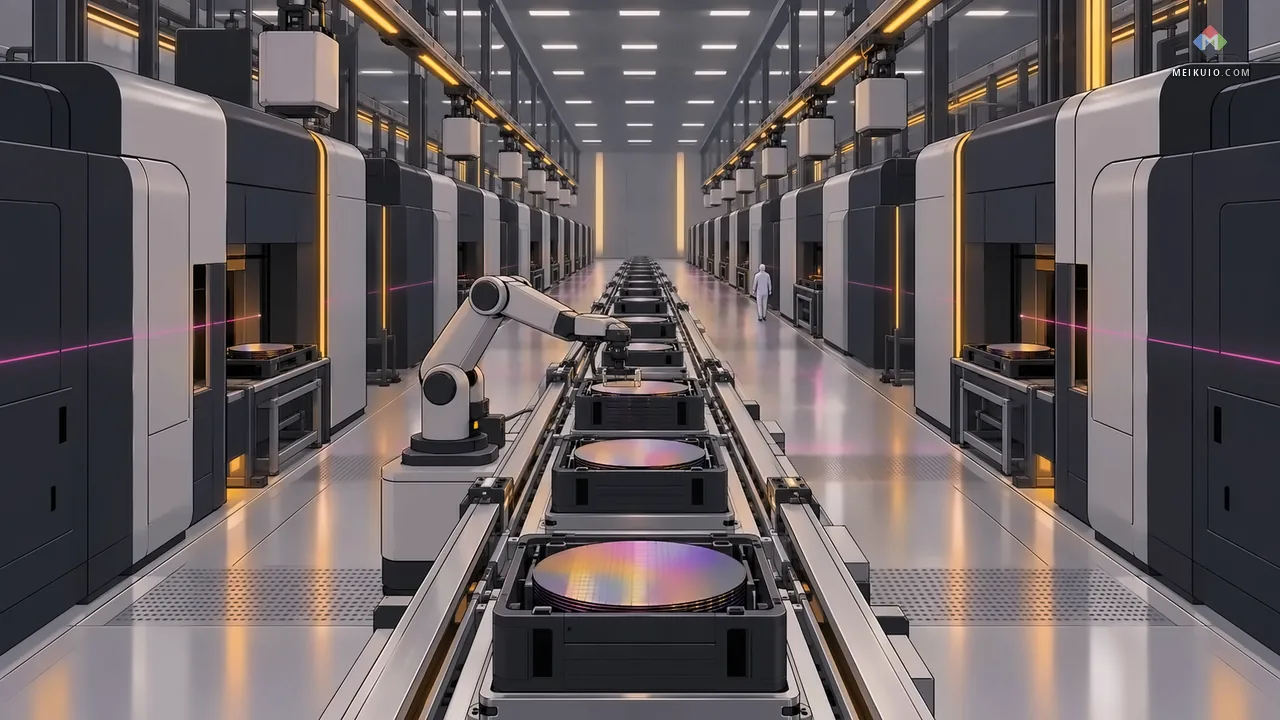
Any list of AI chip stocks is the visible end of a chain that runs from sand to a rack. Each link is a different business with different economics, and only some of them have a listed pure play a US investor can buy. Sorting the names by layer is the fastest way to see what a portfolio actually holds, and it is the sort the published lists skip.
The materials layer has the fewest listed pure plays and the least room to improvise. Wafers, photoresist and packaging film have no substitute inside a production cycle, and a fab that runs out of them does not switch supplier in a quarter. That is a structural fact about the industry, and one company’s own filing puts a number on it.
GlobalFoundries, a listed foundry, told the SEC that it bought 71.4% of its silicon-on-insulator wafers from a single supplier in 2025, up from 60.9% the year before. Silicon-on-insulator is a specialist wafer with an insulating layer built in, used for radio-frequency and power parts rather than for accelerators, so this is not an AI-specific number. It is the clearest published example of what single-supplier dependency looks like in this industry, which is why it is here. The same filing names the supplier, Soitec, and says replacing it would take an extended period. So Soitec, a company most AI chip lists leave out, is the one GlobalFoundries calls its primary supplier of a key input.
Sorting by layer also settles an argument the lists have with themselves. Equipment makers appear on some AI chip lists and not others, and both choices are defensible once the rule is stated. The indefensible move is putting a lithography company and a cloud provider in the same list under the same heading without a word about why either one is there.
What the filings show that no list shows
Every list we read ranks these companies by something the publisher chose: analyst price targets, year-to-date return, an in-house score. None of them ranks by the one source that is dated, signed and legally binding, which is what each company files with the SEC. The same method settles arguments elsewhere: reading the filings is how we worked out who actually owns ChatGPT, who owns Microsoft, and which clinical tech vendors report verified revenue in AI healthcare stocks. Three filings are enough to show what that changes.
Fiscal years differ and so do the bases: Amkor reports shares of net sales, Credo shares of revenue, GlobalFoundries shares of wafer revenue and of one input. The rows are not comparable with each other and are not meant to be.
Start with Amkor, because its filing does something unusual. In the business section it names the customers: direct sales to Apple and Qualcomm accounted for 29.8% and 11.1% of net sales for the year ended 31 December 2025. Later, in the notes to its financial statements, the same two figures appear attached to “our two largest customers” with no names. One document, two levels of disclosure, and only one of them is quotable in a headline.
For a reader, that pairing is the useful part. Amkor packages chips for the AI buildout, and two customers tied to the smartphone market account for roughly two fifths of what it sells. Its ten largest customers account for 72%. Anyone holding Amkor as an AI position is also holding a bet on phone volumes, and the filing says so in plain language on a page nobody links to.
GlobalFoundries shows the same thing from the supply side. Its largest customer was 16.4% of wafer revenue in 2025, which is unremarkable. The number that matters sits in a different note: 71.4% of its silicon-on-insulator wafers came from one supplier, against 60.9% a year earlier. Concentration on the buying side went up while concentration on the selling side stayed flat, and only one of those is a headline anywhere.
Credo is the sharpest case, and the one where a stale number does real damage. Its most recent annual filing, for the year ended 2 May 2026, reports two customers at 49% and 32% of revenue, with the ten largest at about 90%. The prior year, one customer alone was 67%. A list quoting the 67% figure today is not lying; it is a year behind, and it points the reader at the wrong risk.
Amkor names Apple at 29.8% of net sales in its business section and anonymises the same figure in the notes to its financial statements.
None of these three appeared in either AI Overview capture we took on 4 September 2026, and none of them is on the 65-name list. On 5 October only Credo was on the 86-name one, so even the longer list skips the packager and the foundry, and the longer a list runs, the less its heading means. Two of the three also sit in the layer the classification bodies propose to break out, because packaging and foundry are where the chain is thin, and thin is where the disclosures get specific.
Why customer concentration is the number the lists skip
Concentration is a plain question with a filed answer: how much of this company’s revenue comes from its largest customers, and whether that share moved this year. Accounting rules require disclosure once a single customer passes 10% of revenue, so the figure exists, in some form, for every listed name in the chain. It almost never appears in an AI stock list, and the reason is structural rather than lazy.
A list sorted by return or by analyst upside is built from market data, which updates every second and needs no reading. Concentration lives inside a document that updates once a quarter and has to be opened. The same gap between a marketed number and a filed one turned up when we compared Microsoft MAI against Claude. The first kind of list can be generated. The second has to be written, and that difference shows in the top-ranking pages we read.
For a reader deciding where to put money, concentration answers something a return figure cannot. It tells you how many phone calls it would take to change this company’s year. When two customers are 81% of revenue, as at Credo, the investment case is partly a bet on the purchasing plans of two organisations you cannot see. That is not an argument against owning it. It is an argument for knowing it.
The same reading works in the other direction. Supplier concentration of 71.4% on one input, as at GlobalFoundries, means a disruption at a company most readers have never heard of lands directly on one they have. Those two sentences are the whole reason to read filings instead of lists, and they take about ten minutes per company to find.
The category moved in 2026, and the lists moved with it
For two years the phrase AI chip meant a graphics processor. In 2026 the strongest returns on the lists we read came from memory and storage, and those lists followed the returns rather than the definition. That shift is worth understanding, because it is the clearest example of a list changing shape without changing its rule. The same pattern ran through quantum computing stocks, where an index rose on components rather than on the technology in its name.
One publisher makes the point without meaning to. U.S. News ran a list of the five best-performing AI stocks on 10 August 2026. Two of the five make memory chips, two make hard drives, and the fifth builds servers. Two of those five make chips and three do not, and the page draws no such line anywhere on it. Eight days later the same publisher ran seven best semiconductor stocks, and the two lists share exactly one name. We read both on 4 September.
The overlap is not the interesting part. The numbers are. The 10 August list gave Micron’s 2026 return as 207.7%. The 18 August list, same publisher, gave 255% and added 737% over the past year. Neither table printed a measurement date, so a reader arriving from a search could not tell which one described today. The second article has since been updated: on 5 October it is dated 23 September and gives 284% and 566%, still with no measurement date beside either figure.
Neither figure is wrong. Year-to-date returns move daily, and eight days in a volatile sector explains the gap on its own. The problem is presentation. A percentage without a measurement date cannot be checked or compared, and those percentages are the basis on which most of these lists are ordered.
The practical rule for a reader is short. When a list ranks by performance, look for the as-of date before you look at the ranking. If the page does not print one, the ranking describes an unknown day, and the order of the names is the first thing that will be wrong.
The AI chip stocks you cannot actually buy
A recurring feature of AI chip stocks lists is companies that a US retail account cannot hold. They sit in the same table as tickers, described in the same voice, with nothing marking the difference. For a reader building a position, that is the most expensive kind of omission, because it costs a research session before it costs anything else.
Three groups turn up repeatedly. Private accelerator companies get named because their hardware is genuinely interesting and their funding rounds are newsworthy, and none of them has a ticker. In-house silicon programmes run by cloud and platform companies get named because the chips are real, but the chip is not the product and the shares buy a search engine or a retailer instead. Companies listed only in Tokyo, Taipei or Seoul get named because the chain depends on them, and a standard US brokerage account will not reach several of them. The usual workarounds are pre-IPO marketplaces and funds holding a sliver of the company, and both carry the problems we set out in how to buy OpenAI stock and in Neuralink stock.
The practical filter takes one line. Before a name goes on your own list, check whether it has a ticker your broker will accept. If the exposure is indirect, write down what fraction of the parent business the AI silicon represents. Neither question requires a subscription, and both remove more names than any valuation screen will.
There is one honest caveat here. Private company status changes without warning. One name our own research called private, Blaize, turned out to be trading publicly and sitting in an index we quote later in this article. Status is the fastest-decaying fact in this sector, which is why every claim of that kind in this article carries the date it was checked.
Called chip stocks, but they make no chips
The opposite error is more common and easier to check. Server builders, cooling and power vendors, cloud operators and analytics firms all appear on AI chip stocks lists, and most of them never claim to make semiconductors. The evidence sits in the same place as everything else in this article, which is the filing.
Vertiv is the cleanest example. It builds power and cooling systems for data centres, and its reporting segments are geographic rather than product-based. The SEC lists it under standard industrial classification 3679, electronic components not elsewhere classified. Semiconductor companies sit under 3674. The company’s own regulatory record puts it outside the chip category that lists keep placing it in.
Super Micro assembles servers and racks around processors it buys. Arista builds switches around merchant silicon. CoreWeave rents access to accelerators it does not design, and the 2026 GICS consultation names it as an example of a high-performance computing service rather than a semiconductor business. Each of them is a legitimate way to hold AI exposure. None of them is a chip company, and a list that stays silent describes a different market than the reader thinks.
The SEC files Vertiv under electronic components, not semiconductors, while AI chip lists keep putting it in the chip category.
Where Nvidia sits, and what would move it
Nvidia appears on every list we counted, including the six-name answer Google writes above the results, so its position needs no defending. The useful question is narrower: what would have to change for the rest of the category to matter more, and which of those changes is visible in documents rather than commentary.
Three shifts are already documented elsewhere in this article. Cloud and platform companies design their own accelerators, which converts a customer into a competitor while keeping the same purchase orders alive for a while. Custom silicon partners build those chips, which moves value to companies that never appear in a consumer headline. And the classification bodies now propose to separate chip designers from chip manufacturers, which changes what a sector fund holds without changing what it is called.
What none of that settles is timing, and anyone offering you a date is guessing. Comparing accelerators as products rather than as tickers needs a different method, so we are writing it as its own article rather than compressing it into a paragraph here.
Export controls and the part of the chain nobody can move
Every company in this chain files a risk factor about export licensing, and the language is more specific than the summaries suggest. Design software, manufacturing equipment and finished accelerators have all been covered by restrictions at different points, and the filings describe licence requirements rather than general geopolitical worry. The demand side of that story shows up in how Chinese models reached US enterprise traffic.
For a reader, the useful reading is not the politics but the dependency map. A restriction that lands on equipment sales affects the layer with the fewest substitutes. The GlobalFoundries disclosure shows what a single-supplier dependency looks like on paper: 71.4% of one key input from one company. Supply chain security in this sector is a documented number, not a mood.
That is also the honest limit of this bridge. Export policy moves faster than any article, and the rules in force on the day you read this may differ from the ones the filings describe. Treat the risk factors as a map of what each company thinks can break, and check the current rules separately before acting on any of it.
Funds with the same label hold different companies
Buying a fund looks like a way around the definition problem in AI chip stocks, and mostly it moves the problem somewhere less visible. We checked six funds: VanEck SMH, iShares SOXX, Invesco SOXQ, SPDR XSD, Global X CHPX and Defiance AINF. Four of them define no AI category at all and rely on an index provider’s sector classification. The two that do, Global X CHPX under an AI semiconductor label and Defiance AINF under an AI chip label, both start from a 50% revenue threshold, and at least one of them softens it with a second, undefined branch.
The fund that puts the words in its name is worth opening. The Defiance Inference AI Chip ETF tracks an index requiring at least 50% of revenue from, or demonstrated material involvement in, one of six inference chip segments: inference GPUs, custom AI ASICs, FPGA-based accelerators, AI-optimised CPUs, accelerator modules and neuromorphic chips. It is the most specific published rule we found, and it still has a qualitative branch: material involvement is not defined on the page, which is the same kind of language the screeners use. The resulting index of 26 names includes a test equipment maker and a cloud provider.
One more detail belongs to the reader rather than to the fund, and it changed while we were writing. On 4 September 2026 the fund’s own holdings page listed a government money market fund, a total return swap on the index it tracks and a negative cash line, against net assets of $463,037.92 and an inception date of 17 August 2026. A swap is a contract with a bank that pays the index return; it is not a holding of the shares themselves.
When we opened the page again on 4 October, the fund details were dated 2 October and the page listed 31 holdings: the 26 index names held directly, a money market fund and four cash lines. Net assets were $518,953.91 and no swap was listed. Synthetic replication is a normal way to launch a young fund, and this one had moved off it by 2 October. The fund’s name told you nothing about which version you held. The dated holdings page told you both.
Comparing the semiconductor funds properly means comparing holdings rather than names, and that is a piece of work with its own method. We are doing it separately. For this article the point is narrower: two funds with similar names can hold different companies, and the only way to know which is to open the holdings page.
Memory is in, bulk storage is arguable, and that boundary decides your list
The hardest call in this category is memory, and it is worth making by choice rather than by accident. High-bandwidth memory sits on the same package as the accelerator, connected through an interposer, and it sets how fast the processor can be fed. By any working definition it belongs in an AI chip list.
Bulk storage is a different argument. Hard drives and general-purpose flash hold the data that models are trained on, which makes them necessary, but they sit on ordinary system buses as secondary storage rather than inside the compute package. Including them stretches the category until it covers most enterprise hardware.
This is exactly where the 2026 lists split from their own logic. When storage and server companies posted the strongest returns, they moved to the top of pages headed best-performing AI stocks, and no page redefined the category to explain why. The names whose membership is most arguable became the names presented first.
We draw our own line in one sentence, and readers can disagree with it as long as they know it exists. Memory that ships on the accelerator package is in. Storage that ships in a separate box is a data centre business, which is a real investment and a different one. A list that includes both without a word is not making a call; it is following a return column.
The answer above the search results is not a fixed thing
Search for AI chip stocks today and Google writes the first answer, not a publisher. That answer names about six companies with a line each, which is a reasonable summary and an unstable one. We captured it twice on the same day, through two different tools, and got different text with different sources cited.
One capture cited a general reference site, a fund research house and a hardware publication. The other cited a fund research house, a personal finance site, a stock commentary site and a technology industry blog. The list of names overlapped. The sources behind it did not, and neither capture carried a date a reader could quote.
The takeaway is not that the summary is wrong. It is that a synthesised answer is a snapshot of what a system read at that moment, and it changes without a version history. For anything you plan to act on, the source under the summary is the thing to open. Every figure in this article names the document it came from and the day it was read.
Four names that trip people up
Four naming collisions in this sector cost real research time, and all four are easy to check once you know they exist.
- Chip stocks and blue chip stocks. Search volume around the phrase chip stocks is dominated by blue chip stocks, which means large established companies of any industry and has nothing to do with semiconductors.
- HBM the memory and HBM the ticker. High-bandwidth memory is abbreviated HBM, and HBM is also the ticker of a copper mining company. A search for HBM stock returns the miner, not the memory makers.
- SMCI and SMIC. The same four letters in a different order, and entirely different businesses: one assembles servers in the United States, the other is a contract chip manufacturer in China.
- Chip the component and Chip the author. A well-known book on AI engineering is written by an author whose first name is Chip, and searches for AI chip material return it regularly.
None of these is a trick question, and all four turn up inside ordinary keyword research on this topic. They are listed here because a reader running the same searches will meet them, and because a list assembled by keyword matching rather than by reading can quietly inherit all four. Name confusion has a corporate version too, which is why who owns Claude needed a full article to answer.
How to read any AI chip stocks list before you trust it
The method in this article is repeatable, and it does not need a data subscription. Seven checks, in this order, will tell you more about a list than its ranking does. Everything they need is free: the search page you are already on, the fund’s own holdings page, and the SEC EDGAR database of company filings.
- Find the rule. Scan the page for a sentence explaining who qualifies. If there is none, you are reading a selection, not a category.
- Find the date. Any performance figure without an as-of date is unusable, and any list ordered by such figures inherits the problem.
- Sort the names by layer. Materials, equipment, design software and licences, foundry, packaging, memory, accelerators, host processors, networking, power. A list that mixes layers without labelling them is describing a theme rather than an industry.
- Check who you can actually buy. Private companies and foreign listings without a US line belong in a separate column, not in the same table as tickers.
- Check the company’s own code. Open the company page on the SEC EDGAR database and read the standard industrial classification printed there. Semiconductor businesses sit under 3674. Vertiv sits under 3679. It is one lookup and it settles most arguments about whether a company belongs.
- If it is a fund, open the holdings page. The name tells you nothing. The holdings tell you whether you are buying the companies, a swap on an index, or a basket assembled under someone else’s rule.
- Open one filing. Search the annual report for the words customer and concentration, and check its fiscal year end against today’s date before you trust the number. Ten minutes there will tell you more about the risk than the entire list did, and it is the check we would run before touching any name on a broad AI stock list.
One question deliberately left out of that method is which cheap AI chip stocks are about to move. Search suggestions are full of it, and the honest answer is that nobody knows, including the people writing those lists. The seven checks above are about what a company is, which is knowable, rather than what a share price will do, which is not.
Field notes
- How we counted: five sources opened on 4 September 2026. For four of them the count is the number the page prints about itself, not our tally of rows. The Google AI Overview prints no count, so its figure is our count of the names it gave, and it changed between two captures the same day.
- How we classified: a company makes chips if it designs or manufactures semiconductor devices sold as chips; equipment, design software and IP licensing are counted separately rather than excluded silently.
- Filings: Amkor, GlobalFoundries and Credo figures were read from the filings themselves on EDGAR, not from secondary summaries; fiscal years differ and are printed with each figure.
- What changed under us: one widely repeated concentration figure turned out to be a year old and one company described as private was trading publicly; both were corrected before publication. Between 4 September and 4 October one fund replaced the swap on its holdings page with the shares themselves and one list grew from 117 to 124 names; both are dated where they appear.
- What we did not do: we did not price any company, forecast any share, or verify the full membership of the 86-name and 117-name lists: we checked only the names discussed here, and the 117-name list spreads its roster over several pages.
- Sources: GICS Consultation 2026 (MSCI and S&P Dow Jones Indices, 17 July 2026); SEC EDGAR filings for Amkor, GlobalFoundries, Credo and Vertiv; SEC standard industrial classification list; Defiance Inference AI Chip ETF fund documents; published lists from stockanalysis.com, StockTitan, Simply Wall St and U.S. News; Google AI Overview for the query ai chip stocks, captured twice on 4 September 2026; fund pages for VanEck SMH, iShares SOXX, Invesco SOXQ, SPDR XSD and Global X CHPX.
Frequently Asked Questions
What counts as an AI chip stock?
There is no official definition. Working lists range from six companies to 117 depending on whether they count only accelerator designers or everything from wafer suppliers to cloud providers. The most defensible rule is whether the company designs or manufactures semiconductor devices sold as chips.
Is there an official AI chip category for investors?
No. In its 2026 consultation, GICS considered splitting semiconductors by chip type and rejected it, saying limited company disclosures make that split impractical to apply consistently. The proposal on the table instead separates chip designers from contract manufacturers.
Why do published AI chip stock lists disagree so much?
Because the rules they publish are not comparable. Of five sources we counted, two printed no rule at all and the other three ranged from a 50% revenue threshold to a sentence about exposure. Counts run from six names to 117 as a result.
What is the difference between a foundry and a fabless company?
A fabless company designs chips and owns no factories, sending its designs out to be manufactured. A foundry runs the factories and makes chips to other companies’ designs without selling its own. The 2026 GICS proposal would put them in separate sub-industries.
Do memory makers belong in an AI chip list?
High-bandwidth memory ships on the accelerator package and determines how fast the processor can be fed, so it belongs by any working definition. Bulk storage that sits in a separate box is a data centre business, and including it stretches the category to most enterprise hardware.
Can I buy shares in private AI chip companies?
Not through an ordinary brokerage account. Several of the most discussed accelerator companies have no ticker, and in-house chips built by cloud providers are not separable from the parent company’s shares. Listing status changes, so check the date on any claim about it.
Are AI chip ETFs a simpler way to get exposure?
They move the definition problem rather than solving it. Of six funds we checked, four define no AI category and rely on sector classification. The two that do start at 50% of revenue from qualifying activities, though one adds an undefined branch, and their holdings differ.
My Take
I spent a working day on this and the part that stayed with me was not any company. It was that the professionals whose job is to sort companies into categories looked at this one and said the disclosures cannot support it. They published that in a consultation document while dozens of pages went on ranking the same names by last week’s returns. When the people with the most data decline to draw a line, a list that draws one silently is not being decisive. It is being quiet about a judgement call.
If I were building this position for a team, I would start with the layer question rather than the ticker question, and I would open one filing before adding any name. The two figures that changed my view were both filed rather than reported: a packaging company whose two largest customers sell into the smartphone market, and a foundry that buys 71.4% of one key input from a single supplier. Neither number appears on any list I read. Both took ten minutes to find, and both are the sort of thing you want to know before, not after.