

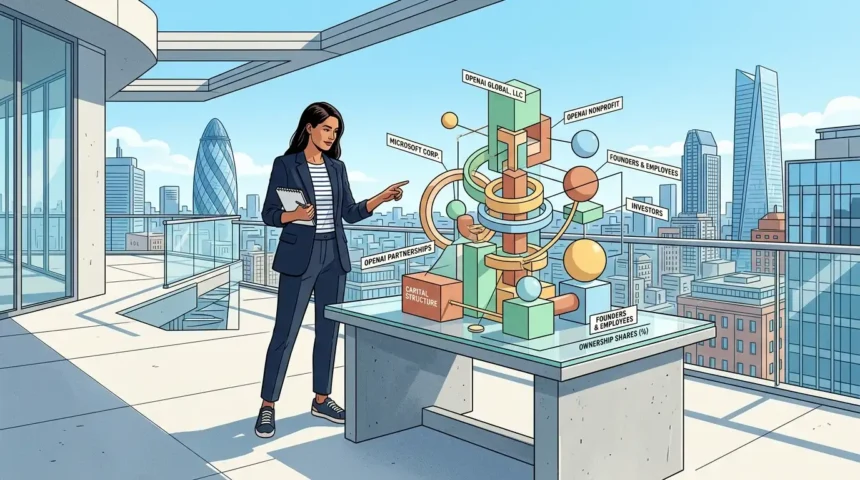
ChatGPT is owned by OpenAI Group PBC, a public benefit corporation controlled by a nonprofit that does not own most of it. Anyone asking who owns ChatGPT is asking two things: who holds the equity, and who can change the product. The answers differ, and the gap is what your team is exposed to.
- Who owns ChatGPT? The short answer
- The four instruments that decide who controls OpenAI
- Control is one share, not a percentage
- Equity: who holds what, and on which date
- The number the whole field gets wrong
- The warrant: what the nonprofit gets after fifteen years
- Who owns OpenAI?
- What Microsoft actually holds
- Who can stop a model from shipping?
- So who controls the Foundation?
- The two attorneys general who signed off
- Does Elon Musk own any of OpenAI?
- Does Sam Altman own ChatGPT?
- How this compares with Anthropic and Claude
- What the top results get wrong
- Can you buy a stake in ChatGPT?
- Why this matters, depending on why you asked
- Frequently Asked Questions
- Who is the real owner of ChatGPT?
- Is ChatGPT owned by Microsoft or OpenAI?
- Does Elon Musk still own any of OpenAI?
- Does Sam Altman own shares in OpenAI?
- Is OpenAI a nonprofit or a for-profit company?
- What is OpenAI Group PBC?
- Can I buy shares in ChatGPT?
- Who decides ChatGPT’s safety rules?
- My Take
Who owns ChatGPT? The short answer
ChatGPT is a product of OpenAI Group PBC, the commercial company OpenAI created when it restructured on 28 October 2025. Ownership of that company was split three ways at the close of the deal: the OpenAI Foundation 26 percent, Microsoft roughly 27 percent, and current and former employees and investors the remaining 47 percent. None of those percentages decide anything. Control sits in a separate instrument, a single share of Class N common stock held by the Foundation, and OpenAI’s own structure page states what it does: the Foundation “appoints all members of the board of directors of OpenAI Group and can replace directors at any time.” Microsoft’s stake appoints nobody. The Foundation’s control does not rest on its 26 percent either, and it would survive the Foundation selling every ordinary share it holds. That is the whole answer, and every other question about who owns ChatGPT is a detail hanging off it.
The four instruments that decide who controls OpenAI
Most pages answering who owns ChatGPT print a pie chart and stop. The pie chart covers one of the four instruments that actually govern the company, and it is the weakest of them. If your team is deciding how much to build on this product, the instrument that matters is not the one with the biggest number attached.
The four run in descending order of real power and ascending order of public attention. A single share decides the board. A pile of ordinary shares decides who gets paid. A warrant decides who gets paid in fifteen years. And two agreements signed with state law officers decide what nobody at the company is allowed to do quietly.
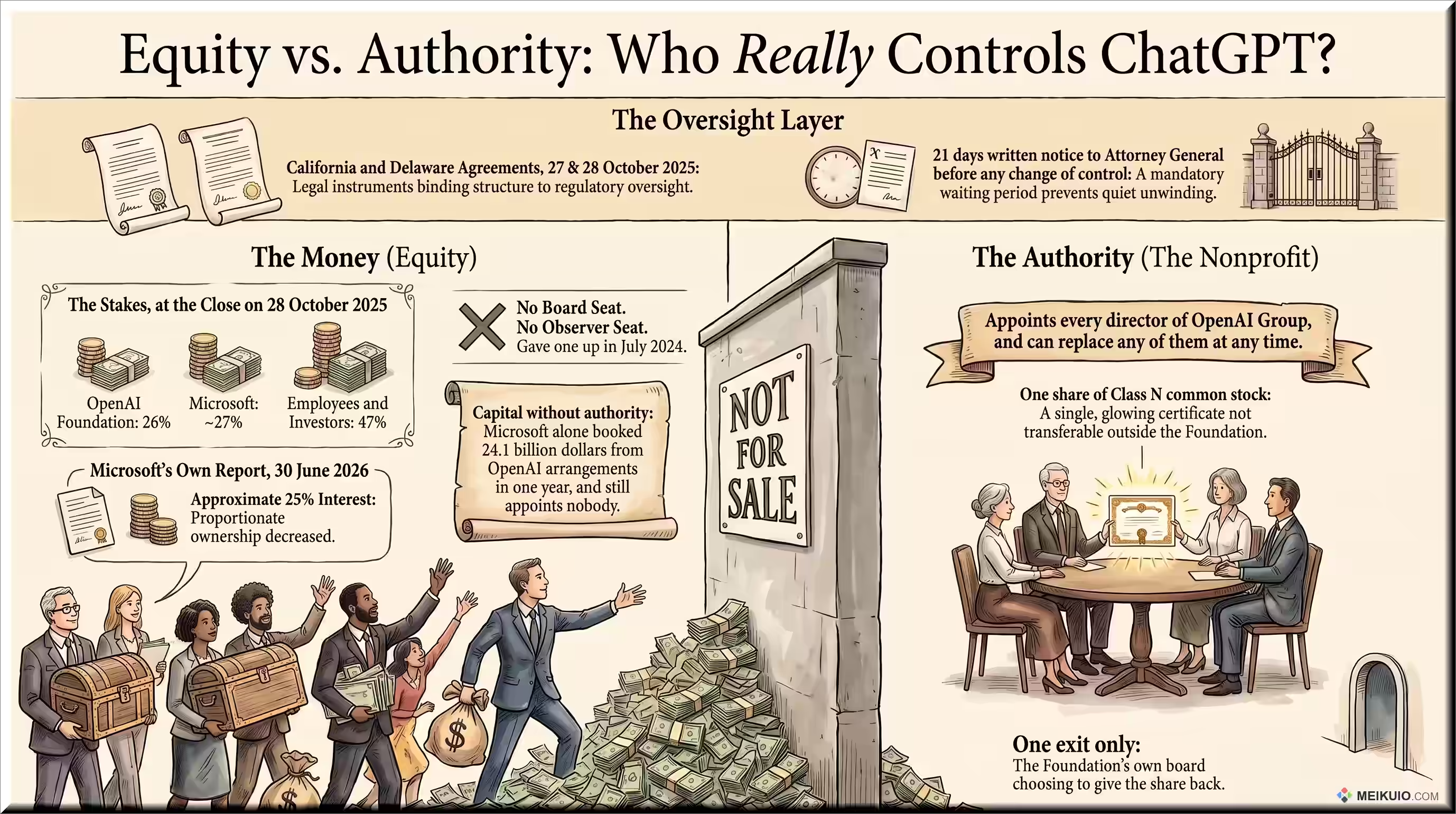
Microsoft has put tens of billions of dollars into OpenAI and appoints none of its directors. The nonprofit holds one share that appoints all of them.
Control is one share, not a percentage
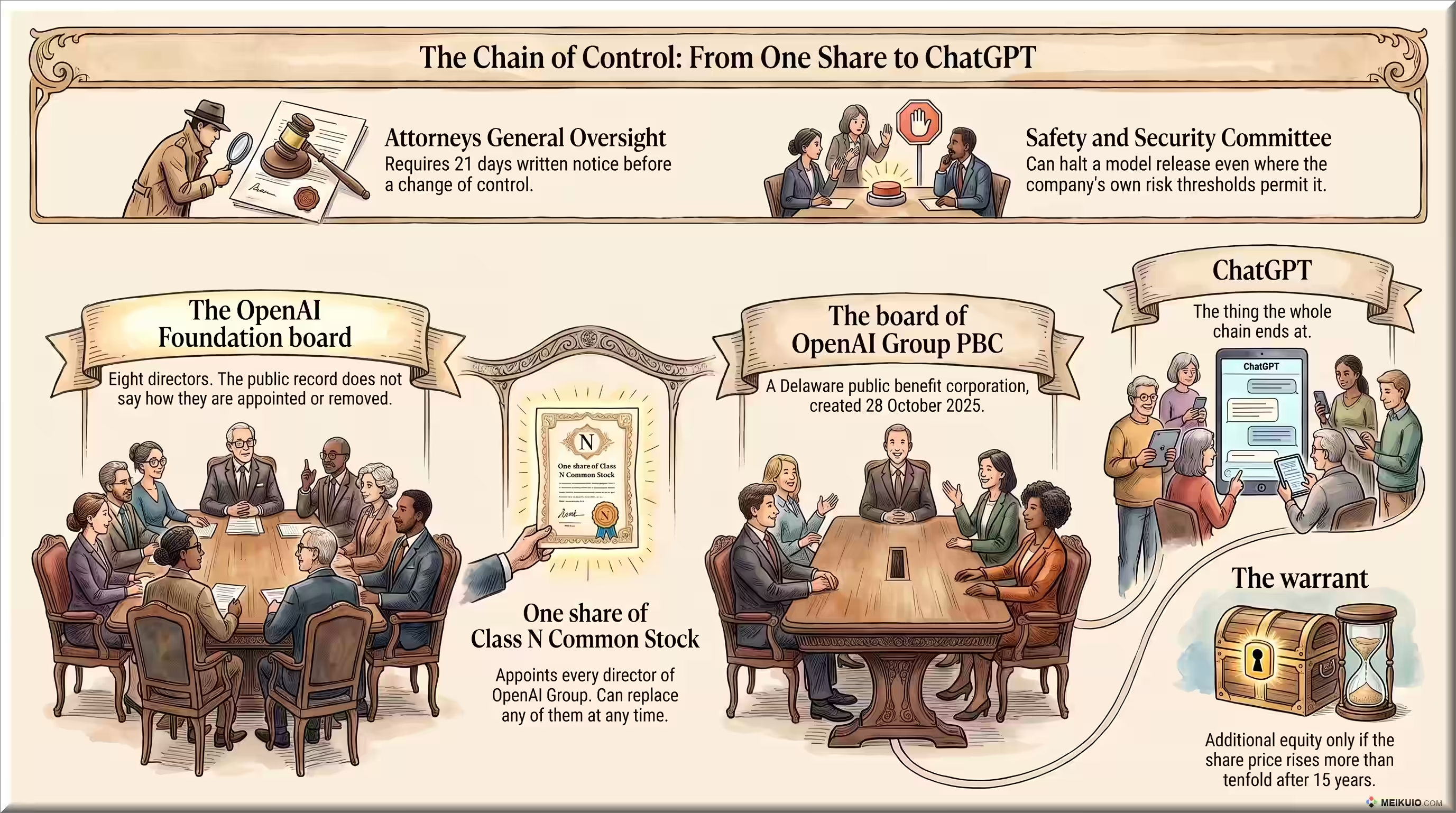
The instrument that decides who runs ChatGPT is a single share of stock, and it carries no economic value at all. The instrument is called Class N common stock, it exists in a quantity of one, and it is defined in the certificate of incorporation that OpenAI Group PBC filed in Delaware on 28 October 2025. The charter locks it in place. Its transferability clause says shares of Class N “will not be transferable (except to the extent it remains directly or indirectly held by OpenAI Foundation (or any successor entity)).”
For a reader deciding how much to depend on this company, that clause is worth more than the whole cap table. It means control cannot be bought. An investor can accumulate ordinary shares indefinitely and still never acquire the thing that appoints the board, because the only share that does it cannot leave the nonprofit’s hands by sale.

The California agreement describes the same instrument from the regulator’s side, and it names the one thing that would end nonprofit control. “The decision whether to relinquish the Class N Common Stock, if ever, is in the control of the NFP Board,” it says, writing NFP throughout for the nonprofit. So the risk to watch sits inside the Foundation rather than outside it. Its own directors would have to choose to give the share up, and that choice now carries a notice requirement to a state Attorney General.
Put together, that answers what most people are really asking when they ask whether the nonprofit is in charge. The control is real in the sense that matters: it cannot be bought, it cannot be diluted, and it does not rest on the Foundation’s 26 percent. It has one exit, and only one. The Foundation’s own board can decide to hand the share back, and that is the single point at which this whole structure can be undone.
Sitting underneath all of this is the company form itself. A public benefit corporation is required to advance a stated mission and to weigh the interests of stakeholders beyond its shareholders. That difference from an ordinary Delaware corporation is legally meaningful, but it is weaker than the phrase sounds. The obligation shapes what directors are permitted to consider. It does not give anyone outside the company a way to enforce a particular decision, which is why the board appointment power, and not the corporate form, is the thing carrying the weight here.
Note
The public copy of the OpenAI Group PBC charter is a scanned document, and parts of it do not read cleanly. The clauses quoted on this page are the ones legible on the filing itself. Figures that circulate elsewhere for the exact voting weight of the Class N share come from secondary write-ups rather than from the charter, so they are not repeated here.
Equity: who holds what, and on which date
The three percentages everyone quotes come from a single sentence pair on OpenAI’s structure page, and both sentences are stamped to the same moment. The Foundation “holds a 26% equity stake in OpenAI Group, worth approximately $130B based on OpenAI Group’s current valuation.” Microsoft “holds roughly 27% of OpenAI Group, and the remaining 47% is held by current and former employees and investors.”
Read the first four words of each sentence. Both begin “as of the closing of the recapitalization,” which means these are numbers from 28 October 2025, not a live cap table. OpenAI has raised capital since then, and no updated split has been published. Any page that prints 26, 27 and 47 as today’s numbers is quoting a snapshot and presenting it as a current state.
That distinction stops being pedantic in the next section, because one of the three holders has since published a different number for itself. If you need the investing angle rather than the governance one, the paths available to a retail buyer are set out separately in our guide to buy OpenAI stock.
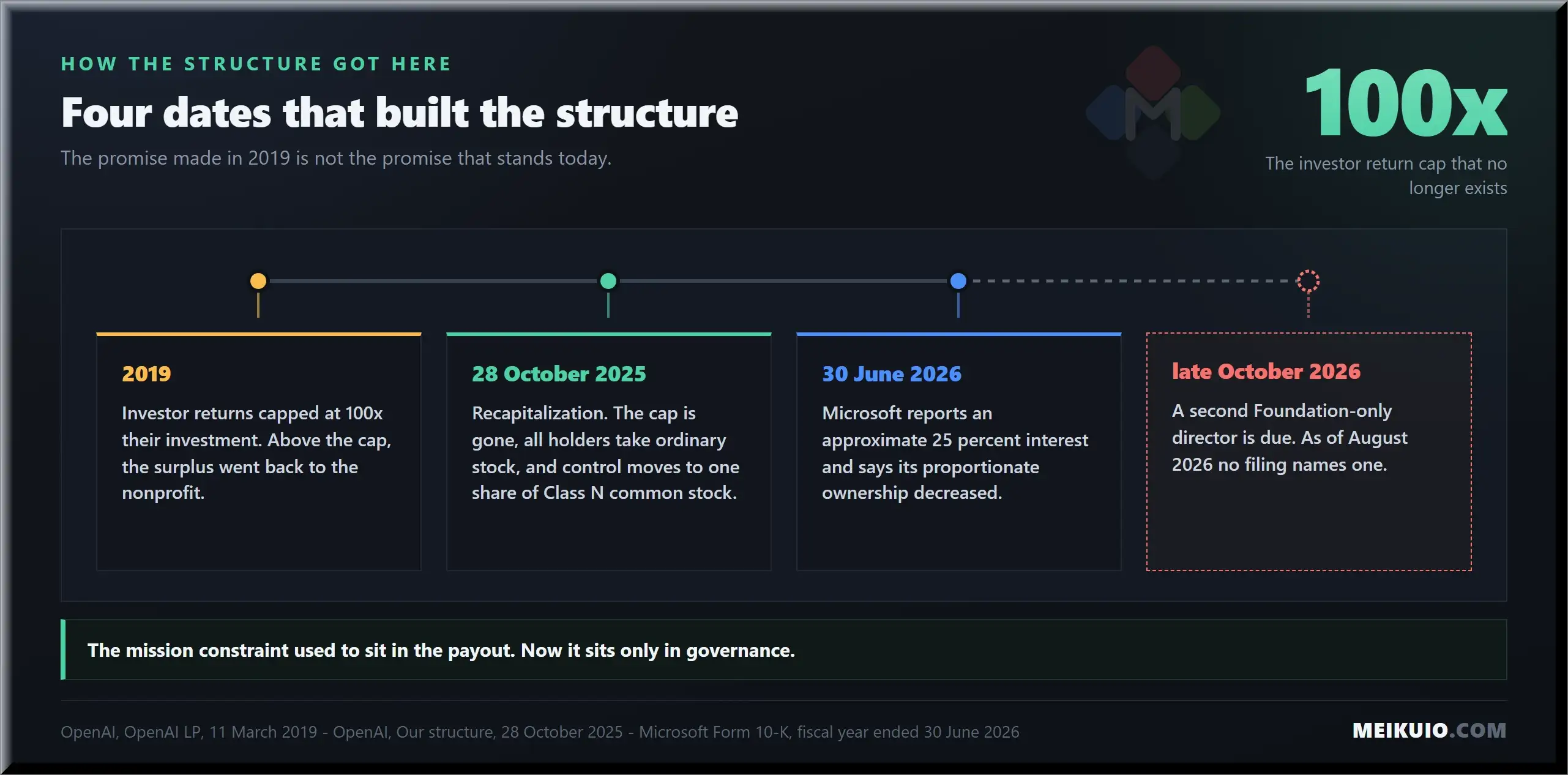
There is also a change buried in the word “ordinary” that most answers to who owns ChatGPT skip entirely. Under the structure OpenAI built in 2019, investor returns were capped. The company said so at the time in plain numbers: returns for the first round of investors were “capped at 100x their investment,” with lower multiples expected for later rounds. Above the cap, the surplus was supposed to flow back to the nonprofit.
That cap is gone. All holders “now own the same type of traditional stock that participates proportionally and grows in value with OpenAI Group’s success,” which is a cleaner arrangement for raising money and a materially different promise to the public than the one made in 2019. The mission constraint that used to be expressed in the payout is now expressed only in governance, in the board seats and the public benefit obligation. That is the trade at the centre of the whole restructuring, and it is why the control instrument carries so much weight.
The number the whole field gets wrong
Every ranking page puts Microsoft at 27 percent. Microsoft’s own annual report does not. In the Form 10-K covering the fiscal year that ended on 30 June 2026, the company describes its position in one line: “We have an investment accounted for under the equity method that represents an approximate 25% interest on an as-converted basis.”
The same filing explains the direction of travel without being asked. “During fiscal year 2026, our proportionate ownership of OpenAI decreased due to the OpenAI Recapitalization and other funding activity, and we recorded dilution gains in other income (expense), net.” Microsoft is telling its shareholders that its slice of OpenAI got smaller while OpenAI raised money from other people.
Set that against the Foundation’s published 26 percent and the ranking pages start to look stale. Six of the pages competing for this query call Microsoft the largest shareholder, in various phrasings, and none of them mention the 25 percent line. The honest reading is narrow and worth stating precisely: on the two most recent primary numbers available, the claim that Microsoft is the largest single shareholder in OpenAI is no longer supported by either company’s own documents.
None of this is hidden. Both numbers sit in documents the companies published themselves, which makes the gap a reporting failure rather than a disclosure one. Anyone answering who owns ChatGPT can open Microsoft’s annual report in a browser and read the line for themselves.
Two cautions belong with that, and skipping them would be the same mistake the field made. The figures carry different dates, ten months apart. They may also be measured differently, since Microsoft says “as-converted” and OpenAI does not qualify its percentages at all. What can be said without stretching is that nobody has published a current cap table, and the most recent number Microsoft published for itself is smaller than the number everyone repeats.
The third block deserves more attention than it gets, for the same reason. That 47 percent held by current and former employees and investors is the largest number in the published split, but it is a category rather than one owner, which is why nobody counts it when they ask who the largest shareholder is. It also grows every time the company raises money, because new capital comes in beside it rather than out of the Foundation’s or Microsoft’s holding. Pages answering who owns ChatGPT tend to treat it as a rounding category. It is the block that dilutes the other two.
Microsoft reports approximately 25%; no updated full cap table published. Two dates and potentially different measurement bases; the 2026 missing stakes cannot be inferred by subtraction. Six competing pages call Microsoft the largest shareholder; none mention the 25% filing figure.
The warrant: what the nonprofit gets after fifteen years
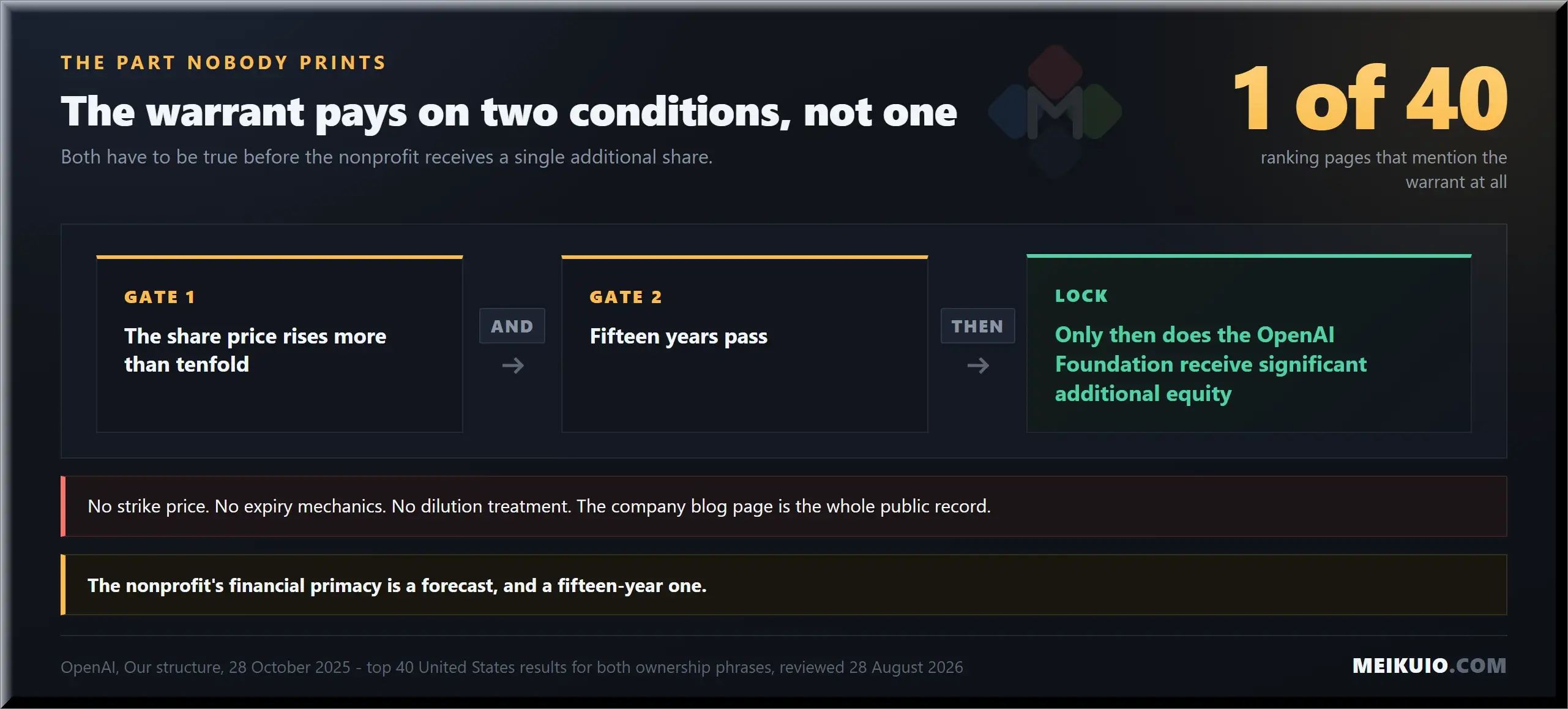
A warrant is a contractual right to receive shares later, at a price fixed now. The OpenAI Foundation holds one, and it is the least discussed part of the structure. OpenAI describes the trigger plainly: if the share price of OpenAI Group “increases greater than tenfold after 15 years, the OpenAI Foundation will receive significant additional equity.” On that basis the company says the Foundation “is positioned to be the single largest long-term beneficiary of OpenAI’s success.”
Two things follow that are useful to anyone weighing how much the nonprofit’s mission actually binds the company. The Foundation’s upside is deferred by fifteen years and conditional on a tenfold rise, so the claim that it benefits most is a statement about a distant scenario rather than about today. And the terms that would let anyone check it, the strike price, the expiry mechanics and how dilution is treated, are not published anywhere. The blog page is the whole public record.
In a review of the top 40 United States results for both ownership phrases, run on 28 August 2026, exactly one page mentioned the warrant at all.
The reason it is worth knowing anyway is that it changes how one of OpenAI’s own claims should be read. The company presents the Foundation as the single largest long-term beneficiary of its success, and that framing depends on the warrant rather than on the 26 percent. Strip the warrant out and the Foundation is simply one shareholder among several, holding roughly the same slice as its commercial partner. The nonprofit’s financial primacy is a forecast, and a fifteen-year one.
Who owns OpenAI?
Three different things get called “OpenAI,” and most of the confusion around this question comes from collapsing them. The OpenAI Foundation is the nonprofit; it was simply OpenAI, Inc. before the restructuring and it is the entity that holds the controlling share. OpenAI Group PBC is the company: it employs the staff, signs the contracts, raises the capital and ships the products. ChatGPT is a product inside OpenAI Group, alongside the model APIs and everything else the company sells.
So the answer to who owns OpenAI depends on which OpenAI is meant. Nobody owns the Foundation, because a nonprofit has no owners. OpenAI Group is owned by its shareholders, the Foundation among them. It is controlled by the Foundation regardless of how those shares move.
The naming makes this harder than it needs to be, and it is a large part of why answers to who owns OpenAI contradict each other. The nonprofit was called OpenAI, Inc. until October 2025 and is now the OpenAI Foundation. The commercial side has been through several shapes and several names, ending as OpenAI Group PBC. Older pages use the older names for entities that have since changed both their form and their relationship to each other, which produces sentences that were accurate when written and are misleading now.
One practical consequence is worth holding onto. When a contract, a policy or a news report says “OpenAI,” it is almost always the company that is meant, because the company is what signs things and ships things. The Foundation appears in exactly one kind of story: the ones about who is in charge.
So who owns ChatGPT and who owns OpenAI are close but not identical questions, and the gap between them is where most of the confusion lives. ChatGPT has an owner, a company with shareholders. OpenAI, taken as the whole organisation, has a controller instead, and the controller is an entity that by law belongs to nobody.
This matters when a product decision looks strange from the outside. A voice feature, a pricing change or a model retirement is a decision of OpenAI Group, not of the Foundation, and our breakdown of GPT-Live is a worked example of how those product calls land on users. The Foundation’s board could replace the people who made such a call. In practice it does not sit in product meetings, and treating a nonprofit parent as a guarantee about any particular feature would be reading the structure for more than it says.
What Microsoft actually holds
Microsoft does not own ChatGPT and does not own OpenAI. It holds an equity stake, a set of commercial rights and a very large invoice relationship, and it holds no governance position at all. Its own filings are the place to check this, because a company describing its own investment to the market has to be precise about what it has. When Microsoft acquires full ownership of an asset, its Form 10-K consolidates it directly, as seen in the SEC filings that explain who owns LinkedIn. With OpenAI, the disclosure describes a commercial partner rather than a subsidiary.
The scale of the commercial side is easy to underrate. Microsoft’s Form 10-K for the year to 30 June 2026 records revenue “from commercial arrangements with OpenAI, inclusive of revenue-sharing payments, of $24.1 billion,” and 6.0 billion dollars still owed at the year end. That is a supplier and partner relationship at enormous scale, and it is completely separate from the question of who appoints directors.
On governance the filing is notable for what it does not contain. Read through it and there is no board seat, no observer seat and no consent right over OpenAI’s decisions. Microsoft did hold a non-voting observer seat once and gave it up in July 2024. Since then its influence has run through contracts and through the fact that OpenAI needs what it sells. Influence of that kind is real, and it is not ownership. Microsoft has also been building models of its own in parallel, which we covered in our look at Microsoft’s own AI models.
The most common wrong answer to who owns ChatGPT is Microsoft, and it is worth being precise about why the mistake is so easy to make. The October 2025 agreement gives Microsoft exclusive rights to OpenAI’s intellectual property and exclusive rights to serve its API on Azure, and both run “until Artificial General Intelligence (AGI).” That reads a great deal like control to anyone skimming. Rights of that kind bind two companies commercially. They do not appoint a single director.
The AGI trigger deserves a pause, because a contract that expires on an event nobody can define is a contract that expires whenever one party says so. The 2025 agreement closes that gap. OpenAI still declares AGI, but the declaration “will now be verified by an independent expert panel,” and Microsoft’s IP rights run through 2032 either way. That panel is the mechanism turning a slogan into a contractual date, and almost nothing written about this partnership mentions it.
The rest of the same agreement reads as a partnership loosening rather than tightening. Microsoft’s IP rights now exclude OpenAI’s consumer hardware. OpenAI can build products with third parties, and only the API ones stay locked to Azure. Microsoft gave up its right of first refusal to supply OpenAI’s computing and can now pursue AGI on its own. Going the other way, OpenAI contracted to buy an additional 250 billion dollars of Azure services.
One correction belongs here, because it is circulating widely. A number of pages report that Microsoft and OpenAI signed a further agreement on 27 April 2026 that ended Azure exclusivity and made the IP licence non-exclusive through 2032. Checked against the primary record, that date does not survive. OpenAI’s own partnership page carrying those terms is dated 28 October 2025, and it says exclusivity continues rather than that it ended. Microsoft’s annual report covering the year to 30 June 2026 refers only to the October 2025 agreement and describes no later amendment.
The likeliest explanation is that the 2032 date and the third-party provisions, both genuinely in the October 2025 agreement, were picked up months later and written up as if they were new. A team relying on these terms for its own planning should read the agreement rather than any article about it, this one included.
Who can stop a model from shipping?
Ownership questions usually stop before reaching the one that matters most to people who use the product: if something is wrong with a model, who has the authority to hold it back? At OpenAI that authority sits with the Safety and Security Committee, and the committee is a committee of the nonprofit rather than of the company that ships the software.
The Delaware Attorney General’s review records what the committee can do, in language OpenAI committed to. It “will have the power and authority to require mitigation measures, up to and including halting the release of models or AI systems, even where the applicable risk thresholds would otherwise permit release.” The last clause is the substantive one. The committee can stop a release that passes the company’s own internal criteria.
Two structural details keep that from being decorative. The committee stays at the Foundation and was not moved into the commercial company during the restructuring. Its chair, Zico Kolter, a computer scientist who sits on the Foundation board, attends the Group board only as a non-voting observer. Read one way that is independence, because the person holding the brake is not sitting in commercial decisions. Read the other way it is a limit, because he has no vote where those decisions are made. Both readings are correct, and the structure does not settle which one matters more.
There is a second seat on the same principle, and it comes with a deadline. Under the commitments recorded in October 2025, the Foundation board must have at least two directors who do not sit on the company’s board, the safety chair among them, within one year of the restructuring. That clock runs out in late October 2026. As of August 2026 no filing names the second director, which makes it the one checkable near-term test of whether these commitments are treated as binding or as language.
The distinction being drawn here is between people who decide what ships and people who decide whether it should. Most of the OpenAI Foundation board sits on both boards, which keeps the two sides aligned and gives the safety side no separate vantage point. Pulling two directors out of the company’s board is the structure’s answer to that, and it is worth watching precisely because it is small, dated and easy to let slide.
So who controls the Foundation?
Every answer on this page eventually arrives at the same eight people. The Foundation board appoints the company’s directors, decides whether to keep the controlling share, and holds the approval rights the state agreements attach to it. Which raises the question none of the ranking pages ask: who appoints the Foundation board?
Nothing in the public record answers it. OpenAI publishes the names, Bret Taylor as chair alongside Adam D’Angelo, Sue Desmond-Hellmann, Zico Kolter, Paul Nakasone, Adebayo Ogunlesi and Nicole Seligman, with Sam Altman as the eighth. It does not publish how they are selected, how long they serve, or what would remove one. The Foundation’s bylaws are not public, and neither state agreement sets out an appointment process.
A nonprofit of this kind has no shareholders to vote a board out, which is what makes the question load-bearing rather than academic. The external check that does exist is the one described above. The Attorneys General of California and Delaware get advance notice of significant governance changes, and California’s agreement lets its Attorney General hire outside experts, at the Foundation’s expense, to examine material transactions. Anyone deciding how much weight to put on this structure should know that the answer stops there. This board is checked by two state officers and by its own composition, and not by an owner.
The two attorneys general who signed off
The restructuring was not something OpenAI could simply announce. A nonprofit converting the assets it controls into a conventional shareholding company sits squarely in the jurisdiction of state charity regulators, and OpenAI’s own account says the deal closed “after nearly a year of engaging in constructive dialogue with the offices of the Attorneys General of California and Delaware.”
Two instruments came out of that year. California signed a memorandum of understanding with OpenAI on 27 October 2025. Delaware issued a statement of no objection the following day. They are not the same kind of document, but they secure a similar set of commitments, and both are public.
The clause with the sharpest practical effect is a notice period. Under the California agreement, the nonprofit must give the Attorney General “at least 21 days’ prior written notice” before consenting to a change of control of the company, a change to its mission, an amendment stripping the nonprofit’s sole right to appoint directors, or a move of either headquarters out of California. In plain terms, the structure described on this page cannot be quietly unwound. Someone outside the company gets told first, with time to act, and disputes go to the Superior Court in San Francisco rather than to arbitration.
The agreement also keeps a set of decisions inside the nonprofit’s hands rather than the company’s. The Foundation’s written approval is required before the company can amend its public benefit provisions, sell material assets or trigger a liquidation event, or issue any additional shares of the Class N stock. The last of those closes the obvious loophole. Control cannot be diluted by minting more of the instrument that carries it.
One more provision is unusual enough to be worth naming. The Attorney General may retain outside experts or consultants to review material transactions, and the nonprofit pays for them. Regulators normally have to fund their own scrutiny out of a budget, which in practice limits how much scrutiny happens. This agreement removes that limit.
Neither instrument is permanent in the way a charter is, and that cuts both ways. The California memorandum can only be ended by written consent of both parties, so OpenAI cannot walk away from it alone. Most of what it secures is tied to a condition rather than a date: the commitments hold “so long as the NFP holds Class N Common Stock.” Give up the share and the scaffolding around it goes too, which is exactly why the notice requirement is attached to that decision.
Does Elon Musk own any of OpenAI?
No. Elon Musk co-founded OpenAI in 2015 and left its board in 2018, and he holds no stake in OpenAI Group. He appears in every discussion of this question anyway, partly because he funded the organisation early and partly because he sued it.
That case mattered to this question more than most coverage suggested, because one of the things Musk asked the court to do was unwind the 2025 restructuring described on this page. It went to a nine-member advisory jury in California in May 2026, a format in which the jury advises and the judge decides, and it took under two hours to find that his claims were brought too late. The judge adopted the verdict and dismissed the case.
Musk has said he will appeal. As it stands the structure is untouched. The case keeps surfacing in ownership searches for a reason. The arguments were about what a nonprofit owes the mission it was founded on, and that is the same question the Class N share and the two state agreements were built to answer.
Musk’s other private ventures raise the same practical question for readers arriving from an investing angle. We worked through it for Neuralink: a private company with no ticker cannot be bought, whatever the headlines suggest.
Does Sam Altman own ChatGPT?
No individual owns ChatGPT, Sam Altman included. He is the chief executive of OpenAI Group and a member of the OpenAI Foundation board, which places him on the control side of the structure rather than the capital side.
His personal stake is one of the few things about this company that the public record does not settle. Pages ranking for who owns OpenAI say different things, some reporting no equity at all and others referring to founder holdings. No primary filing resolves it. What can be checked is the seat rather than the shareholding, and for a question about who decides things the seat is the more useful fact.
The seat is also the more unusual arrangement. The chief executive of the company sits on the board of the nonprofit that appoints his own company’s directors, alongside seven independent members. There is an obvious tension in that arrangement. The restructuring’s answer was to add independent directors and move the safety committee out of the company’s reach, rather than to remove him from the parent board.
How this compares with Anthropic and Claude
OpenAI is not the only lab that tried to keep a mission in charge of a company raising billions. Anthropic did the same thing with a different device, and putting the two side by side shows what each design is actually protecting.
The difference worth taking away is speed against independence. OpenAI’s design hands total board control to the mission holder immediately, but that holder is the parent organisation itself, and its board overlaps heavily with the company’s. Anthropic’s design gives control away gradually to trustees who hold no financial interest in the outcome at all.
Which one is stronger depends on what you think fails first. If the worry is an outside buyer, OpenAI’s version is harder to break, because the controlling share cannot be sold and a state law officer has to be told before it is given up. If the worry is the people already inside, Anthropic’s version puts the decision with trustees who have nothing to gain either way. We took that version apart in detail in who owns Claude, including how Anthropic’s Long-Term Benefit Trust phases directors in.
What the top results get wrong
The pages currently ranking for who owns ChatGPT answer it badly, and the errors are checkable rather than a matter of interpretation. Below are four claims from pages ranking in the United States for these phrases in August 2026, each against the document that contradicts it.
The pattern behind all four is the same. Ownership at OpenAI changed shape in one week of October 2025, and pages written before that week, or written afterwards from sources that predate it, keep circulating. Roughly half the pages ranking for these phrases carry no update date at all, which leaves a reader no way to tell which era they are reading about. The speed at which claims about this industry go stale is a recurring problem, and we have watched it play out before with how fast AI claims go stale.
Can you buy a stake in ChatGPT?
Not directly. OpenAI Group is private, has no ticker and has not gone public, so there is no share of ChatGPT to buy on any exchange. Readers who reach who owns ChatGPT from an investing angle usually want the next step. The honest version is that indirect exposure exists through funds and through the listed companies holding positions. It is diluted enough that the arithmetic surprises most people who try it.
That arithmetic is a separate subject from this one, and we have done it properly rather than in passing. Our guide covers every real path to OpenAI exposure. Our overview of AI stocks sorts the companies booking AI revenue from the ones priced on a promise. And our look at quantum computing stocks is a case study in what is real and what is hype in a young sector. For private AI challengers where valuation rumors circulate without a public ticker, our breakdown of Perplexity valuation in 2026 shows how four conflicting price tags were hung on the same funding round. Nothing on this page is investment advice.
Why this matters, depending on why you asked
People search who owns ChatGPT for four fairly distinct reasons, and the useful answer is different for each.
- You are settling an argument. Microsoft does not own ChatGPT. It holds a large block of ordinary shares, reported by Microsoft itself at about 25 percent as of June 2026, and it appoints nobody to the board. The company that owns ChatGPT is OpenAI Group PBC, and the nonprofit controlling it is the OpenAI Foundation.
- You are worried about the product you rely on. The people who can replace the entire board of the company that ships ChatGPT sit at a nonprofit, and a committee of that nonprofit can stop a release outright. If that governance is part of why you trust the product, it is also worth knowing what would end it: a decision by the Foundation’s own board to give up the Class N share, which now requires 21 days of notice to a state Attorney General.
- You are buying this for a team. The commercial counterparty is OpenAI Group, not the Foundation, and the relationship that shapes availability and pricing is the one with Microsoft rather than the one on the org chart. Teams comparing their exposure across vendors will also want to know which models enterprises actually run.
- You are uneasy about the whole arrangement. The structure is unusual and the disclosure around it is uneven, and if that is your reason for asking, the practical response is to know what else is available. We keep a current list of ChatGPT alternatives.
All four answers rest on the same distinction, and it is the one thing to carry away from any page about who owns ChatGPT. Equity says who profits. A single share says who decides. As of August 2026 those sit with different parties, and only one of them is published as a percentage.
Field notes
- The control instrument: one share of Class N common stock, held by the OpenAI Foundation; appoints every OpenAI Group director and can replace any of them at any time; not transferable outside the Foundation.
- The stakes, and the gap between two dates: Foundation 26 percent, Microsoft about 27 percent, employees and investors 47 percent, all stated as of the close of the recapitalization on 28 October 2025 with no updated cap table published since; against that, Microsoft’s own annual report gives an “approximate 25% interest on an as-converted basis” at 30 June 2026 and says its proportionate ownership “decreased” during the year. Microsoft also books 24.1 billion dollars of revenue from OpenAI arrangements, and holds no board seat and no observer seat.
- The commercial terms, all dated 28 October 2025: exclusive IP rights and Azure API exclusivity until AGI, with any AGI declaration now “verified by an independent expert panel”; IP rights extended through 2032 and excluding consumer hardware; 250 billion dollars of Azure services contracted; Microsoft’s right of first refusal on compute given up. Reports dating these terms to 27 April 2026 do not match either company’s primary record.
- The deferred piece: the Foundation also holds a warrant paying additional equity only if the share price rises more than tenfold, and only after 15 years; no strike price or expiry mechanics are public.
- The regulators: California signed a memorandum of understanding on 27 October 2025 and Delaware issued a statement of no objection on 28 October 2025; 21 days of written notice to the Attorney General before a change of control; disputes go to the Superior Court in San Francisco.
- What is not on the public record: how OpenAI Foundation directors are appointed or removed, and the Foundation’s bylaws; the warrant’s strike price and expiry mechanics; an updated cap table after the 2026 funding rounds; and the name of the second Foundation-only director, due by late October 2026 and unnamed as of August 2026.
- Sources: OpenAI “Our structure”; OpenAI “The next chapter of the Microsoft-OpenAI partnership”, 28 October 2025; certificate of incorporation of OpenAI Group PBC (Delaware); California Attorney General memorandum of understanding; Delaware Attorney General statement of no objection; Microsoft Form 10-K for the fiscal year ended 30 June 2026; Anthropic “The Long-Term Benefit Trust”. Search field reviewed 28 August 2026.
Frequently Asked Questions
Who is the real owner of ChatGPT?
Who owns ChatGPT has two answers depending on what is meant. OpenAI Group PBC owns it as a product, and the OpenAI Foundation controls OpenAI Group. No single person owns it. If the question means who can change the product, that is the board of OpenAI Group, and every member of that board is appointed by the Foundation.
Is ChatGPT owned by Microsoft or OpenAI?
OpenAI. Microsoft is an investor and a commercial partner with a large stake, reported by Microsoft itself as an approximate 25 percent interest as of 30 June 2026. It holds no seat on the board and no vote over the company’s decisions.
Does Elon Musk still own any of OpenAI?
No. He co-founded OpenAI in 2015 and left the board in 2018, and he holds no stake in OpenAI Group. His lawsuit over the organisation’s direction reached an advisory jury in May 2026, which found for OpenAI, and it did not change the ownership structure.
Does Sam Altman own shares in OpenAI?
The public record does not settle it, and pages claiming a precise answer are going beyond what any filing shows. What is documented is his position: chief executive of OpenAI Group and a member of the OpenAI Foundation board, which puts him on the control side of the structure.
Is OpenAI a nonprofit or a for-profit company?
Both, in a specific arrangement. The OpenAI Foundation is a nonprofit and it controls OpenAI Group PBC, a public benefit corporation that raises capital and sells products. Pages describing OpenAI as simply a for-profit company are describing a structure that ended in October 2025.
What is OpenAI Group PBC?
It is the company that employs OpenAI’s staff and ships its products, incorporated in Delaware as a public benefit corporation on 28 October 2025. A public benefit corporation is required to advance a stated mission alongside commercial success, rather than shareholder returns alone. Most answers to who owns OpenAI are really answers about this entity, since it is the one with shareholders.
Can I buy shares in ChatGPT?
No, not directly. OpenAI Group is private, has no ticker and has not gone public, so there is no ChatGPT share to buy. Indirect exposure through funds and listed holders exists, and it is heavily diluted. This is not investment advice.
Who decides ChatGPT’s safety rules?
The Safety and Security Committee, which is a committee of the nonprofit rather than of the company. Under commitments recorded by the Delaware Attorney General, it can require mitigation measures up to halting a model release, even where the company’s own risk thresholds would allow it to ship.
My Take
I spent most of this research expecting to find that nobody writes about the control clause, and that turned out to be wrong: Wikipedia carries it, and so do a handful of others. What almost nobody does is treat the percentages as dated. That is the failure worth naming, because it is the one that misleads people who are making a decision rather than settling a bet. A team choosing a vendor reads “Microsoft owns 27 percent” as a fact about today, when it is a fact about one Tuesday in October 2025, and Microsoft’s own annual report has since printed a smaller number.
If you are deciding how much of your stack to hang on this company, the governance holds up better than the noise around it suggests, and the part I would watch is the calendar rather than the cap table. A second Foundation-only director is due by late October 2026 and has not been named. That commitment came out of a regulator negotiation, and how quietly it is met will tell you more about how binding this structure really is than any percentage will.