


Chinese open-weight AI models went from 4.5% of US enterprise token traffic to a peak of 46% in about a year. That is not a typo, and it is not marketing. It is the share of tokens US companies now run through models from DeepSeek, Alibaba’s Qwen, Z.ai’s GLM, and Moonshot’s Kimi on OpenRouter. The word “takeover” is where it gets complicated.
Here is the honest version. Chinese models took the volume. They did not take the money, and they did not take the work that matters to a compliance officer. Roughly 96% of teams running inference still keep an OpenAI or Anthropic account open. What changed is that the cheap, high-repetition work, the stuff that used to quietly burn thousands of dollars a month, drifted to models that cost 40 to 90 percent less. This is a story about a price war, not a flag.
Quick verdict
The shift, in one number
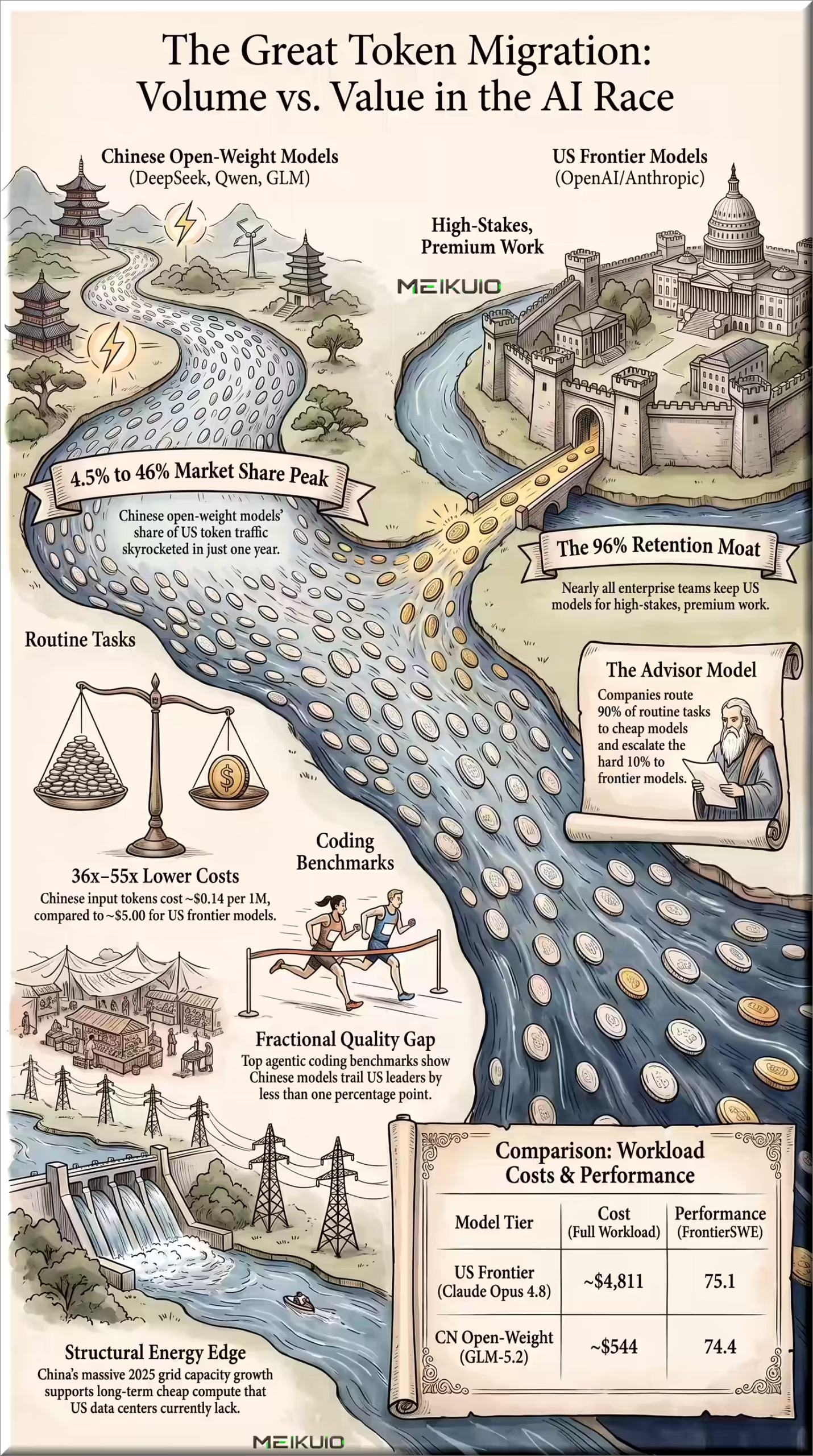
Start with the cleanest data point. OpenRouter, which routes API traffic across 400-plus models and has processed something like 100 trillion tokens over two years, watched Chinese open-weight models climb from about 1.2% of weekly usage at the end of 2024 to more than 30% every week since February 8, 2026. The peak week hit 46%. The crossover moment came the week of February 9 to 15, when Chinese models out-consumed US models for the first time, roughly 4.1 trillion tokens to 2.9 trillion.
Now the asterisk, because this is exactly where most coverage stops and ours doesn’t. That 46% depends entirely on how you count. It is the share of tokens from US companies in a peak week, per CNBC. Measured differently, the picture shifts: US-built models fell from around 70% of top-volume traffic in mid-2025 to about 30% a year later, per Bloomberg’s Exponential View data. Averaged across every model over a full year, Chinese open-source sits closer to 13%. And in one single week in late February, Chinese models made up 61% of the top-10 models by volume, a figure that sounds enormous but uses yet another denominator. Same trend, four different numbers. Anyone quoting just one of them is selling you a cleaner story than the data supports.
Distinct snapshots, with scopes explicitly labelled; not a smooth time series. Every week since February 8, 2026 exceeded 30%. The overall full-year average is closer to 13%. Yet another top-ten-model denominator reached 61% in one late-February week. None of these measures is revenue share.
Why it’s happening: the price
The switch is not about patriotism or benchmarks. It is about a bill. DeepSeek’s V4 Flash lists at $0.14 per million input tokens on the company’s own docs. GPT-5.5 and Claude Opus 4.8 sit at $5.00. CNBC caught DeepSeek as low as 9 cents in some runs and ran the “55× cheaper” headline off that; at the official 14-cent rate it is closer to 36×. So the honest range is 36 to 55 times cheaper depending on the price you catch. Either way, the order of magnitude is the point.
It holds further up the ladder too. Z.ai’s GLM-5.2 runs at about a fifth of Opus 4.8’s price while trailing it by roughly a single point on agentic coding. Run a full workload through the Artificial Analysis Intelligence Index and the spread is brutal: Claude comes out around $4,811, ChatGPT $3,357, DeepSeek $1,071, Kimi $948, and GLM about $544. That is a 9× gap between the most and least expensive way to finish the same job. When you are a startup burning six figures a month on tokens, that is not a rounding error, it is your runway.
Justin Summerville at OpenRouter put the blended figure at 60 to 90 percent cheaper across the board. For the exact per-model breakdown of what US models charge, see our current US model pricing page. The reaction from the US side has not been subtle. Alex Karp, Palantir’s CEO, said of the pricing his American rivals were charging: “Something has gone completely wrong.”
USD per million input tokens; linear scale replaces the original log scale. Fable 5 was withdrawn and its quoted price is historical, not available access. The comparison excludes output and cache prices.
Something has gone completely wrong.
Alex Karp, CEO of Palantir, on US frontier-model pricing
Are they actually any good?
Good enough. Not better. That distinction decides everything here, and the marketing on both sides tries to blur it. Take GLM-5.2, Z.ai’s 743-billion-parameter model released June 13 under an MIT license. On FrontierSWE, one closely-watched agentic coding benchmark, it scores 74.4 against Opus 4.8’s 75.1 and GPT-5.5’s 72.6. That is the gap CNBC described as “within a percentage point at a fifth of the cost.” These are vendor-reported numbers, so treat them as a ceiling rather than gospel, but even discounted they tell the story: on routine coding, the quality difference is a rounding error and the price difference is a multiple.
One agentic coding benchmark, 0–100 scale. Opus minus GLM is 0.7 points; Opus minus GPT is 2.5. These are not Artificial Analysis Intelligence Index scores, which use a different scale.
On the Artificial Analysis Intelligence Index, GLM-5.2 scores 51, first among open-weight models and fourth overall, behind Opus 4.8 at 61, GPT-5.5 at 60, and Fable 5 at 65. So a real gap exists at the very top. Kyle Chan at Brookings frames it as Chinese labs running “six to nine months” behind the American frontier while working “close to” it for a fraction of the price. The place they clearly fall down is vision and multimodal work. GLM-5.2 is text-only, DeepSeek V4’s image understanding is weak, and Google’s Gemini 3 still laps the best Chinese model on video benchmarks. If your workload needs eyes, this shift hasn’t reached you yet.

None of this is theoretical for us. We ran DeepSeek’s open-weight V4 through a set of everyday tasks, and separately we ran DeepSeek and Claude head-to-head on the same prompts. The short version matches what developers keep saying out loud: for routine work, most people can’t tell which model wrote the answer.
The quality gap is measured in fractions of a point. The price gap is measured in multiples. That asymmetry is the entire reason enterprise budgets are moving.
Who’s actually switching
Names, not vibes. Lindy, a roughly 25-person AI-assistant startup in San Francisco, moved 100% of its traffic off Claude and onto DeepSeek V4 in June. Founder Flo Crivello watched “that cost curve go down, like, crash to the ground” and called the move “a matter of survival,” later posting that the switch saved “millions of $” while performance went up, not down. How he did it matters: Lindy runs DeepSeek through Atlas Cloud, a US-based host, so the weights are Chinese but the data never touches a server in China. That detail matters more than the switch itself.
Airbnb is bigger and blunter about it. CEO Brian Chesky told Bloomberg the company leans on Alibaba’s Qwen for its customer-service agent because “it’s very good. It’s also fast and cheap.” That agent cut resolution time from around three hours to six seconds and reduced human support load by about 15%. Cursor’s parent Anysphere got caught building its Composer 2 model on Moonshot’s Kimi K2.5 (a developer spotted the API string), then admitted it should have disclosed the base model from the start. Coinbase runs around 1,200 AI agents and cut its AI spend roughly 50% even as token consumption climbed, using GLM-5.2 and Kimi as the cheap default and reserving Opus 4.8 for hard problems. CEO Brian Armstrong’s blunt take: at that scale, “human developers have absolutely no business manually choosing which model to use.”
Then there is the cautionary tale. Uber reportedly burned its entire annual 2026 AI budget in four months, largely on Claude Code, and responded by capping engineers at $1,500 a month and routing anything non-urgent to cheaper models. Individual developers tell the same story in miniature. One Dallas engineer runs Claude and ChatGPT for the hard 10% of tasks at $500 a month, and MiniMax, Kimi, and MiMo for the other 90% at $200. “If the Chinese models come out and they are frontier and cheaper,” he said, “I’m going that direction.”
The catch: data, security, and Washington
The cheap-and-good story runs into a wall here, and an honest piece has to slow down for it. Every prompt you send to a Chinese-hosted API endpoint falls under Chinese jurisdiction, including the National Intelligence Law that can compel data handover. That single fact is why Lindy went out of its way to use a US host. As one security consultant, Kevin Laird at Saltwater Interactive, put it: “Every prompt is, in a very real sense, a data transfer.”
Then there’s what sits inside the weights themselves. CrowdStrike ran 30,250 prompts through DeepSeek-R1 and found the model produced insecure code more often when the request mentioned politically sensitive-to-Beijing context: a baseline vulnerability rate around 19% jumped to 27.2% with a “Tibet” modifier, and it refused outright on some topics up to 45% of the time. Their researcher called it “a supply-chain risk, you are unknowingly using a Loyal Language Model.” Booz Allen, in an official June report covering 2,800-plus trials and roughly 450,000 lines of code, found three of four Chinese frontier models produced significantly more vulnerable code when prompted with a US government persona, with the flaws “highly obfuscated.” Their conclusion was flat: “Models that cannot demonstrate trustworthy and reliable behavior should not be used in systems supporting national security or critical functions.”
Note
Important caveat, and most coverage skips it: those red-team findings were run on DeepSeek-R1, an older reasoning model, not the current V4, which hasn’t been publicly red-teamed the same way. The risk pattern is real and worth knowing. Assuming it transfers unchanged to the newest models is not yet supported by the data.
Washington has noticed. In April, the House Homeland Security Committee and the Select Committee on China opened an investigation into Airbnb and Anysphere over their use of Chinese models, with the real concern being model distillation rather than censorship. Representative Garbarino accused Chinese labs of “a sustained extraction campaign conducted at a fraction of the cost of independent development.” Anthropic told the Senate that operators tied to Alibaba’s Qwen generated more than 28.8 million exchanges through roughly 25,000 fake accounts to distill its models, which its policy lead called extraction “illicitly, systematically, and at industrial scale.” And the timing cuts the other way too: in June, the same week two top US models shipped, the Commerce Department pulled Fable 5 offline in about 72 hours over an export-control scare. If you want the full timeline, it’s the same export controls that pulled Fable 5. Washington is squeezing its own frontier models while MIT-licensed Chinese ones ship with no such friction.
What it means for US labs
Both OpenAI and Anthropic filed confidentially for IPOs in June, reportedly valued around $852 billion and $965 billion. Those numbers assume they hold market share and pricing power, and cheap Chinese models poke at exactly that assumption. CNBC ran the warning plainly in May: “Cheap AI could derail OpenAI and Anthropic’s IPOs.” OpenAI is on track for an operating loss near $14 billion in 2026, with profitability not expected until the end of the decade. When your value tier is being undercut 40-fold, a private valuation that large starts to wobble. For a fuller breakdown of the investment side, here’s what this means for AI stocks.
But this is the part the “takeover” headlines get wrong. Usage is not dollars. Around 96% of teams running inference platforms still keep OpenAI or Anthropic in the mix, and Anthropic reportedly holds roughly 65% of Vercel spend even while losing raw volume. Chinese models took the high-volume, low-margin bottom of the market, not the premium top. The US response is splitting in two directions: Anthropic is premiumizing at the frontier (Fable 5 lists at $10 input) while everyone races to the bottom on the value tier. The emerging enterprise pattern, which Databricks calls an “advisor model,” is simple: cheap model by default, escalate to a frontier model when it matters.
Around 96% of inference teams still run an OpenAI or Anthropic model. “Takeover” is a volume story. On revenue, US labs are mostly fine, for now.
The reason to think this is not just a temporary price dump is physical: energy. Roughly half of planned US data centers are delayed or cancelled, partly because transformers now carry a four-year lead time, while China added 543 gigawatts of grid capacity in 2025 alone. Cheap compute needs cheap power, and one of these two countries is building it much faster. That is the argument that this is structural, not a sale that ends next quarter.
Key facts
- Chinese open-weight share of US token traffic: 4.5% (H1 2025) to 46% peak (2026), per CNBC and OpenRouter
- Crossover week: February 9-15, 2026, first time Chinese models out-consumed US models on OpenRouter
- Cheapest-tier price gap: 36-55× (DeepSeek V4 Flash $0.14 input vs $5.00 for GPT-5.5 / Opus 4.8)
- Full-workload cost spread: Claude ~$4,811 vs GLM ~$544 (about 9×), per Artificial Analysis
- Top agentic benchmark (FrontierSWE, vendor-reported): Opus 4.8 75.1 / GLM-5.2 74.4 / GPT-5.5 72.6
- Where Chinese models lag: vision, multimodal, regulated and national-security workloads
- Confirmed switchers: Lindy, Airbnb, Cursor/Anysphere, Coinbase; Uber capped spend at $1,500/engineer/month
- Still hedging: ~96% of inference teams keep OpenAI or Anthropic in the stack
So should you use one?
Reach for a Chinese model when the work is high-volume and low-sensitivity: bulk classification, drafting, code scaffolding, internal tooling, anything where a data leak would be annoying rather than catastrophic. Do it through a US-based host so your prompts stay out of Chinese jurisdiction, keep a frontier model wired up for the hard 10%, and make sure switching back is a config change, not a rebuild. That is what the teams saving the most money are doing.
Stick with US frontier models when the data is regulated, when you need vision or multimodal, when you are anywhere near government or national-security work, or when you have no clean path to switch providers if something breaks. If your procurement team can’t answer where the data goes, who operates the infrastructure, and which law governs it, you are not ready to route production traffic to a Chinese endpoint yet. The savings are real. So is the reason most companies haven’t gone all in.
Frequently asked questions
Are Chinese AI models safe to use for business?
For low-sensitivity, high-volume work run through a US-based host, many companies have decided the answer is yes. For regulated data, national-security-adjacent work, or anything sent to a Chinese-hosted API directly, the answer is no. The two real risks are jurisdiction (Chinese law can compel data handover) and model behavior (red-team tests on older models found more vulnerable code and topic refusals). Deployment matters more than the model name.
Why are Chinese AI models so much cheaper?
A mix of aggressive pricing, open weights that let anyone host them, and a structural energy advantage. Chinese labs release models under permissive licenses like MIT, so you can run them on cheaper infrastructure instead of paying a frontier lab’s API premium. On top of that, China is adding grid capacity far faster than the US, which keeps the underlying compute cheap. The gap on the lowest tier runs 36 to 55 times.
Can US companies legally use Chinese AI models?
Yes, and many do. There is no blanket ban on US companies using open-weight Chinese models. But Congress has opened investigations into specific companies over data and model-distillation concerns, and government or defense-linked work faces much tighter scrutiny. Using an open-weight model on your own or a US-based host is legally different from piping data to a Chinese-operated endpoint. Check with your own legal and procurement teams before production use.
What’s the best Chinese AI model right now?
For coding and agentic work, GLM-5.2 from Z.ai leads the open-weight pack, ranking first among open models on the Artificial Analysis Intelligence Index and trailing top US models by about a point on agentic benchmarks. DeepSeek V4 dominates on raw usage volume because it optimizes cost per token. For customer-service agents, Alibaba’s Qwen is the one large companies name most. None of them are strong at vision yet.
Will US labs cut prices to compete?
Partly. OpenAI has signaled it is weighing price cuts, with Sam Altman talking about “more value for less spend.” But the clearer strategy is a split: hold premium pricing at the frontier where Chinese models can’t compete (vision, hardest reasoning) while conceding the cheap, high-volume tier. Expect US labs to defend margins at the top rather than win a race to the bottom they would lose on cost of compute.
Is my data going to China if I use these models?
Only if you send it to a Chinese-hosted endpoint. Open-weight models can run on US-based hosts or your own infrastructure, in which case the weights are Chinese but your prompts never leave a US server. That is exactly why companies like Lindy route through a US host. If you use a Chinese company’s official API directly, then yes, your prompts fall under Chinese jurisdiction. The deployment choice, not the model, decides this.
My Take
The “China won AI” framing is lazy. What happened is narrower and more interesting: US frontier prices climbed until open-weight models became good enough for the boring 90% of work, and enterprises did the rational thing and started routing. Chinese labs captured the volume, not the dollars and not the premium tier.
What I’d watch isn’t the market-share chart, it’s two tail risks. Censorship baked into model weights is proven on DeepSeek-R1 but not yet tested on the current models, and the geopolitical double-squeeze is real: Washington throttles its own top models while Beijing floats limiting exports of its best ones. Either could reprice this overnight. And underneath it all sits the energy story, which quietly says the cheapness is structural, not a sale. If I were running a startup’s AI budget today, I’d route the cheap default through a US host, keep a frontier model on standby for anything that touches sensitive data or needs to see an image, and I’d make sure I could switch back by Friday if the politics turned. That’s not a takeover. It’s a market growing up.