

The Tesla FSD price in the United States in 2026 is 99 dollars a month, and that is the only price there is. The option to buy Full Self-Driving outright is gone, and Tesla says so on its own support page. I opened the order page on August 20, 2026 to check. One line. No second choice.
- What Tesla FSD costs right now
- The purchase option is gone, and Tesla wrote it down
- What the price did before it disappeared
- What ninety-nine dollars a month actually buys
- Your refund depends on which window you clicked in
- What you are agreeing to when you switch it on
- What happens to FSD when you sell the car
- What Tesla’s own used lot says the feature is worth
- The one exception worth checking before you buy used
- The name says one thing, the manual says another
- The other thing that changed in 2026
- The safety numbers, and what they are measured against
- Why so many pages still quote a price that is gone
- What the subscription adds up to
- What everyone else charges for driver assistance
- What driver assistance costs over three and five years
- What the regulators have on file
- Who should pay for it, and who should not
- How I checked all of this
- Where this leaves the price
- Frequently Asked Questions
- How much does Tesla FSD cost in 2026?
- Can you still buy Tesla FSD outright?
- Is Tesla FSD worth 8,000 dollars?
- Does FSD transfer when you sell the car?
- Can Enhanced Autopilot owners get FSD for less?
- Do new Teslas still come with Autopilot?
- Will the FSD subscription price go up?
- How does FSD compare with Ford BlueCruise or Super Cruise on price?
- My Take
That sentence would have been wrong six months ago, and most of the pages ranking above this one still read as if it were. So this is a price guide written the slow way. I opened Tesla’s own pages, counted what is printed on them, counted what is missing, then counted the same things at Ford, General Motors, Mercedes-Benz and Rivian. Everything below carries a date, and every figure is a United States price: Tesla sells the subscription in eleven markets and prices them separately, so read this from outside the US as a shape rather than your bill.
What Tesla FSD costs right now
The Tesla FSD price is one figure: an FSD subscription of 99 dollars a month, billed separately from the car. There is no annual plan, no lifetime licence, no purchase price. That is the entire price list. Tesla’s support page answers the question “How much does Full Self-Driving (FSD) (Supervised) cost?” with one figure and one closing sentence: “Full Self-Driving (Supervised) is not available for outright purchase and is only available as a subscription.”
Here is everything Tesla currently charges for the feature, and everything it declines to charge for, taken from the order page and the two support pages that describe it.
Four of those six rows are the absence of something. Read them twice. That is the shape of the product now.
The purchase option is gone, and Tesla wrote it down
Until February 2026 you could buy Full Self-Driving once and keep it. The last United States price for that was 8,000 dollars. Elon Musk announced the end of it in a post on X in January 2026, and the support page now carries the result as a flat sentence rather than an announcement. No press release followed. If you came here looking for the buy-out price, the honest answer is that there is no longer one to look up. The door is shut.
I checked the order page in both payment views, because the two views show different numbers for the car itself. The cash view lists the Model Y at 39,990, 45,990, 49,990, 57,990 and 61,990 dollars depending on trim. In both views Full Self-Driving appears as one checkbox at 99 dollars a month. The string 8,000 does not appear on that page in either view. I looked twice.
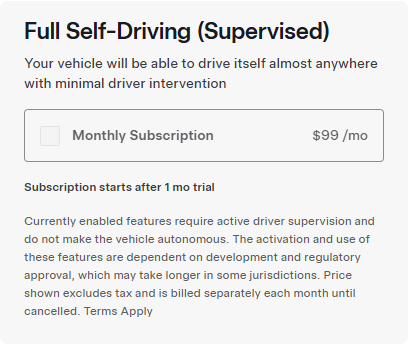
Four of the six things Tesla publishes about FSD pricing are the absence of something: no purchase, no refund, no proration, no printed hardware cost.
The same card carries a promise and its cancellation two lines apart. At the top, your vehicle “will be able to drive itself almost anywhere with minimal driver intervention.” Under the price, the features “do not make the vehicle autonomous.” Both sentences belong to Tesla. Both are on the screen at the same moment.
What the price did before it disappeared
The buy-out price was never a settled number. It tripled over three years, fell by nearly half, then stopped existing. The ladder below comes from the one price history in this search result that has kept up, and the three most recent rungs match reporting from separate sources at the time.
The one-time purchase option was removed in February 2026. Null means unavailable, not a zero-dollar purchase.
Source: published FSD price history – compiled by meikuio, August 2026
Read the shape rather than the individual rungs. A price that moves from 5,000 to 15,000 and back to 8,000 is not a valuation. It is a lever. The February 2026 entry is not a number at all, and that is the point: the lever was removed rather than reset. Nothing replaced it.
What the ladder leaves out
Even the headline figures were not the only prices being charged. In September 2024, according to reporting at the time, Tesla discounted Full Self-Driving to 4,500 dollars on demo vehicles and 6,000 dollars on new inventory cars while the published price stayed at 8,000. I could not confirm that from a Tesla page, because the offer is long gone and the archived captures were not reachable from here. Treat it as reported rather than verified, and treat the ladder as the advertised price rather than the only one anyone paid.
What ninety-nine dollars a month actually buys
The subscription unlocks a set of driver assistance features that work on any road type, including residential streets, and it stays unlocked only while you keep paying. What you fall back to when you stop depends on the car: pre-2026 listings show Autosteer, Tesla’s lane-keeping feature, as part of the vehicle, and 2026 listings do not show it at all. That difference is the subject of a later section. Tesla describes it as software that “can drive your Tesla vehicle almost anywhere” under supervision, making lane changes, taking exits, negotiating intersections and turning. The hardware doing the work is already in the car. You own the sensors. You rent the permission. That is the whole transaction.
Three things matter before the first bill. The subscription is tied to the Tesla Account that owns the car, so only that account can start it. Some configurations need a hardware upgrade first, and Tesla says that upgrade costs extra without saying how much. And the feature can be switched off by Tesla for a week at a time: three or five strikeouts, depending on the car, and the system suspends itself. A strikeout is what happens when the cabin camera decides you stopped paying attention and the system disengages for the rest of the trip.
You can cancel the FSD subscription any time from the app. Cancelling is easy. Getting money back is not: you keep the feature until the end of the month you have already paid for, and nothing is refunded.
More Read

Your refund depends on which window you clicked in
Tesla sells software upgrades through three doors. The door decides what happens if you change your mind. Buy an upgrade in the Tesla app and you can request a refund within 48 hours. Buy the same upgrade through the Tesla website and, in Tesla’s own words, “Refunds are not available for upgrades purchased through the Tesla website.” Subscribe instead of buying and the answer is shorter: “Refunds are not available for subscriptions.” The door decides.
The page that explains how to buy upgrades uses the word “purchase” twelve times and does not contain a single dollar sign. No price. No cost. No figure of any kind. What it says instead is “Open the Tesla app to learn more about the upgrades available to you,” which means the price is behind a login and attached to your vehicle identification number. You cannot comparison-shop a number you can only see once the car is yours. That is the point of putting it there.
If that pattern feels familiar, it should. We found the same thing reading Grammarly’s terms earlier this year, where the channel you buy through decides what you are entitled to. Software companies increasingly write one product and several sets of rights.
What you are agreeing to when you switch it on
The price is the smallest part of the terms. Three conditions attach to the subscription that do not attach to a normal car option, and all three are printed on Tesla’s own support pages rather than buried in a contract.
The first condition of an FSD subscription is that the feature watches you back, through the strikeout system described above. Collect three or five strikeouts, depending on your car’s configuration, and the feature is suspended for a week. A strikeout is forgiven after half a week if you do not collect another. The billing does not pause during a suspension. You pay the full month for a week you cannot use it.
The second is that the FSD subscription belongs to an account rather than to you or the car. Only the Tesla Account that owns the vehicle can subscribe. Sell the car and the subscription does not go with it; buy a used one and you start your own.
The third is the one that costs real money and has no number attached. Older cars were built with earlier self-driving computers, and Tesla says that depending on your vehicle’s configuration and hardware you may need to buy a hardware upgrade before you are even eligible to subscribe, “for an additional cost.” That cost is not published anywhere I could find. You see it in the Tesla app, for your specific car, after you have already bought the car.
None of that is hidden. All of it is on pages most buyers never open, which is a different thing from hidden and produces the same result. This is the fine print. It is not hidden anywhere clever. Read the support pages before the first bill, not after.
What happens to FSD when you sell the car
There are three possible outcomes for a second owner. Tesla prints all three in one support answer. If the previous owner had an FSD subscription, it dies with their account and you start your own. If the previous owner bought FSD outright and never moved it to another car, the feature stays with the vehicle and you get it. If the previous owner had FSD through the Luxe Package, you may get it, “depending on when the Luxe Package was purchased.”
Moving it yourself is no longer possible. Tesla’s answer to whether FSD can be transferred to another account or another car is one word followed by a date: “No. The Full Self-Driving (Supervised) Transfer Program ended on March 31, 2026.” That window is closed.
Note
Tesla has said both things about ownership. The support page says a bought-outright licence stays with the car. A Tesla email sent to owners in February 2026, quoted by Electrek, said it “stays with your Tesla as long as you own it,” which reads as the opposite. Both sentences come from Tesla. I have not found a version that reconciles them, so if you are buying a used car on the strength of its FSD, get the answer in writing from Tesla about that specific vehicle identification number before you pay.
What Tesla’s own used lot says the feature is worth
Resale value is where a one-time software purchase either proves itself or does not, so I counted. On August 20, 2026, Tesla listed 1,431 used cars in its United States inventory: 801 Model Y, 434 Model 3, 137 Model X and 59 Model S. Filtered for Full Self-Driving, that inventory returns zero. Not a small number. Zero.
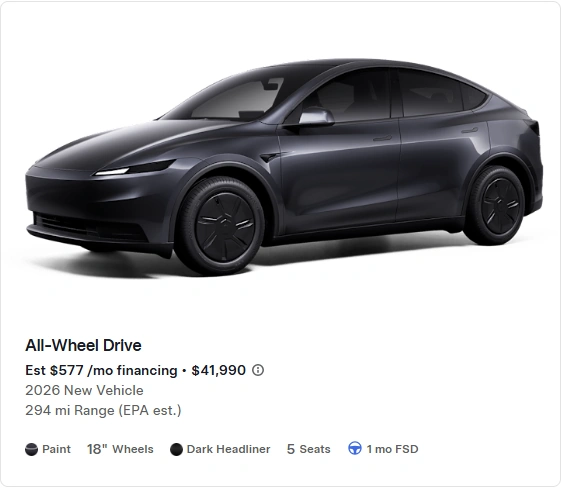
Tesla is selling 1,431 used cars and not one of them comes with Full Self-Driving. What the listings advertise instead is a one-month trial.
A zero is the kind of result that is usually a broken filter, so I checked it two ways before writing it down. The filter value Tesla’s own inventory page uses for the feature sits in that page’s markup alongside the values for the older Autopilot packages, so the query is spelled correctly. Then I read 168 individual listings by hand, the 96 cheapest Model Y and the 72 most expensive. Every one of them carried basic Autosteer or nothing. None carried FSD.
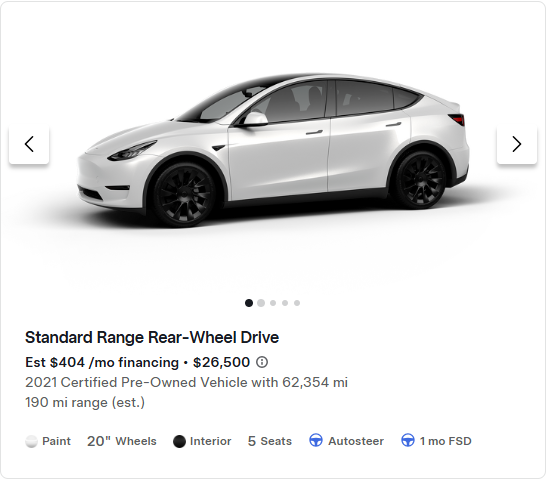
What sits in the feature row of those listings is “1 mo FSD,” which expands to “1 mo Full Self-Driving (Supervised) Trial.” That is not the feature. That is thirty days of it. After that the meter starts, and the car you just bought is the thing it runs on.
The limit of that count
This is Tesla’s own lot, not the used market. Cars with bought-outright FSD do exist in private sales and at third-party dealers, and Tesla’s own support page confirms the feature can travel with the vehicle. What the count shows is narrower and still worth knowing: the company that sold you the option does not resell it, and does not price it when it takes the car back.
The one exception worth checking before you buy used
There is a narrow case where a car can still arrive with Full Self-Driving attached, and Tesla names it in the same support answer that covers resale: the Luxe Package. That was a bundle sold on some Model S and Model X configurations with the feature included in the car’s price rather than bought separately. Tesla does not publish which build dates it covered. If a previous owner had FSD through that package, the support page says your vehicle “may come with FSD (Supervised) depending on when the Luxe Package was purchased.”
That sentence is doing a lot of work with the word “may.” It makes the outcome depend on a purchase date you do not have, for a package you did not buy, on a car you are considering. There is no public table that tells you which dates qualify. None. I looked. Twice.
So if a used listing anywhere advertises Full Self-Driving as included, treat that as a claim to verify rather than a feature to pay for. Ask the seller for the vehicle identification number. Then ask Tesla what that specific car carries. Get the answer in writing. A private seller quoting a package name is not a warranty, and the difference between “has FSD” and “had a trial of FSD” is 99 dollars a month for as long as you own the car.
The wider pattern here is not new to anyone who has bought connected hardware. A device arrives with capabilities that depend on an account, a server and a billing relationship, and the resale market has no clean way to price any of that. We watched the same problem play out with humanoid robots doing paid work and with software that reprices itself around what you actually use. A car is simply the most expensive place it has happened so far.
The name says one thing, the manual says another
The owner’s manual section for Full Self-Driving (Supervised) runs to roughly 19,700 characters. In all of it, the word “Supervised” appears 86 times. The word “autonomous” appears zero times. There are 17 warnings. One of them ends with the phrase “could cause damage, serious injury or death.”
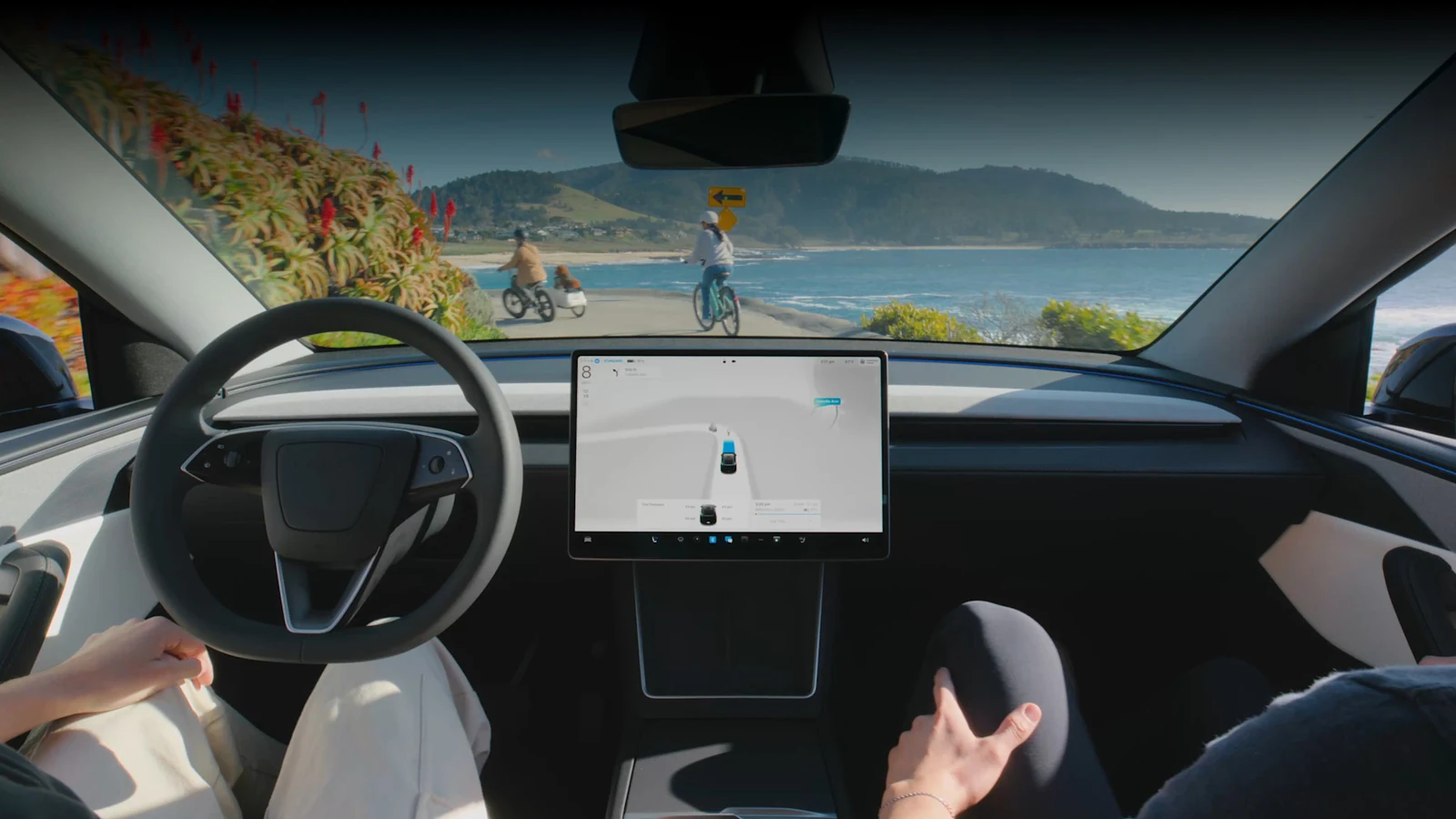
That is not a gotcha, it is the product working as documented. Tesla added the word “Supervised” to the name itself, which is a rare thing for a company to do to its own marketing. The gap worth noticing is between the order page, which sells a car that “will be able to drive itself almost anywhere,” and the manual for the same feature, which requires “a fully attentive driver” and displays escalating warnings until you respond. You are buying the second document. The first one is the advertisement.
The other thing that changed in 2026
Removing the purchase option was the change everyone reported. There was a second one, and I have not seen it written up anywhere. On 2026 cars, Autosteer stopped appearing in the listing as part of the car. Autosteer is Tesla’s lane-keeping feature, the thing that holds the car in its lane and follows the road without you steering. Older cars list it. The 2026 cars do not.
The pattern is clean enough to state precisely, so here is the exact count. Of the 801 used Model Y, 794 list Autosteer under one option code and 7 do not. I opened six of those seven by hand: all six are 2026 builds, all six carry a different option code, and all six have an empty driver assistance field. The seventh I did not inspect, so I am not claiming it. All 64 new Model Y in Tesla’s United States inventory are 2026 builds, and all 64 behave the same way as the six.
The listings show it in plain language. A used 2021 Model Y prints “Traffic-Aware Cruise Control with Autosteer” and a one-month FSD trial. A new 2026 Model Y prints the trial and nothing else. Across the whole new-inventory page, the word “Autosteer” appears zero times. The phrase “1 mo FSD” appears once on every card the page renders.
Then I went to the order page for a new Model Y and counted words rather than features. “Autopilot” appears 244 times in that page’s source code and zero times on the screen a buyer reads. “Traffic-Aware” appears 16 times in the source and none on screen. “Autosteer,” nine times in the source, none on screen. The page’s “Included” list covers paint, wheels, tyres, interior and range. Driver assistance is not in it.
On the page where you order the car, the word Autopilot appears 244 times in the source code and zero times on the screen.
What I proved and what I did not
Everything above is a count of what Tesla lists and displays. It is not a test of what the car does. I have not driven a 2026 Model Y and cannot tell you whether basic lane centring still works on one, and the 244 mentions buried in the page source suggest the feature is still very much alive inside Tesla’s own data. What changed is what the buyer is shown. Owners on Tesla forums have described the same change as a removal, and one trade outlet wrote that Tesla moved to “nix its long-running free Autopilot feature to make people pay for any sort of driver” assistance. That is their reading. Mine stops at the listings.
Checking your own car takes two minutes and does not require trusting me. Open the Tesla app, tap Controls, then look for Autopilot or Self-Driving in the vehicle’s feature list, and compare it against the window sticker or original order agreement for the car. If you are shopping rather than owning, open any listing on Tesla’s inventory site and read the icon row under the price: pre-2026 cars show an Autosteer icon, 2026 cars show only the one-month trial. That row is the fastest tell there is.
Put the two 2026 changes side by side and they point the same way. The thing you could buy once became a thing you rent. The thing that came with the car stopped being shown as coming with the car. Both arrive now as a one-month trial. We watched a gentler version with consumer robot dogs, where the hardware is a one-time price and the useful part is a yearly cloud plan. We watched a harder one with home humanoids offered at 499 dollars a month or 20,000 dollars outright. Cars are simply the largest object the model has reached so far.
The safety numbers, and what they are measured against
Tesla’s support page makes a specific claim for the thing you are paying for: FSD “keeps you safer with 7x fewer major and minor collisions and 5x fewer off-highway collisions.” A multiplier means nothing without its denominator. So I went to the Vehicle Safety Report, where the methodology lives. Tesla publishes it. Most pages quoting the multiplier do not read it.
Four definitions do the heavy lifting, and Tesla states all four openly.
Read those four rows together and the multiplier changes character. A car bought before 2014 has no automatic emergency braking, no lane departure warning and no blind spot monitoring, because almost nothing did. Comparing a 2026 Tesla running FSD on a highway against a 2013 car is a comparison between two eras of hardware, and the driver assistance subscription is only one of the differences. The five-second window matters too: a disengagement four seconds before impact still counts as FSD engaged, which is the conservative choice and worth saying.
Independent researchers have said this more sharply than I will. A Reuters investigation published in May 2026 reported that ten of eleven traffic safety researchers who reviewed Tesla’s methodology called the statistics misleading marketing, and one published reanalysis argues the advantage shrinks to roughly 1.1x once the comparison is adjusted. I have not reproduced that reanalysis and am not endorsing its figure. What I can say from the primary document is narrower and enough: the 7x is real arithmetic on a comparison group Tesla chose and named, and the page telling you the car “keeps you safer” does not name it. The methodology page does. Most readers never reach it.
Tesla also states, to its credit, that federal estimates suggest 60 percent of property-damage-only crashes and 32 percent of injury crashes never reach police reports. That undercount applies to both sides of its own ratio.
This is a different question from robotaxis
Everything on this page is about a feature a private owner pays for on a car they drive. Driverless services are a separate business with separate rules and a separate safety record, and we compared the two biggest of them in Tesla Robotaxi versus Waymo. Do not read a robotaxi statistic as a statement about the subscription in your own car.
Why so many pages still quote a price that is gone
Search for the Tesla FSD price and a good share of what comes back is six months stale. That is not a complaint about other writers, it is a measurable property of the results, and it is worth understanding before you trust any number, including mine. So I read the top results for four different phrasings of the question on the same morning and wrote down what price each page presents as current.
The field sorts into three states rather than two.
The frozen pages are the ones that cost readers money, and the best-built page in the field is one of them. It runs 2,171 words with eleven subheadings, opens with a summary, works through cost scenarios and ends with a FAQ. It is genuinely good work. It was published on December 16, 2025, it prints the figure 8,000 dollars twenty-one times, and the words “removed,” “discontinued” and “no longer” appear on it zero times. On the broadest of the four queries, it ranks first.
It also carries a link to its own methodology and corrections policy. Six months after the central fact changed, the policy is still there and the correction is not.
The best-structured price guide in this search result has a corrections policy on the page and an eight-thousand-dollar price that stopped existing in February.
This is not a small-blog problem either. On one of the four queries, the snippet still showing the 8,000 dollar figure belongs to CNBC. Another page presenting an outright price is a French Tesla accessories shop whose only two subheadings are in French. A third is a price aggregator. The one page that has it right is an enthusiast reference site, and it says so in 887 words with two content subheadings, which is accurate and thin at the same time.
Google itself has not caught up. On the day I checked, the People Also Ask box under the price query still offered the question “Is FSD worth $8000?” The related searches included “Tesla FSD price lifetime.” People are searching for a licence that is no longer sold, and the search engine is helping them phrase it.
How to date any price page in ten seconds
Find the publication date, not the year in the title. Titles are updated for search; dates usually are not. Then search the page for the word “removed” or “no longer.” If a page quotes a purchase price for Full Self-Driving and never uses either word, it was written before February 2026 whatever its headline says. The same test works on any subscription product that has changed how it sells, which is most of them.
The reason this happens is structural rather than lazy. Price pages earn their traffic once and then sit, and nobody is paid to re-check a number that was correct when it was written. We hit the same thing counting robot kits that every list still recommends and nobody still sells. The fix is not better writers. It is a date on the page and a habit of opening the vendor’s own tab before you believe anyone, including this article.
What the subscription adds up to
Every price guide printed the same division. Eight thousand dollars divided by 99 is 80.8 months, or six years and nine months of paying. Several still print it. The division no longer has a numerator.
It is a historical fact now, not a decision anyone gets to make. There is no purchase price to divide by. That sum is dead. What replaces it is a plainer sum. At 99 dollars a month, the FSD subscription costs 1,188 dollars a year, 3,564 dollars over three years, and 5,940 dollars over five. Those are twelve-month years. If your car came with the one-month trial, subtract 99 dollars from the first year and leave every year after it alone. Keep the car eight years and pay every month and you have paid 9,504 dollars, which is more than the buy-out ever cost at its 2024 price and less than it cost in 2022.
Reference buy-out prices are no longer available. At 99 USD/month, the old 8,000 USD price is reached at approximately six years and nine months, not a currently purchasable alternative.
Source: Tesla published pricing – arithmetic by meikuio, August 2026
The FSD subscription has one advantage, and it is not small. You can stop. Winter driver, city driver, someone who uses the feature on two road trips a year, all of them pay less than any buy-out ever offered. The people who lose are the ones who would have kept the car a decade.
What everyone else charges for driver assistance
The Tesla FSD price is not the only one in this category, so I priced the other four the same way, from their own pages, on the same day. One distinction first, because it decides what you are comparing: Super Cruise and BlueCruise are sold as hands-free systems on approved roads. Full Self-Driving is not. Tesla’s manual requires a fully attentive driver with hands ready, and the cabin camera enforces it. The interesting difference is not the amount. It is where each company keeps the number.
Ford is the outlier, and not in the direction you would guess. Its BlueCruise page prints all three ways to pay and then does the arithmetic for you, describing the one-time purchase as “Save 28% compared to renewing annually.” I checked that claim: seven years of the annual plan is 3,465 dollars against a 2,495 dollar purchase, which is a saving of exactly 28 percent. Seven years is also the minimum service period Ford states for the feature. The maths is honest and the horizon is its own.
General Motors is quieter. The Super Cruise page runs 2,351 words, never uses the word “subscription,” and says only that the feature “Requires active Super Cruise Plan or trial.” The 39.99 dollars a month is real, but it is on a different page, in a list of connectivity bundles. Mercedes-Benz publishes 4,064 words of Drive Pilot terms without a single price in them.
Mercedes does publish something Tesla does not, and the contrast is worth a line. If Mercedes withdraws or changes Drive Pilot, its terms say “the subscriber’s sole remedy is a prorated subscription refund.” Tesla’s terms say monthly payments “will not be prorated” and that refunds “are not available.” Same product category, opposite promise about your money.
What driver assistance costs over three and five years
Monthly prices are designed to be compared with each other and not with anything else. Multiply them out and the gap between these five systems stops being a few dollars and becomes the price of a decent used motorcycle. Every figure below is the published price multiplied by the number of months, with no assumptions added. Multiply before you sign.
Over five years Tesla’s only route costs 5,940 dollars. The cheapest published route at General Motors costs 2,399.40, and Ford’s annual plan lands at 2,475 over the same five years. Treat those two as a tie: 76 dollars apart across five years is noise, and the hardware you have to buy first is not. Against Tesla the gap is not noise. It is 3,540.60 dollars for the same category of feature, and the reason is not that Tesla charges twice as much per month. It is that Tesla removed the cheap route and General Motors did not.
Ford’s two rows are the interesting pair. Its one-time purchase costs 2,495 dollars and five years of its annual plan costs 2,475, which means the two routes cross at almost exactly five years. Buy it once and you are betting you will keep the car longer than that. Ford publishes both numbers next to each other and lets you make that bet knowingly. That is the whole difference between a price and a price list.
What this table is not
It is a comparison of what each company charges, not of what each system does. These features differ in where they work, how much of the driving they take on and how closely they watch the driver, and none of that is captured by a monthly figure. Super Cruise and BlueCruise work only on roads their makers have surveyed and approved in advance, and hand control back when you leave those roads. Full Self-Driving carries no such limit. That is the single biggest difference behind the prices, and it is not visible in any of the numbers above. Whether that difference is worth 3,540 dollars over five years is a judgement, and it is yours rather than mine. Mercedes-Benz is absent from the table because it does not publish a price to put in it.
What the regulators have on file
Two agencies have open or recent business with this feature, and both publish their paperwork. None of what follows is my assessment of whether FSD is safe. It is what is on the record, with numbers.
- The California DMV brought cases 21-02188 and 21-02189. On December 16, 2025 the department adopted an administrative law judge’s finding that Tesla’s use of the term “Autopilot” to describe its driver assistance features “is misleading and violates state law.” The proposed 30-day licence suspensions were reduced, and Tesla was given 60 days to act on its use of the term. Tesla filed suit against the DMV in February 2026 to reverse the ruling.
- NHTSA engineering analysis EA26002 opened on March 18, 2026, covering 3,203,754 vehicles, examining whether the system detects degraded visibility conditions and warns the driver in time. An engineering analysis is the last investigative stage before a recall can be demanded. It does not guarantee one.
- NHTSA preliminary evaluation PE25012 opened on July 10, 2025, covering 2,882,566 vehicles, examining reports of cars running red lights and driving against the direction of travel with FSD engaged.
- There is a precedent for how these end. The 2023 recall of Full Self-Driving Beta was resolved with an over-the-air software update at no cost to owners, not with hardware being returned. Tesla noted at the time that it did not concur with the agency’s analysis.
Regulatory records like these are the most reliable thing you can read about a product, because the company does not write them. We used the same approach on Wi-Fi routers and the FCC equipment list and on beginner drones after the FCC shook up that market. The filings are public, dated and specific.
Who should pay for it, and who should not
Five cases cover most drivers. Find yours.
- Pay for it if you drive long highway distances a few times a year. Switch it on for the trip, switch it off after. Two months a year is 198 dollars, and nothing in the terms punishes you for stopping.
- Pay for it if the alternative is a new car. Compared with trading up a trim level, 99 dollars a month is a cheap way to find out whether you want the feature at all.
- Think hard if you keep cars for a decade. Eight years of continuous subscription costs 9,504 dollars, and none of it stays with the car when you sell.
- Skip it if you were buying it for resale value. Tesla’s own used lot lists 1,431 cars and prices the feature at nothing, because it does not resell it.
- Skip it if you expected supervision to be optional. The manual is explicit and the name now contains the word.
One habit is worth more than any of this. Check the charge on your own statement rather than in the app, because the app shows the plan and the statement shows the money. Subscriptions that renew quietly are the most common way people overpay for software, which is the same trap we found in iPhone app pricing. Check the statement. Not the app.
How I checked all of this
Every figure on this page came off a manufacturer’s own page or a regulator’s own filing on August 20, 2026, and I have tried to say which is which as I went. Where something is reported rather than confirmed, it says so in the sentence. That matters more than usual on this topic, because the last six months produced a lot of confident writing about a price that had already been withdrawn.
Three things are worth knowing about the method, including its limits.
- I did not buy anything. No subscription was taken out for this article. Everything here comes from public pages, published terms and public filings, which means I can tell you what the product is sold as and what its documentation promises, and I cannot tell you how it feels on a wet road at night.
- The inventory count covers Tesla’s own lot rather than the market. 1,431 cars is what Tesla itself was listing in the United States that day. Private sellers and independent dealers are a separate pool, and cars with bought-outright licences exist in it.
- One page refused to open. A used-market analysis I wanted to check quotes a resale premium of one to two thousand dollars for a bought-outright licence. Its host blocks automated access, so I could not read it myself and have not repeated its figure as fact. The inventory count above is what I have instead, and it is my own.
Prices in this category move without announcements. If you are reading this months after publication, open the order page and the support page yourself before you act on any number here. That is the same advice I would give about any page on this subject, including the ones ranking above this one.
Where this leaves the price
Tesla did not raise the FSD subscription price in 2026. It removed the other way of paying for it, and stopped listing the feature that used to come free with the car. The number on the page is the same 99 dollars it has been since April 2024. The price held. Everything around it moved.
Elon Musk said in January 2026 that subscription prices will rise as the software gets more capable. No figure and no date have been published since, so treat every number you see predicted for next year as a forecast rather than a price. Forecasts are not prices. Tesla’s newest car goes further: the Tesla Roadster takes a $50,000 reservation and has no price at all. Vendors do reprice quietly: we watched Squarespace raise US prices by up to 26 percent and then call it an error, and the only defence is checking the page yourself on the day you buy.
Price printed on product page: Ford and Tesla. Price a page away: GM and Rivian. Mercedes publishes none. Systems have different operating domains; this is price transparency, not equal autonomy or a capability ranking.
Source: manufacturer pages – all checked by meikuio, 20 August 2026
Field notes
- Tesla FSD price: 99 dollars a month in the US, tax excluded, billed until cancelled; no annual plan; no purchase option; subscription sold in eleven markets, priced separately.
- Order page: checked in both cash and finance views on 20 August 2026; FSD appears as one line; the figure 8,000 appears nowhere on it.
- Used inventory: 1,431 Tesla-listed used cars in the US; cars carrying FSD, zero; what the listings show instead is a one-month trial.
- Word counts: owner’s manual, Supervised 86 and autonomous 0; new-car order page, Autopilot 244 times in source and 0 on screen.
- Refunds: 48 hours in the app; none through the website; none on subscriptions; no proration of a part month.
- Rivals, same day: Ford 2,495 once or 49.99 monthly; GM 39.99 monthly on a separate page; Rivian 49.99 monthly in the terms; Mercedes-Benz publishes no price.
- On file: DMV cases 21-02188 and 21-02189 decided 16 December 2025; NHTSA EA26002 covering 3,203,754 vehicles; NHTSA PE25012 covering 2,882,566.
Frequently Asked Questions
How much does Tesla FSD cost in 2026?
The Tesla FSD price is 99 dollars a month in the United States, excluding tax, billed separately from the car until you cancel. That is 1,188 dollars over twelve months, less the one-month trial if your car came with one. There is no annual plan and no discount for paying ahead. A new car comes with one month included, and cars Tesla sells used carry the same one-month trial.
Can you still buy Tesla FSD outright?
No. Tesla’s support page states that FSD “is not available for outright purchase and is only available as a subscription.” The last United States purchase price was 8,000 dollars, and the option was withdrawn in February 2026. If a page is still quoting you a buy-out figure, check its publication date.
Is Tesla FSD worth 8,000 dollars?
That decision no longer exists, which is worth saying plainly because search engines still ask the question. At 99 dollars a month you would reach 8,000 dollars after about six years and nine months. The subscription can be stopped in any month you do not drive, and the purchase never could be.
Does FSD transfer when you sell the car?
A subscription does not, because it belongs to the seller’s Tesla Account. A licence bought outright before February 2026 stays with the vehicle, in Tesla’s words, if the previous owner “did not transfer it to a new vehicle.” Moving it yourself is no longer an option: the transfer programme ended on 31 March 2026. One caution, because Tesla has said both things: a February 2026 email to owners described the licence as staying with the car “as long as you own it,” which reads differently. Get it confirmed in writing for the specific vehicle before you pay a premium for it.
Can Enhanced Autopilot owners get FSD for less?
Possibly. I cannot confirm the number. Enhanced Autopilot was an older mid-tier package Tesla sold between basic Autopilot and Full Self-Driving. Trade coverage reported a rate of 49 dollars a month for owners who had previously bought it, sourced to a post on X rather than to Tesla. I checked five Tesla domains and found no mention of it anywhere. If you own Enhanced Autopilot, open Upgrades in the Tesla app and read the price your own car is offered, because that is the only figure that is actually yours.
Do new Teslas still come with Autopilot?
Tesla’s own listings no longer say so. Not one of them. Of the 801 used Model Y in its inventory, 794 list Autosteer in the feature row and 7 do not; none of the 64 new 2026 cars listed on the day I checked lists it, and the word does not appear on the new-inventory page at all. The order page mentions Autopilot 244 times in its source code and zero times on screen, and its “Included” list covers paint, wheels, tyres and interior. That is a count of what is displayed, not a test of what the car does.
Will the FSD subscription price go up?
Tesla says the FSD subscription price is “subject to change,” and Elon Musk said in January 2026 that subscription prices will rise as capability improves. No new figure and no date have been published. Every specific number circulating for next year comes from forum speculation, not from Tesla.
How does FSD compare with Ford BlueCruise or Super Cruise on price?
The Tesla FSD subscription is the most expensive monthly of the three, and the only one with no way to buy out. Ford charges 49.99 a month, 495 a year, or 2,495 once, and prints all three on the same page. General Motors charges 39.99 a month for Super Cruise, on a separate plans page rather than the Super Cruise page. Comparing capability is a different exercise; this is only what each one costs.
My Take
The honest headline is not that Tesla got greedy. It is that the company stopped selling a thing you could own and started renting the same software, and did it in the same year it stopped listing the feature that used to come with the car. Ninety-nine dollars a month is not a bad price for what the software does. It is a bad deal for anyone who thought they were buying an asset, because Tesla’s own used lot answers that question with 1,431 cars and a zero.
If it were my car, I would subscribe for the months I actually drive long distances and cancel the rest of the year, and I would not pay a resale premium for a used Tesla on the strength of a licence nobody will confirm in writing. Set a reminder for the day after the free month ends. That is the single most expensive date in this whole product, and it is the one Tesla does not put on the page.