


The best AI gadget of 2026 for most people is a pair of Ray-Ban Meta glasses or the phone already in your pocket. That sounds anticlimactic after two years of pins and pendants promising to replace the smartphone. Those promises died. What survived is quieter, cheaper, and useful: glasses that translate a menu, a $189 recorder that writes your meeting notes, a ring that reads your sleep. Here’s what to buy, what to wait on, and what to skip.
- First, the Graveyard
- Quick Verdict: The 2026 AI Gadgets Worth Your Money
- AI Smart Glasses
- Ray-Ban Meta (Gen 2): the one most people should buy
- Ray-Ban Meta Blayzer & Scriber Optics: for people who wear prescriptions
- Meta Ray-Ban Display: the flex, if you can get it
- Even Realities G2: a display without the camera
- Amazon Echo Frames: the budget entry
- Coming: Google’s Android XR glasses
- AI Note-Takers: For People Who Live in Meetings
- Plaud Note Pro: the winner
- Bee (Amazon): the cheapest way to try the idea
- The pins that died, and why these didn’t
- AI Health Wearables
- Oura Ring 5: the flagship
- Samsung Galaxy Ring: the no-subscription pick
- AirPods Pro 3: the AI gadget most people already want
- Your Phone Might Be the Best AI Gadget
- AI Laptops and Home, Briefly
- What to Skip
- US vs Canada vs Australia: What It Really Costs
- What They Actually Cost Over Three Years
- Which One Should You Buy?
- Frequently Asked Questions
- What’s the best AI gadget for most people in 2026?
- Are AI smart glasses worth it in 2026?
- Do AI gadgets need a subscription?
- Is the Humane and Rabbit era of AI gadgets over?
- Can’t my phone already do all this?
- Which AI gadgets ship to Canada and Australia?
- My Take
I sorted every pick by one question that buying guides usually dodge: can you actually get one today, and what does it cost once the subscription kicks in? Some of the most hyped devices are still waitlists or press releases. A few are cheap up front and expensive forever. The sum is starkest on cellular trail cameras, where three years of the plan can cost up to nearly seven times the camera.
First, the Graveyard
Before the survivors, pay respects to the dead. The 2024–25 AI gadget cycle was a bloodbath, and the wreckage is the whole reason the picks below earned their place. Every device that tried to replace your phone failed. Every device that helped your phone lived. It was the same boom-and-bust energy that briefly put a $499-a-month humanoid robot on the market.
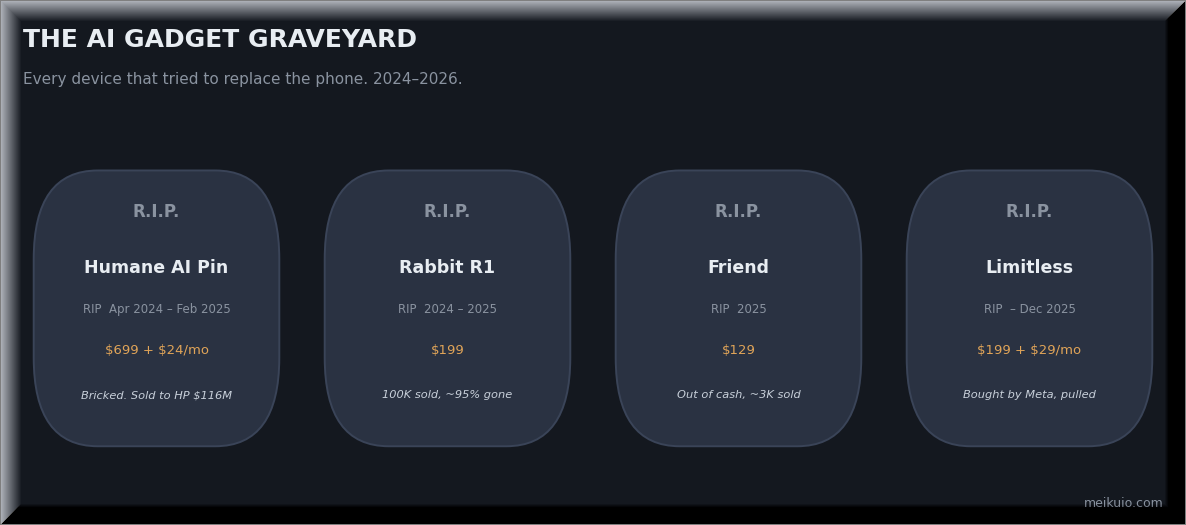
The Humane AI Pin is the headstone everyone points at: $230 million raised, a $699 price plus $24 a month, fewer than 10,000 units sold, and a hard death on February 28, 2025 when Humane killed the servers and bricked every pin in the wild. HP bought the corpse for $116 million. The Rabbit R1 took 100,000 orders at $199 to be an AI that runs your apps, then mostly opened web pages. Even Apple’s Jony Ive called both “very bad products.” The lesson the survivors learned: don’t fight the phone. Help it.
Quick Verdict: The 2026 AI Gadgets Worth Your Money
Short on time? Get the Ray-Ban Meta Gen 2 if you want one AI gadget that handles capture, translation, and quick questions. Get the Plaud Note Pro if your calendar is wall-to-wall meetings. Everything else below depends on what you actually do all day.
Hardware entry prices, not the full subscription cost. Bee’s source graphic rounds 49.99 USD to 50; the current author’s exact 49.99 is retained. Prescription lenses for Blayzer / Scriber are separate. Availability and restrictions remain in the full table.
More Read

AI Smart Glasses
This is the category that grew up. Counterpoint Research put Meta at 82% of global smart-glasses shipments in the second half of 2025, with the wider market up 139% year over year. Meta sold more than seven million pairs in 2025 alone. Glasses won because they don’t ask you to carry a new thing or learn a new habit. You already wear them.
The money backs that up. Smart Analytics Global forecasts the AI-glasses market will roughly quadruple in 2026, from about 6 million units and $1.2 billion in 2025 to 20 million units and $5.6 billion. IDC put 2025 shipments up 241% year over year. And demand got strong enough that, according to Bloomberg, Meta and EssilorLuxottica are weighing a move to double Ray-Ban Meta production to 20 million pairs by year-end. This isn’t a niche anymore.
Ray-Ban Meta (Gen 2): the one most people should buy
Start here. From $379, the Gen 2 frames keep the Wayfarer look, add a 12MP camera, open-ear audio, and Meta AI you can talk to. The useful part isn’t the spec sheet. It’s looking at a menu in another language and asking for a translation without pulling out your phone, or capturing a clip hands-free while you’re holding a kid or a leash.
Note
The trade-off is trust. Meta’s AI features roll out by region, and Meta’s privacy record means you’re making a real call about a camera on your face. If that bothers you, this isn’t your gadget.
Ray-Ban Meta Blayzer & Scriber Optics: for people who wear prescriptions
Announced in March 2026 and on sale April 14, the Blayzer (rectangular) and Scriber (rounded) frames are Meta’s first built prescription-first, at $499 with lenses sold separately. Same camera-and-assistant idea as the Gen 2, no display, but designed so an optician can fit them like real glasses. If you’ve been waiting because you can’t wear non-prescription frames all day, this is the wait ending.
Meta Ray-Ban Display: the flex, if you can get it
The $799 Display is the first Ray-Ban with a screen in the lens: a 600×600 full-color panel, 90Hz, 20-degree field of view, up to 5,000 nits, and it ships with the Meta Neural Band, an EMG wristband that reads finger movements so you can scroll and even handwrite without touching anything. Demand was strong enough that Meta paused its UK, France, Italy, and Canada rollout in early 2026. Waitlists run deep. Buy it to be first, not because you need it.
Even Realities G2: a display without the camera
For $599, the G2 is the anti-Meta: titanium, 35 grams, no camera, and a subtle green monochrome readout for translation, teleprompting, walking directions, and live transcription. Battery lasts about two days. It takes prescriptions from -12 to +12, so it can replace your daily glasses instead of joining them in a drawer. The optional R1 control ring runs another $249. Software has been uneven through 2026, but it’s the rare pair you’d wear out of the house without anyone knowing they’re smart. ($599 is the US price; in the UAE store the same frames list at $699.)
Amazon Echo Frames: the budget entry
If you live in Alexa and just want audio glasses, the Echo Frames Gen 2 start at $269.99 ($389.99 for the Carrera styles). No camera, no display, open-ear speakers and Alexa in your ears. Limited next to Meta, but the cheapest way into the category.
Coming: Google’s Android XR glasses
Google used I/O 2026 to show its Android XR glasses with Gemini built in, made with Warby Parker and Gentle Monster. They launch in fall 2026, audio-first, with a display version later. Pricing isn’t confirmed. We’ll put them head-to-head with Meta in a dedicated comparison once they ship. For now: announced, not buyable.
AI Note-Takers: For People Who Live in Meetings
If your day is calls and you’re tired of typing up notes, this is the category with the clearest payback.
Plaud Note Pro: the winner
$189, a 0.95-inch screen, up to 30 hours of recording, 64GB on board, transcription in 112 languages. Clip it or stick it to the back of your phone, hit record, and the app hands back a clean transcript, a summary, and action items. Forbes Vetted named it the 2026 Best AI Wearable in March. The catch is the subscription: 300 free transcription minutes a month, then roughly $8 to $11 a month for Pro if you record constantly. For someone in back-to-back meetings, that math still works.
The honest test for any AI recorder: would you rather re-listen to an hour of audio, or read a 200-word summary with the decisions pulled out? If it’s the summary, the $189 pays for itself in a week of meetings.
Bee (Amazon): the cheapest way to try the idea
At $49.99, Bee is a wristband that listens ambiently and builds end-of-day summaries and reminders from what it heard. Battery lasts about a week. Amazon bought it in July 2025 and is folding it into Alexa. Two caveats: it’s a first-gen device, and “an Amazon thing that listens all day” is a privacy decision before it’s a purchase. It pauses after 15 minutes of silence, which handles the awkward questions. Also budget for the $19/month Pro plan, which pushes the real first-year cost north of $270.
The pins that died, and why these didn’t
This is the category where the AI-pin dream went to die (see the graveyard up top). What keeps Plaud and Bee alive is that they don’t pretend to be your next phone. They do one job, recording and summarizing, and hand it to the phone already in your pocket. The Limitless Pendant was the best of the dead bunch, good enough that Meta bought it in December 2025 and stopped selling it. Notice the pattern: the recorder that clips to your collar survives, the box that wants to replace your screen doesn’t.
AI Health Wearables
The smartest health AI of 2026 is the stuff you don’t have to look at. Rings won because they track sleep and recovery without a screen buzzing on your wrist.
Oura Ring 5: the flagship
The Ring 5 landed June 4, 2026 at $399 (up to $499 for premium finishes). Oura calls it the world’s smallest smart ring: 40% thinner than the Ring 4, six to nine days of battery, more than 50 health metrics. The AI layer, Oura Advisor, turns your data into plain-language sleep and recovery coaching. The headline addition is Blood Pressure Signals, which watches nighttime blood-pressure patterns for signs of strain. Read that carefully: it isn’t a cuff and doesn’t give you systolic and diastolic numbers. It flags trends (though if chronic nighttime breathing disturbances or sleep apnea are the underlying issue, dedicated medical hardware like a CPAP machine is what directly treats the physical airway), rolling out in the US, India, and UAE from June. Worth it if you want the most refined sleep tracker on the market and you’re on iPhone. Budget $5.99 a month for membership in the US.
The older Oura Ring 4 sticks around at $349 as the cheaper way in.
Samsung Galaxy Ring: the no-subscription pick
If you’re on Android, the $399 Galaxy Ring has one advantage Oura can’t match: no monthly fee. It plugs into Samsung Health, tracks sleep and skin temperature, and adds hardware tricks like a double-pinch gesture to snap a photo or dismiss an alarm. The limit is the walled garden: it’s Android-only and works best inside Samsung’s world. Over three years, the no-subscription math makes it the cheaper long-term ring by a wide margin.
AirPods Pro 3: the AI gadget most people already want
At $249, the AirPods Pro 3 are the easiest yes on this list for iPhone owners. They launched September 2025 with Live Translation powered by Apple Intelligence, heart-rate sensing, tracking for 50-plus workouts, and roughly double the noise cancellation of the Pro 2. If your main priority is overnight sound isolation rather than daytime calls, our roundup of the best noise-cancelling headphones for sleeping in 2026 benchmarks low-profile buds built specifically for side-sleeping. You were probably going to buy earbuds anyway. These happen to translate a conversation in real time.
Your Phone Might Be the Best AI Gadget
Before you buy any of the above, look at your phone. The flagships of 2026 fold most of this functionality in, as we detailed in our guide to choosing an AI phone. The Google Pixel 10 Pro ($999, out August 2025) runs the Tensor G5 chip and Gemini Nano on-device, with Magic Cue surfacing info before you ask, Voice Translate handling live call translation, and Gemini Live giving visual help through the camera. The Samsung Galaxy S26 Ultra ($1,299.99, out March 11, 2026) leans into agentic AI: Now Brief builds a spoken daily rundown, Now Nudge reads your messages and surfaces calendar openings, and a hardware Privacy Display keeps seatmates from reading your screen. It’s the same on-device shift that put Gemini inside Siri, and it’s worth knowing the AI assistants worth switching to before you pick a side.
The point: if your phone is two years old, upgrading it may do more for your daily AI use than any single gadget here. The exception is a trip beyond cell coverage, where a phone does not help; our guide to the best walkie-talkies checks which radios need an FCC license and how far they really reach. When a storm takes out the power and the towers, our guide to the best emergency radio sorts the radios that wake you for your own county from the ones that only play the broadcast.
AI Laptops and Home, Briefly
Two more categories worth a line. Copilot+ PCs are the Windows laptops with a neural processor rated at 40 trillion operations per second or more, which is what unlocks on-device features like Recall, Click to Do, and live caption translation. If you’re buying a Windows laptop in 2026, you’re buying one of these whether you sought it out or not. On the smart home side, Google is rolling Gemini into Nest displays (“Gemini for Home”) and Amazon’s Alexa+ is now a genuinely conversational assistant that reaches the web and your phone, not just the Echo on your counter. Neither is a reason to buy new hardware on its own.
What to Skip
USD, hardware plus subscription; source totals are approximately 734, 615, 477, 399, 379 and 249. Plaud’s paid plan is optional: the free 300-minute tier leaves hardware-only cost at 189 USD. Oura’s quoted 5.99 × 36 is 215.64 USD, rounded to 216 in the original illustration. Plaud’s original table reports 288 USD over three years despite a 9.99/month note; exact multiplication would be 359.64 USD. This existing discrepancy is flagged rather than silently rewriting author figures. Bee is 19 × 36 = 684 USD; current exact hardware is 49.99.
AR display glasses dressed up as “AI glasses.” Plenty of 2026 glasses (Xreal, RayNeo, the gaming-focused ROG models) are excellent wearable monitors that float a big screen in front of you. That’s AR, not an AI assistant. Great for travel and gaming, but if you want AI, the assistant should be the headline, not the display.
Anything where the subscription is the real product. A $49 sticker with a $19/month brain costs more than a $200 device with a free tier over two years. Always do the three-year math before you buy.
The “replace your phone” pitch. Humane and Rabbit proved it. In 2026, the gadgets that work extend your phone. They don’t fight it. The honest question to ask before any of this: can your phone already do it? For translation, recording, and most quick AI tasks, it probably can.
US vs Canada vs Australia: What It Really Costs
Most buying guides quote one US price and stop. If you’re in Canada or Australia, two things bite you.
First, subscriptions scale by region. Oura membership is $5.99/month in the US, $7.99 CAD in Canada, and $9.99 AUD in Australia. Over a three-year ring lifespan that gap adds up, which is part of why the no-subscription Samsung Galaxy Ring is the smarter long-term buy for Android users outside the US.
Second, launches go US-first. New AI gadgets routinely ship to US addresses months before Canada or Australia, and grey-market importers tack on steep markups. Freight-forwarding to a US address is the common workaround, but budget for import duty, GST in Australia, and provincial taxes in Canada.
One US-only perk: Oura and several other health rings are HSA/FSA-eligible in the States, so you can buy them with pre-tax dollars. That option doesn’t exist under Canadian or Australian tax rules.
What They Actually Cost Over Three Years
Sticker price lies. The subscription is where these gadgets either get expensive or stay honest. Here’s the real three-year cost, hardware plus subscription. (For AI-model subscriptions specifically, we keep a running breakdown on our AI pricing page.)
Read the bottom row twice. The $49.99 Bee, the cheapest sticker here, turns into the most expensive thing on the list the moment you switch the AI on. Meanwhile the no-subscription Galaxy Ring quietly undercuts the Oura it’s chasing by more than $200 over three years. Cheap up front isn’t cheap. Ask what it costs running.
The $49.99 Bee becomes the most expensive gadget on this list once you turn the AI on. Always run the three-year math.
Which One Should You Buy?
If you’re a founder living in meetings: Plaud Note Pro for the notes, and a Galaxy S26 Ultra if you handle sensitive material in public (the Privacy Display earns its place).
If you’re a marketer or creator: Ray-Ban Meta Gen 2 for hands-free, point-of-view capture and quick visual AI, full stop.
If you’re a freelancer watching costs: Samsung Galaxy Ring for no-subscription health tracking on Android, or the Oura Ring 5 if you’re on iPhone and will pay for the best. Skip the pins.
Field notes
- Top overall pick: Ray-Ban Meta Gen 2 (from $379, 12MP camera, hands-free POV & real-time visual translation).
- Best meeting productivity: Plaud Note Pro ($189, 64GB storage, 30h battery, 112 language AI transcription).
- Best health ring (no subscription): Samsung Galaxy Ring ($399, Android-optimized, zero ongoing subscription fees).
- Best health ring (iPhone): Oura Ring 5 (from $399 + $5.99/mo, 40% thinner, nighttime blood pressure trends).
- Subscription trap: Bee wearable ($49.99 sticker scales to ~$734 over 3 years via mandatory $19/mo subscription).
- Category verdict: Dedicated single-purpose hardware extending smartphones thrives; standalone “phone replacements” (Humane/Rabbit) failed.
- Sources: IDC & Counterpoint Research Hardware Shipments (2025–2026), Official Manufacturer Pricing.
Frequently Asked Questions
What’s the best AI gadget for most people in 2026?
The Ray-Ban Meta Gen 2 glasses, from $379. They handle translation, hands-free capture, and quick AI questions in a form you already wear, with the widest mainstream support of any AI wearable.
Are AI smart glasses worth it in 2026?
For most people, yes, if you buy the right pair. Ray-Ban Meta glasses do real, daily jobs (translation, capture, quick lookups). Display glasses like the Meta Ray-Ban Display and Even Realities G2 are more niche and worth it only if you specifically want a heads-up screen.
Do AI gadgets need a subscription?
Many do, and it’s the biggest hidden cost. Plaud, Bee, and Oura all charge monthly for full features. Samsung’s Galaxy Ring is the notable exception with no fee. Always calculate three years of subscription before buying.
Is the Humane and Rabbit era of AI gadgets over?
Yes. The Humane AI Pin was bricked in February 2025 and its assets sold to HP; the Rabbit R1 collapsed in usage after launch. The standalone “replace your phone” gadget failed. The gadgets that work in 2026 extend your phone instead.
Can’t my phone already do all this?
Often, yes. A current Pixel or Galaxy handles translation, recording, and most AI tasks. Buy a dedicated gadget only when the form factor matters: glasses for hands-free, a ring for sleep, a recorder for all-day meetings.
Which AI gadgets ship to Canada and Australia?
Mainstream ones (Ray-Ban Meta, AirPods Pro 3, Samsung Galaxy Ring, Oura) sell in all three markets, though often later and pricier than the US. Startup devices frequently launch US-first, so check shipping before you commit.
My Take
After a year of laughing at AI pins, I didn’t expect to recommend this category with a straight face. But the survivors earned it. The pattern is simple: the gadgets that win in 2026 do one job well and hand the rest back to your phone. Ray-Ban Meta nails capture and translation. Plaud nails meetings. Oura nails sleep. None of them tries to be your everything, and that’s exactly why they work. If you’re tempted by something that promises to replace your phone, save your money and watch what happened to Humane. Buy the gadget that makes the phone you already own a little smarter.