

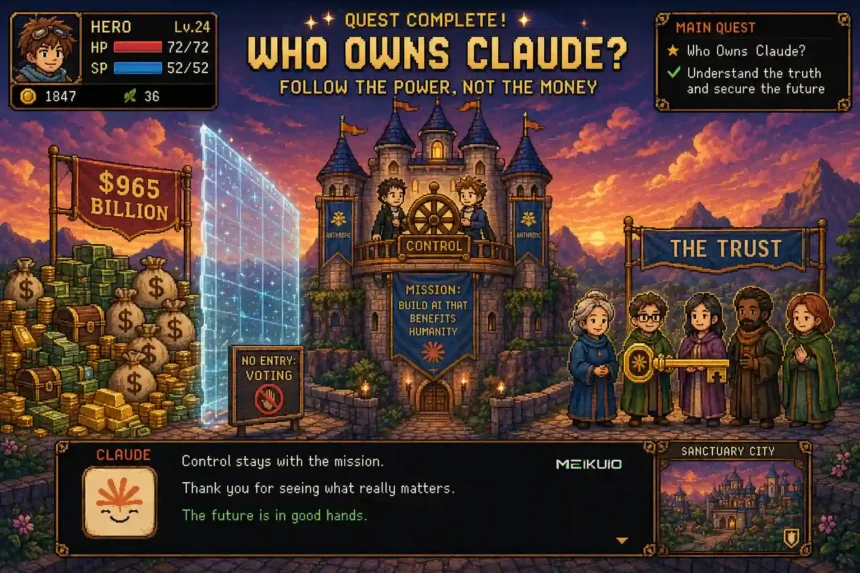
Anthropic owns Claude. Anthropic’s founders run the company and an independent trust elects most of its board, while Amazon and Google, which have put tens of billions of dollars into it, hold no vote. If your team is about to commit a year of budget to Claude, the gap between who pays for Anthropic and who decides for it is what that budget rides on.
- Quick Answer: Who Controls What
- The Founder LLC: one share, half the vote
- The Trust that picks most of the board is down to three
- Amazon and Google: landlord, shop and shareholder, without a vote
- What Anthropic earns, and what it has promised to pay
- What this means if you build on Claude
- The IPO: what is filed and what isn’t
- Frequently Asked Questions
- Who owns Claude?
- Does Anthropic own Claude?
- Does Amazon own Anthropic?
- Does Google own Claude?
- Is Anthropic a public company?
- Can I buy Anthropic stock?
- What is the Long-Term Benefit Trust?
- Is Anthropic bigger than OpenAI now?
- My Take
That gap widened in 2026. The trust has chosen a majority of Anthropic’s board since April. According to its draft prospectus as described by Reuters, the stock market listing Anthropic is preparing would hand seven co-founders 50.1% of the vote through a single share. The draft is still confidential, so every figure taken from it below names the outlet that saw it.
Quick Answer: Who Controls What
Money and votes sit in different hands at Anthropic. The table lists who holds what, and the plus sign on each row opens the document behind it.
The short answer to who owns Claude is Anthropic, PBC, a Delaware public benefit corporation that builds and sells Claude as its product. A public benefit corporation is a for-profit company whose directors must balance shareholder returns against a stated mission. The investors with the most money in it, Amazon and Google, hold large stakes and no say over who runs the company. Control runs through two channels: a Long-Term Benefit Trust that elects most of the board and, once the company lists, a group of seven founders holding just over half of the shareholder vote.

The Founder LLC: one share, half the vote
Anthropic was founded in 2021 by researchers who left OpenAI in 2020, led by the siblings Dario Amodei, now chief executive, and Daniela Amodei, now president and chair of the board. Five years on, the same core group is writing itself into the company’s stock. Reuters described the structure on September 28, 2026, from a copy of Anthropic’s draft IPO filing. Seven co-founders form a “Founder LLC,” and a majority vote among them directs one share of Class F stock. That share carries 50.1% of total voting power on key corporate matters.
Reuters names four of the seven: Dario Amodei, Daniela Amodei, chief compute officer Tom Brown and researcher Chris Olah. The filing describes them as individuals “distinctly equipped to be stewards of our mission,” according to Reuters. A founder leaves the group by quitting, dying, selling too many shares or being removed for cause. The extra voting power starts to wind down once two or fewer co-founders or their successors remain.
One share of Class F stock would carry 50.1% of Anthropic’s vote, and seven co-founders decide together how it is cast.
For anyone buying in at the IPO, the arithmetic is short. Ordinary Class A shares carry one vote each, strategic partners get what Reuters calls “minimal voting rights,” and the single Class F share outweighs every other vote combined. The filing says as much itself: decisions under this setup “may conflict with short-, medium-, or long-term financial interests and business performance, which may negatively impact the value of our Class A common stock.”
The founders are paid like executives of a company this size. Dario Amodei received nearly $18 million in 2025, largely in stock and option awards, and Daniela Amodei $16.4 million, according to the filing’s compensation table as reported by Reuters. The co-founders also pledged in the filing to give 80% of their personal Anthropic equity to charitable causes.

The Trust that picks most of the board is down to three
Anthropic’s founders decided early that the public benefit corporation form wasn’t enough on its own. In 2023 they added the Long-Term Benefit Trust, an independent body of financially disinterested trustees that holds a special Class T stock with the power to elect and remove directors. Anthropic said then that the Trust would elect a majority of the board within four years.
It got there sooner. On April 14, 2026, the Trust appointed Novartis chief executive Vas Narasimhan to the board, and Anthropic wrote: “With Narasimhan’s appointment, Trust-appointed directors now make up a majority of the Board.” Anthropic’s company page currently lists six directors: Dario Amodei, Daniela Amodei, Yasmin Razavi, Reed Hastings, Chris Liddell and Vas Narasimhan. Confluent chief executive Jay Kreps, whom the Trust placed on the board in 2024, was named in the April announcement and isn’t on the current list.
The Trust itself is short of its designed size. Anthropic described it in 2023 as a body of five. Its company page now names three trustees: chair Neil Buddy Shah, Richard Fontaine and former Federal Reserve chair Ben Bernanke, who joined in July 2026. Mariano-Florentino Cuéllar, appointed in January, left in August to become Anthropic’s first chief global affairs officer, reporting to the president. New trustees are chosen by the existing ones in consultation with the company, so the three current trustees choose who fills the empty seats.
Note
Anthropic’s own 2023 page about the Trust, last edited on September 9, 2026, still records Cuéllar’s arrival but omits his departure. For the current roster, use the company page, which lists the three trustees above.
The IPO keeps the Trust in a decisive but bounded role. Under the draft structure Reuters described, the Trust would elect four of seven directors. Class F and Class A holders would elect Daniela Amodei, Dario Amodei and one director not yet named. The design also lets stockholders change the Trust’s powers without the trustees’ consent if “sufficiently large supermajorities of the stockholders agree,” in Anthropic’s words, and the company hasn’t published those thresholds. If they are counted against total voting power, no supermajority can form without the founders’ 50.1%, and the draft, as reported, doesn’t say how the two mechanisms interact.
Amazon and Google: landlord, shop and shareholder, without a vote
Amazon is the clearer case, because it reports its position every quarter. In its filing for the quarter ended June 30, 2026, Amazon says it put $8.0 billion into Anthropic convertible notes between 2023 and 2025. In the second quarter of 2026 it added $5.0 billion each in Anthropic’s Series G and Series H nonvoting preferred stock. On June 30 it carried the notes at about $97.9 billion and the preferred stock at about $92.5 billion. Convertible notes are loans that turn into shares later, and Amazon books them at fair value, so the $8 billion grew on paper as Anthropic’s valuation rose.
None of it buys a vote. The filing says: “The convertible notes are subject to our ownership cap, which may be waived at our election.” After an IPO, it adds, “then-outstanding notes would be converted to nonvoting common stock, subject to our ownership cap.” The cap is Amazon’s to lift. The vote isn’t on offer.
Amazon has also promised up to $20 billion more through a facility that runs for 30 months after a listing. Its $5 billion Series H purchase came out of that facility, leaving $15 billion.

Google’s stake is harder to pin down, because Alphabet’s quarterly and annual reports don’t contain the word “Anthropic” at all. A search of Alphabet’s filings on the SEC’s EDGAR system on October 5, 2026, found the name only in proxy statements and shareholder materials. The figure everyone repeats comes from The New York Times. In March 2025, citing court documents from the Justice Department’s antitrust case against Google, it reported a 14% stake with a 15% ceiling and no voting rights or board seat.
For a team planning around Claude, the more useful fact is what else these two companies are to Anthropic. They are its landlords: the draft prospectus lists about $111.1 billion of computing commitments to Google and $110.0 billion to Amazon, according to a PitchBook analysis published on October 5, 2026. They are also its storefront, since Amazon’s and Google’s cloud marketplaces produced 47% of Anthropic’s 2025 revenue. A shareholder can lack a vote and still sit on three sides of the business.
What Anthropic earns, and what it has promised to pay
Anthropic’s revenue is growing faster than its annual numbers can show. The company’s run rate, which multiplies its latest month by twelve, was about $9 billion at the end of 2025. By Anthropic’s own count it passed $30 billion in April 2026 and $47 billion in early May. PitchBook, reading the draft prospectus, puts it above $65 billion by late July.
A run rate isn’t a year of revenue, and the gap is wide here. Anthropic’s actual 2025 revenue was nearly $4.6 billion, about twelve times its 2024 figure. First-quarter 2026 revenue of $4.73 billion beat the whole of 2025, according to PitchBook’s reading of the draft.
Costs rose too. Reuters, which saw the draft, reported a 2025 net loss of about $42 billion, of which roughly $34 billion was an accounting charge tied to financing that could turn into shares. The operating loss was $8.06 billion, up from $2.98 billion in 2024. Compute and infrastructure cost $7.33 billion, more than half of $12.65 billion in operating expenses. Anthropic held $20.28 billion in cash and short-term investments at the end of 2025.
The larger number is the future one. Reuters reported about $518 billion of cloud, computing and infrastructure obligations in coming years. PitchBook broke them down by partner and found that about 80% of the total is noncancelable or payable regardless of usage. Its analyst noted a positive adjusted operating result in the second quarter of 2026, but concluded that the disclosures so far don’t show Anthropic can turn that growth into durable cash.
One supplier wrote its doubt into a federal filing. Broadcom’s April 6, 2026 report to the SEC says Anthropic will access “approximately 3.5 gigawatts as part of the multiple gigawatts of next generation TPU-based AI compute capacity committed by Anthropic.” The next sentence reads: “The consumption of such expanded AI compute capacity by Anthropic is dependent on Anthropic’s continued commercial success.” Anthropic’s Series H announcement put the whole Google and Broadcom deal at five gigawatts, so the 3.5 gigawatts is Broadcom’s share of it.

What this means if you build on Claude
If your team runs production work on Claude, ownership shows up in three lines of the budget review: what the model may do, how much capacity you get at peak hours, and what it costs. Heavy coding work is where usage limits bite first, as power users learned in GitHub Copilot’s 2026 pricing shake-up.
Ownership doesn’t set your rate limit directly. It shapes which capacity, safety and product decisions get made, and those do. Start with capability. Anthropic’s draft filing, as quoted by Reuters, says the company has “chosen not to develop certain commercially attractive offerings, such as image and video generation models, in order to direct our compute toward our research and safety priorities.” Safety rules route work as well. Anthropic says most cybersecurity tasks sent to Opus 5.5 will be “re-routed to Opus 4.8,” and its anti-distillation safeguard, called preserved thinking, applies to API accounts created on or after August 31, 2026. A structure that lets founders and trustees put safety ahead of revenue also decides what your API will and won’t do.
Capacity comes next. In April Anthropic wrote that “our unprecedented consumer growth, in particular, has impacted reliability and performance for free, Pro, Max, and Team users, especially during peak hours.” On September 22, alongside Opus 5.5, it raised five-hour usage limits on Pro, Max, Team and seat-based Enterprise plans and gave subscribers a rate limit reset they can save for later. Opus 5.5 costs $4 per million input tokens and $20 per million output tokens, with cache reads at $0.20, and Anthropic says that makes typical workloads 40% cheaper than on Opus 5. Our AI pricing tracker keeps the subscription tiers side by side.
Then there’s concentration. Reuters reported that two customers produced nearly a quarter of Anthropic’s 2025 revenue and that many large clients aren’t locked into long-term contracts. For a smaller team, the question to settle before signing is whether the contract guarantees capacity or only access. Amazon Bedrock, Google Cloud’s Vertex AI and Microsoft’s Azure Foundry sell Claude, so your team has a second route to the same model if one gets congested.

The IPO: what is filed and what isn’t
Anthropic confidentially submitted a draft registration statement on Form S-1 to the SEC on June 1, 2026. It announced the step under Rule 135, which lets a company say it plans an offering without making one. As of October 5, 2026, EDGAR holds no public registration statement from Anthropic, and the only filers with “Anthropic” in their names are investment vehicles that pool money to buy its shares. Every prospectus figure in circulation, including the ones in this article, comes from copies reporters have seen, not from a public document.
The timing has moved twice. Reuters reported on September 4 that marketing could begin in mid-October with a listing days before the November midterm elections, then on September 28 that the debut was likely to slip past the midterms. The valuation target reported for the listing is more than $2 trillion. That is over twice the $965 billion set in the $65 billion Series H on May 28, 2026, which followed a $380 billion Series G in February. Private rounds can price the same company very differently, as the four competing Perplexity valuations show.
A buyer at the IPO should also know one limit in Delaware law. Under section 367 of Delaware’s corporate code, a shareholder who wants to sue a public benefit corporation for failing to balance its mission against returns needs at least 2% of the shares. For a listed company, stock worth at least $2,000,000 is enough. The first court decision on what such directors owe came on July 29, 2026, in Drakes Landing v. Tilden Park. The Court of Chancery held that the rule requiring a conventional board to seek the best price in a sale doesn’t apply to a public benefit corporation. That case involved a student lender, not Anthropic, and may still be appealed.
OpenAI, Anthropic’s closest rival, confidentially filed for its own IPO in June 2026, and its control also runs through a single share, held by a nonprofit rather than by founders. We traced that structure in who owns ChatGPT.
Both companies end up in the same place by different routes. A buyer of either stock gets a share of the economics, while stock held by founders, a trust or a nonprofit decides who sits on the board.
Field notes
- Who owns Claude: Anthropic, PBC, a Delaware public benefit corporation founded in 2021 by former OpenAI researchers led by Dario and Daniela Amodei.
- Control: the Long-Term Benefit Trust has elected a board majority since April 14, 2026; the draft IPO structure gives seven co-founders 50.1% of the vote through one Class F share, per Reuters.
- Board and Trust: six directors (Dario Amodei, Daniela Amodei, Yasmin Razavi, Reed Hastings, Chris Liddell, Vas Narasimhan); three trustees (Neil Buddy Shah, Richard Fontaine, Ben Bernanke), per Anthropic’s company page.
- Largest investors: Amazon, whose Anthropic notes and nonvoting preferred stock were carried at about $97.9 billion and $92.5 billion on June 30, 2026; Google, reported at 14% in 2025; neither has a vote or a board seat.
- Money: $965 billion valuation after a $65 billion Series H on May 28, 2026; 2025 revenue near $4.6 billion; about $518 billion of computing obligations reported by Reuters.
- IPO status: draft S-1 submitted confidentially on June 1, 2026; no public filing in EDGAR as of October 5, 2026; reported target above $2 trillion.
- Sources: Anthropic announcements and company page; Amazon Form 10-Q for the quarter ended June 30, 2026; Broadcom Form 8-K of April 6, 2026; Delaware Code title 8, sections 361 to 368; Reuters and PitchBook reporting on the draft prospectus.
Frequently Asked Questions
Who owns Claude?
Anthropic, PBC owns Claude. Anthropic is a Delaware public benefit corporation. An independent Long-Term Benefit Trust elects most of its board, and its founders hold the other lever. Amazon and Google own large stakes in Anthropic but have no vote and no board seats.
Does Anthropic own Claude?
Yes. Anthropic, PBC builds, trains and sells Claude as its own product. Amazon, Google and Microsoft resell access to Claude through their cloud platforms, but the model belongs to Anthropic, and none of those three controls the company.
Does Amazon own Anthropic?
No. Amazon is a major investor, but its own SEC filing calls its Anthropic preferred stock nonvoting and puts its notes under an ownership cap. Those notes would convert to nonvoting common stock at an IPO. Amazon has no board seat.
Does Google own Claude?
No. Google holds a minority stake in Anthropic, which The New York Times reported in 2025 at 14%, capped at 15% and without voting rights. Alphabet’s own quarterly and annual reports don’t name Anthropic. Claude belongs to Anthropic.
Is Anthropic a public company?
Not yet. Anthropic submitted a draft S-1 to the SEC confidentially on June 1, 2026, and as of October 5, 2026, no public registration statement from the company appears in EDGAR. Reuters has reported that the listing is likely to come after the November 2026 midterm elections.
Can I buy Anthropic stock?
Not directly until the IPO. Before then, exposure comes through pre-IPO marketplaces open mostly to accredited investors, as in how to buy OpenAI stock, or through listed stakeholders such as Amazon and Alphabet, covered in our best AI stocks for 2026. Class A shares at the IPO carry one vote each.
What is the Long-Term Benefit Trust?
It’s an independent body of financially disinterested trustees that holds Anthropic’s Class T stock and elects directors. It has chosen a majority of the board since April 2026. Anthropic’s company page lists three trustees: Neil Buddy Shah, Richard Fontaine and Ben Bernanke.
Is Anthropic bigger than OpenAI now?
By its last private valuation, yes. Anthropic’s $965 billion Series H in May 2026 topped OpenAI’s roughly $852 billion round from March 2026. Both companies are preparing IPOs, and the listing prices will reset that comparison.
My Take
I’d treat the Founder LLC as the real news here, more than the $2 trillion figure. For years the reassuring answer to who owns Claude was that an independent trust would eventually run the board. It does now, with three of its five trustee seats filled, and the IPO adds a second lock held by the people who started the company. A team that standardizes on Claude relies on a small group’s judgment, and the filing tells investors plainly that the group may choose the mission over their returns.
If I were approving a multi-year Claude contract this quarter, I’d sign it, with two things in writing first. One is a capacity commitment for peak hours, since Anthropic has publicly admitted that capacity ran short then. The other is a second way in through Bedrock, Vertex AI or Foundry. I’d drop any argument that this ownership makes Claude safer or riskier as a vendor. It does make Claude predictable in one way: when a feature you want competes with the mission, the company has told you which one it will pick.