

Search “buy OpenAI stock” and you’ll get a wall of brokerage ads promising you a piece of the company behind ChatGPT. Most of them are selling you something that doesn’t quite exist. OpenAI is private. There’s no ticker, no share you can add to your Robinhood cart, no IPO that has happened yet. The honest version of the answer is that you can’t buy OpenAI directly, and the more useful question is how much actual OpenAI you get for your money through the workarounds that do exist. Some of them hand you about three cents of OpenAI for every dollar.
- The short answer: you can’t buy OpenAI shares directly
- Why OpenAI doesn’t have “normal” stock
- The 2025 restructure into a Public Benefit Corporation
- Who actually controls OpenAI
- What this means for shareholders
- The money behind OpenAI right now
- How to get OpenAI exposure today, ranked easiest first
- ARK ETFs: the easiest path (ARKK, ARKW, ARKF)
- ARK Venture Fund and Fundrise: more concentrated, less liquid
- Listed proxies: DXYZ and Eightco (handle with care)
- Pre-IPO marketplaces: real shares, accreditation required
- Indirect proxies: Microsoft, SoftBank, Nvidia
- When will OpenAI go public?
- The risks nobody puts in the headline
- Frequently asked questions
- Can I buy OpenAI stock on Robinhood or Fidelity?
- Is there an OpenAI stock ticker symbol?
- What’s the cheapest way to get OpenAI exposure?
- Will OpenAI IPO in 2026?
- Is OpenAI a good investment?
- My Take
This guide walks through every real path to OpenAI exposure in 2026, ranked by how easy they are to reach, with the math on what you’re actually buying. It also covers where the IPO timeline stands now, which moved in late June and is messier than most headlines admit.
Note
Short version: you cannot buy OpenAI shares directly. The closest no-paperwork option is an ARK ETF (ARKK, ARKW, or ARKF), where OpenAI is about 3% of the fund. Accredited investors can buy private shares through Forge, EquityZen, or Hiive. An IPO is filed but not scheduled, and bankers are now leaning toward 2027.
The short answer: you can’t buy OpenAI shares directly
OpenAI has no publicly traded stock. It’s a private company, so its shares don’t sit on any exchange, and the only people who hold them are employees, early backers, and the institutions OpenAI’s board has approved. Retail investors aren’t on that list. That part is simple.
What’s left is indirect exposure: funds and proxies that hold a slice of OpenAI and let you ride along with whatever that slice does. The catch is that the slice is usually small, and the easier a vehicle is to buy, the smaller your real OpenAI stake tends to be. Here’s the shape of it before we get into each option.
If this sounds familiar, it’s the same wall you hit trying to buy into another private AI company like Neuralink: the demand is real, the direct supply is zero, and a small industry has grown up to sell you the gap.
Why OpenAI doesn’t have “normal” stock
OpenAI’s ownership is stranger than a typical startup’s, and the structure matters if you’re going to put money near it. It changed significantly in late 2025.

The 2025 restructure into a Public Benefit Corporation
On October 28, 2025, OpenAI finished a recapitalization it had spent nearly a year negotiating with the California and Delaware attorneys general. The result is two entities. The OpenAI Foundation is the nonprofit parent. Below it sits OpenAI Group PBC, a Delaware Public Benefit Corporation that holds the actual business. Equity in that PBC is split roughly three ways: the Foundation holds 26%, Microsoft holds about 27%, and the remaining 47% belongs to employees and investors. Our separate breakdown of who owns ChatGPT walks through what each of those three stakes actually buys and what Microsoft reports in its own SEC filings.
The recapitalization did one thing that matters for any future buyer. It scrapped OpenAI’s old “capped-profit” model, where early investors’ returns were limited to a fixed multiple and everything above that reverted to the nonprofit. Under the new structure, equity holders own standard stock that grows with the company and has no ceiling. That’s what made the giant funding rounds possible, and it’s what a public listing would eventually sell.
Who actually controls OpenAI
Owning the most equity and controlling the company are two different things at OpenAI. The Foundation holds a minority economic stake, around 26% worth roughly $130 billion at the recap, but it keeps absolute governance control. It alone appoints and can replace every member of the PBC board, currently chaired by Bret Taylor and including Sam Altman alongside independent directors. The Foundation also holds a warrant that issues it more equity if OpenAI’s value grows more than tenfold over 15 years, which is designed to keep the nonprofit the single largest beneficiary if things go well.
What this means for shareholders
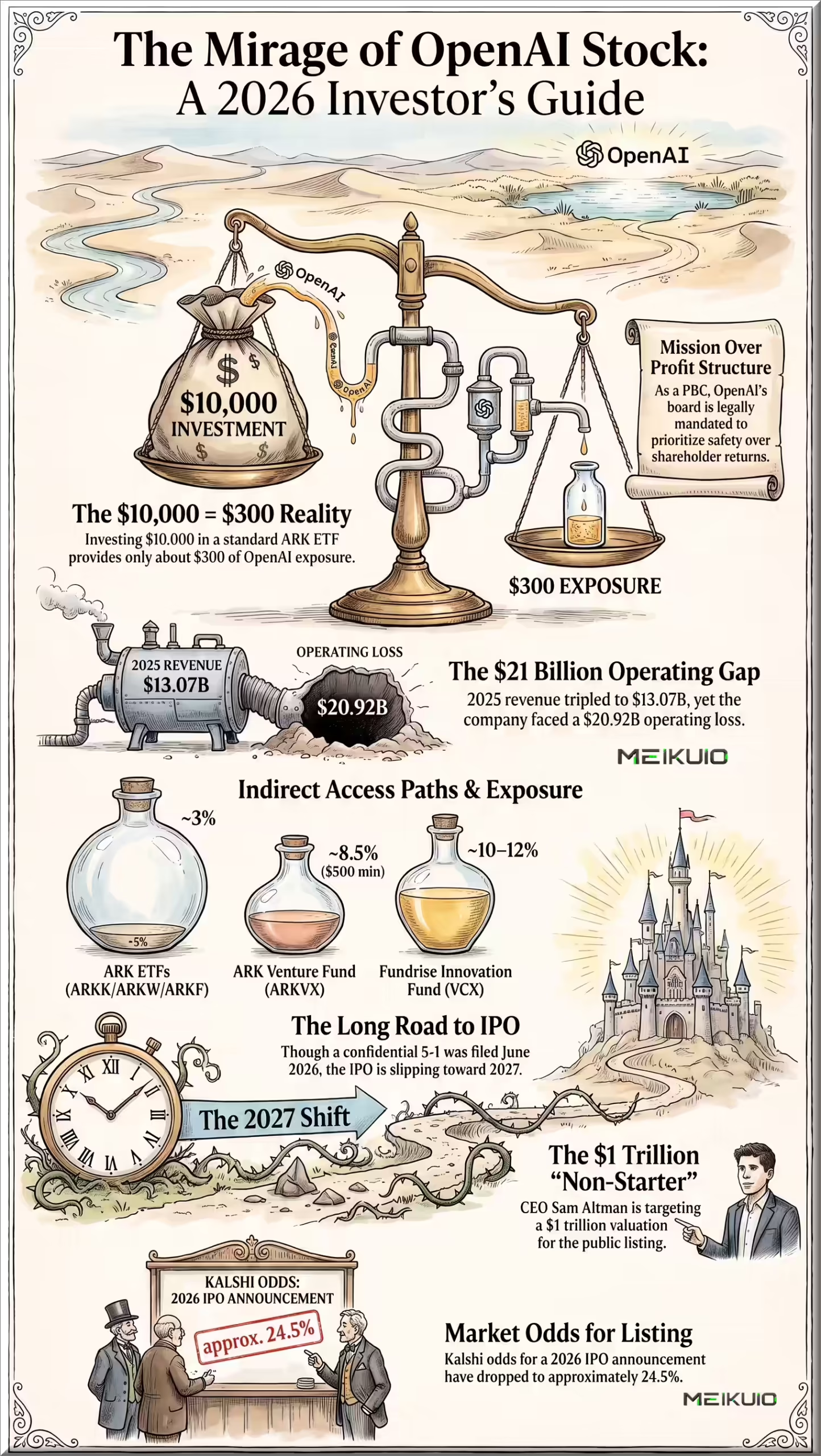
A PBC board is legally allowed to put its mission ahead of your returns. OpenAI’s stated mission is to make sure artificial general intelligence benefits everyone, and if safety ever collides with profit, the board is structured to pick safety. For a shareholder, that’s a real risk that doesn’t exist with an ordinary company: the people in charge have a legal mandate that isn’t “maximize the stock.”
Microsoft’s position shows how tangled this gets. It has put more than $13 billion into OpenAI since 2019, converted into that 27% stake at the recap. A new partnership agreement signed April 27, 2026 keeps Azure as OpenAI’s primary cloud and licenses OpenAI’s IP to Microsoft through 2032, though that license ends if an independent panel ever confirms OpenAI has reached AGI. OpenAI keeps paying Microsoft a revenue share through 2030, capped at around $38 billion. None of this is something you can buy a piece of cleanly.
The money behind OpenAI right now
Before you chase exposure, it helps to know what you’d be buying into. The numbers are enormous in both directions.
On March 31, 2026, OpenAI closed the largest primary funding round in history: $122 billion in committed capital at an $852 billion post-money valuation. Amazon put in $50 billion (about $35 billion of it contingent on OpenAI going public or reaching AGI), while SoftBank and Nvidia each committed $30 billion, with a16z, BlackRock, Fidelity, Sequoia, and T. Rowe Price alongside them. For the first time, OpenAI also routed about $3 billion of that round to individual investors through bank channels, right before its IPO filing.
The 1T USD IPO ask is a reported target, not a priced transaction or completed IPO. March 31 round: 122B USD committed at an 852B post-money valuation. Historical transaction types remain distinct.
Now the other direction. OpenAI’s audited 2025 financials, verified by the Financial Times, show $13.07 billion in revenue, more than triple the $3.7 billion it made in 2024. They also show a net loss of $38.5 billion. That headline number gets quoted everywhere, and it’s misleading.
Note
Of that $38.5 billion loss, about $41.55 billion is a one-time, non-cash accounting charge from the October 2025 conversion to a PBC. It isn’t money going out the door. The actual operating loss, what the business spent beyond what it earned, was $20.92 billion, driven by $19.18 billion in R&D and $5.73 billion in sales and marketing. Still a staggering burn, but “lost $38.5 billion” and “spent $21 billion more than it earned” are different stories, and most coverage only tells the scarier one.
For 2026, OpenAI projects a GAAP loss of $25 billion to $26 billion on revenue somewhere between $26 billion and $42 billion. This is the company that wants to go public at $1 trillion. Whether that holds up is the entire debate, and it’s the same hype-versus-reality split running through the best AI stocks to buy in 2026, where the gap between a company’s story and its actual revenue is the thing worth watching.
How to get OpenAI exposure today, ranked easiest first
These are the real vehicles, ordered from “open a brokerage app” to “prove you’re rich enough.” For each one, the number that matters is how much of it is actually OpenAI.
ARK ETFs: the easiest path (ARKK, ARKW, ARKF)
On March 31, 2026, Cathie Wood’s ARK Invest bought 348,995 Series C OpenAI shares worth about $240 million and spread them across three of its exchange-traded funds: the ARK Innovation ETF (ARKK), the ARK Next Generation Internet ETF (ARKW), and the ARK Fintech Innovation ETF (ARKF). Each fund now holds roughly 3% of its portfolio in OpenAI. You can buy any of them in a normal brokerage account, no accreditation, no minimum beyond one share.
Here’s the part the brokerage ads skip. At a 3% weight, putting $10,000 into ARKK gives you about $300 of real OpenAI exposure. The other $9,700 is riding on Tesla, Coinbase, Roku, and everything else ARK holds. If OpenAI doubles and the rest of the fund stays flat, your $10,000 becomes about $10,300. You’re buying an ARK fund that happens to own a little OpenAI, not OpenAI.
VCX is a 10–12% range, not the old picture’s midpoint of 11%. ARKVX is 8.48% as of May 31 (the graphic rounded to 8.5%). ARK ETFs are approximately 3%; DXYZ approximately 2.1%. Different disclosure dates explicitly retained. Buying a fund buys mostly other holdings.
ARK Venture Fund and Fundrise: more concentrated, less liquid
If you want a bigger OpenAI weight without accreditation, two registered funds get you there. The ARK Venture Fund (ARKVX) held about 8.48% in OpenAI as of May 31, 2026, with a $500 minimum, available through SoFi and Titan. The Fundrise Innovation Fund (VCX) holds somewhere between 10% and 12%. Both charge real fees, 2.9% a year for ARKVX and 1.85% for VCX, and both are far less liquid than an ETF. ARKVX is an interval fund, which means it only lets you redeem up to 5% of its value each quarter. Your money can get stuck.
Listed proxies: DXYZ and Eightco (handle with care)
A few publicly traded companies exist mostly to hold private startups, which makes them tradeable OpenAI proxies. Destiny Tech100 (DXYZ) trades on the NYSE and held about 2.1% in OpenAI as of December 31, 2025. Eightco (NASDAQ: ORBS) disclosed a $90 million OpenAI position through special purpose vehicles as of June 24, 2026, roughly 21% of its treasury, one of the most concentrated OpenAI bets on the public market.
DXYZ has spent long stretches trading at an extreme premium to the value of what it actually holds, meaning you can pay well over a dollar for a dollar of assets.
That premium is the whole problem with this category. When a proxy trades far above its net asset value, you’re betting on the premium holding as much as on OpenAI, and premiums collapse. These are the most volatile way on this list to get OpenAI exposure, and the easiest to lose money on even if OpenAI does fine.
Pre-IPO marketplaces: real shares, accreditation required
If you’re an accredited investor, with a net worth over $1 million excluding your home, or income over $200,000 ($300,000 with a spouse) for the last two years, you can buy actual OpenAI shares on secondary marketplaces. They source shares from early employees and backers. Three names dominate:
- Forge Global lists OpenAI with a $100,000 standard minimum (some pooled vehicles start around $5,000), charges a 2% to 4% commission, and takes 4 to 8 weeks to settle because OpenAI can exercise a right of first refusal.
- EquityZen packages shares into single-company funds with a $10,000 minimum (select deals at $5,000) and a 2.5% upfront fee that scales down to 2% above $1 million.
- Hiive runs an order book that matches buyers and sellers directly, with broker fees of 3% to 5% and single-asset funds for big names around $5,000.
This is the only path that hands you genuine OpenAI shares rather than a sliver of a fund, but the fees, the settlement lag, and the lockups that come later all eat into the upside. The same valuation fog clouds other private AI rounds on secondary platforms: see our breakdown of Perplexity valuation in 2026, where four conflicting numbers claim to price the exact same venture round.
Indirect proxies: Microsoft, SoftBank, Nvidia
The simplest exposure of all is to buy a public company that owns a chunk of OpenAI. Microsoft (MSFT) is the strongest of these, with its 27% stake and IP rights through 2032. SoftBank (SFTBY) is on track for around $64.6 billion invested, roughly 13%, in preferred shares that convert at an IPO. Amazon and Nvidia both anchored the March 2026 round. The honest limit here: OpenAI is a tiny fraction of any of these companies’ value, so Microsoft stock moves on Microsoft, not on OpenAI. You get a whisper of exposure wrapped in an entirely different business.
Here’s everything side by side.
When will OpenAI go public?
This is where the story moved recently, and the clean “IPO coming in 2026” headlines are now out of date.
OpenAI filed a confidential draft S-1 with the SEC on June 8, 2026, and announced it through its own newsroom to get ahead of leaks. Goldman Sachs and Morgan Stanley are leading. A confidential filing starts the regulatory clock without locking the company into a date or exposing its financials to competitors, so the filing itself doesn’t tell you when shares trade.
Then, in late June 2026, reporting from The New York Times and Bloomberg revealed a split inside the company. Advisers gave leadership two options: wait until 2027 and target a $1 trillion valuation, or accept a lower number and list faster in late 2026. Altman called any cut below $1 trillion a “non-starter.” CFO Sarah Friar has been arguing internally for 2027, pointing to OpenAI’s commitment to spend over $600 billion on computing infrastructure through 2030 and the need for several more quarters of cleaner financials before facing public markets.
Altman called any valuation below $1 trillion a “non-starter.” The market is betting he waits until 2027 to get it.
The betting markets agree with Friar. On the prediction platform Kalshi, the odds of OpenAI announcing an IPO by the end of 2026 fell to about 24.5% in late June, down from 88% in May. The odds climb to 59% by March 1, 2027 and 73% by the end of June 2027. The crowd is pricing a spring or summer 2027 listing, not a 2026 one.
Market-implied probability of announcing an IPO by each deadline, not an official timetable or a guarantee of listing.
There’s a rival in the picture too. Anthropic, OpenAI’s closest competitor, filed its own confidential S-1 on June 1, 2026, a week before OpenAI, and is targeting an October 2026 debut on the Nasdaq after a $65 billion round valued it at $965 billion. Bloomberg reports OpenAI’s own advisers expect Anthropic to go public first. Whoever lists first sets the valuation multiple the market will use to price the other, which is one more reason OpenAI might wait to see how Anthropic trades. If you want the fuller picture of that company, we covered who owns Anthropic and where it’s headed separately.
The risks nobody puts in the headline
Every “how to buy OpenAI” article lists the vehicles. Fewer of them are honest about what goes wrong, so here’s the part to read twice.
The dilution is brutal. Run the ARK math again: $10,000 in ARKK is about $300 of OpenAI. Fund wrappers are an inefficient way to catch a single company’s upside, because you’re paying for a whole portfolio to get a sliver of the one you want.
The fees hide. Some secondary platforms advertise “zero trading fees,” then make their money on a wide spread or by marking up the shares inside an SPV before they reach you. Stacked SPVs can charge you twice, once at the feeder fund and again at the platform. Read what your cost basis actually is, not what the headline fee says.
The lockup can trap you at the worst moment. Shares bought through Forge, EquityZen, or Hiive don’t turn into freely tradeable stock the day OpenAI lists. Standard underwriter lockups typically freeze pre-IPO holders for 180 days after the first public trade. SpaceX showed what that costs: after its record IPO on June 12, 2026, the stock jumped about 19% on day one and ran more than 40% above its offer price within days, then sold off hard in a broader tech slide. Investors locked in pre-IPO vehicles couldn’t sell into the spike.
Note
This article is information, not investment advice. Pre-IPO and proxy vehicles are volatile, illiquid, and priced on limited public data. A $1 trillion target sits on a company still losing tens of billions a year, and a PBC board is legally free to choose its mission over your return. Decide what you can afford to lose, and talk to a licensed advisor before committing real money.
Frequently asked questions
Can I buy OpenAI stock on Robinhood or Fidelity?
Not directly. There’s no OpenAI ticker to buy, because the company is private. What you can buy on a standard brokerage is something that holds OpenAI, like the ARK ETFs (ARKK, ARKW, ARKF), the Fundrise Innovation Fund, or shares of Microsoft. The first OpenAI you can buy by name will be at its IPO, which hasn’t been scheduled.
Is there an OpenAI stock ticker symbol?
No. OpenAI has no ticker because it hasn’t gone public. Any site showing an “OpenAI stock price” is either tracking a private secondary-market estimate or pointing you at a proxy like ARKK or MSFT, not a live OpenAI quote.
What’s the cheapest way to get OpenAI exposure?
One share of an ARK ETF is the lowest barrier, often under $100, with no minimum and no accreditation. Just know you’re getting about 3% OpenAI by weight. For a higher concentration at a still-low entry, the ARK Venture Fund starts at $500 but charges 2.9% a year and locks up your money.
Will OpenAI IPO in 2026?
It’s filed but not scheduled, and the momentum has shifted to 2027. OpenAI submitted a confidential S-1 on June 8, 2026, but bankers and CFO Sarah Friar are leaning toward a 2027 listing to chase a $1 trillion valuation. Prediction markets put the odds of even an announcement by end of 2026 around 24.5%, rising to 59% by March 2027.
Is OpenAI a good investment?
That’s yours to judge, and the case cuts both ways. Revenue tripled to $13 billion in 2025, but the company spent about $21 billion more than it earned and wants to list at $1 trillion. Every retail vehicle dilutes your exposure or charges steep fees, and the governance structure can put mission over profit. The upside is real and so is the chance of overpaying for a sliver of it.
My Take
If I wanted OpenAI in my portfolio today, I’d be honest with myself that I mostly can’t have it, and I’d size my expectations to match. The ARK ETFs are the only path I’d call sane for most people: cheap, liquid, and you can stop pretending three cents on the dollar is a concentrated bet. The Venture Fund tempts me with its higher weight, but a 2.9% fee and quarterly-capped redemptions is a lot to pay to be stuck.
What I’d avoid is the proxy stuff trading at a fat premium to what it holds, and any pitch that makes pre-IPO OpenAI sound easy. The SpaceX lockup is the lesson I keep coming back to: people got the company right and the timing taken away from them. If OpenAI lists in 2027 near $1 trillion, the patient, boring ETF route will have captured most of what mattered, without the parts that ruin people.