

You can’t buy Neuralink stock. Not on Robinhood, not on Fidelity, not through any normal brokerage account. Elon Musk’s brain-implant company is private, has no ticker symbol, and hasn’t filed for an IPO. For most people asking how to invest in Neuralink stock in 2026, the honest answer is that the door is mostly closed, and the few ways in come with catches the broker websites won’t tell you about.
- Is Neuralink publicly traded?
- What Neuralink actually does
- How much is Neuralink worth?
- Can you buy Neuralink stock? The honest answer
- The real ways retail investors can get exposure
- Neuralink’s competitors are all private too
- The risks nobody selling you shares mentions
- Frequently asked questions
- What is Neuralink’s stock symbol?
- Can I buy Neuralink stock on Robinhood or Fidelity?
- When will Neuralink IPO?
- How much does Neuralink stock cost?
- Can non-accredited investors invest in Neuralink?
- Is Neuralink a good investment?
- My Take
That’s the part nobody leads with. Search “neuralink stock” and you’ll hit a wall of pre-IPO marketplaces promising access, each one a polished pitch for its own platform. What you won’t find is a straight answer about whether you, a regular retail investor, can actually get shares, and whether you’d even want to. So let’s do that instead.
Is Neuralink publicly traded?
No. Neuralink is a private company. It has no stock symbol, doesn’t trade on the Nasdaq or NYSE, and as of mid-2026 has not filed a Form S-1 with the SEC, the registration document a company submits before going public. There’s no confirmed IPO date and no official signal that one is coming.
A lot of the confusion comes from Musk’s other companies. SpaceX has moved toward a public listing, and headlines about that bleed over into Neuralink searches. But they’re separate businesses with separate cap tables. Neuralink raised enough money in its last round to fund years of work, which removes any near-term pressure to tap public markets. If you’re hunting for AI exposure you can actually buy today, the publicly listed names are a different conversation. We covered the ones worth owning in our breakdown of the best AI stocks to buy in 2026.
What Neuralink actually does
Neuralink builds an implantable brain-computer interface, a device that reads electrical activity from the brain and turns it into commands a computer can use. The hardware has three parts. The N1 implant is a coin-sized device that sits flush with the skull and charges wirelessly. It connects to 64 ultra-thin polymer threads carrying 1,024 electrodes, which a surgical robot called R1 places into the brain while five cameras steer it around blood vessels.
One implant, several planned uses. Telepathy lets people with paralysis or ALS control a cursor by thought. It’s the product in active human trials right now. Blindsight aims to restore a form of vision and earned an FDA Breakthrough Device tag in September 2024. Speech decoding got the same designation in May 2025. A fourth program, aimed at conditions like Parkinson’s, is still in animal testing. All of it is pre-commercial. Neuralink sells nothing and earns essentially no revenue, a detail that matters enormously once you start thinking about valuation. If you are researching what the patient procedure, hardware, and hospital stay will run when commercially cleared, we tracked clinical trial rules and coverage reality in our guide to Neuralink cost in 2026.

How much is Neuralink worth?
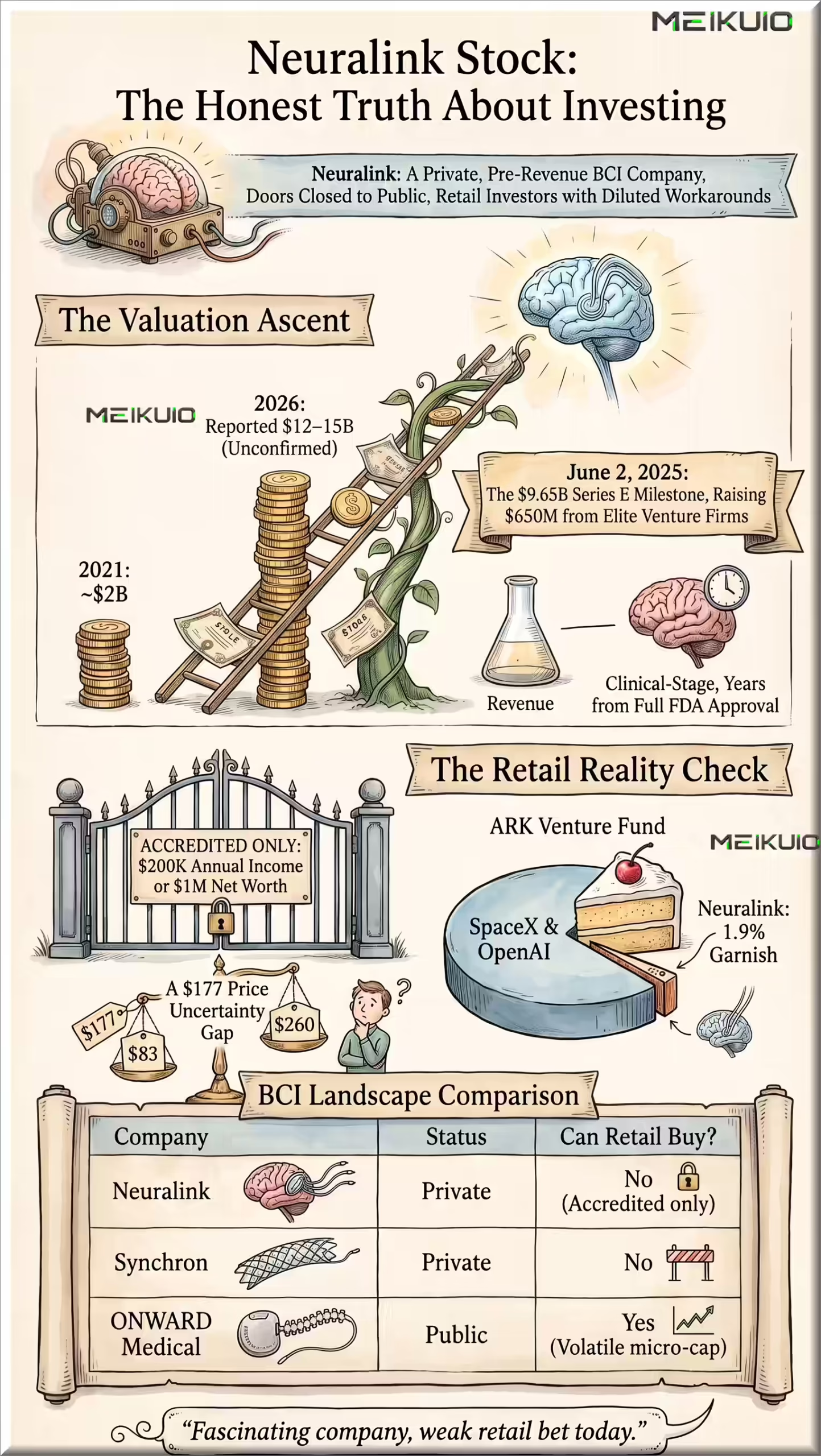
Neuralink’s valuation has climbed fast. It was worth roughly $2 billion in 2021, around $5 billion after a 2023 Series D, and reached a pre-money figure near $9 billion (about $9.65 billion post-money) when it closed a $650 million Series E announced on June 2, 2025. That round drew in ARK Invest, Founders Fund, Sequoia Capital, Thrive Capital, Lightspeed, and Qatar’s sovereign wealth fund, among others.
Reporting from Bloomberg and Reuters since then points to a possible next round valuing the company somewhere between $12 billion and $15 billion, expected to land later in 2026. Treat that as reported, not confirmed. Neuralink hasn’t announced it. Either way, the trajectory is steep for a company with no product on the market, which is exactly the kind of gap between price and revenue that should make any investor pause.
June 2025 pre-money approximately 9B USD; post-money approximately 9.65B after a 650M raise.
12–15B USD range, not its midpoint. Expected later in 2026 but not announced or confirmed by Neuralink.
Can you buy Neuralink stock? The honest answer
For almost everyone reading this, no. Private company shares are restricted to accredited investors, and the bar is high. In the US, that means income over $200,000 a year (or $300,000 with a spouse) for the last two years, or a net worth above $1 million not counting your home. Canada and Australia set similar thresholds, roughly C$1 million in financial assets or A$2.5 million in net assets. If you don’t clear those numbers, the secondary marketplaces simply won’t let you transact.
Even if you do qualify, there’s a second trap. Private companies like Neuralink keep a right of first refusal written into their bylaws, which means the board can block or buy back any share transfer it doesn’t approve. So a marketplace listing isn’t a guarantee you’ll ever own the stock. The company can step in front of the deal.
Then there’s the price problem. Platforms like Nasdaq Private Market, Forge, Hiive, and EquityZen all quote Neuralink shares, but at wildly different numbers. In 2026, Hiive showed an implied share price around $83, while Nasdaq Private Market quotes ranged up past $260 for the same company in the same window. That’s not a typo. It’s what happens when there’s no central exchange setting a real price. You’re guessing at value, and the spread is the risk.
Implied per-share quotes from different desks, not executable exchange prices. The current author text also reports Nasdaq quotes above 260 USD in that window; the graphic’s 244 USD observation is a separate snapshot. No common market-clearing price exists.
The real ways retail investors can get exposure
If you can’t buy shares directly, there are three indirect routes. None of them is a clean way to “own Neuralink,” and it’s worth being clear-eyed about how diluted each one really is.
ARK Venture Fund (ARKVX)
This is the closest thing to a retail on-ramp. Cathie Wood’s ARK Venture Fund is open to non-accredited investors with a minimum of just $500, and it does hold Neuralink. But here’s the math the pitch pages skip: as of ARK’s SEC filing dated April 30, 2026, Neuralink was worth about $16.5 million inside a fund with roughly $871 million in net assets. That’s around 1.9% of the fund, and the position has been shrinking, down from about 5.4% in late 2025.
So when you buy ARKVX, you’re mostly buying SpaceX (about 12% of the fund), OpenAI (around 8%), and Anthropic (roughly 2.6%), with a sliver of Neuralink on the side. The fund also charges a 2.9% annual expense ratio. If your goal is Neuralink specifically, this is a thin and expensive way to get it. If you want broad private-tech exposure and see Neuralink as a bonus, the logic holds up better.
Shares of net assets, not the whole portfolio; other holdings are omitted, so no donut is used. Neuralink approximately 16.5M USD inside approximately 871M USD net assets. Expense ratio 2.9% annually; Neuralink weight had fallen from approximately 5.4% in late 2025.
Medtronic (MDT)
Medtronic is a publicly traded medical-device giant, and in January 2026 it partnered with Precision Neuroscience, a direct Neuralink rival, to fold Precision’s Layer 7 brain interface into Medtronic’s surgical navigation system. That gives Medtronic a real foot in the BCI door. The catch is scale: brain-computer interfaces are a rounding error next to Medtronic’s cardiac, surgical, and diabetes businesses. Buying MDT for BCI exposure is like buying a grocery chain because it sells one product you like.
ONWARD Medical (ONWD)
For a closer-to-pure-play public option, there’s ONWARD Medical, listed in Europe with over-the-counter ADR trading in the US. Its ARC-BCI system pairs a brain interface with spinal stimulation to restore movement after paralysis, with early results published in Nature back in 2023. The honest caveat: ONWARD is a clinical-stage micro-cap that loses money and trades on regulatory headlines. It’s a real BCI bet, but a volatile one, and not a substitute for Neuralink.
Neuralink’s competitors are all private too
Here’s something the brain-implant race makes obvious once you look: the most interesting BCI companies are nearly all private, and a striking number trace back to Neuralink itself. Two of Musk’s co-founders left and started rivals. Benjamin Rapoport founded Precision Neuroscience, which won FDA clearance in April 2025 for a thin electrode patch that sits on the brain’s surface instead of piercing it. Max Hodak, Neuralink’s former president, founded Science Corp, now valued around $1.5 billion after a $230 million raise in March 2026. Even Sam Altman is in. OpenAI led a $250 million seed round for Merge Labs at an $850 million valuation in January 2026.
One name causes constant confusion: Blackrock Neurotech. It has nothing to do with BlackRock the asset manager. The crypto company Tether, the one behind the USDT stablecoin, bought a majority stake for $200 million in April 2024. And the field keeps moving: in June 2026, Paradromics completed its first human implant of a wireless BCI. The point for an investor is simple. There’s no public Neuralink, and there’s no public anyone-else either. The whole frontier is locked behind private cap tables.
Musk isn’t only betting on brains, of course. His broader push into physical AI runs through robotics too. We looked at the jobs humanoid robots are actually taking in 2026, and the investing pattern rhymes: huge ambition, private money, commercialization still years out.
The risks nobody selling you shares mentions
Neuralink is a pre-revenue, clinical-stage company. Its model looks like biotech R&D: spend hundreds of millions on engineering and trials for years before a single device is approved for sale. Invasive brain implants are Class III medical devices, the highest-risk category, and the path to full FDA approval usually runs five to ten years. A Breakthrough Device tag speeds up the paperwork, not the science.
The technical risk is real, not theoretical. Neuralink’s first human patient, Noland Arbaugh, received his implant in January 2024. Within about a month, roughly 85% of his electrode threads retracted from his brain tissue, cutting the device’s performance. Neuralink recovered most of the function through software, and Arbaugh now uses the implant for hours a day, but it was a public reminder that the brain treats these threads as foreign objects and tries to wall them off. That biology problem isn’t solved yet.
Then come the money mechanics. Private shares are illiquid: your capital can be locked up for years with no way to sell until an IPO or buyout. Buying through a special-purpose vehicle stacks on fees: placement charges up to 5%, annual management costs, and performance cuts that can reach 20% of your profit. And plenty of neuroscientists argue the whole sector is running hot, with talk of “mind reading” and AI-brain “symbiosis” far outrunning what the technology can actually do. None of that means Neuralink fails. It means the price you’d pay today is a bet on a future that’s a long way off.
Note
This article is for information only and isn’t financial advice. Private, pre-revenue companies carry a high risk of loss. Do your own research and consider a licensed advisor before investing.
Frequently asked questions
What is Neuralink’s stock symbol?
Neuralink has no stock symbol. It’s a private company and doesn’t trade on any public exchange, so there’s no ticker to look up.
Can I buy Neuralink stock on Robinhood or Fidelity?
No. Mainstream brokerages only list public companies. Because Neuralink is private, you can’t buy it on Robinhood, Fidelity, Schwab, or any standard brokerage account.
When will Neuralink IPO?
There’s no announced IPO date. As of mid-2026, Neuralink hasn’t filed to go public, and its recent funding gives it years of runway, so an IPO doesn’t appear imminent.
How much does Neuralink stock cost?
There’s no single price. On pre-IPO marketplaces in 2026, implied share prices ranged from around $83 on one platform to over $260 on another, a wide spread that reflects the lack of a real public market.
Can non-accredited investors invest in Neuralink?
Only indirectly. The main option is the ARK Venture Fund (ARKVX), which is open to non-accredited investors for $500 and holds a small Neuralink position, currently under 2% of the fund.
Is Neuralink a good investment?
It’s high risk. Neuralink is pre-revenue, years from commercial approval, and only investable through illiquid or indirect routes. The technology is promising, but the investment case carries significant uncertainty and isn’t suitable for most retail investors.
My Take
I find Neuralink genuinely fascinating and a weak place to put retail money right now. If you believe in brain-computer interfaces and want a legal way in, ARKVX is the most honest option. Just go in knowing you’re really buying SpaceX and OpenAI with a 2% garnish of Neuralink, and paying 2.9% a year for the privilege. Chasing the stock itself through pre-IPO desks means accepting a price you can’t trust and a holding period you can’t control. The companies are exciting. The investment case, for most people, isn’t there yet. The smartest move is usually to watch this field closely and keep your money in things you can actually buy and sell.