



The most capable AI model ever released to the public went live on June 9, 2026. Three days later, the US government forced it offline. That model was Claude Fable 5, and its 72-hour public life is the real story of AI model releases in June 2026. Everyone expected this month to be about GPT-5.6 and Gemini 3.5 Pro. Neither is where the hype says it is.
- Quick Verdict: What’s Real Right Now (June 2026)
- Confirmed: Anthropic Shipped a Monster, Then Lost It
- Data Box: The Fable 5 Recall
- Contested: GPT-5.6 Is a Rumor With a Betting Line
- Myth: “Released” Means “You Can Use It”
- So What Should You Actually Do in June 2026?
- FAQ
- What is Claude Fable 5?
- Why did the government pull Claude Fable 5?
- Is Fable 5 available again yet?
- Has GPT-5.6 been released?
- When is Gemini 3.5 Pro coming out?
- What’s the best AI model right now?
- Why does a model getting recalled matter?
- My Take
What actually shipped, what’s still a rumor, and what you can use today, below.
Quick Verdict: What’s Real Right Now (June 2026)
The model getting the most attention this month is one you can’t get, and the two people are waiting for haven’t fully landed.
Confirmed: Anthropic Shipped a Monster, Then Lost It
On June 9, Anthropic released Claude Fable 5, the first generally available model from its “Mythos” tier, a step above the Opus family. The company called it state of the art on nearly every benchmark it tested: software engineering, knowledge work, vision, scientific research. The longer and more complex the task, the bigger its lead.
The numbers backed the language. Fable 5 scored 80.3% on SWE-bench Pro, a hard software-engineering test, against 58.6% for GPT-5.5. Stripe, in early testing, ran a codebase-wide migration on a 50-million-line Ruby codebase in a single day. The company said that work would have taken a team over two months by hand. Cursor’s CEO called it state of the art on their internal coding benchmark and said it opened up “a class of long-horizon problems that were out of reach for earlier models.”
I can add a data point most coverage can’t. In the three days Fable 5 was live, I used it to build meikuio’s AI emoji decoder from scratch: the architecture, the backend, the dictionary handling, the front end. It felt noticeably stronger than Opus 4.8 on the long, multi-step parts where earlier models lose the thread halfway through. Then it was gone.

Pricing was $10 per million input tokens and $50 per million output tokens, less than half the price of the earlier Mythos Preview. For three days, paying Claude subscribers got it bundled in at no extra cost.
Then the government stepped in
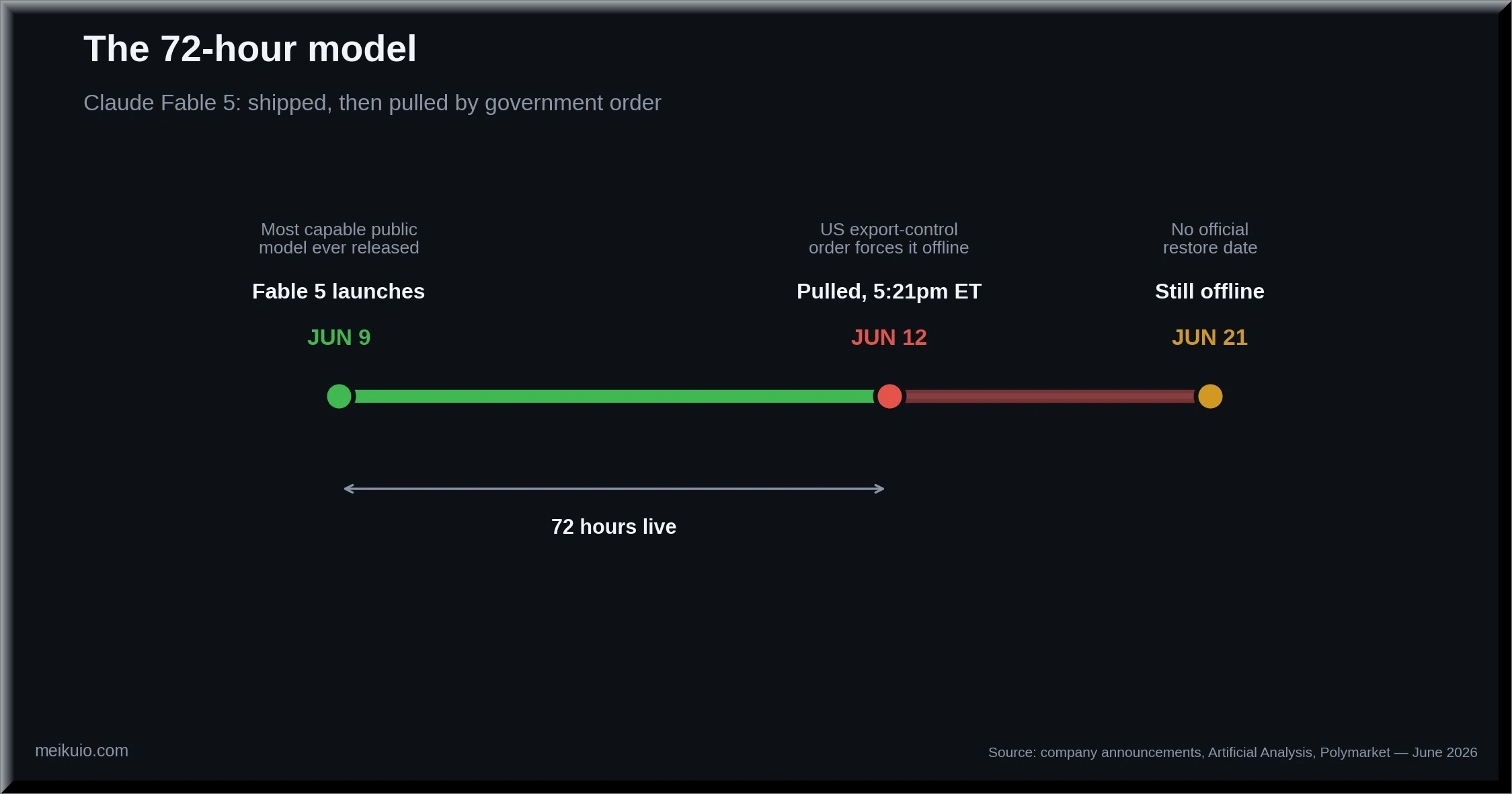
On June 12 at 5:21 p.m. ET, Anthropic received an “Is Informed” letter from the Bureau of Industry and Security, the export-control arm of the Commerce Department, signed by Commerce Secretary Howard Lutnick. Citing national security under the Export Control Reform Act, it required Anthropic to get an individually validated license before letting any foreign national touch Fable 5 or Mythos 5, anywhere in the world, including the company’s own foreign-national engineers.
That last part is what made compliance brutal. Under the “deemed export” rule, giving a foreign national access to the model, even over a cloud API, even inside the US, counts as exporting controlled technology. Anthropic had no way to verify every user’s citizenship in real time, so the only way to comply was to shut both models off for everyone, within hours. Access to every other Claude model stayed up.
The trigger, reportedly, was a jailbreak. Amazon Web Services, an Anthropic investor and competitor, flagged a technique that bypassed Fable 5’s safety classifiers to unlock its cyber-vulnerability skills, and the finding reached the administration. Anthropic pushed back in public, which is rare. It said the bypass amounted to asking the model to read a codebase and find software flaws, a capability “widely available from other models,” pointing directly at OpenAI’s own published GPT-5.5 cybersecurity documentation. Pulling a model used by hundreds of millions over one narrow jailbreak would, the company argued, “essentially halt all new model deployments for all frontier model providers” if applied across the industry.
This is the first time a frontier model has been recalled by a government order days after launch. That precedent will outlast any benchmark score Fable 5 set.
The politics moved fast after that. At the G7 summit in Évian-les-Bains on June 17, Amodei sat in on a working lunch with Trump and other tech CEOs and pitched a US-led coalition for frontier AI standards that keeps China outside. By June 19, Trump told Axios he no longer saw Anthropic as a threat: “Well, not now, but a week ago, maybe. He responded to us very quickly. I think he handled it very responsibly.” He also said he wasn’t sure he needed to formally lift the ban. Not everyone applauded the original move: French President Emmanuel Macron called the US intervention “strictly nationalist,” warning that if Washington can switch off commercial software overnight, the rest of the world can’t safely depend on American AI. The order, as of June 21, is still in force.
Data Box: The Fable 5 Recall
- Released: June 9, 2026
- Pulled: June 12, 2026, 5:21 p.m. ET
- Time live: 72 hours
- Who pulled it: Bureau of Industry and Security (Commerce Dept), letter signed by Secretary Howard Lutnick
- Legal basis: Export Control Reform Act; “deemed export” rule covering any foreign national
- Official reason: national security; a reported method to bypass the model’s cyber safeguards
- Reportedly flagged by: Amazon Web Services, an Anthropic investor and competitor
- Anthropic’s stance: disagrees; says the capability is available in other public models
- Other Claude models: unaffected
- Status as of June 21: still offline; Trump said Anthropic is no longer a national-security threat after meeting Amodei at the G7, but the order stays formally in force
- Price when live: $10 input / $50 output per million tokens
Contested: GPT-5.6 Is a Rumor With a Betting Line
GPT-5.6 is where the month gets murkier. The model the tech press and prediction markets treated as June’s headliner has never been announced by OpenAI: no release date, no model card, no blog post. What exists is a leak in Codex backend logs, an internal memo from OpenAI chief scientist Jakub Pachocki (reported June 11) describing it as a “meaningful improvement” over GPT-5.5, and a very active prediction market.
That market has swung hard. Earlier in June, Polymarket traders priced a late-June launch near 89%. By the third week, the leading outcome had flipped to “not released by June 28” sitting around 77%, with “released by July 31” near 97%. The smart money still thinks it’s coming, just later than the June hype suggested.
Gemini 3.5 Pro is in a softer version of the same spot. Google announced it at I/O on May 19 alongside Gemini 3.5 Flash, which shipped that day. The Pro version, the high-capability one with a 2-million-token context window, went into a staged rollout with “June” general availability and no firm public date. Pricing is still to be confirmed at launch.
So of the three models the internet has been treating as June’s main event, one shipped and got recalled, one is half-out, and one hasn’t been confirmed to exist.
Myth: “Released” Means “You Can Use It”
The biggest misread this month is the assumption that a launch headline equals access. June 2026 broke that assumption three different ways.
A model can ship and vanish: Fable 5 was generally available and then wasn’t, by government order, inside a long weekend. A model can be “announced” and still not be in your hands: Gemini 3.5 Pro has a name, a spec, and a keynote, but a rollout you may not be inside yet. And a model can be treated as imminent while never being confirmed at all: GPT-5.6 has a betting line, not a launch.
The other myth worth killing: that there’s a single “best model” to wait for. There isn’t, and the benchmarks say so. Opus 4.8 leads the Artificial Analysis Intelligence Index at 61.4. GPT-5.5 sits at 60.2 and wins on creative writing. Gemini 3.1 Pro (57) leads on reasoning and data analysis. Grok 4.3 (53) is the cheapest and strong on tool use. The model you should “wait for” depends entirely on the job in front of you.
Original index points, not percentages. Opus leads this index; task-specific leaders differ. Fable/Mythos had been withdrawn, Gemini 3.5 Pro had a staged rollout, GPT-5.6 was unconfirmed in the source date. Full availability matrix retains those conditions.
So What Should You Actually Do in June 2026?
Reach for Claude Opus 4.8 if you want the strongest general-purpose model you can actually use today. It’s the public leader until Fable 5 returns, and it’s the fallback Fable was using under the hood anyway.
Don’t restructure your work around GPT-5.6. It isn’t confirmed. If your workflow depends on a model that “should” arrive, you’re planning around a prediction market, not a product.
If you were counting on Fable 5, watch Anthropic’s status page rather than the headlines. The White House mood has softened since the G7, but the Commerce order is still formally in force and there’s no official return date as of June 21. Don’t promise a client work that depends on it.
Pick by task, not by leaderboard. For exact, current pricing across all of these models, we keep a running AI pricing comparison updated as plans change. For where to go when ChatGPT isn’t the answer, our ChatGPT alternatives guide breaks it down by use case.
FAQ
What is Claude Fable 5?
Claude Fable 5 is an Anthropic model released June 9, 2026, that sits above the Opus family in capability. It’s the first generally available model from Anthropic’s “Mythos” tier, and it topped most independent benchmarks, including the hardest coding tests, before the US government forced it offline on June 12.
Why did the government pull Claude Fable 5?
On June 12, the Bureau of Industry and Security (part of the Commerce Department) issued an “Is Informed” letter, signed by Secretary Howard Lutnick, requiring an export license before any foreign national could use Fable 5 or Mythos 5. The stated concern was national security, tied to a reported jailbreak of the model’s cyber safeguards. Anthropic disagrees and says the capability is widely available in other public models.
Is Fable 5 available again yet?
As of June 21, 2026, no. Trump said after the G7 that he no longer sees Anthropic as a national-security threat (“not now, but a week ago, maybe”), but the Commerce order is still formally in force and there’s no official restoration date.
Has GPT-5.6 been released?
No. OpenAI has not officially announced GPT-5.6. No date, no model card, no blog post. Its existence is based on leaks and an internal memo. Prediction markets have moved the expected window toward July 2026.
When is Gemini 3.5 Pro coming out?
Google announced Gemini 3.5 Pro at I/O on May 19, 2026, with a staged “June” general-availability rollout. Gemini 3.5 Flash is already live. Pro has no firm public release date or final pricing yet.
What’s the best AI model right now?
For models you can actually use today, Claude Opus 4.8 leads the Artificial Analysis Intelligence Index at 61.4, ahead of GPT-5.5 (60.2), Gemini 3.1 Pro (57), and Grok 4.3 (53). But the leaders split by task: GPT-5.5 wins creative writing, Gemini leads reasoning, Grok is cheapest.
Why does a model getting recalled matter?
It’s the first time a government has forced a frontier AI model offline days after a public launch. The precedent, that a national-security order can pull a model used by hundreds of millions over a single jailbreak finding, affects how every AI company plans future releases.
My Take
The benchmark wars are the boring part of this month. The story is what happens when a model is too capable for the rules around it. It ships. The government steps in. It’s gone before most people hear the name.
Anthropic put out something ahead of the field, priced it aggressively, and lost it to a national-security order over a jailbreak it argues is unremarkable. Whether Fable 5 comes back in days or weeks, the line it crossed doesn’t un-cross.
Plan your work around what you can hold, not what the headlines promise. That’s the part of this month that outlasts the news cycle.