



The Perplexity valuation you’ll find quoted almost everywhere is 20 billion dollars. It comes from a round announced in September 2025, and no filing or statement from the company confirms it. On one afternoon in September 2026, four platforms priced the same shares between $58.59 and $71.54, and two SEC-registered funds valued an identical block $686,234.75 apart.
- What is Perplexity’s valuation right now?
- The number the company has never confirmed
- Every round, dated
- Why a private valuation is not a price
- Two funds, one block of shares, two different values
- Where the $69.5444 actually comes from
- Four venues, four prices, one afternoon
- What the secondary price has actually done
- The order books nobody can see
- The share count nobody publishes
- Revenue, ARR and the multiple that keeps changing
- Who put money in, and at what price
- The IPO question, and where 2028 came from
- Can you actually buy in?
- If you already hold shares
- Routes that look open and aren’t
- What PEAI.PVT actually is
- Three questions to ask any platform
- Frequently Asked Questions
- How much is Perplexity AI worth right now?
- Can you buy Perplexity AI stock as a retail investor?
- Does Perplexity have a stock symbol or ticker?
- Why do platforms show different Perplexity share prices?
- Is Perplexity AI going to go public?
- What did Perplexity’s last funding round value it at?
- Can I invest in Perplexity AI from outside the United States?
- My Take
What is Perplexity’s valuation right now?
Perplexity’s most recent published valuation is $20.39 billion, recorded by the private-market data service Notice as the post-money figure on a $524.9 million Series E-6 round. Notice puts that round in January 2026. Forge Global models the same $525 million raise as a September 2025 event at $20.53 billion. Both platforms say they build their round data from corporate filings, and they disagree by four months and by 140 million dollars.
The figure that actually circulates is the older one. Sacra, Business Insider and the brokerage pages all carry the same $20 billion. On September 4, 2026 that number was a year old, and they were still printing it without an expiry date.
Wikipedia is the clearest example of how the two figures live side by side. Its opening section states that “as of September 2025, the company was valued at US$20 billion.” Further down the same article, it says that “as of early 2026, Perplexity AI reached a valuation of $21.21 billion following its Series E-6 funding round.” Both sentences are in the entry right now, and the older one is in the lead, which is the part search engines quote.
Almost every Perplexity valuation you’ll encounter traces back to that one September 2025 round, and almost none of them say so. The figure isn’t wrong. It’s just doing a job it was never built for: describing what a company is worth today.
A private valuation is not a market price. It’s the arithmetic of one transaction: the price a small group of investors paid for newly issued preferred shares, multiplied across the whole company. Nobody has to keep quoting it, and nobody has to update it either.

There’s a newer number in circulation as well. In August 2026 The Information reported that Nvidia was in talks to invest at a valuation above $30 billion, and Reuters carried the report the same day. Those are talks. No round has been announced, Perplexity declined to comment, and Nvidia did not immediately respond to a request for comment. A figure attached to a negotiation is not a valuation, and nobody should treat it as one until somebody signs something.
So the honest answer to what the company is worth comes in three parts, and any Perplexity valuation quoted without them is missing the thing that makes it checkable. There’s the last round price, which is real but historical. There’s what the funds holding the shares say the position is worth, which is an opinion filed with a regulator and still an opinion. And there’s what the marketplaces publish, which is a model output. The rest of this piece takes those three in order.
Note
This article explains where the published numbers come from and how far they can be checked. It is not investment advice and makes no recommendation to buy, sell or hold anything. Private shares are illiquid and can lose their full value.
A private valuation is what one buyer paid on one day, multiplied by every share in the company.
The number the company has never confirmed
Perplexity AI, Inc. has filed one document with the Securities and Exchange Commission in its entire history. It’s a Form D from April 5, 2023, covering the Series A: $28,821,948 sold, first sale on March 21, 2023, 27 investors, a Delaware corporation with a San Francisco address. In the revenue box, the company selected “Decline to Disclose.”
That’s the whole file. There is no later Form D under the company’s own filer number, no registration statement, and no periodic report. The $9 billion, $14 billion, $18 billion and $20 billion figures that anchor every article about this company have no document from the company behind them, and neither does the $23 billion that turns up in some private-market trackers and nowhere else.
None of that is a violation. The law doesn’t require private companies to file periodic reports, and later rounds can rely on exemptions that never surface publicly. What it means for a reader is narrower and more useful: you can’t check the number in the headline against anything the company signed. When Reuters reported the $20 billion round, it noted that Perplexity “did not immediately respond.” Trade coverage said the company “has not publicly confirmed” it. That’s still true a year later.
What does appear in the filing system is other people’s paperwork. At least eight exempt-offering notices have been filed by outside vehicles pooling money to buy Perplexity shares: syndicates, single-asset funds administered by third parties, and structures with names like “Perplexity AI Employee Stock” and “Perplexity AI Insider Stock Acquisitions, LLC.” One of them, a syndicate that filed in July 2025, reports $2,561,745 raised from 30 investors, with a stated minimum ticket of $4,868. That figure is a reminder rather than a route: a small minimum inside a private syndicate still sits behind the same accreditation gate, and these vehicles are assembled by invitation rather than listed for anyone to join.
Those names are the useful part. A vehicle set up to buy employee stock exists because employees want to sell, and a vehicle for insider acquisitions exists because early holders do too. The company files nothing, and the market around it files constantly. That asymmetry is the whole reason a Perplexity valuation is easier to quote than to verify.
Note
The absence above was checked against the SEC’s own filing database and its full-text search on September 4, 2026, covering January 2025 through that date. It says what is not on file. It doesn’t say what happened privately.

Every round, dated
Here’s the ladder as the private-market platforms record it. Read the step-up column first. A step-up is how much higher the price per share was in one round than in the round before it, and it shows how fast the price moved and where it stopped.
Read the step-up column top to bottom and you get the story the headline valuation hides. Series C-1 priced the company 600 percent above the round before it. Series D-1 added 212 percent. Then 59, then 33, then 11, and then nothing. Each round still brought in real money, and each one bought a smaller move in the price.
The last line is the one to sit with: a half-billion-dollar round that raised the company’s paper value by nothing at all. Notice records the Series E-6 step-up as zero percent against the September 2025 price. Money came in, the price per share stayed where it was. Investors in that round paid the same for a share as investors did in the round before: a flat round in everything but name. The post-money figure still edged up from $20.00 billion to $20.39 billion, because the company issued new shares and the total grew even though the price of each one did not.
A flat round isn’t a failure. Companies raise at the previous price for plenty of reasons, including wanting the cash without a negotiation. But it’s the most informative number on this table, and it rarely survives into coverage that leads with $20 billion. The people with access to the books priced the company the same twice in a row.
One more thing about this ladder: it is assembled by data platforms, not published by the company. Forge and Notice both say they build round records from corporate filings, and they still disagree about which year the last round closed. Treat the shape as reliable and the individual dates as contested.
The Series E-6 is the sharpest case, because four sources give it four different answers. Forge models it as a September 2025 event at $20.53 billion. Notice records it closing in January 2026 at $20.39 billion. Wikipedia puts it in early 2026 at $21.21 billion. The press coverage that most people remember was about the $20 billion Series E-5 in September 2025, a different round entirely.
The raise is roughly $525 million in every version. The valuation attached to it moves by $820 million depending on who you ask, and the date moves by four months. That is the actual state of the public record on the most recent Perplexity valuation.
The disagreement extends to something as basic as how many rounds there have been. Published counts range from nine to sixteen, and Nasdaq Private Market’s own page shows why: it breaks the same financings into individual closings. Its record shows seven separate Series A entries all dated March 21, 2023, four for Series B, two for Series C and four for Series D, before the Series E tranches are counted at all.
Whether that’s one round or seven is a labelling choice, not a fact about the company. A tracker that groups them reports nine rounds; a tracker that lists them reports sixteen. Any Perplexity valuation history you read has already made that choice on your behalf, usually without saying so.
Total capital raised is contested for the same reason. Figures in circulation run from about $976 million to $2.27 billion, and the spread comes largely from whether a tracker counts secondary purchases and employee-share vehicles alongside money that actually reached the company’s balance sheet. Only the second kind funds operations.
Even the first round on the ladder has two numbers. Perplexity’s own blog announced “a $25.6 million series A.” The Form D filed a week later reports $28,821,948 sold. Both are accurate for what they describe, and the gap between an announcement and a filing is where most of the confusion in this whole subject lives.
Why a private valuation is not a price
When a startup raises money, it issues a new class of preferred shares at an agreed price. Multiply that price by every share the company has after the round, and you get the post-money valuation. It’s a headline produced by a single negotiation, not by a market of buyers and sellers.
Preferred shares are also not the shares most people picture. Notice records that Perplexity has issued nine classes of preferred stock and two classes of common stock. Preferred sits ahead of common if the company is ever sold, usually with a guaranteed minimum return. Employees hold common. The $20 billion headline is built on the preferred price, and common stock is worth less than that by definition.
The preference is the part that bites. Preferred shares typically carry a liquidation preference, a guaranteed amount paid out before common shareholders see anything. Nine classes of preferred, each raised at a higher price than the last, stack up into a pile that has to be cleared first. In a sale below the last round price, that stack can absorb most of the proceeds, and the common stock behind it gets whatever is left.
This is why a headline valuation and an employee’s equity are not the same currency. The $20 billion figure describes what the newest preferred shares cost. It does not describe what a common share is worth, and no public document tells you the difference for this company.
Which raises the question the rest of this article answers: if no market sets the price, who does? The short version is that four different parties each publish their own Perplexity valuation, and none of them is obliged to agree with the others. It’s also why the same company can carry four different per-share numbers on the same afternoon without any of them being wrong. They’re measuring different things: what one investor paid in a negotiation, what a fund thinks the position is worth today, and what a marketplace thinks a buyer might accept. The pattern repeats across every private AI company, which is why buying into a private AI lab works nothing like buying a listed stock.
Two funds, one block of shares, two different values
Mutual funds and registered venture funds have to do something the marketplaces don’t. Every quarter they file a portfolio report with the SEC, and for each holding, public or private, they must print a share count and a dollar value. There’s no option to leave a private position blank, and there’s no option to describe it in a range.
That obligation makes these filings the closest thing to an audited Perplexity valuation anyone outside the company can read. The fund’s board reviews the valuation policy, the auditor sees it, and the number moves the fund’s published net asset value, the price investors buy and sell at. A marketplace estimate costs its publisher nothing if it’s wrong. A fund’s mark is the price its own shareholders transact on.
Two funds hold Perplexity and both filed this year, which gives us something the rest of this subject lacks: two independent parties, each legally obliged to state a number for the same asset.
ARK Venture Fund’s report for April 30, 2026 lists a single line: “Perplexity AI Inc., Series D-1,” acquired 11/19/24, 60,810 shares, cost $1,999,853, value $3,542,759. That works out to $58.2595 a share.
T. Rowe Price Science and Technology Fund’s report for June 30, 2026 lists the same security: “PERPLEXITY AI SER D-1 CVT PFD PP,” 60,810 shares, value $4,228,993.75. That’s $69.5444 a share, and as the next section shows, that figure did not come from the Series D-1 at all.
The series matches. The share count matches. What the two funds wrote down does not, and the difference is $686,234.75 on holdings of identical size. The two bought separately and happen to hold the same number of shares, which is a coincidence and a convenient one, because it takes size out of the comparison completely. Both are registered with the SEC, both are required to state a fair value, and T. Rowe carries the position 19.37 percent higher than ARK does.
Both funds label the holding Level 3, which in accounting terms means the value rests on the fund’s own assumptions rather than on any observable market. ARK’s filing spells out the method: a market approach built on precedent transactions and a market-movement adjustment, disclosed across a range of minus 23.82 percent to plus 37.60 percent. Its Perplexity mark sits 16.23 percent below the last round price, comfortably inside the range it published for itself.
T. Rowe went the other way. Across three of its funds it holds 769,210 Perplexity shares worth $53,494,232.54, spread over two different preferred series, and it prices every one of them at exactly $69.5444. One number, two series, three funds, four positions, identical to the fourth decimal.
The two report dates are two months apart, and that matters. This isn’t two funds disagreeing on the same afternoon. It’s two funds looking at the same asset in the same year and reaching answers $11.28 a share apart, because there is no price to look up.
Where the $69.5444 actually comes from
That T. Rowe figure looks precise enough to be a measurement. It isn’t. Forge’s model of the Series E-6 tranche puts it at 7,549,132 preferred shares and a $525,000,000 raise. Divide the raise by the share count and you get $69.5444191 a share. Round that to four decimals and you have T. Rowe’s mark, digit for digit. The precision runs backwards. Nobody measured a price of $69.5444; it fell out of dividing a round number of dollars by a share count.
So $69.5444 is the price of one funding round. T. Rowe is still carrying it, unchanged, in a report filed the following summer. On September 4, 2026, Forge’s own live figure was $69.50, four cents from the same round. The number that looks like a current valuation is a transaction from last year, quoted back at you by three different kinds of source.
Three sources, one number: the price of a single funding round, still being quoted a year later.
Four venues, four prices, one afternoon
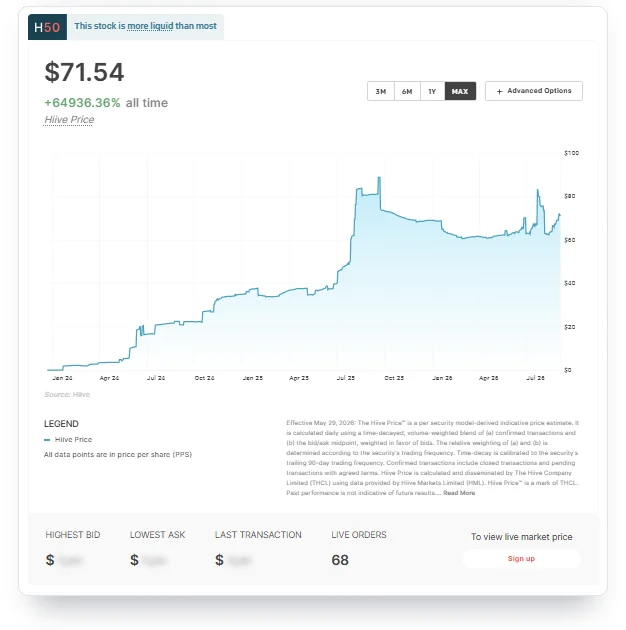
On the afternoon of September 4, 2026, four platforms were publishing a Perplexity share price at the same time. Here is what each of them showed, and what each of them calls the number. Hiive has since rebranded as Clarity (announced September 22, 2026), so the Hiive figures below were read on the Hiive-branded page.
The spread from bottom to top is 22.1 percent, inside a single hour. Count Yahoo separately and you would say five sources, but Forge feeds Yahoo’s page, and Charles Schwab now owns Forge. It’s the same number wearing a different logo, and that’s worth knowing before you treat agreement between two sites as confirmation.
These figures also move faster than the company does. Forge’s page on September 4 reported its own number up $4.50 on the day, a rise of 6.92 percent. Hiive had shown $72.04 the day before and $71.54 that afternoon. Both moved, in opposite directions, for a company whose last documented transaction price was set in September 2025 and has not moved since. Checked again the next morning, Forge still read $69.50, Hiive had drifted to $71.56, and Hiive’s live-order count had fallen from 68 to 64.
Forge is unusually direct about what its own number does and doesn’t mean. On its guidance pages the company writes that “as a private company, Perplexity’s stock is not for sale to the general public, and at this time its shares are generally not available for direct trading on Forge.” The platform publishes a daily price for a security it says you generally cannot trade there.
Hiive labels its listing “more liquid than most” and, in the same panel, reports an all-time return of 64,936.36 percent. A number with that many digits is a calculation running back to an early, tiny reference price, and it tells you nothing about what a share is worth today. Its own note says the platform “has not verified” the underlying data as accurate, complete or up to date.
Each platform is open about the method if you go looking. Hiive’s disclosure, effective May 29, 2026, describes “a time-decayed, volume-weighted blend of (a) confirmed transactions and (b) the bid/ask midpoint, weighted in favor of bids.” Notice states that its price is “algorithmically generated,” and its disclaimers page adds that, in its fund offerings, references to “shares,” “price per share” and “total investment” “are for administrative convenience only.” Nasdaq Private Market calls its figure an estimate “based on market activity, publicly-sourced valuation data, and other proprietary information.”
Read those three sentences together and the disagreement stops being surprising. Three formulas, different inputs, different clocks, all producing something that looks like a stock quote.
What the secondary price has actually done
Here’s the part that the flat headline valuation covers up. While $20 billion sat unchanged in every article, the price on the secondary market moved, and it moved down.
Notice publishes a quarterly series for Perplexity. The third quarter of 2025 closed at $70.32. The fourth quarter closed at $62.06, down 11.73 percent. The first quarter of 2026 closed at $60.89, down another 1.9 percent. The second quarter recovered slightly to $62.13. Over the trailing year to September 4, 2026, the same series is down 15.75 percent.
Notice also publishes what it calls a coverage ratio for the company, its own measure of how much buy and sell interest sits behind the quote. It prints the figure without a scale to read it against, which is a fair summary of how much depth any of these venues will show you without a login.
The quarterly series gives the company two valuations at once, and they point in opposite directions. Notice puts the last round at $20.39 billion and its own real-time market capitalisation at $17.30 billion, and labels the difference plainly: a premium of minus 15 percent. The secondary market is pricing the company 15 percent below what the last round said it was worth.
Not every platform agrees on the direction either. Hiive ranks Perplexity eighth on its most-traded list and shows the price up 13.1 percent over three months. Over a similar window, Notice shows it roughly flat, and down over a year. Same asset, same period, opposite readings, because the two are weighting different order flow.
None of this is a verdict on the business. A secondary price reflects who wants liquidity this quarter, and a small number of motivated sellers can move it more than any operating result. It is still a model output rather than a record of trades, like every other figure on this page. What makes it useful is that the same model has been run every quarter, so its direction carries information even when its level does not. That direction has been away from the number in the headlines.
Notice also prints the age of the record: 238 days since the last funding event, as of early September. That counter refers to the January 2026 round. The Perplexity valuation most pages actually quote is older still, the September 2025 one, which by September 2026 had been standing for a year.
The order books nobody can see
Each of those prices is supposed to come from trading activity. So the obvious question is what the trading activity looks like. On both of the marketplaces that publish a live figure, you can’t find out.
Hiive’s page shows the price in large type at the top and the number of live orders at the bottom, 68 of them on September 4. Between those two facts sit three fields labelled Highest Bid, Lowest Ask and Last Transaction, and each one reads $-.–. Forge does the same thing with a different mask: its Highest bid, Lowest ask and Last matched price all display as $XXXX.
The output of the model is public. The inputs are behind a signup form. A reader can see a number that looks like a market price and cannot see a single trade behind it, which is exactly backwards from how a public quote works.
The commercial logic is obvious enough. The price is the marketing, the order book is the product, and both platforms make money when you register. It’s their data and they’re entitled to charge for it. The consequence for anyone reading is the same either way: the figure you can see comes out of figures you can’t, and there’s no way to sanity-check it from outside.
Nasdaq Private Market goes further and publishes no live two-sided book at all on its public page, only an estimate with a date on it. Notice shows aggregate buy and sell interest as a locked panel. Across four venues, the number of publicly visible completed Perplexity trades is zero.
This is the practical test for any private-market price you meet. If the platform will show you the price but not the trades, the price is a model. That’s not a criticism, it’s a category, and it belongs in a different mental column from a quote on a public exchange.
The share count nobody publishes
To turn a share price into a Perplexity valuation you need one more number: how many shares exist. That number is not published anywhere.
Notice comes closest. Its capital structure table has columns for price per share, authorized shares and outstanding shares, and every cell in them holds a deliberate scramble rather than a figure, with lookalike characters in place of digits. The table shows you the shape of the data and withholds the data itself, which is a fair commercial decision and a hard stop for anyone trying to check the arithmetic.
Work backwards instead and the answer depends entirely on which number you start from. Hold the round price at $69.5444 and change only the valuation, and the implied share count swings by 173 million.
A $18 billion valuation implies about 258.8 million shares outstanding. A $20 billion valuation implies 287.6 million. The $20.53 billion post-money that Forge models for Series E-6 implies 295.2 million. The $30 billion figure under discussion in press reports implies 431.4 million. Those are four different companies, arithmetically speaking, and at most one of them exists.
One document publishes both halves of the multiplication, and the two halves disagree. The Crowdcube offer, approved as a financial promotion under UK rules in March 2026, states a valuation of £15,000,000,000 and a price of £54.3375 a share, while claiming parity with the $20 billion round. Divide the first figure by the second and you get 276.1 million shares, 11.5 million fewer than the dollar pair implies. The two lines imply exchange rates three pence apart. The likeliest reading is that the valuation is a rounded conversion and the share price is the exact one, which is a sensible way to fill in a form and a useless one for anyone trying to count shares.
Flip the exercise and it gets worse. Fix a share count and let the price vary instead, and the four platform figures from September 4 spread the implied company value across billions. There’s no anchor on either side of the multiplication, which is the practical reason two careful people can read the same sources and disagree by 30 percent about what this company is worth.
This is the part of private-company valuation that rarely gets said plainly. Without a share count, a per-share price and a company valuation are two separate claims that cannot be checked against each other. Ownership structure itself can be documented when a company publishes the papers, which is what Anthropic’s ownership looks like written down, and what Microsoft’s looks like in the one proxy table where it names its owners. The share count is the piece that stays private.

Revenue, ARR and the multiple that keeps changing
Every Perplexity valuation argument eventually lands on revenue, and the revenue numbers contradict each other inside the same twelve months.
A financial promotion document approved under UK rules in March 2026 recorded Perplexity’s annual recurring revenue at about $150 million. Five months later, in August 2026, Reuters reported annualized revenue “more than $750 million,” up from “less than $250 million” at the start of the year. Perplexity declined to comment on that report.
Both statements can be technically defensible. Annual recurring revenue counts contracted subscriptions; annualized revenue can take a strong recent month and multiply it by twelve. They are not the same measurement, and the gap between them is the difference between a company at $150 million and one at $750 million.
There is a second $750 million attached to this company, and it points the other way. In January 2026 Reuters reported, citing Bloomberg, that Perplexity had signed a three-year, $750 million agreement with Microsoft to use its Azure cloud service. One $750 million is money coming in over a year, the other is money going out over three. Anyone reading quickly could take the first for the second.
Keeping those two apart matters more than it sounds, because compute commitments are the largest fixed cost in this business, and even what one ChatGPT answer costs to compute is contested. A revenue run rate and a multi-year spending obligation are not comparable quantities, and nobody should build a Perplexity valuation by netting one against the other without saying so.
Run the multiple across the plausible pairs and the range is wide enough to be useless as a benchmark.
Anywhere from 27 to 200 times revenue, depending on which pair of numbers a writer happens to reach for. Much of the coverage settles on roughly 100x without saying that the valuation and the revenue figure were recorded months apart, which is how you get a precise-looking multiple out of two numbers that were never measured together.
Notice runs its own revenue model and lands between the two extremes. It estimates $7 million for 2023, $60 million for 2024, $232 million for 2025 and a trailing figure of $580 million. Its own note says the Perplexity revenue figures are run-rate estimates built from public information, not reported results. On those numbers the company’s price-to-sales ratio was 137 in 2024 and 76.9 in 2025, which describes a valuation growing more slowly than the revenue underneath it.
One more figure puts scale on it. Notice counts 1,367 employees. Against that headcount the 2025 estimate is about $170,000 of revenue per person and the trailing figure about $424,000. Those are operating measures rather than negotiated ones, which makes them a different kind of number from a round price. They still rest on Notice’s estimates rather than on results the company has reported.
Whichever pair you prefer, the underlying business is a subscription product competing with free tiers from much larger companies, which is the same squeeze visible across the field of ChatGPT alternatives. What each of those subscriptions costs is a separate question, and we keep the current numbers on our AI pricing comparison.
Who put money in, and at what price
The investor list is short and public. Nasdaq Private Market names Accel, New Enterprise Associates, Institutional Venture Partners, Bessemer Venture Partners, Databricks Ventures, Laude Capital and Nvidia. Notice adds Elad Gil, Nat Friedman, Tobi Lutke and Jeff Bezos among the individuals.
Nvidia appearing on that list changes how you should read one recent headline. In August 2026, The Information reported that Nvidia was in talks to invest at a valuation above $30 billion, and Reuters picked it up. Nvidia is already a shareholder, so those talks describe an existing backer considering more, not a new name arriving. Perplexity declined to comment and Nvidia did not immediately respond to a request for comment.
The registered funds are the ones that leave a paper trail, and their entry points are datable. ARK’s 60,810 Series D-1 shares carry an acquisition date of November 19, 2024, which is the same day Notice records the Series D-1 round closing at a $9 billion valuation. So ARK bought into the primary round rather than off a marketplace, at a company price of $9 billion.
ARK paid $1,999,853 for that block and carried it at $3,542,759 in its April 2026 report, a gain of 77 percent on paper across seventeen months. T. Rowe, holding a much larger position across three funds, marks its shares at the later round price and shows a different gain on the same underlying asset. Neither fund has sold anything. Both returns exist only as a line in a filing.
That’s the shape of the whole cap table in one line: money goes in at a round price, and the value that comes back out is whatever the holder decides to write down. Several of these investors show up in more than one AI cap table, and the overlap is easier to see in the ownership structure behind ChatGPT.
The IPO question, and where 2028 came from
Search for a Perplexity IPO date, or for a Perplexity valuation with a date attached, and page after page will tell you 2028. There is one source for that, and it is thinner than the repetition suggests.
Chief executive Aravind Srinivas told CNBC on June 8, 2026 that the company was planning for something in 2028 and that this remained the case. That’s a statement of intent in a television interview. It isn’t a filing, a date, or a commitment, and no registration statement exists to support it.
Everything downstream is a paraphrase. The marketplaces host IPO pages for Perplexity that contain no underwriter, no exchange, no schedule and no S-1, which is what a pre-IPO page looks like when there is no IPO to describe yet. Treat 2028 as the earliest the company has publicly mentioned, not as a plan you can hold anyone to.
The date matters more than it looks, because it sets how long a buyer today has to wait. Shares bought on a secondary marketplace in 2026 against a 2028 intention carry at least two years of illiquidity, during which you can revalue the position but not exit it, unless another private buyer appears and the company approves the transfer.
It also breaks the link people assume between today’s price and a future one. At an initial public offering, preferred shares normally convert into common stock, and the preferences that sit ahead of common stop mattering. The prices on these platforms track preferred shares, so they describe a security that would no longer exist in the same form on the day the company listed. Whatever today’s $58 to $71 range measures, it is not a forecast of an opening price.
It also sets a floor under the marketing. Every pre-IPO page selling access to this company is selling a wait, and the length of that wait is a statement made once on television by a chief executive who is under no obligation to keep it.
The gap between a stated ambition and a filed document is the same one that opens up around every AI company with a big number attached, and it’s the reason we keep separating the two in coverage of what’s real and what’s hype in quantum computing stocks.

Can you actually buy in?
Not through a brokerage account. Perplexity shares change hands between accredited investors on private marketplaces, and on the venues that publish a price, transfers need the company’s approval. Accredited investor is a legal category under US securities rules, reached on income or net worth rather than on how much you want to invest, and every venue in this article checks it before it shows you anything tradeable. Nasdaq Private Market states it plainly: to sell Perplexity stock “you need to receive the company’s approval,” and to buy it you must be “an accredited entity or institutional investor.”
The mechanics of that process are the same at each of these venues: the eligibility thresholds, the special purpose vehicles and the right of first refusal. We walked through them in detail for how to buy OpenAI stock, and none of it changes here.
If you already hold shares
Employees and early investors are the people these numbers affect most, and they’re the group the coverage skips. If you hold Perplexity common stock or options, none of the four platform figures describes what you own. Those figures track preferred shares. Common sits behind nine classes of preferred in any payout, so a headline price of $71.54 is a ceiling you don’t reach, not a valuation of your position.
The size of that discount isn’t public. Companies commission a formal valuation of common stock for tax purposes. That figure typically sits well below the preferred price, and nobody files it anywhere you can read. If you hold options, the strike price on your own paperwork is the closest thing you have to it, and it reflects the date your grant was made rather than anything about today.
An option is also not a share. Its value is whatever a share is worth minus the strike you would have to pay to exercise it, and only the portion that has vested is yours to act on at all. Multiplying an option count by any figure in this article, including the strike, produces a number that means nothing.
Notice does record that Perplexity currently allows direct stock transfers, which puts it in a better position than private companies that block them outright. That’s worth knowing, and it isn’t the same as an open market.
The second thing worth knowing before you plan around a sale: agreeing a price with a buyer is not the end of it. Private transfers need issuer approval, and the company can exercise a right of first refusal and redirect the shares to a buyer of its choosing. Notice says trades can take 30 to 60 days to complete. Anyone who has watched a private position sit unsold will recognise the pattern from the Neuralink stock question, where the same structure produces the same wait.
Routes that look open and aren’t
- A crowdfunding page that already closed. Crowdcube hosted a Perplexity offering that took £706,336 from 300 retail investors in April 2026, priced to match the September 2025 round. Its own terms state that the shares were secondary and that “Perplexity AI will not receive proceeds.” The page now reads closed to investment.
- A ticker that isn’t one. PEAI.PVT looks like a symbol and behaves like a web page. The section below explains what it is.
- The wrong Forge. Forge Global Holdings trades publicly under FRGE. That’s the marketplace, not Perplexity, and automated summaries confuse the two often enough that it’s worth checking which company a price belongs to.
- Perplexity’s own finance product. The company runs a stock research tool at its own domain, and those pages carry quotes for other listed companies. Search engines index them, so a page showing a share price on Perplexity’s website is usually showing somebody else’s share price.
- Synthetic exposure. Tokenized pre-IPO products and perpetual contracts marketed against private valuations don’t hold the underlying shares. The same gap between the label and the thing shows up in consumer software, where lookalike AI apps charge for access to free tools.
Indirect exposure through a listed backer is real but thin. Nvidia is a shareholder, and Nvidia is a company whose value tracks chip demand (a dynamic we analyzed across AI chip stocks in 2026), not an answer engine. Buying it to reach Perplexity means paying for something else and receiving a rounding error of what you wanted, which is the same arithmetic that applies to any private company reached through a listed backer.
What PEAI.PVT actually is
Search for Perplexity stock and this is what a lot of people land on. PEAI.PVT is a Yahoo Finance page identifier for a private company, not a security identifier. It has no CUSIP and no ISIN, and it isn’t part of any national market system, which is the identification a brokerage needs before it can route an order. Yahoo runs matching pages for other private names, so OpenAI and Anthropic have their own versions of the same thing.
The page carries a price, a chart and a percentage change, and all of that comes from Forge. It looks like every other quote page on the site because it is built from the same template, and the difference between it and a real quote is a data feed rather than a design.
Nasdaq Private Market says the underlying fact in one sentence: “There is no ticker symbol for Perplexity stock because it is a private company.” Notice adds the timing: companies typically reserve a symbol up to two years before an offering and disclose it when they file an S-1. No S-1 exists here, so no reservation has happened, and any Perplexity valuation attached to a ticker-shaped string is describing a web page rather than a security.
The practical test takes ten seconds. Type the string into a brokerage search box. If nothing comes back, you’re looking at a data product, not an instrument. If you want an AI company with a real ticker behind it, that’s a different search, and we sorted the AI stocks you can actually buy by who books revenue.
Three questions to ask any platform
- How is this number produced? Every platform publishes a methodology. Ask whether the figure is built from completed trades, from open bids, from the last funding round, or from public comparables, because those four inputs give four different answers.
- When was the last confirmed transaction? Not when the page was updated. A price recalculated daily off a year-old trade is a year-old price with a fresh timestamp on it.
- Who carries the risk if the company blocks the transfer? Issuer approval and the right of first refusal can stop a completed deal. Ask in writing what happens to your money and your fees in that case.
None of that is investment advice, and none of it says whether the company is worth $20 billion. Ask those three and the answer to what a Perplexity valuation means stops depending on which tab you happened to open. It’s the minimum needed to know what a number in front of you actually measures, which is the same discipline we apply to every AI valuation claim and to market share statistics that sound more precise than they are.
Field notes
- The filings: ARK Venture Fund and three T. Rowe Price funds were read directly from the SEC’s archive on September 4, 2026; the share counts, values and fair-value levels quoted here are the figures in those documents.
- The gap: 60,810 Series D-1 shares, valued at 3,542,759 USD by one fund and 4,228,993.75 USD by another, report dates two months apart.
- The platform prices: Hiive (now Clarity) 71.54, Forge 69.50, Nasdaq Private Market 59.76, Notice 58.59, all read on September 4, 2026; the Nasdaq figure was last recalculated on August 19.
- The arithmetic: the 525,000,000 USD round size Forge reports for Series E-6, divided by the 7,549,132 shares it models, gives 69.5444191 USD a share, which is T. Rowe’s mark to four decimals.
- The absence: one Form D on file, dated April 5, 2023, covering the Series A. The company has filed nothing since, so no filing of its own supports any valuation reported after that. Checked against SEC full-text search covering January 2025 to September 4, 2026.
- The disputed date: Forge places the 525 million USD Series E-6 in September 2025, Notice places it in January 2026. Both cite corporate filings.
- Sources: SEC Form D for Perplexity AI, Inc. (April 5, 2023); SEC Form NPORT-P, T. Rowe Price Global Technology, All-Cap Opportunities and Science & Technology funds (June 30, 2026); SEC Form NPORT-EX, ARK Venture Fund (April 30, 2026); the Crowdcube financial promotion for Perplexity AI, approved March 5, 2026; Regulation D, Rule 501; Investment Company Act Rule 2a-5 on fair-value determination.
Frequently Asked Questions
How much is Perplexity AI worth right now?
The most recent published Perplexity valuation is $20.39 billion post-money, from a Series E-6 round of about $525 million. Forge dates that round to September 2025 and Notice dates it to January 2026. The company’s only SEC filing is the 2023 Form D for its Series A, so no filing of its own supports any valuation reported since, and Perplexity declined to comment when the $20 billion figure was reported.
Can you buy Perplexity AI stock as a retail investor?
No. Perplexity shares trade only between accredited investors on private marketplaces, and every transfer requires the company’s approval. There is no route through an ordinary brokerage account, and platforms that quote a price still gate the transaction behind accreditation checks and minimums.
Does Perplexity have a stock symbol or ticker?
No. PEAI.PVT on Yahoo Finance is a page identifier for a private company, not a security identifier. It has no CUSIP or ISIN, which is what a brokerage needs to route an order. Companies usually reserve a real symbol only when they file to go public.
Why do platforms show different Perplexity share prices?
Because each one runs its own formula. Hiive (now Clarity) weights bids and confirmed trades, Notice blends market data with public comparables, and Nasdaq Private Market uses proprietary inputs. On September 4, 2026 those methods produced figures from $58.59 to $71.54, so any Perplexity valuation derived from them depends on the venue.
Is Perplexity AI going to go public?
Its chief executive told CNBC in June 2026 that the company was planning for something in 2028. No registration statement has been filed and no underwriter or exchange has been named, so 2028 is the earliest date mentioned publicly rather than a scheduled offering.
What did Perplexity’s last funding round value it at?
Notice records the Series E-6 at $20.39 billion post-money on about $524.9 million raised, a zero percent step-up from the $20 billion Series E-5. Press reports in August 2026 describe talks at more than $30 billion, but those are discussions rather than a closed round.
Can I invest in Perplexity AI from outside the United States?
The accreditation rules that gate these platforms are set under US securities law, and non-US investors face the same approval requirements plus their own local rules. A UK crowdfunding offering did give retail investors indirect access in April 2026 through a nominee structure, and it is closed.
My Take
I spent this research reading filings rather than pages, and the thing that stayed with me is how little of this number anybody owns. Two funds with real fiduciary duties looked at the same 60,810 shares and wrote down values $686,234.75 apart, and both were within their rights. Four platforms published four prices in one hour and each one had a published method that explains the difference. Nobody is lying. There just isn’t a price, and the industry has built a lot of furniture on top of that absence.
So the Perplexity valuation I’d actually use is none of them. If you’re deciding whether Perplexity is a serious company, the useful figures are the ones that move on their own: revenue, headcount, and the step-up from one round to the next. That last one is the tell. A $525 million round at a zero percent step-up says the people closest to the books paid last year’s price this year, and that’s worth more than any quote on a marketplace page. Check the step-up before you check the valuation.