



Copy.ai alternatives are easy to find. The hard part is that Copy.ai no longer sells the plan most of those lists compare it against. There is no free plan any more. The cheapest thing you can buy yourself is a chat box at $29 a month, and the next rung on the ladder is $12,000 a year.
- The ladder has a hole in the middle
- Between the only plan you can buy yourself and the cheapest plan with workflows in it, there is nothing at all: $288 a year, then $12,000.
- What $29 a month actually buys
- The free plan that is still being advertised
- Who owns Copy.ai now
- The story told by Copy.ai’s own documents
- Two buyers arrive at this page, and they need different lists
- How I judged these Copy.ai alternatives
- List A: what replaces Copy.ai as a writing tool
- Rytr, if you want the free tier back
- TextCortex, if the training question matters to you
- Simplified, with a warning about its own numbers
- Anyword, if performance scoring is the reason you are here
- Jasper, and the contradiction to read before signing
- Writesonic, which already made the same journey
- Frase, for long-form with a clean data answer
- Writer, if legal has to sign off
- List B: what replaces Copy.ai as a platform
- The alternative nobody lists: the AI you already pay for
- Do you need a tool in this category at all
- Who owns what you generate
- What you can take with you when you leave
- What a credit actually buys
- Cancelling, renewing, and the five-day window
- What the other lists get wrong
- What working copywriters actually pay for
- In a 73-comment thread about what copywriters actually pay for, Copy.ai and Jasper are named zero times, while ChatGPT is named 46.
- If you would rather build it than buy it
- Best AI copywriting tools by the job you need done
- What is not an alternative, whatever the other lists say
- If your plan disappeared, do this in this order
- Related comparisons on meikuio
- How I checked this
- Frequently Asked Questions
- Does Copy.ai still have a free plan?
- How much does Copy.ai actually cost now?
- Why is Copy.ai’s pricing so different from what I remember?
- Can I get a refund from Copy.ai?
- Who owns the content Copy.ai generates?
- Does Copy.ai use my text to train its models?
- What is the closest free alternative to Copy.ai?
- Can I export my prompts and workflows before leaving?
- Is Copy.ai worth it for a solo freelancer in 2026?
- My Take
I read every page of Copy.ai’s own site on 12 August 2026. The pricing page, both tabs of it. The terms. The help centre. The blog. Then I read the twelve pages Google ranks for this search and counted what they say. This guide is what came out of that.
The ladder has a hole in the middle
Copy.ai’s pricing page has a switch on it. Most people never touch it. The Self-Serve side shows one plan called Chat: five seats, unlimited words in chat, $29 a month, or $24 a month billed as $288 a year. That is the entire self-serve offer.
Flip the switch to Enterprise and the numbers change shape. Growth is $1,000 a month, billed $12,000 a year. Expansion is $2,000. Scale is $3,000, billed $36,000 a year. Nothing sits between $288 and $12,000.
Prices read on copy.ai/prices on 12 August 2026, both tabs of the pricing switch.
On annual billing that gap is 41.7 times. The Chat plan buys you a chat box and nothing else. Workflows, the thing Copy.ai now sells itself on, start at twelve thousand dollars a year.
More Read

This matters more than a normal price rise, because Copy.ai used to publish rungs inside that gap. Its own blog still does. One page on copy.ai lists a Starter plan at “US$49/month (monthly) or US$36/month (annual billing)” and an Advanced plan at “US$249/month” with 2,000 monthly workflow credits. That page is live. The plans are not.
So the cheapest door into workflows moved from $249 a month to $1,000 a month. Four times the entry price. I will be fair about the other half of that: per credit, it got cheaper. Advanced gave 2,000 credits for $249, which is about 12 cents each. Growth gives 20,000 for $1,000, which is 5 cents. The unit price fell. The minimum ticket quadrupled.
If you are still paying for one of those retired tiers, you are the reader I could not answer. I checked the pricing page, the terms, the changelog and the current help centre for any statement about what happens to existing subscribers on a plan the vendor no longer sells. Grandfathered, migrated, or repriced at renewal: none of the four documents says. That is worth an email to support before your renewal date, with the answer in writing.
Between the only plan you can buy yourself and the cheapest plan with workflows in it, there is nothing at all: $288 a year, then $12,000.
Growth is about 41.7 times Chat’s annual cost. Retired Starter at 49 USD/month and Advanced at 249 USD/month with 2,000 workflow credits remain on the vendor blog but are not for sale. There is no plan between Chat and Growth. The workflow entry moved from 249 to 1,000 USD a month.
What $29 a month actually buys
Before you go looking at Copy.ai alternatives, it is worth knowing exactly what you would be leaving. The Chat plan is not a stripped version of the old product. It is a different product.
The pricing card lists four things. Five seats. Unlimited words in chat, unlimited chat projects, and “Access to OpenAI, Anthropic, and Gemini models”. That is the whole specification.
So what you are buying is a chat interface with a choice of models behind it and seats for a small team. Useful, and priced sensibly against buying three separate assistant subscriptions. Just notice what is missing from that list.
No workflow credits, which means no workflows. No agents. The Infobase and Brand Voice features that Copy.ai documents at length belong to the platform tier. That tier starts at $1,000 a month. If you signed up expecting the template library that made Copy.ai popular, this is the moment to check whether you are paying for a familiar name and getting a chat box.
One number puts the plan in context. Five seats at $288 a year works out at about $58 per person per year, which is genuinely cheap for shared model access. Read as a team chat tool, it is fine. Read as a replacement for the writing product people are searching for, it is not the same thing at all.
The free plan that is still being advertised
Google’s own People Also Ask box for this search carries the question “Is there a free version of Copy AI?” It is a fair question. Copy.ai is still answering yes in a thousand places.
The announcement is still up, and it is signed by the founder. In a post titled “Fast and Free Copy”, Paul Yacoubian, CEO and co-founder, wrote: “You can now use Copy.ai completely free, forever! No trial, no credit card.” A few lines down: “Now, you can have a completely free account that gives you 2,000 words per month when you sign up.”
That is not an archive page. It loads today. I checked.
The promise is not confined to that one post either. Every blog article on copy.ai ends with the same block: “Get Started for Free”, then three ticks reading “No credit card required”, “2,000 free words per month”, and “90+ content types to explore”. I checked how far that runs. The sitemap holds 3,266 URLs, of which 1,667 are blog posts. I pulled a random sample of forty of them. Forty out of forty carried it.
Now the other side. On the pricing page, the word “free” appears zero times in the visible text. Not once. And the vendor’s own help centre, in an article published on 5 February 2026, answers a new user like this: “I am new to Copy.ai. What plan am I on? You need to purchase either our Chat plan or Agents plan.”
You need to purchase. That is the vendor’s own sentence, and it is the clearest answer anyone has published.
Both free buttons lead somewhere else. “Try for free” goes to a demo request form, which is a sales queue. “Get Started for Free” goes to app.copy.ai, which redirects to a login wall. Neither one opens a free product.
Note
One more crack worth knowing about before you spend a morning on this. That same help article tells new users to buy “our Chat plan or Agents plan” and links to the pricing page. There is no Agents plan on the pricing page. The word appears once in the visible text and seven times in the page source, and every instance is the navigation link to a product page, not a plan you can buy.
Who owns Copy.ai now
While I was chasing the help centre, the support site moved under my hands. Old support URLs now resolve to support.fullcast.com, a site titled “copy.ai Knowledge Base” with a footer reading “© 2026 Fullcast, Inc. All Rights Reserved”.
Fullcast says it plainly on its own front page. The site-wide banner opens with five words that settle the question: “Copy.ai, a Fullcast company.” The rest of the line is an award mention, “recognized as a Market Shaper in the 2026 Gartner Emerging Market Quadrant for AI Agents for Marketing.”
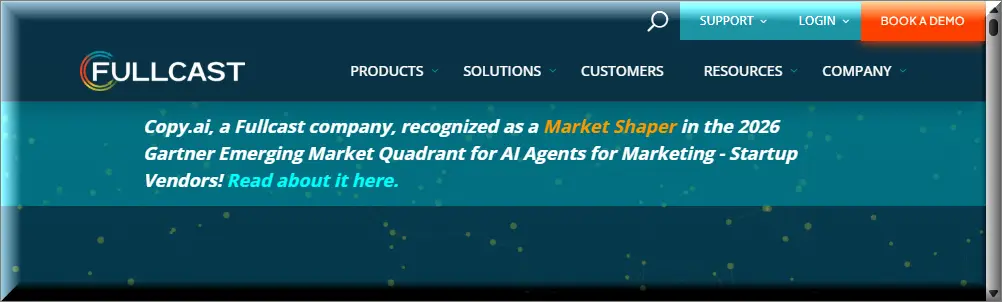
Here is the part that decides how much weight to give it. On Copy.ai’s own home page, the word Fullcast appears zero times in the visible text. Same on the pricing page, the terms, the privacy notice and the security page: zero, zero, zero, zero. The parent announces the relationship. The product never mentions it.
I checked all twelve ranking pages for the word Fullcast. Eleven do not mention it at all. Exactly one does.
I am not going to tell you what kind of deal it was, because no primary source I found says. “A Fullcast company” is the whole of what the parent published, so that is the whole of what I will claim. What follows from it is my read, not a published fact, so treat it as such. Fullcast sells revenue operations software: territory planning, lead routing, forecasting and commission payments for sales teams. A writing tool sitting inside that company is one product among several, aimed at those buyers. Whether your priorities stay on the roadmap is a fair question to ask support, and neither company has published an answer.
The story told by Copy.ai’s own documents
You do not need inside information to see what happened here. Four documents, all published by the company, all still reachable, and each one describes a different Copy.ai.
Nothing was hidden. Every step was published. The problem is that none of the earlier steps were taken down, so a buyer landing from a search finds all four at once and cannot tell which one is current.
That is the mechanism behind most of the confusion in this category, and it is worth carrying to any tool you evaluate next. Vendors update the checkout first, the documentation second, and the marketing pages last, if ever.
Two buyers arrive at this page, and they need different lists
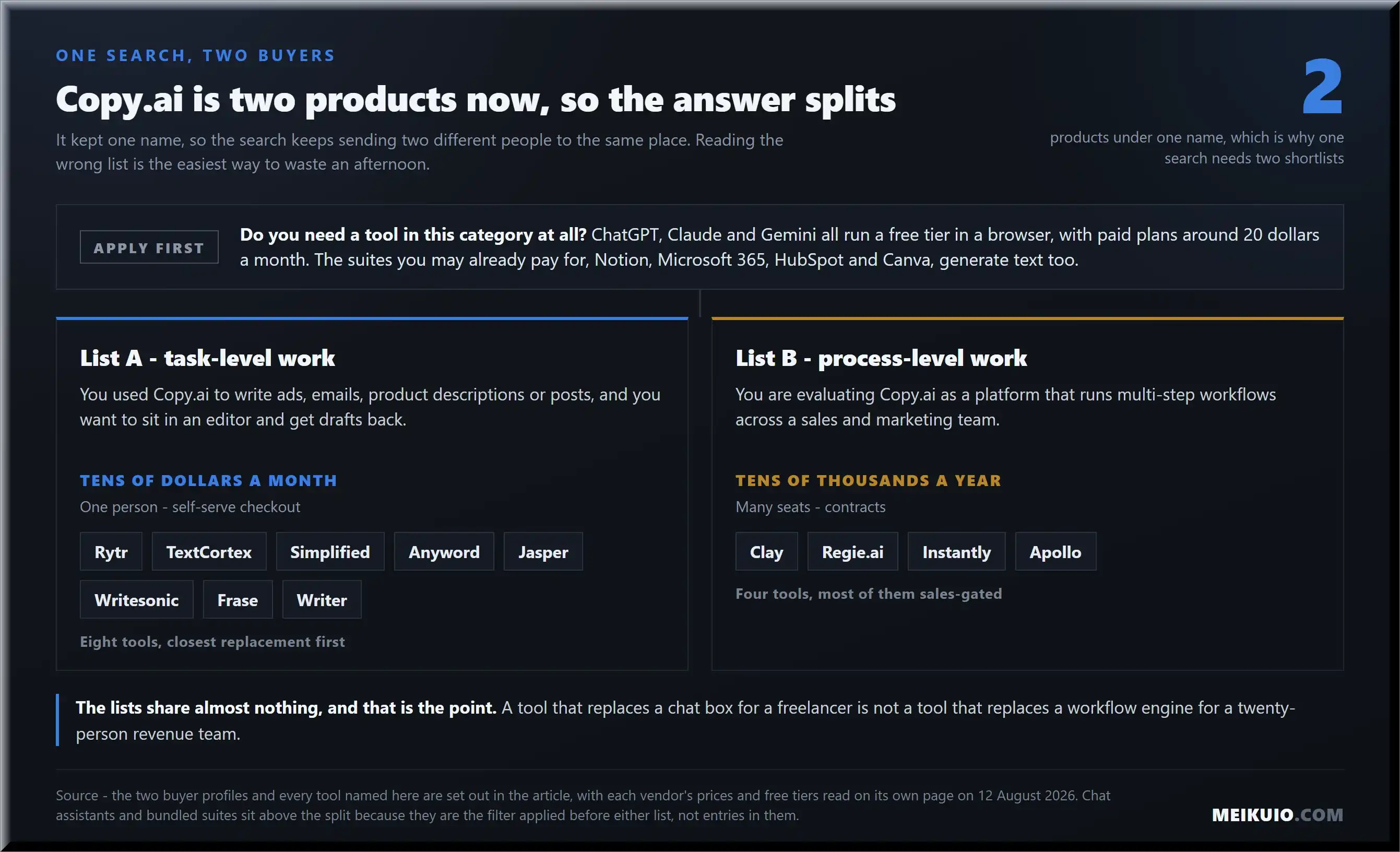
Copy.ai is two products now. It kept one name, so the search keeps sending two different people to the same place.
Which list is yours
If you used Copy.ai to write ads, emails, product descriptions or posts, and you want to sit in an editor and get drafts back, read List A. Task-level work, one person, self-serve checkout, money measured in tens of dollars a month.
If you are evaluating Copy.ai as a platform that runs multi-step workflows across a sales and marketing team, read List B. Process-level work, many seats, contracts, money measured in tens of thousands a year. Skipping to the wrong list is the single easiest way to waste an afternoon here.
The lists share almost nothing. That is the point. A tool that replaces a chat box for a freelancer is not a tool that replaces a workflow engine for a twenty-person revenue team, and every guide that ranks them together ends up recommending both to neither.
How I judged these Copy.ai alternatives
Every ranking has criteria. Most Copy.ai alternatives pages do not publish theirs, which is convenient when the publisher sells one of the entries. Mine are four questions, applied to every tool in the same order. I am not scoring these out of ten, because a score would hide which question decided the answer.
Can you get in without a card? A free tier you can use for real work outranks a seven-day trial, because a trial measures your calendar rather than the tool. This one carries the most weight, since most people reading this lost a free plan.
Does the vendor say what happens to your text? An explicit no-training statement in the vendor’s own documents beats silence, and silence beats a marketing page that contradicts the terms. I did not accept a claim from a features page if the legal page said otherwise.
Is the price visible before you talk to anyone? Published pricing, including the contract tiers, counts in a tool’s favour. A demo form where a number should be counts against it.
What can you take with you? Export of drafts is table stakes. Export of the prompts and workflow logic you built is the real switching cost, and almost nobody documents it.
Two things deliberately carry no weight here. Output quality, because I have not run the same brief through every tool and I am not going to pretend otherwise. And review-site scores, because they measure marketing budgets as much as products.
List A: what replaces Copy.ai as a writing tool
The Copy.ai alternatives below are for the person who wants to open an editor and get a draft back. Every price and free tier below was read on the vendor’s own page on 12 August 2026. Where a vendor contradicts itself, I say so instead of picking the friendlier number. List A runs closest-replacement-first, not by score.
Rytr, if you want the free tier back
Of all the Copy.ai alternatives here, Rytr is the closest thing to the product you remember. Its pricing page says “Free forever, no CC required” at 0 dollars a month, and that free tier carries 10K characters per month. Paid starts at $7.50 a month for unlimited generations, and $24.16 a month for the freelancer tier, which adds multiple brand tones and more plagiarism checks.
Characters, not words. Ten thousand characters is roughly 1,600 words. That is smaller than the 2,000 words Copy.ai used to hand out. The free tier also runs on one tone of voice and no plagiarism checks, so it is a drafting pad rather than a workspace. It is still a free tier that exists, which puts it ahead of most of this list.
Best for: short marketing copy, one person, no card on file.
TextCortex, if the training question matters to you
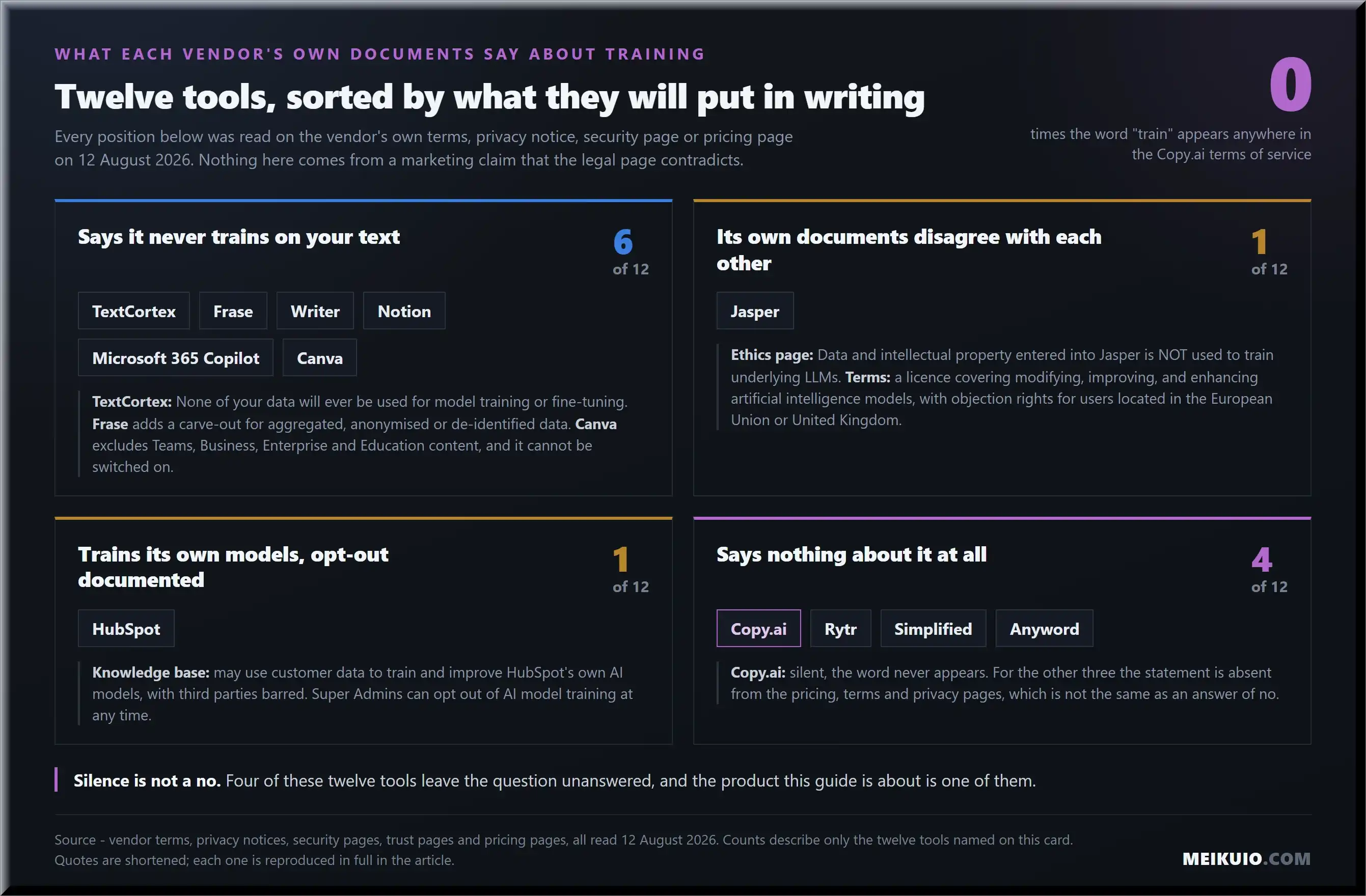
TextCortex has a free plan and, more useful, it answers the question most vendors dodge. Its own pricing page carries this: “Will TextCortex use our data to train AI models? Absolutely not. None of your data will ever be used for model training or fine-tuning.”
That sentence is worth more than a feature list. Copy.ai’s terms never use the word “train” at all, in either direction.
Best for: anyone pasting client material into a text box and wondering where it lands.
Simplified, with a warning about its own numbers
Simplified bundles writing with design and scheduling, and it does have a free plan. Then it tells you two different things about that plan.
Its AI Writer pricing page lists the free tier at 5,000 AI words. The note under it reads: “Free Plan One-time quota. After quota is exhausted, it will not refill.” Its help centre says something else entirely: “Each plan has a limited quota of words that can be generated each month. Free Forever: 2,000 words.”
Five thousand words once, or two thousand words a month. Both pages belong to Simplified. I could not find a third page that settles it. Assume the monthly cap of 2,000 words, which is the version that binds you from month two onward.
Best for: solo creators who want writing, design and posting on one bill.
Anyword, if performance scoring is the reason you are here
Anyword sells prediction rather than volume. It scores copy against audience data before you publish. Starter is $49 a month with one seat, or $39 billed yearly, and Data-Driven is $99 a month with three seats. Every plan button says the same thing: “Start your 7-day free trial.”
There is no free tier here. A seven-day trial is not a free plan, and vendors calling it one is half the reason this category confuses people.
Best for: paid ads and landing page copy, where you test variants against a score.
Jasper, and the contradiction to read before signing
Jasper is the obvious name in this category, and its pricing is no longer a surprise. We broke down every tier in our Jasper AI pricing guide. The part worth reading twice sits in the legal pages.
Jasper’s ethics page states: “Data and intellectual property entered into Jasper is NOT used to train underlying LLMs.” Now the terms. They grant a licence covering “modifying, improving, and enhancing artificial intelligence models”, and give objection rights to “users located in the European Union or United Kingdom”, who may write to [email protected].
Both statements are Jasper’s own. I will not resolve them for you, because only Jasper can. If you are in the US and this matters, get the answer in writing before you buy.
Best for: teams that need brand voice controls and will ask the awkward question first.
Writesonic, which already made the same journey
Writesonic belongs here for a reason beyond features. It was a cheap AI writer and became a search visibility platform, which is the same move Copy.ai made in a different direction. We documented that pivot in our Writesonic review, and the pattern is worth carrying into whatever you pick next.
Best for: SEO-led content teams who want the platform rather than the writer.
Frase, for long-form with a clean data answer
Frase sits on the SEO side of the category: briefs, outlines, optimisation scoring, long-form drafting. Its terms carry a sentence most competitors do not: “Frase does not use Customer Data to develop or train generalized artificial intelligence or machine learning models.”
Read the next clause too. It allows aggregated, anonymised or de-identified data, which is a normal carve-out and a real one.
Best for: article production where the brief matters more than the sentence.
Writer, if legal has to sign off
Writer is the enterprise end of this list, and it is here for one sentence on its own trust page: “WRITER takes a zero data retention approach, storing data for only as long as is needed for you to build with our platform. None of your data is used for training our models.”
The same page settles ownership too, which almost nothing else in this category does: all data, files, inputs and generated outputs “are owned by that customer”. Put that next to section 17 of Copy.ai’s terms and the contrast is the whole argument.
It is not a freelancer tool and the price reflects that. If your blocker is a security review rather than a budget, start here.
Best for: teams whose purchase has to survive a legal and compliance review.
Free tiers and prices read on each vendor’s own pages on 12 August 2026. Where a cell says “not found”, it means I checked the pricing, terms and privacy pages and the statement is absent, not that the answer is no.
One thing that table cannot show, and every buying decision needs. Seats. Jasper prices per seat and its entry plan includes one (see our dedicated review of Jasper alternatives). TextCortex prices per user. Frase gives one seat and one site on Starter, three seats on Professional. Anyword gives one seat on Starter and three on Data-Driven. Copy.ai gives five on the only plan you can buy. If you are buying for a team, that last number is the one worth staring at, because five shared seats for $288 a year is the cheapest per-person figure on this page.
List B: what replaces Copy.ai as a platform
The Copy.ai alternatives in this second list solve a different problem. If you are evaluating the current Copy.ai, you are not shopping for a writing tool. You are shopping for something that enriches a list, researches accounts, drafts at volume and drops the result into a CRM. Different market, different prices.
Clay comes up most often, and unlike most of this tier it publishes a free plan: “Start building in Clay for free. No strings attached”, with 500 actions a month, 100 data credits a month and unlimited seats. In fairness to the criticism I just made of Copy.ai, an action and a data credit are units Clay does not convert into anything either. The difference is that you can spend them for free first.
Regie.ai publishes per-seat contract pricing openly, which is rarer than it should be: $180 per user per month on an annual contract with a ten seat minimum, and $499 per user per month on an annual contract with a five seat minimum. The cheaper plan carries the larger minimum, which is how the page prints it. Do the arithmetic for the number of people you actually have, before the demo. Five people on the $499 plan is $29,940 a year. Ten on the $180 plan is $21,600.
Instantly and the outbound sending tools sit lower. Instantly’s Growth plan is $47 a month for the sending tools, and its bundled plans, which add lead data and credits, start at $94 a month. They do less than Copy.ai’s platform tier and cost a fraction of it, which is the trade.
Apollo keeps a free tier alive, and its own FAQ describes the fallback after a trial as “our Starter plan which is free forever”. For a small team testing whether workflow automation is worth a contract, that is a cheaper first step than a demo call.
One caution about this whole tier. Most of these vendors are sales-gated, and a price you cannot see is a price you cannot compare. Copy.ai is unusual for publishing its contract numbers at all, which is exactly why it is strange that no ranking page repeats them.
Three questions to ask before the demo call
Sales-gated pricing puts you at a disadvantage, so arrive with the arithmetic already done. These three questions cost nothing to ask and change what you are quoted.
What does one unit of work actually consume? If the plan is priced in credits or actions, ask for the consumption of the exact workflow you intend to run, in writing. A vendor who cannot answer that before a contract will not answer it after one.
What is the seat minimum, and does it apply at renewal? Published contract pricing often hides a floor. Regie.ai states its openly, at ten seats on one plan and five on another, which is the honest version. Ask where the floor sits and whether you can go below it next year.
What leaves with us? Not the exported drafts. The workflow definitions, the prompt library, the enrichment mappings. Get the answer in the contract rather than the call, because this is the number that decides whether year three is a renewal or a negotiation.
The alternative nobody lists: the AI you already pay for
Before you buy a new subscription, check the ones you have. Most teams that used Copy.ai for short marketing copy already pay for a suite that generates text, and it usually comes with a clearer data answer than a standalone writing tool.
Notion’s security page is direct: “By default, Notion and its AI Subprocessors do not use Customer Data to train any models.” It adds that contractual agreements with those subprocessors say the same. Microsoft’s documentation for Copilot Chat says: “Prompts and responses aren’t used to train the underlying foundation models.”
Canva draws the line by plan: “Content from Canva Teams, Business, Enterprise, and Education users is not used to improve AI-powered features, and this cannot be turned on.” HubSpot is the honest outlier. Its knowledge base says HubSpot “may use customer data, as defined in the HubSpot Customer Terms of Service, to train and improve HubSpot’s own AI models”, with an opt-out: “Super Admins can opt out of AI model training at any time.”
Statements read on each vendor’s own documentation on 12 August 2026.
This class never appears in Copy.ai alternatives lists, and the reason is structural. A page written by a company selling a writing tool has no reason to tell you that the HubSpot seat you already pay for writes the email. We ran into the same blind spot in the best AI apps for iPhone, where free official apps kept losing shelf space to paid wrappers.
Do you need a tool in this category at all
Ask this before you shortlist any Copy.ai alternatives, not after. For most people who used Copy.ai for short copy, the honest answer in 2026 is a chat assistant and a saved prompt. That is not a cop-out. ChatGPT, Claude and Gemini all run a free tier in a browser, with paid plans around $20 a month if you outgrow it.
The free tiers of the big assistants now write ad copy, subject lines and product descriptions to roughly the standard a template tool produces. We tested that on the plans people actually pay for in Grok vs ChatGPT. We compared the free versions head to head in DeepSeek vs Claude, and looked at writing quality specifically in ChatGPT vs Claude for writing. For the wider field, our ChatGPT alternatives guide covers it.
What you give up is real, so here it is plainly. Templates that stop you staring at a blank field. Brand voice settings shared across a team. A place where last month’s copy still lives. If none of those three matter to you, a dedicated tool is a second subscription doing a first subscription’s job.
I am not ranking chat assistants inside this guide, because they are the filter you apply before the list, not an entry in it.
Who owns what you generate
This is the question no page in the search results answers, and it is sitting in plain sight in Copy.ai’s terms of service.
Section 17(a) reads: “Copy.AI’s licensor, OpenAI LLC, exclusively owns all right, title and interest in and to Generated Content. Copy.AI claims no ownership of Generated Content.”
Read that twice. The vendor disclaims ownership of your output. It assigns that ownership to its model supplier, not to you. Section 8 goes further. It requires you to use Generated Content “in a manner that is consistent with the OpenAI mission and Charter, which is incorporated herein by reference, as determined by OpenAI in its sole discretion.”
A document you have not read, interpreted by a company you have no contract with, at its own discretion. That is what governs the ad copy.
There is a second problem with the same clause. I counted the model providers named in those terms: OpenAI appears five times, Anthropic zero, Gemini zero. The pricing page sells “Access to OpenAI, Anthropic, and Gemini models”. The contract knows one supplier. The storefront sells three, and the ownership clause was written for the world where only the first one existed.
The terms carry a date that explains a lot of this: “Last Updated: October 12th 2023”. They define the service as “Copy.AI’s copy content generation services”, which is the product from three years ago, not the platform on the front page today.
Why this matters more than it used to
Ownership of AI output is unsettled ground, not a solved question. The US Copyright Office has published a series of reports on copyright and artificial intelligence, and the short version for a marketer is that human authorship is what earns protection. If you are producing assets a client will license, or anything that needs a clean chain of rights, the ownership clause in your tool’s terms is not boilerplate. It is the thing to read first.
So I went looking for the same clause in the alternatives, and the results split three ways. Jasper is explicit in your favour: “We claim no ownership rights over Customer Property. The Customer Property remains yours.” Writer is equally direct, saying all inputs and generated outputs “are owned by that customer”. The rest of List A, Rytr, TextCortex, Simplified, Anyword and Frase, say nothing about output ownership on the terms and privacy pages I read. Absent a clause, you are relying on the default position rather than a promise.
Two of ten tools commit in writing. That is the honest state of this category, and it is the first question I would put in an email before paying anyone.
For comparison, this is the sort of clause that decided our verdicts in the best AI music generators, where two vendors with near-identical output had completely different answers about what you were allowed to do with the result.
What you can take with you when you leave
The work you build inside one of these tools is not the drafts. It is the prompts you refined, the brand voice you tuned, the workflow you wired together. Ask where that goes when you cancel.
Copy.ai’s terms explain how to delete your own content, and its help centre explains how to export workflow runs: “Export: Save all the Workflow runs through exporting.” Runs are output. That is not the same as taking the logic with you.
I looked for export documentation for saved prompts, brand voice configurations and workflow schemas across every vendor in List A. I did not find it for any of them. Not a refusal, an absence: the pages simply do not address it.
Checked across vendor documentation on 12 August 2026. “Not publicly available” means the vendors do not document it, not that it is impossible.
This is the same test we applied to SurveyMonkey alternatives: what a tool refuses to let go of tells you more about the relationship than anything on the feature list.
What a credit actually buys
Four questions on Copy.ai’s pricing page are about credits. None of them contains a number.
The definitions are honest as far as they go. “A credit represents a specific amount of computational power necessary to execute the tasks within a given workflow.” Then this: “A credit’s value depends on the complexity of the tasks performed within Copy.ai.” And for the cost of a run: “You can see how much a run costs by opening the side panel.”
Inside the product. After you pay. No conversion table exists on any Copy.ai page I checked.
There is a twist that makes this stranger. The only plan you can buy yourself has no credits in it at all. So those four answers describe a currency that self-serve customers cannot spend, on the page where self-serve customers do their shopping.
Practical version: if a vendor prices in credits and will not say what one buys, treat the price as a starting bid rather than a bill.
Cancelling, renewing, and the five-day window
The storefront card for the Chat plan says “Billed monthly”. The terms of service describe something else.
Section 6 states it plainly. “You will be charged the annual Subscription fee, plus any applicable taxes, and other charges, at the beginning of your Subscription and each year thereafter.” A few lines on, in capitals: “BY PURCHASING A SUBSCRIPTION, YOU AUTHORIZE COPY.AI TO INITIATE RECURRING NON-REFUNDABLE PAYMENTS.”
Both statements belong to the same company. I am not going to reconcile them. Which one binds your account is a question for their support, in writing, before you enter a card.
The refund window is short and it is real. Section 6(c): “You may cancel your Subscription for a full refund within five (5) calendar days of your initial purchase. AFTER THAT, YOUR PURCHASE IS FINAL AND YOU WILL NOT BE ABLE TO CANCEL THE PURCHASE AND/OR RECEIVE A REFUND OF YOUR SUBSCRIPTION FEE AT ANY TIME.” The help centre agrees, calling it a “5-day money-back guarantee from the date of your initial purchase”.
Cancellation is by email, to [email protected], and it takes effect at the end of the current period rather than immediately. Cancelling is not the same as asking for the money back. The help centre spells the refund out as a separate request: “To request a refund, you will need to contact us within five days of the initial charge.”
Five days to evaluate a tool. Put a reminder in your calendar for day four, and run your real work through it before then, not your test prompts. We used the same clock in the Squarespace pricing breakdown, where the gap between the advertised price and the renewal price was the entire story.
What the other lists get wrong
I read the twelve pages that rank for Copy.ai alternatives and counted what they publish about the product. To keep the count fair, I only counted numbers appearing near a mention of Copy.ai, so another vendor’s pricing could not contaminate the result.
Counted on 12 August 2026 across the twelve content pages ranking for this search.
I want to be fair to the field, because the lazy version of this criticism is wrong. The page ranking first gets the headline right. It states plainly that Copy.ai no longer offers a free plan, and that pricing now starts at a Chat plan at $29 a month.
Then it adds three words that the whole field repeats: “Enterprise plans available at custom pricing”.
They are not custom. They are printed on Copy.ai’s own pricing page, behind a switch that takes one click. They run from $12,000 to $36,000 a year. Nobody flipped the switch. Twelve pages, eleven of them written by companies whose job is to know this market, and the numbers were sitting one click away the whole time.
Counts of pages, not mentions. Pricing checks were made within 350 characters of a Copy.ai mention. Four of nine checks are empty. The first six rows measure useful facts; the final three indicate misleading or commercial relationships. The top-ranking page says the free plan is gone and entry is 29 USD/month, but calls the 1,000–3,000 USD contract tiers custom pricing.
There is a structural reason for it, and it is the same one we found when we counted the publishers behind Calendly alternatives: almost every ranking is written by a vendor who sells one of the products in it, and every one of those vendors puts itself first. That is not corruption. It is what the page is for. It just means the reader is holding a sales document with a comparison table on it.
What working copywriters actually pay for
One result in this search is not a listicle. Google puts a Reddit thread from r/copywriting in third place, titled “Copywriters: What AI tools are you actually paying for and why?” I opened it and counted the whole discussion, 73 comments.
Copy.ai is mentioned zero times. Jasper is mentioned zero times.
What working copywriters name instead: ChatGPT, 46 mentions. Grammarly, 13. Claude, 9. Perplexity, 7. A thread full of people spending their own money on this exact job, and the category leaders do not come up once.
In a 73-comment thread about what copywriters actually pay for, Copy.ai and Jasper are named zero times, while ChatGPT is named 46.
Treat that as a signal, not a verdict. It is one thread, and people who love a tool rarely post about it. But it lines up with the shape of the whole search: the vendors write the lists, and the practitioners write something else entirely.
If you would rather build it than buy it
This part is for technical readers, and it explains the price rather than recommending a purchase.
What Copy.ai sells at the contract tier is workflows: research a company, pull the fields, draft the message, push it into the CRM. Those steps are available separately. A model API supplies the drafting, an automation tool supplies the chaining, and your CRM already has an inbound webhook. We covered the shape of that build in our guide to AI agent examples in production, and the economics of selling it in how to start an AI automation agency.
I am not telling a marketer to go and wire this together. Managing API keys, retries and broken JSON is a job, and it is not the job you were hired for. The point is narrower: when a platform quotes $12,000 a year, that number is the packaging, the support and the guardrails around parts that individually cost a fraction of it. Knowing that changes how you negotiate.
Best AI copywriting tools by the job you need done
Most Copy.ai alternatives guides rank tools against each other as if everyone were doing the same work. Here is the same shortlist sorted by the job instead.
What is not an alternative, whatever the other lists say
Read enough Copy.ai alternatives pages and the same wrong categories keep appearing. Each one is in there for a reason, and none of the reasons is that it does the job.
Two of those deserve a caveat rather than a dismissal. A grammar tool paired with a chat assistant covers a lot of ground for one person. And a scheduler that drafts captions genuinely replaces part of the job, if captions were most of what you used Copy.ai for.
The test I apply is simple. If you take the tool away, does the blank page come back? If yes, it was doing this job. If no, it was doing a neighbouring one.
If your plan disappeared, do this in this order
The people arriving at Copy.ai alternatives in 2026 mostly are not shopping. They are recovering from a change they did not choose. Here is the order that wastes the least time.
- Export what you have. Drafts, saved prompts, brand voice notes. The prompts are the part no vendor lets you take, so copy them into a document you own before anything else.
- Check what you already pay for. If your team has Notion, Microsoft 365, HubSpot or Canva, the writing feature is included and the data terms are usually clearer than a standalone tool’s.
- Run one real job through a free tier. Not a test prompt, a real deadline. Rytr and the chat assistants cost nothing to try, and one afternoon tells you more than a week of comparison tables.
- Only then look at paid plans, and price the annual number rather than the monthly one. Most paid plans here advertise a monthly figure that is only available if you commit to twelve months.
- If you are buying anything with a contract, get two answers in writing first: does it train on your text, and what happens to your prompts when you leave.
Step five is the one people skip. It is also the only step that protects you from repeating this exercise in eighteen months, with a different vendor and the same sinking feeling.
Related comparisons on meikuio
We run the same test on every category we cover: who publishes the rankings, what the price becomes at renewal, and what the vendor keeps when you leave. If this guide was useful, these use the same method on neighbouring tools.
- Jasper AI pricing, tier by tier, including the costs that appear after checkout.
- Writesonic review, the clearest example of a writing tool that became a platform.
- Zendesk alternatives, ranked by a site that sells none of them.
- DocuSign alternatives, ranked by what is actually free.
How I checked this
Every claim in this guide to Copy.ai alternatives was read on a live page on 12 August 2026. Prices came from vendor pricing pages, including both sides of the Copy.ai pricing switch. Quotes came from terms, privacy notices, security pages and help centres, and they are reproduced word for word.
The counts are mine. The sitemap sample was 40 blog posts drawn at random from the 1,667 Copy.ai publishes. The field audit covered the twelve content pages ranking for this search, counting only within 350 characters of a Copy.ai mention. The Reddit tally covered all 73 comments in the thread.
Two things I could not establish, said plainly rather than glossed over. What kind of transaction put Copy.ai inside Fullcast: the parent publishes the words “a Fullcast company” and nothing further that I could find, so that is all I claim. And whether Copy.ai trains on customer text: the terms, the privacy notice and the security page never address it in either direction, so the honest answer is that the company is silent, not that the answer is no.
I have not run these tools side by side on the same brief. Where a claim needed a paid account to verify, I left it out rather than describe a test I did not run. I also cannot tell you which of these companies will still be selling in two years. Nobody can, and the ones that make the biggest promises are not the safest bet, as the first half of this guide shows.
Field notes
- The gap: the only plan you can buy yourself is $288 a year; the cheapest plan that includes workflows is $12,000 a year; 41.7 times apart, with nothing sold in between.
- Self-serve: one plan, Chat, five seats, $29 a month or $24 on annual billing, and zero workflow credits.
- Contract tiers: Growth $12,000 a year at 75 seats, Expansion $24,000 at 150 seats, Scale $36,000 at 200 seats; all three printed on the vendor’s own page behind a switch.
- The free plan: removed from sale, still advertised on 40 of 40 sampled blog posts; the founder’s announcement of a free forever account with 2,000 words a month is still live.
- Cancelling: refund window five calendar days from the initial charge and it must be requested; cancellation by email to [email protected]; terms last updated 12 October 2023.
- The field: of twelve ranking pages, 0 print the contract prices, 0 print the annual price, 0 say who owns the generated content, and 11 are published by a company selling a competing tool.
- Sources: Copy.ai pricing page in both tabs, its terms of service, help centre and blog; the pricing, terms and trust pages of every alternative named; and the twelve ranking pages, all read 12 August 2026.
Frequently Asked Questions
Does Copy.ai still have a free plan?
No. The pricing page has no free tier. The vendor’s own help centre tells new users: “You need to purchase either our Chat plan or Agents plan.” The confusion is fair, though. The founder’s announcement of a free forever plan is still published, and every blog post still promises 2,000 free words a month.
How much does Copy.ai actually cost now?
$29 a month for the Chat plan, or $24 a month billed annually, which the page states as $288 a year. Anything with workflows in it starts at $1,000 a month, billed $12,000 a year, and runs to $3,000 a month. Those contract numbers are published, not custom, which is why it is worth clicking the Enterprise tab yourself.
Why is Copy.ai’s pricing so different from what I remember?
Because the product changed shape. Copy.ai now sells itself as a go-to-market platform, and the middle of its old ladder is gone. Its own blog still lists the retired tiers, a Starter at $49 a month and an Advanced at $249 a month with 2,000 workflow credits. Neither is for sale today.
Can I get a refund from Copy.ai?
Yes, within five calendar days of your first purchase, and not after. The terms say the purchase is final once that window closes. Cancellation goes to [email protected] and takes effect at the end of your current period, so cancelling does not produce a refund by itself.
Who owns the content Copy.ai generates?
According to Copy.ai’s terms, its licensor OpenAI LLC “exclusively owns all right, title and interest in and to Generated Content”, and Copy.ai claims none. The same terms require you to use that content consistently with the OpenAI mission and Charter, as determined by OpenAI. If you produce work that clients license, read that section before you buy.
Does Copy.ai use my text to train its models?
It does not say. The word “train” does not appear in its terms of service at all, and neither the privacy notice nor the security page addresses model training. Silence is not a no. If that matters to you, TextCortex and Frase both put explicit no-training statements in their own documents.
What is the closest free alternative to Copy.ai?
Rytr, if you want the same kind of tool: its pricing page says “Free forever, no CC required” with 10K characters a month. If you care about the output rather than the format, the free tier of a chat assistant does more, and it is the answer most working copywriters give when asked.
Can I export my prompts and workflows before leaving?
You can export workflow runs, which are the outputs. I found no documentation, at Copy.ai or at any alternative in this guide, describing an export of saved prompts, brand voice settings or workflow logic. Keep the master copies outside whichever tool you choose.
Is Copy.ai worth it for a solo freelancer in 2026?
For most freelancers, no, and the Copy.ai alternatives above will cost less. $288 a year buys a chat box with five seats, and the workflow engine that makes the platform interesting is four figures a month away. The exception is a freelancer who needs shared seats for a small team and likes the interface enough to pay for it.
My Take
If you came looking for Copy.ai alternatives because your plan disappeared, the tool you want is probably Rytr or a chat assistant with three saved prompts, and the whole decision should cost you an afternoon. I would give Copy.ai itself to exactly one reader: a revenue team with a real workflow budget, who has already priced Clay, and who is going to read section 17 of the terms before signing. Everyone else is being sold a platform to solve a paragraph.
What bothers me is not the price change, because companies are allowed to move upmarket. It is that the old promise is still running. A founder’s post saying “completely free, forever” is still live, 40 out of 40 blog posts I sampled still promise 2,000 free words a month, and the help centre quietly says you have to buy. Whichever tool you pick from this list, check what its own pages promised two years ago, then check what its checkout does today. That gap is where the surprise lives.