



The best Zendesk alternatives in 2026 are Freshdesk, Help Scout, Zoho Desk, Intercom, Gorgias, and HubSpot Service Hub. Which one fits comes down to your channels and ticket volume. The catch nobody puts on the label: most of them now charge per AI resolution, so the cheapest sticker price can quietly cost more than Zendesk did.
- Quick verdict: the best Zendesk alternative by use case
- Why do teams actually leave Zendesk?
- The problem with every “Zendesk alternatives” list (including the ones above this one)
- The 6 Zendesk alternatives worth switching to
- Freshdesk: the closest match, priced lower
- Help Scout: support that feels like email
- Zoho Desk: the most features per dollar
- Intercom: the strongest AI chat, at a price
- Gorgias: built for Shopify support
- HubSpot Service Hub: if you want CRM and support in one
- The pricing trap most comparisons skip: paying per AI resolution
- When Zendesk is still the right call
- How to choose your Zendesk alternative
- Frequently asked questions
- What is the cheapest Zendesk alternative?
- What is the best free Zendesk alternative?
- Is Freshdesk better than Zendesk?
- Do Zendesk alternatives charge extra for AI?
- What is the best Zendesk alternative for Shopify or ecommerce?
- How hard is it to migrate off Zendesk?
- My Take
Note
Full disclosure, because it changes how you should read this: meikuio doesn’t sell a help desk, and there are no affiliate links in this article. Every other “Zendesk alternatives” list at the top of Google is published by a company that sells one of the tools on it. We’re ranking these by what they cost and who they fit, not by who pays us.
Teams don’t leave Zendesk because it stops working. They leave because the bill keeps climbing and the platform starts to feel like a second job. Zendesk’s own Suite plans run $55 to $115 per agent each month before you add anything, and its AI agents bill on top of that per resolution. So the number that matters is what you’ll pay at your real ticket volume, with the AI meter running, not the sticker price on the pricing page. Every price below comes from the vendor’s own pricing page, checked in July 2026.
Quick verdict: the best Zendesk alternative by use case
Gorgias Starter is 40 USD flat per month for 50 tickets and bills by ticket volume, not per agent; it is excluded from this per-seat series. Intercom and HubSpot list prices are 29 USD and 20 USD; the chart preserves the source article’s new-customer offers.
Why do teams actually leave Zendesk?
Teams leave Zendesk for three reasons, in this order: price, complexity, and the new AI billing. The platform still ranks near the top of every analyst list (G2, Capterra, TrustRadius, and Software Advice all shortlisted it for 2026). The complaints are about cost and upkeep, not the software.
The price problem is structural. A Zendesk Suite Team plan is $55 per agent per month, Suite Professional is $115, and the features most teams assume are standard, things like advanced analytics, workforce management, or quality assurance, sit behind higher tiers or paid add-ons. One mid-sized team documented a Zendesk bill near $5,000 a month for a couple dozen users before add-ons. On top of that, ease of setup is Zendesk’s lowest-scoring metric in G2 reviews, and practitioners routinely budget four weeks or more just for basic configuration.
The most common Zendesk complaint of 2026 is the AI meter: every automated resolution bills separately, at a dollar rate Zendesk doesn't publish anywhere on its pricing page.
ARs are a rip off. We stopped using it.
Zendesk customer review on automated-resolution fees, 2026
The problem with every “Zendesk alternatives” list (including the ones above this one)
Search “Zendesk alternatives” and look at who wrote the results. Missive’s list puts Missive first. Zapier’s guide steers you toward Zapier’s own integrations. The rest of page one is a rotating cast of help desk vendors, DevRev, Pylon, Desk365, HappyFox, LiveAgent, each one quietly ranking its own product at the top. That’s just how content marketing works, and it means the “neutral comparison” you’re reading is usually written by a competitor.
More Read

We don’t sell any of these, so the answer isn’t dressed up: there’s no single best Zendesk alternative. There’s a best one for a five-person startup on email, a different one for a Shopify store, and a different one again for a product-led SaaS company. The six below are the ones we’d shortlist, with the trade-off spelled out for each. If you’re also weighing the broader stack of AI automation tools that plug into support, the same rule applies: read who published the ranking. We ran the same audit on scheduling software next, and every top-ranked “Calendly alternatives” list is written by a scheduling vendor putting itself first.
The 6 Zendesk alternatives worth switching to
Freshdesk: the closest match, priced lower
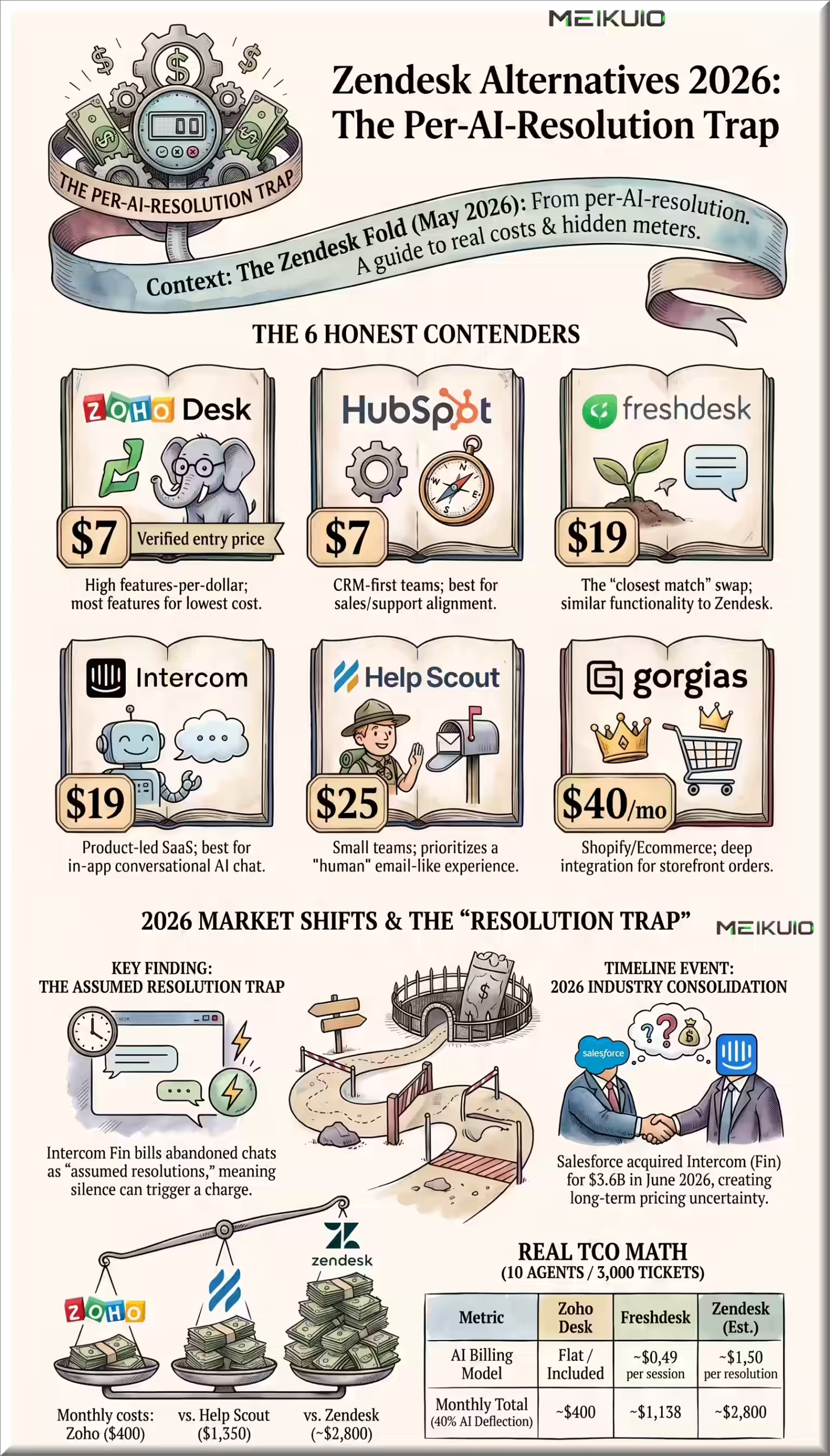
Freshdesk is the most natural swap if you want a Zendesk-style help desk without the Zendesk bill. Its tiers even mirror Zendesk’s: Growth at $19 per agent, Pro at $55, Enterprise at $89. The difference is what you get for the money. Freshdesk includes its Freddy AI agent (500 sessions) starting on the $19 Growth plan, while Zendesk keeps AI agents behind the $55 Suite Team tier. Same entry price, more in the box.
The catch: those 500 AI sessions are a one-time allotment, not a monthly refill, and Freddy bills roughly $0.49 per session after that, whether or not the session actually solved anything. Migration off Zendesk can also be slow, since Zendesk throttles data exports. Freshdesk fits teams under a few hundred agents who want the same channels for less. It’s a weaker pick if you need deep, granular workflow logic and permissions at scale.
Help Scout: support that feels like email
Help Scout built its whole identity around a shared inbox that looks like ordinary email instead of a ticket number. For a small team that wants replies to feel human, that design choice matters more than any feature checklist. Paid plans start at $25 per user (Standard), and it’s the only tool here with a usable free plan, up to five users. Its AI writing features, Drafts, Summarize, and Assist, come included on paid plans, where Zendesk would charge you a separate Copilot add-on for the equivalent.
Scale is where it stops. Help Scout’s Pro plan ($75) requires a minimum of 10 seats, extra inboxes cost $10 a month each, and it isn’t built for heavy phone or omnichannel operations. Its AI Answers add-on bills $0.75 per resolution, though you can set a spending cap that switches the AI off when you hit it. Great for small and mid-size teams that value tone and simplicity. Wrong tool if you’re running a large, multi-channel contact center.
Zoho Desk: the most features per dollar
Zoho Desk is the value pick, full stop. Paid plans run $7 (Express), $14 (Standard), $23 (Professional), and $40 (Enterprise) per user, with a free tier for three agents. For that money you get enterprise-style tooling like Blueprint, a no-code process builder that rivals features other vendors charge far more for. Crucially, Zoho folds its Zia AI into the subscription instead of running a per-resolution meter, which changes the math at high volume (more on that below). It also advertises free assisted migration from other help desks, and unlike HubSpot, it has no mandatory onboarding fee.
Two honest downsides. The interface feels dated and can slow down under heavy ticket loads, and the useful autonomous Answer Bot is gated to the $40 Enterprise tier. Zoho also works best when you’re already inside its ecosystem; it doesn’t read data from non-Zoho sources. Pick it if you’re a value-driven team willing to trade polish for capability. Skip it if a clean, modern interface out of the box is non-negotiable.
Intercom: the strongest AI chat, at a price
If your support lives inside your product and you want the most capable AI agent, Intercom’s Fin is it. Seats run $19 (Essential, on the current offer), $85 (Advanced), and $132 (Expert), and Fin bills $0.99 for every outcome it resolves. You can even bolt Fin onto another help desk without buying Intercom seats, at the same $0.99. The strength is real: for product-led SaaS with a solid help center, Fin resolves more, more cleanly, than most rivals.
The total is what stings. Reviewers describe Intercom’s stacked pricing, seats plus per-outcome fees plus add-ons, as “excessively high,” with “constant upselling.” A recurring review complaint: getting billed for chats the customer simply abandoned, because Fin counts silence as an “assumed resolution.” And the marketed resolution rate near 76% rarely survives contact with reality; named customer cases land closer to 42% to 53%, which changes your per-outcome economics. One more thing to weigh: in June 2026, Salesforce signed a definitive agreement to buy Intercom (which renamed itself Fin in May 2026) for about $3.6 billion, with the deal expected to close in Salesforce’s fiscal 2027. If you sign a multi-year Intercom contract now, you’re betting on how Salesforce prices it later.
Gorgias: built for Shopify support
Gorgias is the specialist. It’s purpose-built for ecommerce, plugs deep into Shopify, and lets agents see and act on orders without leaving the ticket. Its pricing works differently too: you pay by ticket volume, not per agent, starting at $40 a month (Starter, 50 tickets) and scaling to $1,430 a month (Advanced, 5,000 tickets). For a Shopify store past a few hundred tickets a month, nothing else on this list matches its native fit.
The warning is the billing. Every AI resolution counts twice, once as an automated interaction (with overage at $1.50) and again as a help desk ticket. During peak seasons like Black Friday, that structure can inflate the bill fast, and merchants have been surprised by it. Gorgias also really only makes sense on Shopify; it supports other platforms but loses its edge on a custom stack. Perfect for DTC and Shopify brands with real ticket volume. The wrong choice for a B2B SaaS company or a solo founder.
HubSpot Service Hub: if you want CRM and support in one
HubSpot Service Hub makes the most sense when you already run on HubSpot. Because support sits natively on the same CRM as sales and marketing, every ticket carries the customer’s full history with no syncing or connectors. The interface is clean, built-in NPS and CSAT surveys come standard, and there’s a free plan for two users. Paid seats start at $7 (Starter) and rise to $90 (Professional) and $150 (Enterprise).
Watch two numbers, though. Real support capability starts at the $90 Professional tier, and HubSpot charges a mandatory one-time onboarding fee of $1,500 (Professional) or $3,500 (Enterprise), so a 10-agent Professional rollout pays $1,500 before answering a single ticket. And HubSpot’s support depth doesn’t match Zendesk’s; it’s smooth until ticket volume spikes or a case goes off-script, then you feel it strain. Ideal if HubSpot is already your system of record. Not ideal if support is your core operation and needs real depth.
The pricing trap most comparisons skip: paying per AI resolution
In 2026, help desks stopped charging only per agent and started charging per AI resolution, a fee every time their bot closes a ticket without a human. Almost none of the comparison articles mention it, and it breaks the old logic of picking the tool with the lowest seat price. A cheap seat with a high resolution fee can cost more than an expensive seat with a low one.
Two things stand out. First, the billable unit isn’t the same across vendors, so comparing raw rates is misleading: Freshdesk charges per session even when the bot fails, while Zendesk and Help Scout only bill a confirmed success. Second, Zendesk doesn’t publish its dollar rate at all. Its help center only says committed usage costs less than pay-as-you-go; the ~$1.50 to $2.00 figures come entirely from third-party teardowns. As of May 2026, Zendesk also folded its old $50-per-agent Advanced AI add-on into base plans while keeping the per-resolution meter, so “AI included” now means the flat fee is gone but the meter is still running.
Run the numbers and the trap is obvious. For a 10-agent team handling 3,000 tickets a month with 40% deflected to AI (about 1,200 resolutions), estimated monthly cost lands around $400 on Zoho Desk Enterprise (flat AI), roughly $1,138 on Freshdesk Pro, about $1,350 on Help Scout Plus, and near $2,800 on Zendesk Suite Professional at the committed rate. A lower per-seat price can lose: Help Scout Plus ($45 a seat) overtakes Freshdesk Pro ($55 a seat) on total cost past roughly 385 AI events a month, because Help Scout’s $0.75 fee outruns Freshdesk’s $0.49. If you want the same lens applied to model costs, we keep a running breakdown of what AI features actually cost.
Horizontal labels are monthly AI resolutions for the comparison scenario; Freshdesk actually bills sessions. Zendesk uses an unpublished rate estimated at 1.50 USD, with the first 100 included. Preserve that estimate, not a vendor-confirmed quote.
When Zendesk is still the right call
Switching isn’t automatically the answer, and pretending otherwise would make this just another biased list. Zendesk stays the better choice in a few cases. If you’re operating at enterprise scale, with complex multi-brand routing (it supports up to 300 brands on Enterprise), a large app marketplace, and deep custom reporting through Explore, few alternatives match that breadth. Zendesk was named a Leader in Gartner’s 2025 Magic Quadrant for the customer engagement space, and it serves over 100,000 organizations, including large deployments like Siemens.
There’s also the switching cost itself, which is the part spreadsheets miss. Moving off Zendesk isn’t a weekend job; teams commonly spend 60 to 120 days on content cleanup, rebuilding workflows, and reconnecting integrations. If you’re already standardized on Zendesk and it’s working, that lock-in tax often outweighs the monthly saving. The move makes sense when support is a cost you’re actively trying to cut. It rarely makes sense purely to chase a lower sticker price. A similar dynamic shows up when operations teams evaluate DocuSign alternatives in 2026, where legacy contract workflows and compliance archives frequently keep established platforms in place despite cheaper e-signature tiers.
How to choose your Zendesk alternative
Skip the feature grids and decide on three questions instead:
- What’s your main channel? Mostly email and a small team, Help Scout. Selling on Shopify, Gorgias. In-app chat for a SaaS product, Intercom.
- What’s your ticket volume, and how much will AI handle? High volume with heavy AI deflection favors a flat-fee model like Zoho over any per-resolution meter. Low volume makes the meters cheap and the seat price the thing to watch.
- What are you already running? On HubSpot, Service Hub keeps everything on one record. Inside the Zoho suite, Zoho Desk is the obvious fit. Neither is worth adopting a whole ecosystem for.
For most small and mid-size teams leaving Zendesk over price, Freshdesk or Zoho Desk will cover 90% of the need at a fraction of the cost. The AI-first options (Intercom, and Zendesk itself) earn their premium only when a capable agent measurably moves your numbers, and only after you’ve done the per-resolution math. Many of these tools also lean on the same ChatGPT alternatives and underlying models to power their bots, so the AI quality gap is narrower than the marketing suggests.
Frequently asked questions
What is the cheapest Zendesk alternative?
Zoho Desk is the cheapest full help desk, starting at $7 per user a month (Express) with a free plan for three agents. HubSpot Service Hub and Help Scout also have free tiers, for two and five users respectively, which can be enough for a very small team.
What is the best free Zendesk alternative?
Help Scout has the most usable free plan, covering up to five users with a shared inbox and knowledge base. Zoho Desk’s free tier supports three agents with email ticketing. HubSpot’s free plan works for two users but pushes you toward paid tiers quickly.
Is Freshdesk better than Zendesk?
For teams under a few hundred agents, Freshdesk is usually the better value: the same channels at a lower price, with an AI agent included from the $19 tier. Zendesk pulls ahead at large enterprise scale, where its routing, analytics, and integration depth matter more than the monthly cost.
Do Zendesk alternatives charge extra for AI?
Most do. Freshdesk bills about $0.49 per AI session, HubSpot around $0.50 per resolution, Help Scout $0.75, Intercom $0.99 per outcome, and Gorgias $1.50 per automated interaction on overage. Zoho Desk is the main exception, folding its AI into the subscription with no per-resolution meter.
What is the best Zendesk alternative for Shopify or ecommerce?
Gorgias. It’s purpose-built for ecommerce, integrates deeply with Shopify, and lets agents handle orders inside the ticket. It’s priced by ticket volume rather than per agent, which suits stores with seasonal spikes, as long as you watch the double billing on AI resolutions.
How hard is it to migrate off Zendesk?
Harder than the price saving suggests. Zendesk throttles data exports, and moving tickets, macros, and workflows typically takes 60 to 120 days for a large team. Free migration tools exist, Zoho’s Zwitch assistant and Help Scout’s Import2 wizard among them, but quirks survive the transfer: Gorgias, for example, collapses Zendesk’s six ticket statuses into two.
My Take
After pricing all seven out, my honest read: for most teams leaving Zendesk over cost, Freshdesk or Zoho Desk end the pain at a fraction of the price, and Zoho’s flat AI billing is the quiet winner once your volume climbs. Don’t switch for an “AI agent” until you’ve done the per-resolution math, because trading a $55 seat for a $0.99 outcome fee can just be swapping one runaway bill for another. And if you’re a Shopify store, Gorgias; if you’re already on HubSpot, Service Hub. Everyone else: start with the two cheapest and only pay up when a real capability, not a marketing number, earns it.