DeepSeek and Claude both run for free in a browser, and for most people that free version is the whole decision. The short version: DeepSeek gives you a frontier-grade model at zero cost with no message cap worth worrying about, and it’s genuinely strong at math and competitive coding. Claude wins on writing that sounds human, on multi-file code that has to actually ship, and on one thing DeepSeek quietly fails at on its free plan. I ran both on the same tasks to find out where each one breaks.
- Quick verdict
- What each one actually is
- I gave both the same coding task
- Then I asked them to write like a human
- The freshness test that exposed the real gap
- The benchmarks, and where they don’t tell the whole story
- Price: this is where DeepSeek is hard to argue with
- The part nobody likes to talk about: your data
- So which should you use?
- Frequently asked questions
- Is DeepSeek better than Claude?
- Is DeepSeek really free, with no catch?
- Which is better for coding, DeepSeek or Claude?
- Can DeepSeek search the web like Claude?
- Is DeepSeek safe to use?
- Does Claude train on my conversations?
- My take
Quick verdict
Neither one is the “better AI.” DeepSeek is the better deal and the better mathematician. Claude is the better writer, the more careful engineer, and the only one of the two that knows what year it is.
What each one actually is
DeepSeek comes out of a Hangzhou lab funded by the quant trading firm High-Flyer. Its defining choice is that it’s open-weight: the company publishes the model under an MIT license, so anyone can download it and run it on their own hardware. On the free web app, your messages route through one of two modes. Instant Mode runs V4-Flash, a smaller, faster model. Expert Mode runs V4-Pro, the 1.6-trillion-parameter flagship built for hard reasoning and code. Both launched in late April 2026, and both are free with no paid tier above them. If you want the deeper background on the V4 family and how it’s built, I wrote a full breakdown of DeepSeek V4 separately.
Claude comes from Anthropic, a public-benefit corporation in San Francisco. It’s the opposite philosophy: closed source, hosted only on Anthropic’s own servers and a few cloud partners. The current lineup is Opus 4.8 (the flagship, out May 28), Sonnet 4.6 (the everyday workhorse and the model you get free), and Haiku 4.5 (the fast, cheap one). Anthropic briefly shipped a more powerful tier called Fable 5 in June, then pulled it days later under a government export-control order, which is a strange story I covered in what actually shipped in June 2026. For now, Opus 4.8 is the most capable Claude you can actually reach. If you’re curious who controls Anthropic and why that matters, here’s who owns Claude.
One thing to set straight before the tests: I ran both on the plans most people use, not the $200 tiers. DeepSeek in Expert Mode, Claude on the free Sonnet 4.6. That’s a fair fight, because that’s the fight almost everyone is having.
I gave both the same coding task
First test was a real chore, not a toy. The kind of thing a marketer or a founder needs at 11pm. I gave each one the exact same prompt, cold, in a fresh chat:
I asked each model to write a small Python script for a sales spreadsheet – each row has a date, a product, a region and an amount – that lists the three best-selling products in each region by total revenue, handles missing or broken rows, and includes short comments.
Both produced working code on the first try. The interesting part is how differently they think. DeepSeek reached for pandas, wrapped everything in one function, and commented nearly every line. It handled every edge case in the prompt: bad rows get flagged and skipped, missing product and region values get filled, non-numeric amounts get stripped out, and it even counts how many rows it threw away and tells you. Then it went one step past the ask and offered to generate a sample CSV so I could test it. Thorough, a little heavy, and the kind of answer that assumes you have pandas installed.
More Read

Claude took the same prompt somewhere else. No pandas. It used only Python’s standard library, which means the script runs on any machine without a single pip install. It split the work into four small functions instead of one big block, so each piece is easy to test on its own. It caught everything DeepSeek caught, plus one thing DeepSeek missed: it treats negative sales amounts as bad data and skips them. The output is a clean aligned table, and the command-line handling works out of the box. Where DeepSeek says “here’s everything,” Claude says “here’s the right amount, done properly.”
Same prompt, two philosophies. DeepSeek gave the maximal answer with a bonus test file; Claude gave the leaner, zero-dependency one and caught an edge case DeepSeek skipped. If you write a lot of throwaway scripts, you’ll be happy with either. For code that other people have to read and maintain, Claude’s structure is the one I’d keep. For the deeper rabbit hole, here’s my full test of the best AI coding tools, where I ran the paid tiers head to head.
Then I asked them to write like a human
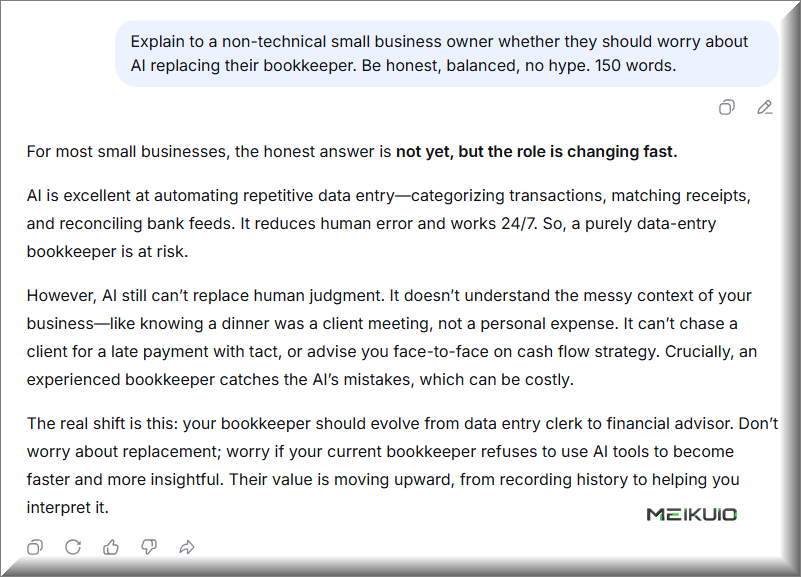
Code is one thing. The reason a lot of people pay for these tools is words. So I gave both the same writing brief, the kind a small business owner might ask: explain whether they should worry about AI replacing their bookkeeper. Honest, balanced, no hype, 150 words.
DeepSeek opened with “not yet, but the role is changing fast,” then walked through it in clean paragraphs. It made a good concrete point that a human still knows a client dinner isn’t a personal expense, and it landed on a fair warning: worry less about replacement, more about a bookkeeper who refuses to touch AI tools. Reads like a competent consultant. Nothing wrong with it.
Claude opened with “partly yes, fully no,” then did something DeepSeek didn’t: it broke the “what AI can’t do” part into a short bulleted list, which is exactly how you’d want to skim this. It named real tools (QuickBooks, Xero), mentioned the IRS, and closed harder: “if you’re paying someone mostly to enter data, it’s worth asking what exactly you’re paying for.” That last line has an edge to it. It sounds like a person with an opinion, not a model hedging.
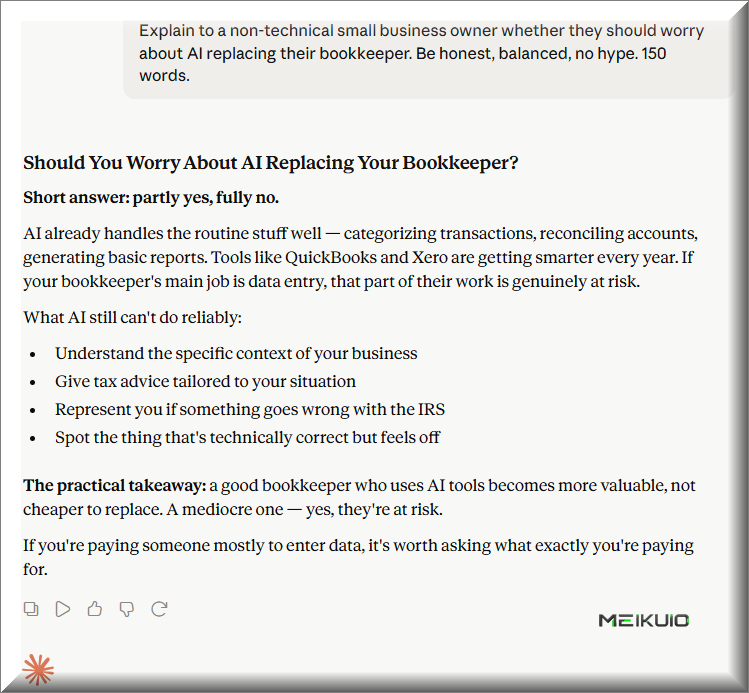
Both hit the word count, both were honest. The gap is tone. Claude’s read like someone talking to you; DeepSeek’s read like a well-organized memo. For marketing copy, client emails, or anything with a byline, that gap matters. It’s the same edge Claude shows when you put it up against other chatbots for writing, which I dug into in ChatGPT vs Claude for writing.
The freshness test that exposed the real gap
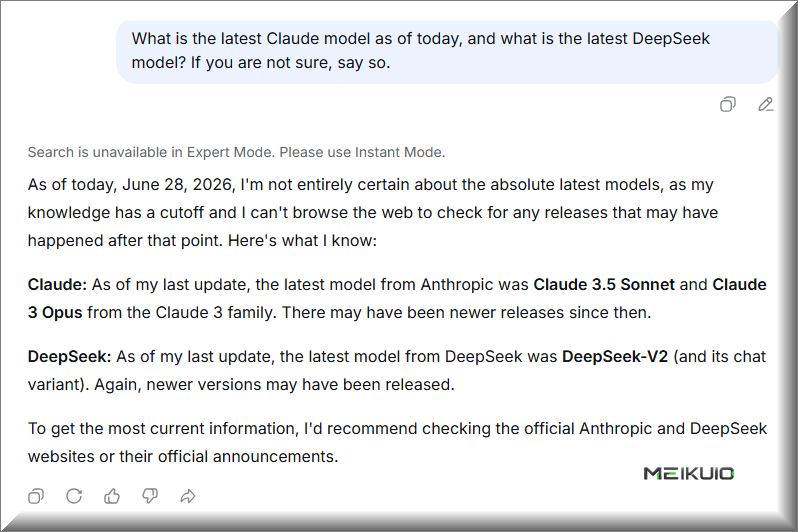
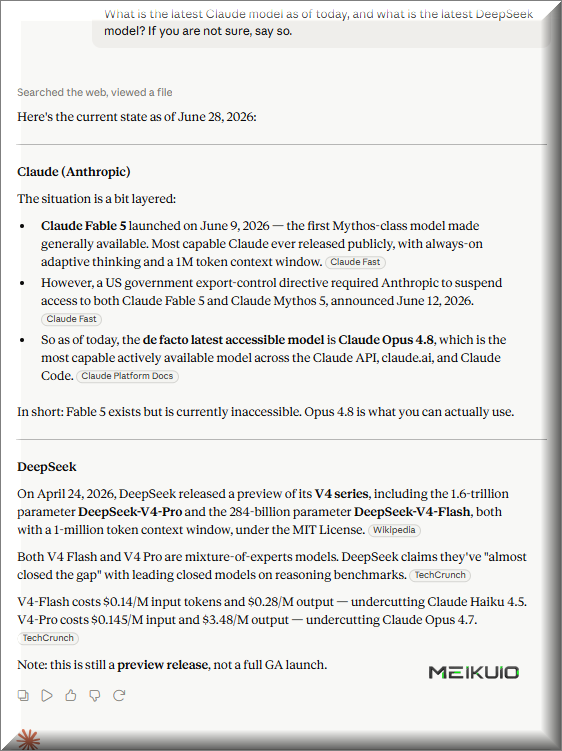
This is the one that actually changed how I think about the two. I asked both the same simple question: what’s the latest Claude model, and the latest DeepSeek model, as of today? And I told each one to say so if it wasn’t sure.
DeepSeek, in Expert Mode, started its answer with a quiet line: “Search is unavailable in Expert Mode.” Then it told me the latest Claude was Claude 3.5 Sonnet and the latest DeepSeek was DeepSeek-V2. Both of those are from 2024. It was honest about having a knowledge cutoff, which I respect, but sit with what just happened: the most powerful version of DeepSeek, the one it points you to for hard problems, has no internet, and it didn’t even know its own current model exists. I was talking to V4 while it told me V2 was the newest thing going.
Claude, on the free plan, did the opposite. It searched the web, then gave me an accurate picture as of that exact day: Opus 4.8 as the model you can actually use, the Fable 5 launch and its recall days earlier, and on the DeepSeek side it correctly named V4-Pro and V4-Flash, the MIT license, and the per-token prices. It even reconstructed the Fable 5 export-control story that I’d written about the week before. Free Claude knew more about DeepSeek’s current model than DeepSeek’s own flagship did.
Note
DeepSeek can search the web, but only in Instant Mode (the lighter V4-Flash model). So freshness on DeepSeek is a trade: you give up the flagship to get the internet. On Claude, search works on the model you’re already using. If your work touches anything current, that trade is the whole ballgame.
The benchmarks, and where they don’t tell the whole story
My three tests are a sample, not a lab. So here’s the wider picture from standardized benchmarks, the ones designed to resist being gamed. They back up what I saw by hand, with one twist worth flagging.
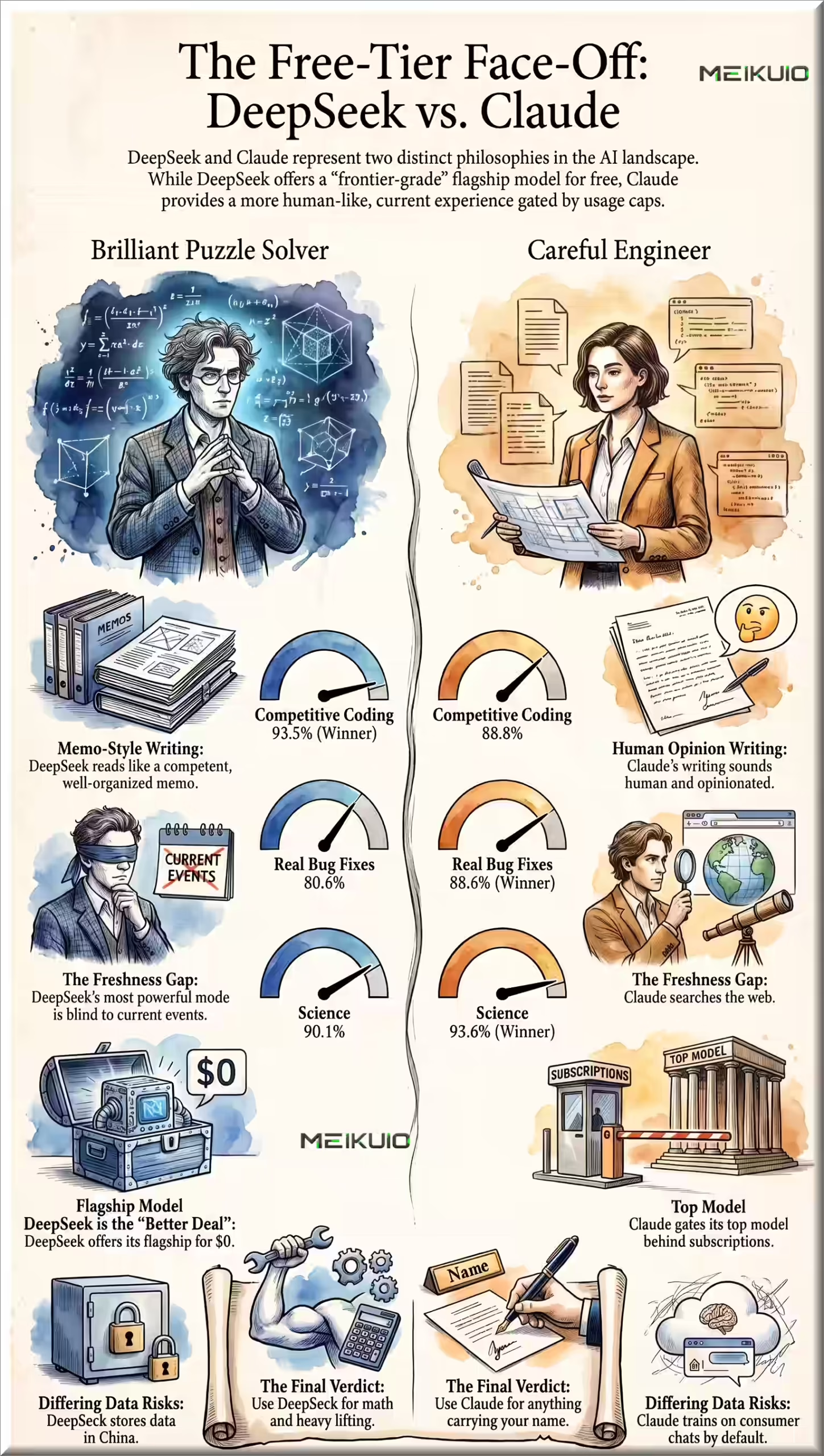
Original benchmark winner record: SWE-bench Verified – real bug fixes: Claude (+8.0%); SWE-bench Pro – multi-file, contamination-screened: Claude (+13.8%); LiveCodeBench – competitive programming: DeepSeek (+4.7%); GPQA Diamond – graduate-level science: Claude (+3.5%)
Read those two coding rows together, because they look like a contradiction and aren’t. DeepSeek tops LiveCodeBench, which is competitive-programming puzzles: self-contained, algorithm-heavy, the kind of thing it’s exceptional at. Claude tops both SWE-bench tests, which throw a model into a real GitHub repository to fix an issue across multiple files without breaking anything. That’s the difference between a brilliant puzzle solver and a careful engineer, and it’s exactly the split I watched in my own code test.
These are flagship-model benchmarks, not the author’s free-tier task test. Free Claude uses Sonnet 4.6; free DeepSeek Expert uses V4-Pro. Each benchmark measures a different task.
The twist is honesty under pressure. On a hard knowledge benchmark called AA-Omniscience, which checks whether a model admits what it doesn’t know, DeepSeek V4-Pro fabricated answers about 94% of the time instead of saying “I’m not sure.” That’s not a claim that DeepSeek is wrong all the time, it’s good on plenty of factual tests, but on the obscure stuff it tends to invent rather than admit. That lines up uncomfortably well with my freshness test, where it confidently named a two-year-old model as the newest one. Claude leans the other way by design: Anthropic says Opus 4.8 is four times less likely than its previous version to let an error slide without flagging it.
A brilliant puzzle solver and a careful engineer are not the same hire. The benchmark you pick decides which one looks better.
Price: this is where DeepSeek is hard to argue with
On the free web app, DeepSeek gives you V4-Pro, its actual flagship, at no cost and with no real message cap beyond some throttling at peak times. There is no paid consumer tier, because there’s nothing to upsell you to. Claude’s free plan caps you at roughly 40 messages a day on Sonnet 4.6, and to reach Opus 4.8 you need Pro at $20 a month, with Max at $100 or $200 for heavier use.
The gap gets wider on the API, where developers feel it. DeepSeek’s V4-Pro runs about $0.435 per million input tokens and $0.87 per million output. Claude Opus 4.8 runs $5 and $25. That’s roughly 28 times more expensive per output token. One developer running V4-Pro through their tooling reported a full month’s bill of $1.83. You cannot do that on Opus. If your work is high-volume and the absolute top of writing quality isn’t the point, the math is brutal in DeepSeek’s favor.
DeepSeek has no paid consumer tier. Free Claude has approximately 40 messages per day on Sonnet 4.6; Pro is needed for Opus 4.8.
API output only, separate from subscriptions. Input costs are 0.435 USD for DeepSeek and 5 USD for Claude. The output-price ratio is approximately 28 times.
One caveat I’ll keep repeating: exact prices move, and the per-token rates shift more often than the subscription tiers. For the current numbers across all the major models in one place, I keep our AI pricing comparison updated separately.
The part nobody likes to talk about: your data
This is where the comparison stops being about features. And it’s where most of the “DeepSeek vs Claude” articles go quiet, because the honest answer is that both have real problems, just different ones.
DeepSeek is a Chinese company, and under its own terms, everything you send, every prompt, every uploaded file, every log, is stored on servers in China. Chinese law, specifically the National Intelligence Law, can compel domestic companies to hand data to the state on request. That’s not a rumor, it’s the legal reality, and Western governments have acted on it. DeepSeek is barred from US Department of Defense systems, and states including Texas, New York, Tennessee, and Virginia have banned it on government devices. Canada restricted it on federal devices in early 2025, and Australia banned it from government networks the same year. For a student or a freelancer with non-sensitive work, that may not matter. For anyone touching client data or government contracts, it’s disqualifying. The one escape hatch is that DeepSeek is open-weight, so a technical team can download it and run it entirely on their own servers, where nothing leaves the building.
Claude is hosted in the US, which clears the geopolitical hurdle, but Anthropic’s own consumer policy has teeth people don’t expect. On the Free, Pro, and Max plans, Claude trains on your chats by default; to stop it you have to go into Settings, Privacy, and switch off “Help Improve Claude,” which drops your data to a 30-day deletion cycle. There’s more: a privacy policy update taking effect July 8, 2026 lets Anthropic share user conversations with law enforcement based on its own “good faith belief,” without a court order, on those same consumer plans. And a February 2026 federal ruling, US v. Heppner, found that chats with Claude carry no attorney-client privilege. The API, Team, and Enterprise plans are carved out of the training and law-enforcement clauses, which tells you something about who those consumer defaults are really for.
Note
The fair summary: DeepSeek’s risk is where your data physically lives and who can legally reach it. Claude’s risk is what the company itself does with it by default. Neither free tier is the right place for genuinely confidential material. If the data is sensitive, self-host DeepSeek or pay for a Claude plan that’s contractually walled off, and on Claude turn the training setting off either way.
So which should you use?
After all of it, the choice is less about which model is smarter and more about what you do all day.
Reach for DeepSeek if:
- You’re on a tight budget and want a frontier model for free, with no daily message anxiety.
- Your work is math, competitive coding, or standalone scripts, where it’s genuinely best in class.
- You run high-volume API jobs and the cost difference (roughly 28x cheaper output) decides it.
- You have the technical chops to self-host the open weights and keep your data in-house.
Stick with Claude if:
- You write for a living, copy, content, client work, where tone and judgment show.
- Your code has to ship and survive other people reading it, not just pass a puzzle.
- You need current information, because free Claude searches the web and DeepSeek’s flagship can’t.
- You’re selling into US, Canadian, or Australian government or regulated spaces where a China-hosted tool is a non-starter.
Plenty of people will end up using both, and that’s the smart move, not a cop-out. DeepSeek for the cheap heavy lifting, Claude for the things that carry your name. If you’re still weighing the broader field, our roundup of ChatGPT alternatives worth switching to puts both in context with the rest.
Frequently asked questions
Is DeepSeek better than Claude?
Neither is universally better. DeepSeek wins on price (it’s free and its API is far cheaper) and on math and competitive coding. Claude wins on writing quality, on multi-file production code, and on staying current. Pick by task, not by reputation.
Is DeepSeek really free, with no catch?
The web app and mobile apps are free, including Expert Mode, which runs the V4-Pro flagship. There’s no paid consumer tier. The real “catch” isn’t money, it’s data: your conversations are stored on servers in China.
Which is better for coding, DeepSeek or Claude?
It depends on the coding. DeepSeek leads on competitive, algorithm-heavy problems (it tops LiveCodeBench). Claude leads on real-world software engineering across multiple files (it tops both SWE-bench tests). For code that has to integrate into a working project, Claude is the safer pick.
Can DeepSeek search the web like Claude?
Yes, but only in Instant Mode, which runs the lighter V4-Flash model. In Expert Mode, search is off, so the flagship has no live information. Claude searches the web on its standard models, including the free tier.
Is DeepSeek safe to use?
For casual, non-sensitive tasks, it works fine. For anything confidential, be cautious: data is stored in China and subject to Chinese law, and it’s banned on government devices in several countries. Sensitive work should go to a self-hosted version or a different tool.
Does Claude train on my conversations?
On the Free, Pro, and Max plans, yes, by default. You can turn it off in Settings under Privacy by switching off “Help Improve Claude,” which also shortens data retention to 30 days. API, Team, and Enterprise plans aren’t used for training.
My take
I went into this expecting the free-versus-free angle to be the story, and it was, just not the way I assumed. I figured DeepSeek being free would feel like a compromise. It doesn’t. The thing is fast, it’s smart, and the code it wrote me was the equal of anything I’ve paid for. If you’d shown me that CSV script with no label, I couldn’t have told you it came from the free tier of a tool that costs nothing.
What stuck with me was the freshness test. Watching DeepSeek’s most powerful mode tell me, with total confidence, that a model from two years ago was the latest one, while it was literally running a newer version of itself, was the moment the free price stopped feeling free. For a student checking math, who cares. For me, drafting something that has to be right and current, that’s the kind of confident wrongness that gets you in trouble. Claude pulling the actual facts off the web on its free plan, including a story I’d written days earlier, was the quiet flex of the whole test.
So I use both, and I’m not being diplomatic about it. DeepSeek does my heavy, repetitive, math-shaped work for nothing. Claude writes the things with my name on them and answers anything that depends on what happened this week. The privacy stuff keeps me from putting client files in either one’s free version, and honestly that’s the part I wish more people talked about before picking a side.