



The beehiiv vs Substack decision comes down to a number neither platform asks you for. One bills your list. The other bills your income. Both publish a calculator, and each calculator leaves out the cost that belongs to its own publisher. Here is the arithmetic, priced against one newsletter on 12 August 2026.
- The number neither calculator shows you
- Substack’s own calculator applies three of the four fees its own help centre documents.
- Two meters: one bills your list, one bills your income
- The crossover: when zero percent starts saving money
- At a thousand subscribers, the zero percent platform is the expensive one until roughly one reader in twelve is paying.
- What you actually keep on Substack
- The zero percent take rate is something you buy
- Trialling beehiiv's most expensive feature set, all three money screens stay locked.
- What the ten percent is buying
- Which one can pay you back
- Moving between them
- You cannot start moving your paying readers off Substack until you are already paying beehiiv.
- Why the two paths work so differently
- What does not come with you
- What it looked like for the people who did it
- Where each rate is actually written down
- Neither company prints its headline rate in the document that obliges you to pay it.
- Deliverability and the address your mail comes from
- Who owns what you wrote
- Who is the seller, and who owes the tax
- The third option neither page mentions
- How to choose
- How we checked this
- Frequently Asked Questions
- Does Substack really take only 10%?
- Is beehiiv free if I have a small list?
- Can I take paid subscriptions on beehiiv's free plan?
- What happens to my paid subscribers if I switch?
- Which one is cheaper if nobody pays me yet?
- Does beehiiv or Substack own my subscriber list?
- Can I use my own domain on both?
- Which one brings subscribers I do not already have?
- What is the cheapest way to run a paid newsletter if I skip both?
- My Take
The number neither calculator shows you
Both companies want you to compare them, and both have built a calculator to help. Substack’s sits on its “going paid” page. beehiiv’s sits on a page named after its competitor. Neither one subtracts the money its own publisher collects.
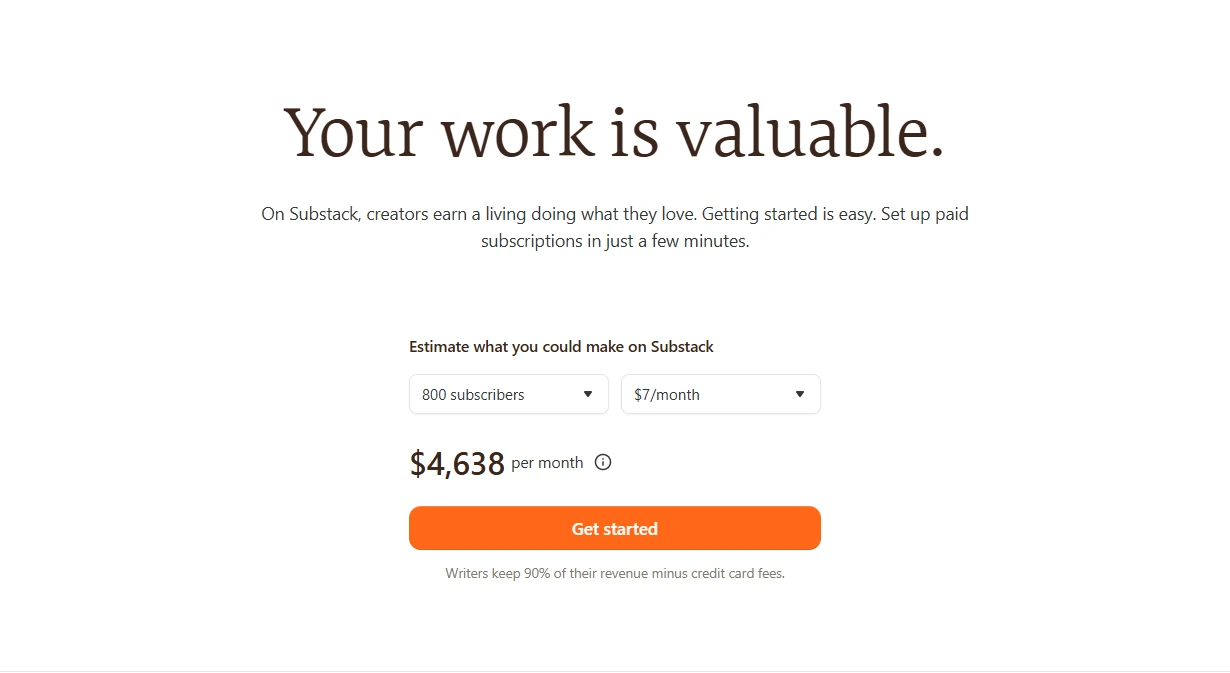
Substack’s calculator returns 4,638 dollars a month at 800 subscribers on 7 dollars, above the line that promises writers keep ninety percent.
What Substack’s calculator leaves out
Set the calculator to 800 subscribers at 7 dollars a month and it returns 4,638 dollars a month. The line under it reads: “Writers keep 90% of their revenue minus credit card fees.” We ran every combination the two dropdowns allow, 54 in total, and matched each result against one formula: gross, minus ten percent, minus 2.9 percent, minus thirty cents per transaction. All 54 matched to the dollar.
That formula is missing a fee Substack documents itself. Its help centre lists four deductions, not three: ten percent to Substack, a card fee of 2.9 percent plus thirty cents, and a Stripe billing fee for recurring subscriptions of 0.7 percent. The same page adds a warning most creators never see: the billing fee “is not included in the Stripe processing fee” amount, so it does not appear where you would look for it.
At 800 subscribers paying 7 dollars, that missing 0.7 percent is about 39 dollars a month, or 470 dollars a year the calculator hands back to you on screen and Stripe takes anyway. The gap is small per transaction and steady over a year, which is exactly the kind of line that survives three budget reviews without anyone noticing it.
More Read

Substack’s own calculator applies three of the four fees its own help centre documents.
What beehiiv’s comparison leaves out
beehiiv runs a page called “beehiiv vs Substack” with a calculator of its own. Set to 2,000 premium subscribers at 5 dollars a month, it shows a creator keeping 97,668 dollars a year on Substack against 109,320 on beehiiv, and concludes that you earn 11,652 dollars more with beehiiv. The three numbers in the Substack column are gross revenue of 120,000, a paid subscriptions fee of 12,000, and a Stripe fee of 10,680.
Two things are wrong with that card, and only one of them is arithmetic. Subtract the two printed fees from the printed gross and you get 97,320, not 97,668. The 348 dollar difference comes from charging Stripe on the post-fee balance rather than on what the reader actually paid, so the Stripe line printed beside Substack is not the Stripe line used in Substack’s total.
In fairness, that error runs in Substack’s favour, and beehiiv’s own column adds up exactly. Call it sloppy rather than sly.
The second omission is larger. Nowhere on that page does beehiiv print what beehiiv costs. The words “per month” never appear next to a plan price, and none of its published prices, from 517 dollars a year to 3,474, show up anywhere in the comparison. A publication with 2,000 paying subscribers almost certainly carries a list in the tens of thousands, which puts it on a plan costing between 1,785 and 2,629 dollars a year. Subtract that and the 11,652 dollar advantage shrinks by 15 to 23 percent depending on where the list sits, before anyone has checked anything else.
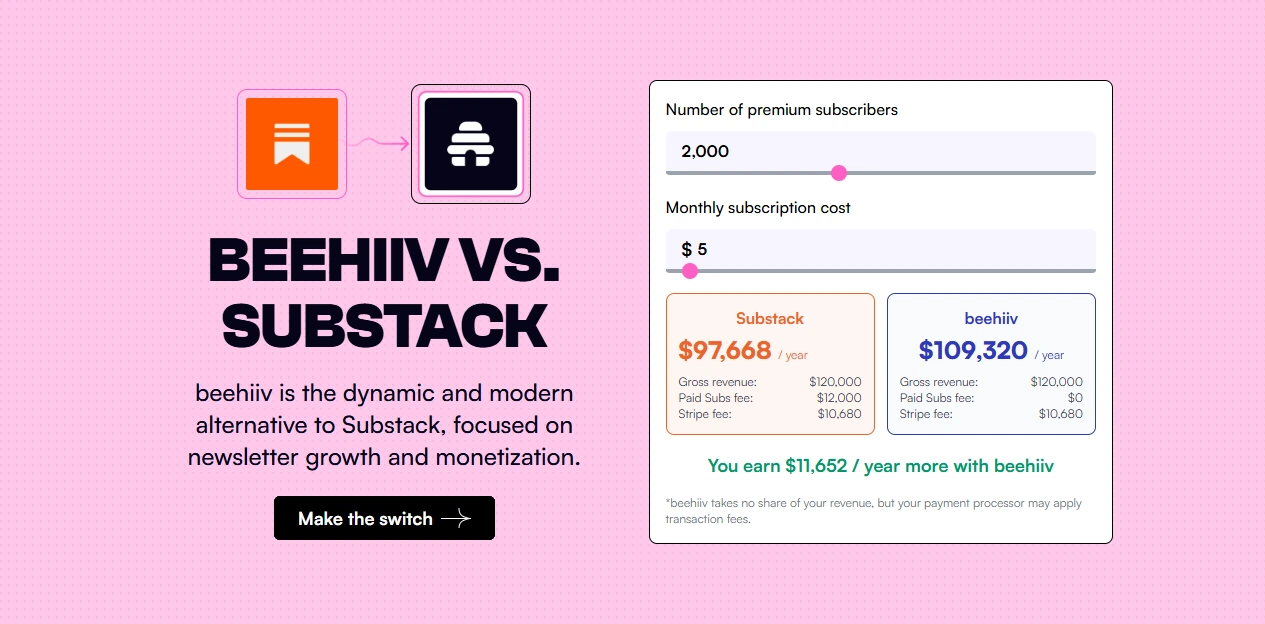
beehiiv’s comparison card prints Substack’s fee at 12,000 dollars a year and its own plan fee nowhere.
This is why the rest of this piece is arithmetic rather than opinion. Both vendors will do the sum for you, and both will do it with one hand off the scale.
Two meters: one bills your list, one bills your income
Most beehiiv vs Substack comparisons put two prices side by side as though they measure the same thing. They do not. Above 2,500 subscribers, beehiiv charges a subscription that rises with the size of your email list, whether or not a single reader pays you. Substack charges nothing to publish at any size and takes a share of what your paying readers send, so a list of fifty thousand free subscribers costs zero there and 2,629 dollars a year on beehiiv.
You can watch each company confirm which number it cares about during signup. beehiiv’s onboarding asks what platform you are coming from, then asks the size of your email list, and the brackets it offers are the same rungs as its price ladder. Substack’s calculator asks how many premium subscribers you have and what you charge them. Each product asks first for the number it bills on.
Here is beehiiv’s ladder in full, read from its pricing page on 12 August 2026. Most comparisons publish one rung of it, usually the cheapest. Substack has no equivalent ladder, because it has no plan fee at any size, so the comparison column for it would read zero all the way down.
Note
Prices were read from beehiiv’s own pricing page on 12 August 2026, at every one of the nine subscriber settings and in both billing modes. Annual billing runs about twelve percent under the monthly rate. The page defaults to the annual view, so the first number a visitor sees is the discounted one.
Read the ladder as a cost per subscriber and the shape changes again. At a thousand subscribers, Scale costs 517 dollars a year, which is about 52 cents per subscriber. At a hundred thousand it costs 3,474, which is about 3.5 cents each. That is a fifteenfold difference in unit price, and it runs the wrong way: the publication least able to absorb a fixed line item pays the most per name on it.
Launch cannot accept paid subscriptions. Substack has no list-size price ladder: publishing is free at any list size; it takes 10% of paid revenue before shared Stripe costs. 50,000 free readers therefore cost 2,629 USD/year on beehiiv and zero on Substack. Different meters are not plotted as like-for-like prices.
beehiiv’s nine-rung ladder against Substack’s flat rate: the same fifty thousand free readers cost 2,629 dollars a year on one platform and nothing on the other.
The crossover: when zero percent starts saving money
Both platforms pass the same Stripe charges to you, so those cancel out of the beehiiv vs Substack comparison entirely. What remains is one number against another: ten percent of your subscription revenue on Substack, against a fixed annual plan fee on beehiiv. The two are equal when your revenue reaches ten times that plan fee, and that is the whole decision.
The table below runs that break-even at each rung, then converts it into the number a team can actually check: how many of your readers have to pay, and what share of your list that is. It assumes the common five dollar monthly price and the cheaper annual billing.
The column on the right is the one to take into a budget meeting. A publication with a thousand subscribers needs almost nine percent of that list paying before beehiiv’s zero percent saves it a dollar. A publication with twenty five thousand needs a bit over one percent. Paid conversion in the low single digits is the ordinary case for newsletters.
That column has a step in it that the numbers alone hide. beehiiv prices in brackets, and its own page labels them “up to” a size rather than “at” one, so the fee changes the moment a list crosses a boundary while the readers on it do not. A publication sitting at exactly 1,000 subscribers pays 517 dollars and needs 8.7 percent of that list paying. Add one more subscriber and the plan becomes the one printed against up to 2,500, the fee becomes 729 dollars, and the break-even share jumps to 12.2 percent before falling again as the list grows into the bracket it now occupies. The cheapest place to sit on this ladder is just under a ceiling, and the most expensive is one subscriber over it.
That puts the crossover directly inside the range where most publications actually sit, which is why neither platform is cheaper in general.
At a thousand subscribers, the zero percent platform is the expensive one until roughly one reader in twelve is paying.
One publisher put the same sum in plainer terms after making the move. Martin SFP Bryant of PreSeed Now wrote that his team had “reached a scale where it would cost less to pay for Beehiiv’s top tier annual subscription than it would to give 10% of every subscription payment to Substack.” That is the crossover, described by someone who crossed it.
There is one honest adjustment to make in beehiiv’s favour, and it comes from beehiiv’s own dashboard. Its ad network is pitched with the line that most publishers cover the cost of their subscription by running a few ads a month. If that holds for your publication, the fixed fee is partly or wholly offset, and the crossover moves toward beehiiv. We could not measure it, because the ad network sits behind the same paid plan as everything else that moves money, and that gate gets its own section below.
Discrete sampled thresholds, not a smoothed continuous curve. Share decreases within each bracket, then jumps when its price steps up. One additional subscriber after 1,000 raises the required share from 8.7% to 12.2%. Whole paying-reader counts are rounded upward. Revenue break-even equals ten times annual fee; shared Stripe charges cancel in this comparison.
The break-even share of your list drops from 8.7 percent at a thousand subscribers to 0.6 percent at a hundred thousand, but it jumps to 12.2 percent one subscriber past the first bracket.
The same arithmetic drives every price comparison we run, whether the meter is a channel, a seat or a subscriber. We took the same approach to two website builders priced over three years, and the pattern held there too: the sticker is rarely the bill.
What you actually keep on Substack
Ten percent is the number every beehiiv vs Substack page quotes, and it is the smallest of the four deductions that reach a Substack payout. The fixed thirty cents per transaction does the quiet damage, because it is charged per payment rather than per dollar, so it weighs most on the cheapest subscriptions.
Against the promise of keeping ninety percent, the real figure runs from 80.4 percent at the common five dollar price to 86.0 percent at seventy five. None of that is hidden, and none of it is unusual for card payments. It is simply not what the sentence under the calculator says, and the difference is largest for exactly the small publications the sentence is written to encourage.
Shares of gross monthly payment before annual discounts. Printed rounded writer shares: 80.4%, 82.1%, 83.4%, 84.4%, 85.4%, 86.0%. Billing 0.7% is additional to card processing, omitted by the vendor calculator. beehiiv passes the same Stripe charges, so only the 10% platform cut is specific to Substack. Four deductions retained: 10% Substack; 2.9% Stripe card fee; fixed 0.30 USD per payment; 0.7% recurring billing.
The four deductions on every Substack payment, priced against six subscription tiers: 80.4 percent reaches the writer at five dollars a month and 86.0 percent at seventy five.
Split that 19.6 percent honestly and it matters less than it looks. On a five dollar subscription Substack's own share is 50 cents, and the other 48 cents goes to Stripe. Stripe charges the same on beehiiv, so the comparable figure there is about 90.4 percent kept, not 100, before the plan fee is counted at all. The gap between the two platforms on a single payment is ten percentage points, not twenty.
One more variable moves this table more than the platform choice does. Every rate above assumes monthly billing, and the fixed thirty cents lands on each payment. Sell the same subscription annually and it lands once instead of twelve times, which pulls the effective rate on a sixty dollar annual plan down close to Substack's headline ten percent. Substack's own pledge defaults nudge toward annual pricing, and no comparison we read models it.
If you price in another currency
One of the two Substack help pages that lists these fees adds a further charge: Stripe may apply a one to two percent fee where currency conversion is required. The other page does not mention it. Teams billing readers outside the United States should assume the higher end of the range until they see their own payout summary.
One default arrives switched on before you get there. A new Substack publication comes with pledges enabled and the amounts already filled in at eight dollars a month, eighty a year and a hundred and fifty for founding members. Readers can promise money before any paid tier exists.
Nobody on your team chose those numbers. Most teams running a beehiiv vs Substack trial will not notice them until a pledge shows up in the dashboard.
The zero percent take rate is something you buy
The central claim in every beehiiv vs Substack pitch is that beehiiv takes no share of subscription revenue. That is true, and it is a feature you pay for rather than a property of the platform. On beehiiv's own feature table, the free Launch plan lists paid subscriptions as unavailable, so a publication on it cannot charge a reader at all.
The line "0% Take Rate on Paid Subscriptions" first appears on the Scale plan, and it carries an asterisk. The asterisk resolves only on hover, and what it says is that the feature is not included in the free trial. A second marker beside neighbouring lines adds that they are not available in all regions. Neither sentence exists in the visible text of the page.
We opened an account to see what that means in practice. The billing page describes the state precisely: the plan is Launch, the free one, with a fourteen-day trial of Max features running on top of it. Max is the most expensive tier beehiiv sells, and on that trial the paid subscriptions screen still carries a banner: "This feature is part of the Scale plan." Underneath, it explains that you can explore how paid tier creation works. To launch a tier and let subscribers pay, you upgrade. Directly above all of that sits the sentence "You keep 100% of revenue, we don't take a cut."
The same gate covers the other two ways money moves. Boosts buys subscribers. The ad network pays you. Both show the Scale plan banner, and both carry an explicit badge reading "Not included in free trial." The trial screen said as much before we started, listing monetisation features with a cross beside them. So a creator gets fourteen days of beehiiv's best feature set and cannot take a single payment during them.
Trialling beehiiv's most expensive feature set, all three money screens stay locked.
The upgrade banner on that screen carries the only figure either company publishes about how many creators actually charge. beehiiv puts it at over 1,527 publishers offering paid subscriptions, earning 2,243 dollars a month on average. Take it as a vendor's marketing number rather than an audited one. It does not say whether the average is gross or net. Neither company publishes how many publications it hosts, so there is nothing to measure that count against.
Substack's equivalent step is the first item on its own setup checklist, and it costs nothing to reach. That difference is real and it favours Substack, particularly for anyone who wants to find out whether readers will pay before committing to a subscription of their own. Metering what you can try is a familiar move in this category, and we found the same pattern when we looked at a vendor that would not publish its overage rate.
What the ten percent is buying
A revenue share is a strange price for software, because the software costs the same to run whether you charge five dollars or fifty. Substack's answer is that the share pays for readers, not for the editor. Its own figure, published on its company blog, is that the Substack network drives more than half of new free subscriptions and more than thirty percent of new paid ones.
Treat that number carefully. The only source for it is Substack, the press that repeats it cites the company, and no independent measurement exists. What can be checked is whether the company behaves as though it believes it, and here the product answers plainly. Open the stats section of any Substack publication and the first tab is called Network effect, above a single question: what percent of your subscribers came from the Substack network.
beehiiv answers the same question with a price list. Its Boosts marketplace is described in one sentence on the product's own screen: grow your audience by paying other publishers to recommend your newsletter, where you set the price per subscriber and only pay when someone subscribes. Both companies know that acquisition is the expensive part. One bundles it into the revenue share and reports it back to you as a percentage, and the other sells it to you by the head.
Where the recommendation networks really differ
Both platforms give every publication access to a free recommendation network, including beehiiv's free plan. The difference sits one level up: beehiiv also sells paid recommendations through Boosts and keeps them behind the Scale plan, while Substack has no paid equivalent to sell.
Neither arrangement is automatically better, and the evidence from publishers cuts both ways. Bryant's team found that "the Substack 'network effect' just wasn't very powerful for us" for a niche business audience. Another creator, moving in the opposite direction, said the platform "brings people I would not have found." A team choosing between them is choosing which of those two outcomes it expects, and no comparison page can settle that from the outside.
Where your readers come from is the same question we keep running into on the distribution side, whether the surface is a feed or an inbox. It is why we track how the LinkedIn feed decides what to show and what the TikTok algorithm rewards rather than assuming any platform sends traffic by default.
Which one can pay you back
Subscriptions are only one revenue line, and the beehiiv vs Substack question stops being about price here. It becomes a question about who sells the advertising and who qualifies to be sold. beehiiv runs a programmatic ad network that matches publications with pre-negotiated campaigns, paying per click or per thousand opens, and a separate storefront for selling sponsorships directly. Substack launched a curated sponsorship programme in June 2026, built around Creator Kits and a set of brand partners it introduces itself.
The last row is worth a moment. On a new Substack publication there is no sponsorships tab anywhere in the interface, which matches the documented rule that it appears once a publication reaches a hundred paying subscribers. beehiiv shows you the room and asks for money to open the door. Substack does not show you the room until you have earned your way to it.
For a team weighing this, the practical question is which threshold arrives first. A hundred paying subscribers is a real editorial milestone. A Scale plan is a purchase order, and it can be signed on a Tuesday.
For one group the question does not arise at all. A newsletter that never charges anyone can never reach a hundred paying subscribers, so Substack's sponsorship programme stays closed to it permanently. An ad-funded free publication has one platform to choose from here, and the entry price is beehiiv's plan fee.
Count what a tool meters before you compare what it charges. That is the same discipline we applied to what each video tool actually counts, where one company's own unit differed by a factor of sixty between two of its products.
Moving between them
Most of a beehiiv vs Substack decision can be undone later, including the paying readers. Their subscriptions live in Stripe rather than inside the platform, so they can follow you without re-entering a card. What decides whether that goes smoothly is the platform you are moving to, because the receiving side runs the transfer and the side you are leaving says nothing about it.
Each side documents only the way in
The mechanics differ more than the marketing suggests. beehiiv requires a new Stripe account created through its own setup, then copies customer records and payment methods across, a process its help centre says can take up to seventy two hours. Substack reuses the account you already have, and asks you to revoke the other platform's access before the import starts. Both warn, in their own words, that failing to cancel on the old side leaves readers charged twice.
There is one more gate on that path, and it is the sharpest thing we found. beehiiv's settings carry a tool called "import paid subscriptions from Stripe," described as migrating subscriptions from your previous platform with uninterrupted billing. Starting it while trialling Max features redirects to the Scale plan paywall. The mechanism for leaving Substack behind is itself a paid feature.
You cannot start moving your paying readers off Substack until you are already paying beehiiv.
Why the two paths work so differently
The reason is plumbing, and it is visible from inside the settings. beehiiv splits payments across separate Stripe relationships by purpose. One Stripe Express account sits on the publication and handles money coming to you from ads and paid recommendations. Its own settings note that this account is separate from the workspace billing account. Paid subscriptions run through a third connection, and the help centre states that an existing Stripe account cannot be reused, so a new one has to be created through beehiiv's own setup.
Substack connects to the single Stripe account you already own. That is the whole difference.
Arriving at beehiiv means copying customer records between two accounts, which is why it takes hours and needs a migration tool. Arriving at Substack means pointing at an account that is already yours, which is why it takes a click. The asymmetry in the documentation follows the asymmetry in the wiring rather than any decision about how much to tell you.
What does not come with you
The export button is not the safety net it looks like. beehiiv's export offers a subscriber list with email, status and tier, a fuller version that adds revenue totals, custom fields and stats, and a separate export of posts. No payment method appears in any of them. Substack's export is described as posts, subscriber list and related data, with no mention of paid subscriptions either.
Your list travels. The billing relationship does not.
It lives in Stripe rather than in the export, and it only moves if the receiving platform runs a migration for it. So the export button protects your list and does nothing for your revenue, and the platform you are leaving will not tell you that.
Two practical details sit inside the import wizard itself, and both are easy to miss. Imported posts appear on your new site only, and are not emailed to your subscribers, so a migration does not accidentally resend years of archive to everyone. The wizard also asks you to confirm that you own the content you are importing, and warns that claiming someone else's work breaches the terms of service and can end the account. For a publication with guest writers or syndicated pieces, that is a question to settle before the import runs rather than after.
The archive loses pieces too. beehiiv's help centre states that video posts, podcast posts, photo galleries, comments and category structures are not migrated, that code blocks arrive as plain text, and that previous paywall placements do not carry over, so paid posts land fully gated. Its import wizard is blunter still, labelling audio and video content as manual work. Post URLs are the happy exception, since both platforms use the same slug structure, so links keep working without redirects.
What it looked like for the people who did it
Publishers who have moved describe a day of work rather than a disaster. Rusty Foster of Today in Tabs exported forty thousand subscribers and imported thirty seven thousand after invalid addresses were cleaned out, and his paid subscribers transferred without re-subscribing. The web tool "kept glitching out," he wrote, and repairing the accounts it missed "took about two hours of clicking" in Stripe.
The losses he reported were editorial rather than financial: dropped image links and alt text, missing embeds, no footnotes. Lucian Ghinda of Short Ruby Newsletter found the same gap in a different place, writing that imported posts arrived without captions, so "the source information for all images is missing."
Note
These accounts are public write-ups by the publishers themselves rather than tests we ran. We have not reproduced them, and we did not connect Stripe on either platform, so everything beyond that connection is reported from documentation rather than from our own account.
One asymmetry is worth carrying into the decision. Detailed technical write-ups of moving from Substack to beehiiv are easy to find, and we found four. Write-ups going the other way are not, and the accounts that exist are informal forum posts about wanting the community back. That imbalance describes where the traffic is going, and it also describes whose migration path has been tested by more people.
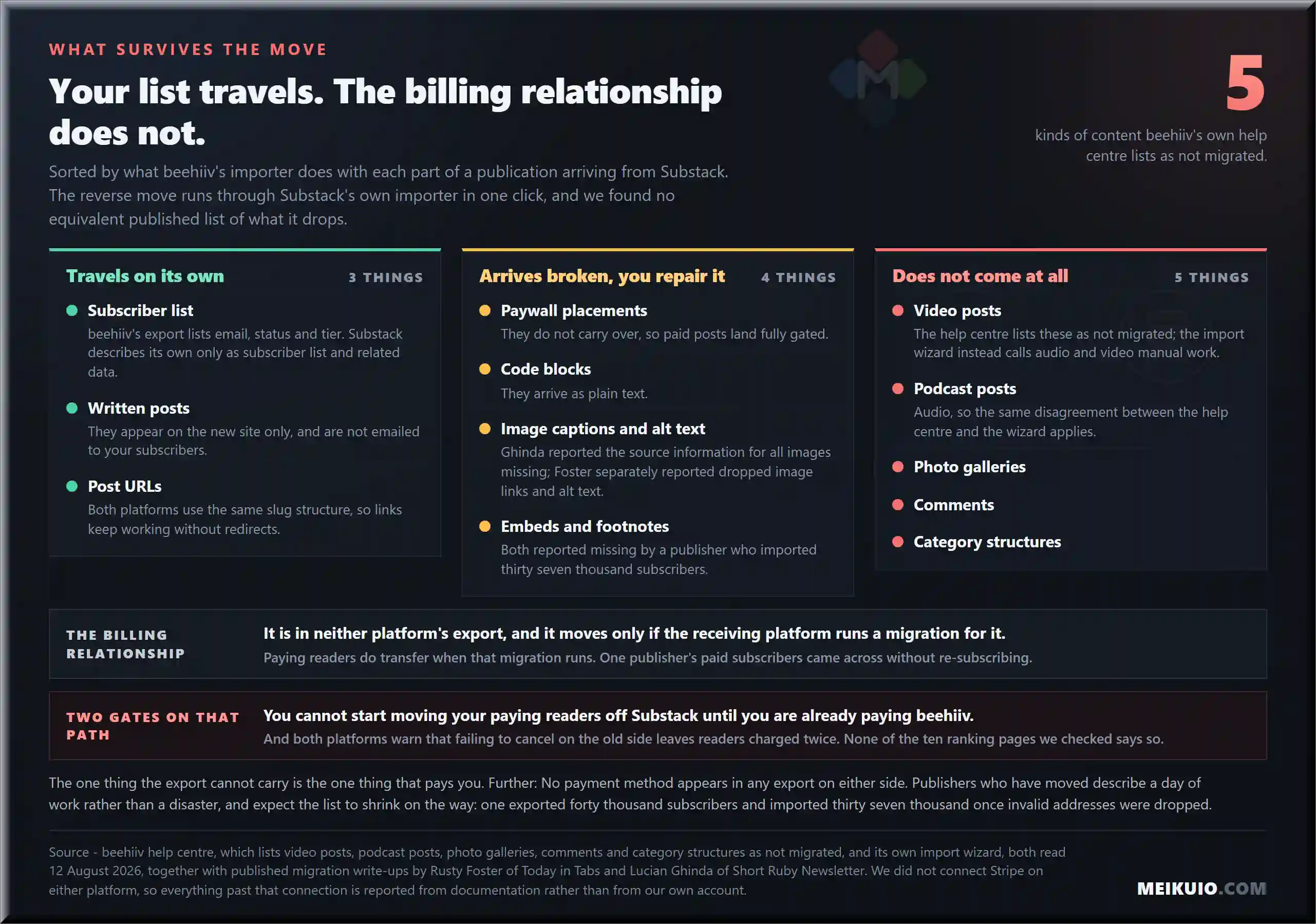
What arrives, what arrives broken and what does not arrive at all when a Substack publication imports into beehiiv.
Where each rate is actually written down
Anyone running the beehiiv vs Substack numbers eventually goes looking for the rate in writing, and it is harder to find than it should be on both sides. We counted the places a Substack creator meets the question of what the platform takes, from the marketing pages through to the screen where payments get switched on.
Five places, and the complete answer appears in exactly one of them.
Two say nothing at all. The two that do speak round the figure to ninety percent using two different prepositions, and minus and after describe two different sums. The billing fee appears nowhere except the help centre, which is the page a creator is least likely to open before signing up.
beehiiv has the mirror version of the same problem. Its zero percent claim lives on marketing pages, and we could not find it stated in the same words anywhere on its support domain. Substack's is stranger still: the publisher agreement, the document that actually binds you, does not name a percentage at all. It says the revenue share is set between you and Substack when the account is registered, and that revenue share payments are non-refundable.
Neither company prints its headline rate in the document that obliges you to pay it.
Two live Substack help pages disagree with each other on the billing fee as well, one saying 0.5 percent and one saying 0.7. The second page dates its own figure to July 2024 and explains that the 0.5 rate was grandfathered for existing creators until 30 June 2025. That makes the lower number the expired one, and the other page out of date. We hit the same class of problem when we priced what a website builder's checkout really charges, and the fix is the same: read the page that explains its own history, not the one that repeats a figure.
None of this is unique to newsletters. Working out what a tool bills for, before working out what it costs, is the recurring job in this category, and it is exactly what we had to do to work out what social schedulers bill you for across fifteen products.
Deliverability and the address your mail comes from
Email that does not arrive is not a pricing problem, and the two platforms are unusually far apart here. beehiiv publishes numbers. It treats a spam complaint rate at or under 0.10 percent as acceptable and 0.30 percent or higher as a problem. High rates can trigger deferrals or blocking, and direct abuse complaints can lead to suspension. It offers shared and dedicated sending addresses, and requires a dedicated one above roughly 700,000 emails a day per publication.
Substack publishes no equivalent thresholds we could find, and it also fixes the address your mail comes from. Its help centre states that newsletters are always sent from an address at substack.com, that changing your custom domain does not change this, and that there is currently no option to customise the sending address. For a publication that wants its own sending reputation, that is a hard limit rather than a setting.
Note
Custom domains work on both platforms for the website your readers visit. The difference described here is the envelope, not the address on your site.
Who owns what you wrote
Both companies open with the same sentence in their terms: you own what you create. Substack's terms say your original content remains yours, including your publication and your subscriber list. beehiiv's say the same thing and add that it makes no claim to own it.
The licences underneath differ, and the difference is worth ten seconds of a founder's attention. Substack's terms describe the licences you grant as royalty-free, perpetual, irrevocable and worldwide, and its publisher agreement adds a sublicensable, transferable right to market your publication and use your name and logo in doing so. beehiiv calls its licence limited, also sublicensable and worldwide, and states plainly that you keep the right to have your content removed from the service.
Ownership and licence are separate questions, and both companies answer the first one generously. On the second, one grants a permission that does not expire and the other grants one you can end by deleting the post.
Who is the seller, and who owes the tax
Neither platform describes itself as the merchant of record, and the phrase does not appear in either set of terms. What both do state, in near-identical language, is that you are responsible for all applicable taxes on your publication, including sales and value added taxes. Substack adds that its Stripe Tax integration can calculate tax at the point of sale. Once you pass a threshold in a country or a US state, you have to register with that authority yourself before tax can be added.
Read together, both arrangements point the same way: the creator is the seller and the platform processes the payment. That is an inference from the documents rather than a quotation from them, and any team selling across borders should treat it as a question for an accountant rather than a settled fact from a comparison page.
The third option neither page mentions
Every beehiiv vs Substack page starts by assuming the answer is one of the two names in the title. There is a third class, and it changes the arithmetic more than either platform does. Ghost runs as hosted software or on your own server, takes no share of subscription revenue in either form, and prices its hosted tiers by member count. Kit and Buttondown sit in similar territory with simpler pricing and smaller networks; if you want a complete breakdown of what each competitor charges, our guide to Substack alternatives in 2026 maps the revenue share across seven platforms.
Below that sits infrastructure rather than publishing: self-hosted senders such as Listmonk, or an API-first service where you pay per email and build the front end yourself. Both remove the platform fee entirely and replace it with engineering time, which is a real cost that does not appear on any pricing page.
This class sits in a blind spot with a financial cause. Guides funded by referral commissions have no reason to recommend software that pays nothing for the recommendation, which is why the free and self-hosted options are usually missing from the comparison entirely. We ran into the identical gap while checking a category from the position of not selling any of it, and the open-source entries were the ones nobody had ranked.
Use this as a filter, not a shortlist
The point of naming these is to test whether the question is right, rather than to rank them here. If your publication has no paid tier and no plan to add one, the entire fee comparison stops mattering, and the choice comes down to where your readers already are.
How to choose
The rule is short. Multiply beehiiv's annual price at your list size by ten. If your yearly subscription revenue is below that, Substack costs less. If it is above, beehiiv costs less, and the gap widens every month you grow.
Applied to real teams, the beehiiv vs Substack answer comes out differently at each end of the range, which is why a single winner would be useless here.
If a single verdict is wanted anyway, here it is, and it is not evenly split. For a publication that is not yet earning, Substack is the cheaper and lower-risk starting point, and the network is an asset rather than a slogan. For everyone past the crossover, beehiiv wins on money, and more publications are past it than they think: at 25,000 subscribers the line sits at 1.2 percent paying, and ordinary paid conversion runs in the low single digits. A mid-sized paid newsletter that has never run the sum is probably already losing money by staying.
What each one is better at is easy to state. Substack is better at getting a publication its first thousand readers and at letting a team find out whether anyone will pay without spending anything to ask. beehiiv is better at everything that happens after the money starts, from segmentation and automations to selling advertising, and it does not take a growing cut of the result.
The same question sits underneath every tool a content team buys, which is why our advice on what social media schedulers actually cost ends in the same place: count the unit you are billed on before you compare the prices.
How we checked this
Every price here was read from the vendor's own live page on 12 August 2026, at all nine subscriber settings and in both billing modes, rather than taken from a summary. The effective rates come from running Substack's own calculator across all 54 combinations its dropdowns allow and matching the results to a formula. We opened an account on each platform to see what is gated, and we did not connect Stripe or buy a plan, so anything past that point is reported from documentation and marked as such.
We also read the field. The first ten organic results for beehiiv vs Substack, read on 12 August 2026, were checked against nine specific questions, and a check counts only where the page states the figure itself rather than leaving it to be inferred, and the results are worth publishing because they explain why this article is mostly arithmetic.
Six pages carry referral links and five state a relationship in their text, but only four do both, so two of the six say nothing on the page itself. Of the three pages that mention the recurring billing fee, the two that put a number on it disagree with each other, repeating the same 0.5 against 0.7 conflict that exists between Substack's own help pages. The field inherited the vendor's contradiction.
Each row counts pages stating the fact explicitly; rows overlap and do not identify the same publications. Four pages both carry and disclose referrals; two of six carrying links disclose nothing in page text. Two pages putting a number on billing repeat the source’s conflicting 0.5% and 0.7% figures.
None of the ten ranking pages we audited answered the four reader questions this article is built on.
There is a financial reason for the pattern. beehiiv runs a partner programme that pays fifty percent of referred revenue for twelve months at the entry tier, with higher rates further up. The referred reader gets a fourteen-day trial plus twenty percent off for three months. That explains the discount codes scattered through the ranking pages: they are a standard part of the referral link rather than deals individual reviewers negotiated. Substack has no comparable commission programme that we could find on its own surfaces.
How central that channel is shows up in an unlikely place. When beehiiv asks a new user how they heard about it, "Affiliate Partner" sits in the list as its own answer, next to YouTube and conferences. The partner dashboard is in the top navigation of every account from day one, before a single post exists.
The correlation is strong and it is not absolute, which matters. Most pages carrying a referral link conclude in beehiiv's favour, but one of them gives the win to Substack for small and free newsletters, so the incentive shapes the field without dictating every page in it. Vendor-funded rankings are a structural feature of this category rather than a scandal, and we found the same thing when we counted who writes the results for a scheduling category where every ranking was written by a vendor.
What we could not check
We did not connect Stripe on either platform, so live tax settings, real payout timing and the paid tier editor sit outside what we verified. The migration accounts quoted here are public write-ups by the publishers themselves rather than tests we ran. Substack's network figure is the company's own, with no independent measurement available.
Reading a platform's own rules before trusting a summary of them is the habit that makes these pieces work, and it is the same one that produced our findings on what a platform's own rules actually allow.
Field notes
- The field: ten pages ranking for this phrase, checked against nine questions. None worked out where the two pricing models cross, printed five or more rungs of the nine-rung price ladder, warned that a botched migration can bill readers twice, or said what does not survive the move. Six carry referral links, five state a relationship in their text, and only four do both.
- beehiiv's ladder: nine subscriber settings. The Scale plan billed yearly runs from 517 dollars at 1,000 subscribers to 3,474 dollars at 100,000. The free Launch plan covers up to 2,500 subscribers and cannot take paid subscriptions at all.
- What Substack keeps: four deductions, not three. Ten percent to Substack, 2.9 percent plus thirty cents to Stripe, and a Stripe billing fee of 0.7 percent that its own calculator leaves out. The effective rate runs 19.6 percent at five dollars a month and 14.0 percent at seventy five.
- The crossover: the two cost the same when subscription revenue reaches ten times the annual plan fee, which is 8.7 percent of a 1,000-subscriber list paying, 1.2 percent at 25,000 and 0.6 percent at 100,000. Because the ladder is bracketed, one subscriber past a boundary lifts the requirement to 12.2 percent.
- What a migration drops: beehiiv's help centre lists video posts, podcast posts, photo galleries, comments and category structures as not migrated, and its tool for importing paid subscriptions redirects to the Scale plan paywall. Both platforms warn that failing to cancel on the old side leaves readers charged twice.
- Dated change: Substack launched a curated sponsorship programme in June 2026, open at 100 paying subscribers. beehiiv's ad network needs a paid plan, Scale or above.
- Sources: vendor pricing and help pages read on 12 August 2026, at all nine subscriber settings and across all 54 combinations of Substack's own calculator. Stripe was not connected on either platform, so anything past that connection is reported from documentation.
Frequently Asked Questions
Does Substack really take only 10%?
Ten percent is Substack's share, and it is not the whole deduction. Its own help centre lists a card fee of 2.9 percent plus thirty cents per transaction and a recurring billing fee of 0.7 percent on top. On a five dollar monthly subscription the total comes to 19.6 percent, and on a seventy five dollar one it falls to 14 percent, because the fixed thirty cents weighs less on larger payments.
Is beehiiv free if I have a small list?
Yes, up to 2,500 subscribers on its Launch plan, which includes the website, the editor, analytics and access to its recommendation network. What it does not include is any way to charge readers. For a free newsletter under that ceiling, beehiiv costs nothing and the comparison with Substack comes down to features rather than fees.
Can I take paid subscriptions on beehiiv's free plan?
No. Paid subscriptions start on the Scale plan, which costs from 517 dollars a year at the smallest list size. We confirmed this from inside an account: even while trialling the features of the top Max tier, the paid subscriptions screen shows an upgrade banner and states that launching a tier requires the Scale plan.
What happens to my paid subscribers if I switch?
They can move without re-entering a card, because the subscriptions live in Stripe rather than in the platform. The receiving side runs the transfer, and you have to cancel or pause on the old side or readers get billed twice. Set aside a working day, expect a handful of accounts to need manual repair, and do it in a quiet week.
Which one is cheaper if nobody pays me yet?
Substack, without qualification. It charges nothing to publish at any list size, so a free newsletter costs zero there and costs the plan fee on beehiiv once the list passes 2,500. The zero percent take rate only becomes worth buying when there is revenue for it to apply to.
Does beehiiv or Substack own my subscriber list?
You do, and both say so in their terms. Both let you export the list at any time, and neither export includes payment methods, which stay in Stripe. Ownership of the list is not the constraint on leaving; the billing relationship is.
Can I use my own domain on both?
Yes for the website, and only on beehiiv for the email itself. Substack states that newsletters are always sent from an address at substack.com and that there is no option to change it, whatever domain your site uses. If your team needs its own sending reputation, that decides the question on its own.
Which one brings subscribers I do not already have?
Substack is built around that, and it reports the result: the first tab of its stats section asks what percent of your subscribers came from its network. The company says the network drives more than half of new free subscriptions, though that figure is its own and unaudited. beehiiv sells the same outcome instead, through a marketplace where you set a price per subscriber and pay only when someone subscribes.
What is the cheapest way to run a paid newsletter if I skip both?
Self-hosted software with your own sending provider, which removes the platform fee entirely and replaces it with maintenance. Ghost is the usual middle ground, taking no revenue share whether you host it yourself or pay for its hosted tiers. The saving is real and the cost moves to someone's time, which is the same trade we found when ranking tools by what they do not charge you for.
My Take
If a team asked me to sign off on this today, I would start them on Substack and set a calendar reminder rather than a preference. The reason is not that it is better software, because on most days it is not. It is that the beehiiv vs Substack decision is cheap to reverse in one direction and expensive in the other, and paying a share of revenue you do not yet have costs nothing while you find out whether readers will pay at all.
The line I would put in the budget is the reminder itself. Once annual subscription revenue passes ten times the beehiiv plan price for your list size, the revenue share stops being an acquisition cost and becomes a tax on work the platform is no longer doing, and that is the quarter to move. I would budget a week for the migration rather than an afternoon, I would do it before the archive gets any larger, and I would not let anyone approve either platform until they can say out loud what percent of the list is actually paying.