RFC 9340, the document that lays out the architecture of a quantum internet, contains this sentence: “A quantum node that is able only to communicate classically with another quantum node is not a member of a quantum network.” I read it three times.
- What the people writing the protocols actually mean
- Three different things share one name
- The number nobody prints
- What actually moves down the fibre
- Three things almost everyone gets wrong
- What two agencies say about quantum key distribution
- The asterisk on every "2,000-kilometre network"
- What quantum key distribution hardware you can actually buy
- Who prints numbers, and who prints adjectives
- The rollup nobody covered
- What actually protects you right now
- The ones that quietly stopped
- What's actually running in the United States
- The thing that changed this year
- So when will there be a quantum internet?
- Frequently Asked Questions
- Is the quantum internet the same thing as quantum key distribution?
- How fast is a quantum internet connection?
- Will the quantum internet replace the internet I use now?
- Is quantum encryption really unhackable, as vendors claim?
- What is a trusted relay, and why does it matter?
- When will the quantum internet be available?
- Should I buy QKD hardware to protect my organisation?
- Does a quantum link need its own dedicated dark fibre?
- How much does quantum key distribution hardware cost?
- Is quantum internet the same as Quantum Fiber, the internet provider?
- My Take
The people who write the protocols just told you that what is sold as a quantum internet, which in almost every case is quantum key distribution, isn’t one.
Quick housekeeping first, because half the people reading this arrived by accident. If you typed “quantum internet” looking for your broadband bill, you want Quantum Fiber, the consumer brand AT&T picked up when it closed its purchase of Lumen’s mass-market fibre business in February 2026. That’s a different thing entirely, and nothing below will help you log in.
Everyone else: what follows is what’s actually installed, what it actually moves, and how fast. Every number here comes from a page I opened or a paper I read, quoted the way the source prints it. That turns out to matter, because the numbers are the part nobody prints.
Start with the name, because almost everything else follows from it. Quantum key distribution, shortened to QKD from here, is the only part of this field you can buy today. It uses single photons to let two ends agree on a secret number, and ordinary encryption then uses that number to protect ordinary traffic. Quantum key distribution produces a key. It does not produce a network, and it does not carry your data one metre.
I counted. The top explainer on this topic runs 1,269 words and mentions a key rate zero times. The second runs 2,566 words, says “QKD” thirteen times, and mentions a rate zero times. The page belonging to the research institute whose own staff co-authored that RFC runs 384 words and contains no numbers at all. Distances get printed constantly. The speed that goes with the distance never does.
More Read

What the people writing the protocols actually mean
RFC 9340 came out of the Internet Research Task Force in March 2023, written by researchers at QuTech in Delft, Keio University and the University of Naples. It’s the closest thing this field has to a founding text, and it is unusually blunt about what does and doesn’t count.
“A quantum network is defined as a collection of nodes that is able to exchange qubits and distribute entangled states amongst themselves. A quantum node that is able only to communicate classically with another quantum node is not a member of a quantum network.”
Read that against what’s commercially available. Quantum key distribution, the product every vendor in this space actually sells, uses single photons to agree a secret key, then hands that key to ordinary encryption hardware. The key is classical. The data is classical. The photons never carry your traffic.
The same RFC says so directly: “QKD only provides increased security for the distribution of symmetric keys. The handling, manipulation, sharing, encryption, and decryption of data will remain entirely classical, limiting the benefits to privacy that can be gained from using a quantum network.”
And it draws the boundary in one clause: “it is the transmission of qubits that draws the line between a genuine quantum network and a collection of quantum computers connected over a classical network.” So a national QKD backbone, by the standard set in the architecture document, is a collection of boxes connected over a classical network. Impressive engineering. Not a quantum internet.
The document that defines the architecture of a quantum internet excludes, by its own definition, the only version of it you can currently buy.
Three different things share one name
Most confusion here comes from grouping this field by distance, which is the wrong axis. A 1,200-kilometre satellite link sounds more advanced than a 20-kilometre city link, and often it’s the reverse. Distance measures how well someone fought optical loss. It says nothing about what the link can do.
Group it by what physically travels instead, and the field splits into three layers that don’t do the same job at all.
Keep that third row in mind, because the whole vision depends on it, and the people building the world’s largest quantum network wrote its status down most plainly. In the January 2021 paper describing China’s integrated network in Nature, the authors state: “Quantum repeaters could in principle provide a viable option for such a global network, but they cannot be deployed using current technology.”
They built the biggest thing in the field. They also said the missing piece is still missing.
The number nobody prints
Here’s the table this topic has needed for years. Speed and distance in the same row, each from its own source, each with the caveat that belongs to it. I’ve kept every figure the way the paper or the product page prints it.
Bits per second, converted from printed units without rounding. Different distances and losses are explicitly labelled; no same-condition ranking. Satellite and Tokyo examples use trusted relays; entanglement example does not. Classical traffic on the Chicago fibre was 800 Gbit/s in July 2026: it is ordinary traffic, not a QKD key rate, so it is outside this axis. At 0.12 bit/s, one byte takes approximately 67 seconds.
Every published key rate on one logarithmic scale, from 0.12 bits per second to Toshiba's 300 kb/s, with the 800 Gbit/s classical channel from the Chicago fibre as the scale anchor.
Do the arithmetic on the second row. At 0.12 bits per second, the rate published in Nature in June 2020, one byte takes about 67 seconds. A single text message would take most of a day. It matters because of the caveat in its own abstract: the team achieved it "without the need for trusted relays," which none of the faster numbers in that table can say.
The 2025 microsatellite result looks much better until you convert it. 1.07 million bits per satellite pass works out to roughly 134 kilobytes. That's the entire harvest of one overhead pass, about the size of one modest photo, and it isn't a photo. It's key material.
Don't average these
These figures measure different experiments with different protocols, and combining them produces nonsense. 0.12 bits per second is entanglement-based distribution with no trusted node in the path. 47.8 kilobits per second is a decoy-state satellite link feeding a ground network that does use trusted nodes. 1.07 million bits is a per-pass total, not a rate. Decoy-state means faint laser pulses on a link that needs trusted relays to go far; entanglement-based means shared photon pairs that need no relay at all. Any article that averages them, or adds the fibre kilometres to the satellite kilometres to produce one triumphant number, has stopped describing the technology.
A hard floor sits under all of this, and it was proved. A 2017 paper in Nature Communications established what the authors call "the ultimate rates that are reachable without quantum repeaters," and states that they "exactly determine the fundamental rate-loss tradeoff affecting any protocol of quantum key distribution." Translated: without repeaters, key rate falls off with distance in a way no engineering fixes. You can build a better box. You cannot argue with the channel.
What actually moves down the fibre
Your email is not going over a quantum link. Neither is your video call, your bank session or anything else you'd think of as data. On a QKD link the photons exist to produce a shared random number, and once that number exists the photons have done their entire job.
The distinction has a name in RFC 9340: "a classical data plane carries user data but a quantum data plane provides the resources for the user to transmit user data themselves without further involvement of the network." The quantum side hands you a capability. The classical side still does the carrying.
One honest exception exists, and it belongs to the layer that isn't in production. When two quantum processors teleport a state between them, the state itself is the payload, and that genuinely is quantum information moving across a link. That's the thing the RFC calls a real quantum network. It exists between laboratory nodes and across a few city fibres, and nowhere else.
One more dependency almost never gets mentioned. Quantum protocols need a parallel classical channel running alongside them, and the RFC notes that protocols "may impose requirements on the classical channel, e.g., to be authenticated." Cut the classical channel and the quantum link stops. The unbreakable physics rides on top of an ordinary network connection that has to be there and has to be trusted.
Three things almost everyone gets wrong
These come up in every comment thread under every quantum networking story, and the marketing actively encourages two of the three.
It sends information instantly. Entanglement is a pair of photons whose measurements stay correlated however far apart they are, and it produces matching results at both ends the moment either side measures, which reads like instant messaging and isn't. Measuring your half gives you a random outcome. To learn anything from it, the other party has to tell you what they measured, and that message travels over a normal channel at normal speed. The correlation is instant. The information is not, and no arrangement of the hardware changes that.
A dropped packet just gets resent. Classical networks work because data can be copied. A router holds a copy, the copy goes out, and if it's lost the copy goes out again. Quantum states can't be copied at all, which is the property the security rests on, and it costs you the retry. A lost photon is gone. There's no buffer holding a spare, and this is precisely why quantum memory matters so much in the third layer: without something that can hold a state and wait, multi-hop routing has nothing to work with.
The word "unhackable" describes the system. It describes one channel, under stated conditions, assuming the equipment behaves as specified. Attackers don't queue up at the fibre. They go for the detector electronics, the software around the key, the machine storing it and the people with access to the relay room. NSA's page puts the general form of this bluntly: security here is "highly implementation-dependent rather than assured by laws of physics." A perfect channel between two imperfect endpoints is an imperfect system.
The same pattern shows up whenever someone sells a security product on a single strong property. The property is real, the marketing extends it over the whole system, and the parts it never covered stay uncovered. You see the identical move in consumer security, where monitoring products advertise what they watch and stay quiet about what they don't. The physics here is better than the marketing. It's the coverage claim that's oversold.
What two agencies say about quantum key distribution
This is the part I expected to find hedged, and it isn't hedged at all. The US National Security Agency publishes a page on quantum key distribution and what it calls QC, its shorthand for quantum cryptography, and the conclusion is a single sentence with no room in it. The reasons follow further down the same page, and further down here.
"For all of these reasons, NSA does not support the usage of QKD or QC to protect communications in National Security Systems, and does not anticipate certifying or approving any QKD or QC security products for usage by NSS customers unless these limitations are overcome."
The same page says NSA "views quantum-resistant (or post-quantum) cryptography as a more cost effective and easily maintained solution than quantum key distribution." Britain's National Cyber Security Centre reaches the same place in fewer words: "The NCSC will not support the use of QKD for government or military applications," and "PQC is the best mitigation to the threat to cryptography from quantum computers."
Now put that against what the sellers print. Singtel's quantum-safe network page describes QKD as "based on the laws of quantum physics that current or future mathematical algorithms cannot break, making it inherently secure." NSA's page contradicts that sentence directly.
"Thus, security of QKD and QC is highly implementation-dependent rather than assured by laws of physics."
Those two sentences are about the same technology. One is on a page trying to sell it. The other is on a page from an agency that would benefit more than anyone from it working, and has decided it doesn't want it.
NSA lists specifics rather than vibes. QKD "requires special purpose equipment," and that requirement "requires users to lease dedicated fiber connections or physically manage free-space transmitters." Networks "frequently necessitate the use of trusted relays, entailing additional cost for secure facilities and additional security risk from insider threats." And a detail that undercuts the whole marketing frame: "QKD does not provide a means to authenticate the QKD transmission source. Therefore, source authentication requires the use of asymmetric cryptography or preplaced keys to provide that authentication."
That last one deserves a plain reading. The physics stops an eavesdropper from copying the key. It tells you nothing about who's on the other end. To know that, you fall back on the same conventional cryptography QKD was sold as replacing.
The field pushes back, and the pushback is published rather than muttered. Renato Renner and Ramona Wolf wrote a direct reply in 2023 titled "The debate over QKD: A rebuttal to the NSA's objections," and their summary of it is careful: "some of the points raised are unjustified, whereas others are problematic now but can be expected to be resolved in the foreseeable future." A team at TerraQuantum published its own response the same year, disputing the agency's claim that QKD is inferior to quantum-resistant cryptography.
Read that Renner and Wolf line again, because it's the most honest sentence anyone in this argument has written. Some objections are wrong. Others are real right now. Nobody on either side is claiming the limitations are imaginary. The disagreement is about how long they last, and that's a much narrower argument than the marketing on either side suggests.
The asterisk on every "2,000-kilometre network"
China's network is the one that gets cited whenever somebody wants to argue the quantum internet has already arrived somewhere. The January 2021 Nature paper describing it reports "more than 700 fibre QKD links and two high-speed satellite-to-ground free-space QKD links," reaching a node "more than 2,600 kilometres away" for a total span of 4,600 kilometres. Those numbers are real and they're enormous.
The sentence that matters opens with four words most coverage drops: "Using a trusted relay structure, the fibre network on the ground covers more than 2,000 kilometres."
A trusted relay is a building where the key from one segment exists as plain classical data on a machine in a room. Inside it, the key arriving from one segment is turned back into ordinary bits, held in ordinary memory, and re-encrypted for the next hop. Whoever controls the room controls the key.
So the protection across a 2,000-kilometre backbone isn't physics end to end. It's physics on each segment plus locks, guards and staff vetting at every junction in between. That's a real security model and governments use it deliberately, because it works today and quantum repeaters don't. But it's the same model as any classically encrypted network with secured facilities, and it's the exact thing the marketing language promises to eliminate.
It's also why that 0.12 bits per second result got published in Nature at all. The rate was terrible. The achievement was the phrase attached to it: "without the need for trusted relays." Buy the fast version and you're trusting rooms. Buy the trustless version and you're moving a byte a minute. That trade is the actual state of the art, and you'll rarely see it stated as a trade.
NSA's page names the cost of those rooms without any diplomacy: trusted relays entail "additional cost for secure facilities and additional security risk from insider threats," and the agency adds that this "eliminates many use cases from consideration." That's a procurement judgement rather than a physics one, and it's the judgement most buyers never see, because the vendor deck stops at the map with the long line drawn across it.
So when you next see a network described by its length, ask one question before anything else. How many buildings does the key sit inside on the way? If the answer is more than zero, the length is a logistics achievement rather than a security one, and you should read it the way you'd read any other number that depends on somebody else's premises staying intact.
What quantum key distribution hardware you can actually buy
A real market exists here, with rack units, connectors and specification tables. It's a market for quantum key distribution appliances rather than for anything that would satisfy RFC 9340. Here's what the vendors themselves print, quoted from their own pages.
Toshiba's page is worth a second look, because it does something quietly instructive. The prose promises "metro-scale transmission distances of 80 km+." The specification table on the same page lists Maximum Range as "90 km+." Two numbers, one screen, and they don't match, because one is a marketing sentence and the other is an engineering row. Nobody's lying. The page just has two voices.
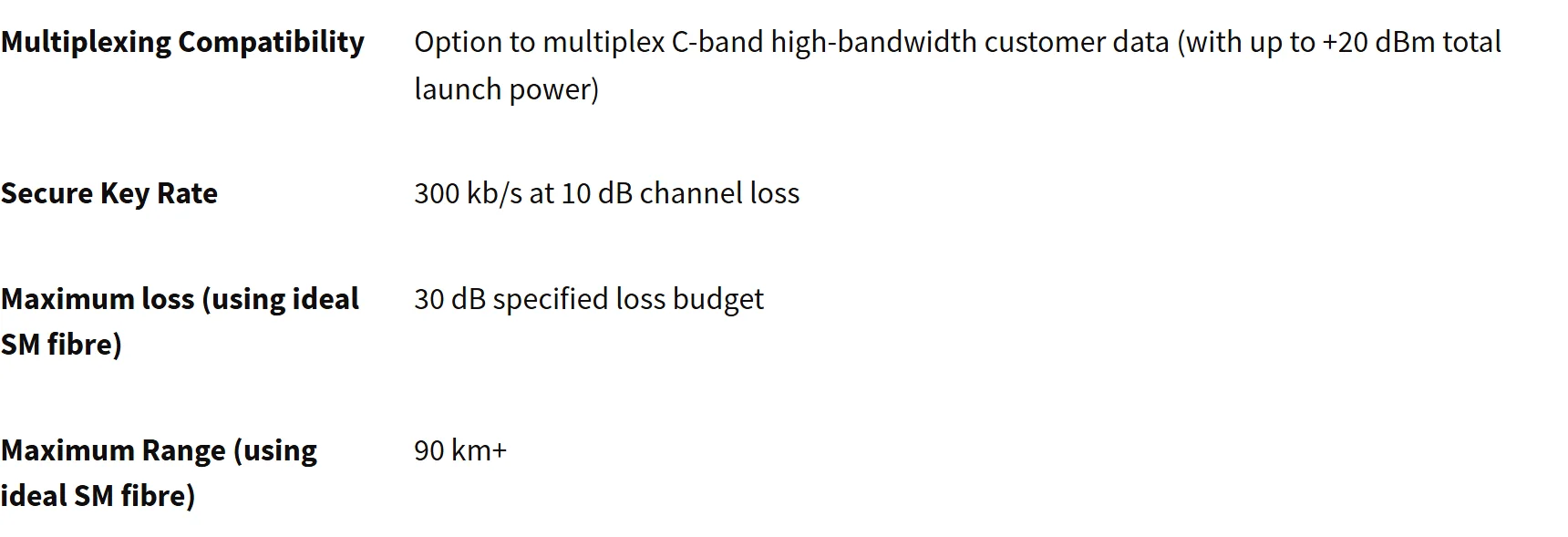
The specification rows on Toshiba's multiplexed system page, read in September 2026: the rate is stated at a channel loss, and the range is a separate figure.
LuxQuanta is the case I keep thinking about. Its page prints a distance three different ways and never prints a key rate. Distance is the flattering number here. Rate is the one that decides whether the box is useful. Guess which one made it onto the page.
Notice what these specifications have in common, because it changes how you read them. Every rate is quoted at a stated channel loss rather than at a distance: 300 kb/s at 10 dB, 2.2 kb/s at 13 dB. Loss is what the photons actually experience, measured in decibels, where 10 dB means a tenth of the light arrives. Standard fibre costs roughly 0.2 dB per kilometre, which is how a loss figure becomes a distance on the same page. Read Toshiba's two numbers that way and they stop conflicting: 300 kb/s is the rate at 10 dB, about 50 kilometres of fibre, and 90 km+ is the furthest the box reaches, at a rate the page doesn't print. Quote a rate without the loss beside it and the number means nothing at all, because you can produce any rate you like by shortening the link.
That's the second reason the honest pages look worse than the vague ones. A vendor printing "2.2 kb/s at 13 dB" has told you the ceiling of its own product. A vendor printing "secure reach to 100 km" has told you nothing you can hold it to, and reads better while doing it.
None of these boxes does anything from the second or third layer. They don't route entanglement, they don't hold a quantum state, and they can't connect two quantum processors into one machine. They generate key material for classical encryption, in a 19-inch rack unit, at a rate their own tables print. That's a real product solving a real problem. It just isn't the product the category name promises.
One more thing missing from every page I opened, and it's the thing you'd ask first about any other piece of hardware. Not one of them prints a price. Toshiba, ThinkQuantum, LuxQuanta, Qunnect, Singtel: five vendors and operators, full specification tables on two of them, and no figure anywhere for what a unit or a link costs. Numbers exist in the trade press, but a number in an article is not a number on a price list.
Take that at face value rather than as an oversight. Equipment sold by quotation, to buyers who arrive through a sales conversation, doesn't need a public price, and enterprise networking hardware often works this way. But it does mean nobody outside the process can compare cost against the rate in that specification table, which is the one comparison that would tell you whether any of this is worth deploying. You can find out what it does. You cannot find out what it costs.
Who prints numbers, and who prints adjectives
Once you've read enough quantum key distribution product pages, the field sorts itself into two piles, and the split doesn't run along the line you'd expect. It isn't big companies versus small ones, or research versus commercial. It's whether the organisation expects to be checked.
The ones that publish figures sell to engineers who will measure the box on arrival. Toshiba prints a rate at a stated channel loss, which is the only way that number means anything. ThinkQuantum prints a whole table including the depth of the chassis in millimetres. Both are inviting a test.
The ones that publish adjectives sell to buyers who won't. "Inherently secure" cannot be measured, which is what makes it safe to print.
One page moved between piles while I was writing this. In August, Qunnect's product page carried no figures at all and described the company as a "global leader in developing robust, field-ready quantum hardware." By September the page had been rebuilt around a product called Carina, and it now prints "80 million entangled pairs per second" and "99.5% fidelity." That is the right direction. It is also a reminder that the date on a claim matters as much as the claim, because the August version of this paragraph would have been wrong within three weeks.

Qunnect's rebuilt Carina page in September 2026, with the three figures that the August page did not carry.
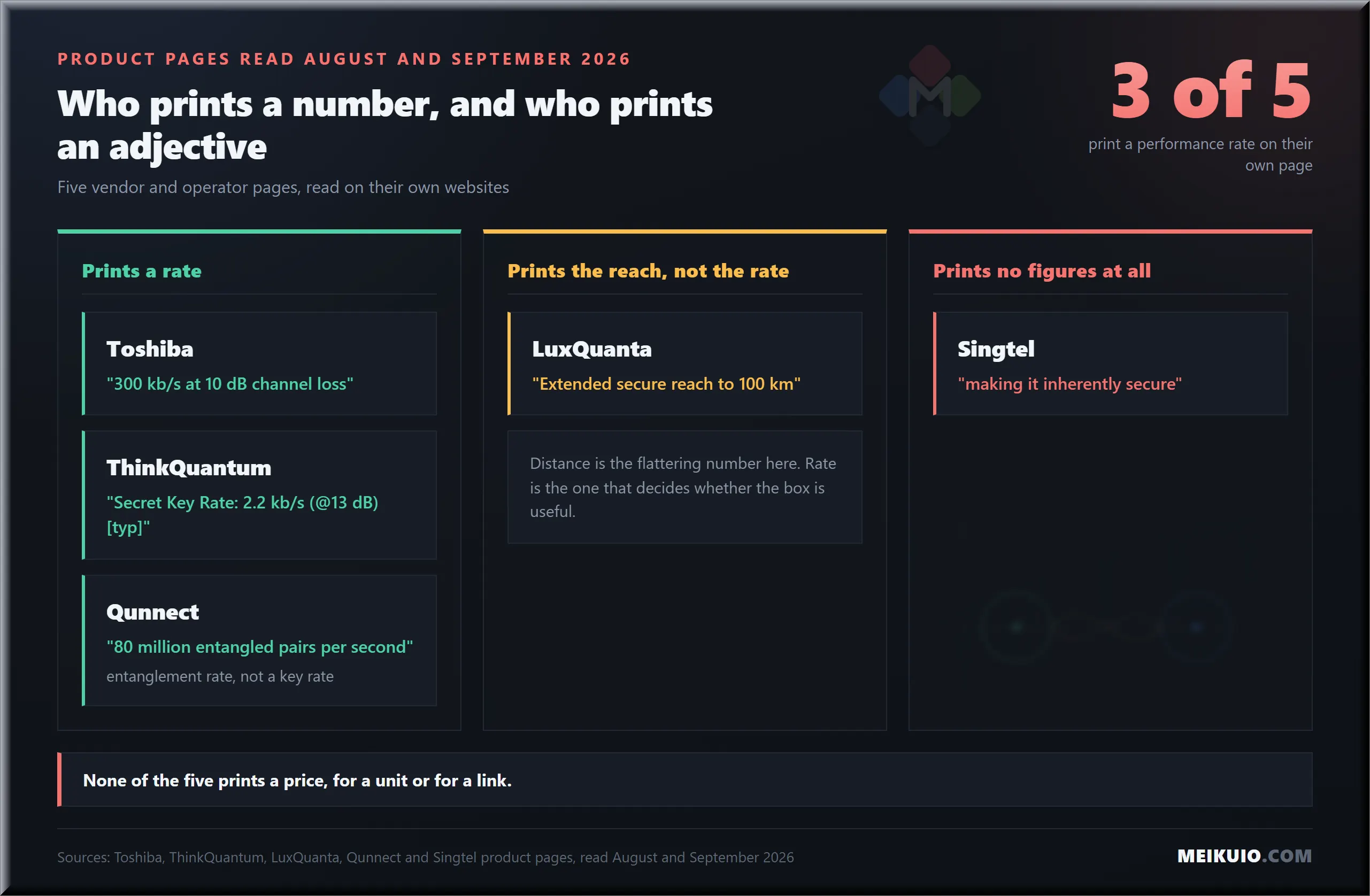
Five vendor and operator pages sorted by what they print: three print a performance rate, one prints reach without a rate, one prints no figures, and none prints a price.
Use it as a filter. Open any quantum security vendor's page and look for a rate with a loss figure beside it. If the rate is missing, you're not reading a specification. You're reading a brochure that has decided you won't ask. It's the same test that separates a real product page from a placeholder anywhere else in hardware, and it works here better than usual, because in this field the honest number is embarrassing and the flattering one isn't.
The rollup nobody covered
While the explainers were explaining entanglement, the vendor map redrew itself. In May 2025 IonQ, an American quantum computing company, completed its acquisition of a controlling stake in ID Quantique, the Swiss firm that has been one of the two or three names in commercial QKD since the technology had a market at all. IonQ had already bought Qubitekk, a US quantum networking company, before that.
None of the explainer pages I measured mention this. It's the kind of change that decides what gets built. A quantum computing company buying the key-distribution vendors is a bet that the two layers converge, and it means a boardroom with a different set of priorities now sets the roadmap for hardware a European bank installs.
If you follow the money side of this field, the same consolidation logic runs through the listed names; read it against what quantum computing stocks are actually priced on before treating any of it as a signal about the physics. Corporate structure and channel loss are unrelated. Only one of them shows up in press releases.
Be precise about what an acquisition does and doesn't tell you. It says a buyer believes the assets are worth owning. It says nothing about whether the boxes got faster. Frontier technology attracts this pattern reliably, and the reporting around it tends to treat ownership news as progress news, which is how you end up with excited coverage of companies whose products haven't changed, and with retail investors trying to buy into private companies that have never sold them a share.
What actually protects you right now
If you came here worried that a quantum computer will eventually read your saved messages, the answer is not quantum key distribution. It's post-quantum cryptography: ordinary software algorithms designed to resist quantum attack, deployed over the internet that already exists, at close to no marginal cost. The worry has a name, harvest now, decrypt later: traffic recorded today and read once a large enough quantum computer exists. Post-quantum cryptography addresses it inside the same software that already protects your connections, the TLS layer behind HTTPS and most VPNs, which is why for a small business it arrives through ordinary updates to a browser, an operating system or a VPN client rather than through anything you buy.
That's the substance of both agency positions. NSA calls it "more cost effective and easily maintained." NCSC calls it "the best mitigation." Neither is making a statement about physics. They're making a statement about deployment: one option is a software update, the other needs leased dark fibre, special purpose hardware and secured buildings at every relay.
The two aren't rivals in the way coverage frames them. They sit at different layers and rest on different assumptions, and the published counter-arguments from the research side make exactly that point. But for the question most readers actually have, which is what protects the traffic leaving their own machine, there's no contest, because only one of the two is available to them at all.
It's a familiar shape. The protection that gets marketed hardest is rarely the protection that does the work, which is the same thing you find when you read the fine print behind consumer security products and discover how much of the cover is already free by law. Different industry, identical structure.
The ones that quietly stopped
Every field has a graveyard, and this one is unusually well documented because the projects were run by people who publish. Three cases, all confirmed in the organisations' own words.
Arqit. The British company launched with a plan to deliver quantum encryption keys from its own satellites, and the press covered it accordingly. Then it filed its annual report with the US Securities and Exchange Commission in December 2022, and the filing says: "In December 2022 Arqit updated its technology strategy to eliminate quantum satellites and the associated ground infrastructure from its core QuantumCloud product offering." The same document adds that Arqit "intends to sell (in part or in whole) its quantum satellite currently under construction," and that "if an agreement to sell the satellite cannot be reached Arqit will suspend construction of the satellite currently under construction and any further satellites."
There's one more line in that filing, and it's the one I'd frame. "Arqit previously referred to its technology as quantum encryption, however following innovations that resulted in improvements in its technology it is more accurate to describe it as symmetric key agreement." Symmetric key agreement is a software method for two parties to arrive at the same key, with no satellite and no photons involved. A company renaming its own core technology in a regulatory filing is about as clear a signal as this industry produces.
Worth sitting with, if you're ever the customer in one of these stories. The strategy changed in a document most buyers never open, and anything already installed on the old plan is now attached to a company doing something else. Hardware that depends on a vendor's continued interest has a failure mode that has nothing to do with the hardware, and it's the same failure mode that turns an expensive machine into a paperweight when the servers behind it go quiet.
SwissQuantum. Geneva ran a metropolitan quantum network across real telecom fibre and published the results in New Journal of Physics in 2011: "The network was installed in the Geneva metropolitan area and ran for more than one-and-a-half years, from the end of March 2009 to the beginning of January 2011." It did what it set out to do, which was test long-term reliability in a production environment, and then it ended.
The DARPA quantum network. The first one. A 2005 paper by the BBN team reports that it "became fully operational in BBN's laboratory in October 2003, and has been continuously running in 6 nodes operating through telecommunications fiber between Harvard University, Boston University, and BBN since June 2004." Six nodes, running through real fibre between real institutions, more than twenty years ago. It was a research programme and it concluded like one.
None of these are scandals. Research projects are supposed to end, and a company allowed to change its mind in public is behaving better than one that doesn't. The reason to list them is that coverage of this field keeps citing networks in the present tense years after they stopped, and the same habit produced buying guides still recommending kits that were discontinued long before the page was written. Nobody goes back to check.
Checking is easy and almost nobody does it. Every one of the three above published its own status: a filing, a journal paper, a project report. Ten minutes each. That's the same reason so many security tools recommended in current listicles turn out to have shut down, and it's why the date on a claim matters as much as the claim.
One I removed from this list while reporting: Tokyo. NICT's own pages say it has been operating the Tokyo QKD Network since 2010, covering an area within 100 kilometres of the city centre, at key generation rates around 100 kbps. It's the longest-running testbed in the world and it's still on.
What's actually running in the United States
Less than the funding announcements imply, and more than the sceptics do.
The clearest US result I could verify comes from a collaboration between Harvard and AWS, published on Amazon's own quantum computing blog in May 2024. They describe "a 35 km long link that can communicate and store quantum information for more than a second using a unique quantum memory: an atomic defect in diamond called the Silicon Vacancy Center," running through several neighbourhoods in Cambridge and Boston. Photons carrying quantum information travelled the loop and interacted with a memory at the far end, and the entanglement held for over a second.
Look at where that sits on the three-layer table. It's entanglement distribution, which is the second layer, but it's carrying a working quantum memory, which belongs to the third. What's missing is the rest of the third layer: the swapping between hops that would turn one link into a network. A memory on a city fibre is the hardest piece of the repeater problem showing up outside a laboratory, and it's still one link between two ends.
Note the date, though. It's from May 2024, and it's still among the most advanced field results anyone can point to. Two years is a long time in a field that gets written about weekly. This one moves more slowly than its press cycle.
The Department of Energy laboratories run the other US testbeds, around Chicago and between Brookhaven and Stony Brook. Both get described publicly in the same shape: a distance, a number of nodes, a milestone. Neither the announcements nor the coverage built on them carries a current secret key rate, and that omission matches every other layer of this field I've been through. Distance is announceable. Rate is not.
The gap between what gets announced and what's carrying traffic is the same gap that runs through the difference between systems running in production and systems that exist as demos, and through the fleet numbers behind autonomous driving claims. Announcements scale beautifully. Hardware doesn't.
A structural reason separates the US picture from China's, and it isn't only money. China built its network as infrastructure with trusted relay sites, which is an operational choice a state can make and then guard. The American testbeds went the other way, chasing entanglement distribution and quantum memory, which is the harder layer and the one with no shortcut. That's why the headline American result is 35 kilometres under Boston rather than 2,000 kilometres between cities. Different targets, not different budgets.
It also means the two programmes can't be ranked against each other with a single number, which is exactly what most coverage does. One built reach with rooms in the middle. The other built the thing that would eventually remove the rooms, and got it to work across three neighbourhoods. If you only count kilometres, you'll pick the wrong winner, in the same way that counting robot announcements gives you a completely different answer from counting robots actually doing jobs.
The thing that changed this year
For most of this technology's life the standard answer to "can it share a fibre with normal traffic" was no. Single photons are fragile, classical channels are loud, and NSA's page still lists leasing dedicated fibre as one of QKD's practical costs.
In July 2026, a Northwestern University team led by Prem Kumar, with Gina Talcott as first author, published a result in Optica Quantum that distributed entanglement across 24.4 kilometres of real municipal fibre between Evanston and downtown Chicago, at better than 94% fidelity, while that same fibre carried two classical channels running at 800 gigabits per second each.
Hold those two numbers next to each other. Eight hundred gigabits per second of ordinary traffic in one direction, and in the same glass, at the same time, a stream of entangled photons that carries no user data whatsoever. That contrast is the honest picture of where this technology sits.
Toshiba's commercial page makes the same point from the product side, describing how its multiplexed system "enables QKD signals to co-exist on fibre carrying multiple 10 Gb/s or 100 Gb/s classical data channels." So coexistence is real, it's shipping, and it removes one of the cost arguments against deployment. It doesn't touch the rate.
So when will there be a quantum internet?
Not on a date anyone can give you, and the reason is specific rather than vague. Quantum key distribution is already here and already shipping; the quantum internet is a different thing and is not. The quantum internet in RFC 9340's sense needs quantum repeaters, and the authors of the largest network ever built wrote in 2021 that repeaters "cannot be deployed using current technology." Nothing I could verify has changed that.
What you can watch for is a threshold rather than a headline. Here's the one I'd use: a working quantum repeater carrying a rate above the repeaterless ceiling, on real installed fibre, outside a laboratory, running long enough to publish uptime. That single result would make most of this article obsolete, and it's the only announcement in this field I'd treat as a change of state.
Until then the pattern holds. Quantum key distribution keeps shipping as commercial hardware with real specification tables and real limits. Entanglement links keep appearing under a few cities as research results. The gap between them stays open, and both keep getting reported under one name that fits neither.
For anyone waiting to buy something, there's a simpler answer: nothing on this page is sold to households, and nothing on it will be. The consumer end of networking hardware moves on its own schedule and its own rules, which is where you actually have decisions to make about what's legal to sell and worth putting in your home. Quantum links are infrastructure for organisations that lease dark fibre. If that isn't you, this is a story to follow rather than a purchase to plan.
And when the announcements do come, read them the same way I've read the pages here. Find the rate. Find the loss it was measured at. Find out whether a trusted node sits anywhere in the path. Three questions, and they'll separate a genuine result from a press release faster than any amount of background reading about entanglement. The field is not short of physics. It's short of numbers printed next to their conditions.
Field notes
- The definition: RFC 9340 (IRTF, March 2023) states that a node communicating only classically "is not a member of a quantum network"; QKD leaves handling and encryption of data "entirely classical".
- The rates: 0.12 bits per second over 1,120 km with no trusted relay (Nature 582, June 2020); 47.8 kbit/s average per satellite pass on a trusted-relay network (Nature 589, January 2021); 1.07 million bits per pass, roughly 134 kB (Nature 640, 2025).
- The ceiling: a 2017 Nature Communications result fixes "the ultimate rates that are reachable without quantum repeaters"; the builders of China's network wrote in 2021 that repeaters "cannot be deployed using current technology".
- The agencies: NSA "does not support the usage of QKD or QC" for National Security Systems and calls its security "highly implementation-dependent rather than assured by laws of physics"; NCSC "will not support the use of QKD for government or military applications".
- Commercial disclosure: Toshiba prints 300 kb/s at 10 dB and 90 km+; ThinkQuantum prints 2.2 kb/s at 13 dB over 100 km; LuxQuanta prints reach but no key rate; Singtel prints no figures; Qunnect printed none in August 2026 and prints an entanglement rate since its September rebuild; none of the five prints a price.
- Ownership and status: IonQ completed its acquisition of a controlling stake in ID Quantique in May 2025; NICT has run the Tokyo QKD Network since 2010 at around 100 kbps; SwissQuantum ran from March 2009 to January 2011; Arqit's own SEC filing eliminated quantum satellites from its product in December 2022.
- Sources: RFC 9340; Nature 582, 589 and 640; Nature Communications 8; NSA and NCSC published positions; Arqit Form 20-F FY2022; New Journal of Physics 13; arXiv quant-ph/0503058; NICT; Optica Quantum, July 2026; Toshiba, ThinkQuantum, LuxQuanta, Qunnect and Singtel product pages, read August and September 2026.
Frequently Asked Questions
Is the quantum internet the same thing as quantum key distribution?
No. RFC 9340 defines a quantum network as nodes that exchange qubits and distribute entangled states, and says a node that communicates only classically "is not a member of a quantum network". Quantum key distribution produces a classical key for classical encryption, which places nearly every commercial deployment outside it.
How fast is a quantum internet connection?
Slower than any connection you'd recognise, because it carries no user data. The entanglement-based record over 1,120 km ran at 0.12 bits per second, about one byte a minute. Commercial fibre boxes do better over shorter runs: Toshiba prints 300 kb/s at 10 dB loss. Every figure is key material.
Will the quantum internet replace the internet I use now?
No. It runs alongside the classical internet, not instead of it. RFC 9340 describes the split: the classical data plane carries user data, the quantum side supplies a resource the user spends. In the July 2026 Chicago experiment, one fibre carried two 800 Gbit/s classical channels beside the quantum signal.
Is quantum encryption really unhackable, as vendors claim?
Not as sold. NSA's published position is that QKD security is "highly implementation-dependent rather than assured by laws of physics", and that QKD "does not provide a means to authenticate the QKD transmission source". The physics protects one channel, not the endpoints, the hardware or the relay rooms.
What is a trusted relay, and why does it matter?
A site where a key is converted back to ordinary bits and re-encrypted for the next hop, so it sits in plain form on a machine in a room. Nature describes China's 2,000-kilometre network as "Using a trusted relay structure". NSA calls relays an "additional security risk from insider threats".
When will the quantum internet be available?
No credible date exists. The missing component is quantum repeaters, and the team behind the world's largest quantum network wrote in Nature in January 2021 that repeaters "cannot be deployed using current technology". The signal to watch is a repeater beating the repeaterless ceiling on installed fibre.
Should I buy QKD hardware to protect my organisation?
Two national agencies say no for their own systems. NSA "does not support the usage of QKD or QC to protect communications in National Security Systems"; the UK's NCSC "will not support the use of QKD for government or military applications". Published rebuttals call some objections temporary, not imaginary.
Does a quantum link need its own dedicated dark fibre?
Not any more, though NSA's page still lists leasing dedicated fibre among QKD's costs. Toshiba's multiplexed system lets QKD signals "co-exist on fibre carrying multiple 10 Gb/s or 100 Gb/s classical data channels", and the July 2026 Chicago result ran entanglement through fibre carrying 800 Gbit/s. Sharing costs reach.
How much does quantum key distribution hardware cost?
None of the five vendor and operator pages I read publishes one. Across Toshiba, ThinkQuantum, LuxQuanta, Qunnect and Singtel, two print full specification tables and none print a price. Figures circulate in trade coverage, but a number in an article is not a number on a price list.
Is quantum internet the same as Quantum Fiber, the internet provider?
No, they are unrelated. Quantum Fiber is a consumer broadband brand that came to AT&T with its purchase of Lumen's mass-market fibre business in February 2026, and it delivers ordinary fibre internet. The quantum networking on this page is not sold to households and carries no web traffic.
My Take
The technology is real and the naming is dishonest, and after two weeks in these documents I've stopped treating that as harmless. Vendors sell key-distribution appliances under the banner of a quantum internet that their own field's architecture document says they aren't part of. When the marketing says "inherently secure" and the NSA says "highly implementation-dependent," someone is going to buy the wrong thing, and it won't be the agency.
If I were responsible for protecting anything right now, I'd deploy post-quantum cryptography and skip the fibre entirely. That's not scepticism about the physics, which is beautiful and works. It's arithmetic: one option is a software rollout, the other is leased dark fibre, special purpose boxes and a guarded room at every relay, in exchange for a key rate you'd have to see printed to believe. I'd revisit the day someone runs a repeater outside a lab. Until then I'd read the specification table, and if a vendor won't print a rate next to a loss figure, I'd take that as the answer.