
The Gemini-powered Siri is a decision your team can already make, because the software is out in public beta and the question is no longer whether to believe the keynote. It is whether the assistant that reads your mail and your messages should be switched on before September. Apple published the device list, the country exclusions and the architecture. Google published a joint statement. Between those documents and the coverage sits a gap, and this article is about what falls into it.
- Does iOS 27’s Siri actually run on Gemini?
- The five models behind Siri AI, and where each one runs
- Which iPhones get the new Siri?
- Is the new Siri out yet, and can you try it now?
- Does Siri send your data to Google?
- What Apple documents, and what only reporting says
- How to check what left your device
- Why Siri AI isn't in the EU, and what Apple asked for
- China, and the Qwen page that appeared and vanished
- How to turn the new Siri off
- Can you use Claude or ChatGPT instead?
- The $250 million Apple already paid for the Siri that never shipped
- Who should care now, and who can wait
- Frequently Asked Questions
- Does iOS 27 Siri use Gemini?
- Which iPhones get the new Siri?
- Can the iPhone 11 use Siri AI?
- Is the new AI Siri out yet?
- Does Siri send data to Google?
- How do I turn off the new Siri?
- Why isn't Siri AI available in the EU?
- Can I use ChatGPT or Claude instead of Gemini?
- My Take
Three things are true at once, and most coverage picks one and drops the other two. Siri now runs on models built from Google’s Gemini. Gemini itself does not run as Siri. And the single sentence everyone repeats about Google being barred from training on your data does not appear on any Apple or Google page.
Every quote below was read on the source page in August 2026, and the date matters, because this story moved three times since June. Where a number comes from reporting rather than a company page, it is labelled as reporting in the sentence, not in a footnote.
Does iOS 27’s Siri actually run on Gemini?
Not in the way the phrase suggests. What everyone calls the Gemini-powered Siri runs on Apple Foundation Models that were built from Google’s Gemini and then retrained by Apple. The Gemini app you can download is a different product, and it is not what answers when you talk to your iPhone. Both halves of that sentence matter, and the popular version keeps only one of them.
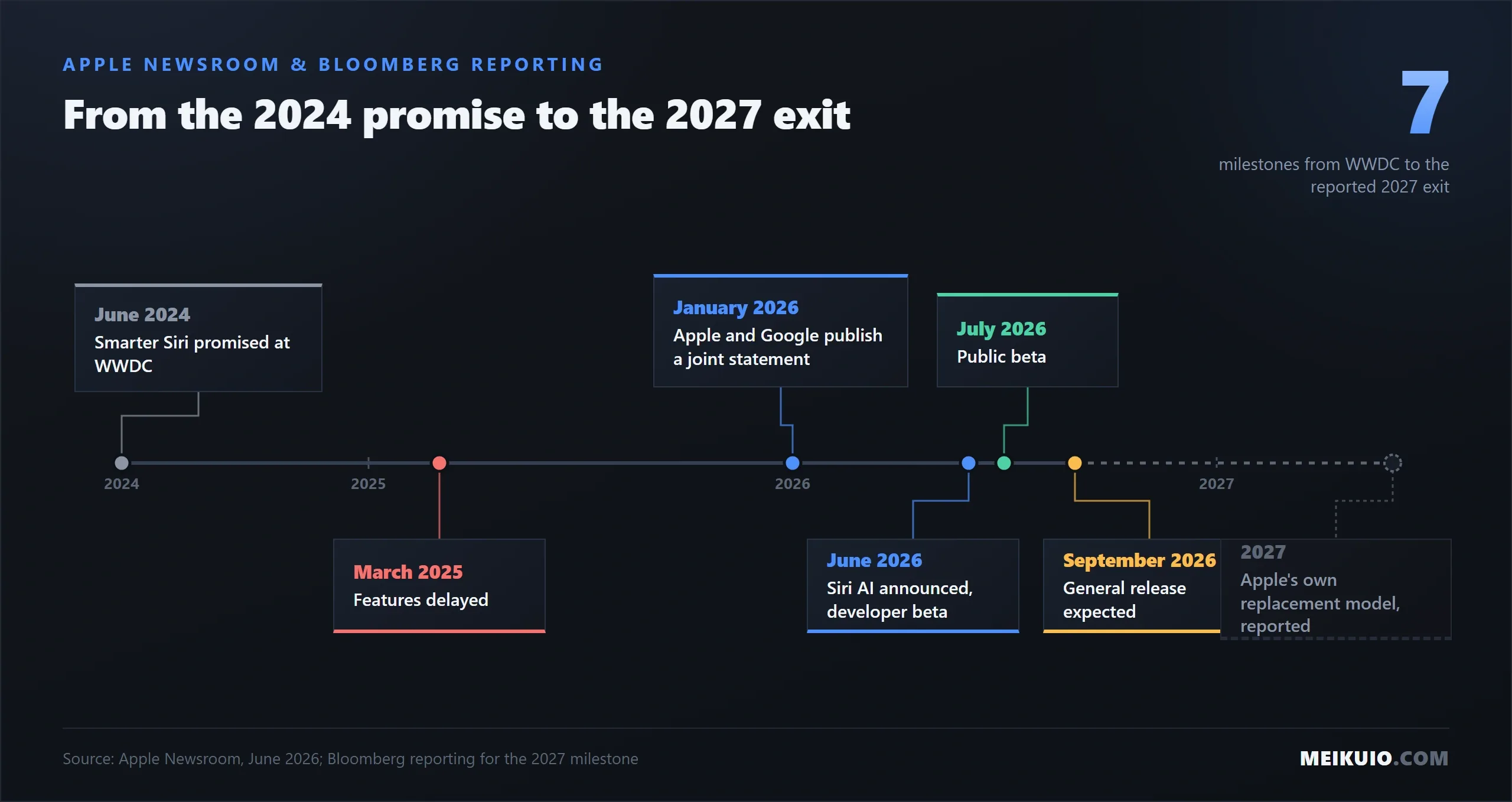
The joint statement Apple and Google published on 12 January 2026 says the next generation of Apple Foundation Models “will be based on Google’s Gemini models and cloud technology.” Apple’s own security post from 8 June is more specific: “Apple collaborated with Google to leverage the technologies behind its Gemini family of models to build the next generation of Apple Foundation Models.”
Read those two sentences slowly and notice what neither says. Neither says Gemini answers your questions. Apple’s WWDC materials describe the shipping models as custom-built, and the word Gemini does not appear anywhere on Apple’s Siri AI announcement page. The models were started from Gemini, rebuilt for Apple Silicon, and retrained with Apple’s own data, weights and guardrails.
Google’s models are the foundation Siri was built from, not the voice that answers you.
The five models behind Siri AI, and where each one runs
There are five foundation models behind Siri AI. Two run on the device itself, two run on Apple’s Private Cloud Compute servers, and one runs on Google’s infrastructure. Four of the five are custom versions of Gemini compiled for Apple Silicon. The fifth is closest to a standard Google model, and it is the only one that leaves Apple’s own estate.
That distribution is the detail worth carrying out of this article, because it breaks the two stories that dominate search results. The version that says Google handles only the hardest thinking is wrong: Gemini sits underneath even the models that never leave your pocket. The version that says Google is barely involved is also wrong, for the same reason.
Apple describes the four Apple Silicon models as “trained using proprietary data with reinforcement learning and refined using outputs from Gemini frontier models.” That is distillation: Apple started from Gemini’s foundations and taught its own models on Gemini’s outputs. What ships on your phone is a descendant, not a copy.
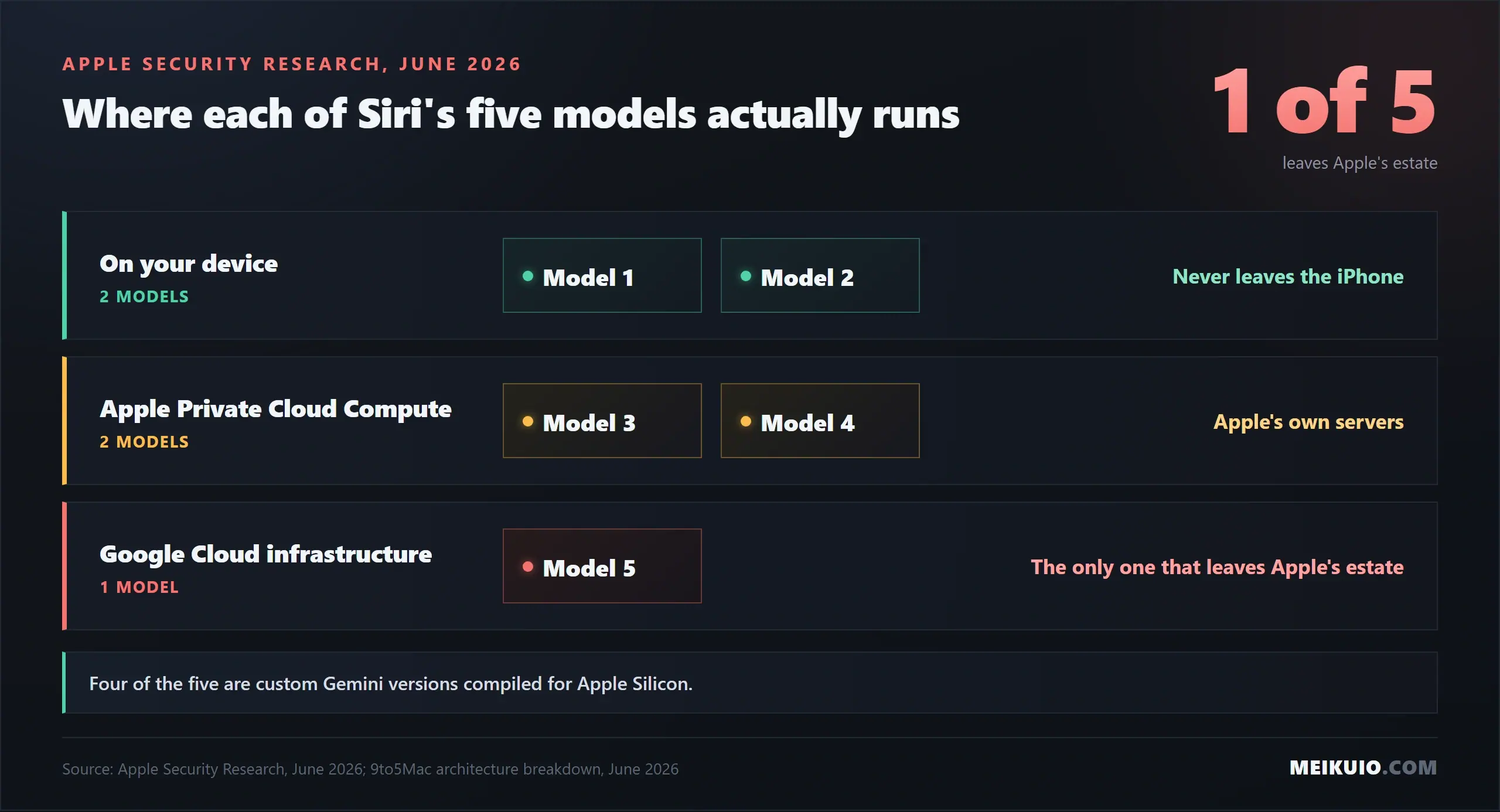
For the fifth model, Apple extended its own server architecture onto someone else’s hardware. In its own words: “we worked with Google and NVIDIA to extend our PCC infrastructure to Google Cloud systems using NVIDIA GPUs.” The stack it names is specific, and it is worth quoting because most coverage guesses at it: “NVIDIA Confidential Computing with NVIDIA GPUs, Intel CPUs with TDX, and Google’s Titan chip.”
Which iPhones get the new Siri?
iOS 27 installs on every iPhone that ran iOS 26, back to the iPhone 11. Siri AI does not. The update is universal and the assistant is not, and that gap is where most of the confusion in this category lives. If you own an iPhone 11, 12, 13 or 14, you will get the new operating system and you will not get the new Siri.
More Read

Apple’s requirement line, published on 8 June, is worth reading in full rather than in the shortened form that circulates: Apple Intelligence and Siri AI across iOS 27, iPadOS 27, macOS 27, watchOS 27 and visionOS 27 “are available on iPhone 16 models or later, iPhone 15 Pro, iPhone 15 Pro Max, iPad mini (A17 Pro), MacBook Neo (A18 Pro), iPad models with M1 or later, Mac with M1 or later, Apple Vision Pro, Apple Watch Series 9 or later, Apple Watch Ultra 2 or later, and Apple Watch SE 3 when paired with an Apple Intelligence-enabled iPhone nearby.”
Then there is a second tier that almost nobody reports, and it sits in a footnote. Apple’s most powerful on-device model, the one behind expressive voices and more advanced dictation, needs newer hardware again: “iPhone Air, iPhone 17 Pro, iPhone 17 Pro Max, iPad (M4) or later with at least 12GB of unified memory, and Mac (M3) or later with at least 12GB of unified memory.” Apple Vision Pro (M5) also gets it.
The practical consequence for a team is unglamorous. A company that refreshed phones two years ago has a fleet on the iPhone 14 and 15, which means a mixed estate where the assistant exists on some desks and not others. That is a support question before it is a technology question, and it is the same split that decides what an "AI phone" actually buys you at any price point.
Is the new Siri out yet, and can you try it now?
Yes, in beta, on a supported device set to English. The developer beta arrived on 8 June 2026, the public beta followed in July, and the general release is expected in September alongside the iPhone 18. Apple's own wording is careful: Siri AI "will be available as a beta later this year for users with a supported device set to English," with more languages to follow.
What it does, in Apple's description, is the part that decides whether any of this needs a policy. The assistant works by "surfacing relevant information from a user's personal messages, emails, photos, and more," it can "answer questions related to the content on a user's screen," and it can "get up-to-date information from the web on virtually any topic." It also takes actions across apps, which is where a mistake stops being cosmetic. Apple has published no price for Siri AI, and it arrives inside the operating system update rather than as a separate purchase.
Nothing arrived before that. The Siri capabilities in iOS 26.4 back in March were Apple Music additions, new emoji and fixes, which matters because several guides describe an earlier phase of the Gemini work reaching users in the spring. Apple's own release notes for that update mention no new Siri capability at all.
What running a beta actually costs you
A public beta is a pre-release build on the device that holds your calendar and your two-factor codes. For one curious phone that is a reasonable trade. For a working device, or for anyone else's device in your organisation, the sensible order is to wait for the September build and spend the intervening weeks deciding who is allowed to switch the assistant on at all.
Does Siri send your data to Google?
Some requests are processed on infrastructure that sits inside Google Cloud, and Google has publicly said it does not receive Apple user data from the arrangement. Those two statements are compatible, because Apple extended its own server architecture onto that hardware rather than handing queries to Google's service. The claim that fails verification is a third one, and it is the one repeated most often.
Here is the evidence behind the Gemini-powered Siri sorted by what actually backs it, which is the part no other page in these search results does.
Look at the last two rows together, because that pairing is the strongest thing in this article. When Apple briefly published its Chinese guide for connecting Siri to Alibaba's Qwen, the training restriction was written into the document: Alibaba was barred from using submitted materials to train or improve its models. For the Google arrangement, that sentence exists in newspapers and not on a page either company publishes.
What Apple does commit to in writing is narrower and still meaningful: "User data will continue to be protected by the full force of PCC's extraordinary security and privacy properties. Regardless of where the infrastructure is hosted, Apple retains complete control over PCC software."
For China, the training ban is printed in Apple's own document. For Google, it lives only in press coverage.
What Apple documents, and what only reporting says
The distinction is not pedantry, and it changes what a compliance review can rely on. A statement on a vendor's own page is something your organisation can cite. A figure attributed to a reporter's sources is context, and it will not survive the first question from anyone who has to sign off on the decision.
Three of the numbers that appear in almost every article on this subject belong in the second category. Bloomberg's Mark Gurman reported in November 2025 that Apple is "planning to pay about $1 billion a year" for a 1.2 trillion parameter model, and CNBC noted at the time that neither company had confirmed the price. Reporting also places the heaviest queries on specific NVIDIA silicon, and describes Apple as anonymising requests before they arrive. Apple's own page names a different combination of hardware and says nothing about a proxy.
The same applies to the exit. Apple is reported to be building its own trillion-parameter cloud model to replace the arrangement "as early as 2027," and the hedge in that phrase is the reporter's, not ours. Apple has published nothing about a replacement timeline, which is worth remembering whenever this deal is described as temporary. The company that Microsoft's own AI push made a rival of everyone has not committed to any date in public.
Independent scrutiny is worth more here than either side's framing. The cryptographer Matthew Green has argued at length that private inference is not private enough, and his critique is aimed at the architecture rather than at the companies. That is the level at which this should be argued, because the marketing claim and the security claim are answering different questions.
How to check what left your device
You do not have to take any of it on trust. Apple ships a log of requests that were processed off the device, it is off by default, and turning it on takes about fifteen seconds. It is the only part of this entire story that a reader can verify personally rather than read about.
- On iPhone, iPad or Apple Vision Pro, open Settings, then Privacy & Security, then Apple Intelligence Report.
- On a Mac, the same entry sits in System Settings under Privacy & Security.
- Switch on the report, then use the assistant normally for a day.
- Read the log. Apple states that it "will show requests sent off your device and processed by Private Cloud Compute, including requests originating from watchOS."
Know what the log does not contain before you draw conclusions from it. Apple says it collects "limited information about the request, such as the approximate size of the request and response, which features are used for the request, and how long the request takes to complete," and states plainly that this "does not include any information about the content of your request or the returned result." You get the shape of the traffic, not the contents.
Why Siri AI isn't in the EU, and what Apple asked for
Anyone with an iPhone in the European Union will install iOS 27 and find the assistant missing. Apple's line is direct: "Due to the Digital Markets Act (DMA), Apple will not be able to ship Siri AI in the European Union with the release of iOS 27 and iPadOS 27." The exclusion covers iOS, iPadOS and watchOS, and the company published a separate page to explain it.
The asymmetry inside that decision is the part worth knowing. EU users are not cut off entirely: "EU users will be able to access Siri AI on macOS 27 and visionOS 27." The same person, the same account, the same country, gets the assistant on a Mac and not on the phone in their pocket.
Apple says it offered an alternative. It designed "a solution called Trusted System Agent, an intermediary that would allow virtual assistants to safely access the same features and capabilities as Siri AI for devices in the EU," and asked for time to roll it out. Its account of the response is two sentences long: "The European Commission said no. In fact, the European Commission did not agree to any of Apple's proposals."
The Commission's side has been quoted in European press coverage, and its position is that the choice was Apple's own rather than a consequence of the law. No Commission document setting out that position was available to read directly, so treat the regulator's answer as reported and Apple's as published. Both readings are on the record, and they do not agree.
China, and the Qwen page that appeared and vanished
China is excluded too, in Apple's words "while Apple works through regulatory requirements." What happened next is more interesting than the exclusion. On 8 August 2026, Apple published a Chinese-language support guide explaining how eligible Mac users in mainland China could connect Alibaba's Qwen models to Siri and Writing Tools, then pulled it in under a day.
The document was specific while it existed. It required macOS 26.6 or later, it required users to sign into their own Qwen account, and it stated that Alibaba could not use submitted materials to train or improve its models. No equivalent guide appeared for iPhone or iPad, which suggests the Mac is where Apple intends to test this first.
How to turn the new Siri off
On current shipping software the switch is one screen deep: open Settings, choose Apple Intelligence & Siri, and turn Apple Intelligence off. Individual pieces can go separately if you would rather keep some of it, including notification summaries, writing tools and the ChatGPT extension, and Screen Time restrictions can lock those choices for a managed device.
Two caveats belong with that instruction. Turning the feature off leaves some apps installed but inert, so a tidy home screen is not the outcome. And reports from the iOS 27 betas describe a version where the master switch is harder to find, which is beta behaviour and may not survive to release. Check the setting after you update rather than assuming your previous choice carried over.
For a managed fleet, decide this before September
The assistant reads mail, messages and on-screen content by design, and the update that enables it will land on staff phones automatically. Whoever owns device policy should agree a position on personal context before the release rather than after the first person asks why Siri summarised a client thread.
Can you use Claude or ChatGPT instead?
Partly, and the mechanism has a name worth knowing, because the rumour cycle called it something else for months. It is not an extensions store. Apple opened its Foundation Models framework, and Google's developer post states the change directly: "Starting with iOS 27, macOS 27, iPadOS 27, visionOS 27 and watchOS 27, model providers can implement the new public LanguageModel protocol."
What that protocol provides is "a common interface for model inference," which means an app can call a cloud model or a local one through the same code path. The practical effect for a reader is that the model answering inside supported features can be one you chose, rather than the one Apple picked, in the places where a provider has done the work.
Whether that matters depends on whether you already have a preference worth carrying. Teams that standardised on one assistant tend to discover the cost of switching in the details rather than the demo, which is the same lesson that shows up when you compare Claude and Gemini for creative and research work or weigh ChatGPT against Claude for writing. Those preferences can now follow you onto the phone instead of stopping at the desktop, and the apps you already run are covered in our roundup of the AI apps worth keeping on an iPhone.
The $250 million Apple already paid for the Siri that never shipped
Before this Siri arrived, Apple agreed to pay for the last one it promised. In May 2026, plaintiffs filed for preliminary approval of a $250 million settlement over advertising that showed an enhanced Siri which had not shipped. Apple admits no wrongdoing, the settlement was not final as of August 2026, and no claims process had opened.
The eligibility window is specific, and it explains why the money matters more as context than as a payout. It covers buyers of the iPhone 16 and certain iPhone 15 models between 10 June 2024 and 29 March 2025, with payments reported in the range of $25 to $95 per device. That is the period between the promise at WWDC and the admission that the features were delayed.
Set that against the reported billion a year Apple now pays Google and the shape of the decision becomes clear. Building it in-house cost two years and a quarter of a billion dollars in settlement exposure. Renting the foundation from a rival costs money and a dependency, and it produced shipping software in under six months. The second deal looks expensive only until you price the first one, and pricing what a delay actually costs is the discipline that also decides what each assistant is really worth per month.
Who should care now, and who can wait
Act now if you handle other people's confidential material on an iPhone, or if you own device policy for anyone besides yourself. The assistant reaches mail, messages and screen contents by design, the update arrives automatically, and a decision made in advance is cheaper than one made after an incident. The setting to agree on is personal context, not the assistant as a whole.
Act now for a different reason if you are in the EU and were planning around these features. The exclusion covers iPhone, iPad and Watch with no published end date, and the workaround Apple proposed was refused, so any plan that assumed a September rollout needs rewriting rather than postponing.
You can wait if you own an iPhone 15 Pro or newer, use Siri for timers and music, and simply want it to stop embarrassing itself. Nothing about that use changes what you should do next. The update will arrive, the assistant will get better at the small things, and the interesting questions in this article will not touch your day.
Field notes
- The architecture: five Apple Foundation Models, two on device, two on Apple Private Cloud Compute, one on Google infrastructure; four of the five are custom Gemini versions compiled for Apple Silicon.
- Devices: iOS 27 installs back to the iPhone 11 and drops nothing; Siri AI needs iPhone 16 or later, iPhone 15 Pro or 15 Pro Max, or an M1 iPad or Mac; the top on-device model needs iPhone Air or 17 Pro, or 12GB of unified memory on an M4 iPad or M3 Mac.
- Dates: joint statement 12 January 2026; announcement and developer beta 8 June 2026; public beta July 2026; general release expected September 2026; Apple's own replacement model reported for 2027.
- Geography: no Siri AI in the EU on iOS, iPadOS or watchOS, available there on macOS 27 and visionOS 27; unavailable in China; Apple's China guide for Alibaba's Qwen appeared on 8 August 2026 and was pulled in under a day.
- The unverified line: no Apple or Google page states that Google is contractually barred from training on Siri requests; the equivalent restriction for Alibaba was printed in Apple's own China guide.
- Reported, not confirmed: about $1 billion a year, a 1.2 trillion parameter model, and an in-house replacement "as early as 2027", all from Bloomberg; Apple has declined to confirm terms.
- Sources: Apple Newsroom Siri AI announcement and DMA statement, both 8 June 2026; Apple Security Research on expanding Private Cloud Compute; Apple's Intelligence Engine privacy page; the Google and Apple joint statement of 12 January 2026; Google's developer post on the LanguageModel protocol; Apple's China support guide as reported in August 2026.
Frequently Asked Questions
Does iOS 27 Siri use Gemini?
It uses models built from Gemini, which is not the same as running Gemini. Apple says it "collaborated with Google to leverage the technologies behind its Gemini family of models to build the next generation of Apple Foundation Models." Four of the five models behind Siri AI are custom Gemini versions compiled for Apple Silicon and retrained by Apple; the fifth runs on Google infrastructure under Apple's own server architecture. The word Gemini does not appear on Apple's Siri AI announcement page.
Which iPhones get the new Siri?
iPhone 16 models or later, plus the iPhone 15 Pro and iPhone 15 Pro Max. On other hardware it needs an iPad mini with A17 Pro, an iPad or Mac with M1 or later, Apple Vision Pro, MacBook Neo with A18 Pro, or Apple Watch Series 9, Ultra 2 or SE 3 paired with a supported iPhone. A second tier of features, including expressive voices and advanced dictation, needs an iPhone Air or 17 Pro, or 12GB of unified memory on an M4 iPad or M3 Mac.
Can the iPhone 11 use Siri AI?
No, and the confusion is understandable, because the iPhone 11 does get iOS 27. Apple dropped no devices this cycle, so the operating system installs on every phone that ran iOS 26. Siri AI is gated separately on hardware, and the iPhone 11 through iPhone 14, along with the standard iPhone 15, fall below that line. The classic Siri continues to work on those phones.
Is the new AI Siri out yet?
It is out in beta and not in general release. The developer beta arrived on 8 June 2026 and the public beta followed in July, with the general release expected in September 2026. Apple describes it as available "as a beta later this year for users with a supported device set to English." Nothing related to it shipped in iOS 26.4 in March, despite guides that say otherwise.
Does Siri send data to Google?
Some requests are processed on infrastructure hosted inside Google Cloud, and Google has said on the record that it does not receive Apple user data from the arrangement. Apple states that "regardless of where the infrastructure is hosted, Apple retains complete control over PCC software." The widely repeated claim that Google is contractually barred from training on your requests appears in press coverage and on no Apple or Google page we could open.
How do I turn off the new Siri?
On current shipping software, open Settings, choose Apple Intelligence & Siri, and switch Apple Intelligence off. Individual features can be disabled separately, and Screen Time content restrictions can lock those choices on a managed device. Some apps remain installed but stop working rather than disappearing. Check the setting again after updating, since reports from the iOS 27 betas describe the master switch moving.
Why isn't Siri AI available in the EU?
Apple attributes it to the Digital Markets Act and says it "will not be able to ship Siri AI in the European Union with the release of iOS 27 and iPadOS 27." It proposed an intermediary called Trusted System Agent and says the European Commission refused every proposal. The Commission's position, quoted in European coverage, is that the choice was Apple's own. EU users do get Siri AI on macOS 27 and visionOS 27.
Can I use ChatGPT or Claude instead of Gemini?
In supported features, yes, where the provider has implemented it. Google's developer post states that "starting with iOS 27, macOS 27, iPadOS 27, visionOS 27 and watchOS 27, model providers can implement the new public LanguageModel protocol," which gives apps "a common interface for model inference." The mechanism is Apple's Foundation Models framework rather than the extensions store described in earlier rumours, and Siri's own foundation remains the Apple models built from Gemini.
My Take
The thing that changed my reading of this deal was not the money. It was finding the training restriction written into Apple's Chinese guide for Alibaba and then failing to find the same sentence anywhere for Google. Apple knows how to put that commitment in a document when it wants to, which makes its absence here a choice rather than an oversight. That does not mean anything improper is happening. It means the strongest privacy claim in this story is the one nobody has signed.
If I were advising a team on this, I would not start with whether to trust Google. I would start with who is allowed to give the assistant personal context, and I would settle it before the September update decides by default. Turn on the Apple Intelligence Report for a week and read what actually leaves the device, because that log is worth more than any statement from either company. Then make the call on evidence you collected yourself.