


Space tourism in 2026 is a booking page with no flight behind it. Blue Origin paused New Shepard on January 30 for “no less than two years”; Virgin Galactic’s spaceship retired in June 2024, with a successor due in February 2027. Both booking pages stay open. Here is what a seat buys, what a license certifies, and who has flown.
- What space tourism actually is, and the two lines that decide it
- Who is actually flying paying passengers in 2026
- The storefront that still says “Book your flight”
- How much does it cost to go to space?
- Where every number in the field comes from
- What your money buys: a seat, a mission, or a place in a queue
- What an FAA license actually certifies
- The learning period: no occupant-safety rule until 2028
- What you sign before you fly
- Has anyone died? The safety record on paper
- The queue outlives the vehicle
- Who has actually flown, and who paid
- Did Katy Perry go to space, and how long does it take?
- Balloon “space” flights: the stratosphere, sold as space
- What you can actually buy this year: Zero-G, centrifuges, camps, and a flight for your ashes
- Orbit for private citizens: buy the mission, not the seat
- Outside the US: a ticket with a year on it
- Seven questions to ask before you pay
- Frequently Asked Questions
- Can a normal person go to space in 2026?
- How much does it cost to go to space?
- Is Blue Origin currently flying tourists on New Shepard?
- Can you buy a Virgin Galactic ticket today?
- Does the FAA certify space tourism rockets as safe?
- Has anyone died on a space tourism flight?
- How long does a space tourism flight last?
- Did Katy Perry really go to space?
- Is a balloon flight to the stratosphere a spaceflight?
- Can tourists stay on the International Space Station?
- Is there a space hotel opening in 2027?
- What happens to your deposit if the company stops flying?
- What are the main arguments for and against space tourism?
- My Take
What space tourism actually is, and the two lines that decide it
Space tourism is paid travel above the atmosphere by people who are neither crew nor government astronauts, on a vehicle they didn’t build and can’t fly. In US law the passenger is a “space flight participant”, the flight is licensed rather than certified, and the price runs from a few thousand dollars for a parabolic flight to a negotiated sum in the tens of millions for an orbital mission.
The words space tourism cover four physically different things. An 11-minute rocket hop that crosses 100 kilometers and comes straight back down. A multi-day orbital mission on a capsule that docks with a space station. A balloon ride to 25 kilometers that never leaves the atmosphere. And a parabolic flight in an ordinary airliner that never leaves the sky. The first two are spaceflight. The third is sold as space. The fourth is weightlessness with a Part 121 certificate.
Two lines decide which word you’re allowed to use. The FAA’s line is 50 statute miles: its December 10, 2021 notice said that “any individual who is on an FAA-licensed or permitted launch and reaches 50 statute miles above the surface of the Earth will be listed on the site”. That list is the public register of who has been to space on a licensed flight. The other line is the Kármán line at 100 kilometers, which is 62 miles, and which Blue Origin prints on its own pages as “the internationally recognized boundary of space”. New Shepard crosses both. Virgin Galactic’s flights crossed the first and stopped short of the second. Balloons cross neither.
Keep those two lines in your pocket. Every claim in space tourism, from “astronaut” to “edge of space”, is a claim about which line a vehicle reaches, and the sellers know it.
Who is actually flying paying passengers in 2026
Blue Origin’s missions page ends its New Shepard list at NS-38, flown on January 22, 2026. Eight days later the company announced the pause. Since then the page has added one launch of New Glenn, the company’s orbital rocket, and no New Shepard flights at all. That is the whole US space tourism schedule on rockets for 2026, and it’s empty.
More Read

Virgin Galactic’s last flight was Galactic 07 on June 8, 2024, which its own release called the “Final Commercial Flight of VSS Unity”. The next ship hasn’t flown. The 10-Q for the quarter ended June 30, 2026 says the flight test program is expected to “commence in October 2026, followed by our first commercial spaceflight which is expected to occur in February 2027”. SpaceX flies people to orbit, but it sells missions to Axiom, to NASA and to individuals like Jared Isaacman, and nobody sells a single orbital seat off a web page. The balloon companies have flown tests and carried no paying passenger. Zero-G sells seats on an airliner and prints its price, but its only plane has been grounded since July 2025.
So the honest status line for space tourism in September 2026 is short. No rocket seat sold in the US flies this year. Two companies are taking names anyway. The gap between the fleet that exists and the fleet that was promised is the whole story.
The storefront that still says “Book your flight”
Open blueorigin.com/new-shepard/fly and the headline over the video says “Book your flight on New Shepard”; lower down, “Join a new generation of astronauts.” I read it on September 11, 2026, and again on October 4. The word “pause” doesn’t appear on it. Neither does a price. The pause notice lives on a different page of the same site, dated January 30, 2026, and it says New Shepard “has flown 38 times and carried 98 humans above the Kármán line to date” and that the demand “has resulted in a multi-year customer backlog”. A backlog with no vehicle is still a backlog. The space tourism storefront mentions neither the pause nor the backlog.

Virgin Galactic’s home page runs the other version of the same trick. On September 11 the banner said “Spaceflight expeditions are currently fully booked” and asked you to “Register your interest for our Fall 2026 Bookings Release”; the page collected interest, not bookings. Fully booked on a ship that has never carried a passenger. By October 4 the banner had changed to “Limited Bookings Now Available”, over a “Begin Journey” button that opens an account sign-up. I found no price, tranche size or press release attached to it. The FAQ page answers “When will I fly to space?” with “several hundred customers already in line” and no date. Not a year, not a quarter. I opened every reservation answer on that page. None of them contains a date.
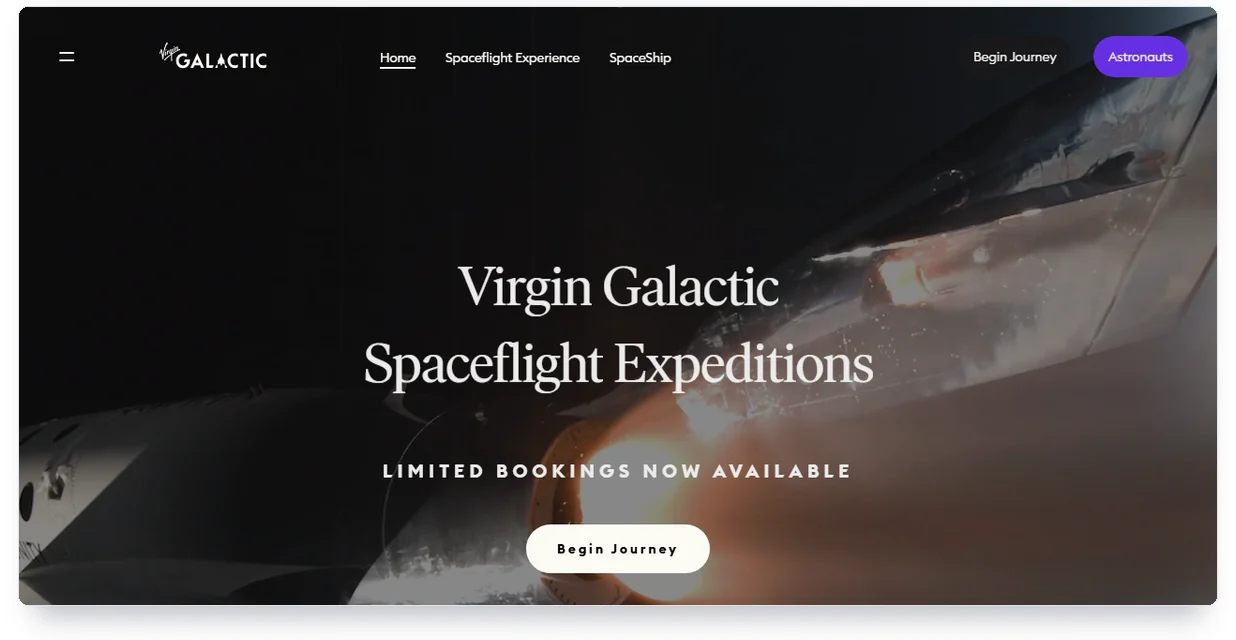
Blue Origin paused New Shepard for no less than two years on January 30, 2026, and its booking page still invites you to fly.
There’s a formula under both space tourism pages. The brand is the vehicle that flew. The product is the successor that hasn’t. New Shepard flew 38 times; the thing you’d be booking is New Shepard after a stand-down of at least two years for a lunar program. VSS Unity flew 12 times to space; the thing you’d be booking is a Delta-class ship that starts captive-carry tests in October, flights where the spaceship stays bolted under its carrier aircraft. Tesla’s Full Self-Driving page taught me to read this pattern, a promise and its cancellation on the same page. The space version is cleaner, because the vehicle in the photo has already been retired or parked.
How much does it cost to go to space?
Space tourism in 2026 costs 8,900 dollars plus tax for a parabolic flight, 180,000 euros for a balloon to 25 kilometers, 750,000 dollars for a Virgin Galactic seat in a batch that sold out, and 1.5 million yuan for a Chinese rocket ticket dated 2027. Blue Origin publishes no price. Nobody lists an orbital seat at a retail price; the tens-of-millions figures come from press. And the 8,900 dollar seat is on sale while the only plane that could fly it is grounded, with no return expected before mid-2027.
That answer has a column the field leaves out: where the number is printed. Some of these prices sit on the seller’s own page and you can read them today. Some sit in an SEC filing, which is better than a page because the company has to stand behind it. Some exist only in press coverage. And some don’t exist at all, which the sellers would rather you didn’t notice. The space tourism price ladder below carries the provenance on every rung.
Read the ladder from the cheap end. The three sellers that print a price on their own page are the three that never take a person past the FAA’s line: a memorial capsule that flies without you, an airliner, a balloon. The one price that sits in a filing belongs to a ship that hasn’t flown. And the two vehicles that have actually carried the most people, New Shepard and Crew Dragon, are the two with no retail price anywhere. I’ve seen this curve before, on robot dogs, where price transparency falls as the price rises, and on exoskeletons, where a printed price and a printed proof rarely share a page. Space tourism runs the same slope, steeper.
Two numbers on the ladder need their fine print. Zephalto’s 180,000 euros comes with a 20 percent deposit of 36,000 euros, and its shop takes a first online payment of 10,000 euros with 30 days to pay the rest of the deposit. Virgin Galactic’s 750,000 dollars was the price of an April 2026 tranche, a batch of 50 seats the company calls expeditions; by August 12 the company said the tranche “was oversubscribed” and it had “closed active bookings”, and the CEO said the next tranche would come “at higher price points this fall”. As of October 4 the home page says “Limited Bookings Now Available” and prints no price. So the only US rocket price on the space tourism ladder is a price you can no longer pay, and the only other rocket price is Chinese, from a 2024 press report, for a vehicle that hasn’t flown.

Where every number in the field comes from
Google’s AI Overview for space tourism prints a price range and cites two niche sites. Those sites print the same range and cite each other. So I traced each figure to the document that first held it, the same method that sorts Microsoft’s real owners from the popular numbers, because in space tourism a number has one source and many copies.
- The 20 to 40 million dollar orbital ticket comes from the Soyuz era. National Geographic put it plainly in 2018: private citizens “have been sent to the International Space Station on $20-to-40-million round-trip tickets”. The number still anchors every orbital estimate.
- The 450,000 dollar Virgin Galactic price is in the company’s 10-K: “In August 2021, following Sir Richard Branson’s successful test flight, we reopened ticket sales to a select group and increased the pricing of our consumer offerings to a base price of $450,000 per seat.” The same paragraph gives the next rung: “In 2023, we increased the pricing of our consumer offerings to a base price of $600,000 per seat.” The 250,000 dollars that older articles quote is the 2018 price the Los Angeles Times reported, and the 750,000 is the 2026 tranche.
- The 28 million dollar “Blue Origin ticket” was never a ticket. On June 12, 2021 the company wrote that it “concluded the online auction for the very first seat on New Shepard with a winning bid of $28 million”, and that “Nearly 7,600 people registered to bid from 159 countries”, and that it would donate the amount to its foundation. The winner, Justin Sun, was announced in December 2021 with a flight “in 2022”. The FAA’s register lists him on NS-34, flown August 3, 2025.
- The 125,000 dollar balloon seat is the price Space Perspective announced and never charged, repeated in cost-of-space-tourism tables since. The company ceased operations in 2025 and its assets were sold; the buyer told Travel Weekly it was “reassessing the entire customer journey and value proposition before reopening official sales”.
- The “55 million” Axiom figure that AI Overviews repeat comes from press coverage of the company’s early plans. Axiom’s own site prints no price; its “Start Your Mission” button opens a form.
- The “$250,000 to $300,000+” Blue Origin price that Google’s AI Overview printed on September 11, in the present tense (“charges roughly”), does not come from any Blue Origin page. Blue Origin’s own pages print no seat price, and it isn’t flying.
Six origins. Everything else is a copy. When a page gives you a space tourism price without a date and without saying where it found the figure, the number is one of these, aged.
What your money buys: a seat, a mission, or a place in a queue
Blue Origin’s crew capsule “seats six”, says its Fly page, and every New Shepard flight since NS-19 has carried six. That’s the first thing money buys in space tourism: one seat on a shared flight, on a date the operator picks, next to five people you didn’t choose. Virgin Galactic sells the same unit, with a twist its FAQ spells out: “a full spaceship charter (up to 6 seats)” is available, and “a single waitlist place can be used to make a reservation of any size”. A seat, or the whole cabin. Either way the operator flies when it flies.
The second thing money buys is the mission itself. No one buys an orbital seat off a web page. Inspiration4 in 2021 was a flight Jared Isaacman bought whole and filled with three people of his choosing. Fram2 in 2025 was the same shape. On Axiom’s missions to the station the buyer is a government, a sponsor or a wealthy individual, and the person in the seat is whoever the buyer chose. That is why the FAA’s register lists an Axiom-4 crew with an Indian, a Polish and a Hungarian name. You can’t join that queue with a deposit. You’d be buying a launch.
The third thing money buys is a place in line, and this is the space tourism product both US suborbital sellers are actually offering in 2026. Virgin Galactic’s 10-Q for June 30, 2026 puts it in numbers: “reservations for spaceflights for approximately 675 future astronauts, which represent approximately $203 million in expected future spaceflight revenue upon completion of the spaceflights”. Completion is the operative word. The revenue is expected. The flights haven’t happened. Blue Origin’s version is “a multi-year customer backlog” behind a vehicle it parked.
There are side doors, and they say a lot about what a seat is worth. Blue Origin auctioned the very first one in June 2021 for 28 million dollars, and the winning bidder didn’t fly on that flight; the FAA’s register has him on NS-34 in August 2025. Virgin Galactic’s first private mission carried “Keisha Schahaff and Anastatia Mayers, a Caribbean mother-daughter duo who won their seats in a draw that raised funds for non-profit Space for Humanity”, next to “Jon Goodwin, Olympian and early Virgin Galactic ticket holder”. When one NS-38 crew member got ill in January 2026, the seat went to Laura Stiles, a Blue Origin employee who “had filled multiple New Shepard launch crew roles”. And Blue Origin’s own NS-30 page lists five names “and an undisclosed sixth crew member”. Auctions, draws, employees, and a seat with no name on it. The manifest is not a customer list.
What an FAA license actually certifies
Title 14, section 450.3(a) of the Code of Federal Regulations is one sentence long on this point: “A vehicle operator license authorizes a licensee to conduct one or more launches or reentries using the same vehicle or family of vehicles.” Authorizes. Launches. That’s the space tourism license. It is a permission to fly a rocket over people on the ground without hurting them. The FAA’s own licensing page describes the financial side the same way: license holders “must provide evidence of funds to cover potential damage incurred as a result of a mishap”. Damage to others. Not to you.
The law then makes the operator tell you so, in writing, before it takes your money. Section 50905(b)(5) of Title 51 of the US Code says a license holder “may launch or reenter a space flight participant only if” it “has informed any space flight participant in writing, prior to receiving any compensation from that space flight participant… that the United States Government has not certified the launch vehicle as safe for carrying crew or space flight participants”. The regulation that implements it, 14 CFR 460.45(b), repeats the sentence almost word for word: “An operator must inform each space flight participant that the United States Government has not certified the launch vehicle and any reentry vehicle as safe for carrying crew or space flight participants.”
An FAA launch license authorizes the launch. It does not certify the vehicle as safe for the people on board.
Then there’s the word for you. You aren’t a passenger in this rulebook. You’re a “space flight participant”, and 14 CFR 440.3, the definitions section of the financial responsibility rules, draws two lines around that term. First: “A space flight participant, for the purposes of this part, is not a customer.” Second, the definition of “third party” lists the people who aren’t one, and item (v) on that list is “A space flight participant”. The insurance in 14 CFR 440.9 that the FAA makes every operator carry covers “claims by a third party for bodily injury or property damage”. The definition excludes you. The mandatory policy is about the farmhouse under the flight path, and you signed up to sit above it.
What the license covers, what it requires of the seller, and what it leaves entirely to you, with the section number for each line.
I’ve watched the same agency handle aircraft, and the difference is the whole point. When the FAA certifies an airliner, or finishes every rule for electric air taxis except the aircraft itself, it is vouching for the machine. When it licenses a space tourism launch, it is vouching for the sky and the ground under it. The same agency that writes the rules for the drone in your garage has, by statute, no general rule for the seat you’d be strapped into. That isn’t an oversight. Congress wrote it that way, and attached a clock to it.
The learning period: no occupant-safety rule until 2028
Section 50905(c)(9) of Title 51 reads: “Beginning on January 1, 2028, the Secretary may propose regulations under this subsection without regard to subparagraphs (C) and (D) of paragraph (2).” That date ends what the space tourism industry calls the learning period. The notes under the section record how it got there: Public Law 118-159, they say, substituted “January 1, 2028” for “January 1, 2025”. Congress has moved this date repeatedly since the original 2004 law, most recently in December 2024. None of the nine pages I measured on the first page of Google prints it.
Until that date, subparagraph (C) limits what the FAA can regulate about the people on board. It may write occupant-safety rules only for design features or operating practices that “have resulted in a serious or fatal injury… to crew, government astronauts, or space flight participants during a licensed or permitted commercial human space flight”, or that “contributed to an unplanned event or series of events during a licensed or permitted commercial human space flight that posed a high risk of causing a serious or fatal injury”. Read that twice. Before 2028 the agency may write a general rule about a hazard after it has hurt someone, or after it nearly did. It may not write the rule in advance. The limit is on rules for everyone, not on policing one vehicle: the FAA can still investigate a mishap and make the operator fix its own rocket before it flies again, which is what the 21 corrective actions on New Shepard were.
The gap shows most clearly in the medical rules. Part 460 has a medical standard for the people who fly the vehicle: section 460.5(e) says “each crew member with a safety-critical role must possess and carry an FAA second-class airman medical certificate”, the same class of certificate a commercial pilot holds. I read the participant sections of the same part, 460.41 through 460.53, on September 11, 2026, and none of them contains a medical standard for the person in the passenger seat. Virgin Galactic’s FAQ fills the silence with its own line: “If you are able-bodied and cleared by a medical practitioner, you should be able to enjoy both your training and your spaceflight.” That’s the operator’s standard. The government doesn’t have one. The operators’ own height, weight and age limits aren’t on the pages quoted here; ask for them in writing with the rest of the paperwork.
I’ve written about what it looks like when agencies decline to endorse a technology, and this is the opposite shape: an agency Congress has told not to write the rule yet. Either way the space tourism seller’s page doesn’t change. The word “licensed” sits on it and does the work of “certified” in the reader’s head, and until January 2028 there’s no rule under it about you.
What you sign before you fly
Section 460.45 is the part of the space tourism rulebook that is actually about you. Read it as the seller’s script. Before taking money, the operator “must inform each space flight participant in writing about the risks of the launch and reentry, including the safety record of the launch or reentry vehicle type”, and the disclosure must list “for each mission, each known hazard and risk that could result in a serious injury, death, disability, or total or partial loss of physical and mental function”. It must say “that there are hazards that are not known”. And it must say “that participation in space flight may result in death, serious injury, or total or partial loss of physical or mental function”.
Then come the numbers the operator has to show you. Under 460.45(c) the disclosure must include “the total number of people who have been on a suborbital or orbital space flight and the total number of people who have died or been seriously injured on these flights”, plus “the total number of launches and reentries conducted with people on board and the number of catastrophic failures of those launches and reentries”. Under 460.45(d) the operator must describe its own vehicle’s record, including “the number of vehicle flights”, the number of mishaps, and “whether any corrective actions were taken to resolve these mishaps”. The FAA’s 21 corrective actions on New Shepard after the 2022 mishap belong in that paragraph of the document.
Only after that do you sign. Section 460.45(f): the operator “must provide each space flight participant an opportunity to ask questions orally to acquire a better understanding of the hazards and risks of the mission, and each space flight participant must then provide consent in writing”. The consent must “identify the specific launch vehicle”, must “state that the space flight participant understands the risk, and his or her presence on board the launch vehicle is voluntary”, and must “be signed and dated”. Two more sections close the file. Section 460.49: “Each space flight participant must execute a reciprocal waiver of claims with the Federal Aviation Administration.” Reciprocal means you agree not to sue the government over the flight and it agrees not to sue you. Section 460.51: the operator “must train each space flight participant before flight on how to respond to emergency situations, including smoke, fire, loss of cabin pressure, and emergency exit”.
If that reads like the paperwork for a clinical trial, it should. It is the same legal shape as informed consent on an investigational device: the government hasn’t certified the thing, so the law shifts from certifying the product to documenting that you understood. Virgin Galactic’s 10-Q even times its cash to the paperwork. It expects to “receive cash payments in connection with spaceflights after we deliver the conditions of carriage to customers and receive customer executed informed consents”. The signature is the trigger for the balance. The ride is what you get for signing.

Has anyone died? The safety record on paper
OSHA inspection 310821103 is the oldest document in the space tourism file. “At approximately 2:30 p.m. on July 26, 2007”, it says, Scaled Composites “was conducting a ‘Cold Flow’ test of nitrous oxide, a component to be used in the propulsion system of a spacecraft under development. Approximately three seconds into the test an explosion occurred. Two employees were fatally injured at the scene, and another employee died later while being treated.” The spacecraft under development was SpaceShipTwo. The people who had already put down deposits for it were nowhere near the test stand.
The second document is NTSB report AAR-15/02, adopted July 28, 2015, on the October 31, 2014 breakup of the first SpaceShipTwo over the Mojave desert. The breakup killed co-pilot Michael Alsbury and seriously injured pilot Peter Siebold. The board’s probable cause is one sentence: “Scaled Composites’ failure to consider and protect against the possibility that a single human error could result in a catastrophic hazard to the SpaceShipTwo vehicle.” The ship was flying under an FAA experimental permit, the lighter authorization the FAA issues for test flights of reusable suborbital rockets, not a license, and it was a test flight with no participants aboard. Test crew only. The FAA’s recognition list carries both pilots with the asterisk of its old Astronaut Wings program, awarded to them as an honorary exception: the ship broke up far below 50 miles.
The third is the FAA’s closure notice for New Shepard, dated September 27, 2023. It names “the proximate cause of the Sept. 12, 2022, mishap as the structural failure of an engine nozzle caused by higher than expected engine operating temperatures”, and it says “The FAA required Blue Origin implement 21 corrective actions”. That flight, NS-23, carried payloads and no people. The closure “does not signal an immediate resumption of New Shepard launches”, the FAA added.
So here is the record, with its edges drawn. On FAA-licensed or permitted commercial human spaceflights, no paying participant has died or been seriously injured in flight. The four deaths on record are three employees in a 2007 ground test and one test pilot in 2014, both inside the development programs, neither on a flight carrying a customer. The count comes from the FAA’s recognition list of 192 names, last updated October 2, 2026, and the FAA and NTSB mishap records I read on September 11, 2026. It covers US-licensed flights only; Soyuz tourist flights are outside it. That is the whole boundary of the claim, and it should travel with the claim wherever the claim goes. Four deaths, zero customers.
Note
A clean record on 192 names is a small sample, and the operators know that better than anyone: section 460.45(c) makes them show you the whole human spaceflight record, government and private, including the deaths, before you sign. Read that page of your paperwork before the one with the price on it.
The queue outlives the vehicle
The going-concern note in Virgin Galactic’s 10-Q for the quarter ended June 30, 2026 is where I’d start if I held a reservation. A going-concern note is where a company says whether it expects to survive the next twelve months. Management’s evaluation, it says, “resulted in the determination that the Company may not have sufficient cash and marketable securities to maintain its planned operations for the next twelve months” and concluded “that there are conditions present in the aggregate that raise substantial doubt about the Company’s ability to continue as a going concern”. The plans listed to fix that include “Commencing commercial service in February 2027” and “Generating significant cash from the current backlog of future astronauts as their final payments become due in advance of their spaceflight”. And then the line that matters: management “has concluded that its plans do not alleviate substantial doubt”.
Read that as a space tourism reservation holder and the queue looks different. The final payments of the people in line are part of the plan to keep the company that owes them a flight solvent. I’m quoting, not accusing; the filing lists those plans in that order.
The balance sheet on the same filing gives the shape of the money. Customer deposits: 80.27 million dollars at June 30, 2026, up from 78.54 million at the end of 2025. Restricted cash: 31.07 million, which the notes define as “cash deposits received from future astronauts that are contractually restricted for operational use until the condition of carriage is signed or the deposits are refunded”. Subtract one from the other and 49.2 million dollars of the deposit liability sits outside restricted cash. That subtraction is mine; the filing doesn’t do it, and it doesn’t say where the rest sits. The press release’s headline number, “cash, cash equivalents and marketable securities of $286 million”, adds 187.34 million of cash, 67.71 million of securities and the 31.07 million of restricted deposits together. One more line from the debt notes: the 2028 notes are secured by “substantially all of the assets of the Company… subject to customary exceptions, including customer deposits”. The deposits are carved out of the lien, the lenders’ claim on the company’s assets if it defaults. That’s the only protection in the document, and it’s a contract term, not a law. And neither US seller prints what the deposit is: Blue Origin’s Fly page has no figure at all, and Virgin Galactic reports deposits only as a total in its filings.
Public charter flights must escrow passenger money under 14 CFR 380.34. No federal rule protects a spaceflight deposit.
Because the law does protect other people’s deposits, through escrow, which means money held by a third party until the service is delivered. Book an air taxi seat or public charter flight and 14 CFR 380.34(a) says the charter operator “shall furnish a security agreement in an amount for not less than the charter price for the air transportation”, or, under 380.34(b)(2), run “all payments by charter participants” through a designated bank under a depository agreement. Book a cruise and 46 CFR 540.5 requires coverage “no less than 110 percent of the unearned passenger revenue” for “indemnification of passengers in the event of the nonperformance of water transportation”. I read chapter 509 of Title 51 and Parts 440, 450 and 460 of Title 14 on September 11, 2026 looking for the spaceflight equivalent. There isn’t one. The rules that make you “not a customer” for insurance purposes say nothing about your deposit either. State law and the operator’s own contract are all that’s left. I didn’t read those, so assume nothing about them.
What happens without that rule is already on the record.
XCOR is the case to measure every space tourism deposit against. Its Lynx spaceplane sold tickets at 100,000 dollars for the first hundred seats. One holder, the Los Angeles Times reported in December 2018, “expected 2015 to be the year he would finally achieve his childhood dream of going to space”, asked for a refund, and was told he would “at the least” get 35,000 dollars. That was the portion the company described as held in a separate escrow account. XCOR filed for Chapter 7, the liquidation form of bankruptcy, in November 2017 with, by the Times’ count, 282 ticket holders. Another holder “applied to be a creditor in Xcor’s bankruptcy case but has since learned he would not receive any funds”. The vehicle never flew. The escrow was a promise on paper. The refund never came.
Space Perspective is the fresh one. It sold balloon seats at 125,000 dollars and ceased operations in 2025. The Spanish company EOS-X bought it out of liquidation. The buyer’s law firm told Travel Weekly the new company “will not assume debts or contractual obligations, including customer contracts or the reservation database”, and that “client deposits for Space Perspective were held in escrow and are under the management of a liquidator or fiduciary as part of bankruptcy proceedings”. Escrow, in this case, meant the money went to the liquidator rather than the buyer. The reservation database, the list of people who paid, stayed out of the sale. On the day I checked, spaceperspective.com was a “Launching Soon” page with a contact form.
Two programs ended cleanly, and the way they ended is the point. The dearMoon flight around the Moon, announced in 2018 for a 2023 launch, was canceled by a notice dated June 1, 2024: “launch within 2023 became unfeasible, and without clear schedule certainty in the near-term, it is with a heavy heart that Maezawa made the unavoidable decision to cancel the project.” The crew were invited artists; the buyer was Maezawa himself. Orion Span, the “space hotel” that took 80,000 dollar deposits in 2018 for a 9.5 million dollar stay, shut down in 2021 with a notice still readable in the web archive: “We have kept our commitments to our customers and fully refunded all customers’ $80,000 deposits to travel to space with us.” That is the only full refund in this table. It came from the company that never built anything.
I’ve already priced a deposit for a delivery year that moves, and the space tourism version has one feature the robot version lacks: the delivery year can move because the vehicle stopped existing. Virgin Galactic’s 2024 release said the Delta ships were “expected to enter commercial service in 2026”. Its Q1 2026 filing said the fourth quarter. The Q2 filing says February 2027. The queue didn’t shrink while the date moved; the 10-K counted “approximately 675 future astronauts” at the end of 2025 and the 10-Q counts approximately 675 at the end of June. The vehicle is the variable. The line is the constant.
If you already hold a reservation
Three documents tell you where you stand, and none of them is the confirmation email. Your reservation agreement says what is refundable and when. The operator’s latest 10-Q, if it has one, says what it plans to do with your final payment and whether its auditors doubt the year ahead. And the conditions of carriage, the contract terms for the flight itself, which Virgin Galactic says it delivers before it collects the balance, is the one that turns a deposit into a fare. Ask for all three in writing before the next payment date, and read them in that order.

Who has actually flown, and who paid
The FAA’s Commercial Human Space Flight Recognition page is a single table, sorted by flight date, “last updated: Friday, October 2, 2026”. It is the closest thing space tourism has to a passenger manifest. I pulled it into a spreadsheet and counted. It holds 192 names: 92 who flew on New Shepard, 37 on SpaceShipTwo, 59 on SpaceX vehicles and 4 on Scaled Composites test flights. Thirty carry the asterisk of the old Astronaut Wings program, which ended in December 2021. Twenty-one carry a plus sign, meaning they flew more than once and are listed under their first flight. By year of first flight: 21 in 2021, 25 in 2022, 32 in 2023, 36 in 2024, 56 in 2025, and 13 so far in 2026, plus nine earlier names from the test flights of 2004, 2014, 2018 and 2019. Two of those, the 2014 crew, never reached the line; their asterisk is honorary.
Those 192 are people, and that matters when you read Blue Origin’s “98 humans”. The two numbers reconcile exactly. Ninety-eight is seats: two flights of four, then fifteen flights of six. Ninety-two is individuals; the six missing seats belong to people who flew twice. Five of those people carry the FAA’s plus sign, and the sixth is Lane Bess, who Blue Origin’s own NS-30 page says “flew for the second time, the fourth New Shepard customer to do so”. Blue Origin’s own release before NS-38 counted “92 humans (86 individuals)”, seats and people; add the six seats and six new people on that flight and you get 98 seats and 92 people. Both sources agree once you know which one counts seats.
One square per person on the FAA’s list. Only Virgin Galactic’s own releases say who held a ticket, so the 92 on New Shepard stay undisclosed.
Virgin Galactic’s 37 names split, because the company’s releases say who each person was. Fourteen were employees, pilots or the founder: the Mojave test flight crews, the Unity 22 crew of Branson and two staff, three employees flying as mission specialists on Unity 25, and the pilots listed on later flights. Four flew for governments: two Italian Air Force officers and a researcher from Italy’s National Research Council on Galactic 01, and a Turkish astronaut-researcher on Galactic 07. Two flew as researchers, Alan Stern and Kellie Gerardi on Galactic 05. Two won their seats in the Space for Humanity draw. That leaves fifteen private ticket holders across six flights, from Jon Goodwin on Galactic 02 to the three private astronauts on Galactic 07. All fifteen flew inside ten months, between August 2023 and June 2024, on six of the company’s twelve spaceflights. That’s the entire space tourism output of the company that has “several hundred customers already in line”.
Blue Origin’s 92 won’t split, and I want to be exact about why. The company has never published a seat price on its site or in any release I could find. It calls some flyers customers, Lane Bess among them, and publishes no flight-by-flight list of who paid. Its own pages carry the evidence of how loose the category is: a Bezos family flight, a talk-show host, a 90-year-old actor, an “undisclosed sixth crew member” on NS-30, an employee taking a sick customer’s seat on NS-38. The public record can’t prove the thesis you’ll read elsewhere, that most New Shepard flyers didn’t pay, and it can’t prove the opposite either. What I can say is narrower. Of the two US space tourism operators, only one has published, flight by flight, which of its passengers held tickets and which didn’t, and it’s the one that flew fewer people.
One more thing about the FAA list, since you may go and count it yourself. It reads like a hand-kept table. One Axiom-2 astronaut appears twice, the second time under a NASA mission whose fourth crew member is missing, and a few names and one launch site are misspelled. If you’ve ever read a public registry line by line you know the drill: the register is the best evidence there is, and it still needs a second source next to it.
Did Katy Perry go to space, and how long does it take?
Did Katy Perry go to space?
Yes, by both definitions. Katy Perry flew on Blue Origin’s NS-31 on April 14, 2025, with Aisha Bowe, Amanda Nguyen, Gayle King, Kerianne Flynn and Lauren Sanchez. New Shepard crosses the 100-kilometer Kármán line, so the flight cleared the FAA’s 50-mile line and the international one, and the FAA’s register lists her as “Hudson, Katheryn (Katy Perry)”.
The flight was Blue Origin’s eleventh with people aboard, and its release called it the first all-female crew since Valentina Tereshkova’s solo flight in 1963. Whether anyone on it paid, the company doesn’t say. Its NS-31 page names the six and stops. The flight itself follows New Shepard’s standard profile, about eleven minutes from lift-off to landing with a few of them weightless. That’s consistent with every other New Shepard flight, and it’s the reason the question “did she pay” has no documented answer: Blue Origin does not publish who paid for a seat, on that flight or any other.
How long does it take to go to space?
Eleven minutes on New Shepard, from lift-off to the capsule landing under parachutes, with “several minutes of weightlessness” inside that, by Blue Origin’s own description. About an hour on Virgin Galactic: Galactic 07 took off at 8:31 and landed at 9:41, seventy minutes gate to gate, with the rocket burn and the weightless minutes in the middle. Days in orbit. Six hours in a balloon, none of them weightless.
The table is the article’s definition of space tourism in numbers. Only the rocket rows cross the FAA line. Only New Shepard and the orbital capsules cross the Kármán line. Virgin Galactic’s apogees, 54.4 miles on Galactic 07 and 55.2 on Galactic 06, sit above 50 miles and below 62, which is why the company’s passengers are on the FAA’s list and why, under the international definition, they never reached space. Both statements are true. The seller picks the line that suits the brochure. The balloon rows reach a quarter of the way to the lower line and still say “space” in the name of the product.
Time is the other honest measure. Yusaku Maezawa spent, by his own project’s biography, “about 12 days” on the International Space Station in December 2021. A suborbital space tourism customer buys eleven minutes or seventy. A Zero-G customer buys fifteen parabolas, “around ~7.5 minutes of zero gravity” in the seller’s own words, about thirty seconds at a time. Zephalto’s brochure is the frankest of all: “6 hrs” for the “total duration of your flight”, broken down as ninety minutes up, three hours at 25 kilometers, ninety minutes down, and no weightlessness anywhere in it. A balloon at 25 kilometers is still in the pull of the planet.
Balloon “space” flights: the stratosphere, sold as space
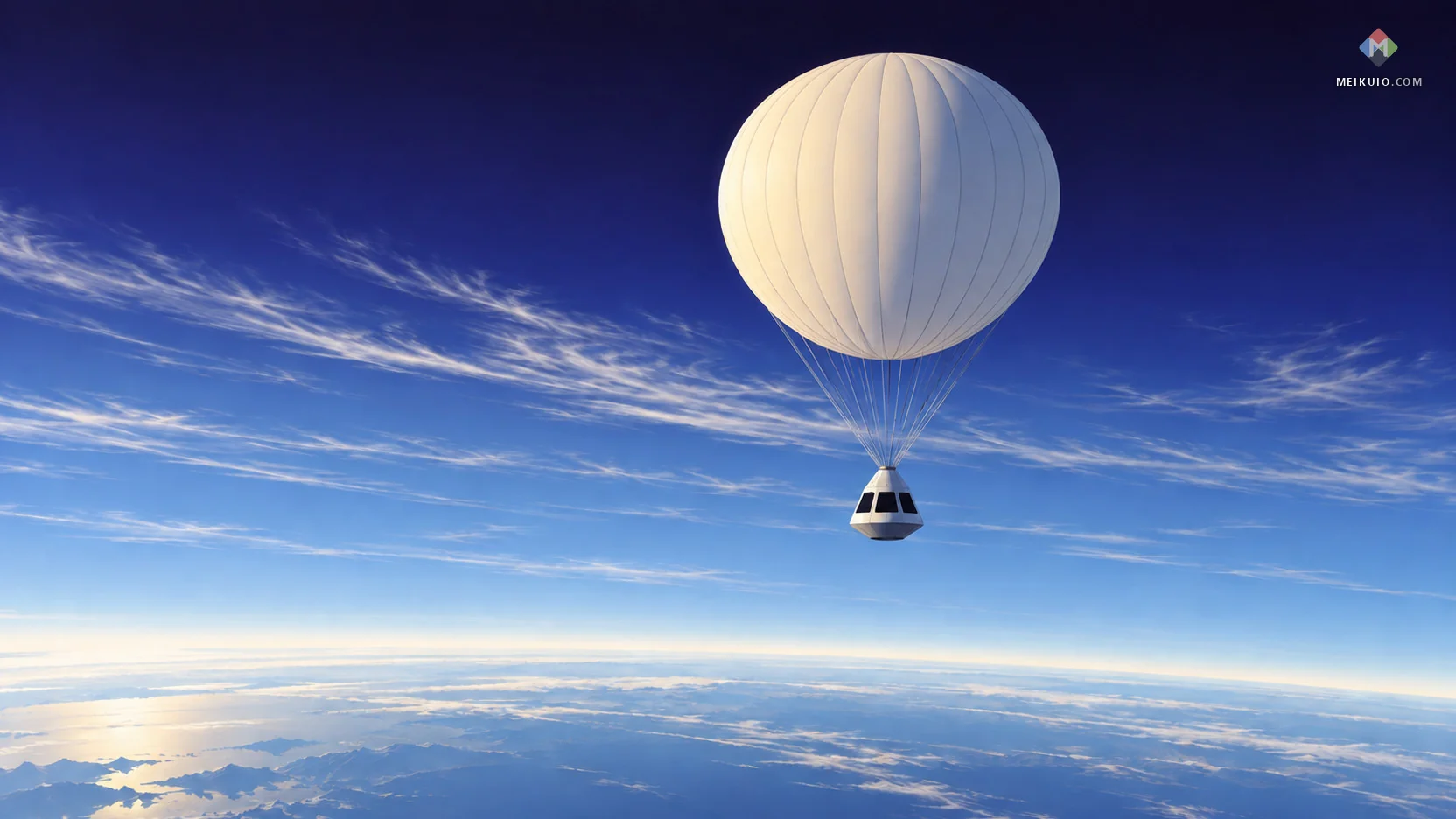
Zephalto’s home page calls its product “The low-carbon journey to space” and tells you to “Soar into space by 2026”. Its own numbers page, a few lines lower, says the capsule reaches “25 km” and sits “Above Earth and 98% of the atmosphere. In the darkness of space.” Twenty-five kilometers is 15.5 miles. The FAA’s line is 50 miles. The Kármán line is 62. The page is accurate about the altitude and inaccurate about the noun, on the same screen.
I read all four balloon space tourism sellers on September 11, 2026, and Zephalto again on October 4. Zephalto, in France: 180,000 euros per guest, a roadmap entry that said 2026 on September 11 and says 2027 now for “First Zephalto flights open to the public”, a widget that says “2 Seats remaining”, and an FAQ that says the capsule “will be certified by the EASA”, Europe’s aviation safety agency, future tense. HALO Space: no price, a “Join Waitlist” button, a test flight in 2024 that ended in an incident the page itself describes, “the next test flight targeted for late 2026”, and “crewed test flights targeted for late 2027, subject to technical readiness and regulatory approvals”. Space Perspective: a “Launching Soon” placeholder. World View: “now part of Ondas Sentinel”, a defense sensing company, with no passenger product anywhere on the site. Four sellers. Zero paying passengers carried to the stratosphere, by their own pages.
Balloons are where I found a seller printing both a price and a deposit on its own storefront, Zephalto, and also where the most recent customer money went through a liquidation. Those two facts belong together. Zephalto’s 20 percent deposit is a real number on a real shop page. Space Perspective’s 125,000 dollar seat was a real number too, and its deposits are now “under the management of a liquidator”. A printed price tells you what the seller wants. It tells you nothing about whether the capsule will fly, and nothing about what happens to the deposit if it doesn’t. HALO’s page says something true in passing: “Less than 700 people have witnessed this view.” None of them bought a balloon ticket.
What you can actually buy this year: Zero-G, centrifuges, camps, and a flight for your ashes
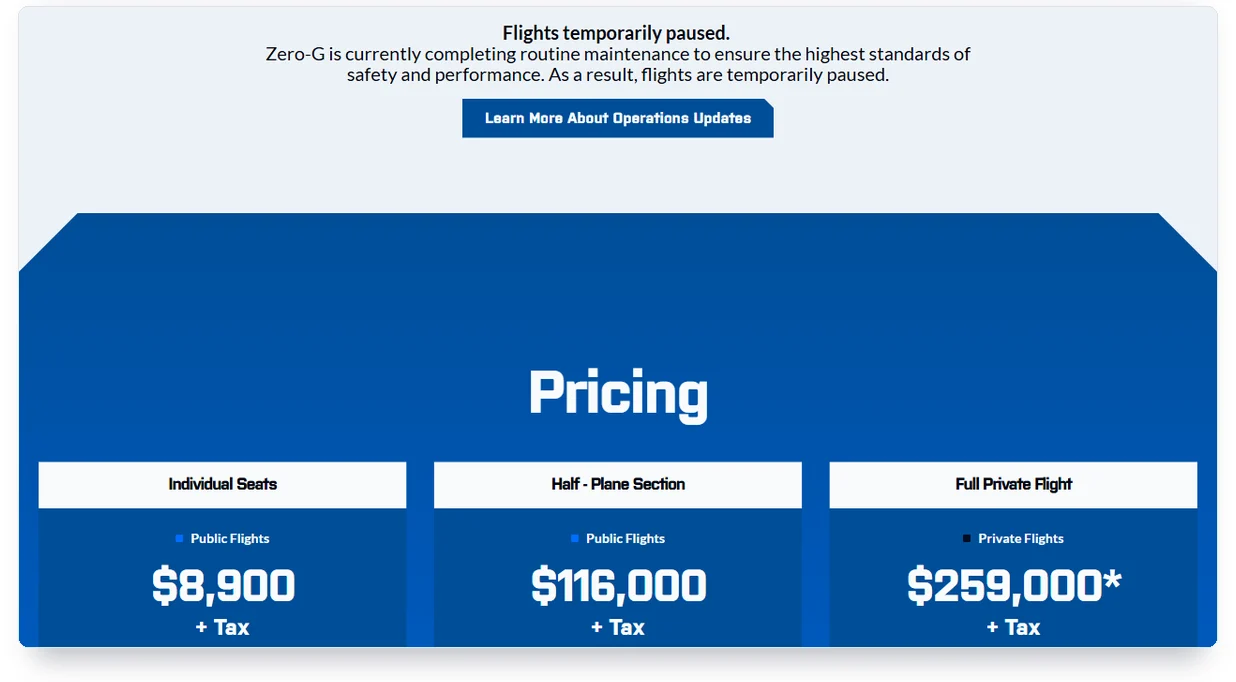
Zero-G’s price page lists “Individual Seats” on “Public Flights” at “$8,900 + Tax”, and the line under it lists what that buys: “15 parabolas, Zero-G flight suit (yours to keep!), merchandise, Regravitation celebration, flight completion pin, champagne toast, photos and videos of your experience”. A half-plane section for up to 14 people is 116,000 dollars plus tax. The whole aircraft, up to 28 seats, is 259,000 dollars plus tax. Those prices sit under a notice: “Flights temporarily paused.” The page puts it down to “routine maintenance”; the longer account is on the company’s operations update, dated July 20, 2026. In July 2025 its Boeing 727, G-Force One, “sustained extensive damage while in the exclusive custody and control of a third-party maintenance facility”, and because it was the company’s “sole operating aircraft”, Zero-G has been “unable to conduct flight operations since the damage occurred”. It has filed suit over the damage, and it writes: “we do not anticipate a return earlier than mid-2027.” So the one US space tourism product with a printed price has no aircraft and no date. And even flying, it never leaves the atmosphere.
It also has the one thing no rocket seat has: a normal certificate. The company calls itself “the only FAA-approved provider of zero gravity flights” and says it is “held to the exact same Part 121 safety standards as passenger airlines”, with “20 years, 850+ flights, and 22,000+ guests”. Part 121 is the airline rulebook. Nothing in Part 460 comes close to it, and that is the law’s structure, not Zero-G’s marketing: an airliner flying parabolas is certified for the people inside it; a rocket carrying participants is licensed for the people under it. Read the two paragraphs above together and you have the whole regulatory gap in one purchase decision. The July notice says the company is “pursuing the capital necessary to resume flights”, and on September 11 its home page carried “Invest In Zero-G! Open to the public, minimum investment $100.” The one seller with a certificate is asking for money while it has no plane to fly.
Below Zero-G sit the things that sell the day rather than the altitude: a centrifuge session at a commercial training center, a week at a space camp, a jet ride. None of them reaches either line, and none needs to: the product is the day, and the day is what you get. And at the bottom of the ladder sits Celestis, which will fly a symbolic portion of cremated remains or DNA on a real rocket, with prices printed on its own page: Earth Rise “Starting at $3,495” for a launch and return, Earth Orbit from 4,995 dollars, Luna from 12,995 dollars, and Mars300 from 24,995 dollars. It is, of everything I priced here, the cheapest way to send part of a person to space with a price you can read today. The capsule flies. You don’t.
Orbit for private citizens: buy the mission, not the seat
Axiom Space’s home page has a button that says “Start Your Mission”. It opens a form. The site prints no price anywhere, not on the missions page and not in the news feed, which on September 10, 2026 announced a memorandum with the European Space Agency and, earlier in the year, subsidiaries in Switzerland and Japan. That’s orbital space tourism in one screen: the customer is a country, a company or a very rich individual, and the product is a mission, negotiated, not a seat, listed.
The FAA’s register shows what that produces. Of the 59 SpaceX names on the list, 24 are first-time flyers on private missions: four on Inspiration4, four on each of the first two Axiom flights, two and three on the next two, three on Polaris Dawn and four on Fram2. The other 35 are NASA and partner crews. Twenty-four people in five years, on missions bought whole. Compare that to the “several hundred” in Virgin Galactic’s queue and you have the two ends of space tourism: the orbital end flies people and sells no tickets; the suborbital end sells tickets and flies no one.
The station itself is the other half of the price, and its owner’s price list has gone quiet. NASA’s page on commercial and marketing pricing, last modified in October 2024, carries an editor’s note that it “was updated to reflect an update to the pricing policy for Private Astronaut Missions”, then the headings “Table A” and “Table B”, and under them, on the day I read it, no table. The per-night figures that circulate for a stay on the station come from earlier versions of that policy and from press. I’m not printing them, because the page that would confirm them doesn’t. What the page does say is that pricing for private astronaut missions “reflects full reimbursement for the value of NASA resources” and “will be negotiated at time of mission award”. Negotiated. Again.
As for the “space hotel”, the phrase people search for next: the one company I found that took hotel deposits from the public, Orion Span, refunded them in 2021 and closed. No operator prints a room rate for a private station today, and the station that hosts private astronauts prices them by negotiation and flies them through Axiom on SpaceX capsules. Yusaku Maezawa’s twelve days aboard in December 2021, on a Russian Soyuz, remain the template for what an orbital tourist actually buys: not a room but a seat on a government vehicle and an agency’s schedule.
One line for the people who arrived here from a stock ticker. Virgin Galactic trades on the New York Stock Exchange as SPCE, and everything above about its deposits and its going-concern note comes from the filings that ticker obliges it to publish. Blue Origin is private. There is no Blue Origin share price, and any page offering you one is selling something else. Neuralink is in the same position: private, with no ticker and no IPO.
Outside the US: a ticket with a year on it
China: two tickets sold on Taobao for 2027
On October 24, 2024, Deep Blue Aerospace put two suborbital tickets on sale in a livestream on Taobao, Alibaba’s shopping platform, and, the South China Morning Post reported, “sold them within 20 minutes”. The price was 1.5 million yuan, about 210,000 dollars, with a 50,000 yuan deposit and a 500,000 yuan discount during the event, according to People’s Daily. The company promises the flight for 2027, “around 12 minutes” with “at least five minutes of weightlessness”, on a six-seat capsule to 100 to 150 kilometers. A second company, CAS Space, said it would fly its first vehicle in 2027 and people in 2028. So the Chinese space tourism product has a year printed on it, unlike the American one, and a deposit of 3.3 percent of the price. It also has no flight history at all, and whether more tickets are on sale today isn’t in the reports I read. As for the US sellers, their queues are already international: the FAA’s list has a Briton, two Antiguans, Italians, a Turk, an Indian, a Pole and a Hungarian among the people who flew.
Britain: a consent form written into the statute
The UK wrote the American informed-consent idea straight into primary law. Section 17 of the Space Industry Act 2018, in force since July 2021, says an operator “must not allow an individual to take part” in spaceflight activities unless the individual “has signified his or her consent to accept the risks involved”, and that consent “must be signified by signing a document (a ‘consent form’) that gives details of the risk assessment carried out for those activities”. Same shape as 14 CFR 460.45, with one difference: contravening it is an offense for the licensee. Neither country certifies the vehicle for you. Both make sure you signed.
Seven questions to ask before you pay
You can answer every question below in ten minutes from a space tourism seller’s own page, and a seller that can’t answer one of them has told you something.
- Which line does the vehicle reach, 50 miles, 100 kilometers, or neither? The answer decides whether the word “space” on the ticket is a measurement or a brand.
- Am I buying a seat, a mission, or a place in a queue? Only the first two come with a vehicle attached.
- Is the price printed on the seller’s page, in a filing, or only in press? Blue Origin fails this question today; Virgin Galactic’s last printed price is for a tranche that closed.
- Where does the deposit sit, and what happens to it if the company stops? Ask for the word “escrow” in writing, then remember that XCOR told ticket holders a portion was in escrow, and one of them still got nothing.
- Has this exact vehicle carried people, and when was the last time? “Has flown 38 times” and “will fly in 2027” are answers to different questions.
- Am I dealing with the operator or a broker? The FAA license, the consent form and the refund policy all belong to the operator, whoever took your card.
- What sentence will the operator show me before I sign? By law it must say that “the United States Government has not certified the launch vehicle… as safe for carrying crew or space flight participants”. If the seller’s page says “licensed” and means “safe”, you’ve found the gap this article is about.
Field notes
- Status, September 11 to October 4, 2026: Blue Origin paused New Shepard on January 30, 2026 for “no less than two years” after 38 flights and 98 seats; Virgin Galactic’s last flight was June 8, 2024 and its next ship is due to fly commercially in February 2027; both booking pages remain open with no flying vehicle; Zero-G’s only aircraft has been out of service since July 2025, with no return expected before mid-2027.
- Printed prices: Zero-G 8,900 dollars plus tax per seat, with flights paused; Zephalto 180,000 euros with a 36,000 euro deposit; Celestis from 3,495 dollars; Deep Blue Aerospace 1.5 million yuan with a 50,000 yuan deposit; Virgin Galactic 750,000 dollars for a 2026 tranche that closed; Blue Origin and Axiom publish no price.
- The license: 14 CFR 450.3 authorizes launches; 51 U.S.C. 50905(b)(5) and 14 CFR 460.45(b) require the operator to state in writing that the government “has not certified the launch vehicle” as safe for participants; 14 CFR 440.3 makes a participant neither a “customer” nor a “third party”, so mandatory liability insurance excludes them; 51 U.S.C. 50905(c)(9) bars general occupant-safety rules until January 1, 2028.
- Virgin Galactic’s filing, June 30, 2026: about 675 reservations worth about 203 million dollars; customer deposits 80.27 million dollars against 31.07 million of restricted cash; a going-concern note stating “substantial doubt”, with final payments from the backlog listed among the plans to address it.
- Deposit protection: charter flights must secure the fare under 14 CFR 380.34 and cruise lines must cover 110 percent of unearned passenger revenue under 46 CFR 540.5; no rule in 51 U.S.C. chapter 509 or 14 CFR Parts 440, 450 and 460 protects a spaceflight participant’s deposit; XCOR’s 282 ticket holders and Space Perspective’s depositors went through bankruptcy, Orion Span refunded everyone.
- Who has flown: the FAA’s recognition list of October 2, 2026 holds 192 names, 92 on New Shepard, 37 on SpaceShipTwo, 59 on SpaceX vehicles and 4 on Scaled Composites tests; of Virgin Galactic’s 37, fifteen were private ticket holders; no paying participant has died on an FAA-licensed commercial spaceflight, and the four deaths on record came in a 2007 ground test and a 2014 test flight.
- Sources: Blue Origin release of January 30, 2026 and mission pages; Virgin Galactic Form 10-Q for the quarter ended June 30, 2026, Form 10-K for 2025 and the August 12, 2026 results release (SEC EDGAR); FAA Commercial Human Space Flight Recognition list, FAA notices of December 10, 2021 and September 27, 2023; Zero-G operations update of July 20, 2026; 51 U.S.C. 50905 and 14 CFR Parts 380, 440, 450 and 460 and 46 CFR 540.5 (Cornell LII); NTSB AAR-15/02; OSHA inspection 310821103; Los Angeles Times, December 30, 2018; Travel Weekly, July 25, 2025; Space Industry Act 2018 s.17; South China Morning Post and People’s Daily, October 2024; seller pages read September 11 and October 4, 2026.
Frequently Asked Questions
Can a normal person go to space in 2026?
Not on a US rocket this year. Blue Origin paused New Shepard for at least two years, and Virgin Galactic’s next ship isn’t due to carry customers until February 2027. You can buy a place in a queue, a balloon deposit, or a Zero-G seat on a grounded plane.
How much does it cost to go to space?
The printed prices run from 8,900 dollars plus tax for a Zero-G parabolic flight, grounded since July 2025, to 180,000 euros for a Zephalto balloon and 750,000 dollars for Virgin Galactic’s closed 2026 tranche. Blue Origin publishes no price. Orbital missions are negotiated, not listed.
Is Blue Origin currently flying tourists on New Shepard?
No. Blue Origin announced on January 30, 2026 that it would pause New Shepard flights for no less than two years to focus on its lunar program. The last crewed flight was NS-38 on January 22, 2026. The company’s Fly page still invites new astronauts and doesn’t mention the pause.
Can you buy a Virgin Galactic ticket today?
You can apply, but not at a price you can read. As of October 4, Virgin Galactic’s home page says “Limited Bookings Now Available”, with no price. The April 2026 tranche at 750,000 dollars closed, and the company says the next one comes “at higher price points this fall”.
Does the FAA certify space tourism rockets as safe?
No. An FAA license authorizes launches and protects the public. Federal law requires the operator to tell you in writing that the government “has not certified the launch vehicle as safe for carrying crew or space flight participants”. Federal law bars general occupant-safety rules until January 1, 2028.
Has anyone died on a space tourism flight?
No paying participant has died on an FAA-licensed commercial spaceflight, by the FAA’s list of 192 names as of October 2026. Four people died building and testing the vehicles: three Scaled Composites employees in a 2007 ground test and a co-pilot in the 2014 SpaceShipTwo test flight.
How long does a space tourism flight last?
Eleven minutes on New Shepard, with several minutes of weightlessness, by Blue Origin’s own description. About seventy minutes gate to gate on Virgin Galactic, based on Galactic 07’s take-off and landing times. Days for an orbital mission. Six hours for a Zephalto balloon flight, with no weightlessness at all.
Did Katy Perry really go to space?
Yes. She flew on Blue Origin’s NS-31 on April 14, 2025, and New Shepard crosses the 100-kilometer Kármán line, well above the FAA’s 50-mile line. The FAA’s recognition list carries her as “Hudson, Katheryn (Katy Perry)”. Whether anyone on that flight paid, Blue Origin hasn’t said.
Is a balloon flight to the stratosphere a spaceflight?
No, by either line. Zephalto’s own page puts its capsule at 25 kilometers, about 15.5 miles; the FAA counts space from 50 miles and the Kármán line sits at 100 kilometers. The view is real, but there’s no weightlessness and no altitude a register would recognize as space.
Can tourists stay on the International Space Station?
Private citizens have, through Axiom missions on SpaceX capsules and, before 2022, on Russian Soyuz flights. Those are missions bought whole and negotiated with NASA, not tickets. Axiom’s site prints no price, and NASA’s pricing page for private astronaut missions currently shows table headings with no table under them.
Is there a space hotel opening in 2027?
No operator sells a room on a station today; the private guests who have flown went to the ISS on negotiated missions. The one company that took public deposits for a “space hotel”, Orion Span, refunded the deposits in 2021 and closed. Treat any 2027 date as a projection.
What happens to your deposit if the company stops flying?
Whatever the contract says, because no federal rule protects it. XCOR’s ticket holders learned in bankruptcy that they “would not receive any funds”; Space Perspective’s deposits sit with a liquidator; Orion Span refunded everyone. Ask in writing where the money sits and what “escrow” means before you pay.
What are the main arguments for and against space tourism?
For it: paying passengers fund reusable vehicles, 192 people have reached space on FAA-licensed or permitted flights since 2004, and Blue Origin counts over 200 research payloads. Against it: no occupant-safety rules until 2028, no deposit protection, four deaths in development, and two US sellers taking bookings with nothing flying.
My Take
I didn’t buy a seat and I didn’t fly, and after reading the filings I understand why the people who did are so quiet about what they paid. Space tourism in 2026 is a queue with a logo on it. The two American sellers of rocket seats have, between them, one vehicle on a stand-down of at least two years and one vehicle that hasn’t flown, a going-concern note that lists customer payments among its remedies, and booking pages that mention none of it. The law lets them fly you without certifying the vehicle and lets them hold your deposit without protecting it. The only document that will ever tell you so is the one you sign at the end.
If I wanted the view, I’d look at the 8,900 dollar Zero-G seat, because it has a price and a certificate. Then I’d wait, because its only plane is grounded and its own notice says mid-2027 at the earliest. I’d put nothing down on anything that doesn’t have a price, a certificate and a date. If I wanted to be in the queue anyway, I’d hold the reservation agreement, the latest 10-Q and the conditions of carriage in one folder and read them before every payment, in that order. And if a page told me a flight was “licensed”, I’d ask it to say “certified” and watch it change the subject. Licensed is not certified.