



Care robots for the elderly are, in 2026, mostly companions: machines that talk to a person and keep family in touch. ElliQ, the best-known, costs $837 for a first year on its annual plan. The only robot a US household can buy that does physical care is a feeding arm. No robot sold to families lifts or bathes a person.
- What is a care robot for the elderly?
- What can an elderly care robot actually do today?
- Which care robots for the elderly can a US family actually buy?
- ElliQ: what the best-known companion robot costs and what the lease says
- Robot pets for the elderly: PARO, Joy for All and the dementia question
- Feeding robots: the one kind of physical help you can buy
- Robots that lift, move or bathe a person: where they really are
- How much does an elderly care robot cost?
- How can you get a care robot for free?
- What happens when the company behind the robot shuts down?
- What a care robot hears and sees in your parent’s home
- Do you need a robot at all?
- How to tell a care robot video from a product you can buy
- Questions to ask before you get one
- Frequently Asked Questions
- What are care robots for the elderly, and what do they do?
- How much does an elderly care robot cost?
- Is there a free AI companion robot for seniors?
- Are there free robotic pets for seniors?
- Can a robot be a caregiver for an elderly person?
- Does Medicare pay for a companion robot or robotic pet?
- Is the PARO robotic seal FDA approved?
- Are robot pets good for people with dementia?
- Is there a robot that can lift an elderly person at home?
- What is the downside of using robots in elderly care?
- My Take
I didn’t buy a robot for this. On October 15, 2026, I opened the pages a family would sign: ElliQ’s checkout, its terms of use and its privacy policy. I looked up PARO in the FDA’s device database, read the New York State Office for the Aging’s program page and Washington State’s Medicaid announcement, and opened the makers’ own stores and the lab pages behind the videos everyone shares. Every price below is the one printed that day.
What is a care robot for the elderly?
A care robot for the elderly is a machine that takes over part of a care task for an older person: talking to them, comforting them, watching over them, fetching things, feeding them or moving them. I couldn’t find a US legal definition of the term. Anyone can use it.
The closest thing to a definition is an international safety standard. ISO 13482 covers “personal care robots,” and its scope names three types: “mobile servant robot; physical assistant robot; person carrier robot.” ISO published it in 2014, and its page says the standard was “last reviewed and confirmed in 2020.” The same scope leaves out “robots as medical devices,” so a robot sold as a medical device falls outside it. That comes up again with PARO, below.
On a search page the phrase covers much more than those three types. I sort what’s out there by what the machine physically does for the person, because that’s the question a family is asking. There are six answers, and the matrix below uses them: it talks and reminds, it comforts by touch, it feeds, it helps a person stand or walk, it lifts or transfers them, or it bathes and dresses them. Machines that only watch for trouble or fetch things sit at the edges, and I cover the alert question further down. Each machine also sits somewhere between a lab video and a box you can order. That second question, whether you can get it at all, decides more.
What can an elderly care robot actually do today?
An elderly care robot that a US family can get today can talk, remind, comfort and feed. That’s the whole list. Machines that lift a person out of bed, help them stand, bathe them or dress them exist as lab prototypes, as experiments and as equipment in some Japanese care homes. I didn’t find one sold to a household.
The gap shows up in the machines that circulate in videos. The robot that lifts a patient from a bed is RIKEN’s ROBEAR, which RIKEN itself called “a new experimental nursing care robot” when it showed the machine in 2015. The robot that helps a person up from a chair and catches them if they fall is MIT’s E-BAR, which MIT News says “is operated via remote control” in its current version. Both are real machines. Neither is for sale.
The only body-care task a US family can hand to a robot it can buy is eating.
That leaves a short list of things a robot for elderly care does well. It talks first, so a lonely person doesn’t have to start every conversation. It reminds them about medication. It gives a person with dementia something warm to hold. And one kind of arm lifts a spoon to a mouth for someone whose own arms no longer can.
Which care robots for the elderly can a US family actually buy?
Three kinds of care robots are available to US families: tabletop companions like ElliQ, robotic pets like the Joy for All cat, and feeding arms like Obi. Telepresence robots such as temi are sold mostly to businesses and care facilities. Everything else in the coverage is either sold only to facilities, still in a lab, or already discontinued. The table below shows where each care robot for the elderly sits, with the availability I could prove from the maker’s own page.
Look at two columns: who can get it, and the price. Many of the famous names come back Limited or No. And few makers print a price at all. Blue Frog’s Buddy, a companion robot pitched at nursing homes, offers only “Get a Quote.” Obi’s maker shows spoons at $71 and the robot itself with no price. PARO’s US site shows no price either. A missing price means a sales call, a retailer or a facility stands between you and the machine.
If you want a robot to build and program with a parent, that’s a different shelf entirely. I covered it in robot kits for adults, and nothing on that list is a care device.
ElliQ: what the best-known companion robot costs and what the lease says
ElliQ costs $837 for the first year on its annual plan, and you never own it. That’s the short answer for the robot most coverage leads with. The longer answer sits in a checkout page and a long terms document, and the two don’t always agree.
What ElliQ does
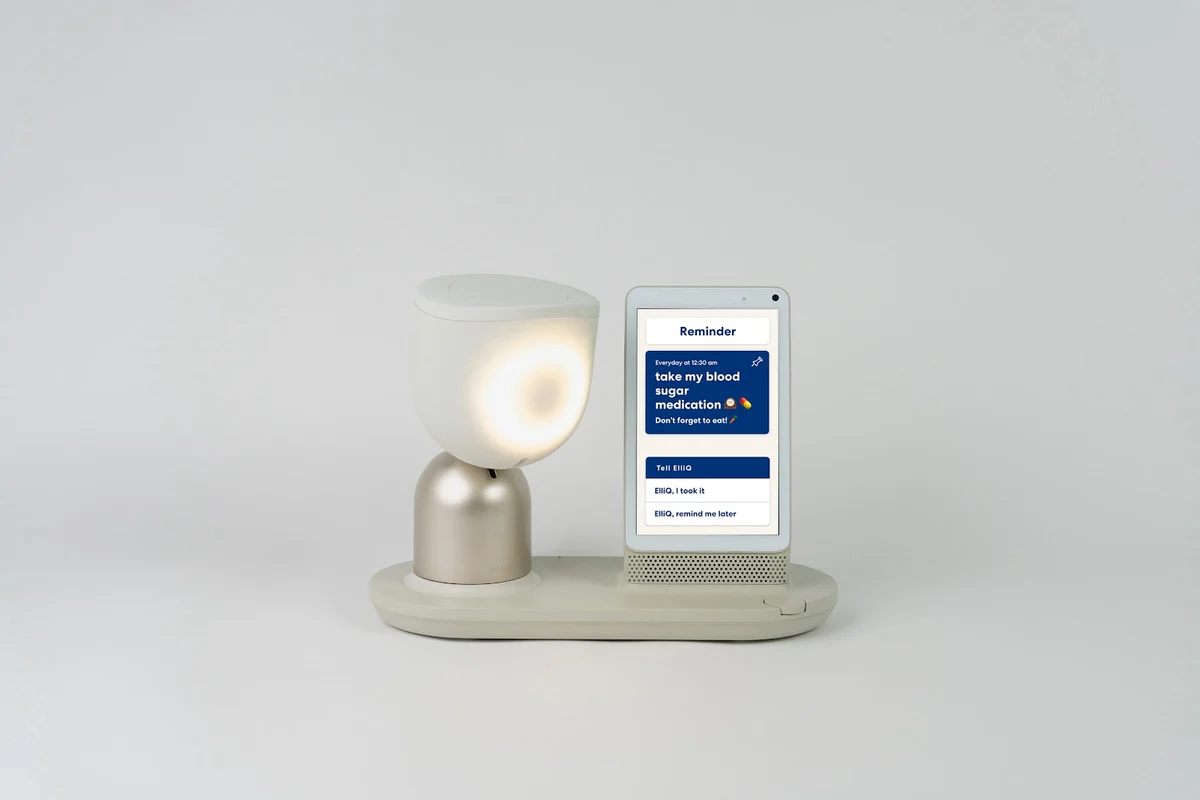
ElliQ is a tabletop companion robot made by Intuition Robotics. It has a lamp-like head that turns and lights up, and a tablet screen beside it. It starts conversations, gives medication reminders, suggests activities and connects to family through a caregiver app. Nothing about it moves around the house. It doesn’t lift, fetch or touch anyone.
More Read

The part that matters for an older person is that it speaks first. A smart speaker waits for a wake word. ElliQ’s privacy policy explains how the robot decides to talk: its cameras and microphones “monitor their immediate surroundings and ambient sound to detect whether the User is nearby.” Some people love that. One Reddit commenter set one up for their mother, who has mild dementia, and wrote the same day: “Ma’s not a fan. She’s not understanding the purpose.” They expected to find the robot “unplugged when I get home tomorrow.” Another commenter’s mother, 82 and living alone, has one “and she loves it.”
My read on who ElliQ suits is narrow. It fits an older person who lives alone, is still sharp enough to enjoy a conversation, and finds a phone hard to use. It’s a poor fit for someone who dislikes a machine talking to them, and for someone whose dementia makes a voice from a lamp frightening. Talk it over with your parent before the robot arrives. A robot your parent unplugs in week one costs you the return fee and a trip to the post office. One they unplug in month three costs the year.
The price on ElliQ’s own checkout
On October 15, 2026, ElliQ’s checkout offered three memberships: $39 a month on a 24-month plan, $49 a month on the annual plan, and $59 a month with no commitment. The annual plan is the one marked “MOST POPULAR,” and the page says “$588 is billed today for your 12-month ElliQ membership.” Every plan adds a “Lease initiation fee $249 / one time.” The checkout summary for the annual plan reads “Subtotal: $837.”
That $837 is the number to remember. Month to month, a first year comes to $957. The annual plan comes with a “30-day risk-free trial,” and the page advertises “Free returns,” yet the terms say a cancelled trial gets its fees back “less a return fee in the amount $49.99.” The trial is for first-time buyers, and the terms count the enrollment fee among the fees returned. After it, “A Subscription Period is not cancellable, and Subscription Fees for such Subscription Period are not refundable,” except where the terms or a separate agreement say otherwise. Year two on the annual plan is $588, if the checkout’s renewal wording holds. A “Free Month on us” badge was showing that day, which is a promotion, not the price. ElliQ’s FAQ is plain about ownership: “At this time, ElliQ is only leased through a membership.”
Google gives a different answer. Its AI Overview for “care robots for the elderly” told me ElliQ “Costs range from roughly $360 to $600 annually depending on the plan.” No current plan matches that range. The $360 matches an older annual plan: a product page still live on elliq.com carries the title “Annual Subscription ($359.88).” The $600 matches a $49.99-a-month plan printed on that same page. Both numbers come from ElliQ’s own older pages, and neither includes the $249 fee.
The blog the Overview cites can’t agree with itself. Its comparison table says “~$250 + $30/mo,” one paragraph says “ElliQ is around $250 plus $30/month subscription,” and another says it “costs around $250 plus $49.99–$59.99/month.” A family that asks a search engine what ElliQ costs gets a number no current plan matches.
What the ElliQ terms say
ElliQ’s Terms of Use, “Last updated: January 1, 2026,” are blunt about four things. You don’t own the robot: “the ElliQ Device is not and may not be, purchased, but it is rather loaned to the User.” It needs your home network: it “may not be operated or used without an ElliQ Device, a valid User account, and a WiFi internet connection and electricity.” It won’t call for help: “You acknowledge that you cannot use the ElliQ Solution to access emergency services, such as 911.” And in capital letters, “ELLIQ IS NOT A MEDICAL DEVICE.”
Then there’s the return. The terms set “a late return fee in the amount of $1,500,” and the FAQ puts the deadline plainly: “If ElliQ is not returned within 45 days after cancellation, a device non return fee of $1,500 applies.” If your parent moves into care or dies, someone has to box the robot up and ship it back. Put that on the list now.
The renewal wording doesn’t match. The checkout says that after 12 months “your membership will renew for another 12 months.” The terms say a subscription will “automatically renew to a new monthly Subscription Period, regardless of the expiring Subscription Period’s basis (annual or monthly).” Those are different contracts. Before you pay, ask ElliQ in writing which one applies, and keep the reply.
Because ElliQ needs Wi-Fi to work, the router in your parent’s home is part of the care plan. If the signal drops in the room where the robot sits, ElliQ goes quiet. Fix a weak link before the robot arrives; my notes on which routers hold a signal through walls cover what to check.
Robot pets for the elderly: PARO, Joy for All and the dementia question
Robot pets for the elderly are the one kind of care robot here with a published randomized trial behind it, PARO’s, and the Joy for All kind is the cheapest care robot in this article. A Joy for All cat costs $159.99. PARO, the robotic seal used in hospitals, has no public US price at all. Both are sold for comfort by touch, and both makers point to people living with dementia.
The Joy for All cat

The Joy for All Companion Pet cat is a battery-powered robot cat for older adults. It purrs, meows and moves when someone strokes it or when it senses motion. On October 15, 2026, the maker’s store listed three colors, each at $159.99, with an “Add to Cart” button and a 4.5-star rating across 763 reviews. The dog version, the Companion Pup, was listed at $179.99 and marked “Out of Stock – Available on Amazon.com.”
Two lines on the product pages matter more than the price. The pup needs “4 C batteries,” and both pages warn: “Do not soak the fur or place under running water.” For someone who eats with the pet in their lap, that rule bites. One family member described what happened to a mother’s cat: “Now it just sits on a chair in her room like an expensive furry ornament, only with spaghetti sauce on its head ha.”
Others had the opposite result. A commenter in a dementia support forum wrote that the cat stopped their mother from constantly asking for a real cat. A long-term-care worker in the same thread added the most useful sentence I read in the whole forum: “Residents who are at the right stage love them, but i find there is a very particular sweet spot of the disease+personality where it works and then it stops.”
PARO, the robotic seal

PARO is a robotic baby harp seal developed in Japan and used mostly in care homes and hospitals. Its US site prints no price. It does link to an old Wall Street Journal story headlined “It’s Not a Stuffed Animal, It’s a $6,000 Medical Device.” That $6,000 is the figure care sites still repeat, and it’s not a current price.
The “medical device” part needs a closer look. PARO Robots US describes the seal online as “an FDA cleared Class II Medical Device in the US, since 2009.” PARO’s record in the FDA’s device identifier database lists it under product code HCC, “Device, Biofeedback,” with “Prescription Use (Rx): Yes.” The same record says “Premarket Submission Number Not Available/Not Released” and “Device Exempt from Premarket Submission: Yes.” I also searched the FDA’s 510(k) clearance database for PARO and its makers and got no records.
The FDA rule for biofeedback devices, 21 CFR 882.5050, puts them in Class II and exempts them from premarket notification when the device is “a prescription battery powered device that is indicated for relaxation training and muscle reeducation.” So PARO is listed with the FDA as a prescription device that didn’t have to go through premarket review. That isn’t the same as being cleared. If you want to see what a real FDA safety record on a home device looks like, I walked through one in how an FDA recall reads for a CPAP machine.
PARO has been through a large randomized trial, and the result is humbling. In a cluster randomized trial published in 2017, residents with dementia across 28 long-term care facilities got PARO, a look-alike plush toy with the robotics switched off, or usual care. Sessions ran 15 minutes, three times a week, for 10 weeks. The authors’ conclusion: “Although more effective than usual care in improving mood states and agitation, PARO was only more effective than a plush toy in encouraging engagement.”
Are robot pets good for people with dementia?
Robot pets help some people with dementia some of the time, mostly in supervised care homes. That’s where the studies were done. At home, alone, the picture is less clear, and even the agencies that hand these pets out disagree with the makers.
Joy for All’s own page says its pets “have also been shown to reduce incidents of dementia-related agitation.” New York State hands these pets out by the thousands, yet a CBS New York report from August 2026 says the state’s robots and pets “aren’t given to seniors with dementia because studies show they may cause confusion instead of comfort.” Both can be true. New York’s programs serve older adults living at home, often alone, where nobody is there if the pet frightens or confuses them. The trials ran with staff in the room.
Families in the forums landed in the same place. One commenter brought a robot cat to an aunt in her last weeks: “She threw it across the room as soon as I handed it to her.” Another commenter skipped the robot and gave a late-stage patient a realistic plush puppy, and wrote that “the robot part isnt necessary.” If you’re not sure, the cheapest test is a regular stuffed animal first.
Robot dogs are a bigger topic, from the Joy for All pup to Sony’s aibo and Tombot’s puppy. I covered them in robot dogs for dementia care and the rest of the market, including what each one needs from its maker to keep working.
Feeding robots: the one kind of physical help you can buy
Feeding robots are the only care robots for the elderly on sale to US households that do physical work on the body. It’s a narrow market. They’re for people whose arms no longer get food to their mouths, because of conditions that, in one maker’s words, “completely or severely impair the upper extremities.” They cost about as much as a used car.
Obi
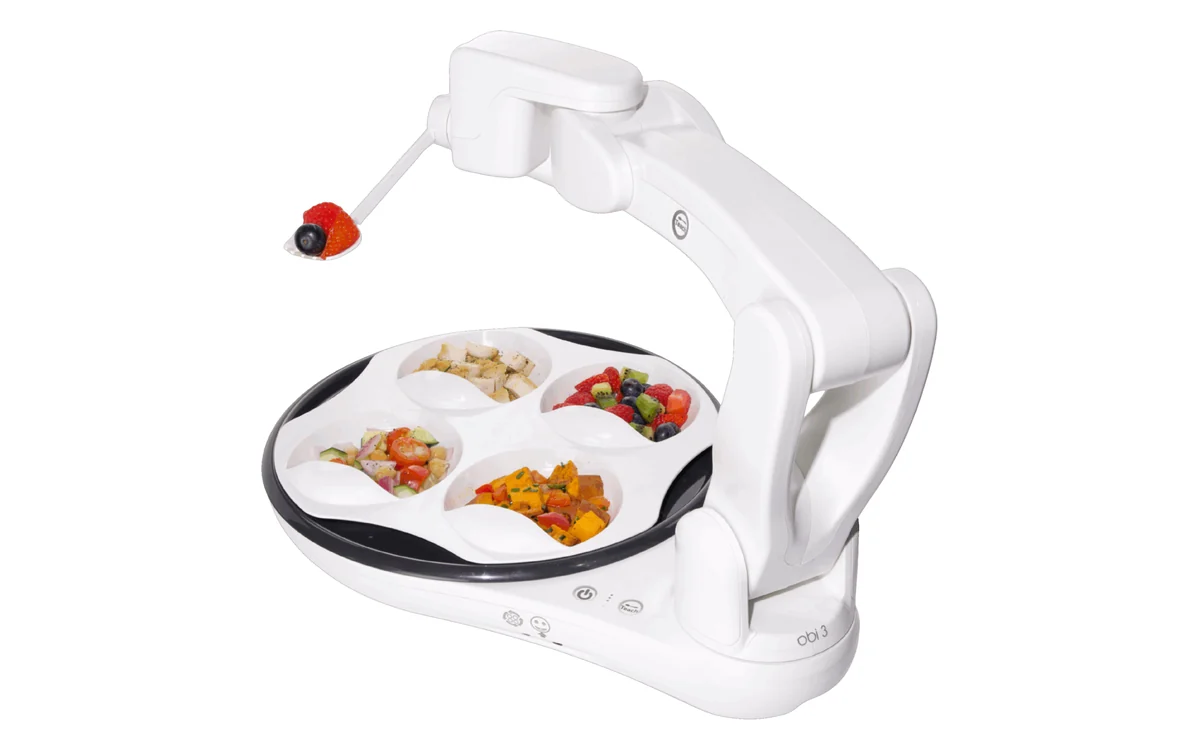
Obi is a robotic arm on a base with a four-section plate, and it brings food from the plate to the user’s mouth. In a study protocol filed on ClinicalTrials.gov, its maker, Desin, describes it as “a reusable robotic utensil intended to compensate for the function of a human arm” at meals. The same protocol calls Obi “a Class I, 510K Exempt medical device” and says “over 3,000 devices have been sold across 20 countries.”
Obi’s own shop lists “Obi Robot Generation 3” with no price, next to spoons at $71. Its pricing page says only “Contact Us for Specials.” The retailer SpinLife lists the Generation 3 robot “Starting at $12,950.00,” against a list price of $19,950. Here the retailer’s price is the only public one. One family member on an ALS forum explained what the money buys better than any spec sheet: “she got some dignity back by being in control of eating.”
Before anyone spends $12,950, ask the doctor for a referral to an occupational therapist. A feeding arm has to fit how the person sits, swallows and signals, and that’s the therapist’s assessment to make. The therapist also writes the paperwork an insurer or a state program will ask for. Skip that step and you risk $12,950.
Robots that lift, move or bathe a person: where they really are
A robot caregiver that lifts a person from bed, helps them stand or bathes them is not something you can buy for a home in 2026. The ones in the videos are prototypes, experiments or Japanese facility equipment. Each famous one has a document that says so.
MIT’s E-BAR is “a mobile robot designed to physically support the elderly and prevent them from falling as they move around their homes,” according to MIT News in May 2025. It sits on “a heavy, 220-pound base,” and its arms carry airbags to catch a fall. It’s a lab prototype “operated via remote control.” The MIT team itself calls the field “an unexplored frontier in America.”
RIKEN introduced ROBEAR in 2015 as “a new experimental nursing care robot,” a 140-kilogram, bear-faced machine that lifts a patient from a bed into a wheelchair. Panasonic’s Resyone Plus, a care bed that splits in half to become a wheelchair, was sold in Japan; Panasonic’s product page now marks it “生産終了,” production ended. None of the three is for sale.
Japan is the country much of the coverage uses as proof that these machines work. Japan’s health ministry did pay for them, but the money went to care facilities. Its program rules for the 2015 grants covered robots for transfer, mobility, toileting, monitoring or bathing, priced over ¥200,000 and brought into long-term care facilities and providers. One condition reads “販売価格が公表されており、一般に購入できる状態にあること”: the price must be published and the product on general sale. The subsidy paid the facility, not the family.
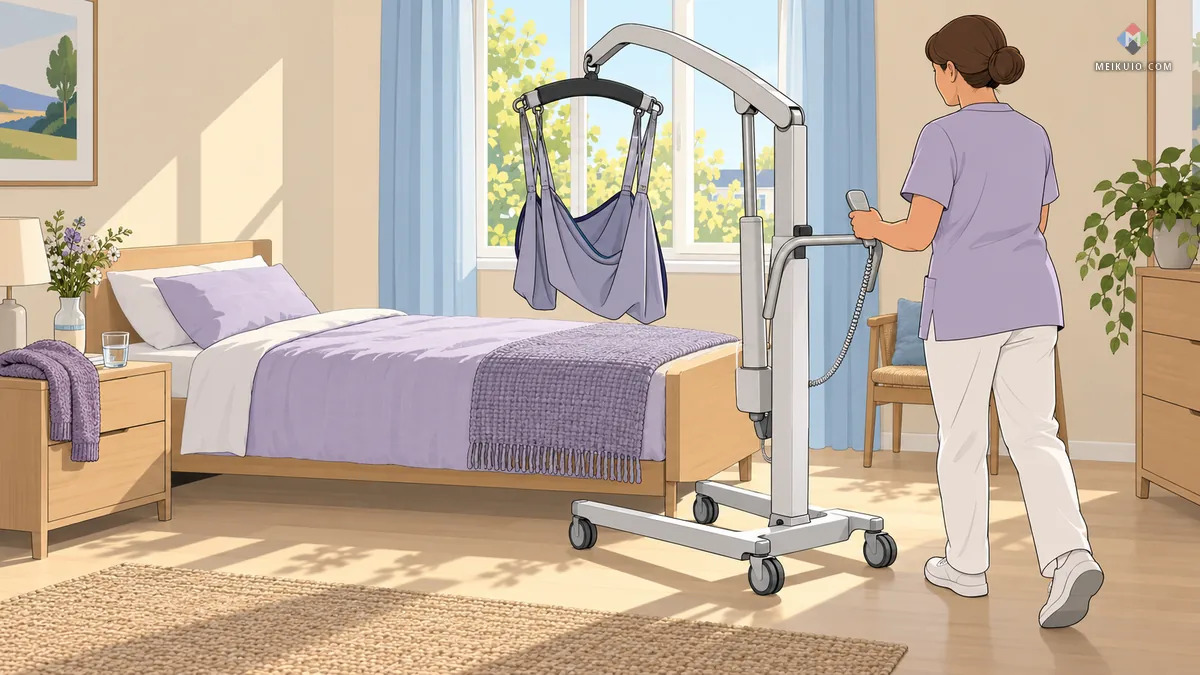
What lifts a person at home today is a patient lift with a human at the controls. Medicare’s coverage rule for lifts is specific: “A patient lift is covered if transfer between bed and a chair, wheelchair, or commode is required and, without the use of a lift, the beneficiary would be bed confined.” That’s the machine to ask a doctor about. It isn’t the machine in the videos, but it’s the only one in this article that lifts a person at home. Powered suits that help a person walk are a separate category, and I went through the claims in what exoskeletons cost and what they prove.
Humanoid robots are the other thing in the videos. The home humanoids on offer today are general-purpose machines, not care devices, and what a home humanoid costs runs far above anything here. The paid work humanoids do so far is mostly in factories and warehouses, which I tracked in the jobs humanoid robots are actually doing.
How much does an elderly care robot cost?
An elderly care robot costs from $159.99 for a robot cat to about $12,950 for a feeding arm, and most care robots for the elderly sit at the bottom of that range. ElliQ, the best-known companion, comes to $837 for its first year and keeps billing after that. Count the whole lease, not the monthly rate. The machines that would cost the most, the lifting robots, have no price because they aren’t sold to families.
Medicare won’t pay for a companion or a pet. Its definition of durable medical equipment requires something that “Is primarily and customarily used to serve a medical purpose” and “Generally is not useful to an individual in the absence of an illness or injury.” A robot that chats and reminds fails both tests, and ElliQ’s own terms say it’s not a medical device. So the elderly care robot price to plan for is what you pay yourself, unless a state program pays it for you.
How can you get a care robot for free?
You can get some care robots for the elderly free, depending on the state: ElliQ or a robotic pet, through the local office for the aging or Medicaid. New York and Washington are the two clearest cases I found. Where you live decides whether this works.
New York’s State Office for the Aging runs the largest program I found. Its page says “NYSOFA’s program includes approximately 900 units being made available to older adults in the community,” and that it works “with local offices for the aging to identify older adults who would most benefit.” It also warns that units are available “only in participating counties/offices and subject to the availability of funding.” CBS New York reported in August 2026 that state officials counted “900 ElliQ companions” placed in homes, “More than 40,000 therapeutic robot pets” distributed, and “a waitlist of about 300 New Yorkers for an ElliQ robot.” Expect to wait.
The state’s page also claims “a 95% reduction in loneliness” from a 2023 report. Read that as what users told the program, not as a trial result. ElliQ’s randomized trial on ClinicalTrials.gov, more on that below, hasn’t posted any results.
Washington went further. Since March 2026, the state has offered ElliQ as a “Smart Care Device” to Medicaid recipients in two of its in-home care programs, Community First Choice and Roads to Community Living. Washington’s Department of Social and Health Services runs both, and Intuition Robotics told The Robot Report that case managers identify eligible people and refer them. If your parent is on Medicaid in Washington and gets in-home care, ask the case manager about ElliQ by name.
In New York and Washington, the cheapest way to get ElliQ is to qualify for a program that already pays for it.
Everywhere else, start with two calls. The first is your county’s Area Agency on Aging, the local office for older adults, where New York’s program runs. The second is your state’s assistive technology program; the national AT3 Center keeps a directory of them by state and territory. Michigan’s, for example, runs a “FREE device loan program” that lets you “borrow assistive technology and use it in your own environment for an extended period, typically 14-45 days.” Whether a given state lends a robot is up to its inventory, so ask before you buy.
What happens when the company behind the robot shuts down?
When a care robot’s company shuts down, the robot usually loses whatever ran on the company’s servers, which for a companion is most of it. This has happened often enough to home robots, and to robots for elderly people, that it belongs in the decision. Four cases show the range.

Amazon’s Alexa Together is the closest case to ElliQ: a caregiver service that let families watch a parent’s daily activity through Echo devices. It launched at “$19.99 a month or $199 per year.” Amazon’s announcement page now carries the line “Update May 21, 2025: Alexa Together is no longer available. You can now subscribe to Alexa Emergency Assist for remote caregiver service.” Families felt it. “Now that she is 90 and very frail, this is the worst possible timing for AT to be discontinued,” one wrote. Another had relied on it to “notify me at the first activity at my elderly Moms house in the morning.”
The others went better or worse. Mayfield Robotics stopped making its Kuri home robot in July 2018, and The Robot Report wrote at the time that “All pre-order deposits will be refunded to customers.” Keecker, a French home robot, pushed one last update in March 2019 that “removed its dependencies on its servers,” so owners kept movies and music but lost features such as remote video. Jibo’s owners got lucky: when NTT Disruption bought the company’s assets in 2020, its president said “Jibo will remain operational for the people who already bought it.”
ElliQ’s terms keep the door open for the same thing: “We may change, suspend, or discontinue the ElliQ Solution, or any part of it, at any time without notice.” Because the device is leased, you’d risk less than an owner who paid for the hardware, though a prepaid plan would still be at stake. You’d still lose the companion your parent got used to. Before you sign, ask ElliQ in writing what happens to a prepaid plan if the service ends. The same logic applies to robot pets with apps, which I traced in what happens to a robot dog when the servers go off.
What a care robot hears and sees in your parent’s home
Among care robots for the elderly, a companion like ElliQ uses cameras and microphones to sense the room, and the health details your parent tells it aren’t protected by HIPAA. The privacy policy says so itself.
ElliQ’s privacy policy, “Last updated: January 1, 2026,” says its cameras and microphones “monitor their immediate surroundings and ambient sound.” It lists health information it may collect, including “diagnosis, test results, treatments and prescriptions,” and “the contents of your interaction with ElliQ, which may include text/video/audio data of such communications.” It says “The ElliQ Devices will provide a visual light ring indication, to reflect that its microphone is on and is sensing the rooms sounds.” HIPAA is the federal law that protects medical records held by doctors, hospitals and health plans. On HIPAA, the policy says the services “are not subject to the Health Insurance Portability and Accountability Act of 1996.” After an account closes, “we will retain your personal information for at least 6 years.”
The footer of that same page carries a link titled “Designed for HIPAA Compliance.” Both lines are ElliQ’s. The operative one is the policy text, which says HIPAA doesn’t apply. The footer more likely describes how ElliQ works with health plans that deploy it, but the page doesn’t say that, so I’m reporting the contradiction as it stands. Assume the room is heard.

Settle two more things before a camera goes into a bedroom. Decide with your parent, not for them, what the caregiver app shows and who sees it. And remember that an older person who’s used to a friendly voice from a machine is an easier target for a fake one. With your parent, go through my guide to spotting an AI voice scam, and if you’re also managing their accounts, what family identity theft plans cover explains which parent a family plan includes.
Do you need a robot at all?
Often you don’t. A smart speaker, a simple tablet or a scheduled phone call can do most of the same jobs as a companion elderly care robot, for a fraction of ElliQ’s $837 first year. What a robot adds is that it speaks first and has a face. Whether that’s worth the money depends on whether your parent will start a conversation with anything. Try the cheap option first.
The evidence doesn’t settle it. The randomized trial of ElliQ registered on ClinicalTrials.gov, NCT03972787, enrolled 54 people and finished on July 31, 2020; its record shows no posted results. A 2024 paper on ElliQ, written with Intuition Robotics staff among its authors, says “randomized controlled trials are needed to establish its efficacy compared to other forms of intervention.” None of the research engines I used, and none of my own searches, found a trial comparing a companion robot with a speaker, a tablet or a phone call.
Amazon now points families to Alexa Emergency Assist “for remote caregiver service,” and the name tells you its focus: emergencies, the one job ElliQ’s terms rule out. Simple tablets and video-calling frames built for older users exist for exactly the calls-and-photos part of the job. If you’d rather start with cheaper hardware, I sorted the AI gadgets worth buying by what they really do.
If falls are the worry, a care robot is the wrong tool. ElliQ’s terms rule out 911, and no robot sold for homes picks a person up. A medical alert pendant or a fall-detection service is the device built for that job. Ask the doctor whether a patient lift belongs in the plan too.
How to tell a care robot video from a product you can buy
You can tell a lab video from a product in about ten minutes, without any technical knowledge. I used the same checks on every elderly care robot in this article.
Start with the source. A video from a university news office, a research institute or a trade show is showing research. MIT’s E-BAR story says in its own text that the robot is a prototype. RIKEN’s ROBEAR release says “experimental.” A product page from the maker with a cart or a price is the clearest sign a household could get the thing. A quote form means it’s for sale to someone, usually a facility.
Then look for the boring documents. A real product has terms of use, a privacy policy, a return policy and a user guide, because a company that takes money has to publish them. ElliQ has all four. Joy for All has user guides linked from its product pages. A robot with a launch video and none of those papers isn’t for sale to you yet, whatever the headline says.
Last, check who the buyer is. A button that says “Get a Quote,” as on Blue Frog’s Buddy page, or a menu that leads with “For Healthcare,” as on temi’s site, usually means the maker sells the machine to facilities. Facility sales are fine. They mean your parent would meet the machine in a care home, not in their kitchen. If the only way to get a robot is through a facility contract, it isn’t a home care robot, however it’s pictured.
Questions to ask before you get one
Before you lease or buy any robot for elderly care, I’d run through these eight questions with whoever will live with it.
- Can your parent start a conversation with a machine, or will it need to start every one?
- Does the robot work without Wi-Fi and the maker’s servers, and what’s left of it if the company stops?
- Is it bought, or leased with a return deadline and a non-return fee?
- Does it have a camera, and can your parent see when it’s on?
- Can it call for help, or does its own contract say it can’t?
- Can it be washed, charged and set up without you in the room?
- Does your county office for the aging, your state’s Medicaid or its assistive technology program already hand one out?
- If the maker says “FDA,” does the FDA’s own record say the same thing?
The FDA check takes two minutes. The agency publishes searchable device records, the same kind of database I used for the FDA’s list of AI-enabled devices in which healthcare companies actually hold FDA records.
Field notes
- ElliQ price: $39 a month (24 months), $49 a month billed yearly ($588) or $59 month to month, plus a one-time $249 lease fee; $837 for the first year on the annual plan, checked October 15, 2026.
- ElliQ terms: leased, never sold; no 911; “ELLIQ IS NOT A MEDICAL DEVICE”; $1,500 fee if not returned within 45 days of cancelling.
- Robot pets: Joy for All cat $159.99, pup $179.99 (out of stock on the maker’s store); PARO prints no US price.
- PARO and the FDA: listed as a prescription biofeedback device, product code HCC, exempt from premarket submission; no 510(k) clearance found.
- Feeding robot: Obi Generation 3, from $12,950 at SpinLife; the maker calls it a Class I, 510(k)-exempt device.
- Free programs: New York, about 900 ElliQ units and more than 40,000 robot pets; Washington Medicaid, ElliQ through Community First Choice and Roads to Community Living since March 2026.
- Sources: ElliQ checkout, Terms of Use and Privacy Policy; FDA AccessGUDID record for PARO and 21 CFR 882.5050; ISO 13482:2014; New York State Office for the Aging; ClinicalTrials.gov NCT03972787; Moyle et al., JAMDA 2017.
Frequently Asked Questions
What are care robots for the elderly, and what do they do?
Care robots for the elderly are machines that take over part of a care task: talking, reminding, comforting, watching, fetching, feeding or moving a person. The ones sold to US families in 2026 talk, remind, comfort and feed. Robots that lift or bathe a person aren’t sold for homes.
How much does an elderly care robot cost?
From $159.99 for a Joy for All robot cat to about $12,950 for an Obi feeding arm. On October 15, 2026, ElliQ, the best-known companion robot, cost $837 for its first year on the annual plan, including a one-time $249 lease fee.
Is there a free AI companion robot for seniors?
Yes, in some places. New York’s Office for the Aging makes about 900 ElliQ units available through participating county offices, and Washington State’s Medicaid offers ElliQ through two in-home care programs. Elsewhere, ask your county’s Area Agency on Aging first.
Are there free robotic pets for seniors?
Yes, through some state and county aging programs. New York officials said in August 2026 that the state had distributed more than 40,000 robot pets. Your local office for the aging or your state’s assistive technology program will know whether yours lends or gives them out.
Can a robot be a caregiver for an elderly person?
Only for part of the job. A companion robot can talk and remind, a robot pet can comfort, and a feeding arm can lift a spoon. No robot sold for homes can lift, bathe or dress a person, and ElliQ’s own terms say it can’t reach 911.
Does Medicare pay for a companion robot or robotic pet?
No. Medicare’s equipment rules require an item used mainly for a medical purpose that isn’t useful to someone without an illness or injury. Companion robots and ordinary robot pets fail that test. Washington’s Medicaid offers ElliQ in two in-home programs, and New York gives units out free.
Is the PARO robotic seal FDA approved?
Not in the way the phrase suggests. The FDA’s device record lists PARO as a prescription biofeedback device that’s exempt from premarket submission. I found no 510(k) clearance for it. Listed and exempt isn’t the same as cleared or approved.
Are robot pets good for people with dementia?
Sometimes, mostly in supervised care homes. In a 2017 trial in 28 facilities, PARO beat a look-alike plush toy only at encouraging engagement. Care workers describe a narrow stage of the disease where the pets work. New York’s program doesn’t give them to seniors with dementia.
Is there a robot that can lift an elderly person at home?
Not one you can buy. MIT’s E-BAR is a remote-controlled prototype, and RIKEN introduced ROBEAR as an experiment that isn’t sold. At home, the lifting device is a conventional patient lift run by a person, which Medicare covers when someone would otherwise be confined to bed.
What is the downside of using robots in elderly care?
Companion robots can collect audio and video of conversations in the home, fall outside HIPAA and can stop working when the maker’s servers do. Robot pets can confuse some people with dementia. And I found no trial showing a companion robot beats a phone call.
My Take
The care robot for the elderly that you see in the news doesn’t exist yet. What exists is a talking lamp on a lease, a robot cat you can’t put under the tap, and a feeding arm that costs as much as a used car and changes a life for the right person. The marketing calls all three caregivers. Their own paperwork doesn’t: ElliQ’s terms say it isn’t a medical device and can’t call 911, and PARO’s FDA record says exempt, not cleared. That gap between the word and the documents is the whole story.
If I were choosing for my own parent, I’d make two phone calls before spending anything: the county office for the aging and the state assistive technology program. If they can’t help, I’d try a $159.99 robot cat or a plain stuffed animal for someone with dementia, and a scheduled phone call for someone who’s lonely. I’d lease ElliQ only for a parent who’d actually talk back to it, and I’d write the 45-day return deadline on the box the day it arrives.