



A team of three picks a community platform this quarter, and the choice looks like an $89 line against a $100 line. The card price is the wrong comparison, because four of the six plans below also take a share of what members pay.
- What is a community platform?
- The four things vendors actually meter
- Circle prints one rate on the page and another in the contract
- Skool charges more on paper and less in practice
- Mighty Networks sells three plans and documents five
- How to add up what a community platform really costs
- One community, six bills
- Fit first, then the bill
- The five platforms worth pricing
- Inside the app, the rate is not the vendor’s
- Online community software you host yourself
- The stack you have already paid for
- When the answer is an API rather than a platform
- The part of the market that will not print a price
- What it costs to email your own members
- What you take with you when you leave
- Is a free chat app enough?
- Who this market serves worst
- How to choose without guessing
- How these numbers were checked
- Frequently Asked Questions
- What is a community platform?
- What does it cost to run one each month?
- Do these tools take a cut of your sales?
- Is Skool cheaper than Circle?
- Is Discourse really free?
- What happens to your members if you leave?
- Do you pay Apple’s fee inside a community app?
- Do you need a community platform at all?
- My Take
Four of the six plans in the example below sit inside the payment path, the route money takes from a member’s card to your bank. They take a percentage of what members pay you, so the bill grows every time the community works.
The others charge a flat subscription and never touch member revenue, and that difference decides who approves the spend. A flat $500 a month is a budget line the finance lead signs off once a year. A percentage of member payments is a variable cost nobody owns until it lands in the quarter.
The five platforms priced here meter four different quantities between them. Circle, Skool and Mighty Networks bill on a share of member payments. Bettermode bills on how many members exist, whether or not any of them pay. Discourse leaves member revenue alone and meters the operation instead: staff seats, plus activity in the form of page views and email volume. The quantity a vendor meters says more about the long-run cost than the number on the card does.
One gap matters before the numbers start. On at least one vendor, the rate printed in the comparison table and the rate written into the contract your team signs differ. Every price and rate below was read on the vendors’ own pages on 13-14 August 2026.
What is a community platform?
A community platform is hosted software that gives an organization its own membership space: profiles, discussion areas, courses or events, and a paywall, the gate that takes payment before a member gets in. It replaces a Slack or Discord group with something the operator controls. Whether that swap is worth making is settled further down, in “Is a free chat app enough?” Vendors differ mainly in whether they sit inside the payment path and take a share of what members pay.
More Read

That payment question splits the market into four classes, and the class matters more than the feature list. The first class is the creator platforms that process member payments and keep a cut. Circle, Skool and Mighty Networks all work this way. The percentage is small on paper, but it applies to gross member revenue, so it scales with the thing your team is paid to grow.
The second class is the software vendors that stay out of the payment path entirely and charge a flat subscription. Discourse and Bettermode belong here, so your team keeps the member revenue. The Discourse pricing page never mentions a transaction fee, not in the text a buyer reads and not in the page’s underlying code. Bettermode publishes no cut of member payments either.
The third class is the enterprise and association portals sold through a demo call, and Hivebrite publishes a starting price of $895 a month billed annually. Higher Logic offers only “Flexible pricing for associations of all sizes”, Gainsight shows “Request Pricing”, and Khoros has no pricing page at all. Budgeting for this class starts with booking a call.
The fourth class is the open source engines: Discourse under GPL 2.0 or later, Flarum and NodeBB under MIT. HumHub’s Community Edition is listed under AGPL v3 by secondary sources, which we have not confirmed in the project’s own repository. There is no per-member charge because there is no vendor in the payment path. Your team supplies the server, the mail service and the person who owns upgrades, which is a headcount question rather than a software one.
The category name itself is loose. Google’s first result for that exact two-word query, measured on 14 August 2026 with personalization off, is community.com. That product sells text-message marketing rather than community software.
Note
All prices, comparison-table rows and contract lines quoted in this article were read on the vendors’ own pages on 13-14 August 2026. On at least one vendor the contract rate differs from the pricing-table rate. Confirm the current figure on the vendor’s page before your team commits a budget line.
The four things vendors actually meter
Vendors meter four quantities: a share of member payments, the number of members, staff seats, and activity such as page views, emails and storage. The monthly price is the least useful number in this category, because two plans can look identical on the card and separate sharply once one of those four starts growing. Take a community of 1,000 members where 100 of them pay $25 a month, so $2,500 a month in member revenue, run by a team of three. That is 100 separate payments, and on some vendors a fixed per-transaction fee lands on each one alongside the percentage.
No two of these five vendors meter the same set of the four quantities that build a bill.
Discourse Pro is $100 a month and takes no cut, with all three staff inside the five included seats. Circle Professional is $89 plus 2% of $2,500, so $139 a month before the Stripe fee that Circle states sits underneath. Circle publishes two different rates, a ladder on its pricing page and a flat 0.5% in its contract. Every Circle figure in this article uses the pricing page’s 2%, the higher of the two; on the contract rate the same month would carry $12.50 instead of $50. The cheaper card costs more in practice.
Circle Professional matches Discourse Pro at $550 a month in member revenue, because $89 plus 2% of $550 equals $100. Any community earning more than $550 a month pays more on the plan that advertises the lower price.
The same trap sits inside a single vendor: Skool Hobby is $9 a month with a 10% transaction fee, and Skool Pro is $99 a month at 2.9%. Both plans also charge 30 cents per transaction, which is $30 across those 100 payments. On a $25 membership that fixed fee is another 1.2% of revenue, so it behaves like a percentage even though the card prints it as cents. Hobby costs $289 a month on that $2,500, against $201.50 on Pro. They still cross at about $1,268 in monthly member revenue, because the identical fixed fee cancels out on both sides. The $9 plan stops being the cheap one well before a community feels established. The same discipline applies to pricing social tools by what they actually cost per month.
Member-count metering behaves differently. Bettermode Starter is $399 a month billed annually, covers up to 10,000 members, and takes no cut on payments at all. A 1,000-member community pays the same as one at the 10,000 ceiling, and that headroom is waste or runway depending on the growth plan your team committed to. Comparing vendors that bill for completely different units is the hard part of this comparison.
Staff seats are the quantity that surfaces only when someone new needs access. Circle caps admins at 3 on Professional and 5 on Business, and charges “$20/mo per 10 moderators” beyond the included allowance. Discourse gives 2 staff seats on Free, 5 on Pro and 15 on Business, and Bettermode allows 5 collaborators on Starter and 10 on Growth. A single new hire can move the plan.
One warning on that last row: Mighty’s documentation puts a 5% transaction fee on the Explore plan, a rate that does not appear on its pricing page. The free tier carries a higher rate on member payments than the $79 plan does. Discourse’s free plan is the only free tier in that row with no percentage attached.
Circle prints one rate on the page and another in the contract
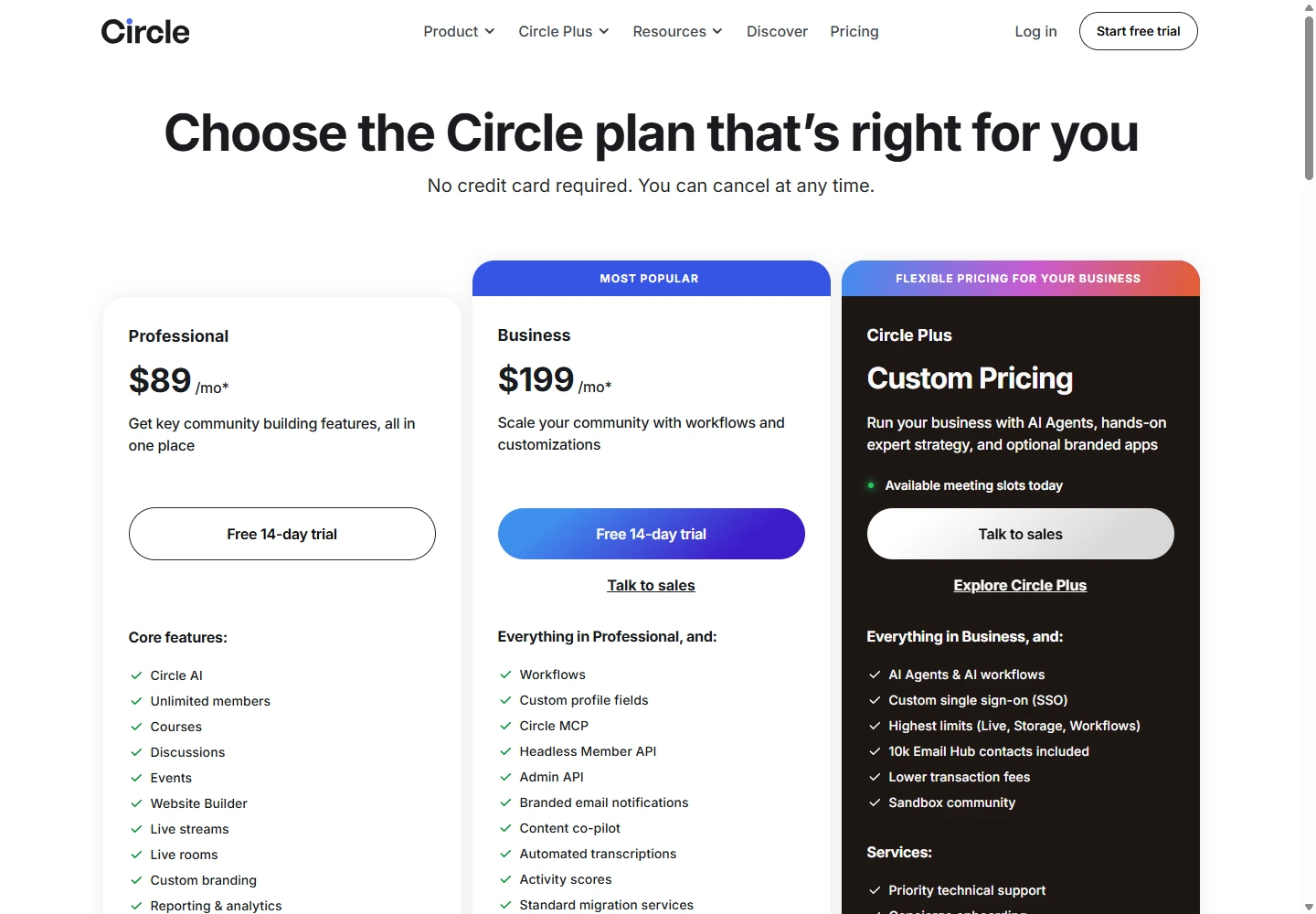
A team approving Circle at $89 a month still has one number to find: the share of member payments that leaves with the vendor. The pricing page answers with a ladder of 2%, 1% and 0.5%. The Creator Terms of Service answers with one flat rate of 0.5%. The two answers build different budgets.
The three numbers live in a row named Transaction fees inside the plan comparison table, and nothing above that table prints them. A tooltip on them is collapsed by default; opened, it says the fee is charged in addition to the standard Stripe processing fee. The Circle Plus card sells the benefit in words, with a feature bullet reading Lower transaction fees and no percentage beside it.
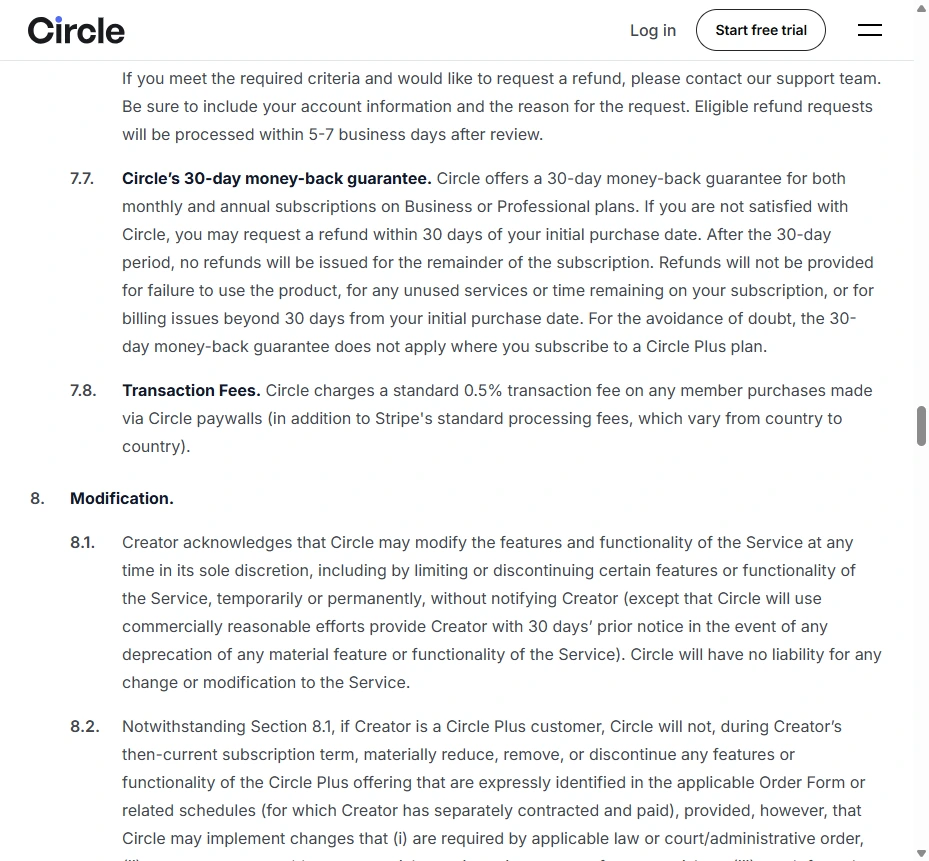
Circle’s Creator Terms of Service, last updated July 8, 2026, states in section 7.8: “Transaction Fees. Circle charges a standard 0.5% transaction fee on any member purchases made via Circle paywalls (in addition to Stripe’s standard processing fees, which vary from country to country).” One rate, called standard, with no plan attached to it.
A community platform bill has three moving parts, the subscription, the cut of member revenue and the processor underneath it, and on Circle’s card only the first carries a number. Take 1,000 members where 100 pay $25 a month, so $2,500 in member revenue. On Professional, the pricing page rate of 2% takes $50 and puts the monthly bill at $139. The contract rate of 0.5% takes $12.50 on the same revenue.
Neither figure closes the bill, because both documents put Circle’s cut on top of Stripe’s processing fee. The $139 is a floor at that revenue, and neither document prints the processor’s rate. A finance approver asks about that first, and the pricing page has no answer.
The two rates could not be reconciled from the published documents. The contract page never prints 2% or 1% anywhere, and nothing in either document says which rate governs a Professional account. A buyer sees the pricing page first; the contract is what gets signed. A team should put that question to Circle in writing and keep the reply with the invoice.
The safety net has a hole in the same place. Section 7.7 gives a 30-day money-back guarantee on Business or Professional, then excludes Circle Plus. So the plan with the least published pricing is also the one a team cannot unwind inside a month. The gap between a published rate and the rate a creator is actually charged turns up in newsletter tools too; our breakdown of Substack alternatives in 2026 shows how platform fees scale across different member volumes. The fix is the same: read the agreement before the quarter’s budget is committed.
Skool charges more on paper and less in practice
A team comparing cards sees 2.9% at Skool against 2% at Circle and picks Circle. That reading is wrong. Skool’s percentage already contains the payment processing, while Circle’s and Mighty’s sit on top of a separate processor fee that Circle names in a collapsed tooltip and never puts a number to. The bigger number is the complete one.
Skool’s card carries two plans and little else. Hobby is $9 a month with a 10% transaction fee. Pro is $99 a month with a 2.9% fee. The Skool help page on payments, updated August 13, 2026, adds what the card leaves out. Every transaction also costs 30 cents, and a second step of 3.9% plus 30 cents applies above $900.
One line on that page changes the comparison: “This is cheaper than Stripe because Stripe charges an additional 1.5% for international cards and 0.5% for subscriptions.” Of the vendors here that charge a percentage, Skool is the only one whose headline number is the finished number.
On $2,500 a month of member revenue, Skool Pro costs $99 plus $72.50 plus $30 in per-transaction fees, so $201.50 a month, and nothing else comes off afterwards. Circle Professional on the same revenue is $139 before Stripe takes its share. The gap is smaller than the cards suggest, and it moves with a processor rate Circle does not publish.
Hobby looks like the cheap plan and stops being one fast. At $2,500 a month in member revenue it costs $9 plus $250 plus $30 in per-transaction fees, so $289 a month, against $201.50 on Pro. The two plans still cost the same at about $1,268 a month in member revenue, because the 30 cents is identical on both and cancels out. Everything above that line is cheaper on Pro. On a $9 monthly membership, those rates pay out $7.80 on Hobby and $8.44 on Pro.
A $999 charge pays out $959.74, which is the 3.9% step plus the fixed 30 cents, and a single charge is capped at $100,000. Balances pay out every Wednesday, and the first payout can take up to 14 days.
Skool is the merchant of record, the party that legally sells to the member and owes the tax, so it collects and remits VAT and the operator skips country-by-country registration. In the UK it says it collects no VAT at all, because the service is treated as VAT-exempt there. That arrangement has a cost on refunds: transaction fees are non-refundable, so a refunded member payment still leaves the fee with Skool.
Vendors in other categories run the same play with credits and minutes, quoting a unit that hides what a team actually pays for. Convert every card to a single monthly figure at the revenue the team already has, then approve.
The headline percentages aren’t comparable, because one of them already contains the processing fee.
Mighty Networks sells three plans and documents five
A team pricing Mighty Networks from the card is choosing between three plans: Launch at $79 a month, Scale at $179 and Mighty Pro at custom pricing. The help documentation prices five. Mighty is a community platform whose real menu is longer than the page a buyer reads.
The documentation states it in one run: “On the Explore Plan, a 5% transaction fee applies. On the Launch Plan, a 2% transaction fee applies. On the Scale Plan, a 1% transaction fee applies. On the Growth Plan, a .50% transaction fee applies. On the Growth Free Trial, a 5% transaction fee applies.” Explore, Growth and the Growth Free Trial are absent from the pricing page, and Growth carries the cheapest rate in the set. A team expecting heavy member revenue has to ask for a plan by name; the page will not offer one.
Explore is the omission that matters, because it is the free one. Mighty describes it as free to start with no upfront cost, staffed at 1 Host and 1 moderator. That headcount is the catch for a team of three, since the third person has no seat. Launch, with 3 Hosts, 10 moderators and 200GB of storage, is where a team of three begins, and its 2% takes $50 a month on $2,500 of member revenue.
The rates for the plans Mighty leaves off the page exist only in that documentation, and they sit on top of whatever the processor takes. A team that wants the whole cost line reads the help pages first, then adds the processor’s share itself.
Read on August 14, 2026, the $79 and $179 turn out to be annual-billing figures, and monthly billing is quoted at $95 and $215. A team that won’t commit a year of budget in one approval pays the second pair, and that is the number the quarter’s plan has to carry.
How to add up what a community platform really costs
A team approving a community platform this quarter is signing off on three charges. The monthly subscription is the one everyone reads. The platform’s percentage of every member payment is the second. Underneath both, at some vendors, sits the payment processor taking its own cut of the same money.
The sum runs: subscription, plus the platform’s share of member revenue, plus processing, except at the vendors whose percentage already includes processing. Circle and Skool land on opposite sides of that exception. A team comparing plans per seat will miss it, because member payments meter this part of the bill.
Circle prints its percentage where a buyer has to go looking for it. Its pricing table carries a transaction fee row of 2%, 1% and 0.5% across Professional, Business and Circle Plus. The tooltip on those numbers, collapsed by default, says the fee is in addition to the standard Stripe processing fee. On $2,500 of monthly member revenue, Professional’s 2% is $50, and the processor’s share is a separate line the tooltip names without a number.
Skool works the opposite way, and its help page on subscriptions and payments, last updated August 13, 2026, prices Pro at 2.9% plus 30c per transaction up to $899. The page explains that this comes in cheaper than Stripe, because Skool’s percentage already contains the processing. It puts the result plainly: “Most people switching from Stripe to Skool will save 1-2%.” That makes the rate all-in, meaning it already contains processing rather than stacking on top of it. On the same $2,500, Skool Pro’s percentage is $72.50, with no processor fee underneath.
Mighty Networks documents the stack outright. Its pricing page shows the same 2% / 1% / 0.5% row. Its help documentation puts that percentage on top of the payment processor’s fee rather than in place of it. A team budgeting from the pricing row alone is budgeting for one percentage and paying two.
That leaves one number unaccounted for, and it is the processor’s own share of every member payment. Mighty Networks tells its hosts the processor takes “typically between 2.5% and 5%”. On $2,500 of member revenue that band runs from $62.50 to $125, so the uncertainty alone is $62.50 a month. Skool describes the same processor differently, arguing its rate undercuts going direct because “Stripe charges an additional 1.5% for international cards and 0.5% for subscriptions”.
Those two descriptions do not match each other: one gives a broad band, the other gives surcharges on top of a base it never states. This article does not print a single headline processor rate either, because Stripe’s own United States rate page could not be read from the location the editor checked from. The processor’s share is the one number in this comparison that nobody in the category states consistently. Your team should ask for it in writing before it signs.
Credit where it’s earned: the largest page audited for this search already does part of this job. At 9,274 words and updated on 11 August 2026, it prints a fee table, separates the Stripe fee from the platform fee, and works an example. Of the five article-style pages audited, only two print the percentage as a number.
What none of those five checks is whether a given percentage is all-in. The leader separates the two fees but treats every platform rate as sitting on top of the processor’s, which is right for Circle and wrong for Skool. Assume it stacks and Skool looks dearer than it bills. Assume it doesn’t and Circle looks cheaper than it bills. Circle’s Creator Terms of Service, section 7.8, names a single 0.5% rate, which on that same $2,500 is $12.50 rather than the $50 the pricing table implies.
- Does the vendor’s percentage include the payment processor, or sit on top of it?
- What is the bill metered on: members, staff seats, emails, or contacts?
- Does the contract state the same rate the pricing page shows?
Scenario: 1,000 members, 100 pay 25 USD/month, team of three. Skool Pro: 99 + 72.50 + 30; Hobby: 9 + 250 + 30, both include processing. Circle: 89 + 50, plus unpublished processing; its terms rate 0.5% would make the cut 12.50 instead. Mighty: 79 + 50, plus reported processor range 62.50–125. Discourse and Bettermode need storefront tool plus processor; unknowns are not zero. Bettermode charges annually in advance. Only two bills are complete.
Only the two Skool rows are finished bills; the rest are a floor with a processor’s share, or a payment tool, still to add.
One community, six bills
Price one community six ways: 1,000 members, 100 of them paying $25 a month, so $2,500 in monthly member revenue, run by a team of three. Those 100 payments are 100 separate transactions, so a fixed per-transaction fee lands 100 times as well as the percentage. Same people, same work, same Thursday.
One column will not hold this comparison honestly, so the table below uses two. The first is what the platform itself charges on this profile. The second is what your team still has to add before money reaches the bank, and on two of these products that second column includes buying a payment tool in the first place. Four of the six plans take a percentage of the $2,500: 2% on Circle Professional, 2% on Mighty Networks Launch, 2.9% on Skool Pro and 10% on Skool Hobby.
Two things about that first column before anything else. Only the two Skool rows are finished bills; everything else is a floor, and the second column is why. And the rows are not quoting the same billing period: Circle’s $89 and Mighty’s $79 are annual-billing figures while Skool’s card opens on monthly, so put Skool on annual terms too and Pro reads $82 plus $72.50 plus $30, which is $184.50 rather than $201.50. Circle and Mighty still owe a processor its share of every one of those 100 payments, and on the band Mighty publishes for its own hosts that is $62.50 to $125 a month. Discourse and Bettermode owe nothing against member revenue for the plainest reason available: neither one sells your team a way to take the money.
That reframes the ranking. Among the platforms that do stand in the payment path, Skool takes the smallest real cut on this profile. Its 2.9% has processing inside it. Circle’s 2% and Mighty’s 2% each sit on top of a processor share their own pages describe but never total. A team reading only the printed percentages picks the opposite of what the invoice will say.
Discourse Pro is the cheapest platform line on the page for a team of three, and it earns that with five included staff seats and no cut of member revenue. It is not the cheapest way to run a paid membership, and the gap is worth pricing rather than waving at. Charging 100 members $25 each needs a processor whatever the platform, and on the 2.5% to 5% band Mighty publishes that is $62.50 to $125 a month, so Discourse lands at $162.50 to $225 before anything gates access. Add the membership tool that actually locks the content, and the honest range overlaps Skool Pro’s $201.50 rather than beating it. Discourse wins outright when the community is not paywalled at all; on this profile it is a coin toss your team should settle with two real quotes. Bettermode Starter fails for the opposite reason: $399 buys room for up to 10,000 members, so a community of 1,000 pays for nine tenths of a ceiling it never touches, on a year committed up front.
The order changes as revenue grows. Circle Professional passes Discourse Pro at $550 a month in member revenue, because $89 plus 2% of $550 equals $100. Treat that line as the earliest possible crossing rather than the real one. The processor does not move it, because a paid community needs one on either platform and the charge cancels on both sides of the comparison. What moves it is the payment tool Discourse does not include: add its subscription to the Discourse side and the crossing arrives later, at higher revenue than $550. The direction of the lesson holds either way. The plan that looked cheaper on the pricing page becomes the dearer one on the invoice, and the only question is when.
One more thing separates these cards before any percentage does: they are not quoting the same billing period. Circle’s $89 and Mighty’s $79 are annual-billing figures, and Mighty charges $95 for the same Launch plan by the month. Skool’s card does the opposite and opens on monthly, $9 and $99, dropping to $7.50 and $82 on its yearly toggle. Discourse quotes $100 a month and tells buyers they can change plans at any time. Bettermode’s $399 is a year committed in advance.
So the card comparison a team starts with, $89 against $99, is a year of Circle against a month of Skool. Put both on annual terms and it reads $89 against $82, which is the reverse of the impression the two pages give. Before your team compares any percentage, make every price on the shortlist mean the same period, and note which vendors will take a year of budget up front.
Skool’s internal crossing point sits higher. Hobby at $9 plus 10% beats Pro at $99 plus 2.9% only until member revenue reaches about $1,268 a month, a line the shared 30-cent fee does not move. Past that, the $9 plan is the expensive one, and a team that never revisits the choice pays for the wrong tier.
One cost sits outside the table. Circle caps moderators at 10 on Professional and charges $20/mo per 10 moderators beyond the cap. A team of three won’t reach it, though a volunteer moderation program will, and that’s a second approval few teams plan for.
At 25 USD per paying member, 0.30 USD fixed processing contributes 1.2% of revenue. Circle uses pricing-card 2%, not conflicting terms 0.5%. Discourse/Circle first cross at revenue 550 USD before a missing storefront tool; tool cost pushes crossing later. Hobby/Pro cross at approximately 1,268 USD. Shared processor costs excluded from the Discourse/Circle comparison.
Circle passes Discourse at 550 dollars a month in member revenue, and Skool’s own tiers cross again at about 1,268.
Fit first, then the bill
Before anyone compares bills, a team should settle who runs the community every week and what happens there. Pick the cheapest metering model, ship a space members never open, and the saving buys nothing: an unused community still bills every month, anywhere from $9 to $399 on the plans priced above.
The costly part of this decision is headcount. Someone owns the weekly rhythm: the prompts, the calls, the answers people are waiting on by Wednesday. Those hours already belong to something else, and they can outweigh the whole spread between the plans above.
An order of operations that survives approval:
- Choose the format first: threaded discussion, cohort courses, weekly live calls, or a support space.
- Name the person who runs it every week, and put those hours in the quarter’s plan.
- Estimate what that format can collect from members across its first two quarters.
- Compare bills last, against your team’s own revenue estimate rather than a vendor’s example.
The same sequence applies to any tool billed on a percentage or a tier. Ranking scheduling tools by what is actually free rewards the same patience, and so does checking what a plan stops including once your list grows. A plan can be swapped in month four. A format nobody owns can’t be rescued that way.
The five platforms worth pricing
Five products are worth a real pricing exercise: Circle, Skool, Mighty Networks, Discourse and Bettermode. Two take a cut of member revenue on top of the plan fee, one folds processing into a single rate, and two take nothing from member payments and meter something else. Purchases members make inside a mobile app follow different rules, covered after these profiles in “Inside the app, the rate is not the vendor’s”.
Circle
Circle is a community platform aimed at creator businesses, and Professional at $89 a month reads like the obvious entry. The headline bullet says “Unlimited members”, but the caps sit just below it: 3 admins, 10 moderators, 20 spaces. Business at $199 raises those to 5, 15 and 30.
Extra moderators cost $20 a month per ten, so a volunteer team that outgrows the cap adds a line nobody approved. The Email Hub add-on is $99 a month for 10,000 contacts. On Professional, that add-on costs more than the plan underneath it.
The pricing table prints 2%, 1% and 0.5%. Section 7.8 of Circle’s Creator Terms of Service names one rate: “Circle charges a standard 0.5% transaction fee on any member purchases made via Circle paywalls”. On $2,500 a month of member revenue, that gap is $50 against $12.50. Contract wording decides renewals, the same way it does with tools whose terms decide whether you can keep using them. The same document is also where Circle earns real credit. It promises never to train AI models on your members’ posts, the only such promise we found written down in this category. That is the line a legal review asks for and rarely gets.
Best for: a creator business that budgets the add-ons alongside the sticker price.
Skool
Skool sells one product on two plans. Hobby is $9 a month at a 10% transaction fee. Pro is $99 at 2.9% plus 30 cents per transaction up to $899, and 3.9% above $900. Hobby stops being the cheap plan at about $1,268 a month in member revenue.
That percentage is all-in, which the other transaction rates here are not. Skool’s payments help page, updated August 13, 2026, says the rate works out cheaper than Stripe’s own. Skool is merchant of record on those sales, and the arithmetic on a $9 membership lands at $7.80 on Hobby and $8.44 on Pro.
Transaction fees are non-refundable, so a refunded member still leaves the operator paying the cut. Balances pay out every Wednesday and the first one can take up to 14 days.
Best for: a small team selling one paid membership that wants one bill and one rate, with no processor statement to reconcile.
Mighty Networks
Mighty lists Launch at $79 a month and Scale at $179 on the annual view, with Mighty Pro quoted on a call. The documentation names five plans where the pricing view shows three: Explore at 5%, Launch at 2%, Scale at 1%, Growth at .50%, and a Growth Free Trial at 5%. A team has to establish which name its own account sits on.
The documentation puts Mighty’s own rate on top of the processor’s rather than inside it. On $2,500 a month of member revenue, Launch’s 2% is $50, and the processor’s share sits on top of that.
Mighty is unusual in documenting what happens inside its own iOS app. Apple charges 15% per transaction, Mighty adds nothing on top, and there are no Stripe fees on those purchases.
Best for: a team whose members buy on a phone and need the app store math written down before the quarter starts.
Discourse
Discourse takes nothing from member payments. Hosting is $100 a month on Pro and $500 on Business, there’s a free plan, and members are unlimited on every tier.
The bill is metered on seats and volume instead. Free gives 2 staff seats, 500,000 monthly page views and 20,000 emails; Pro raises the seats to 5 and the emails to 100,000. A team of three needs Pro, because Free stops at 2 seats. Metering activity rather than member revenue is close to what automation vendors actually bill for.
Discourse content is indexable, so a support community earns search traffic from answers a login would hide. The code is licensed under the GNU General Public License version 2.0 or later, so a team with an engineer can self-host at no license cost. What it does not give you is a creator storefront.
Best for: a support or product community that wants its answers indexed and its budget line fixed at the hosting cost.
Bettermode
Bettermode takes no cut of member payments either. The bill is driven by member count: Starter covers up to 10,000 members at $399 a month billed annually, and Growth covers up to 25,000 at $1,500. Circle works the other way round: adding members costs nothing until those members pay.
That entry price is $4,788 a year. For 1,000 members where 100 pay $25 a month, Starter runs $399 against $139 on Circle Professional at the pricing table’s 2% and $100 on Discourse Pro. The trade works once member volume is large and member revenue is small.
Collaborator seats cap at 5 on Starter and 10 on Growth, which prices like enterprise software. Finance can approve the annual $4,788 before the year starts.
Best for: a company running a large unpaid community where headcount and member count are the numbers under review.
Inside the app, the rate is not the vendor’s
Inside a vendor’s own iOS app the vendor’s percentage can stop deciding anything. Mighty Networks documents that Apple charges a 15% transaction fee on in-app purchases made through its iOS app. Mighty applies no additional transaction fee to iOS purchases, and there are no Stripe fees on purchases made through its iOS app.
Put that on the same profile as everything else. If those 100 members pay their $25 inside the app, Apple’s 15% is $375 a month. That single line is the size of the entire spread this article has been arguing about, where the platform charges run from $9 to $399. It is decided by which icon a member taps, not by which plan your team approved. And 15% is the reduced rate: it applies under Apple’s App Store Small Business Program, and a developer outside that programme pays the standard 30%, which on the same revenue is $750 a month. The tier comparison you spent an afternoon on governs web checkout and stops at the app icon.
A team expecting most paid joins on a phone should model Apple’s share first and the vendor’s tier second. For Mighty Pro the iOS percentage depends on enrolment in Apple’s App Store Small Business Program, a question for whoever owns the app listing.
Circle sells the same capability. Its pricing page prints the words “Offer in-app purchases” where any buyer would see them. Circle does not document the store’s share of those purchases, or who absorbs it, on the two pages read for this article: the Creator Terms of Service and the payments page. A team budgeting a branded app has to ask Circle directly before the quarter’s forecast means anything.
There is a way to keep that $375. In the United States, Apple’s review guidelines let an app send members out to your own checkout: section 3.1.1(a) says the special permissions Apple normally requires “are not required for developers to include buttons, external links, or other calls to action in their United States storefront apps.” Route US members to the web and the store’s share goes back to being your processor’s much smaller one. Outside that storefront, in-app purchase of digital content is still the rule, so the same community can carry two different costs depending on where a member lives. This wording was read during our document pass rather than on the live guideline page, so confirm it before it becomes a budget assumption.
Online community software you host yourself
Hosting community software yourself deletes two lines from the bill: the percentage of member payments and the vendor’s tier ladder. Nothing trips a tier when the community grows. What replaces those lines is a server bill, a mail service, and hours from someone on the team every month.
Terms row denominator is three; other rows five. Vendor homepages and a ranking forum thread excluded. Largest guide: 9,274 words, updated three days earlier; it excludes Discourse and other providers explicitly.
The best any of the five pages manages is 2 of 5, and three of the six checks land at 1 of 5 or worse.
The category merges two questions, and a team approving this should split them before anyone signs. One is whether you can run the software on your own infrastructure. The other is whether the licence costs money. Plenty of online community software answers yes to the first and still sends an invoice for the second.
For this whole group the licence line in the budget is zero, and that is the only thing about the licence a team needs at approval. Discourse is GPL 2.0 or later, confirmed in the project README. Flarum and NodeBB are MIT, Elgg carries GPL and MIT terms, and HumHub’s Community Edition is AGPL v3. Those four come from our document pass rather than a re-read at source. What replaces the licence fee is a server bill and an SMTP mail service, the outside sender that delivers notification email, plus the hours of whoever owns upgrades. On the $2,500 profile that trade removes a $139 line and adds a name to somebody’s week.
vBulletin, XenForo and Invision Community sit in the other column, commercially licensed rather than open. vBulletin’s licence describes the source code as “valuable trade secrets”, which tells your team exactly how much modification the vendor expects to allow. XenForo grants lifetime use of a licence, and Invision forbids removing copyright or proprietary notices. These are self-hosted without being free.
Vanilla is worth reading twice. The repository is still published under gpl-2.0-only, so the licence is genuinely open. The owner then announced that from 1 January 2025 it would stop updating the open source version. A team can still run it, and inherits the patching. Open licence and stopped development point in opposite directions for anything longer than a one-year plan.
Managed hosting exists, so nobody has to rack a machine. Plugin updates and moderation still land on a named person, and so does email deliverability, the ongoing work of keeping notification mail out of spam folders. That person’s hours are the real price of online community software. If the answer to who owns this is nobody, the server bill is the least of your problems.
The benchmark to beat is the hosted bill on that same community: $139 a month on Circle Professional before the Stripe fee, and $201.50 on Skool Pro with processing and the fixed per-transaction fee already inside it. A self-hosted engine has to come in under that on infrastructure and hours, which is the same arithmetic behind our guide to e-signature tools ranked by what they never charge you for.
Of the five article-style pages the editor audited on 14 August 2026, none covers this class at all. The largest, 9,274 words and updated on 11 August 2026, lists what it dropped: “Disciple Media, Disco, Zapnito, Discourse, GlueUp, SocialPlus, Hivebrite, Khoros, MembersClicks, and WildApricot were also outta my list.” Discourse is named there, and Discourse Pro is $100 a month with no cut of member revenue and three staff sitting inside the five included seats.
The stack you have already paid for
If the team already runs a WordPress site, the community can live inside it rather than on a new platform subscription. BuddyPress, bbPress, BuddyBoss and PeepSo add profiles, groups, forums and paid membership to a site that already exists. Their terms were not read for this article, and the operator supplies hosting that is already on the bill.
That changes who has to approve it. It skips the platform contract, the procurement review and the seat count you would defend at the next planning meeting. The work lands on whoever already updates the site, so the request is for hours rather than for spend.
Three conditions make it sensible. The site exists and gets traffic, someone on the team already runs its updates, and the community is meant to sit beside the content rather than replace the product. Turning a site you already run into a community platform is cheap because the maintenance habit is already there, while the platform subscriptions it replaces start anywhere from $9 to $399 a month.
It stops being sensible the moment nobody owns maintenance. A membership plugin that handles payments is a payments surface, and an unpatched payments surface is a different category of expense. Hosted vendors absorb that work inside the monthly fee. A team choosing the WordPress route is choosing to pay for it in headcount instead, and that trade only works if the headcount exists.
When the answer is an API rather than a platform
Some teams are adding community features to a product they already ship, so the decision moves from a subscription to an engineering plan. Stream, Sendbird, CometChat and Amity sell feeds, chat and moderation as infrastructure, delivered through an API into your own application.
No figures appear here, because none were read for this article. Any number your team plans against has to come from the vendor’s own quote, and the question to put to it is the one that separates the platforms above: what quantity is the bill metered on, and what happens to that quantity when the product succeeds?
At one end sits a hosted community platform where the vendor owns the surface and charges a percentage of what members pay. At the other sits an API where your engineers own the surface and the cost appears as their time every quarter. Headcount decides which end a team can afford, and a team of three without an engineer to spare is not shopping in this row at any price.
The part of the market that will not print a price
At the top of the community platform market, a pricing question is usually answered with a form. Hivebrite prints “Starting at: $895 /mo Billed annually” for Core and $1,995 a month for Flex. No other vendor in this quote-only class publishes a starting price at all. Higher Logic offers “Flexible pricing for associations of all sizes”, Gainsight shows a Request Pricing button, and Khoros has no pricing page.
The two creator-facing vendors do the same at the top of their ladders. Circle Plus is Custom Pricing behind a Talk to sales button, and Mighty Pro is Custom Pricing behind a demo request. The plans underneath show figures, so the quote-only tier is where the sales call replaces the price.
An evaluation then costs calendar time. A published price can be compared straight away by whoever owns the budget line, while a quote has to be requested first. A shortlist can’t mix the two, so the vendors that print nothing are the ones holding the comparison open.
What it costs to email your own members
Emailing your own members is a separate purchase on Circle and an included allowance on Discourse. Circle sells Email Hub as an add-on at $99 a month for 10,000 contacts, with the first 30 days free. Circle Plus bundles 10k Email Hub contacts into the quote.
Discourse meters the same action inside the plan. Its comparison table lists 20,000 monthly emails on the free plan, 100,000 on Pro, 300,000 on Business and 1.5 million or more on Enterprise. No contact count appears in that row, so a list that doubles doesn’t move the invoice until the sending does.
For a team on Circle Professional, the add-on costs more each month than the plan it attaches to: $99 against $89. Discourse Pro carries 100,000 monthly emails inside its $100.
The schedulers in the same stack bill by channel and seat instead of by how many people you can reach. Circle’s add-on works the other way round: the contact count is what the price attaches to.
What you take with you when you leave
A team takes four CSV files out of Circle. They cover members, spaces, posts and comments, with fields including first and last name, email and join date. That is enough to rebuild a member directory somewhere else.
Circle’s help page states: “You can request an export of your community data at any time by reaching out to us at [email protected].” The request travels through support, so the date a team can leave depends on the vendor’s response time, and any wait is time spent paying two platforms at once.
The page was last updated on March 21, 2022. The Creator Terms of Service were refreshed on July 8, 2026, so Circle has maintained the contract and left the export instructions alone.
The page states the posts and comments CSV won’t include uploaded media, so anything uploaded stays behind unless somebody saves it by hand. The word subscription never appears on that page, so nothing there says paying relationships travel with the rows.
Circle is the only vendor here whose exit is documented in this much detail, and that is a fact about our reading rather than about the other four. Skool, Mighty Networks, Bettermode and Discourse were not checked for what leaves with a departing operator, so treat their silence in this article as unmeasured rather than as good news. Skool carries one extra complication worth asking about: as merchant of record it is the party that legally sold to each member, which is a different starting point for taking those relationships elsewhere.
The archive is one thing and the paying relationships are another: everyone who paid monthly has to be asked to pay again somewhere new.
The funnel is the other thing that doesn’t transfer. Operators who have moved describe a manual approval gate on the new platform, sitting between a member joining and being allowed to buy. Every hour a member waits for approval is an hour they can’t buy, and somebody on your team does the approving.
Before you migrate
Request the export while the team still holds admin access on an active plan, since the request travels through support. Save the media separately, since the posts and comments files leave it behind.
Is a free chat app enough?
For a lot of teams, yes. Discord, Facebook Groups, Telegram and WhatsApp Communities already hold the members’ attention, and starting one needs no approval, contract or budget line. The trade is that the ground is rented, and the rent never appears on an invoice.
Charging for access is the part these apps leave to you. A team that wants to sell entry bolts a payment tool onto the outside and grants access by hand, which is how one operator describes paid access through a Facebook group. Each new customer becomes a small manual task, and the work grows with the membership.
Distribution is the second cost. What members see is decided by ranking rules the team doesn’t set, the same problem operators know from any platform where the feed decides who sees a post. Those rules belong to the platform, not to the team.
Support is the third cost. In a chat server, one unhappy customer complains in the same room as everyone else. Founders have described a support Discord turning into a pile-on. Moderating that is a rota.
Whichever of the four a team picks, the same three jobs stay in house: billing, access and moderation. That’s cheap while a community is free and small, and it becomes somebody’s job the month the team starts charging.
Who this market serves worst
The worst-priced community here is a big one that earns little. A free forum with tens of thousands of members produces no member revenue, so a percentage of member payments costs nothing. A ladder priced by member count charges full rate for exactly the people who will never pay.
Bettermode meters on people. Starter is $399 a month billed annually for up to 10,000 members. Growth is $1,500 a month billed annually for up to 25,000, and Premium (100,000 or more members) is quote-only. Growing the audience moves the invoice, whether or not the audience buys anything.
Discourse prices the same growth differently. Members are not one of its meters on any plan, including the free one, and what the plans count is staff seats, monthly page views, monthly emails, storage and AI credits. Pro is $100 a month with 500k monthly page views, which a large reading community can sit inside without paying per head.
Circle sits between the two. Professional’s headline bullet is Unlimited members, and the cost that scales is the 2% cut of member purchases that its pricing page attaches to that plan, which is nothing while nothing is being sold. For a large community with no revenue, the cheapest defensible answer is Discourse’s free tier, as long as two staff seats cover the team. A team that needs more seats than that is better off self-hosting. The most expensive answer is a community platform that bills by member count.
How to choose without guessing
Four questions produce the shortlist, in this order: what the community is for, who runs it every week, whether members pay, and what the bill is metered on. Teams that answer them out of order buy capacity they never use, and that invoice arrives every month.
- Is it for public answers, paid cohorts, or a private customer channel?
- Who runs it weekly, by name, and for how many hours?
- Do members pay, and how much in total each month?
- What is the bill metered on: seats, members, page views, or revenue?
Purpose settles more than any feature list does. If the value is answers strangers find months later, indexability outranks everything else on the pricing page. That points at Discourse: Pro at $100 a month, five staff seats.
Ownership settles the next branch. Self-hosting looks cheap because Discourse, Flarum, NodeBB and HumHub publish open-source editions with no licence fee. It stays cheap only when someone on the payroll owns upgrades, spam and the mail service. Without that person, the saving turns into unplanned hours that can cost a team of three more than $100 a month.
If members never pay, a revenue percentage costs the team nothing and the per-member ladder is the trap. Bettermode Starter is $399 a month billed annually and covers up to 10,000 members, so a free community of 1,000 pays exactly what one at the 10,000 ceiling pays. Hivebrite starts at $895.
If members do pay, total the monthly member revenue before comparing anything. Circle Professional passes Discourse Pro at $550 a month in member revenue, and Skool Hobby passes Skool Pro at about $1,268.
The community priced throughout this article, 1,000 members with 100 paying $25 and a team of three, sits above every threshold here: past the $550 line where Circle stops being cheaper, past the $1,268 line where Skool Hobby stops being cheaper, and inside a plan tier on all six products. For that shape the shortlist is two names. Skool Pro at $184.50 on annual terms is the only finished bill and the smallest real cut of member money. Discourse Pro plus a bought-in payment tool is the alternative, and it wins on owning the archive and being indexable rather than on price. Ask both for a written quote before the quarter closes.
A team publishing public answers with one named maintainer starts on Discourse Pro. Paid cohorts under $550 a month start on Circle Professional. A solo operator who wants the payment plumbing handled starts on Skool Pro.
A large free membership with an approved budget line fits Bettermode Starter. A team with no weekly owner and no paying members buys nothing this quarter and keeps the conversation where the audience already spends its attention.
The last thing to price is reversal, because every pick above can turn out wrong. Circle’s contract gives a 30 day money back guarantee on Business and Professional, and explicitly excludes Circle Plus.
Bettermode Starter, Hivebrite and Mighty’s headline prices are annual billing figures, which means a year of budget commits at signature. Mighty charges $95 and $215 monthly against $79 and $179 on annual, so the escape route costs $16 and $36 a month. Whether annual money is refundable or pro-rated is not documented on the pages the editor read, so your team should ask before it signs.
How these numbers were checked
Every price and contract line above was read on the vendor’s own pages on 13 and 14 August 2026. The field was measured across the same two days on the editor’s own search results, in a US browser with personalization switched off. Circle’s pricing table shows 2% on Professional while section 7.8 of its Creator Terms of Service names 0.5%. Mighty Networks documents five plans where its pricing page shows three. No product in this article was purchased and no vendor was asked for a quote.
Field notes
- The contract gap: Circle’s pricing table shows 2%, 1% and 0.5% by plan, while section 7.8 of its Creator Terms names a flat 0.5%; on $2,500 of member revenue that is $50 against $12.50.
- All-in versus stacked: Skool’s 2.9% and 10% already contain processing and add 30 cents a payment; Circle’s and Mighty’s percentages sit on top of a processor their own pages put at 2.5% to 5%.
- What gets counted: Circle meters 3 to 5 admins and 10 to 15 moderators at $20 per 10 more, plus $99 per 10,000 email contacts; Discourse meters 2 to 15 staff seats, 500,000 page views and 20,000 to 300,000 emails; Bettermode meters members to a ceiling of 10,000, 25,000 or 100,000.
- Entry prices: Skool $9 and $99 monthly, $7.50 and $82 yearly; Circle $89 and $199 on annual billing; Mighty $79 and $179 annual against $95 and $215 monthly; Discourse free, $100 and $500; Bettermode $399 billed annually; Hivebrite from $895.
- Inside the app: Apple takes 15% of in-app purchases under its Small Business Program and 30% outside it, which is $375 or $750 a month on this revenue; Mighty Networks documents this and Circle does not.
- What leaves with you: Circle’s export is four CSV files requested through support, its help page is stamped March 21, 2022, uploaded media is excluded and the word subscription never appears on it.
- Sources: vendor pricing and help pages, Circle’s Creator Terms of Service, Apple’s App Review Guidelines and five guides ranking for this search, all read 13 and 14 August 2026.
Frequently Asked Questions
What is a community platform?
The term covers hosted software where members post, reply, take courses and sometimes pay, under a brand the operator controls rather than a social network’s. Vendors sell it as online community software, and the pitch is a branded space the operator owns instead of another Slack or Discord group. The category runs from free forum software a team installs itself to enterprise contracts starting at $895 a month.
What does it cost to run one each month?
Published monthly prices here run from nothing to $1,995. Discourse lists a free plan and Pro at $100. Circle lists Professional at $89 and Business at $199, Skool $9 for Hobby and $99 for Pro, Mighty Networks $79 and $179 on the annual view. Bettermode Starter is $399 a month billed annually, and Hivebrite Core starts at $895.
Do these tools take a cut of your sales?
Most do, and the disclosure sits at a different depth with each vendor. Circle’s comparison table shows 2%, 1% and 0.5% across its three plans, with the Stripe fee sitting on top. Mighty Networks shows the same 2 / 1 / 0.5 ladder on its pricing page, and its documentation names five plans. Skool prints 10% on Hobby and 2.9% on Pro, and its help page says processing is already inside that rate. Discourse and Bettermode charge no transaction fee.
Is Skool cheaper than Circle?
It depends on how much members pay each month. At $2,500 a month in member revenue, Circle Professional costs $89 plus 2%, so $139 before the separate Stripe fee. Skool Pro costs $99 plus 2.9% plus 30 cents on each of the 100 payments, so $201.50 with processing included. Circle looks cheaper until the processor’s cut is added back. Inside Skool itself, Hobby at $9 beats Pro until roughly $1,268 a month in member revenue, then Pro wins.
Is Discourse really free?
The software costs nothing, the operation costs staff hours. Discourse is licensed under the GNU General Public License version 2.0 or later, so self-hosting carries no licence fee. The operator supplies the server and an SMTP mail service, and someone owns upgrades and moderation every week. Discourse also sells hosting: a free plan, Pro at $100 a month with five staff seats, Business at $500. For a team of three with nobody free to run a server, the hosted $100 costs less than the free version.
What happens to your members if you leave?
Ask before signing, because the answer is thinner than teams expect. Circle’s export help page, still stamped March 21, 2022, says an admin can request an export at any time by emailing support. It arrives as four CSV files covering members, spaces, posts and comments, with emails, join dates and other profile fields. The same page states that posts and comments won’t include uploaded media, and the word subscription never appears on it. Paying members are a separate migration cost.
Do you pay Apple’s fee inside a community app?
Usually yes, when members buy digital access inside an iOS app. Mighty Networks documents Apple’s 15% fee per transaction in its own iOS app, and applies no fee of its own and no Stripe fee to iOS purchases. Apple’s App Review Guidelines section 3.1.1(a) says US storefront apps can include external purchase links without a special entitlement, while in-app purchase of digital content remains the rule globally. Circle advertises in-app purchases on branded apps, and its creator terms and payments pages document no split for them.
Do you need a community platform at all?
Often no, and a team of three should test that before approving the budget line. If nobody on the team has weekly hours for moderation, a paid seat buys unused capacity every month. The argument for buying is ownership, because building an audience on rules you do not set means one feed change can cut reach overnight. A WordPress site running BuddyPress or bbPress takes no cut of member payments and uses hosting the team already pays for. Buy nothing here until one person owns it weekly.
My Take
If I were setting this up for a team of three next quarter, I’d start on Discourse Pro at $100 a month and fund one person’s protected hours to own it by name. It takes no cut of member revenue and includes five staff seats.
The first thing I’d cut is the branded mobile app and every add-on billed per contact, including Circle’s Email Hub at $99 a month for 10,000 contacts. Both bill monthly, and neither changes whether members show up on a Tuesday. The second cut is the tier nobody asked for: Bettermode Starter at $399 a month, where a community of 1,000 pays in full for a 10,000-member ceiling. Spend the $100, fund the hours, revisit at $550.