

Payroll services for small business calculate and send pay and, on full-service plans, deposit and file payroll taxes. At ten employees, the entry plans we priced run $84 to $130 a month. The IRS holds you liable: a payroll service provider “assumes no liability” for those taxes. Its guarantee and contract decide whether it pays you back for its mistakes.
- What does a payroll service do for a small business?
- What kinds of payroll service are there, and who answers to the IRS?
- Which kind of payroll service fits which business?
- Who pays when a payroll service makes a mistake?
- What payroll providers promise, and what their contracts say
- How to read a payroll guarantee in five questions
- QuickBooks: “It doesn’t matter who made the error”
- Paylocity: the tax page and the agreement say different things
- Wave: “100% payroll accuracy guaranteed,” and $500
- SurePayroll: the guarantee page that disappeared
- Toast: up to $4,000, first quarter only
- Rippling: a summary and the terms behind it
- Gusto: no guarantee page we found, a clause in the terms
- What owners report when they try to collect
- What happens when a payroll provider takes the money?
- How to protect your business when someone else runs payroll
- How much do payroll services cost?
- Can you do payroll yourself?
- Questions to ask before you sign
- Who writes the “best payroll services” pages you’re reading?
- Frequently Asked Questions
- How much should I pay for payroll services for a small company?
- What is the best payroll service for a small business?
- Can I do payroll myself for my small business?
- Does my payroll company pay IRS penalties if it makes a mistake?
- Who is responsible if my payroll company doesn’t pay the taxes?
- What does a full-service payroll service actually do for me?
- What is Form 8655, and should I sign it?
- What happens if I switch payroll providers mid-quarter?
- My Take
On October 8, 2026, we read the guarantee pages and available terms of 16 payroll providers. We also read the IRS pages and manual sections on third-party payroll, the Taxpayer Advocate’s reports and the Justice Department’s releases on payroll firms that kept their clients’ tax money. We bought nothing and submitted no forms. Guarantee pages change without notice, and SurePayroll’s guarantee page went offline in the weeks before we read it, so the reading dates below matter.
What follows puts each provider’s promise next to its own contract, in its own words, wherever both are public. It doesn’t interpret your agreement, and it isn’t tax or legal advice. If a notice is already on your desk, call the number printed on it, then your provider and a tax professional.
What does a payroll service do for a small business?
A payroll service is a company that turns hours and salaries into paychecks, withholds the taxes, pays your people and, on a full-service plan, deposits those taxes and files the returns under your employer identification number. For a growing team, it takes over the arithmetic of every pay run and a calendar of federal and state deadlines that runs all year.
On a full-service plan, the work usually breaks down like this:
- Calculating gross pay, overtime and deductions, then withholding federal income tax, Social Security and Medicare from each check.
- Paying employees by direct deposit or check.
- Depositing federal employment taxes through EFTPS, the Treasury’s Electronic Federal Tax Payment System, on the monthly or semiweekly schedule that IRS Publication 15, the employer’s tax guide, assigns to your business by the size of its tax bill.
- Filing Form 941, the quarterly federal payroll tax return, and Form 940, the annual federal unemployment tax return, and sending W-2 wage statements to employees and, with the Form W-3 summary, to the Social Security Administration.
- Handling state income tax withholding, state unemployment tax and new-hire reports.
- Withholding wage garnishments, such as child support orders, on plans that include them.
Many full-service providers file those returns as your reporting agent. You authorize that on IRS Form 8655, which lets the provider sign and file Forms 940 and 941 electronically and receive copies of your IRS notices. The form you sign carries its own warning: the agreement “does not relieve me, as the taxpayer, of the responsibility to ensure that all tax returns are filed and that all deposits and payments are made.”
More Read

Three things stay with your team on every plan. Someone still owns the inputs: hours, new hires, raises, terminations and enough cash in the account on debit day. The quarters filed before the service took over remain yours to fix. And unless you use a certified PEO, the tax liability itself doesn’t move off you.
What kinds of payroll service are there, and who answers to the IRS?
Payroll services for small business come in six kinds: doing it yourself, software where you file, full-service payroll, an accountant or payroll bureau, a payroll button inside your bank or point-of-sale app, and a professional employer organization (PEO) or similar agent. In the first five, the IRS treats the business as the only party liable for its employment taxes. In the sixth, it depends on IRS status: a certified PEO (CPEO) generally takes the liability over for the wages it pays, and a section 3504 agent, approved by the IRS on Form 2678 to file and pay under its own tax number, shares it with you. The split comes from a one-page IRS chart, which the table below follows.
At one end, you do it yourself: you calculate withholding with the IRS tables in Publication 15-T, deposit through EFTPS and file every form. Payroll software where you file sits one step over. It does the arithmetic and fills in the forms, but you still make the deposits and submit the returns. Patriot sells exactly this split as two plans, Basic and Full Service. In both setups, the IRS has one party to bill, and it’s you.
Full-service payroll is what Gusto, ADP RUN, Paychex Flex, QuickBooks Workforce, OnPay and most of the names in this guide sell. The IRS calls such a company a payroll service provider (PSP), and when it files under your number with Form 8655, it is also a reporting agent. The IRS chart answers “Has employment tax liability?” with “No” for both: the “Employer/Client, not the PSP, remains liable for ensuring all tax returns are filed timely and all deposits and payments are made timely.” You pay for the work, and the liability stays on your side of the table.
An accountant or a local payroll bureau often does the same job under the same authorization, so the same answer applies: a reporting agent “assumes no liability” for its clients’ employment taxes. If the firm has no public guarantee page, its engagement letter is the first place to look for what happens after an error. Ask for that clause before the first pay run, not after the first notice.
The payroll button inside your bank, point-of-sale system or accounting app is often someone else’s engine under a new label. In late September 2026, Chase’s payroll ran on Gusto (we priced both in our Gusto pricing breakdown), Clover’s on ADP, Wave’s on Check and When I Work’s on Rippling. Square runs its own payroll company. The IRS chart applies under any label. The label still decides whose terms you accept, so find out which company you’re contracting with before you compare guarantees.
A PEO goes further. It becomes a co-employer and runs payroll, benefits and often HR under its own tax number, and liability follows its IRS status. According to the same IRS chart, “Generally, the CPEO is solely liable for paying the customer’s employment taxes” on wages it pays to worksite employees, meaning the people who work in your business under the CPEO contract. The IRS publishes a quarterly list of certified PEOs, so certification is easy to check before you sign. A section 3504 agent is liable together with you, and a PEO without either status can leave you liable whatever its contract says, because the IRS “is not generally bound by any agreement between an employer and a third party.”
Which kind of payroll service fits which business?
Our rule of thumb: for one or two salaried employees in one state, software where you file or doing it yourself costs the least; from about three people up, full-service payroll earns its fee; and generally only a certified PEO takes the federal employment tax liability off your books. Three facts decide which: how many people you pay, how many states they work in, and how much of the tax risk you want another company to carry. The first two set the price. The third decides which documents someone on your team has to read before anyone approves the contract.
- One or two salaried employees in one state: software where you file, or doing it yourself through EFTPS, costs the least, and a missed deadline is the main risk.
- Three to twenty people in one state: a full-service plan earns its fee by taking over the deposit calendar, so compare providers on what their guarantee pays and how quickly you must forward a notice.
- Employees in more than one state: confirm that every state is inside the plan price before comparing per-person fees. Gusto’s entry plan, for example, covers “basic payroll in one state.”
- A restaurant or shop on a point-of-sale system: payroll inside the POS saves re-keying hours and tips, but check what its guarantee covers. Toast’s applies only to the first quarter Toast files for you.
- You want another company to hold the federal employment tax: that is what a certified PEO does for the wages it pays (a section 3504 agent shares it), and it comes as part of a co-employment arrangement.
- You already work with an accountant: ask whether the firm files as your reporting agent under Form 8655, and ask for its liability clause in writing.
Per-person price is the easy number to compare, because providers that publish a price print it on the plan card. What a provider pays after its own mistake is the number that decides the budget in a bad quarter, and only 3 of the 16 we read print it as a dollar amount.
Who pays when a payroll service makes a mistake?
You pay first. The IRS bills the employer for a late or missing payroll tax deposit even when a payroll service caused it, because a payroll service provider “assumes no liability” for your employment taxes. Whether the provider pays you back depends on its guarantee and its contract, and the IRS takes no part in that decision.

Page after page of IRS guidance says the same thing. The IRS page on outsourcing payroll duties states that “the employer is liable for all taxes, penalties and interest due.” A companion page on third-party payers adds that “in the event of default by a third party, the employer remains responsible for the deposit of the federal tax liabilities and timely filing of returns.” Publication 15, the employer’s tax guide, puts it in one line: you remain responsible “if the third party fails to perform any required action.”
The IRS manual then sends you to your own contract. The tax code “does not authorize the IRS to charge a penalty against payroll processors,” the Internal Revenue Manual says in section 20.1.4.24.1. A processor’s late deposit therefore “is considered an issue between payroll processors and the taxpayer (their client) according to the contract liability clause in their service agreement.”
The IRS bills your account. Your provider’s contract decides whether the provider pays you back.
The penalty grows with lateness, and the tiers replace each other rather than add up. On a $20,000 federal deposit, Publication 15 charges 2% of the late amount for one to five days, 5% for six to 15 days and 10% from 16 days, rising to 15% if the money is still unpaid more than 10 days after the IRS’s first notice or on the day a notice demands immediate payment, whichever comes first. Interest runs on top of both the tax and the penalty: 7% a year, compounded daily, for the quarter that began on October 1, 2026.
Relief exists, but the manual only promises to consider it. The section cited above also says penalty relief for deposit delays by payroll processors “isn’t available,” and that line sits in a section about relief when Treasury’s own financial agent delays a timely electronic deposit. A later section of the same chapter, 20.1.4.24.3.1, tells IRS staff to use the Reasonable Cause Assistant, its internal tool for deciding whether to remove a penalty, when a third party held the taxpayer’s funds. Separately, section 5.1.24.5 tells the IRS collection officers who handle such cases that when it has been established that an employer is the victim of a provider’s “failure or fraud,” penalties for those periods “will be considered for abatement,” meaning removal. The factors, listed in subsection 5.1.24.5.5, favor the owner who had the money in the account on time and acted quickly once the problem surfaced. Plan the budget as if relief is an exception you will have to argue for.
Reasonable cause is the IRS term for an excuse it accepts for a missed deadline, and interest on the tax is not part of that argument: “Under no circumstances may interest be removed for reasonable cause.” Interest charged on a penalty goes away when the penalty does. Pointing at the provider is not, by itself, a defense either. On its penalty-relief page, the IRS says “you’re generally responsible for complying with tax law even if someone else handles your taxes.”
What the IRS calls its most common penalty waiver keys on your own record, not on who caused the error. That waiver, First Time Abate, lets a taxpayer with three years of timely history ask the IRS to remove a penalty. An Automatic Exemption from Penalty, which needs no request, already applies to 2026 quarterly returns and replaces First Time Abate for returns due on or after January 1, 2027, and the IRS says taxpayers “must still pay any tax and interest due.” A clean history can protect you from the penalty. It never sends the bill to your provider.
Courts have read the law the same way. In Kimdun Inc. v. United States, decided by a federal court in California in 2016, a McDonald’s franchisee said its outside payroll service or that service’s clearinghouse bank, or both, made off with deposits it had sent on time. The company sued to recover its penalties and interest, and the court held that its complaint “must be dismissed,” though it gave the company 14 days to amend. In Lanco Inns v. IRS (2006), a federal court in New York summed up earlier cases, one involving an outside payroll service: reliance on an agent “does not constitute reasonable cause even when the individual embezzles a company’s tax payments.”
The risk can also reach past the business account. If withheld income tax and the employees’ share of Social Security and Medicare go unpaid, the trust fund recovery penalty is “100% of the unpaid trust fund tax.” The IRS can collect it personally from a responsible person who acted willfully, which can include someone who “signs checks for the business.”
What payroll providers promise, and what their contracts say
Of the 16 payroll providers whose guarantee pages and available terms we read on October 8, 2026, nine put a promise to pay penalties for their own errors or breaches into their terms, and three more make it only on a marketing or help page. Of those 12 promises, only three print a dollar amount, and only five give a deadline in days for sending them your tax notice.
Of 12 payroll penalty promises we found, seven print neither a dollar amount nor a notice deadline.
Patriot, Square and Paylocity make the promise only outside their terms, on marketing or help pages. Patriot’s pricing page says “We’ll take care of any penalties and interest in the unlikely event of a glitch on our end.” Square’s help center has a section titled “Review the Square Payroll Guarantee,” and Paylocity’s tax page says “We assume liability, penalty, or interest charge in the event of a Paylocity error.” In the published terms of all three we found no sentence that commits the company to pay. Paylocity’s public subscription agreement reads differently: in item (c) of its warranty disclaimer, which opens by saying Paylocity is not an accounting or law firm, it states that “IT IS CLIENT’S RESPONSIBILITY TO PAY ANY FEE OR PENALTY ASSESSED BY THE INTERNAL REVENUE SERVICE.”
Four providers promise nothing we could find. On the Paychex pages we read, Paychex Flex shows no guarantee, and its services agreement isn’t posted there. Justworks’ help center says that without the tax information and authorization it needs, “your company would be responsible for any penalties or fees from late filings.” Homebase says that when tax filings pause over an unresolved billing problem, “Any penalties or interest resulting from this pause will be the business owner’s responsibility.” For Paychex Flex, Justworks and Homebase we found no payroll service contract posted, so a promise could sit in a contract we couldn’t read. TriNet Zenefits’ agreement says TriNet isn’t liable for tax deficiencies, interest and penalties unless they result from its negligence, and it makes no express promise to pay.
For whoever owns the payroll budget, the table reduces to two numbers per provider: the most it will pay and the days you have to claim it. When the guarantee prints neither, the number isn’t in the documents we read, and neither you nor your bookkeeper can plan around it. Ask the provider to write it down before a notice arrives.

How to read a payroll guarantee in five questions
- What triggers it? “Error,” “negligence,” “breach” and “solely” are four different promises. An error is any mistake, negligence is a careless one, a breach means breaking the contract, and solely rules out any error you contributed to. OnPay’s help center promises to pay penalties or interest “due to an OnPay error,” but its terms cover a “negligent error or omission.” Toast pays only when a penalty is “due solely to a calculation or software error on the part of Toast Payroll.” The trigger also decides whether a late deposit counts: Gusto’s clause is written for late remittance and late filing, ADP’s and Rippling’s terms pay interest for the time they held your tax money, and Wave’s covers only calculation errors. Ask whether a late or missed deposit by the provider’s system is covered.
- What does it pay? Penalties, interest, or both, and at which level of government. QuickBooks Elite names “federal, state, or local” penalties and Toast covers federal and state returns but not local ones; most others say only “taxing authorities” or similar, and none of the wording we read names state unemployment tax, so ask about it in writing. Wave’s terms leave “any unpaid taxes, fees and interest charges” with the employer. The promises we read pay penalties and, in some cases, interest, not the tax itself; QuickBooks, Toast, Wave and Paycor say so in words.
- How much? Three name a number. QuickBooks Workforce Elite pays up to $25,000 a year, Toast up to $4,000 per federal employer identification number, and Wave $500 or your fees for the prior 12 months, whichever is greater, never more than the penalty. The other nine print no amount on the guarantee. If the same contract caps liability elsewhere, ask the provider in writing whether that cap applies to the guarantee.
- How fast must you send the notice? QuickBooks’ penalty page wants it within 15 days “from the date printed on your first notice,” and Toast within 30 days after the penalty is assessed. Rippling allows 30 days from receipt and Wave 90 days from the first notice. Gusto counts backward: its terms make the employer responsible for telling Gusto about a tax notice “no less than thirty (30) days prior to any applicable response date,” so a notice that gives you exactly 30 days to reply has to be forwarded the day it arrives. The clause doesn’t say what happens to the reimbursement if you are late. QuickBooks’ terms say two things about a notice that sits in a pile for three weeks. One clause says QuickBooks “will still cover the original penalty and interest identified on your first notice” but not what accrues after day 15, and another says that to qualify you must submit the notice “no later than 15 days after the date printed on the notice of your first notice.” Ask QuickBooks in writing which one it applies.
- What’s excluded? Many of the terms exclude wrong data you entered, and some exclude an account short of funds on debit day or quarters before the provider started; Toast also excludes local taxes. A QuickBooks Team reply told one customer in 2024 that Elite doesn’t cover “errors made during periods before your first payroll date with Elite.”
QuickBooks: “It doesn’t matter who made the error”
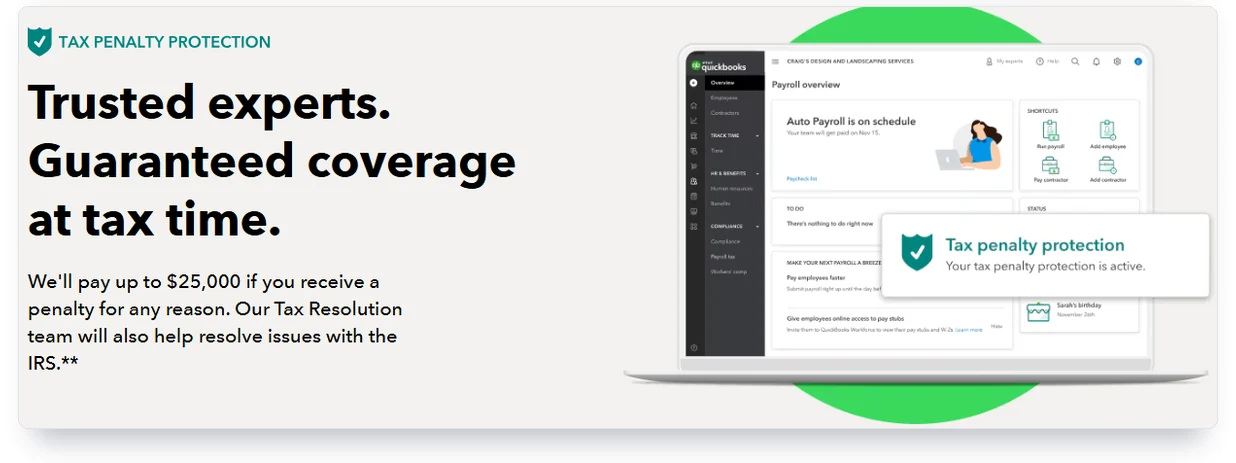
QuickBooks Workforce Elite carries the largest printed guarantee we found: up to $25,000 a year in payroll tax penalties and interest from errors made while you use Elite. Its penalty page says “We’ll pay up to $25,000 if you receive a penalty for any reason.” QuickBooks added that sentence in 2023: it appears in a December 2023 Wayback Machine capture but not in a January 2023 one. The same page and the disclosure page both say “It doesn’t matter who made the error.” The terms are narrower. They cover a penalty “from an error affecting your tax calculation accuracy made while using Workforce Elite.” On that wording, a team that moved to Elite in July would have no $25,000 cover for an error in the spring quarter, which matches what a QuickBooks Team reply told one customer in 2024. The protection also comes only with Elite, the top payroll tier; QuickBooks’ lower payroll plans carry an accuracy guarantee with no dollar amount.
Paylocity: the tax page and the agreement say different things
Paylocity’s tax services page says “We assume liability, penalty, or interest charge in the event of a Paylocity error.” Its public subscription services agreement (version 30.0, July 2025) says in section 6.3(c), a warranty disclaimer, that paying IRS fees and penalties is the client’s responsibility, and its 27 pages of service-specific terms (September 2026) contain no clause that takes the marketing promise on. A client’s own order form may add one; the public documents don’t. Ask Paylocity to write the tax-page sentence into your order form, because the signed agreement is the document you will be holding when a notice arrives.
Wave: “100% payroll accuracy guaranteed,” and $500
Wave’s plan card promises “100% payroll accuracy guaranteed.” Under its payroll terms, Wave pays $500 or what you paid it over the prior 12 months, whichever is greater, and never more than the penalty itself. The terms open by covering calculations that are wrong “due directly to Wave’s negligence,” then require the penalty to be “the direct result of incorrect calculations made by Wave.” The notice must reach Wave within 90 days of the first notice. Say a Wave calculation error brings a $2,000 penalty. If your Wave fees for the past year came to less than $500, Wave pays $500, and the other $1,500 stays on your books along with the interest. A late deposit that isn’t a calculation error falls outside this promise.
SurePayroll: the guarantee page that disappeared
SurePayroll, a Paychex company, once put a promise on its tax page. In April 2024, the page said “if we’re at fault, we’ll pay all the associated penalties and fines,” and added that the guarantee “is based upon receiving accurate and timely information from client.” By September 2, 2026, the same page carried a guarantee title that was “subject to the terms of use of the applicable service agreement” and no promise to pay. By October 8, the address redirected to SurePayroll’s general payroll page. The 2013 service agreement form we could read makes the client’s sole remedy for SurePayroll’s breach remitting the funds it received and reimbursing “any penalties resulting from Provider’s breach.” It excludes “any negligent act or omission” and, “Except as provided above,” caps liability at six months of service charges. The same form lets SurePayroll change its terms at any time, and a customer who keeps using the service is bound by the change. New customers should ask for the guarantee in writing.
Toast: up to $4,000, first quarter only
Toast’s guarantee, “available to select customers” who are live Toast Payroll customers “using the Services on or after April 1, 2026” and meet a list of conditions, among them completing “all tax tasks within the Toast Payroll platform,” covers penalties and interest “up to $4,000 per FEIN,” the federal employer identification number. It applies only to “the first quarter for which Toast Payroll files your federal and state payroll tax returns,” and not to local taxes. The penalty has to be Toast’s error alone. Toast wants to hear about a suspected error as soon as you learn of it, and in any case within 30 days after the penalty is assessed. Say a Toast calculation error in that first quarter brings a $3,000 penalty: it fits under the cap. From the second quarter on, the same error falls outside this guarantee.
Rippling: a summary and the terms behind it
Rippling’s Contracting Principles, a public PDF whose file name carries April 2024, say that if Rippling “fails to pay a related payroll tax, Rippling will pay any interest and penalties assessed as a result, as described in our terms.” The terms it points to are narrower. They cover a “negligent error or omission by Rippling” and pay interest only for the period your funds “were held by Rippling.” The notice must reach Rippling within 30 days of your receiving it. The terms call this promise Rippling’s “sole liability and your sole remedy,” meaning it is the only thing you can claim. The gap matters when a deposit goes out late and nobody agrees on whether the cause was negligence. Before signing, ask Rippling to confirm in writing that its payroll terms are the whole promise. What Rippling charges for that payroll is a separate question, and our Rippling pricing breakdown works it out from the prices Rippling prints.
Gusto: no guarantee page we found, a clause in the terms
On the Gusto pages we read on October 8, 2026, we found no penalty guarantee page. The promise sits in section 11 of its payroll terms. It applies when Gusto “fails to timely remit payroll taxes” or “fails to timely submit a tax filing,” a failure the terms call a “Gusto Error,” and covers “the amount of any penalties directly arising from such failure(s).” The clause doesn’t mention interest, requires the employer to make “prompt and reasonable efforts to mitigate,” and makes the employer responsible for telling Gusto about a tax notice “no less than thirty (30) days prior to any applicable response date.” For the budget, that makes it a penalty-only promise, with the interest left on your side. A Gusto customer on Reddit wrote in May 2025: “We did eventually get the fees/penalties reimbursed by Gusto because it was their error.” Another, in r/Payroll in February 2026, reported “$8k in IRS penalties” after deposits went out late “for weeks.” When we read that thread on October 9, it didn’t yet say how the case ended.
What owners report when they try to collect
The guarantees set deadlines for you, not for the provider, and the public accounts show what that means for cash flow. A Wave customer on Reddit wrote in June 2025 that late tax payments by Wave led to an IRS fine of “over $400.” Seven weeks after paying it, the customer wrote, “I still don’t have reimbursement from them.” A QuickBooks Community member wrote in 2023 that Intuit wasn’t paying state unemployment tax it had withheld, and that the promised reimbursement had not come “after 6 months.” A Paycor client on Reddit said a state unemployment agency fined the business “$2050 plus $288 in interest” for a Paycor withholding mistake, and the agency refused to waive it. These are complaints people chose to post, so they show what can happen, not how often. Budget for paying the penalty yourself first and recovering it later, if at all.
What happens when a payroll provider takes the money?
When a payroll provider keeps the tax money instead of depositing it, the business still owes the tax, usually with penalties and interest on top. The IRS warns that “unprofessional or fraudulent companies will take the money and run.” The business stays “legally responsible for reporting and paying the taxes due, even if it sent funds to the third-party payroll service provider.”

The National Taxpayer Advocate, the independent office inside the IRS that reports to Congress, described the cost in 2012. Victims “may be required to pay the amount of payroll taxes twice, once to the PSPs and again to the IRS, along with interest and penalties.” The report counted failures over the previous five years that had left “thousands of employers with hundreds of millions of dollars in unpaid employment taxes.” For a ten-person company sending $20,000 a month in federal deposits, one lost quarter is a $60,000 hole before the first penalty.
The Justice Department’s own releases show how it happens. AccuPay, a Maryland payroll company, took clients’ full tax amounts and paid only part. Its owners were sentenced on May 18, 2016, to six and five years in prison, and the release says “both the federal and state taxing authorities imposed interest and penalties on AccuPay’s clients.” The Taxpayer Advocate’s 2014 annual report said that for many of those clients it “successfully advocated to abate penalties,” but had been “less successful in working with the IRS to compromise the underlying tax liability.”
In many AccuPay cases, the Taxpayer Advocate won penalty relief and installment plans; cutting the tax itself proved harder.
Elite Payroll in Florida filed false returns that understated what its clients owed. In one 2021 quarter, a client owed about $219,000, Elite reported and paid about $32,000, and the owner “kept the remaining approximately $190,000,” in the release’s rounding. He was sentenced on April 24, 2025, to 50 months and ordered to pay $22,401,585 in restitution. Moresource, in Missouri, owed “approximately $1.377 million in payroll taxes on behalf of its clients” by January 2020, with “less than $400,000” in its payroll account. Its owner had asked clients to send payroll deposits early to cover the gap, and her sentence was announced on September 9, 2026.
MyPayrollHR, in New York, processed payroll and tax payments for about 1,000 small businesses until September 2019. Its chief executive was sentenced on August 4, 2021, to 144 months for a fraud that cost banks and lenders more than $100 million and also took money entrusted to his payroll companies; prosecutors said he stole “the tax payments of hundreds of small businesses.” The United States alleged that Pioneer Bank wrongfully set off about $7.3 million from an account held by Cloud Payroll, a MyPayrollHR affiliate, to cover debts that Cloud Payroll and other affiliates of the chief executive allegedly owed the bank, and that the money was payroll tax held in trust. The case settled confidentially in March 2024. Wisconsin’s revenue department offered to help about 180 affected businesses avoid penalties. In searches of IRS and Taxpayer Advocate pages on October 8 and 9, 2026, we found no IRS statement about relief for MyPayrollHR’s clients.
Getting the money back from the provider is a separate, slower fight. AccuPay filed for Chapter 7 bankruptcy, a liquidation, after clients sued over about $465,000 they said was never remitted, and its owner’s plea agreement called for restitution, a court-ordered repayment, covering “both the IRS and the individual clients of AccuPay.” Businesses described in Pioneer’s filings as alleged MyPayrollHR clients sued Pioneer Bank too, and its parent company’s August 2026 quarterly report still listed a related lawsuit by payroll and payment firms, set for trial on September 28, 2026, seven years after the collapse. The bank disputes the claims, and as of October 10 we found no later filing that says what happened on that date. A guarantee from a provider that has collapsed is only a claim against it, and a restitution order or a court claim is a long wait, so plan to pay the IRS first.
In Justice Department releases we read on October 8, 2026, the owners of at least eight payroll firms have been sentenced since 2013 in cases that involved keeping client tax money. The firms were AccuPay, Paymaster, Siham Solutions, Harpers Data Services, Aliat, Elite Payroll, Moresource and MyPayrollHR, and a Kansas bookkeeper was charged in January 2026. That is a search of public releases, not a complete count; the Taxpayer Advocate put the earlier toll at “at least 24” prosecuted owners and operators of third-party payers between fiscal 2007 and 2012.
If it happens to you, report the provider on IRS Form 14157, which the IRS says gets “expedited handling and investigation,” and talk to a CPA or an enrolled agent, a tax practitioner licensed by the IRS, about relief. The Taxpayer Advocate says victims can offer to settle the tax debt for less than the full amount and can ask the IRS collection officer on the case not to assert the trust fund recovery penalty.
How to protect your business when someone else runs payroll
Protecting the business costs a few minutes after each pay run and a careful read of two documents at signing: the guarantee and Form 8655. The IRS’s own advice comes down to watching the deposits yourself, keeping your notices coming to you, and reacting the first time something is late. In order of payoff for a small team:
- Get your own EFTPS login and look at it after payroll. The IRS tells employers to “register on the EFTPS system to get their own PIN and use this PIN to periodically verify payments.” It adds: “A red flag should go up the first time a service provider misses a payment or makes a late payment.” If a provider enrolled you, you receive an Inquiry PIN; activate it and compare each deposit’s date and amount with your payroll report. EFTPS shows 16 months of payment history, and your IRS business tax account, the agency’s online account for businesses, has a payment history too, though the IRS page doesn’t say whether a provider’s deposits appear in it.
- Keep your own address on file with the IRS. “The IRS strongly suggests that the employer does not change their address of record to that of the payroll service provider.” The U.S. Attorney’s release on the AccuPay indictment alleged that its owner did exactly that for certain clients, so IRS notices about unpaid tax went to AccuPay instead of to them.
- Open every tax notice the day it arrives, and put your provider’s deadline on the calendar that same day. That’s 15 days from the printed date at QuickBooks, 30 days at Toast (after the penalty is assessed) and Rippling (after you receive the notice), 90 days at Wave, and at Gusto no later than 30 days before the reply-by date on the notice.
- Read Form 8655 before you sign it, and expect a letter. When you sign up and “at least quarterly thereafter,” a reporting agent must remind you in writing that you remain responsible and should enroll in EFTPS. If that letter never arrives, ask why.
- Compare what your provider shows you with what the IRS has. The IRS manual warns that fraudulent payers give clients “accurate employment tax returns, W-2s, and W-3 while filing employment tax and informational returns with the IRS that understate the amount of wages.” Once a year, order an IRS account transcript, the agency’s record of what was filed and paid for each quarter, and compare it with your own copies.
- When you switch providers mid-year, put in writing who files the current quarter’s Form 941 and the year’s Form 940 and W-2s. One Reddit user wrote in 2025 that the old provider filed the fourth-quarter returns anyway, and employees “get two different W2’s with essentially almost double earnings.” Export your payroll records before the old account closes; our HR software guide covers how long the law makes you keep them.
- Know when the money leaves your account. Providers debit payroll and tax money ahead of the IRS due date and hold it in between, and that float is a revenue line of its own. ADP reported $1,354.8 million of “interest on funds held for clients” in fiscal 2026, about 6% of its $21.9 billion in revenue, on average client funds of $40.4 billion. Paychex’s rose too, as the chart below shows. Neither company’s 2026 annual report puts a dollar figure on what it paid out under a tax-penalty promise.
- Verify every request to change bank details. Treat any call or email asking for one as suspect until you’ve called back a number you already had. A cloned voice can sound convincingly like the owner, and our guide on how to spot an AI voice scam covers the call-back rule.
- If a deposit is missing, call your provider and the number on any IRS notice first. Once you know the deposit wasn’t made, paying it yourself through EFTPS stops the penalty from rising and the interest on the tax from building; file Form 14157 if you suspect the provider.

If a tax notice just arrived
Write down both the date printed on the notice and the day it reached you; QuickBooks counts its 15 days from the printed date, and Rippling counts 30 days from receipt. Send a copy to your provider the same day, in writing, and keep the confirmation. Check EFTPS for the deposit the notice says is missing, and if your provider confirms it never went out, pay it there yourself. The IRS’s own clock runs too: an amount still unpaid more than 10 days after the first notice, or on the day a notice demands immediate payment, draws a 15% penalty. If you believe the provider caused it, the IRS asks you to call the number on the bill or write to the office that sent it as soon as possible.
How much do payroll services cost?
Payroll services for small business that publish prices charge a monthly base fee plus a fee for each person paid. At ten employees, the entry full-service plans we priced cost $84 to $130 a month, or $1,008 to $1,560 a year. On the pages we read, ADP RUN, Paychex Flex and Paylocity showed no price; each asks you to request a quote.
Per person, that is $8.40 to $13 a month at ten employees. That fee is small next to the risk: one $20,000 federal deposit that lands 16 days late draws a $2,000 penalty, more than a full year of any entry plan in the table. That is why the guarantee belongs in the price comparison itself.
The plan card is not always the whole bill. Gusto’s help center, for one, lists a $100 fee for a failed bank debit and separate charges for tax filings after you cancel, which our Gusto pricing breakdown itemizes. Before comparing per-person prices, ask each provider for its full fee schedule, including year-end forms, off-cycle pay runs and each additional state. The largest printed guarantee costs extra as well: QuickBooks’ $25,000 penalty protection comes only with Workforce Elite, its top payroll tier, which the table shows at about two and a half times QuickBooks’ base payroll plan at ten people.
Note
Prices are list prices for full-service plans from each provider’s US pricing page on October 9 and 10, 2026, before introductory discounts; the entry-plan range in the text uses each provider’s cheapest plan. Chase Payroll and U.S. Bank Payroll are bank-branded services whose base fee includes the first employee, so their ten-person total is the base plus nine per-person fees; Roll by ADP is ADP’s app-based product, priced separately from ADP RUN. The table leaves out Patriot, Rippling, Paycor, Toast, SurePayroll and TriNet Zenefits, whose prices we did not capture.
Can you do payroll yourself?
Yes. Any employer can run payroll without a service: calculate withholding with IRS Publication 15-T, deposit through EFTPS, file Forms 941 and 940, and send W-2s to employees and, with Form W-3, to the Social Security Administration. The liability is yours either way. A service changes who does the work and, if its guarantee says so, who pays you back when it’s done wrong.
Among owners with employees, about three in ten still do it in-house, by our arithmetic on the National Small Business Association’s February 2025 survey of 625 owners. The National Federation of Independent Business found 64% doing payroll in-house back in 2006, though the two surveys sorted their answers differently.
The owners who do it themselves describe both sides. A Reddit user with three salaried employees wrote in 2024 that QuickBooks Desktop handles each paycheck and that the user pays the federal tax through EFTPS and files the quarterly reports. “It takes me less than 10 minutes to do it all.” A QuickBooks Community member with one employee and manual payroll wrote the same year about paying late. The result was a “Failure to make a proper federal tax deposit on time penalty,” which they paid.
Doing it yourself saves the plan fee, about $44 to $66 a month for two people on the entry plans we priced, and costs whoever does it their time on every pay date, plus the penalty risk on every deposit. For one or two salaried employees in one state, that trade usually favors doing it yourself. With ten hourly employees across two states, the hours and the chances of a late deposit grow faster than the fee. Workflow tools can move hours from a time clock into a spreadsheet or remind you of a deposit date; we compared the main AI automation tools and what they bill for. None of them replaces EFTPS or the returns.
Questions to ask before you sign
Ask these in writing and file the answers with the contract. If you don’t get written answers to the first four, budget as if there is no guarantee.
- Where is your penalty promise written, and is it in the agreement I’m signing?
- What triggers it: any error on your side, only negligence, or only a breach?
- Does it pay penalties, interest or both, and up to what amount a year?
- How many days do I have to send you a notice, and counted from which date?
- Does it cover state and local taxes, and quarters before my start date?
- Will you file as my reporting agent under Form 8655, and will I get the quarterly reminder letter?
- How many days before the due date do you debit tax money, and where is it held until you pay it?
- What happens to filings, notices and my records if I cancel or switch mid-quarter?
- Does this product run on your own payroll engine or a partner’s, and whose terms apply to me?
Who writes the “best payroll services” pages you’re reading?
Most of the pages we found ranking for payroll services are written by companies that sell payroll or by publishers paid when you sign up. On October 8, 2026, six of the nine organic results on Google’s first page for “payroll services for small business” were provider landing pages. The other three were CNBC Select’s affiliate list, a ranking of payroll software published by OnPay with OnPay in first place, and a Reddit thread, so seven of the nine came from companies that sell payroll.
We read 14 pages on October 8: the first-page results we could open for that search and for “best payroll services for small business,” plus Fit Small Business’s guide. One says the employer keeps “ultimate responsibility,” in a table cell that doesn’t name the IRS. Four mention a guarantee. None states a notice deadline, none tells the owner to check EFTPS, and none mentions Form 8655. Google’s AI Overview for the question “does my payroll company pay irs penalties” did a little better on October 9. It still told readers that many guarantees require notices “within 10 to 15 days.” Of the five providers that print a deadline in days, only QuickBooks sets 15; Toast, Rippling and Wave allow 30 to 90, and Gusto counts backward from the agency’s response date.
The disclosures say money may shape the order. CNBC Select’s reads: “This commission may impact how and where certain products appear on this site (including, for example, the order in which they appear).” Forbes Advisor labels one provider “Most Popular” and explains that “Most Popular is calculated from the number of times each affiliate product was selected by Forbes Advisor users over a six-month period.” A provider ranking itself first is a pattern we found before, when we compared Calendly alternatives and most of the rankings we read came from vendors ranking themselves.
Some of the statistics that circulate on payroll pages don’t survive a trace. The claim that 40% of small businesses pay an average of $845 a year in IRS penalties first appears, as far as we could find, in a SurePayroll media alert of June 15, 2000. That alert credited “an ICR study”; by 2002, SurePayroll’s site was attributing the figure to the IRS. In searches of irs.gov, the Treasury Inspector General for Tax Administration and the Taxpayer Advocate on October 8 and 9, 2026, we found it on no page. Yet at least five pages dated 2025 or 2026 still printed it when we looked, one of them on the site of Paychex, which now owns SurePayroll. The claim that one in three employers makes payroll errors has no primary source we could find: pages credit the IRS, and none points to an IRS document. Neither is a number to approve a budget on.
Field notes
- The census: 16 payroll providers’ guarantee pages and available terms read on October 8, 2026; 9 put a promise to pay penalties for their own errors or breaches in their terms; 3 more promise it only in marketing (Patriot, Square, Paylocity); 4 promise nothing we could find.
- Dollar amounts: QuickBooks Workforce Elite up to $25,000 a year; Toast up to $4,000 per FEIN, first quarter only; Wave $500 or 12 months of fees, whichever is greater, never more than the penalty; the other nine print none.
- Notice deadlines: QuickBooks 15 days from the printed date; Toast 30 days after assessment; Rippling 30 days after receipt; Wave 90 days; Gusto at least 30 days before the notice’s reply-by date; seven of the 12 promises give no number.
- The IRS rule: payroll service providers and reporting agents assume no liability for a client’s employment taxes; the IRS manual sends a processor’s deposit delays to the contract liability clause, and a second chapter says interest is not removed for reasonable cause.
- Provider failures: owners of at least eight payroll firms sentenced since 2013 in Justice Department releases we read, MyPayrollHR among them; MyPayrollHR processed payroll for about 1,000 clients when it collapsed in 2019; victims can owe the same taxes twice.
- The ranking pages: 0 of 14 pages we read on October 8 state a notice deadline, tell owners to check EFTPS or mention Form 8655; 1 says the employer keeps responsibility.
- Sources: IRS Publication 15 (2026); IRS third party arrangement chart; Internal Revenue Manual 20.1.4 and 5.1.24; IRS Tax Tip 2023-65; IRS news release IR-2026-83; National Taxpayer Advocate reports of 2012 and 2014; Justice Department releases; providers’ terms and help pages, read October 8, with quoted passages rechecked October 9 and 10, 2026.
Frequently Asked Questions
How much should I pay for payroll services for a small company?
Expect a monthly base fee plus a fee per person paid. At ten employees, entry full-service plans that publish prices cost $84 to $130 a month in October 2026. ADP RUN, Paychex Flex and Paylocity showed no price, and tiers with HR features cost more.
What is the best payroll service for a small business?
The best fit depends on headcount, states and how much risk you want covered. Among full-service providers, compare the guarantee first: of the 16 providers we read, only QuickBooks Workforce Elite, Toast and Wave print a dollar amount, and only five print a notice deadline in days.
Can I do payroll myself for my small business?
Yes. You can calculate withholding with IRS Publication 15-T, deposit through EFTPS and file Forms 941, 940, W-2 and W-3 yourself. It costs your time instead of a monthly fee, and a late federal deposit draws a penalty of 2% to 15% of the amount.
Does my payroll company pay IRS penalties if it makes a mistake?
Usually only if its guarantee or contract says so; the IRS bills you either way. Of 16 providers we read, nine promise it in their terms and three only in marketing. Three print a dollar amount, and five set a notice deadline, from 15 to 90 days.
Who is responsible if my payroll company doesn’t pay the taxes?
You are. The IRS says the employer remains responsible when a third party defaults, and the trust fund recovery penalty can reach owners personally. The IRS may abate penalties if you were the victim of a provider’s failure or fraud, but relief isn’t guaranteed and interest on the tax stays.
What does a full-service payroll service actually do for me?
It calculates pay, pays employees, deposits federal and state payroll taxes and files the returns, often as your reporting agent under IRS Form 8655. It doesn’t take on your tax liability. A certified PEO generally takes it over for the wages it pays, and a section 3504 agent shares it.
What is Form 8655, and should I sign it?
Form 8655 authorizes a payroll provider to sign and file returns such as Forms 940 and 941 for you and to receive copies of your IRS notices. Many full-service providers ask you to sign it. The form itself says signing it doesn’t relieve you of responsibility for filings and deposits.
What happens if I switch payroll providers mid-quarter?
You can end up with both providers filing the same quarter, or with neither. Agree in writing which one files that quarter’s Form 941 and the year’s Form 940 and W-2s, check EFTPS after the switch, and export your records before the old account closes.
My Take
For a team of ten in one state, I would buy full-service payroll and choose among providers by the guarantee, not the per-person fee. The entry plans priced in this guide differ by $46 a month at ten people, or $552 a year, while one 16-day-late deposit of $20,000 costs $2,000 in penalty alone. I would put each provider’s trigger, dollar amount and notice deadline next to its price before anyone approves the spend, and pay more for the one that commits to the most in its terms. On paper, the largest printed guarantee in this census is QuickBooks Workforce Elite’s, so I would price it against a plain full-service plan before deciding.
What I would cut first is the belief that the provider owns the risk. Someone on the team checks EFTPS after every payroll, and the provider’s notice deadline goes on the shared calendar. Any promise from a sales page goes into the order form before anyone approves the contract. If a provider won’t put its guarantee in writing, I budget as if it doesn’t have one.