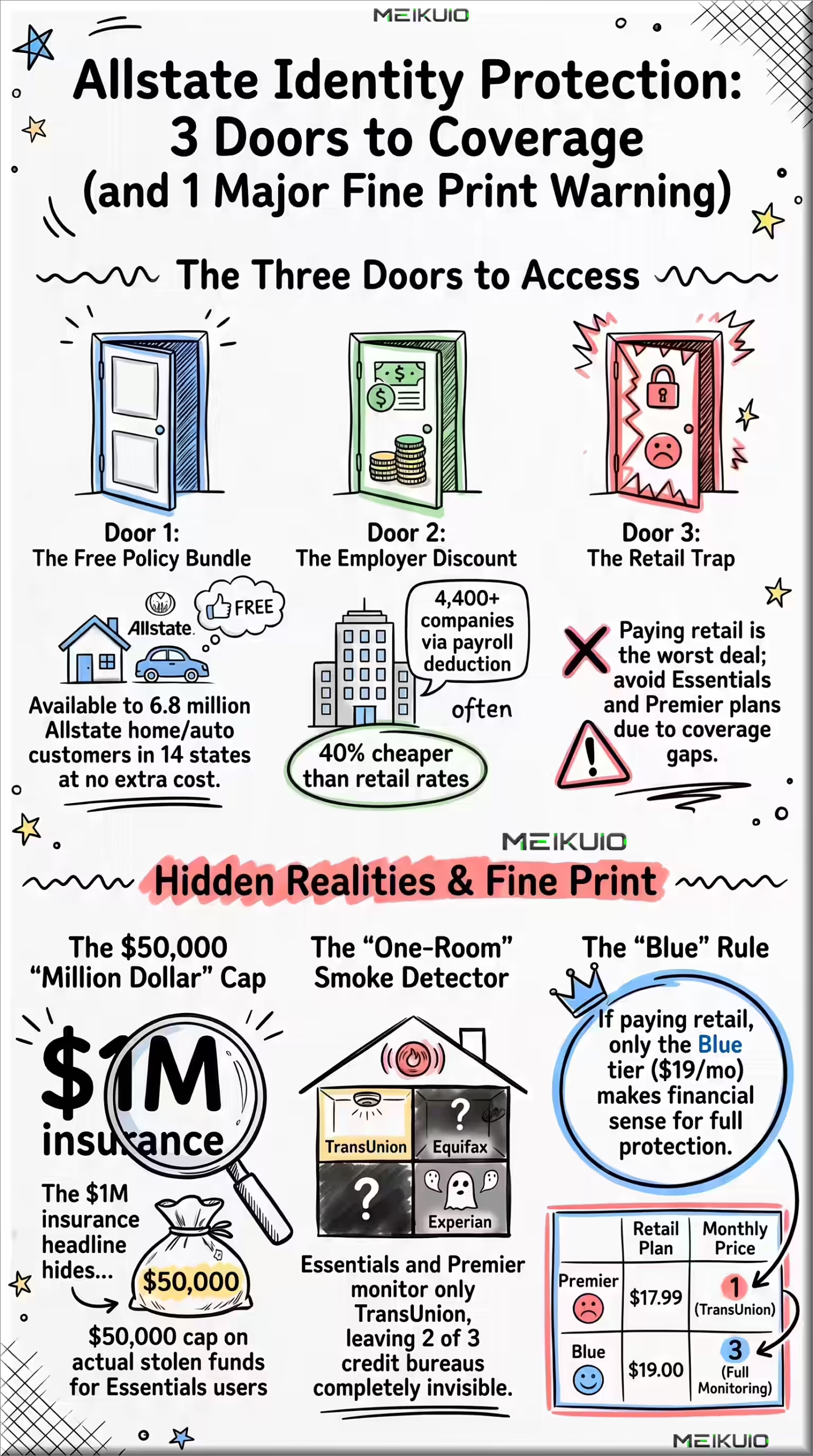


Allstate Identity Protection is a legitimate identity-theft service with one of the strangest sales pitches in the category: most of the people it covers never paid retail for it. Direct plans run $9.99 to $19 a month. The same product is handed out through thousands of employers, and since April 2026, free with Allstate home and auto policies in 14 states. That changes the whole question.
- Key facts
- What is Allstate Identity Protection, and who actually runs it?
- How you actually get AIP: through work, your Allstate policy, or retail
- Allstate Identity Protection pricing and plans
- What each plan includes
- Why “TransUnion only” matters more than it sounds
- The identity-theft insurance: reading the fine print
- Restoration and support: the strong half of the product
- Allstate Identity Protection vs LifeLock, Aura, and Identity Guard
- What real users complain about
- The free stack: what to do before paying anyone
- Who should buy Allstate Identity Protection?
- Frequently asked questions
- What is Allstate Identity Protection and is it worth it?
- How much does Allstate Identity Protection cost in 2026?
- Is Allstate Identity Protection free with an Allstate policy?
- Does Allstate Identity Protection monitor all three credit bureaus?
- Is Allstate Identity Protection better than LifeLock?
- Can I get Allstate Identity Protection through my employer?
- How do I cancel Allstate Identity Protection?
- Does the identity theft insurance actually pay out?
- My Take
Key facts
What is Allstate Identity Protection, and who actually runs it?
Allstate Identity Protection is an identity-monitoring and restoration service that watches your credit file, the dark web, your financial accounts, and your scattered online logins, then assigns a human specialist to clean up the mess if someone steals your identity. Allstate bought the whole operation rather than building it.
The product is InfoArmor, a Scottsdale, Arizona company founded in 2007 that sold identity protection to HR departments as an employee perk. Allstate paid $525 million in cash for it in October 2018 (the figure is in Allstate’s own SEC filing) and renamed it Allstate Identity Protection in 2021. The fine print still says every plan is “offered and serviced by InfoArmor, Inc., a subsidiary of The Allstate Corporation.”
That corporate history explains the product’s whole shape: AIP grew up as a workplace benefit, and it still behaves like one. Over 4,400 companies offer it, including roughly a quarter of the Fortune 500. In one breath, here’s what it does:
- Watches: credit activity, dark-web markets, bank and 401(k) transactions, social accounts
- Maps: your forgotten logins and data-breach exposure via the Digital Footprint tool
- Fixes: full-service restoration by in-house, US-based specialists when theft happens
How you actually get AIP: through work, your Allstate policy, or retail
Before you look at a single price, check whether you already have Allstate Identity Protection for free. There are three doors into this product, and the retail one is the worst deal of the three.
Door one: your employer. This is AIP’s home turf. It’s sold through benefits brokers as a payroll deduction, and the workplace version of the top plan (called Pro+ Cyber in that channel) has been listed at around $10.95 per employee per month, about 40% less than the retail Blue price. Employer plans are often more generous too: restoration help applies even to identity theft discovered before your coverage started, something the retail insurance explicitly excludes.
More Read

Door two: your Allstate policy. On April 16, 2026, Allstate became the first major US insurer to bundle identity protection into standard home, auto, and renters policies at no extra cost. The rollout covers 6.8 million customers across 14 states (Alabama, Arkansas, Colorado, Delaware, Illinois, Michigan, Missouri, Nebraska, Ohio, South Carolina, Texas, Utah, Wisconsin, and Wyoming), with more states promised through the year. Two catches: it’s not automatic, you have to enroll through the Allstate app or site when notified, and the free tier is the slim one. You get full-service restoration, data-breach alerts, and 24/7 support. You don’t get credit monitoring or stolen-funds reimbursement.
Door three: retail. Pay $9.99 to $19 a month yourself. This only makes sense if the first two doors are closed and you specifically want AIP’s family coverage or restoration muscle.
USD per month; these access routes have different coverage. Retail Blue includes three bureaus and Bitdefender. Employer terms vary; available at 4,400+ employers, roughly a quarter of Fortune 500 companies. The free route reached 6.8M customers in 14 states, requires Allstate-app enrolment and includes restoration, breach alerts and 24/7 support, but no credit monitoring.
Allstate’s own CEO framed the free rollout as a loyalty play, which tells you how the company thinks about this product:
“We also routinely expand or improve benefits. For example, we recently added free identity protection, so customers think beyond price.”
Tom Wilson, Allstate CEO, Q1 2026 earnings call, April 30, 2026
Allstate Identity Protection pricing and plans
Retail pricing is refreshingly flat: no first-year teaser rates, and renewal happens at the same monthly price you signed up at. Prices checked July 23, 2026.
Three things to check before you enter a card number. First, the 30-day free trial requires that card, and plans auto-renew at the listed rate unless you cancel (the same auto-renew pattern we flagged in App Store subscription traps, though AIP’s version is tamer). Second, an annual option exists with a discount, but Allstate doesn’t publish the actual annual dollar amounts on its pricing page; they only appear at checkout. Third, cancellation is low-friction by the standards of this category: portal, phone, or email, with prorated refunds on annual plans.
The pricing quirk that matters: Blue costs $1.01 more per month than Premier and adds three-bureau credit monitoring, a Bitdefender security suite, and double the family insurance aggregate. Premier is priced out of its own lineup. If you’re paying retail at all, Blue is the only tier that makes arithmetic sense.
What each plan includes
Two footnotes to that table. The credit score you’ll see in the dashboard is VantageScore 3.0 from TransUnion, not the FICO score your lender uses. And the Digital Footprint tool, which does a clever job of surfacing accounts you forgot existed, sends data-deletion requests companies “may not be legally required to comply with,” per Allstate’s own disclaimer. AIP has no dedicated data-broker removal service the way Aura or DeleteMe do. That’s the gap rivals poke at, and it’s real.
Why “TransUnion only” matters more than it sounds
Essentials and Premier monitor one credit bureau out of three. Lenders don’t coordinate which bureau they pull, so a fraudster opening a card that gets reported to Experian or Equifax is invisible to a TransUnion-only plan until the damage compounds. New-account fraud is exactly the crime moving fastest right now: Javelin Strategy and Research’s 2026 identity fraud study counted 5.4 million new-account fraud victims, up 31% year over year.
Every AIP competitor plays some version of this game (LifeLock also locks tri-bureau monitoring behind its priciest tier, and only Aura includes all three bureaus on every plan). But the practical takeaway is blunt: a one-bureau monitoring plan is a smoke detector installed in one room of a three-room house. If monitoring is the reason you’re buying, Blue or nothing.
The identity-theft insurance: reading the fine print
Every plan advertises up to $1 million in identity theft insurance, rising to a $2 million family aggregate on Blue. Here’s what the headline hides. That figure is an expense-reimbursement pool covering things like legal fees, notary costs, document replacement, and lost base wages. The money stolen from you falls under a smaller sub-limit called Cash Recovery, and the policy states each sub-limit is “part of and not in addition to” the aggregate. One pot, not stacked coverage.
On Essentials, stolen-funds recovery caps at $50,000. That’s 5% of the $1 million headline. The big number is an expense pool, not a payout.
These caps are 5%, 50% and 100% of the advertised 1M USD expense aggregate, and are part of, not in addition to, that aggregate. Blue family expense aggregate: 2M USD. Underwriter: American Bankers Insurance Company of Florida (Assurant). A 1.01 USD monthly price difference separates Premier and Blue.
More fine print. The underwriter is American Bankers Insurance Company of Florida, an Assurant company, so Allstate sells you the plan while a different insurer decides your claim (some third-party reviews name Allstate as the underwriter; the Summary of Benefits says otherwise). Claims demand discipline: notice within 60 days of discovery, a sworn proof of loss, a police report if a law was broken, and lawsuits limited to 24 months. Cryptocurrency theft is excluded by name. Ransom payments are excluded. And stolen-funds coverage is secondary: if your bank owes you the money under Regulation E’s fraud rules, the policy expects you to chase the bank first.
One more industry-wide truth: no provider, Allstate included, publishes how often these policies pay or how much. Treat the insurance as a nice-to-have wrapper around the restoration service, not as the product.
Restoration and support: the strong half of the product
Restoration is where Allstate Identity Protection’s InfoArmor DNA earns its keep. Specialists are in-house, US-based, and certified in identity-risk management (CITRMS), and they take over the case rather than emailing you a to-do list. Under a limited power of attorney they’ll dispute fraudulent accounts directly with creditors and handle the parts that normally eat a victim’s weeks: bureau disputes, creditor calls, affidavits, and the follow-ups that stretch across months. In one documented 2022 case, an AIP specialist joined a three-way call after a member’s bank denied a $56,000 fraud claim and pushed the bank into reopening the investigation and refunding in full.
The support experience around that core is patchier. There’s no live chat and no general-support email for retail customers (a dedicated address exists for cancellations, but day-to-day help routes through the phone), and users report waits of days to weeks for non-emergency consultations. The mobile app sits near 2.9 stars on Android. Good surgeons, understaffed reception.
Allstate Identity Protection vs LifeLock, Aura, and Identity Guard
Context that comparison tables usually omit: the identity-protection aisle is a hall of mirrors. Aura owns Identity Guard, so two of the four “competitors” share a parent, and Aura’s content site publishes its own “Is Allstate Identity Protection worth it?” takedown. That article claims AIP’s Blue renews at $280 a year; Allstate’s own pricing footnote puts renewal at $19 a month, which is $228. When a rival’s math runs 23% hot, remember who’s grading the homework.
Against LifeLock the verdict splits cleanly. LifeLock has the stronger monitoring stack and brand, but its renewal pricing jumps hard (bundle renewals climb as much as 60%), and its cheapest tiers cap stolen-funds reimbursement at $25,000, a pattern we took apart in our full LifeLock review. AIP wins on family value ($36 covers up to 10 people, including parents over 65 living elsewhere) and on flat renewal pricing. LifeLock wins for a single user who wants the deepest monitoring and will pay Ultimate Plus prices. If your employer offers AIP, that beats both on price, and the decision is over.
AIP tiers: Essentials, Premier, Blue; one-bureau tiers monitor TransUnion, and Blue adds Equifax and Experian plus an annual tri-bureau report. LifeLock: Standard, Advantage, Ultimate Plus. Identity Guard is owned by Aura. Free freezes at all three bureaus block new accounts regardless of paid plan.
What real users complain about
Allstate Identity Protection holds a BBB A+ accreditation (accredited since 2009) and a “Great” rating around four stars on Trustpilot, which is unusually healthy for this category. The praise clusters around restoration specialists by name. The complaints cluster around three themes: refund lag when canceling annual plans (one BBB complaint from March 2024 describes a promised $166 refund drifting into “3-4 weeks” of waiting), an aggressive robocall blocker that screens out legitimate calls, and alerts that arrive after the fact rather than before it.
That last theme deserves its own quote, because it’s the most clear-eyed criticism of this entire product category, not just AIP:
“They just alert you to when you’re already f***ed. They literally can’t do anything to protect you that you can’t do yourself.”
Reddit user on r/Frugal, late 2024
Harsh, mostly true, and the reason the next section exists.
The free stack: what to do before paying anyone
Monitoring tells you about fraud. Freezes prevent it. Deciding is identity theft protection worth it starts by separating commercial alerts from the statutory rights you already have. Everything below is free, federally guaranteed, and more protective against new-account fraud than any subscription:
- Freeze your credit at all three bureaus (Equifax, Experian, TransUnion). Free by federal law since 2018, and it blocks new accounts at the source instead of alerting you afterward.
- Pull your free weekly reports at AnnualCreditReport.com and scan for accounts you don’t recognize.
- Get an IRS Identity Protection PIN so nobody files a tax return as you.
- If theft happens, IdentityTheft.gov generates your recovery plan and the affidavits, free.
What the free stack can’t give you: a human who spends the dozens of hours of phone calls on your behalf, insurance for out-of-pocket expenses, and monitoring for threats that never touch a credit file, like the AI voice-cloning scams and deepfake impersonation now driving fraud losses. That gap, restoration plus scam-era threats, is the honest case for paying a service like Allstate Identity Protection anything at all.
One development on that front: in November 2025 Allstate launched a separate product, Allstate Scam Protection, that reimburses up to $50,000 for money lost to scams and social engineering, including crypto theft, precisely the losses traditional identity-theft insurance refuses to cover because the victim “authorized” the transfer. The catch fits the pattern of this whole review: it’s employer-only. It reached nearly 7 million employees during the November 2025 open-enrollment season, allows unlimited claims up to the $50,000 annual cap, and that cap is a separate pool from the Essentials stolen-funds limit that happens to share the number. Read the two products side by side and Allstate’s strategy comes into focus: the interesting protections launch in the benefits channel first, and retail gets them later or never. If your HR portal offers both, you’re shopping in the wrong store by reading retail pricing pages at all.
Who should buy Allstate Identity Protection?
Take it free, obviously, if you can. Allstate policyholder in the 14 states? Enroll, it costs nothing and adds real restoration coverage. Employer offers it? The group rate beats every retail competitor.
Buy Blue retail if you’re covering a big or multi-generational family. $36 a month for up to 10 people, including elderly parents living elsewhere, with flat renewals, is the best family math in the category, and seniors are prime targets for the scams we cover constantly.
Skip it if you’re a single, reasonably organized person. Freeze your credit, take the free weekly reports, and put the $228 a year toward literally anything else. And skip Essentials and Premier entirely at any household size: one bureau of monitoring plus a $50,000 stolen-funds cap is the appearance of protection more than the substance of it.
Frequently asked questions
What is Allstate Identity Protection and is it worth it?
Allstate Identity Protection is an identity-monitoring and restoration service run by Allstate’s InfoArmor subsidiary. It’s worth it at $0 through an employer or an Allstate policy, and a fair deal for large families on the Blue plan. Single users can usually replicate the important parts free with credit freezes.
How much does Allstate Identity Protection cost in 2026?
Retail prices as of July 2026: Essentials $9.99, Premier $17.99, and Blue $19.00 per month for individuals; family versions run $18.99 to $36.00 for up to 10 people. Renewals stay at the same rate. Annual billing carries a discount, but Allstate only shows the exact annual figure at checkout.
Is Allstate Identity Protection free with an Allstate policy?
Since April 2026, yes, in 14 states, for eligible home, auto, and renters customers, with more states rolling out. You must enroll through the Allstate app or website; it doesn’t switch on automatically. The free tier covers restoration, breach alerts, and 24/7 support, but not credit monitoring or stolen-funds reimbursement.
Does Allstate Identity Protection monitor all three credit bureaus?
Only on the Blue plan. Essentials and Premier monitor TransUnion alone, which means fraud reported to Experian or Equifax can go undetected. Blue adds tri-bureau monitoring plus an annual three-bureau report and score. The dashboard score is VantageScore 3.0, not the FICO score most lenders use.
Is Allstate Identity Protection better than LifeLock?
For families, usually yes: AIP covers up to 10 members including elders for $36 a month with flat renewals, while LifeLock’s family bundles renew up to 60% higher. For a single user wanting maximum monitoring depth, LifeLock’s Ultimate Plus is stronger. Through an employer, AIP’s group pricing wins outright.
Can I get Allstate Identity Protection through my employer?
Very possibly: over 4,400 companies offer it, including about a quarter of the Fortune 500. Workplace plans bill through payroll, cost about 40% less than the retail rate, and often include restoration help even for pre-existing theft. If you leave the job, you can port coverage to direct billing at new pricing.
How do I cancel Allstate Identity Protection?
Three ways, per AIP’s terms of service (checked July 23, 2026): your account portal, phone at 1-855-821-2331, or email to [email protected]. Monthly plans run to the end of the paid month without refunds; annual plans refund a prorated amount. That’s lower friction than most competitors in this category.
Does the identity theft insurance actually pay out?
It can, but the “up to $1 million” is an expense pool with sub-limits: stolen-funds recovery caps at $50,000 on Essentials. Claims require notice within 60 days, sworn documentation, often a police report, and your bank must deny reimbursement first. No provider publishes payout statistics, Allstate included.
My Take
I spend my weeks writing about voice clones and deepfakes, so I’ll say this plainly: the monitoring half of this product is table stakes, and the restoration half is genuinely good. That inversion is the review. Most identity services sell you alerts and staff the cleanup thinly; AIP staffs the cleanup properly and lets rivals win the spec-sheet war. So my advice is boring. Check your HR portal tonight. Check your Allstate policy if you’re in the 14 states. If either says yes, take it, it’s free money. If you’re paying retail, it’s Blue for a big family or nothing at all. And freeze your credit either way, because no subscription, this one included, stops a new account the way a freeze does.