




This Aura review answers the two questions the higher-ranking reviews skip: what year two costs, and what it means that a company selling identity protection lost 903,100 records to a phone call. Short version: the bundle delivers, the app is good, the price you see is a promo, and the renewal price is a secret.
- Aura at a glance
- What does Aura cost in 2026, and what is “Save 60%” measured against?
- What each plan actually includes
- Four gates the pricing page keeps in the fine print
- If your identity actually gets stolen while you’re a member
- What happened when Aura itself got breached?
- Who reviews Aura, and who pays them
- Aura vs LifeLock: which one, if either?
- Is Aura worth it? Who should buy it, and who should buy nothing
- Cancelling, refunds, and the 14-day trial
- Frequently asked questions
- Is Aura worth it in 2026?
- Is Aura legit?
- Who owns Aura, and does Aura own Identity Guard?
- Was Aura hacked in 2026?
- What does Aura cost after the first year?
- Does Aura give you a FICO credit score?
- Is Aura better than LifeLock?
- My Take
Aura at a glance
Aura is an identity-protection bundle that folds credit monitoring, a VPN, antivirus, a password manager, and data-broker removal into one subscription. Four plans, one variable that matters: headcount. Prices below are from Aura’s own pricing page, checked on July 25, 2026, from a US location, billed annually.
What does Aura cost in 2026, and what is “Save 60%” measured against?
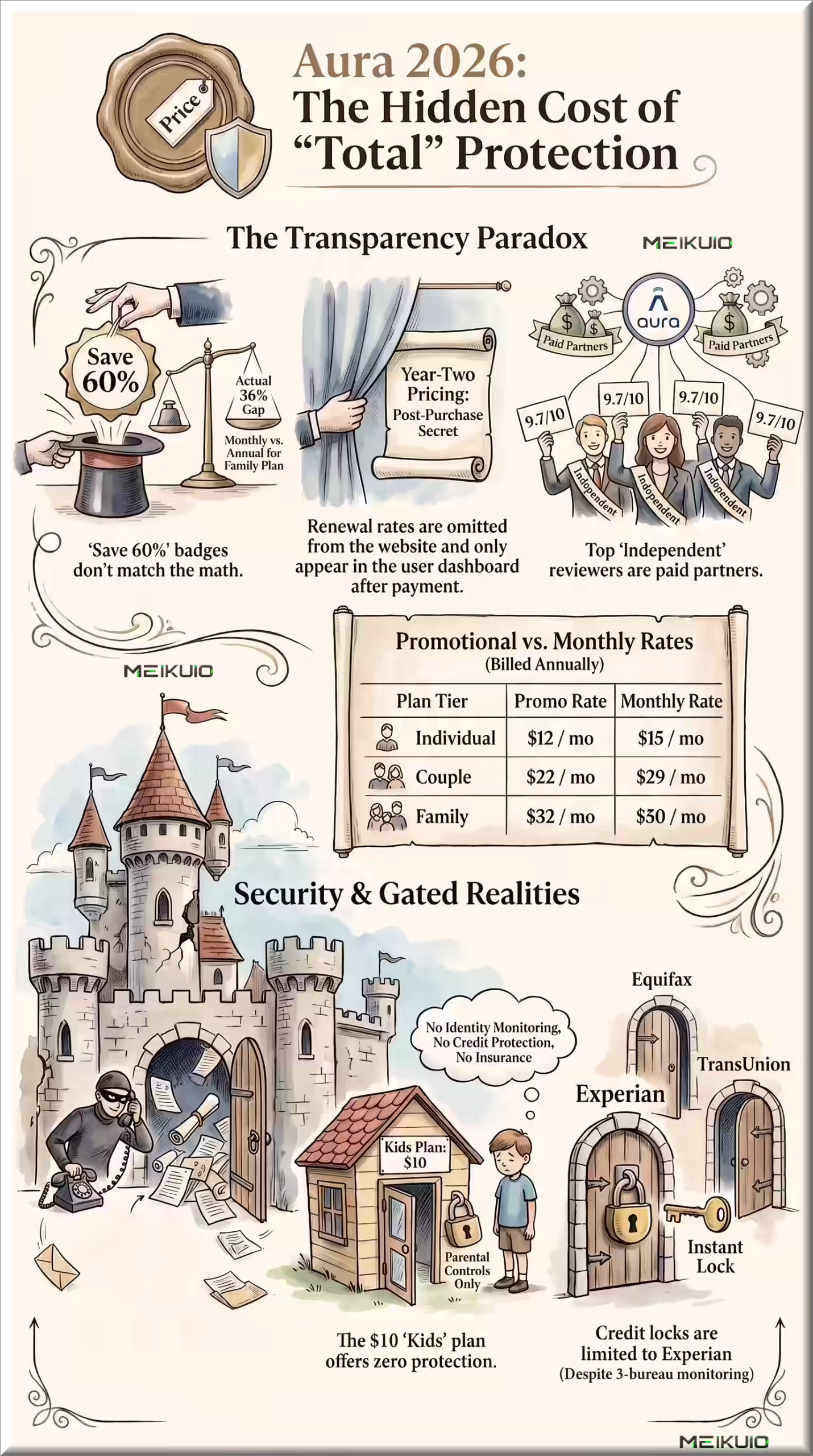
Aura costs $12 a month for one adult, $22 for a couple, and $32 for a family of five adults with unlimited kids, all billed annually, as of late July 2026. Pay monthly and those numbers become $15, $29, and $50. Every plan starts with a 14-day free trial. So far, so clean.
The discount badges don’t survive arithmetic. The Individual card says “Save 50%,” yet $12 against the $15 monthly rate is a 20% saving. Family says “Save 60%,” and the gap between $32 and $50 is 36%. The percentages are measured against some reference price that appears nowhere on the page. Each plan’s signup button even carries its own offer code in the link, which makes the page a promo machine with interchangeable numbers where a price list should be.
The number that would settle it, the renewal price, is not published anywhere on aura.com. The terms of service say renewal happens at the price shown in your account dashboard. You learn the cost of keeping Aura only after you’ve bought it. The same terms let Aura raise fees with 30 days’ notice and convert an annual plan to monthly billing at renewal with 10 days’ notice. A Better Business Bureau complaint shows the mechanics in the wild: an automatic $119.88 renewal charge the customer says arrived without warning.
That omission looks deliberate next to what Aura publishes about everyone else. Aura runs an article about LifeLock’s prices, updated July 2, 2026, that warns readers: “LifeLock’s advertised prices also only apply to your first year as a customer” and “prices can still increase up to 60% from year one to year two.” Both true, and we documented the same thing in our LifeLock review. But that Aura article promotes Aura’s own $144-a-year intro rate and never mentions what Aura charges in year two. The company criticizes a competitor, in print, for the exact practice its own checkout is built on. At least LifeLock publishes its renewal numbers.
Renewal appears only in the paid account dashboard, not publicly. Save badges: Family 60%, Couple 54%, Individual 50%, Kids 52%; actual annual-versus-monthly gaps on those cards are 36%, 24%, 20%, 23%. Null renewal values are unpublished, not free.
What each plan actually includes
Adult plans share one feature set; only the headcount and two gates change. Every adult tier gets three-bureau credit monitoring across Equifax, TransUnion, and Experian, an instant credit lock, financial transaction alerts, home and auto title monitoring, the antivirus, the VPN, the password manager, data removal from what Aura counts as 200+ broker sites, and US-based White Glove fraud resolution. That last one matters: Identity Guard, which Aura also owns, reserves White Glove for its most expensive tier. Aura gives it to everyone, and the two brands share support infrastructure either way.
More Read

For parents looking at identity theft protection for families, the Family plan is where Aura is strongest. Five adults and unlimited children on one subscription, where LifeLock’s family plans cover two adults and up to ten children. Child SSN monitoring and a streamlined three-bureau credit freeze for kids, both Family-only. The parental controls come from Circle, a company Aura bought in 2021, and the in-game voice and text monitoring is licensed from Kidas. A separate $5 million insurance policy backs the plan, and that headline needs the fine print below it.
“They proactively have contacted various data brokers and have started the fairly laborious process of getting my information legally removed. They even tell me when that data broker is legally allowed to return my data to their database, and tell me they will start the removal process over again.”
Aura subscriber on r/IdentityTheft, March 4, 2024
That quote is the bundle at its best. The counterweight came in November 2025, when Incogni audited the same service and counted about 140 public people-search brokers in the automated list, with no way to request a custom removal. Aura’s own terms admit it can’t guarantee brokers comply. Incogni sells a competing removal service, so read its audit with the same skepticism you’d read Aura’s LifeLock article. Nobody neutral has counted.
Four gates the pricing page keeps in the fine print
Four features are less than their card suggests, per Aura’s own feature table. The “AI Spam Call and Message Protection” advertised with a ribbon on the Family card is Family-only; Individual and Couple subscribers pay extra for it. The “Instant Credit Lock” locks your Experian file only. Monitoring covers three bureaus, the lock covers one, and locking TransUnion and Equifax stays your manual homework.
“401k and Investment Account Monitoring” is, by Aura’s own description, an alert if your account details surface on the dark web, which is a different product than watching your 401k. And your monthly credit score is VantageScore 3.0 calculated from your Equifax file. You have to read the footnote to learn either of those things, and no plan shows you the FICO score a lender would actually pull.
Note
The standalone Kids plan ($10/mo) contains no identity monitoring, no credit protection, and no insurance. It is a parental-controls product sold under an identity-protection brand. A child’s identity gets covered only on the Family plan.
If your identity actually gets stolen while you’re a member
What the marketing calls White Glove resolution reads differently in the terms. Full case management starts only after you sign a Limited Power of Attorney; without it, Aura’s team can coach you but can’t act for you. The insurance runs on deadlines: you must file a claim within 60 days of discovering the theft, deliver a sworn proof of loss within another 60, and back stolen-funds claims with a police report plus your bank’s written confirmation that the money is unrecoverable. Cash recovery pays out for one occurrence per 12 months, and it draws from the same aggregate pool as everything else. Stolen funds get no ceiling of their own. Lawyers are reimbursed at up to $125 an hour. Curiously, the $5 million Family policy defines legal costs at up to $350 an hour and then excludes fees over $125 an hour a few pages later, a contradiction sitting unresolved in Aura’s own document. Subscribers on r/IdentityTheft who went through an active theft describe the same limit: the alerts tell you someone got in, and the filing is still yours to do.
What happened when Aura itself got breached?
In March 2026, Aura disclosed a data breach affecting roughly 900,000 records, 903,100 of them indexed by Have I Been Pwned on March 18. An employee took a targeted voice-phishing call, and the attacker spent about an hour inside a marketing database inherited from Circle, the parental-controls company Aura acquired in 2021. Exposed fields included names, emails, phone numbers, home addresses, IP addresses, and customer-service notes. Aura says fewer than 20,000 active and 15,000 former customers were affected, that the identity-protection vault was never touched, and that no Social Security numbers, passwords, or financial data leaked. The ShinyHunters group claimed 12 gigabytes and two million records, then published the data after failed extortion; Aura disputes both the count and the group’s claim of an Okta single-sign-on exploit.
Two details put the incident in proportion. Aura’s follow-up statement of March 26 notes that about 90% of the leaked email addresses were already circulating from earlier breaches of other companies. And no breach filing appears on the California, Vermont, or Massachusetts attorney-general portals, checked directly in July 2026, because marketing contact data without SSNs or financial details generally doesn’t trigger state notification laws. The intrusion happened, it embarrassed a security company, and it stayed inside the least sensitive database Aura had. The part that says more about the industry is that LifeLock published its own “Aura data breach” explainer within three days, inviting Aura’s customers to switch. Nothing in this market stays un-marketed for long.
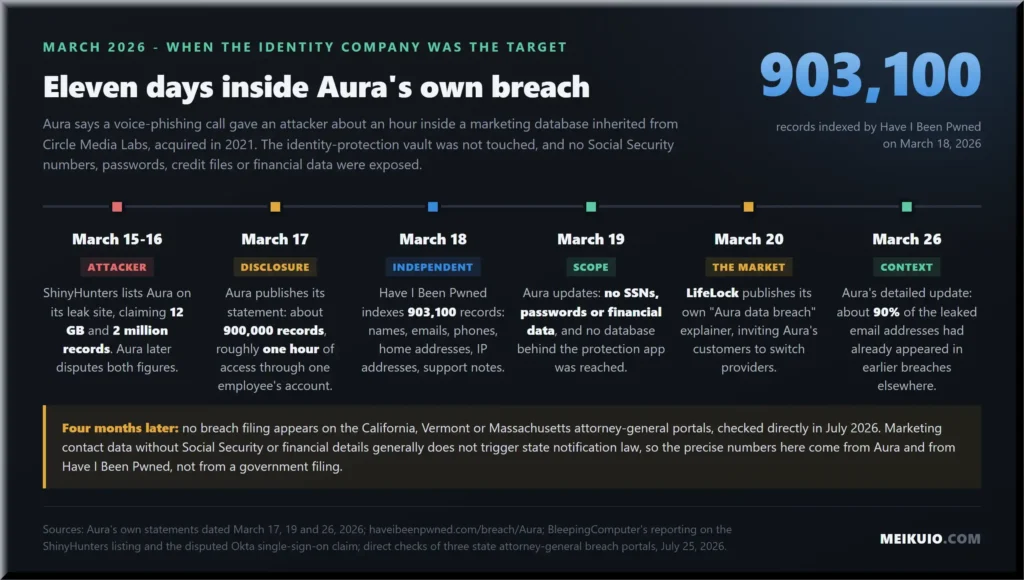
The company underneath all this is stable enough. Aura was valued at $1.6 billion in a March 2025 funding round, spun out from its former sibling business in May 2024, and PCMag puts its customer base above a million. No regulator has taken action against Aura as an entity, though the corporate ancestor it inherited from, Intersections Inc., paid a $1.2 million CFPB penalty in 2015 over billing practices. In its own incident update, Aura points to ISO 27001, SOC 2 Type II, and PCI-DSS certifications. Certifications are not a promise that no employee will ever answer the wrong phone call.
Who reviews Aura, and who pays them
Search “aura review” and the scoreboard looks unanimous. The top result scores Aura 9.7 out of 10; another gives 4.8 stars and an Editors’ Choice badge. The fine print is less unanimous. The 9.7 comes from security.org, whose earnings disclosure names Aura among its paying partners and whose page carried a LifeLock promotion when we checked in July 2026. The 9.6 a few results down comes from safehome.org, which the footer identifies as a Centerfield Media company, the same parent as security.org. One owner, two scorecards. The 4.8-star review displays a July 2026 date while stating it last tested Aura in January. Two of the three never mention the March breach; the third gives it one sentence. To be fair, all of them disclose the money somewhere; none hides it. But a buyer skimming scores has no idea the referee is paid by the players.
Aura plays the same game from the other side. Its own aura.com/reviews page ranks for this query, headlining “#1 for family online protection” while citing a March 2026 US News award; by late July, US News listed Aura at #2, with a separate nod for best user experience. That second one is earned. The app is the least frustrating part of this product, and nothing below should be read as saying otherwise. The page shows a 4.1 Trustpilot score, which is at least honest, since Trustpilot itself showed about 4.2 in July 2026, next to a Better Business Bureau profile holding an A+ accreditation and a 1.06-out-of-5 customer score from 64 reviews. Both BBB numbers hold. A+ measures how a company answers complaints, not how many it earns.
Aura vs LifeLock: which one, if either?
Pick Aura for households and transparency-of-features; pick LifeLock for transparency-of-price. Aura gives every tier three-bureau monitoring and White Glove restoration, covers unlimited kids on Family, and bundles software LifeLock sells separately through Norton 360. LifeLock publishes its renewal prices, holds its standalone tiers flat at renewal, and reserves its steep jumps for the Norton bundles, up to 60% in year two, as we broke down in our Identity Guard vs LifeLock comparison and LifeLock review. With Aura you know what you get but not what you’ll pay. With LifeLock it’s closer to the reverse. One more disclosure the comparison sites skip: Aura also owns Identity Guard, so when a top-10 list offers you Aura, Identity Guard, and LifeLock as three choices, two of the three are the same house.
Is Aura worth it? Who should buy it, and who should buy nothing
Aura is worth paying for if you’d otherwise buy three or four of its components separately. That’s mostly one buyer: a family. Kids’ identity coverage, parental controls, spam-call screening, and per-adult insurance on one bill is a configuration nobody else matches at $32 a month, and it’s the only plan where the bundle math clearly beats à la carte.
A solo buyer who already runs a dedicated VPN, a password manager, and any antivirus is paying Aura to duplicate them. The VPN is Hotspot Shield’s engine with mostly US locations and no manual server choice, and the antivirus had no AV-TEST or AV-Comparatives certification as of January 2026, per Cybernews. Monitoring-only competitors cost less, and if an employer or insurer offers identity protection as a benefit, check that first; our Allstate Identity Protection review found identity protection bundled free with some home and auto policies. And if your worry is someone opening accounts in your name, the strongest move costs nothing: free credit freezes at all three bureaus, which block new-account fraud outright instead of alerting you after it happens. The FTC counted $15.9 billion in fraud losses in 2025, about 25% more than the year before, so asking is identity theft protection worth it is a decision that matters. It just doesn’t have to be a paid one.
Cancelling, refunds, and the 14-day trial
Cancelling Aura is self-service, in the app or account settings, or by phone. Refunds are narrower: the 60-day money-back guarantee covers annual plans only, requires a phone call to claim, and excludes app-store purchases. Monthly plans get no refunds at all, and outside the window Aura’s terms state it has no obligation to refund an unused balance. If you start with the 14-day trial, the 60-day clock runs from signup, not from your first charge. The terms also route disputes to individual arbitration with a class-action waiver.
“On January 11, I subscribed to a 2 week free trial with Aura and planned to just use Aura for those 2 weeks and then cancel. But today, on January 24, it suddenly charged me a whole day before it was supposed to.”
r/IdentityTheft, January 24, 2025
Three dates belong in your calendar the day you sign up:
- Day 12 of the 14-day trial: decide whether you’re keeping it, before the first charge lands.
- Day 55 after purchase: the last useful moment to claim the 60-day refund, which needs a phone call.
- 35 days before renewal: check the renewal price in your dashboard, since Aura only owes you 30 days’ notice of a fee change.
Frequently asked questions
Is Aura worth it in 2026?
Aura is worth it mainly for families: the $32/month Family plan covers five adults and unlimited kids with child SSN monitoring, parental controls, and $1 million of insurance for each adult. Solo users who already own a VPN and antivirus are paying for duplicates, and anyone who only fears new-account fraud can freeze their credit for free instead.
Is Aura legit?
Yes. Aura is a Boston-based company valued at $1.6 billion in its March 2025 funding round, with a customer base PCMag puts above a million and no regulatory actions against it as an entity. Legitimate doesn’t mean flawless: it suffered a marketing-database breach in March 2026, and its renewal prices aren’t published anywhere before purchase.
Who owns Aura, and does Aura own Identity Guard?
Aura is a private company founded by Hari Ravichandran, built from the 2019 merger of iSubscribed and Intersections Inc. It owns Identity Guard, a fact Aura’s own help center confirms. The two brands run on shared infrastructure, so comparison lists offering Aura and Identity Guard as separate alternatives are offering one company twice.
Was Aura hacked in 2026?
Yes. In March 2026, a voice-phishing call gave an attacker about an hour inside a marketing database, exposing roughly 903,000 records of names, emails, phones, and addresses. Aura says no Social Security numbers, passwords, or financial data leaked and the core identity vault was untouched. About 90% of the emails had already leaked elsewhere before.
What does Aura cost after the first year?
Aura doesn’t say. The advertised $12 to $32 monthly rates are first-year promotional prices, and the terms of service state renewals happen at the price shown in your account dashboard, visible only after you buy. Aura can also raise fees with 30 days’ notice. No ranking review publishes a verified year-two figure either.
Does Aura give you a FICO credit score?
No. Aura’s monthly score is VantageScore 3.0, calculated from your Equifax file per the pricing page’s own footnote. Lenders mostly use FICO, so Aura’s number tracks the direction of your credit rather than the score a mortgage or auto lender would pull. Its credit lock also covers only your Experian file.
Is Aura better than LifeLock?
Aura wins on features per dollar: three-bureau monitoring and full restoration on every tier, unlimited kids on Family. LifeLock wins on price transparency, publishing renewal rates Aura keeps in the dashboard. Families lean Aura; buyers who want to know their year-two bill before paying lean LifeLock, or freeze their credit free instead.
My Take
I spent this review reading Aura’s legal pages so you don’t have to, and the document that stuck with me wasn’t the breach disclosure. It was their article warning people about LifeLock’s renewal jumps, published three weeks before I wrote this, by a company that hides its own renewal price in a post-purchase dashboard. That’s the industry in one page.
The product itself is fine. Better than fine for a family with kids, where nothing else bundles this much for $32. But “fine product, promo-first pricing, paid scoreboard” describes every brand in this aisle, which is why my actual advice hasn’t changed across every one of these reviews: freeze your credit first, it’s free. Then buy Aura only if you’d have bought half its parts anyway.