


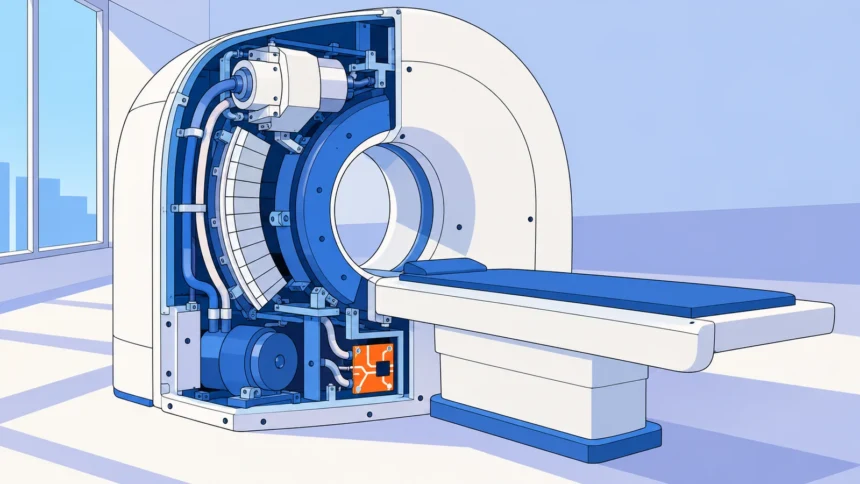
AI healthcare stocks, judged by the public record, are a short list. HeartFlow, Nano-X, Lunit and RadNet’s DeepHealth unit sell AI as a product. GE HealthCare, Siemens Healthineers and Philips hold the most FDA entries for AI devices, mostly built into scanners. Three of US News’ eight May 2026 picks hold no FDA entries at all.
- How do 25 AI healthcare stocks compare on the public record?
- What makes a company an AI healthcare stock?
- How does the FDA’s AI device list work?
- Why do imaging companies dominate the FDA list?
- Which medical AI stocks sell AI as the product?
- Does any AI healthcare company report its AI revenue?
- Who pays for medical AI?
- AI biotech stocks: has AI discovered an approved drug yet?
- Why are Amazon, Hims & Hers and Doximity on AI healthcare lists?
- Which medical AI companies can’t you buy?
- What does an AI healthcare ETF actually hold?
- How can you check an AI healthcare stock yourself?
- Frequently Asked Questions
- What are the best AI healthcare stocks to buy in 2026?
- Is Tempus AI an AI company or a lab company?
- Does Hims & Hers actually sell artificial intelligence to anyone?
- How many AI-enabled medical devices has the FDA authorized?
- Has the FDA approved any drug that was discovered by AI?
- Is there an ETF that holds only AI healthcare stocks?
- Why do some popular AI healthcare stocks have zero FDA entries?
- My Take
Before an AI label goes into a portfolio, it deserves the review any line item gets before a budget passes: what exactly the money buys, and who pays the company for it. This article checks 25 companies, the names that turn up on AI health-care lists plus the ones that hold the FDA record, against four public records read on October 5, 2026. Those records are the FDA’s AI-Enabled Medical Device List, each company’s latest annual report, Medicare’s payment rules and ClinicalTrials.gov. It explains who sells medical AI and who pays for it. None of these records predicts a share price, this isn’t investment advice, and nothing here is ranked to buy.
The FDA count matters for AI healthcare stocks because health care is a corner of AI where a regulator publishes a list of what it has authorized. A company that sells diagnostic AI to hospitals usually needs FDA authorization first, and that authorization tends to land on the list. A company that only uses AI in its own operations needs neither.
How do 25 AI healthcare stocks compare on the public record?
The table sorts 25 AI healthcare stocks by their entries on the FDA’s AI device list, counted across every legal name each company files under, subsidiaries and bought companies included. Two columns come from the companies’ own annual reports: where the AI sits in the business, and whether any revenue from it is visible. The last column shows where each name was picked or held; a passing mention doesn’t count. The sources are US News’ May 2026 picks, Simply Wall St’s “3 AI Healthcare Stocks With Earnings Growth Up To 15%” on Yahoo Finance (October 2, 2026) and the Fidelity Select Health Care Portfolio’s top ten holdings as of May 31, 2026. An older Motley Fool article and a MarketBeat roundup complete the editorial lists, and the Global X HealthTech ETF, a fund rather than a list, marks the names in the table that it holds. Eighteen of the 25 come from those sources; the other seven were added because they hold FDA AI entries or supply the computing. Canon, United Imaging and Samsung hold more entries than several names here but appear on none of those lists, so they show up in the chart further down instead.
Note
An FDA entry is one marketing decision on a public list. It says nothing about how many units sold or how much revenue followed. The FDA also says the list isn’t complete, so a missing company can still sell AI the list doesn’t catch.
Four of these AI healthcare stocks sell AI as a product in its own right, something a customer pays for separately: HeartFlow’s coronary CT analysis, Nano-X’s Nanox AI tools, Lunit’s INSIGHT software and RadNet’s DeepHealth products. For Nano-X and RadNet that product is a small slice of the business, and the scale varies widely. HeartFlow reported $176.0 million of revenue for 2025, Nano-X booked $958 thousand from AI, and RadNet’s Digital Health segment, which holds the DeepHealth products, was 4.5% of its sales.
The big device makers carry the largest counts. GE HealthCare, Siemens Healthineers and Philips hold 292 of the 413 entries in the table, and in most cases the AI ships inside a scanner, an ultrasound system or a workstation. Neither GE HealthCare’s 10-K nor Philips’ 20-F, the annual reports each files with the SEC, gives a figure for that AI, and Siemens Healthineers doesn’t file annual reports with the SEC at all.
Seven of the 25 companies have no FDA AI entries, and four of them were 2026 picks on the US News or Yahoo lists.
Those four are Amazon, Eli Lilly and Hims & Hers, all US News picks, and Pfizer, from Yahoo’s October list. Their exposure to medical AI comes from buying it, using it or supplying the computers it runs on, and their annual reports discuss AI mostly in risk factors. If you hold one of them for its AI story, that story isn’t the part of the business producing your returns.
What makes a company an AI healthcare stock?
An AI healthcare stock, read strictly, is a listed company that sells artificial intelligence used in medical care, with a regulator’s record, a paying customer and a revenue line behind it. Few companies meet that definition in full. Most of the lists checked for this article use a looser one, in which any health-care company that talks about AI qualifies. That’s how a telehealth retailer ends up beside a scanner maker. Three tests separate the two:
- The FDA has authorized the AI, and the entry traces back to the company through its own name or a subsidiary named in its annual report.
- Someone pays for the AI as a service in its own right, whether through a Medicare billing code, a hospital software contract or a drug-company partner.
- The annual report shows where the AI’s revenue sits, even if only inside a larger segment.
Drug-discovery AI and back-office AI fail the first test by design, because neither one is a medical device. Those companies need different evidence: a clinical-trial record for drug discovery, a contract or a segment for software sold to hospital offices. Each group gets checked against its own record, so a drug developer isn’t marked down for lacking a device it was never going to make.
The label problem isn’t unique to health care. It shows up in lists of the best AI stocks as a whole, where a company’s description of itself can drift far from what produces its sales. Health care is the easier case to check, because regulators and payers leave a paper trail.
How does the FDA’s AI device list work?
The FDA’s AI-Enabled Medical Device List is a public table of devices that the agency identifies as using artificial intelligence and has authorized for sale in the United States. On October 5, 2026, it held 1,614 entries. The FDA last modified the page on September 4, 2026, and the newest decision in it dates from June 29, 2026. The oldest entry is a 1995 approval for an automated Pap smear screener.
The agency is direct about the list’s limits. “The list is not a comprehensive resource of AI-enabled medical devices,” the page says. It is built “primarily based on the use of AI-related terms in the summary descriptions of their marketing authorization document and/or the device’s classification.” A device whose public summary never uses those terms can be missing, and a scanner whose summary mentions one AI feature gets counted like a standalone AI product.

Most entries, 1,553 of the 1,614, are 510(k) clearances: the FDA agreed the device is substantially equivalent to one already on the market. Another 40 are De Novo grants for new low- to moderate-risk devices, and 21 are premarket approvals, the route for the highest-risk ones. Radiology is the lead review panel on 1,230 entries, or 76.2%, and 2025 added 335 entries, more than any other year.
For anyone sizing up medical AI stocks, the list can’t yet tell you whether a device uses generative AI. The FDA says it will explore ways to tag devices built on foundation models, “from large language models (LLMs) to multimodal architectures.” Ambient scribes, which listen to a doctor’s visit and draft the note, run on the kind of model explained in our guide to how ChatGPT works. Two that investors know, Doximity’s Scribe and Microsoft’s Nuance products, don’t appear on the list at all.

Why the name in the FDA file often isn’t the stock you’d buy
The list records whichever legal entity filed the submission, and that often isn’t the name on the ticker you’d buy. The FDA file uses 817 different company strings. GE HealthCare alone appears under 30 spellings, including “GE Medical Systems SCS” and “GE Healthcare (Tianjin) Company Limited.” Another 20 of its entries sit under four companies it bought, among them Caption Health and icometrix. RadNet has no entries under its own name: all 28 sit under DeepHealth, Quantib, iCAD and See-Mode, businesses its Digital Health segment runs. Six of Tempus AI’s ten entries are filed by Arterys, which Tempus bought in 2022, and one by Paige.AI, which it bought in 2025. United Imaging’s count leaves out four entries filed by Shanghai United Imaging Intelligence. United Imaging’s 2025 annual report lists that company as a subsidiary of United Imaging’s parent, United Imaging Group, and shows United Imaging holding 0.98% of it.
A second trap runs the other way: a company can claim AI whose FDA record sits under another company’s name. Medtronic calls its GI Genius colonoscopy module “our first FDA-cleared AI product in gastrointestinal care.” All six FDA entries for GI Genius are filed by Cosmo Artificial Intelligence, not by Medtronic. Medtronic’s own 2023 announcement says “Cosmo Pharmaceuticals will continue to be the exclusive manufacturer, granting Medtronic exclusive, global, commercial rights.” Under that deal, Medtronic agreed to pay Cosmo $100 million upfront, a double-digit royalty on net sales and a further $100 million in potential milestone payments. Medtronic sells the product; the regulatory record belongs to Cosmo.
Medtronic’s own 21 entries are real: 11 under Medtronic names and 10 under Medicrea, Covidien, Mazor and CathWorks, all four listed as subsidiaries in its latest annual report. Counted by parent company, the list’s leaders are imaging companies, and two of the top ten are private.
GE HealthCare holds 129 of the 1,614 entries on the FDA’s AI device list, more than any other parent company. Siemens Healthineers is close behind. Aidoc, a radiology-software company with no US listing, holds more than RadNet or Medtronic.
Why do imaging companies dominate the FDA list?
Three-quarters of the list sits in radiology, so the companies that build scanners file the most AI submissions. The top five parents by entries, GE HealthCare, Siemens Healthineers, Philips, Canon and United Imaging, account for 379 of the 1,614 entries, or 23.5%. Many of those entries are whole machines, such as Philips’ Alturion and EPIQ ultrasound systems, whose decision summaries mention AI features. By this measure they lead the field, and four of the five appear on none of the editorial lists checked here.
That makes the AI inside these companies hard to price from the outside. Much of it arrives bundled with a capital purchase or a service contract, and neither GE HealthCare nor Philips breaks it out in its annual report. A hospital that buys the scanner pays for the AI inside the scanner’s price, and the investor sees one revenue line for both. On its own filings, GE HealthCare is a device maker whose scanners carry AI features, and that’s how its revenue should be read.
Siemens Healthineers, second on the list, is listed in Frankfurt and doesn’t file annual reports with the SEC; US investors reach it through an unsponsored American depositary receipt traded over the counter under the symbol SMMNY. Philips trades on the New York Stock Exchange as PHG. None of the editorial lists checked for this article names Siemens Healthineers, Philips, Canon or United Imaging, even though those four hold 250 entries between them.
Some of the best-known names on AI lists carry little on this one. Stryker has four entries, Boston Scientific two and Intuitive Surgical two, all tied to their own products, such as Intuitive’s IRISeg and Stryker’s SurgiCount+ System. Boston Scientific’s pair shows how the paper moves with deals: Preventice Technologies filed the 2020 entry for the BodyGuardian heart monitor, and a Boston Scientific entity filed the 2026 entry for the same monitor.
Which medical AI stocks sell AI as the product?
None of the four medical AI stocks that sell AI as the product was among the eight US News picks. Only RadNet showed up on another editorial list checked here, a 2023 MarketBeat roundup. Their filings tell a more specific story than any list does.
HeartFlow (HTFL)
HeartFlow describes its business as “software and artificial intelligence” for diagnosing coronary artery disease. Its software turns a coronary CT scan into an estimate of how much each narrowing restricts blood flow in the heart’s arteries. That analysis has its own CPT code, the billing code a doctor uses for a specific procedure. “Our Heartflow FFR CT Analysis is reimbursed under a Category I CPT code, 75580, effective as of January 1, 2024,” the company’s 10-K says. By the company’s count, payer coverage policies apply to “approximately 99% of covered lives in the United States.”
Revenue was $176.0 million in 2025, up from $125.8 million in 2024. HeartFlow has traded on Nasdaq since 2025 and holds seven entries on the FDA list. On the record checked here, it’s the clearest case of an AI product with a regulator’s authorization, a dedicated payment code and revenue you can see in the filing.
Nano-X Imaging (NNOX)
Nano-X reports what the other 21 companies whose annual reports were checked don’t: a revenue line called AI. Its 2025 Form 20-F shows $958 thousand of AI revenue, up from $727 thousand in 2024. Total revenue was $13.0 million, most of it from teleradiology services. The cost of revenue for “the sale of AI solutions” was $8.7 million, mostly labor and the amortization of intangible assets, according to the filing.
Nano-X’s AI line cost about nine times what it brought in: $8.7 million against $958 thousand in 2025, or roughly nine dollars of cost for every dollar a customer paid. The 20-F explains part of the gap: it says Nano-X’s products and services, its AI software included, “are not yet widely approved for third-party payor coverage or reimbursement.” Nano-X holds 12 FDA entries, nine of them filed under Zebra Medical Vision, the company it bought in 2021 and renamed Nanox AI.
Lunit (KOSDAQ: 328130)
Lunit’s nine FDA entries are all software: INSIGHT products for mammography, breast tomosynthesis and chest X-ray triage, plus Volpara Imaging Software, which came with Lunit’s 2024 purchase of Volpara Health Technologies. Lunit trades on Korea’s KOSDAQ market and doesn’t file with the SEC, so its accounts weren’t part of this check, and a US investor needs a broker that trades Korean shares. Vuno, another Korean developer of medical AI listed on KOSDAQ, holds two entries.
RadNet (RDNT)
RadNet runs outpatient imaging centers and, beside them, a Digital Health segment that “develops and deploys Artificial Intelligence” tools for “breast, lung and prostate images.” The segment brought in $92.7 million in 2025, 4.5% of RadNet’s $2,040.2 million in revenue, and lost $32.3 million at the operating line. RadNet says AI-related revenue grew 64.9% inside the segment but gives no dollar figure, and the segment also sells imaging software that isn’t AI.
RadNet’s own count of its approvals differs from the FDA’s. The 10-K says the segment “has by now 22 FDA clearances,” while the FDA list carries 28 entries under the four businesses the segment runs. The filing doesn’t say how it counts, so the two numbers can’t be reconciled from the public record alone.
Does any AI healthcare company report its AI revenue?
For this check, the latest 10-K or 20-F filed by October 5, 2026 for 22 AI healthcare stocks from the table was searched for every sentence that pairs AI with revenue and a dollar amount. The other three companies in the table, Siemens Healthineers, Lunit and Hologic, have no current SEC annual report. HeartFlow needs no separate line, because its whole business is AI software. For the other 20, AI appears in business descriptions, segment discussions and risk factors, without a dollar figure of its own.
Of 22 annual reports checked, one has a revenue line labelled AI: Nano-X, at $958 thousand for 2025.
Tempus AI, one of the US News picks, shows how far an AI healthcare stock’s name can run ahead of its revenue. Diagnostics, its lab-testing business, produced $955.4 million of its $1,271.8 million in 2025 revenue, or about $75 of every $100 the company took in. The other $316.4 million came from data and applications, a line that the 10-K says includes its “Insights, Next, Trials and Algos businesses.” Through the third quarter of 2025, when the line was still called Data and services, its quarterly reports said: “We currently report our AI Applications revenue within this line item as it is immaterial.” Immaterial is the accounting word for too small to report separately.
Tempus does sell AI tools, but they sit inside a testing and data business. Six of its ten FDA entries are Arterys imaging tools, one is Paige’s prostate pathology software, and two are ECG algorithms, Tempus ECG-AF and Tempus ECG-Low EF. The money comes from testing, from licensing de-identified data to third parties and from matching patients to clinical trials.
The large device makers describe AI as part of what they sell without sizing it. GE HealthCare’s 10-K says it generates revenue from “medical devices, consumable products, service capabilities, and AI-enabled cloud and software solutions.” Medtronic’s 10-K names AI inside several products, such as an AI-powered surgical video platform, and puts no revenue figure on any of them. Microsoft reports its former Nuance business, now “Health and Life Sciences cloud services (formerly Nuance Healthcare cloud services),” inside Azure and other cloud services. Microsoft’s filings fold that business into a cloud revenue line rather than a health one, with no number of its own.
The risk factors often say more than the marketing. Hims & Hers lists “unsatisfactory suggestions made by artificial intelligence tools” among the things that could hurt its business. iRhythm warns that its billing faces audits from “government and commercial payers who are utilizing AI to review our bills.” In that sentence the AI sits on the other side of the invoice.
Who pays for medical AI?
A medical AI product earns repeatable revenue when someone pays for each use, and Medicare has a dedicated payment route for very few of them. Billing codes come from the American Medical Association’s CPT panel; Category I codes are the permanent ones, and Medicare then sets what it pays for each, which varies by setting and location. For anyone holding AI healthcare stocks, that code is the difference between a product that bills per patient and one that has to win a line in a hospital’s IT budget every year. The table lists four AI services with their own payment route and a public record behind each one; only the add-on payment has a single published dollar cap.
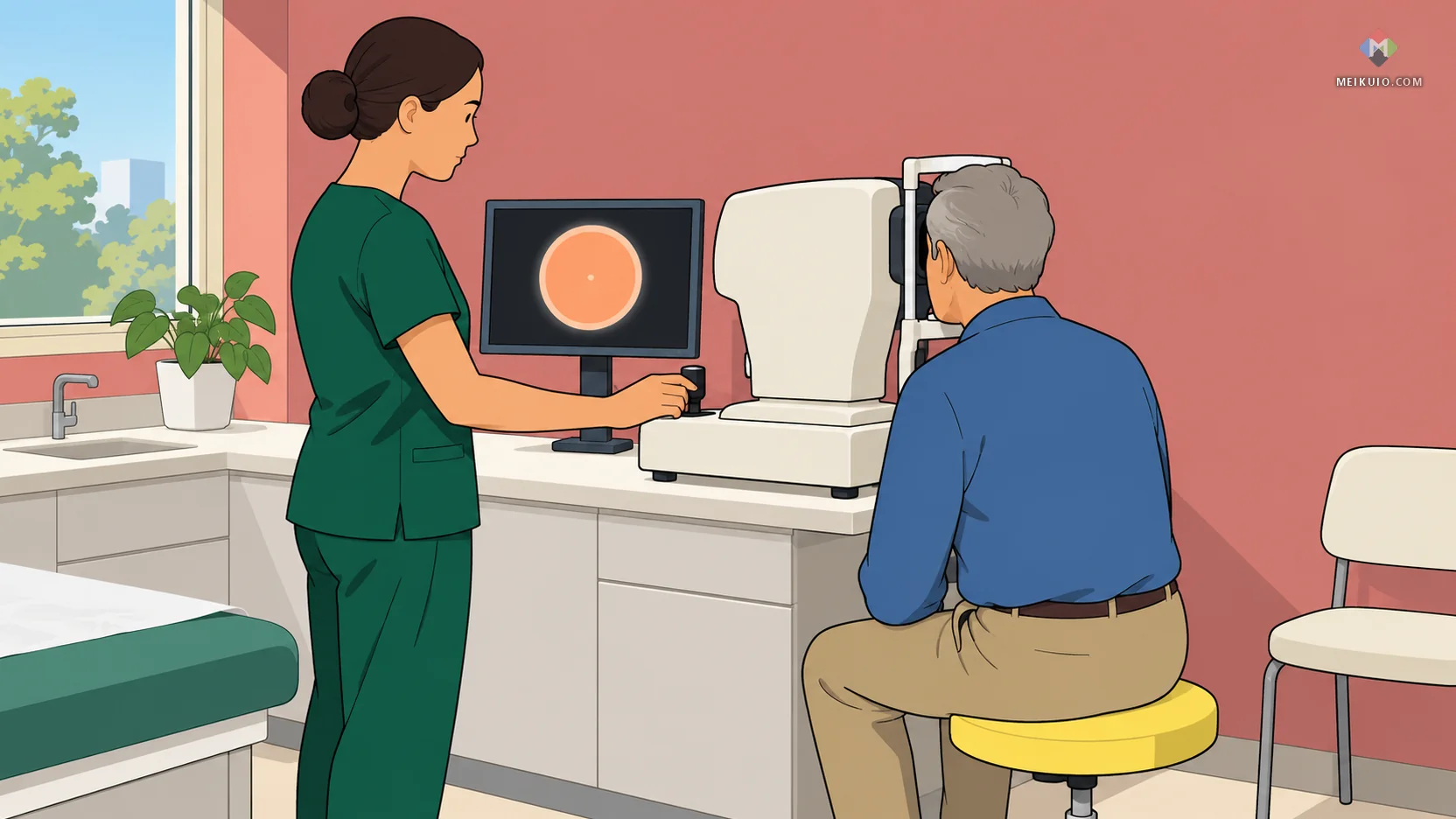
Code 92229 pays for “imaging of retina for detection or monitoring of disease; point-of-care autonomous analysis and report, unilateral or bilateral” and took effect in January 2021. IDx-DR, an autonomous retinal screening system that predates the code, entered the FDA list as a De Novo grant in 2018. It is now filed by Digital Diagnostics, a privately held company that doesn’t appear in the SEC’s list of ticker symbols.
Coronary CT analysis has two codes. Code 75580 covers a “noninvasive estimate of coronary fractional flow reserve (FFR) derived from augmentative software analysis” of a CT angiogram, and HeartFlow says its product has been paid under it since January 1, 2024. In September 2024 the CPT Editorial Panel created code 75577 for plaque analysis, also “derived from augmentative software analysis.” Even so, Medicare’s 2026 physician payment rule says “software analysis fees are not well accounted for in our direct PE methodology.” That methodology is the formula that sets the practice-expense part of a payment.
Hospitals can also get a new technology add-on payment, or NTAP, a temporary extra payment for a new technology used during an inpatient stay. Medicare’s rule for fiscal 2021 granted one to ContaCT, Viz.ai’s stroke-triage software: “the maximum new technology add-on payment for a case involving the use of ContaCT is $1,040 for FY 2021.” Using the applicant’s estimate, CMS projected the add-on would raise Medicare’s fiscal 2021 payments by $72.1 million. Viz.ai has no US listing either.
For nearly everything else, the 2026 physician rule opened a “Comment Solicitation on Payment Policy for Software as a Service (SaaS)” and explained, “We refer to these software-based technologies as software as a service (SaaS).” Asking for comments isn’t paying. A company whose AI waits on a new Medicare code is waiting on a process that moves one annual rule at a time. An FDA clearance and a payment decision are separate steps, as powered exoskeletons show. Implanted brain-computer interfaces such as Neuralink’s have neither yet.
AI biotech stocks: has AI discovered an approved drug yet?
As of early October 2026, no drug its developer calls AI-discovered or AI-designed has FDA approval; Insilico’s rentosertib dosed its first Phase 3 patient on September 9, 2026. Insilico Medicine calls the trial, for idiopathic pulmonary fibrosis, the first Phase 3 trial of a drug driven by generative AI. The company’s own announcement is explicit about the status: “the drug remains investigational and has not been approved by any regulatory authority.”
The trial is expected to enroll 320 patients at 47 centers in China, with 52 weeks of treatment. Its lead investigator put the timeline plainly: “From initiating Phase III to obtaining final regulatory approval, it will take three to four years under favorable conditions.” Insilico listed in Hong Kong on December 30, 2025, and trades there under the code 3696. It doesn’t appear in the SEC’s list of ticker symbols, though an unsponsored American depositary receipt, IMDCY, has been quoted over the counter in the US since September 2026.
The business model shows where the money comes from in the meantime. On August 26, Insilico reported about $106 million of revenue for the first half of 2026, up 287%. It also reported its first profitable half-year since listing, a net profit of $35.5 million or $51.2 million on its adjusted measure, and credited licensing, co-development and research deals with partners that include Eli Lilly. At Insilico, AI drug discovery earns its revenue from deals for now, and the drugs come later if the trials succeed.
Recursion is a US-listed name that turns up on AI biotech lists. Its 2025 annual report says: “The current pipeline consists of 5 clinical programs and 2 preclinical programs.” One clinical program came with Exscientia, which Recursion absorbed; the trial record for GTAEXS617 lists its sponsor as “Exscientia AI Ltd., a wholly owned subsidiary of Recursion Pharmaceuticals, Inc.” None of those programs has reached approval.
Two repurposed drugs show what AI credit looks like on an approved medicine. BenevolentAI says its scientists used AI in January 2020 to flag baricitinib, a rheumatoid arthritis drug, as a possible COVID-19 treatment. The FDA approved it for certain hospitalized adults with COVID-19 on May 10, 2022, and Lilly and Incyte’s release on the approval describes it as “discovered by Incyte and licensed to Lilly.” BioXcel says its AI-based approach led to Igalmi, a film form of the older drug dexmedetomidine, which the FDA approved on April 5, 2022. In both cases the molecule already existed, and the AI is credited with a new use for it, not a new design.
The big drug makers on AI lists are buyers of the technology. Eli Lilly’s 10-K describes “partnerships and collaborations relating to the use of AI technology to aid in drug discovery.” Pfizer’s says the company is “scaling AI across R&D, manufacturing, commercial and patient engagement.” Neither has an entry on the FDA’s AI device list, and both earn their revenue from medicines.
Why are Amazon, Hims & Hers and Doximity on AI healthcare lists?
Amazon, Nvidia, Eli Lilly, Pfizer, Hims & Hers and Doximity have no entries on the FDA’s AI-enabled device list. They make lists of AI healthcare stocks because they are large and visibly tied to AI somewhere in the business, and in each case the tie runs through something other than a medical AI product. Their own filings say where.
Amazon is a US News pick. Its 10-K counts health care among the businesses it runs and lists “providers of virtual or in-person healthcare services” among its competitors, but reports no health-care revenue figure. The AI that does show up in its filing sits elsewhere, including its investment in Anthropic, which the 10-K describes in terms of convertible notes.
Hims & Hers, another US News pick, says it generates revenue “by selling non-prescription health and personal care products to consumers and offering consumers a technology-driven platform to access telehealth consultations with Providers”. AI shows up in its risk factors and in its forward-looking statements about expanding its offerings, and the company has no FDA AI entries.
Doximity shows AI working as a feature that attracts users while someone else pays. On August 7, 2026, MarketWatch ran the headline “Doximity’s stock skyrockets 50% on medical AI excitement. Can the rally last?” Doximity’s AI tools for doctors, including Scribe, which listens during visits and drafts notes, sit inside a platform that is “free to join and use.” The money comes from elsewhere: “Our revenue-generating customers, primarily pharmaceutical manufacturers and health systems, have access to a suite of commercial solutions.” The AI brings doctors in, and drug companies and health systems pay the bills.
Nvidia sits on the supply side. Its 10-K lists “Clara for healthcare” among the software stacks it builds on its chips, and its health-care exposure runs through customers who build on its chips. Alphabet’s one FDA entry is Fitbit’s Loss of Pulse Detection, and Google itself has none. The three Study Watch entries belong to Verily, which moved out from under Alphabet’s control with a funding round announced in March 2026. Apple, which none of the lists checked here includes, holds five: Apple Watch features for irregular rhythm notifications, AFib history, sleep apnea and hypertension. Microsoft’s single entry is a 2017 Radiomics App, and Nuance, which Microsoft bought in 2022, has none.

Which medical AI companies can’t you buy?
Some of the companies with the most FDA entries can’t be bought on a US exchange at all. Aidoc holds 35 entries, more than RadNet or Medtronic. RapidAI’s 17 entries are all filed as iSchemaView, and Viz.ai, the company behind the ContaCT add-on payment, holds 12. None of the three appears in the SEC’s list of ticker symbols, and all three are privately held, so none has a US listing.
Hologic joined this group on April 7, 2026, when funds managed by Blackstone and TPG completed their takeover and its shares stopped trading on Nasdaq. Its nine FDA entries, led by Genius AI Detection mammography software, now sit inside a private company. Any list that still carries Hologic as an AI healthcare stock predates April or hasn’t been updated since.
Private medical AI sits behind the same wall that stands between most people and buying OpenAI stock: a retail investor can reach it only indirectly. Brain implants sit behind it too: Neuralink has no ticker, and its devices are still investigational.
What does an AI healthcare ETF actually hold?
The fund to check first is the Global X HealthTech ETF, ticker HEAL, which US News calls the benchmark health-tech ETF. Its index rule is broad by design: a company qualifies “if it derives at least 50% of its revenue” from healthcare analytics and software, smart medical devices, AI-enabled drug discovery or tech-enabled consumer healthcare. The first category also takes in insurance technology, medical billing software and electronic medical records.
On October 2, 2026, HEAL held 39 stocks and $30.38 million in net assets. Only 11 of the 39 stocks in Global X’s HealthTech ETF have even one entry on the FDA’s AI list; together they make up 32.38% of the fund. Among its ten largest holdings, IQVIA, Veeva, Oscar Health, Dexcom, Hims & Hers and Waystar have none, and Oscar’s SEC industry code is the one for hospital and medical service plans, meaning health insurance.
HEAL follows its own rules, and those rules measure health-care technology broadly, taking in clinical-trial data, glucose monitors and CPAP machines, and AI-enabled drug discovery is one of the four categories in its index. Put $1,000 into HEAL for its AI exposure, and about $324 of it lands in companies with even one entry on the FDA’s AI list. That $324 buys whole companies, GE HealthCare’s scanners included, so the share that is medical AI itself is smaller still. The fund used to be the Global X Telemedicine & Digital Health ETF, ticker EDOC, until it was renamed on April 1, 2025.
How can you check an AI healthcare stock yourself?
Five steps answer most of the question for any AI healthcare stock, and every record they use is free to read. Start with the subsidiary list, because it tells you which names to search on the FDA list.
- Get the subsidiary names from Exhibit 21 of the company’s 10-K, the attached list of subsidiaries, or from the matching list in a foreign company’s 20-F, on the SEC’s EDGAR system.
- Download the FDA’s AI-Enabled Medical Device List as a CSV file and search the Company column for the parent’s name and every subsidiary’s name.
- Read the revenue note and the segment note in the same annual report, and look for any line or segment that names AI.
- Check whether a dedicated payment code covers the product: a CPT code in Medicare’s physician fee schedule, or a new-technology add-on payment in the inpatient rule.
- For drug-discovery companies, search ClinicalTrials.gov by sponsor and write down the phase and status of each program.
Lists of AI medical stocks also trip over tickers. C3.ai trades under the symbol AI, and its SEC industry code is prepackaged software, not health care. HeartSciences (HSCS), which has agreed to merge with Fortitude Mining Holdings, has no entries on the FDA list, while HeartFlow (HTFL), a different company, holds seven. Butterfly Network (BFLY) and BullFrog AI (BFRG) are unrelated companies with similar tickers.
The same five checks work on any thematic list, whether it covers quantum computing stocks or AI chip stocks: find the document that would prove the label, then see whether it exists. A company that sells medical AI should leave a record in at least one of these places.
When to check again
The figures here come from dated records, and four events would move them. The FDA updates its AI list periodically, and the newest decisions in this version are from June 29, 2026. Eighteen of the 22 annual reports used here were filed between February and April, so the next round lands in early 2027; Doximity, Medtronic, Microsoft and Apple file later in the year. Medicare publishes its physician payment rule each fall, and the next one will show whether the request for comments on software as a service turned into a payment method. Rentosertib’s Phase 3 trial treats each patient for 52 weeks.
Field notes
- The FDA list: 1,614 entries on October 5, 2026; page modified September 4, 2026; newest decision June 29, 2026; radiology leads 1,230 entries; 1,553 are 510(k) clearances; the FDA says the list isn’t complete.
- Who holds the entries: GE HealthCare 129; Siemens Healthineers 101; Philips 62; Canon 46; United Imaging 41; Aidoc, with no US listing, 35; RadNet 28, all under subsidiaries.
- The popular picks: US News’ eight May 2026 picks hold 146 entries, 129 of them GE HealthCare’s; Amazon, Eli Lilly and Hims & Hers hold none; Medtronic’s GI Genius is filed by Cosmo.
- AI revenue: one of 22 annual reports has a revenue line labelled AI, Nano-X’s, at $958 thousand for 2025 against $8.7 million in related cost of revenue; RadNet’s Digital Health segment is 4.5% of sales; Tempus earned 75.1% of 2025 revenue from diagnostics.
- Who pays: CPT 92229 since January 2021; CPT 75580 since January 1, 2024, used by HeartFlow; CPT 75577 created in September 2024; ContaCT add-on payment capped at $1,040 per case in fiscal 2021.
- Drugs and funds: as of early October 2026, no FDA approval for a drug its developer calls AI-discovered or AI-designed; Insilico dosed rentosertib’s first Phase 3 patient on September 9, 2026; 11 of HEAL’s 39 holdings have FDA AI entries, 32.38% of the fund on October 2, 2026.
- Sources: FDA AI-Enabled Medical Device List and CSV; latest 10-K and 20-F filings of 22 companies on SEC EDGAR; Medicare CY2026 physician fee schedule and FY2021 inpatient rules in the Federal Register; ClinicalTrials.gov; Global X HEAL holdings and summary prospectus; company announcements from Medtronic, Hologic and Insilico Medicine.
Frequently Asked Questions
What are the best AI healthcare stocks to buy in 2026?
This article doesn’t rank stocks to buy. On the record, the companies that sell AI as the product are HeartFlow, Nano-X, Lunit and RadNet’s Digital Health unit, while GE HealthCare and Siemens Healthineers hold the most FDA entries. HeartFlow’s AI revenue is tied to a payment code.
Is Tempus AI an AI company or a lab company?
By revenue, mostly a lab company. Diagnostics brought in 75.1% of its $1.27 billion in 2025 revenue, and its 2025 quarterly reports called AI Applications revenue immaterial. Tempus does hold ten FDA entries, six of them under Arterys, which it bought in 2022.
Does Hims & Hers actually sell artificial intelligence to anyone?
No, not as a product. Hims & Hers earns revenue by selling health and personal care products and access to telehealth consultations. It has no entries on the FDA’s AI device list, and AI appears in its annual report as part of its plans and its risk factors.
How many AI-enabled medical devices has the FDA authorized?
The FDA’s list held 1,614 entries on October 5, 2026, with decisions through June 29, 2026. The FDA says the list isn’t complete, because it finds devices mainly by AI-related terms in their public summaries, so the real number of AI-enabled devices may be higher.
Has the FDA approved any drug that was discovered by AI?
Not as of early October 2026: the FDA hasn’t approved a drug its developer calls AI-discovered or AI-designed. Insilico’s rentosertib, which it calls AI-discovered, dosed its first Phase 3 patient on September 9, 2026. BenevolentAI and BioXcel credit AI for the repurposed drugs baricitinib and Igalmi, whose molecules already existed.
Is there an ETF that holds only AI healthcare stocks?
Not that this check found. The Global X HealthTech ETF, the fund examined here, has an index covering four categories, and the software one takes in insurance technology. On October 2, 2026, only 11 of its 39 holdings had entries on the FDA’s AI device list, 32.38% of the fund.
Why do some popular AI healthcare stocks have zero FDA entries?
Because their AI isn’t a medical device they sell. Drug makers use AI in research, Nvidia supplies computing, and Amazon and Hims & Hers run health services without an FDA-listed AI device. Sometimes another company holds the FDA record, as Cosmo does for Medtronic’s GI Genius.
My Take
When a team asked me to sign off on a new tool, I wanted three things in writing before the demo: the contract, the invoice and the name of the person who would own it. An AI healthcare stock deserves the same treatment, with three documents of its own: its entry on the FDA list under every legal name, the revenue note in its annual report, and the payment code a hospital bills. On the record I checked, HeartFlow is the one company where all three line up; the others pass two at most, and several pass none.
The first thing I’d cut from an AI healthcare watchlist is the AI label itself on any name whose medical AI shows up only in its plans and risk factors. Amazon, Eli Lilly and Hims & Hers are priced on other parts of their business, and those parts are what deserve the analysis. I’d keep the label for the companies that sell the AI and can show who pays for it, and I’d check the FDA list again every time it updates.