


An air taxi is a small aircraft you hire on demand, and in the United States it is a legal category that already flies. The FAA’s own list of certified operators, updated October 5, 2026, names 1,798 companies cleared for on-demand and commuter flights, with 11,480 aircraft between them. Not one is an electric air taxi.
- What is an air taxi?
- Where can you book a seat today?
- Who flies you when an app sells the seat?
- Broker, public charter, carrier: three roles, three rulebooks
- Blade, in its own words
- The electric air taxi company that earns its money from helicopter seats
- What’s on Joby’s and Archer’s FAA certificates?
- Can you ride an electric air taxi anywhere in 2026?
- United States: a pilot program with only pilots on board
- Dubai: Uber Air, powered by Joby
- Abu Dhabi: Archer’s Midnight
- China: EHang’s flights are still trial operations
- Everywhere else
- What can you actually fly this year?
- How much does an air taxi cost?
- Which U.S. cities have flying taxis?
- Which services already shut down?
- How do you check a carrier before you book?
- Frequently Asked Questions
- What is an air taxi service, and who runs it?
- Are air taxis available in the USA right now?
- How much does an air taxi ride cost in 2026?
- How much will a Joby air taxi ride cost?
- Does a flying taxi exist that you can ride today?
- Which country has electric flying taxis carrying paying passengers?
- Did the FAA approve electric flying taxis to carry passengers?
- Can you book an Uber Air flight in Dubai yet?
- Is an air taxi the same thing as an eVTOL?
- Is an air taxi a drone, or is there a pilot?
- My Take
I downloaded that list on October 6 and counted every row. The 11,480 aircraft are 8,620 airplanes, 2,857 helicopters, three package drones and zero powered-lift aircraft, the FAA’s category for the electric machines Joby and Archer are building. Both companies are on the list anyway. Each holds a certificate with exactly one aircraft on it. Both aircraft are piston airplanes.
So the air taxi you can book today is a helicopter or a small plane. Blade, a booking company whose passenger business Joby bought in 2025, sells a helicopter seat from Manhattan to JFK starting at $195. Small scheduled airlines under the same FAA rules sell seats too: Cape Air advertises Hyannis to Nantucket from $79 one way. Nobody sells a public seat on the electric kind in the four places I checked: the U.S., Dubai, Abu Dhabi and China.
I read the rules that define the term, Blade’s own terms, the reports Joby and the Chinese maker EHang filed with the U.S. Securities and Exchange Commission and the price pages of four operators on September 27, 2026. On October 6 I recounted the FAA list, read the prices again and scanned the week’s news. The prices and FAA counts below are from October 6. The electric-seat checks are dated September 27, and nothing in that week’s news put an electric seat on sale. I didn’t buy a seat or fly in one. The filings and the rules agree with one another. The headlines don’t.
What is an air taxi?
An air taxi is an on-demand flight in a small aircraft: you hire the whole aircraft for a trip you choose, or buy a seat on a charter someone else arranged, instead of a seat on an airline’s timetable. In U.S. law, an air taxi operator flies small aircraft on demand and sells no scheduled passenger flights. That meaning is decades older than the electric air taxi, and it describes the only kind on sale in the U.S. today.
The legal meaning: two agencies, one word
Two agencies share the term. The Department of Transportation’s rule, 14 CFR Part 298, sets up a class of air carriers “designated as ‘air taxi operators'” that carry people, cargo or mail. To stay in that class, a company must use only small aircraft and can’t “engage in scheduled passenger operations” under its air taxi registration. Small means an aircraft originally designed for 60 passenger seats or fewer, or for 18,000 pounds of payload or less.
More Read

The paperwork is short. An operator files a registration form and proof of insurance at least 30 days before the first flight, and the rule spells out the fee: “An 8 dollar ($8) registration filing fee in the form of a check, draft, or postal money order payable to the Department of Transportation.” Eight dollars. That part is easy.
The same rule shows where the air taxi class ends. A company that wants to fly a commuter schedule needs a separate Commuter Air Carrier Authorization: “A $670 filing fee” and a finding that it is “fit, willing, and able”. Until then, the rule says, such companies “are not permitted to conduct such operations under their air taxi registration”. On demand costs $8 to register. A schedule costs a review and $670.
The Federal Aviation Administration handles the flying, and its approval is the hard part. Its Part 135 is the rulebook for commuter and on-demand flights: pilot rules, maintenance, training, and an FAA certificate before anyone carries a paying passenger.
The FAA’s definition of an on-demand flight is the most honest description of a taxi I’ve read in a regulation. It covers any trip where “the departure time, departure location, and arrival location are specifically negotiated with the customer or the customer’s representative”. You pick the when and the where. The operator flies.
The same definition lists public charters, where an organizer sells single seats on a flight it arranged, as on-demand flights too. Blade says it sells seats this way on select routes. Scheduled flights in small aircraft are a different class: the Department of Transportation treats small scheduled airlines as commuter air carriers, and the FAA runs both kinds under Part 135. In practice, an air taxi flight is a charter in a small aircraft, whether you hire the whole aircraft or buy one seat on a charter someone else arranged.
The marketing meaning: electric aircraft
The FAA’s own public page uses the same words for something else. Its “Air Taxis” page covers advanced air mobility and says aircraft that “fall into the powered-lift category are often referred to as air taxis.” Powered-lift means an aircraft that lifts off vertically like a helicopter and cruises on wings like a plane. The ones in the news are electric, the industry calls them eVTOLs, and many stories call them flying taxis. If you came here to buy the aircraft rather than a ride, start with what an eVTOL is and which ones you can legally buy.
Google’s AI Overview for “air taxi” goes further. On September 27, 2026, it described air taxis as “emerging electric vertical takeoff and landing (eVTOL) aircraft” and nothing else. That description leaves out every company actually selling rides under the name today, including one whose name is Talkeetna Air Taxi. Wikipedia, the first result under that Overview the same day, still uses the old meaning: “An air taxi is a small commercial aircraft that makes short flights on demand.” The encyclopedia and the AI answer above it describe two different things.
The regulator is more careful than the search engine. The same FAA page says: “Initial operations will be much like helicopter service today.” Borrowed names are common in new technology, and what the quantum internet actually carries is a good example of a label running ahead of the product. Here, the label ran ahead by years. The helicopter is still doing the work.
Where can you book a seat today?
You can book an air taxi today. It’s a helicopter shuttle, an Alaska bush plane or a seat on a small commuter airline, all flying under FAA Part 135 certificates. The FAA lists 1,798 companies holding such a certificate. Some fly cargo, some sell whole aircraft, and a handful sell single seats to anyone with a card.

What the FAA’s own list says
The FAA publishes the list as a spreadsheet with one row per aircraft: the certificate’s four-letter designator, the company’s legal name, the aircraft model and its registration number. The copy I downloaded on October 6 was last modified on October 5, 2026. I counted it by script, then counted it again.
It names 1,798 certificate holders and 11,480 aircraft: 8,620 airplanes, 2,857 helicopters and three drones. Of the 1,798, 37 list no aircraft at all. One aircraft in four is a helicopter. The most common single model is the Bell 407 helicopter, with 558 on the list, ahead of the Cessna Grand Caravan, a single-engine turboprop, with 474. The list skews small: 674 of the 1,798 companies list exactly one aircraft, and 28 of those fly nothing but a single Cirrus SR22, the same model Joby keeps on its own certificate.
Eighteen companies carry “Air Taxi” or “Airtaxi” in their legal names. The biggest is Executive Air Taxi Corporation, with 12 aircraft including Beechcraft King Airs and Hawker business jets. Talkeetna Air Taxi in Alaska flies seven de Havilland Turbine Otters, a Cessna 185 and two Robinson R44 helicopters. Thirteen of the 18 list one or two aircraft. Skyway Air Taxi lists one Cirrus SR22.
Eleven of the 18, including Talkeetna, Iliamna, Seward and Kantishna, answer to the FAA’s district offices in Alaska. Alaska’s offices oversee 292 of the 1,798 certificates nationwide, about one in six. In Alaska, the old meaning of the word is still the everyday one.
The only battery-powered aircraft I found on the entire list are three Matternet M2 drones on one company’s certificate. Each weighs up to 29 pounds at takeoff and carries a package of up to 4.4 pounds. You won’t be riding one. If you’d rather fly a small drone yourself, that’s a different set of rules and a different shopping list: the best beginner drones for 2026.
1,798 companies hold the FAA certificate for air taxi and charter flights. Not one lists an electric air taxi on it.
What this count covers
The FAA says the spreadsheet exists to show “whether an operator is certificated for charter and which aircraft are authorized for charter.” It lists aircraft, not flights flown. Among the 1,798 certificates, a company with one helicopter and a company with 97 airplanes each count once. It is one file on one date, and the FAA replaces it weekly. Joby’s electric aircraft don’t appear on it. The one aircraft on Joby’s certificate is the Cirrus.
Three ways to book an air taxi, and a scheduled cousin
Book an “air taxi” today and you’re booking one of three things. The first is the whole aircraft, for your trip only. You call a charter operator, name the time and the place, and get a quote. The price covers the airplane or helicopter and its crew, whether you fill every seat or fly alone.
The second is a seat on a shared flight an app sells you: Blade’s helicopter shuttle to JFK. You share the aircraft with strangers and pay for one seat. Blade calls this an air taxi on its own page.
The third is a loop: a sightseeing flight that lands where it took off, like Talkeetna Air Taxi’s flights over Denali. Talkeetna has the words in its name.
There’s also a close cousin: a seat on a small scheduled plane. Cape Air, whose legal name on the FAA list is Hyannis Air Service, lists 97 aircraft: 62 Cessna 402s, 30 Tecnam P2012s and five Britten-Norman Islanders. Cape Air and Seattle’s Kenmore Air sell tickets on short hops to islands and small towns, on timetables, at posted fares. These are commuter airlines, the air taxi’s scheduled cousins under the same FAA rulebook. The FAA calls this a commuter operation when a carrier flies small aircraft on a published schedule with at least five round trips a week on a route.
One word stretched over several products is a pattern in new technology. The phrase robot dog now covers four different kinds of machine at very different prices. The comparison table near the top of this article lists five, counting the scheduled cousin and the electric kind. Only the electric one isn’t for sale.
Who flies you when an app sells the seat?
When Blade sells you a seat, another company flies you. Blade’s terms say that in the U.S. it “acts as an air charter broker and indirect air carrier, not a direct air carrier, and does not have operational authority of aircraft.” The flights themselves “are operated by DOT/FAA licensed direct air carriers.” Blade’s U.S. terms don’t name them. The seller doesn’t need an FAA certificate of its own. The company flying you does.
Broker, public charter, carrier: three roles, three rulebooks
Federal rules split an air taxi sale into roles, and each role has its own part of the code. The direct air carrier is the company that “has control over the operational functions” of the flight: the pilots, the aircraft, the certificate. Under Part 295, a rule the Department of Transportation adopted in 2018, an air charter broker sells a whole aircraft to one customer and uses a direct air carrier to fly it. Under Part 380, a public charter lets an organizer sell seats on a flight “performed by one or more direct air carriers”. Part 380 calls that organizer an indirect air carrier. It can’t sell or even advertise the seats until the Department of Transportation accepts its charter prospectus, a filing that names the carrier and the arrangements that protect passengers’ money, and every ad has to “include the name of the charter operator and the name of the direct air carrier”. Your contract has to name the carrier too. Blade says it works as a broker and, “For select routes,” as an organizer of public charters.
If you hire a whole aircraft, the broker rules are the ones written for you. Every broker advertisement, “including internet web pages,” has to say “clearly and conspicuously” that the broker is not the carrier in control of the aircraft. Before you sign, a broker must tell you “The corporate name of the direct air carrier” that will fly you. A broker may even put its own name and logo on the aircraft, but only if the carrier’s name “is displayed prominently and clearly on the aircraft”. The seller is not the pilot’s employer. The law makes the seller say so.
Blade, in its own words
Blade’s page titled “NYC Air Taxi Services” sells exactly this kind of seat. Its booking pop-up offers to “fly between JFK & NYC in 5 Minutes” “from $195/seat.” Blade’s airport booking page says the same: “Fly between Manhattan and JFK or Newark in 5 minutes from $195”.
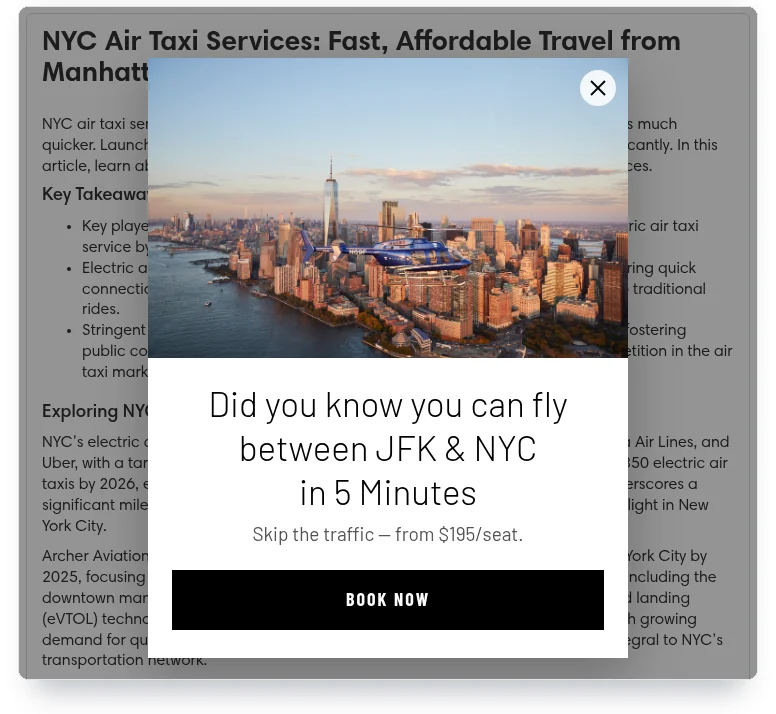
The terms behind that seat decide what happens to you on the day. I read Blade’s general terms, its luggage page and its cancellation page. Four lines matter most:
- If you weigh more than 275 pounds, you pay for a second seat. “Passengers exceeding the weight limit will be required to purchase an additional seat.”
- Your bags go on a scale. You get one carry-on of 22 by 16 by 9 inches plus a personal item, and “The combined luggage weight may not exceed 25 lbs.”
- If weather cancels the flight, you get store credit unless you bought Blade’s insurance: “you will receive BLADE Credits equal to the value of your entire order.” Without Blade’s Flight Cancellation/Weather Insurance, “you will only receive BLADE Credits.” With it, you can choose a card refund instead. The insurance itself is non-refundable and can’t be added after you buy, and the terms say some airport fares include it.
- The aircraft can change: “Blade may reassign Customer to a different aircraft, which may include a change of airframe model.”
Read those four lines before you pay. The page title sells an air taxi. The terms describe a helicopter seat with a weight limit, a luggage scale and store credit for bad weather. Tesla’s self-driving subscription has the same gap between the name and the terms: what you’re actually renting with Tesla FSD.
For seats Blade sells as public charters, its operator-participant agreement answers the question its general terms skip. Blade doesn’t list which routes those are. The carrier “and the type and capacity of the aircraft to be used for the Flight will be displayed in the Flight Documents”, which include the quote and the confirmation, and Blade and the operators can still swap either one “based on operational or safety conditions”. Your payment goes into an escrow account at Shelby Financial Corporation, and federal rules limit how money leaves that account; it’s backed by a security agreement with ACSTAR Insurance Company. File any claim within 60 days of the flight, or the insurer is released.
Blade’s safety page adds that “All flights are conducted by FAA-certificated operators under 14 CFR Part 135”, and lists what it reviews before it uses an operator, including “manuals, training, maintenance, and compliance records”. That’s Blade’s own vetting. The FAA certificate is the legal floor.
The electric air taxi company that earns its money from helicopter seats
Joby is building the electric air taxi Uber plans to sell rides on in Dubai. It bought Blade’s passenger business, now a Joby subsidiary; the purchase closed on August 29, 2025. From April through June 2026, Joby reported $38.6 million in revenue. Its filing with the SEC for those three months breaks out $36.2 million as “Passenger” revenue, and defines it as revenue “from the transportation of passengers via helicopter or fixed-wing aircraft, booked through” Blade. Joby doesn’t pilot those helicopters. The Part 135 carriers Blade books do.
About 94 percent of Joby’s April-to-June 2026 revenue came from helicopter and airplane flights booked through Blade. Joby’s letter to shareholders for the same months says seats sold rose more than 50 percent from a year earlier, and adds: “On many routes, aircraft availability, rather than passenger demand, is now the primary constraint on growth.” People want the ride. The aircraft carrying them today burn fuel.
The two-minute check
Before you pay for any seat sold as an air taxi, find two names: the seller printed on the page, and the company that operates the aircraft. Look the second one up in the FAA’s spreadsheet of certificate holders, which the agency publishes “To verify whether an operator is certificated for charter and which aircraft are authorized for charter.” If the name isn’t there, the FAA says to “contact your local Flight Standards District Office (FSDO) to verify charter status.” I wouldn’t board before that answer comes back. The full checklist comes just before the FAQ.
What’s on Joby’s and Archer’s FAA certificates?
Joby’s and Archer’s FAA air carrier certificates each list one piston airplane and no electric aircraft. Joby’s is a 2016 Cirrus SR22. Archer’s is a 1963 single-engine Cessna. Both certificates let the companies fly passengers for hire. The FAA hasn’t approved either company’s electric design.
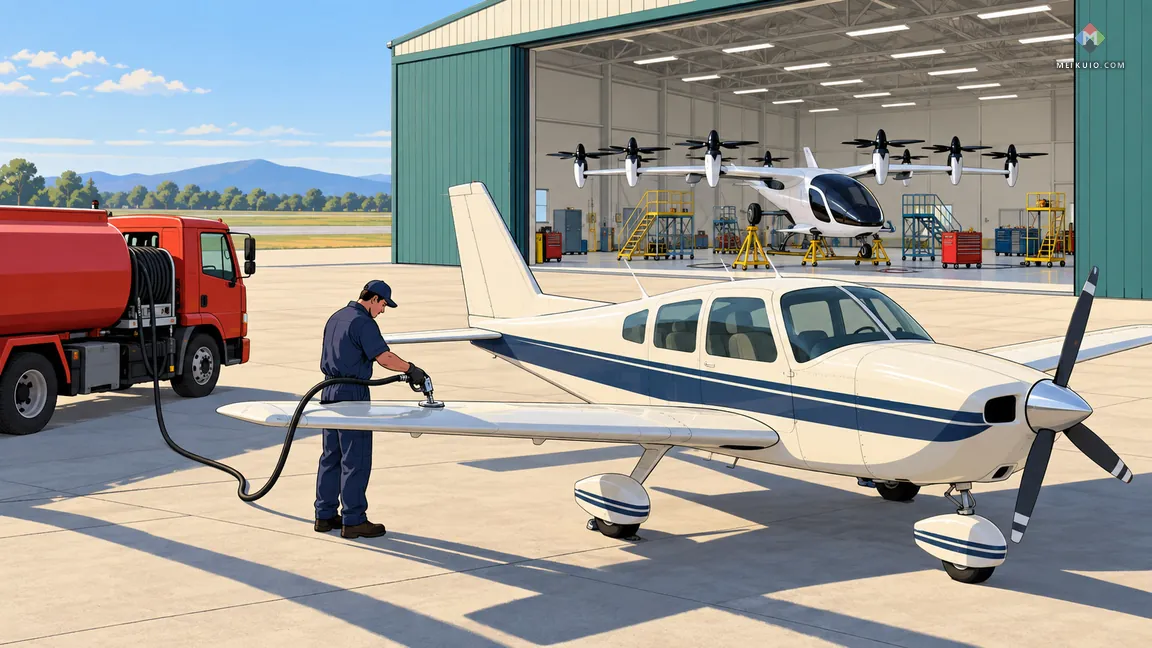
Two approvals are at work, and the news tends to blur them. A type certificate approves an aircraft’s design. An air carrier certificate approves a company to carry passengers for hire under Part 135. A third, the production certificate, lets a manufacturer build copies. Joby spelled this out itself in May 2022, calling the carrier certificate “one of three FAA approvals required” to run its air taxi service, “alongside a Type Certificate and a Production Certificate.”
Joby’s certificate: one 2016 Cirrus SR22
On the FAA’s list, Joby’s certificate sits under the name Joby Elevate Inc. and the designator JBEA. It lists one aircraft, registration N827UR. I looked that tail number up in the FAA’s aircraft registry as a second source: a 2016 Cirrus SR22, a single-engine plane with a Continental piston engine, registered to Joby Aero Inc. of Santa Cruz, California.
When Joby announced the certificate in May 2022, it described the next step plainly: “Once Joby receives a type certificate for its eVTOL aircraft, the Company will complete the FAA review process to add the new aircraft type to its existing air carrier certificate.” That step hasn’t happened. In its August 2026 letter to shareholders, Joby reported “our strongest progress yet in the fifth and final stage of type certification” and said it has “five electric air taxis flying, including our first FAA-conforming aircraft”, meaning one built to the exact design the FAA is reviewing. Those are test aircraft. Progress isn’t a certificate. As of September 2026, neither Joby’s nor Archer’s electric aircraft held an FAA type certificate.
Archer’s certificate: one 1963 Cessna
Archer’s certificate sits under the name Archer Air LLC and the designator AXRA. It lists one aircraft, registration N8246Z. The FAA registry describes it as a 1963 Cessna, model 210-5(205), a single-engine plane with a Continental piston engine.
Archer explained why. Its June 2024 announcement said “Archer plans to use conventional aircraft now to refine its systems and procedures in advance of launching Midnight into service when it receives Midnight’s Type Certification”. Midnight is Archer’s electric aircraft. It has no FAA type certificate. Archer plans to put it into service in Abu Dhabi, under a separate program run by the UAE’s aviation regulator.
So on paper, both companies are air taxi operators today. They’re certified to fly a small piston-engine propeller plane. The electric aircraft in their ads still need the approval that comes first: a type certificate.
Can you ride an electric air taxi anywhere in 2026?
Not yet. I found no electric air taxi selling public seats in the U.S., Dubai, Abu Dhabi or China as of September 27, 2026. Dubai is nearest to a launch: the city expects the service to launch in 2026, and Joby and Uber say the first passengers will fly there “later this year”, without saying whether those passengers will pay. The U.S. pilot program carries no passengers yet, and in China, EHang’s own filings describe trial operations.
- In the United States, electric air taxis fly test campaigns under an FAA pilot program, with no passengers on board.
- In Dubai, the transport authority expects the service to launch in 2026, and no operator has put a fare on a booking page.
- In Abu Dhabi, Archer’s aircraft is in a restricted certification program, with no start date.
- In China, EHang holds a type certificate and its operators hold operator certificates, but EHang still reports trial operations.
- In Canada, Harbour Air’s electric seaplane is still in certification.
United States: a pilot program with only pilots on board
The FAA’s route to early flights is the eVTOL Integration Pilot Program, or eIPP. The agency announced it in the Federal Register on September 16, 2025, as a program for “an ambitious scale of pre-certification operations”, which means flying the aircraft before it is certified. The notice says the program “shall conclude 3 years after the date the first pilot project becomes operational”. The notice runs to 1,995 words. I searched it for the word “passenger.” It appears zero times.
The first flights in Texas show what that looks like. On September 10, 2026, Joby started a flight campaign between Perot Field Fort Worth Alliance Airport, locations in the city and Dallas Fort Worth International Airport (DFW), scheduled to run to September 14. WFAA, a Dallas-Fort Worth TV station, citing the Texas Department of Transportation, reported that “The initial flights will not carry passengers” and that “The final phase will involve passengers in ‘air taxi’ flights across the Texas Triangle”, the region linking Dallas-Fort Worth, Houston, Austin and San Antonio. The program unfolds in phases over three years.
Joby’s own plan, from its August letter to shareholders, is a three-step climb: flights under the program should “progress from those with only a pilot on board, to those carrying non-paying passengers, and eventually paying passengers”. The same letter lists “First eIPP flights expected in September, targeting first passengers in 2026” without saying where those first passengers will fly or what they will pay. A flight with a pilot and no passengers is a test flight. That’s what the U.S. has. Whether paying riders will ever fly under the program itself, the notice doesn’t say.
Dubai: Uber Air, powered by Joby
Dubai has the closest thing to a launch date, and it is only a year. The city’s Roads and Transport Authority said in November 2025 that “the aerial taxi service is expected to launch in 2026”. It planned four vertiports, the pads and small terminals these aircraft take off from: near Dubai International Airport, at Zabeel by the Dubai Mall, at Atlantis The Royal on Palm Jumeirah, and in Dubai Marina. The aircraft “can accommodate four passengers and the pilot”. The authority named Skyports Infrastructure as “responsible for the vertiport design, construction, and operations”.
Uber and Joby described the booking in February 2026. Riders “open the Uber app and enter their destination in the ‘Where to?’ bar”, and the app books every leg of the trip, including a car from Uber Black, Uber’s premium ride service, to and from the vertiport. The flight is “Flown by a certified commercial pilot”. The release says Joby “expects to carry its first passengers later this year in Dubai”. Joby’s August letter adds that “the second of four vertiports being built by our partners is nearly complete”.
No operator or authority document I read prints a fare: not the transport authority’s November 2025 announcement, not Uber’s February 2026 release, not Joby’s letters. The one figure in circulation is older. In May 2024, after a Joby preview, Khaleej Times reported the cost as “Dh350 per passenger” (UAE dirhams), about $95. That’s a 2024 estimate in a newspaper, not a fare on a booking page.
Abu Dhabi: Archer’s Midnight
In May 2026, Archer said the UAE’s General Civil Aviation Authority had “transitioned Archer’s Midnight aircraft into a Restricted Type Certificate (RTC) program”. Archer’s own description of that step is careful: “The RTC program provides an established pathway for Archer to begin limited commercial operations”. Midnight “is planned to enter service in Abu Dhabi with Abu Dhabi Aviation, Archer’s local operating partner”. Archer gives no date and no fare. A pathway isn’t a timetable.
China: EHang’s flights are still trial operations
China got further on paper than the U.S. or the UAE. EHang’s EH216-S, which the company calls “pilotless passenger-carrying aerial vehicles”, received a type certificate from China’s aviation regulator in October 2023, according to EHang. On March 28, 2025, EHang’s operating unit in Guangdong and a partner in Hefei received “the first batch of Air Operator Certificates” for such aircraft from the Civil Aviation Administration of China.
Then the filings with the SEC take over. In March 2026, EHang said it “expects to officially commence EH216-S commercial operations in China in March 2026”, with operators set to launch “ticketed aerial sightseeing services for the public” at two sites, EHang Future City in Guangzhou and Luogang Park in Hefei. By June, the company was “conducting routine internal trial commercial operations” and “working closely with the CAAC to meet additional operational and safety requirements” ahead of “the launch of public ticketed flight services”. That means flights, but no public tickets yet.
The August 25 filing is the one to read. “Routine trial operations at the two sites have remained safe and stable for 17 months”, EHang wrote, but “a major accident involving a piloted light-sport aircraft in China prompted greater caution”, and it “affected the pace of passenger commercial operation approvals in certain regions”. EHang withdrew its 2026 revenue forecast of 600 million yuan. Even its first point-to-point route is a test: it “has entered internal trial operation”.
A travel booking site tells a different story. Its Guangzhou page, headed “NOW FLYING”, says the city “is one of only two cities on earth where you can buy a ticket and board an autonomous eVTOL today” and lists a 10-minute scenic loop at ¥299, about $41. The same page offers a waitlist. When a travel site and the operator’s own filing with U.S. regulators disagree, I go with the filing. Certificates in hand, no public ticket. China shows how long that gap can last.
Everywhere else
Harbour Air flew its electric de Havilland Beaver seaplane for the first time on December 10, 2019. The airline’s own page says the aircraft “is currently undergoing the certification and approval process with the FAA and Transport Canada”. No passengers yet. LIFT Aircraft’s HEXA is a different thing entirely: its ultralight version is flown at LIFT’s flight experience centers, “requires no pilot’s license” and is limited to “personal, non-commercial use”. The person in the seat is the pilot.
Beyond the four main places, I looked at one more, Harbour Air in Canada, above. I didn’t check Japan, South Korea, Brazil, Europe or Saudi Arabia, so I won’t tell you nobody on earth sells a seat. In the four places most air taxi news covers, nobody did on September 27, 2026.
What can you actually fly this year?
This year you can fly the old kind of air taxi. Check its paperwork before you pay. The electric kind has no seat for sale in the places I checked, so there’s nothing to book yet.
If you want the ride now, the options are real and priced. In New York, Blade’s helicopter seat to JFK starts at $195. On Cape Cod, the scheduled airline Cape Air advertises Hyannis to Nantucket from $79 one way. In Seattle, Kenmore Air’s seaplanes serve the San Juan Islands, with a $196-a-person badge on the route page. In Alaska, Talkeetna Air Taxi flies sightseeing loops over Denali from $304 per adult.
Cape Air, Kenmore Air and Talkeetna hold their own FAA certificates. Blade says its carriers do too, though its U.S. terms don’t name them.
If you want the electric one, watch three documents instead of the ads: the next update from Dubai’s Roads and Transport Authority, Joby’s next letter to shareholders and EHang’s next filing with the SEC. All three have announced their steps so far in writing. A real launch needs a start date and a fare. None of them has printed both.
If what you want is a ride with nobody at the controls, that exists today, on the ground: the robotaxi you can hail right now.
Booking through a tour marketplace doesn’t change the check. The company that operates the aircraft is the one to look up on the FAA’s list, whoever sold you the ticket.
What not to pay for: a waitlist, a “reservation” or a deposit for an electric air taxi seat. In the four places I checked, nobody sells the seat itself, so any money you hand over buys a promise. Space tourism sells the same kind of promise, and no federal rule protects a spaceflight deposit. Keep your card in your wallet.
How much does an air taxi cost?
The cheapest air taxi seat I found starts at $195: a Blade helicopter seat between Manhattan and JFK, as printed on October 6, 2026. Talkeetna Air Taxi sold Denali flightseeing from $304 per adult. Scheduled commuter airlines under the same FAA rules were cheaper or close: Cape Air advertised Hyannis to Nantucket from $79 one way, and Kenmore Air showed $196 a person to the San Juan Islands. No operator has put a fare for an electric air taxi on a booking page.
Prices you can see today
Every one of those numbers comes with a condition attached. Cape Air’s headline says “Flight Deals from $79!” The asterisk leads to this: the prices “have been viewed by other users searching within the last 48 hours for flights on this route, and may not be currently available.” Across the open October dates, its own fare calendar ran from $79 to $99 one way, and “Additional baggage charges and fees may apply.”
A helicopter seat from Manhattan to JFK starts at $195 on Blade, as of October 6, 2026. “From” is the key word, and the page doesn’t say which fare class it belongs to or whether it’s one way. Blade’s terms decide the rest: above 275 pounds you buy a second seat, and a weather cancellation pays you back in Blade Credits, not cash, unless you bought the insurance.
Blade’s airport seats, the kind sold for JFK, carry their own cancellation terms. On the Basic fare, cancel more than 24 hours out and you get Blade Credits “minus a cancellation fee of $95 per seat”. Inside 24 hours: “No cancellations allowed. Any cancellation will result in a full forfeiture of the value of your entire order.” A Flex fare lets you cancel for credits any time before departure. The terms don’t say which airport fares already include the weather insurance.
Kenmore Air’s San Juan Islands page shows a badge reading “$196 pp”, which stands for per person. It doesn’t say one way or round trip. The same page’s banner is clearer about a different route: “Seattle to Victoria, BC Getaway Flights from $198 pp/ow”, meaning per person, one way. Ask Kenmore which one it means before you book.
Talkeetna Air Taxi lists its cheapest Denali flight, the Southside Explorer, from $304 per adult, and its card shows no minimum. The Summit Tour starts at $547 per adult, and the page says “This flight has a 4-passenger minimum.” The Winter Explorer, flown from October to April, also starts at $304, with a 2-passenger minimum. If you’re traveling alone, read the minimums first.
Note
I read each price on the operator’s own page, from a U.S. location, on October 6, 2026, and stopped before checkout, so I can’t confirm the final totals. Blade’s public charter agreement says its flight pricing “includes all applicable taxes and fees”; Cape Air warns that baggage charges and fees may apply. Fares change. Check the page on the day you book.
Prices you are promised
When I asked Google on September 27 what an electric air taxi will cost, its AI Overview answered with confidence: “Early commercial rides are expected to cost roughly $3 to $6 per mile”, falling to “$1 to $2 per mile” as fleets grow toward 2030. The Overview credited evtol.travel. I read that page. It prints the same ranges and cites no source for them.
On September 27, 2026, every per-mile price in Google’s answer traced back to a page that names no source.
Another source in that same Overview is Blade’s “NYC Air Taxi Services” page. It says “Initial fares are projected to be similar to Uber Black service initially, at approximately $6 per mile per passenger.” Later, it says, the cost could fall to “around $2 to $3 per mile”. Of electric air taxis to JFK, it says “Launching in 2025”. (The $195 offer above comes from the page’s booking pop-up. The per-mile figures come from its text.) Its last paragraph explains the rest: “Please be aware that the content on this page has been generated by using artificial intelligence language models and may contain errors, inconsistencies, or outdated information.”
The oldest of these promises is Uber’s. Its Elevate white paper, published in October 2016, projected that in “the long-term autonomous case” a shared 45-mile flight replacing a 60-mile drive “could approach as low as $21”. Shared, pilotless and long-term: three conditions. Shared seats exist today. Pilotless passenger flights don’t, in the U.S.
The companies that would sell the seats haven’t printed a number: not in Joby’s letter, not in Uber’s Dubai announcement and not in Archer’s Abu Dhabi release. Neither has Dubai’s transport authority. The only Dubai number is the 2024 newspaper estimate of Dh350. It’s a common gap at the frontier: what Neuralink costs has no published answer either.
Why one seat costs what it costs
A seat is a slice of an aircraft that costs roughly the same to fly whether it’s full or empty. BlackJet learned that in public. It sold single seats on private jets, with a site quote of $3,766 for Boston to San Francisco one way and a $2,500 annual membership on top, as the Boston Globe’s Scott Kirsner reported in December 2013. A former employee told him “you can’t fly somebody for $3500 coast-to-coast and guarantee them a seat when it costs you $20,000 to fly the plane.” And: “We were losing $200,000 a week”.
Blade’s terms show how a seat seller protects itself from the same math. If weather cancels, you get credits and the money stays with Blade. If you weigh more than 275 pounds, you buy the second seat you’d take up. Blade prints all of it in the terms.
Judge any promised fare the way you’d judge what an exoskeleton costs and what it proves. A price printed next to something you can buy today tells you something. A price per mile for an aircraft that can’t carry you yet tells you nothing.
Which U.S. cities have flying taxis?
No U.S. city has an electric flying taxi you can ride. New York has helicopter seats on sale today. Florida, Los Angeles, Texas and the San Francisco Bay Area have test flights, vertiport projects and announcements, and none of them comes with a fare.
In New York, the air taxi you can book is on Blade’s airport page: helicopter seats between Manhattan and JFK or Newark “in 5 minutes” from $195. Uber sold a similar helicopter hop to JFK in 2019, for at least $200. Joby, which now owns Blade’s passenger business, reported “Demonstration flights in New York and the San Francisco Bay Area earlier this year” in its August letter. A demonstration flight carries no paying customers.
In Florida, the news is about landing pads. Joby’s letter says “Florida enacted legislation allowing the state to fund certain vertiport projects at up to 100 percent”, and that Orlando “is moving forward with developing a vertiport in the central terminal area”. Neither one sells a seat.
In Los Angeles, the date on the calendar is the 2028 Olympics. WFAA, citing an Archer press release, reported that Archer “was named the official air taxi provider of the LA28 Olympic and Paralympic Games and Team USA.” Archer’s plans for the Games, the release said, include “transporting VIPs, fans and stakeholders, electrifying vertiport takeoff-and-landing hubs at key venues, and supporting emergency services and security”. WFAA calls it an exclusive partnership. The Games are in 2028. Midnight’s FAA type certificate still has no date.
In Texas, pilot-program flights under the Texas Department of Transportation’s winning “Project Nexus” proposal began around Fort Worth and DFW on September 10, 2026, without passengers. In the Bay Area, Joby’s demonstration flights happened earlier in 2026, and Airbus’s Voom sold helicopter seats there until March 2020. Outside New York, the air taxi news is plans and test flights. In New York, it’s a helicopter.
Which services already shut down?
Four services that sold seats on shared flights have already stopped: Uber Copter, Airbus’s Voom, BlackJet and Flytenow. Three of them left a reason on record: scale (Voom), cash (BlackJet) or a court loss (Flytenow). Uber Copter left none; the only account says it was shut down during the pandemic.
Uber Copter launched in July 2019 with helicopter rides between Lower Manhattan and JFK that took eight minutes and cost “at least $200 per passenger”, according to NBC New York. It ran on weekdays, only for Uber’s Platinum and Diamond loyalty members, from heliports “near the Staten Island Ferry in Manhattan and by Terminal 8 at JFK.” NBC described it as a pilot program for Uber Elevate, the company’s air taxi division. In October 2019 it opened to any Uber user willing to pay “the $200-225 tab (one way)”, Business Traveller reported. Flying Magazine reported in 2025 that the service “was swiftly shut down during the COVID-19 pandemic”; I found no document with the exact date. In a deal announced in December 2020, Joby took over Uber Elevate as part of a $75 million investment from Uber, AOPA reported.
Airbus launched Voom in 2016 as an app for booking helicopter seats. By the end it had “arranged flights for around 15,000 passengers”, according to Vertical Magazine, and it was flying in São Paulo, Mexico City and the San Francisco Bay Area. The pandemic grounded it on March 23, 2020, and a week later Airbus decided Voom “will not resume its operations.” Vertical Magazine reported that Airbus closed it “citing completion of its twin goals”, one of them “democratizing the urban skies”. Voom’s chief executive, Clément Monnet, put it this way: “Scaling globally isn’t easy for any business, and we found this to be especially true in an expensive industry”. AIN reported that Airbus said the booking data “will inform its urban air mobility plans.” The data went into Airbus’s plans. The seats didn’t come back.
BlackJet, with Uber co-founder Garrett Camp on its founding team, sold single seats on private jets to members paying $2,500 a year. It had raised “north of $2 million” from backers including Ashton Kutcher and Jay-Z, and members “had to give two days notice when they wanted to fly”. It laid off most of its staff in 2013 after, in a former employee’s words, “the investors weren’t willing to put in more money.” It stopped for good in May 2016. Its chief executive, Dean Rotchin, said “bad press” had “stunted membership sales” and that “it became impossible to continue”.
Flytenow never owned an aircraft. It ran a website where private pilots offered their planned flights to “passengers willing to share the pilots’ expenses”, in the words of the federal appeals court that ruled against it. The FAA said those pilots would be operating as “common carriers,” which requires a commercial pilot license. On December 18, 2015, the D.C. Circuit agreed: “Flytenow’s petition for review is denied.” In plain terms, the court upheld the FAA. Flytenow’s own blog post then said “we are left with no choice but to shut down Flytenow.”
The court’s test for common carriage starts with “a holding out of a willingness” to carry people or goods for pay. Offering seats to the public is holding out. Holding out makes a flight commercial, and commercial flights need commercial pilots and a certificated operator. That’s why an air taxi needs a certificate.
How do you check a carrier before you book?
Check the carrier, not the app. Find the name of the company that operates the aircraft, confirm it on the FAA’s list, and read the fare, weather and weight rules before you pay. The whole check takes about ten minutes. The first two steps take two.

- Find the carrier’s name. The seller’s terms or booking page should name the company in operational control of the aircraft. When a broker sells you a whole aircraft, the federal rule requires it to disclose “The corporate name of the direct air carrier” before you sign. For a seat on a public charter, the ads and your contract must name the carrier; Blade’s charter agreement puts it in the quote and the confirmation.
- Look that name up on the FAA’s list of Part 135 certificate holders, under the company’s legal name: Cape Air is Hyannis Air Service there. The spreadsheet is free on the FAA’s site, on a page titled “FAA-certificated Aircraft Operators (Legal Part 135 holders)”, and, the agency says, “Updated weekly.” It’s the same kind of two-minute public lookup as checking a router’s FCC approval. If the name isn’t there, the FAA’s own instruction is to contact your local Flight Standards District Office before you fly.
- See the price before you hand over your phone number. Blade, Cape Air, Kenmore Air and Talkeetna all print theirs on the page.
- Read what happens when weather cancels the flight: money back, another aircraft or credit. Blade pays credits unless you bought its insurance.
- Check the weight and bag limits. Above 275 pounds, Blade makes you buy a second seat, and it caps bags at 25 pounds combined, weighed at the lounge.
- Check the passenger minimum. Talkeetna’s Summit Tour needs four people, and its Winter Explorer needs two.
- Ask whether it’s a trip or a loop. A sightseeing loop lands where it took off. You get the view, and you end up where you started.
- Ask which certificate the flight runs under. Test flights under the FAA’s pilot program don’t sell seats to the public.
If the seller can’t name the carrier, don’t book.
Field notes
- The register: FAA list of Part 135 certificate holders, file of October 5, 2026; 1,798 certificates; 11,480 aircraft: 8,620 airplanes, 2,857 helicopters and three battery-powered package drones; zero powered-lift aircraft.
- Joby and Archer: one aircraft on each company’s FAA carrier certificate; Joby a 2016 Cirrus SR22, Archer a 1963 Cessna; both piston-powered, confirmed in the FAA aircraft registry; neither company’s electric design holds an FAA type certificate.
- Who flies Blade: Blade says it acts as a broker and indirect air carrier, not a direct air carrier; its general terms don’t name the carriers, but its public charter agreement puts them in each flight’s documents; flights booked through Blade brought Joby $36.2 million of $38.6 million in revenue from April to June 2026, about 94 percent.
- Electric seats: none on public sale in the U.S., Dubai, Abu Dhabi or China on September 27, 2026; Dubai’s launch expected in 2026 with no fare on any booking page; EHang still reports trial operations despite a type certificate and operator certificates.
- Prices printed October 6, 2026: Blade from $195 a seat to JFK; Talkeetna Air Taxi from $304 per adult; scheduled airlines under the same rules, Cape Air from $79 one way and Kenmore Air $196 a person; no operator’s fare for an electric air taxi anywhere I checked.
- Shut down: Uber Copter, launched in 2019; Airbus’s Voom, 2016 to 2020, about 15,000 passengers; BlackJet, closed in 2016; Flytenow, which lost in federal appeals court in 2015.
- Sources: FAA list of Part 135 certificate holders and FAA aircraft registry; 14 CFR Parts 135, 295, 298 and 380; Federal Register 2025-17844; Joby and EHang filings with the SEC; Dubai Roads and Transport Authority; Archer and Uber releases; Khaleej Times (May 2024); operators’ own pages.
Frequently Asked Questions
What is an air taxi service, and who runs it?
An air taxi service is an on-demand flight in a small aircraft, run by a company that holds an FAA Part 135 certificate. The seller can be a different company: Blade, for example, says it acts as a broker and doesn’t operate the aircraft.
Are air taxis available in the USA right now?
Yes, if you mean helicopters and small planes: 1,798 companies hold the FAA certificate for air taxi and charter flights. No, if you mean electric ones. The FAA’s pilot program flights carry no passengers, and no electric air taxi sells seats in the U.S.
How much does an air taxi ride cost in 2026?
The cheapest air taxi seat I found on October 6, 2026 was Blade’s helicopter seat between Manhattan and JFK, from $195. Small scheduled airlines under the same FAA rules can be cheaper: Cape Air advertised Hyannis to Nantucket from $79 one way. Check the final total at checkout.
How much will a Joby air taxi ride cost?
Nobody knows yet. No operator has put a fare on a booking page. The only Dubai figure is a May 2024 Khaleej Times estimate of 350 UAE dirhams, about $95, a passenger. Per-mile figures online, such as $3 to $6, trace back to pages that cite no source.
Does a flying taxi exist that you can ride today?
A flying taxi you can ride today is a helicopter, seaplane or small plane, sold by companies such as Blade and Talkeetna Air Taxi or chartered whole. Nobody sells a public seat on the electric kind in the U.S., Dubai, Abu Dhabi or China.
Which country has electric flying taxis carrying paying passengers?
None of the four I checked as of September 27, 2026: the U.S., Dubai, Abu Dhabi and China. China comes closest on paper, with EHang’s type certificate and operator certificates, but EHang’s August filing still describes trial operations. Dubai expects a launch in 2026.
Did the FAA approve electric flying taxis to carry passengers?
No. The FAA’s pilot program allows flights before certification, and its Federal Register notice never mentions passengers. As of September 2026, neither Joby’s nor Archer’s electric aircraft held an FAA type certificate, and their carrier certificates each list one piston airplane.
Can you book an Uber Air flight in Dubai yet?
Not yet. Uber says Dubai riders will book in the Uber app’s “Where to?” bar, with an Uber Black car at each end, and Joby expects its first passengers there “later this year”. No booking page shows a fare yet.
Is an air taxi the same thing as an eVTOL?
No. An air taxi is a service: a small aircraft you hire on demand, a legal category for decades. An eVTOL is a kind of aircraft, electric and able to take off vertically. In the places I checked, nobody sold a public seat on one by September 2026.
Is an air taxi a drone, or is there a pilot?
Most have a pilot. Every helicopter and airplane sold as an air taxi today does, and Joby’s Dubai flights will be “Flown by a certified commercial pilot”. EHang’s EH216-S is the exception: EHang calls it “pilotless”, and it still flies only trial operations.
My Take
The air taxi is the most misnamed product I’ve covered this year. The name is borrowed. What you can buy under that name is a helicopter or a small piston plane flown by a company you’ve probably never heard of, and nobody sells a public seat on the electric aircraft in the ads anywhere I checked. In the U.S. the order is fixed: a type certificate for the aircraft, then the aircraft on a carrier’s certificate, then a seat for sale. Neither Joby nor Archer has finished step one.
This year, I’d book the helicopter seat or the Alaska flightseeing loop, and I’d check the carrier named in the quote on the FAA’s list before I paid. For the electric one, I’d buy nothing. I wouldn’t pay for a waitlist, a deposit or a “reservation.” I’d wait for a fare printed on an operator’s own page, next to the name of the company that holds the certificate.