

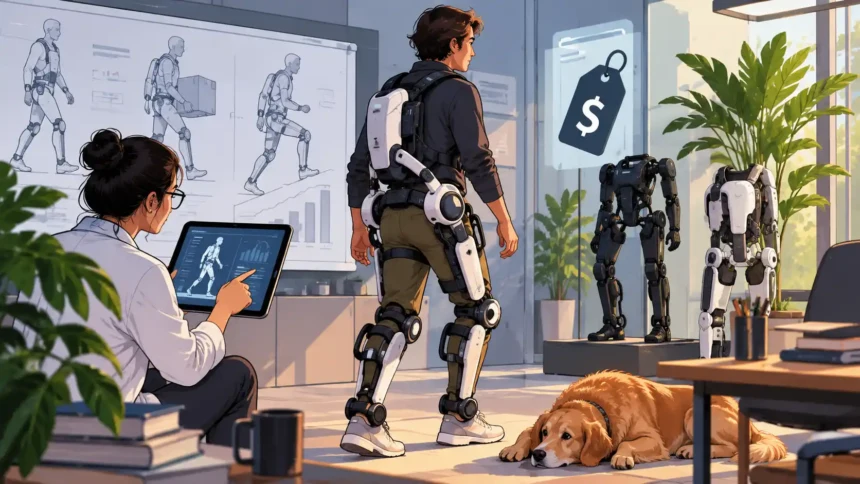
An exoskeleton is a wearable machine that pushes your body through a movement you would otherwise power yourself. Five different products answer to that word, they range from a nine-hundred-dollar hiking aid to a prescription device you never see a price for, and the number every seller prints is the one number most of them will not explain.
- What an exoskeleton actually is
- The five things people mean by the word
- Start here: which movement is actually hard for you
- Do you need one of these at all?
- Will it catch you if you stumble?
- Can one of these hurt you?
- What you cannot find out before you buy
- The number every seller prints, and what it leaves out
- Why one device can be advertised with two different numbers
- Nobody is required to prove any of it
- What owners say the assistance actually does
- What is actually on sale to a consumer
- What one of these costs, and who decides that
- The class you cannot order
- Will Medicare pay for an exoskeleton?
- Workplace devices, and the checkout nobody mentions
- The people this market serves worst
- What happens when the battery dies
- The app, the account, and what you actually own
- How to choose, in order
- Frequently Asked Questions
- Do exoskeletons actually work?
- How much does an exoskeleton cost?
- Will Medicare pay for an exoskeleton?
- Will an exoskeleton stop me falling?
- Will it help me climb stairs?
- How long does the battery last?
- Can you buy a military exoskeleton?
- Is it safe if I have a medical condition?
- How long do these devices last?
- Can you take an exoskeleton on a plane?
- What is the difference between an exoskeleton and an exosuit?
- Can a private buyer purchase an industrial exoskeleton?
- My Take
What an exoskeleton actually is
Start with the word, because Google still can’t decide what you mean by it. Search it and you get a shopping shelf of powered hip units on top, a dictionary entry about the hard shell of an insect underneath, and an encyclopedia page in between. Google is hedging. This article is about the second meaning: a device you strap to your body that applies mechanical force to a joint.
The mechanics split two ways, and the split matters more than any brand name. A powered exoskeleton uses motors and a battery to add torque at your hip, knee or shoulder. An unpowered one, usually sold as an exosuit, uses springs or elastic bands to store energy when you bend and hand it back when you straighten. You will also see the same machines sold as an exoskeleton suit or a wearable robot, and the words point at the same shelf. Both are sold under the same word. Only one of them can run out of charge halfway up a hill.
The second thing that separates these machines is where the load goes. A standing-support frame routes your body weight down external struts into the floor, which is why you can lean on it like a chair that isn’t there. A back-support suit does something different: it takes strain off your lower back by transferring it into your thighs and pelvis. Nothing reaches the ground. That distinction decides whether a device relieves you or simply moves the ache somewhere else, and almost no product page states which one it is doing. If you want the same question asked about a category that had already been through this hype cycle, we did it with the definition of an “AI phone”.
The five things people mean by the word
These five classes share a name and almost nothing else. They are built for different jobs, sold through different doors, and priced by different people. Ranking them against each other in one list, which is what most of the internet does, produces a ranking that cannot help anyone. The word is doing too much work.
Read the column headed who sets the price, because it is the whole story. In the first class you decide what the machine is worth. In the middle two, a safety manager does. In the last one, a payer does, and the manufacturer never prints a number at all. Same word, and you hold the pen in exactly one row.
One word, five machines, and you only set the price for one of them.

Start here: which movement is actually hard for you
Each of these machines assists one movement well and ignores the rest. This is the single most common reason people stop wearing them, and it has nothing to do with build quality. The machine did exactly what it was designed to do. It just wasn’t the thing that hurt.
More Read

So before you look at a single product, name the movement. Not the activity, the movement.
- Swinging your leg forward on the flat. This is what a consumer hip unit assists. Long walks, airports, sightseeing, gentle trails.
- Pushing yourself up. Stairs, standing up out of a chair, hauling yourself over a step. This needs force at the knee, or hip extension, and a hip device does not provide it. A long gradual incline is a different case, and owners do report help there.
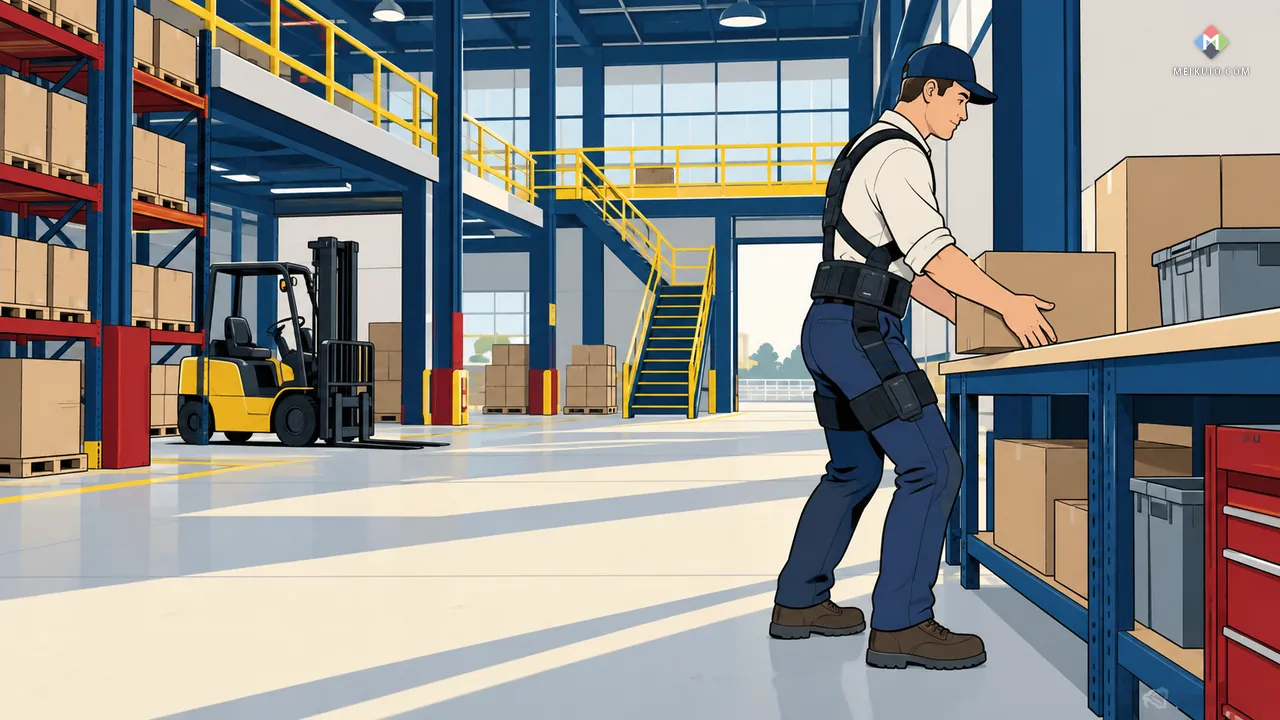
- Bending forward and coming back up under load. Lifting boxes, patient handling, warehouse work. This is what a back-support suit is for.
- Holding your arms above your head. Drilling ceilings, working under a car. A shoulder support carries the arm weight, and does nothing for your back.
- Staying upright for hours. Assembly lines, kitchens, surgery. A standing frame, not a walking device.
- Walking at all. If the honest answer is that your legs will not carry you without help, none of the consumer classes apply, and the section on medical devices below is the one to read.
Pick one. If you picked two that sit in different rows, no single device on the market does both, and any page that tells you otherwise is selling something.
Do you need one of these at all?
Nobody selling these devices will ask you this, so it goes here, near the front. For a share of the people searching this term, the honest answer is that the cheap thing already works.
A pair of trekking poles moves load off your knees on descents, weighs a fraction of any powered unit, costs a small fraction of one, and never needs charging. A properly fitted pack with a real hip belt shifts weight off your shoulders. An off-the-shelf brace from a pharmacy supports a specific joint for the price of a takeaway. None of these are exciting and all of them are the correct answer for someone reading this page. Boring, and often right.
There is a second option people miss, and it is cheaper to run rather than cheaper to buy: the unpowered class. A spring-loaded back suit has no battery, no firmware, no app and no failure mode where it turns into luggage. If your problem is lifting rather than walking, the machine you want may be the one with no electronics in it at all. It cannot run out.
This is the same question worth asking before any subscription or device purchase, and the answer is often that a free mechanism already covers you. We ran the same test on what the law already covers for free before recommending anyone pay for identity protection. The logic transfers.
Will it catch you if you stumble?
No. A consumer exoskeleton will not catch you, will not stabilise a buckling knee, and is not designed to prevent a fall. If you are considering one of these for an older parent because their balance is going, that is the answer, and it changes the decision entirely. What a robot can actually do for an older parent at home is a short list, which I went through in care robots for the elderly.
The reason is mechanical. A consumer exoskeleton puts motors at the hips and swings the leg forward. Your knee, which is the joint that gives way, has no actuator on it and no sensor watching it. The device is assisting a movement you are already making. It has no model of you falling.
What makes this worth a section of its own is where the answer lives. This is the question people actually ask, in public, repeatedly, and not one manufacturer page I read answers it. The clearest statement I found in the entire field sits in the FAQ of a retailer, not a maker: the Hypershell X Series listing on Rehabmart says plainly that this is not a medical device and requires users to lift their legs and maintain balance without assistance, checked August 15, 2026. The seller says it. The manufacturer does not.
If you are buying this for a parent
Ask the question in the shop, in writing, before you pay: does this device do anything at all if the wearer starts to fall? The answer for every consumer exoskeleton on sale today is no. A device that reduces fatigue may still be worth having for someone who tires quickly on flat ground. It is the wrong purchase for someone whose problem is balance, and the two get confused because both look like “walking is getting hard”.
Can one of these hurt you?
It can, in two ordinary ways, and the product pages are silent on both.
The first is fit. NIOSH, the US federal institute for occupational safety and health research, has published the warning plainly: poorly fitting exoskeletons can cause awkward working postures and increase the risk of shoulder or back fatigue. A machine strapped to you in the wrong position does not do nothing. It does something you did not ask for, for hours.
The second is where the load goes. These devices do not delete force, they move it. A back suit takes strain off your lower back by pushing into your thighs and pelvis. A hip device changes how your leg swings, which changes what your knee and your other side are doing. Whether relief at one joint becomes an ache at another is real, it is individual, and it is one of the things you cannot find out from a web page.
If you have a diagnosed condition, this is not a product question
Here is what I did not find on a single consumer product page: a contraindication list. Nothing about joint replacements, osteoporosis, neuropathy, skin that marks easily, or the neurological gait conditions that make people search for these machines in the first place. The medical class has all of that, in clearance documents, because it must. The consumer class avoids the subject entirely, which is what a product that makes no medical claim is supposed to do. So if you or the person you are buying for has a diagnosis, the question of whether a powered device is safe for that body is a question for the clinician who knows it, and there is no page on the open internet that answers it for you.
One more absence worth naming, because it decides the two-year version of this purchase rather than the first week. I could not find published figures for how long these machines last, what a replacement battery costs, whether parts are sold separately, or what a repair looks like once the return window closes. Consumer exoskeletons are new enough that nobody has a five-year-old one to complain about. Buy accordingly.
What you cannot find out before you buy
Seven things decide whether one of these machines works for you. I could check three of them from a web page. Four cannot be known by anyone, including me, until the device is on a body for several hours. No amount of research closes that gap.
Four of seven. That ratio is why the return window matters more here than the specification sheet: it is the only test of the four unknowable things that you can actually run. It is also the honest limit of this article. I read pages, documents and policies. I did not wear these machines for a shift, and anyone who tells you a web page settled the comfort question is guessing.
The last row is the one nobody checks and everybody can. Before you buy, open the terms and find out whether the hardware moves without a phone in your pocket, whether firmware updates are mandatory, and what happens to the machine if the company stops running the service. Read the terms first. We asked those same questions of the AI gadgets worth buying in 2026, and the pattern held there too: the device that needs a live account is the device that can be switched off from somewhere else.
The number every seller prints, and what it leaves out
Most of these machines are sold on a percentage. Less effort, less fatigue, less strain, more range. I went through sixteen brands and read the claim on each one, then asked five questions of every number: what was measured, what it was measured against, on what task, with how many people, and whether the weight of the device itself was counted. Eleven of the sixteen print a percentage. Three of those eleven answer the second one, the question of what the number was measured against, and all three of them sell to employers or clinics.
The sixteen, so you can check the work: on the consumer side Hypershell, AstroShell, Dnsys, Skip with Arc’teryx, and Roam Robotics. On the workplace side HeroWear, Auxivo, Levitate, Laevo, Innophys, Verve Motion, German Bionic, and SuitX under Ottobock. On the medical side Lifeward and Myomo, plus Enhanced Robotics, which prints nothing measurable at all. Pages read between August 15 and 16, 2026. A brand counts as answering a question if any page on its site answers it, which is a generous rule and still produces the result below.
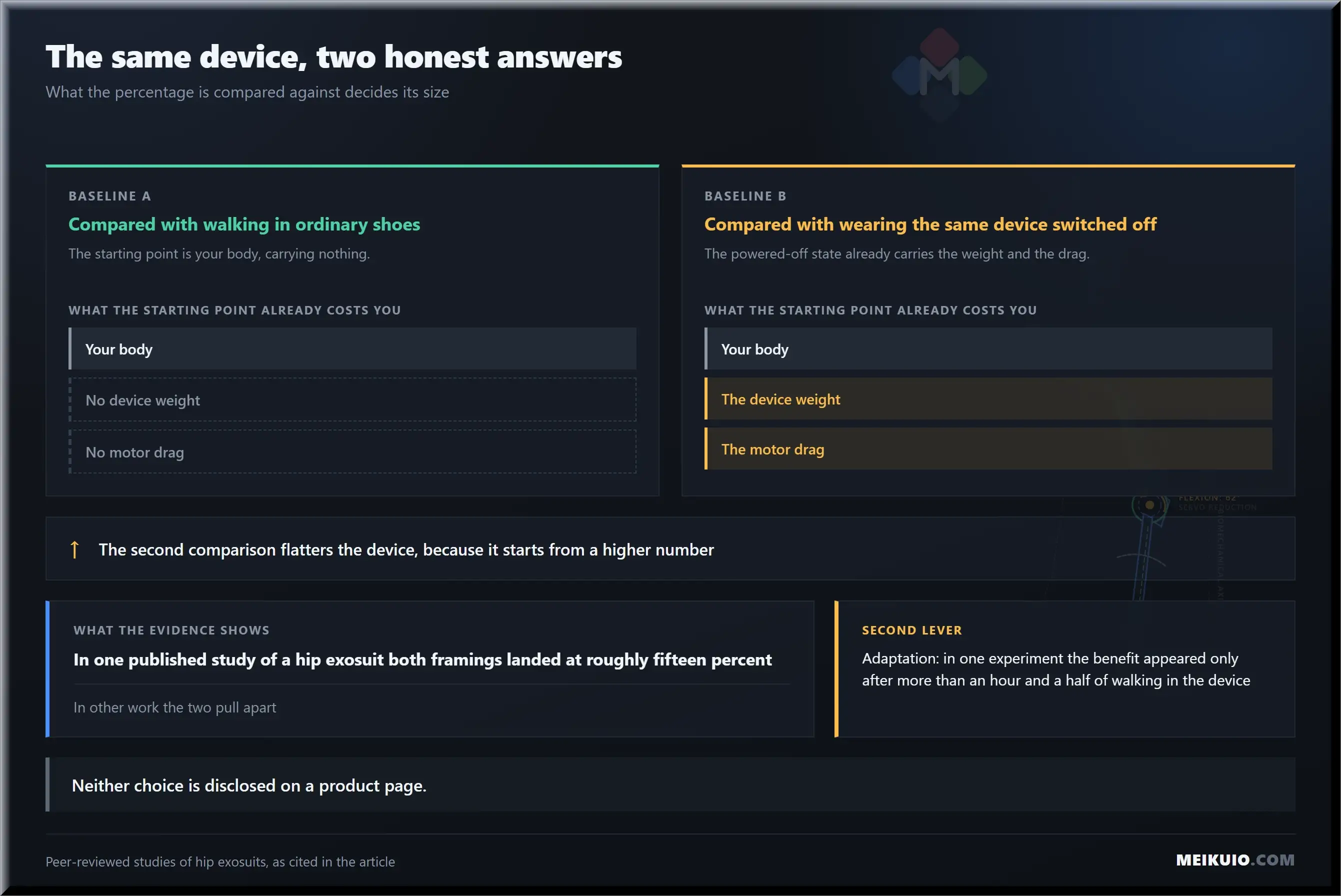
The second question decides the size of the number. You can compare a person walking normally against the same person wearing the machine. Or you can compare a person wearing the machine switched off against the same person wearing it switched on. The second comparison flatters the device, because the powered-off state already carries the weight and the drag. Every published study I read states which of the two it used. That is convention in the literature, not courtesy.
Split the sixteen by who the number is written for, and the pattern stops being about honest and dishonest companies.
Even that is generous to the sellers. In the three cases where a comparison is named, it is almost never printed next to the number. SuitX puts percentages on eight pages of its site without a comparator anywhere near them, and the word compared appears only on a separate studies page, quoting academic papers. Auxivo names its baseline on one product page and omits it on three others carrying ten more figures. So the honest version is that three of eleven brands publish the comparison somewhere on the site, and one publishes it beside the figure a buyer will actually read.
Nobody is lying here. A safety manager has to justify the purchase to someone above them and will ask what the study compared, so the study gets published. You will not ask. The number arrives on its own, in a large font, with nothing behind it. It is the same shape of problem we found when we ran AI humanizers against the claims their sellers make: the figure is real, the test behind it is missing, and the buyer is the only person who could have demanded it.
Across sixteen brands, not one consumer device says what its percentage was measured against.
Counts overlap and are not shares of a partition. No consumer device printing a percentage names its measurement baseline.
Three examples of what that looks like on the page. AstroShell’s homepage carries four figures for one machine: fifty percent of the leg-lifting burden, thirty percent less physical exertion, a forty percent leg strength boost, and a forty percent power boost on inclines. Three of those are different quantities. The first is introduced with the words in theory, written by the seller. Checked August 15, 2026.
Hypershell sells the percentage as a feature of the tier. On the US retailer listing, the specification table has a row called Physical Exertion Reduction, and it reads thirty, thirty-nine, thirty-nine across the three models, priced at $999, $1,499 and $1,999. Read that row again. The step from the first model to the second costs $500 and buys nine points of a number with no method behind it. The step to the third costs another $500 and buys none.
Auxivo, selling to industry, prints four figures on its lifting suit and puts an asterisk on every one: thirty-three percent lower back muscle activity in forward-leaning postures, twenty-one percent during repetitive lifting, forty-four percent lower hip muscle fatigue, seven percent lower cardiovascular cost. The asterisk is doing a lot of work. The company does publish study material elsewhere on the site, which is more than any consumer brand manages.
What a percentage has to carry to be checkable
Five things, and you can run the list on any product page in about a minute. What was measured: muscle activity at one site, whole-body energy use, heart rate, or someone’s opinion. What it was compared against: no device, or the same device switched off. On what task: what load, what slope, what distance, what pace. With how many people, and whether they had trained on the device first, because the effect grows with practice. And whether the cost of carrying the machine itself was subtracted. A number missing all five is not a measurement. It is a headline.
Why one device can be advertised with two different numbers
In one published study of a hip exosuit, the same device on the same people produced a reduction of roughly fifteen percent measured against walking with the assistance switched off, and roughly fifteen percent measured against not wearing the suit at all. Close, in that case. In other work the two framings pull apart, because the powered-off device is not a neutral starting point. You are already carrying it.
There is a second lever, and it is training time. In one experiment the benefit appeared only after participants had walked in the device for more than an hour and a half, adapting to it. Measure someone on day one and you understate the machine. Measure them after a week and you overstate what a buyer will feel in the first month. Either choice moves the number. Neither choice is disclosed on a product page.
Then there is the modality problem, and consumer marketing walks straight into it. One storefront advertises a forty-two percent reduction in heart rate. Heart rate is not a measure of mechanical assistance. It moves with heat, hydration, caffeine, fitness, how hard you were breathing before you started, and how fast you chose to walk. Muscle activity at a single site is narrow but specific. Whole-body energy use is the honest measure and the hardest to flatter, which is presumably why nobody selling a consumer exoskeleton publishes it.
None of this means the machines do nothing. It means the printed number cannot tell you how much they do for you.
Nobody is required to prove any of it
The obvious question at this point is who checks. I went looking for the standard that would force a seller to show its working, on the assumption that a category this old would have one by now.
ASTM International runs a committee dedicated to exoskeletons and exosuits, F48, formed in 2017, and it has published work. What it has published is terminology and labelling: an agreed vocabulary so that engineers, buyers and regulators mean the same thing by the same word. There are also international safety standards covering personal care robots, ISO 13482, and medical rehabilitation robots, IEC 80601-2-78. Every one of those documents is about vocabulary or safety. In the standards I could read, none of them specifies a required, reproducible protocol for testing an effort-reduction or fatigue-reduction claim. Some work items in that committee I could not open, so the honest phrasing is that no such requirement appears in the published standards I examined, rather than that none exists anywhere.
NIOSH, the US federal institute for occupational safety and health research, has been blunter than any of the vendors. In a 2020 science bulletin it wrote that despite a lack of research, manufacturers of these devices claim productivity gains, work quality improvements and a reduction in the risk of work-related musculoskeletal disorders, and it cautioned that research is needed before widespread implementation. In a separate post NIOSH noted that poorly fitting exoskeletons can cause awkward working postures and increase the risk of shoulder or back fatigue. That is the safety establishment saying the machines can make things worse if they do not fit, in the same period the marketing was printing percentages.
Advertising law is the other place you might expect a floor, and it is stricter than most sellers behave. The Federal Trade Commission’s health products compliance guidance says that substantiation of health-related benefits will generally need to be in the form of randomised, controlled human clinical testing. The catch is the words health-related. A device sold as a fitness accessory that promises less fatigue on a hike is standing on a line, and the line has not been tested here: I found no enforcement action anywhere against an exoskeleton or an ergonomic wearable over a performance claim.
It has been tested next door, though. The FTC went after toning shoes twice, settling with Skechers for $40 million and Reebok for $25 million over claims about what wearing them did to the body. It also went after a wearable pain-relief device, Quell. The category of things you strap on that promise your body a percentage has a history. Exoskeletons have simply not had their turn.
No exoskeleton standard I could read requires a seller to show what its percentage was measured against. The number is voluntary all the way down.
What owners say the assistance actually does
The consumer exoskeleton class is almost entirely hip devices. A motor sits on a belt at the small of your back, arms run down and clamp above your knees, and the machine swings your thigh forward as you walk. That geometry explains most of what owners report, including the disappointments.
The theme that repeats is that the device swings your leg but does not lift your body. One owner, asked whether it helps getting up from a squat, ran the test and answered in six words: it does not help with that. On stairs the same owner says it will lift your leg onto the next step, but it will not straighten that leg under you to raise your body. Another owner, a trail runner, was disappointed there was no help with jumping or squatting. Hills are the exception, and the distinction is exact: the same person who reports nothing on stairs says the device is much more helpful on a gradual incline. Steady walking is what the machine is for. Vertical lift is not.
That distinction appears on no product page I read, and it decides whether the machine solves your problem. It also explains the second-hand market, which takes two minutes to search and will tell you more than any review.
On eBay, Gumtree and Mercari on one day in August 2026 there were units listed as used once, used twice, tried for under a kilometre. The reasons sellers give are almost never faults. One bought it for a grandfather who declined the gift. One has multiple sclerosis and could not stay stable enough in it. One was given the device for a medical purpose and wrote that it does not really help my situation. A UK seller listed a unit as used twice but found to be unsuitable, at £450 against the £899 they paid, and in the same advert mentioned a friend who walks a lot and says it transformed his daily walks. Both halves of that sentence are true. That is the buying problem in one classified ad.
The second-hand listings are not full of broken machines. They are full of machines that went to the wrong body.
Fit is the other recurring theme, and it fails at both ends of the size range. A buyer at 152cm reported the frame sits too low with the adjustment already at its last click, so it slips over the knees. A 163cm, 66kg man with cerebral palsy had the hip and thigh clamps at zero and it still slid down; he measured himself before ordering and the chart said he would fit. At the other end, a son bought one for his father and found the belt could not strap around his waist without being pushed down. Published height ranges are not catching these people.
Two smaller things owners raise that no specification sheet covers. The thigh braces sit on the front of your legs, so you stand further back from a kitchen counter and lean over the sink instead. And one owner would not wear it on a bus or a train, because the frame holds the small of your back about ten centimetres off the seat, and because of what a sudden stop would do.
Two owner complaints that are weaker than they look
Battery range comes up constantly, but the strongest version I found is a soft judgement rather than a measurement: one owner writes that he does not think it gets near the battery life and distance claims, then adds that it does not matter for how far his wife walks. Nobody in that thread published a measured runtime. The other is lag. One owner describes climbing two steps before the assistance arrives, which sounds damning until the next clause, where he explains that raising the sensitivity in the app fixes it. Quoting the first half alone would misrepresent him.
What is actually on sale to a consumer
The consumer exoskeleton aisle is smaller than the search results suggest, and it divides on one question: which joint the motor sits on. Get that wrong and nothing else about the product matters.
Hip devices are the bulk of the market. A belt at the small of your back, two arms down to clamps above the knees, and a motor that swings each thigh forward. Hypershell is the brand most people meet first, with three models at $999, $1,499 and $1,999 at US retail. AstroShell sells a magnesium-alloy unit at $1,199, quoting 4.4 pounds of frame, 40 newton metres of torque and 14.9 miles of range. Dnsys sells a hip unit as well. Sold as an exoskeleton for walking, all of them assist the same movement. All of them stop where vertical lift begins.
Knee devices are the newer and much smaller group, and they exist precisely because the hip devices do not push you upwards. Skip, a company spun out of Alphabet’s moonshot lab, built its motors into a pair of Arc’teryx hiking trousers and sells them under the name MO/GO. Dnsys has a knee exoskeleton alongside its hip one. If your problem is stairs, hills under load, or standing up, this is the group to look at, and the honest note is that it is young: fewer owners, fewer reports, more pre-orders than shipped units.
Unpowered suits are the group nobody puts in a listicle, because there is no motor to photograph and nothing about them makes a good video. A spring-loaded back suit, sold as a lifting exoskeleton, costs less than a powered unit, carries no battery, cannot lag, cannot brick, and does not become dead weight. If your task is lifting rather than walking, start here and only move on if it fails you.
Everything else in the search results is not for sale to you. The overhead shoulder supports, the standing frames, the powered lift assists: real products, sold to employers, mostly quoted rather than priced. Some reach a retail shelf anyway, which is the next section.
Why the reviews all cover the same two brands
The video layer of this category is monetised end to end. Reviewers publish tracked links, one manufacturer runs a programme through a performance-marketing network, and creators say outright that the unit was sent to them. Disclosure is common and none of that is a scandal by itself. What it explains is the shape of the coverage: the classes that pay a commission get reviewed, and the classes that pay nobody, unpowered suits and anything bought by an employer, barely appear at all.
What one of these costs, and who decides that
Consumer exoskeletons are the class where the price is simply printed and you simply pay it. Search for an exoskeleton price, or an exoskeleton for sale, and this is the class the results land you in. At a US retailer in August 2026 the three Hypershell X models list at $999, $1,499 and $1,999. AstroShell lists its unit at $1,199. That is the whole transaction.
One thing to know before comparing prices across sellers: this category is priced by region, aggressively. Opening the US pages of one manufacturer from outside the country pushed me to a regional storefront with prices in dirhams and no obvious way back. If a price you find does not match a price someone else quotes, check which country the page thinks you are in before concluding that anyone is discounting. Vendors publishing more than one price list at once is not unique to this category, and it is worth seeing how far it goes: one software vendor was running three price lists in a single day.
The workplace classes are where the number disappears. German Bionic’s homepage contains no dollar sign, no euro sign, and not the word price. What it prints instead is a physical specification, up to 38 kilograms of lifting support per movement, and three buttons: discuss use case, talk to an expert, sales inquiries. Auxivo publishes a starting figure in Swiss francs and routes you to a quote. SuitX lists products as price on request, spelled prize on request on the page I read.
US retail prices only. Consumer buys hip assist; buyer or employer buys support suit. Employer sets procurement for standing frames and powered industrial devices. Insurer determines medical procurement. Unpublished prices are null, not zero.
Note what German Bionic does instead of a percentage. Kilograms of support is a physical quantity you can check against your own load. It is the most useful number any vendor in this category gave me, and it comes from the one that publishes no price at all. We saw the same inversion when we priced what a humanoid robot costs to rent: the more a machine costs, the less willing anyone is to print the figure.
The class you cannot order
A personal medical exoskeleton is a prescription device. You do not buy one. You qualify for one. The manufacturer’s homepage reflects that exactly: on the day I looked, the front page of the company behind the best known personal exoskeleton contained no dollar sign and neither the word price nor the word cost. What it carried was news about who had agreed to pay, naming an insurer and Medicare Advantage plans.
That is not evasion. It describes how the class works. The FDA clearance record for the ReWalk Personal calls it a wearable, battery-powered prescription device intended for use by certified individuals at least 18 years old with lower limb disability, to perform routine ambulatory functions at home and in the community. An earlier clearance for the same line adds a sentence no marketing page would volunteer: it is not intended for sports or stair climbing. Reading the clearance record rather than the brochure is a habit worth keeping for any regulated hardware, and it is the same check we ran on how to confirm a device is still legal to sell.
Medicare created a billing code for powered lower-limb exoskeletons, and a 2023 rule classified powered exoskeletons that support a patient’s weak arms or legs as braces, which is what placed them in a benefit category at all. Go looking for a ReWalk cost and you will not find one published by the company. Trade reporting puts the resulting lump-sum rate around $91,000, with a ceiling and a floor either side. I could not open the primary fee schedule file to read that figure myself, so treat it as reported rather than checked.
Coverage is not approval, and the gap between them is where people get hurt. Private plans are still refusing in writing. One insurer’s policy states that powered exoskeleton orthotic devices, naming two of the main products, are investigative and unproven and therefore not covered. Another classifies robotic-assisted rehabilitation as experimental, investigational, or unproven. Not one private clinical policy I read named a dollar figure of any kind. It is the same silence we met on the quantum key distribution hardware pages: five vendors, a distance on every one, a rate on three, a price on none.
On the medical side the manufacturer never prints a price. The payer does, and several large plans print the word unproven instead.
Will Medicare pay for an exoskeleton?
Sometimes, for a narrow group, through a specific route. Medicare has a billing code for these devices and a rule placing them in the brace benefit category, and more than one personal exoskeleton has been approved for billing under it, though the published lists have not always agreed on how many. That is the door. It is narrow. It is not open to everyone who wants to walk better.
Getting through it takes a diagnosis in a defined range, a prescription, a clinical assessment, training for you and for whoever will be with you, and a supplier set up to bill the code. Commercial coverage is a separate fight with a separate answer, and the written answer today is often no. If you are starting, establish two things in this order: whether the specific device is billable under the code, and what your own plan’s written policy says. That reimbursement gap is even wider for invasive medical tech; we mapped the exact same friction between clinical trials, surgeon fees, and Medicare rules in our report on Neuralink cost in 2026.
None of this applies to the walking aids in the rest of this article. A consumer hip exoskeleton is not a medical device, cannot be prescribed, and will not be reimbursed by anyone. Nobody is going to pay for it but you.
Workplace devices, and the checkout nobody mentions
Every source I read describes industrial exoskeletons as enterprise equipment: sold through procurement, deployed in fleets, quoted rather than priced. That is true of the manufacturers. It is not true of the market.
On August 15, 2026 I put a commercial back-support exosuit into a cart at a US retailer and went through to the payment page. The device was an Auxivo LiftSuit 2 at $1,695, listed in stock. The checkout asked for an email address and a delivery address in the United States, and offered Shop Pay, PayPal and Google Pay. No business gate. No tax identification number. No request for a quote. The company field was marked optional. I stopped at the payment step.
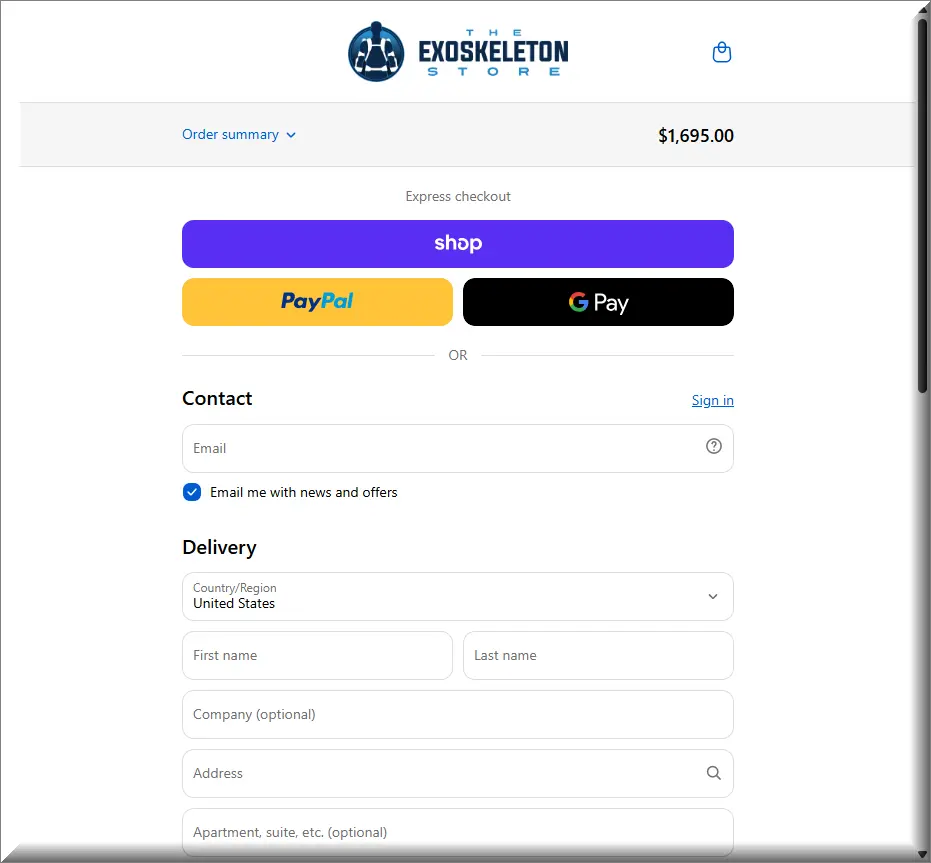
So the same device sits behind a sales conversation on the manufacturer’s site and one click from a card payment at a retailer. If your back is the problem and you are a sole trader, a carer, or simply someone who lifts things, the workplace aisle is open to you, and almost nobody writing about this category says so.
Two cautions before you treat that as a recommendation. These devices are sized and fitted for a shift, and the fitting normally arrives with the corporate deployment you are skipping. And support, spares and warranty terms on a professional product bought at retail are written for a company with a purchasing department, so read them before the order rather than after. That is the lesson buying guides for connected hardware keep relearning, and we went through it in detail with best robot kits for adults, where products every list still recommends had quietly stopped existing.
The people this market serves worst
Three buyers keep asking the same questions in public. Nobody answers them.
The first is an older person losing stamina or balance, or the adult child shopping for them. They are not impaired enough for the medical class, and the consumer class disclaims everything they need. The clearest answer in the field came from an owner, not a manufacturer. It was about stairs: he would be more concerned about coming down, and it is not going to do anything to stop a fall.
The second is a tradesperson whose day is overhead work, kneeling, ladders and driving between sites. Industrial exoskeletons are built for one repeated motion at one station, which is the same shape the rest of workplace robotics has taken: when we counted the jobs humanoid robots are actually taking, the work that got automated was repetitive and stationary too. Nothing on any product page tells this person what the suit costs them on every other movement in a working day.
The third is someone with one-sided weakness after a stroke, at home, wondering whether they can get the thing on alone and whether it can assist one leg differently from the other. Owners describe exactly that situation. One husband reports the device stopped his wife compensating for a weaker left leg. There is no manufacturer documentation showing a person with one working hand fastening a hip belt and two thigh clamps by themselves.
All three are the same failure. These machines are described by what they add, and never by whom they fit. That is a marketing choice, not a physics problem.
What happens when the battery dies
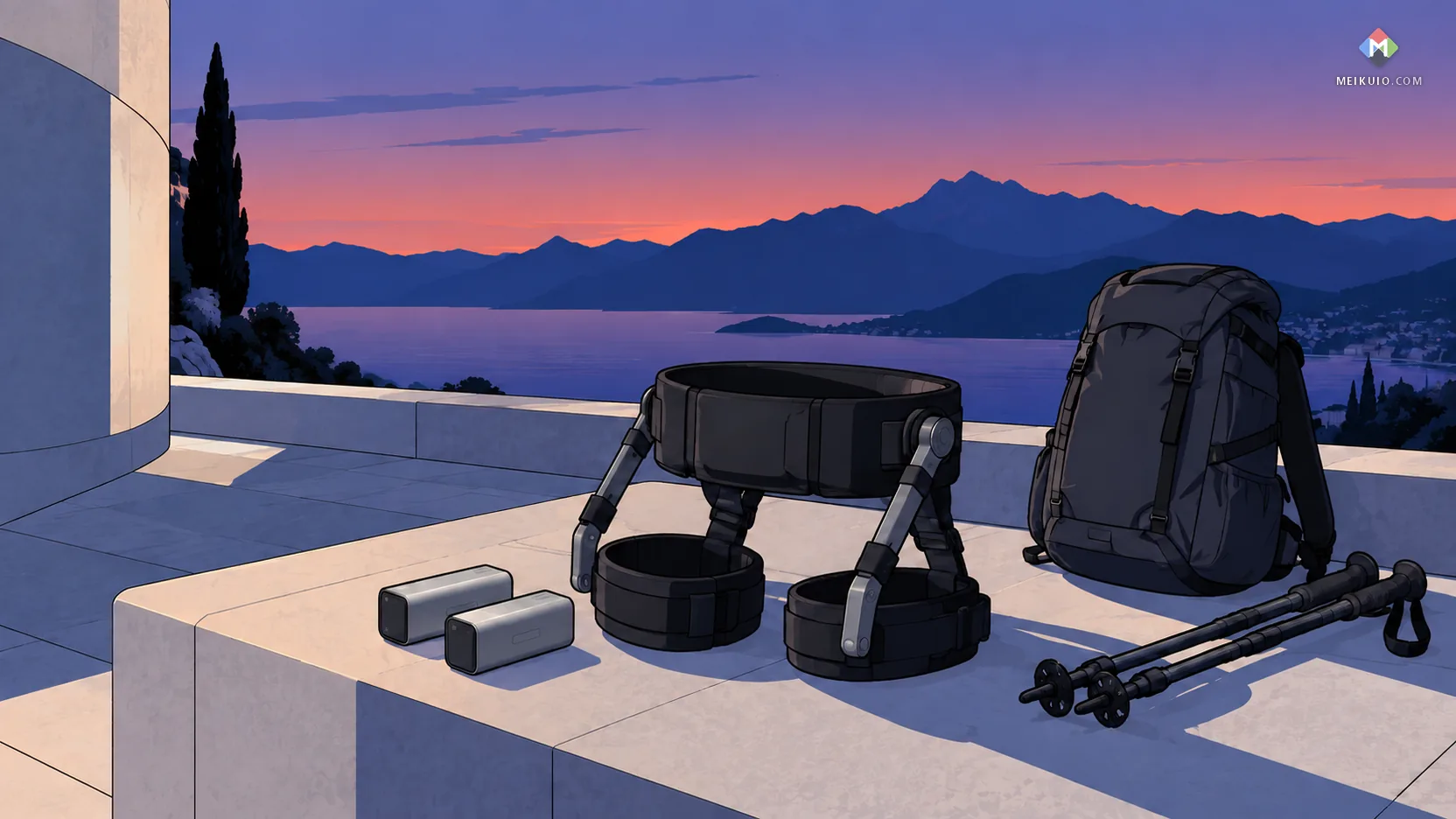
A powered exoskeleton with a flat battery is a few kilograms of frame strapped to your legs. It does not assist and it does not disappear. On a day walk that is an annoyance. Two hours from the car park it is the thing you should have thought about.
The answers owners land on are unglamorous. Carry a spare pack, and treat the published range as an upper bound set in conditions you will not meet. Unpowered suits have no version of this problem. Nothing to charge, nothing to run out. If your task is lifting rather than walking, that alone may decide it.
Check one more thing before you fly with one. Lithium battery rules are set by watt-hours: up to 100 watt-hours travels in carry-on without asking, 101 to 160 watt-hours needs the airline’s approval, and above that it does not fly as passenger baggage at all. Find the watt-hour figure for the device and for every spare, then ask the airline before the trip rather than at the gate. Anyone who has travelled with a beginner drone has already met these rules, and they are enforced the same way here.
The app, the account, and what you actually own
This is the one hard question you can settle from your sofa, and almost nobody asks it. Consumer exoskeletons pair with a phone app for modes, sensitivity and firmware. That app is where real settings live, as the owner who fixed his assistance lag by raising the sensitivity discovered. The phone is part of the machine.
Before you buy, get four answers in writing: whether the hardware moves without the app, whether an account is required to pair it, what the warranty says about firmware, and what happens to the device if the company stops running the service. Manufacturer terms in this category are thin. One consumer maker’s published warranty is void if the product is subject to any modification to its hardware or firmware, so tinkering costs you the cover. Reading terms before paying rather than after is the cheapest habit in consumer tech, and it is the one that decided most of what we found reading the fine print on credit monitoring services.
Return windows matter more here than in most categories, because the research says adaptation takes time. Consumer return windows in this category run to a couple of weeks, and people describe getting used to these machines over a month or more, so the window is a shorter test than it sounds. I could not reach the US terms pages of the biggest consumer brand from outside the country, so check the exact number yourself. Check the window, check who pays return shipping, and check the cancellation terms before the unit ships. Read it before you pay.
How to choose, in order
- Name the movement that is hard. Swinging your leg forward, pushing yourself up, bending under load, holding your arms up, or standing still. One of them.
- Check whether the cheap thing covers it. Poles, a proper hip belt, a brace, or an unpowered suit. If it does, stop here.
- Match the movement to the class, not to the brand. A hip device will not get you up the stairs whatever logo is on it.
- Find out who sets the price in that class, because that tells you what the buying process will be: a checkout, a quote, or a coverage decision.
- Run the five questions on the percentage. If none are answered, treat the number as marketing and decide on the mechanism instead.
- Check what can be checked: the return window, who pays return shipping, the app dependency, the battery watt-hours, and the fit range against your own measurements.
- Accept what cannot be checked. Drag, heat, timing and secondary strain only appear on a body, and service life is not published by anyone. Buy where you can send it back.
Field notes
- The audit: sixteen brands read; eleven print an effort percentage; three say what it was measured against; none of those three sell to consumers.
- Consumer prices: Hypershell X at 999, 1,499 and 1,999 dollars at US retail; AstroShell at 1,199 dollars.
- Workplace prices: 995 to 3,995 dollars at the US retailer checked; German Bionic and SuitX publish no price at all.
- Retail checkout: an Auxivo LiftSuit 2 reached a working payment page at 1,695 dollars with the company field marked optional.
- Coverage: Medicare classifies powered exoskeletons that support weak arms or legs as braces, while private plans still print investigational and not covered.
- Standards: no exoskeleton standard read here requires a reproducible protocol behind an effort-reduction claim.
- Sources: FDA clearance records, FTC health products compliance guidance, NIOSH science bulletin, ASTM F48, ISO 13482, IEC 80601-2-78, CMS coding article.
Frequently Asked Questions
Do exoskeletons actually work?
They do something measurable, and published research shows real reductions in the energy cost of walking. What no consumer seller tells you is how much of that applies to you, because none of them state what their advertised percentage was measured against, on what task, or with how many people.
How much does an exoskeleton cost?
Consumer hip exoskeletons run about $999 to $1,999 at US retail. Workplace suits ran from $995 to $3,995 on the US retailer I checked in August 2026, and most manufacturers quote rather than publish. Personal medical exoskeletons carry no public price; the payer sets the amount.
Will Medicare pay for an exoskeleton?
For a narrow group, yes. Medicare has a billing code for powered lower-limb exoskeletons and a rule placing them in the brace benefit category, and it requires a diagnosis in a defined range, a prescription, clinical training and a supplier who bills that code. Commercial plans decide separately, and several still classify these devices as unproven in writing.
Will an exoskeleton stop me falling?
No. Consumer exoskeletons put motors at the hips and assist a step you are already taking. They do not stabilise the knee, do not detect a stumble, and have no fall response. If balance rather than stamina is the problem, this is the wrong category of purchase.
Will it help me climb stairs?
Barely. A hip device swings your leg up to the next step but does not push down to lift your body, which is the hard part. Owners report the same about standing up from a chair or a squat. Gradual inclines are different, and several owners say hills are where they notice it most.
How long does the battery last?
Manufacturers publish ranges in miles rather than hours, and owners describe those figures as optimistic without publishing measurements of their own. Carry a spare pack. When the battery is flat the device becomes weight you are still wearing, and that is the part worth planning around.
Can you buy a military exoskeleton?
No. Defence work on exoskeletons is real, but that class is procured rather than sold: there is no consumer channel and no published price. I did not audit individual military programmes for this guide, which covers what a person can actually obtain. If that phrase brought you here, the machines you can buy are the consumer and workplace classes above.
Is it safe if I have a medical condition?
No consumer product page I read publishes a contraindication list, so there is nothing to check against. The medical class documents its indications because regulators require it; the consumer class stays silent because it makes no medical claim. If you have a diagnosis, ask the clinician who knows your case rather than a product page.
How long do these devices last?
Nobody publishes a figure. I found no manufacturer data on service life, replacement battery prices, spare parts or repair once the return window closes. Consumer exoskeletons have not been on sale long enough for a used one to be old, so treat longevity as unknown rather than good.
Can you take an exoskeleton on a plane?
It depends on the battery. Packs up to 100 watt-hours travel in carry-on, 101 to 160 watt-hours require airline approval, and anything larger is not permitted as passenger baggage. Find the watt-hour rating for the unit and every spare, then ask the airline before you travel.
What is the difference between an exoskeleton and an exosuit?
An exoskeleton usually means a rigid frame with joints, and an exosuit usually means a soft textile version using elastic or springs. The words are not policed and sellers use them interchangeably. The more useful question is whether the device has a motor, and where the load it takes off you ends up.
Can a private buyer purchase an industrial exoskeleton?
Yes, at retail, even though manufacturers route businesses through sales teams. In August 2026 a commercial back-support exosuit went into a cart at a US retailer at $1,695 and reached a normal payment page with the company field marked optional. Fitting and support are what you give up by skipping the corporate route.
My Take
The percentage on the box is the least useful number in this category, and it is the only one anyone advertises. Sixteen brands, eleven printed a figure, three said what it was compared against, and every one of those three sells to employers or clinics rather than to you. That is not a scandal. It is what happens when the buyer never asks, and the fix is that you ask.
If I were buying, I would ignore the headline figure and buy on mechanism and returns. Name the movement that hurts, check the device acts on that joint in that direction, then buy from a seller who will take it back, because the four things that decide whether you keep wearing it cannot be known until it is on you. And if the honest answer is that stairs are the problem, or that balance is the problem, I would keep the money. Nothing in the consumer class is built for either.