



Child identity theft is somebody using your child’s Social Security number to open accounts, claim benefits, or file a tax return. Every warning sign published about it arrives after the damage is done. The check that finds it early is free, and almost nobody tells you the exact words to use when you ask for it.
- What child identity theft is, and why a child’s number is the one they want
- Every warning sign the guides list, and when each one can actually appear
- The one sign that could arrive early, and why no guide explains how to read it
- How to check whether your child has a credit file
- What a “no file found” answer does and does not prove
- Checking is not freezing, and freezing is not checking
- The places a credit check will never look
- Wages reported under your child’s number
- Tax returns, bank accounts, utilities and medical files
- How the details get out in the first place
- How parents actually find out
- The one group of children the government checks on purpose
- The number nobody checks
- What family plans actually do for a child
- If your child does have a file: what to do, in order
- Frequently Asked Questions
- How do I check if my child’s Social Security number is being used?
- Does a child have a credit report?
- What does it mean if the credit bureau says there is no file?
- Can I freeze my child’s credit and skip the check?
- Do pre-approved credit offers in my child’s name mean identity theft?
- Can someone use my child’s Social Security number to work?
- Can my child get a new Social Security number?
- Who steals a child’s identity most often?
- How can I tell if a caller asking for my child’s information is real?
- At what age should I check my child’s credit for the first time?
- My Take
What child identity theft is, and why a child’s number is the one they want
The Federal Reserve Bank of Boston defines the crime that drives most of this in one sentence: synthetic identity fraud is “the use of a combination of personally identifiable information (PII) to fabricate a person or entity in order to commit a dishonest act for personal or financial gain.” Read that again with a child in mind. The fabricated person needs a real Social Security number that nothing is attached to yet. Your seven year old has exactly that.
Congressional testimony on synthetic fraud puts the requirement plainly: the scheme needs a number “that is not yet in the financial services and credit ecosystem.” Children qualify. So do elderly people and incarcerated people, for the same reason, because none of them are using credit and none of them are watching.
There is a second reason, and it has a date on it. Until 25 June 2011, a Social Security number carried information inside it. The first three digits encoded the state where it was issued, the middle two encoded the batch, and the last four ran in sequence. Because the batches ran in order, the number itself carried a rough signature of when it was handed out, so a number issued to a newborn and presented alongside a birth year two decades earlier did not fit its own scheme. The Social Security Administration switched to randomization on that date, in its own words, so the number would be harder “to reconstruct using public information.” It worked. It also removed the last thing about a number that quietly disagreed with a lie told about its owner.
So the modern version of this crime does not steal your child’s identity in the way the phrase suggests. It takes the number, attaches a different first name, a different surname, and a different date of birth, and grows a credit history around that combination for years. Nothing arrives at your house. Nobody calls. The person being built does not live with you.
That single fact decides everything else in this article, including whether the standard advice works. If you want the wider question of whether paying somebody to watch all of this is worth it, I answered that separately in is identity theft protection worth it. This piece is narrower. It is about finding out.
More Read

Every warning sign the guides list, and when each one can actually appear
I pulled the first page of results for child identity theft on 2 August 2026 and wrote down every distinct warning sign published across it, then asked one question of each: can this reach you before an account has been opened, used, and allowed to go bad? Seven signs. Six of them cannot.
Here is the full list, with the publisher of each and the earliest point it can physically arrive. This is the same list the top results give you, assembled from all of them at once, which no single one of them does.
Look at the right hand column. A jury summons addressed to a nine year old, a driver’s licence refused at sixteen, a medical bill for a procedure that never happened: none of these is an early warning. Each one is the moment the consequence catches up with a family, and each one is preceded by months or years in which nothing at all happened at your address.
One published item is missing from that table on purpose. Experian tells parents to watch for “a credit report with no credit,” meaning a file that exists before the child has ever used credit. The existence of that file is the most reliable indicator of fraud there is, and I have left it out of the list because it never arrives at your house. You only ever see it if you go and ask, which makes it the answer to this problem rather than a warning about it.
Six of the seven published warning signs require the account to already exist and already have failed. Vigilance is not the tool for this job.
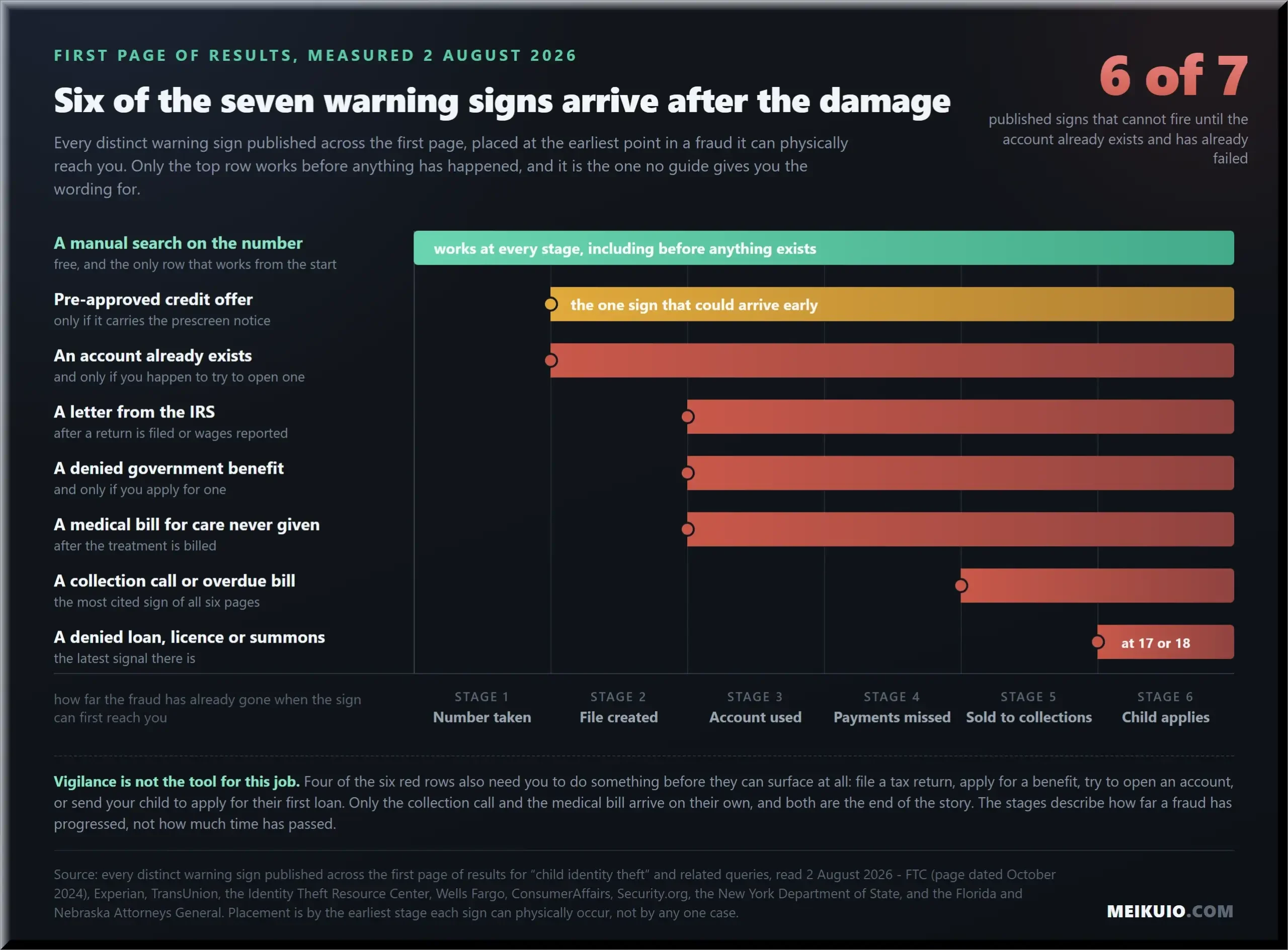
There is a reason this matters more here than it would for an adult. When somebody opens a card in my name, a bank tells me within days, because I have a file, a balance, and a phone number attached to all of it. A child has none of that. The alerting machinery that protects adults is built on a file that a child is not supposed to have, which is the same structural point I made about what best credit monitoring service plans can and cannot see. Nothing can watch a file that does not exist.
The one sign that could arrive early, and why no guide explains how to read it
Pre-approved credit offers in a child’s name are the most cited warning sign in every guide to child identity theft I measured, and the advice attached to them is wrong often enough to matter. Two envelopes can look identical on your kitchen table. One of them means a credit file exists. The other means somebody bought a mailing list.
The distinction is written into the Fair Credit Reporting Act. A prescreened offer, which the statute calls a firm offer of credit, is one that will be honoured if the consumer “is determined, based on information in a consumer report on the consumer,” to meet the criteria. Producing one therefore requires a consumer report to exist. Ordinary marketing mail requires nothing of the kind, and TransUnion says so on its own site: “Your child may be on a promotional mailing list. Companies purchase mailing lists from many sources.”
There is a way to tell them apart, and it is printed on the letter. Section 615(d) of the same law requires every prescreened offer to carry a clear and conspicuous statement that information from the consumer’s credit report was used, together with the opt out route and the shared toll free number the bureaus run for it. If that notice is on the page, the mailing came from a prescreen list. If it is not there, it came from a marketing list and it proves nothing about your child.
Now the part that makes a genuine prescreened offer to a child worth acting on immediately. Since the Credit CARD Act of 2009, the law has required bureaus to leave people under 21 out of prescreen lists unless the person consents. So a firm offer addressed to your eight year old is not one anomaly. It is two: a file that should not exist, and an exclusion that should have caught it.
If an envelope just arrived?
Before you do anything else, look for the opt out notice on the letter itself, usually in small type at the bottom or on the reverse. It will say that information in a consumer report was used and it will give a toll free number for removing yourself from prescreened offers. If that paragraph is present, treat it as a reason to run the checks in the next section this week. If it is absent, your child’s name and address are on a rented marketing list, which is worth fixing but is not evidence of anything. Neither case is proof on its own, and no publisher I measured tells parents to look for the difference.
Ten publishers in the field I measured tell parents that this mail is evidence of identity theft. None of them explains the distinction, and none of them mentions the opt out system. That is not a small editorial gap. It is the difference between a parent panicking over a magazine subscription list and a parent missing the one signal that could have reached them early.
How to check whether your child has a credit file
Ask each of the three credit bureaus, separately, whether a file exists for your child. A credit file is the record a bureau keeps once somebody has applied for or opened credit in a given name, and a child should not have one at all. Asking is free, and it is the only step in the whole of child identity theft advice that returns a direct answer about your own child. The FTC’s own guidance, on a page dated October 2024, tells you to contact the three credit bureaus and, in its words, “ask for a manual search for your child’s Social Security number.”
The guides stop there. What they leave out is that the three bureaus turn that one question into three unrelated errands. I opened TransUnion’s form and Experian’s minor request page myself on 2 August 2026 and read what each one asks for; the Equifax column below comes from Equifax’s own published instructions and the federal guidance on them, because Equifax runs this by post. Here is what each one demands and what it sends back.
One bureau answers a web form with nothing attached. Another wants four documents and takes up to a fortnight. The third wants an envelope and a stamp. The task most guides describe as “contact the three bureaus” is a browser tab, a scanning session, and a trip to the post office.
All inquiries are free. TransUnion requests no documents: name, SSN and birth date, reply by email; report copy requires separate mail request. Experian needs your photo ID, address proof, child’s birth certificate and SSN card; asks two years of addresses; reply by email or post in 10–15 days; existence only. Equifax needs your ID, child’s birth certificate and SSN card; reply by post or email; separate disclosure form for the report. Manual SSN-only search is requested by phone or letter, not those fixed fields.
Two more things about the request itself, and both change what you get back.
The first is the wording, and there is a practical problem with it that no guide mentions. The online forms above are fixed fields: a name, a number, a date of birth, an address. There is no box to type a sentence into. So the request for a manual search based only on the Social Security number is one you make in the channel that has room for it, which means the phone call to the bureau’s fraud line or the letter you put in the envelope to Equifax. The FTC’s page points you to IdentityTheft.gov for each bureau’s current contact details, and that is where to get them, because the numbers and addresses change.
Be ready for the phrase not to land the first time. No bureau publishes a search on the number alone as a named service, which is exactly why you have to ask for it in words rather than tick a box. Ask anyway, ask for it to be noted on the request, and keep whatever they send back. The reason all of this matters is the next section, and it is the reason this article exists.
The second is that asking is not the same as protecting. The free freeze that stops new accounts being opened is a different form and a different submission, and I went through that whole route, along with the rest of what the law already gives you for nothing, in is identity theft protection worth it. Do both. Do not let anybody tell you that one replaces the other.
What a “no file found” answer does and does not prove
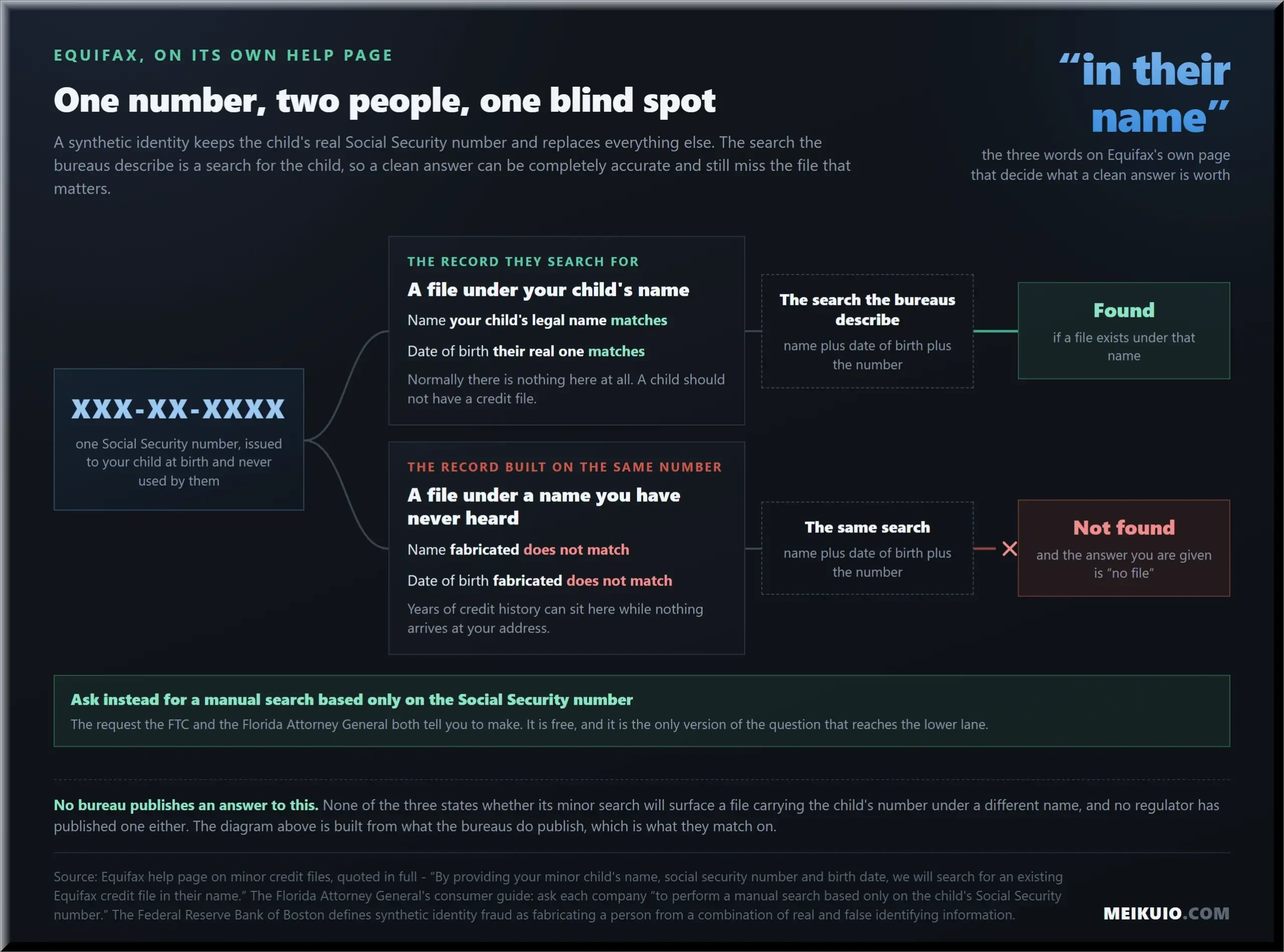
It proves that no credit file exists under your child’s name and date of birth. It does not prove that nobody is using your child’s Social Security number. Those are two different statements, and the gap between them is where synthetic fraud lives.
Equifax describes its own search on its own page, and the wording is the clearest statement of the mechanic anywhere in the category: “By providing your minor child’s name, social security number and birth date, we will search for an existing Equifax credit file in their name.” In their name. That is a search for your child, and a synthetic profile is not your child. It carries your child’s number attached to a fabricated first name, a fabricated surname, and a fabricated year of birth, and to an index built around names, that combination is a stranger.
So the answer can come back clean and be completely accurate while a credit history funded by your child’s number is three years old and two states away.
The published advice turns actively unhelpful at exactly this point. The New York Department of State tells parents that “contacting the credit reporting agencies to confirm your child does not have a credit file will likely mean that he/she has not been a victim.” A local television news report says minors cannot be issued credit reports, so finding one means fraud. Two credit unions tell parents that no file is good news. A financial adviser calls the existence of a file “the #1 sign.”
None of those statements is written in bad faith, and each describes the ordinary case correctly. The defect is that the reassurance carries no condition. Not one of them says what a clean result cannot rule out, and the news version has a second problem, because a file can also exist for the dull reason that somebody requested a freeze on a child who had none.
Two sources in the field do. The FTC tells you to ask for the search on the number. The Florida Attorney General’s consumer guide is the only place I found that explains why the word “only” belongs in the request: ask each company “to perform a manual search based only on the child’s Social Security number. This way, if the child’s Social Security number is associated with a different name and personal information, it will be discovered.”
Ask for a manual search based only on the Social Security number. That one word changes what is being searched for, from your child to the number itself.
I want to be straight about the limit of what I can tell you here. No credit bureau publishes a statement about whether its minor search will surface a file carrying the child’s number under a different name, and no regulator has published one either. What the bureaus do publish is what they match on, and that is what the paragraphs above are built from. The absence of a plain answer from the companies holding the data is not a detail. It is the thing a parent most needs and cannot get.
Checking is not freezing, and freezing is not checking
A freeze stops new accounts from being opened. A check tells you whether accounts already exist. Neither one does the other’s job, and confusing them is the most common way a careful parent ends up unprotected in exactly one direction.
The Identity Theft Resource Center, a non-profit that runs a free victim support line and ranks on the first page for this topic, tells parents to request a credit report for their child every year, then adds this: “Please note, this is only necessary if your child’s SSN has already been misused. If you preemptively freeze your child’s credit, monitoring should not be necessary.”
The advice is reasonable about the future and wrong about the past. A freeze placed today does nothing about an account opened in 2023. It cannot report what is already there, because reporting is not what it does. And a parent who reads that sentence and files the freeze away as finished has skipped the only step that would have found existing damage.
There is a wrinkle worth knowing before you do either. At Experian and Equifax, freezing a child who has no file causes the bureau to create one so that it has something to lock. Equifax says it in the same sentence as the search: “If one does not exist, we will create one.” That is the correct behaviour and it is not a trap, but it means the order of operations matters. Ask first. Freeze second. If you freeze first, the file that turns up afterwards may be the one your own freeze request created.
The FTC page that ranks first for this topic lists both tasks, one after the other, and never says which question each of them answers. That is how a household ends up doing half the job and believing it did all of it. If you want the fuller version of what a paid service adds on top of the free steps, that is what credit monitoring actually watches, and the short version is that it watches a file.
The places a credit check will never look
Child identity theft is not one crime with one record. A credit file holds credit. It does not hold wages, tax filings, bank account histories, utility accounts, or medical claims. A parent who checks all three bureaus, gets three clean answers, and stops has checked one of at least six places a child’s Social Security number can be in use.
Wages reported under your child’s number
This is the channel nothing in the consumer field covers, and it is the one with a federal audit attached to it. When an employer files a W-2 whose name and Social Security number do not match the Social Security Administration’s records, the form is posted to something called the Earnings Suspense File. The agency’s own Office of the Inspector General describes it as “a repository of W-2s that failed SSA’s name and SSN matching criteria.” The audit put the wages sitting in it, uncredited to anybody, at 1.2 trillion dollars.
The same audit went looking for children inside it. Of the hundred employers that most often reported wages using the Social Security numbers of children between tax years 2007 and 2010, twenty nine “reported wages for 977 children that appeared to involve SSN misuse.” The auditors recorded the ages. They ranged from four months old to thirteen.
Now the part that should be the headline. Under the regulation governing wage reports, the agency writes to the employer or the worker to get the record corrected, and it notifies the IRS about wage reports filed without Social Security numbers. It does not notify the person whose number was used. There is no letter to your family. The record simply accumulates.
You can see it, but you have to buy it. A parent or legal guardian can request a child’s earnings record on Form SSA-7050-F4, with proof of the relationship such as a birth certificate or a court order, and the form charges a fee of 61 dollars for the request. So the check that is free cannot see employment fraud at all, and the check that can see it is a paper form with a price on it.
Tax returns, bank accounts, utilities and medical files
The tax side surfaces on its own terms, usually when you file. The IRS describes the moment precisely: a taxpayer “can’t e-file because a dependent’s Social Security number or ITIN was already used by someone on another return.” Deposit account histories live with specialty reporting agencies outside the big three, which is why a child can be refused a bank account years from now with a spotless credit report. Utility and telecom accounts often sit in their own exchange until they are sold to a collector. Medical claims sit with insurers, which is why the Florida Attorney General lists bills for treatment the child never received as a warning sign while nobody else does.
I could not get primary documentation on how those specialty agencies handle a request about a minor, and I am not going to describe a process I have not read. If you want to know what a paid plan claims to cover across these channels, the closest thing to an honest answer is in the Identity Guard review, where I went through what the monitoring actually reaches.
Only two of six uses have a documented check a parent can initiate. Not claimed means the vendor’s wording does not say it reaches that use. The article found no primary documentation on minor requests for the bottom three categories and does not describe an unverified process. Child features describe public records, credit headers and breach compilations, not an SSN-based bureau search.
How the details get out in the first place
Schools and their software vendors hold more of your child’s identity than your bank does. In December 2024 a contractor’s stolen credentials opened the customer support portal of PowerSchool, a company whose products sit inside thousands of American districts. The counts in the criminal case are 62.4 million students and 9.5 million teachers across more than 6,500 districts, and the company’s own statement said “fewer than 25 percent of registered students had Social Security numbers stored in the affected system.” A nineteen year old pleaded guilty in May 2025 and was sentenced in October 2025 to four years and 14.1 million dollars in restitution. The data does not expire with the sentence.
If a letter about a school or vendor breach is what brought you here, the notice itself will rarely tell you whether your own child’s number was in the exposed set, and chasing that answer is slower than getting the one that matters. Run the three bureau inquiries this week with the wording above, take whatever free monitoring the breached organisation is offering because it costs you nothing, and then freeze the files once the answers are back. A breach notice changes the urgency of the check. It does not change what the check is.
The other route into a household is the phone, and it has become much harder to spot since voice cloning got cheap. If a caller claims to be the school office, the district’s insurer, or a fraud department and needs your child’s number to confirm something, the safe move is to hang up and call the organisation on a number you already had. The call-back rule and the rest of the protocol are in how to spot an AI voice scam, and they apply here without modification.
How parents actually find out
Almost nobody spots a warning sign. In the accounts of child identity theft I read across public legal advice forums, consumer complaints and news coverage, discovery arrives as a piece of the parent’s own paperwork failing: a tax return the IRS refuses, a benefit application that comes back denied, a first loan turned down at eighteen, a collection letter for a relative’s utility account.
That pattern has a consequence worth stating plainly. You do not find this by watching. You find it by asking, or by accident, years late.
The accounts also say something uncomfortable about who does it. Javelin’s 2021 child fraud study puts it at 73 percent of victims knowing the person responsible, and the stories match the number. One poster on a public legal advice forum described finding out “the day after Christmas that my Mother had opened several accounts in my name. She confessed when I confronted her. She filed bankruptcy about 3 years ago. This is why she ‘needed’ credit.” Another, writing about the same situation years later, put the cost in one line: “my family convinced me not to report it, but just pay it off and move on, and I regret it every day. It took my credit YEARS to recover.”
If the other parent is the problem
The free freeze that protects a child has to be requested by a parent or a court appointed guardian, with documents proving the relationship. When the person misusing the number is the person with that authority, the protection is being handed to the wrong hands, and there is no version of the form that solves it. Two things still work. The credit file inquiry can be made by either parent with the same proof, so you can find out what exists without the other person’s cooperation. And the report you eventually file names the account and the creditor, not the household, which matters at eighteen when the young adult decides what to do. Nothing here is legal advice, and a case involving a family member is one where a lawyer and a police report do more than any subscription.
Family plans are sold on precisely this scenario, and it is the scenario they handle worst, because the alert goes to the account holder. That is part of why the family tier arithmetic came out the way it did in is LifeLock worth it.
The one group of children the government checks on purpose
There is one population of American children whose credit files the federal government requires somebody to look at every single year. Not watch. Look at. The rule tells you what the government thinks actually works, and a federal audit tells you how often it happens.
The statute is section 475(5)(I) of the Social Security Act, and it requires that “each child in foster care under the responsibility of the State who has attained 14 years of age receives without cost a copy of any consumer report” every year until they leave care, along with assistance “in interpreting and resolving any inaccuracies in the report.” The requirement started at sixteen in 2011 and was lowered to fourteen by the Preventing Sex Trafficking and Strengthening Families Act, effective September 2015.
Read what that instrument is. Faced with more than 600,000 children a year whose documents pass through many hands, Congress did not write a list of warning signs into federal law. It wrote an annual check of the file. That is the same instruction this article has been building toward, and it has been on the books for a decade.
In September 2024 the Department of Health and Human Services Office of Inspector General published what happened in practice, in report OEI-07-22-00510, covering fiscal year 2021. Two findings matter here.
The first: “Over half of the children in foster care who should have received credit checks did not receive any credit checks in FY 2021.” The second is the only measurement of its kind I have found anywhere in this subject: “Credit reports existed for 4 percent of children who received at least one credit check, which could indicate potential identity theft because children under age 18 generally do not have the legal capacity to sign a contract or apply for credit.”
Four percent. Not a survey, not an extrapolation from breach notifications, not a vendor’s estimate. It is the only count of child identity theft in the United States produced by somebody actually looking. And the auditors added that those children “rarely received assistance in interpreting or resolving credit reports, as required,” which means that even where the alarm went off, in most cases nothing followed it.
Two cautions, because this number will be quoted badly by somebody. Children in foster care are at higher risk than children generally, so 4 percent is not a national rate. And the auditors chose their words: a credit report existing “could indicate” identity theft, which is not the same as proving it. Neither caution changes what the figure demonstrates, which is that checking finds things, at a rate nobody in the consumer field has ever put a number on.
The number nobody checks
A fair question at this point is why a lender cannot simply confirm that a Social Security number, a name and a date of birth belong together before opening an account. The answer is that a federal service does exactly that, it has existed since June 2020, and almost nobody uses it.
The Social Security Administration built it after Congress ordered it in 2018. In the agency’s words, it “allows permitted entities to verify if an individual’s SSN, name, and date of birth combination matches Social Security records,” returning a yes or no. That is the precise check a synthetic identity fails, because the number is real and the name attached to it is not.
Two limits kill it for you. The first is that only permitted entities can enrol, meaning financial institutions and their service providers. A parent cannot buy this. The second is in the Government Accountability Office report published in September 2024, and the numbers are stark: the agency “projected that eCBSV would have 123 direct users that made 1.1 billion transactions in FY 2021.” Through fiscal 2023 it had 25 direct users and 76.8 million transactions. The GAO also found the agency “had not established performance measures and goals for the service’s use and benefit.”
So the one federal mechanism that would catch the commonest form of child identity theft at the moment it starts exists, is funded, and is running at a fraction of what was planned. Nobody is required to use it.
There is a matching gap on the repair side. Getting a child a new Social Security number is close to impossible before harm has already happened. A House committee report published in 2025 describes the current policy: a number holder generally has to show both “that their SSN has been misused by a third party and that this misuse has resulted in harm,” with the harm normally occurring within two years of the application. A bill to change that for children under fourteen whose card was lost or stolen in the post, the Social Security Child Protection Act of 2025, passed the House of Representatives on 1 December 2025 by 386 votes to nothing. It was referred to the Senate Finance Committee the next day. As of early August 2026 it has not become law.
What family plans actually do for a child
Every major identity protection service sells a child identity theft feature, and the names all sound like the thing you want. Read the sentence underneath the name instead, because that is where the mechanism is described, and in every case I checked it describes something other than a bureau search on the number.
Aura’s family plan says it will “scan billions of public records to detect and alert you if your Child’s SSN is being used by someone else,” and it generates pre-filled freeze requests for the three bureaus. LifeLock Junior “monitors your child’s Social Security number to detect credit information associated with your child’s identity.” Identity Guard’s child feature will “scan credit header data and other identity databases” and alert you if the number turns up against credit applications, utilities or bankruptcy records. Credit header data is the identifying top layer of a credit file, the names, addresses and dates attached to a number, sold on separately from the account history underneath it. It is a real source and it is not the file itself.
Public records. Credit headers. Breach dumps. Those are real sources and they catch real things. None of those sentences describes the manual search on the number that the FTC and the Florida Attorney General tell you to request, and that request is free.
Three more things about children inside these products, each of which I have gone through in detail elsewhere and will not repeat here. The insurance that headlines a family plan generally does not extend a pool to the children on it, which is the reading I took from the policy in the children get no insurance pool section of that review. A plan sold under a child’s name is not automatically a child identity product: Aura’s standalone Kids tier carries no identity monitoring, no credit protection and no insurance at all, which I worked through in the Aura review. And cover you already hold can beat cover you buy, because some of it arrives through an insurance policy or an employer instead of a subscription, which is the pattern in the Allstate identity protection review.
None of this makes the paid products worthless. It makes them the wrong first move. Do the free request first. Then decide what is left for a subscription to solve, and if you get that far, the current prices and what each tier actually includes are in the individual reviews linked above rather than here, because they change often enough that a number printed in this article would be wrong within a month.
If your child does have a file: what to do, in order
A file came back, which means you are dealing with child identity theft rather than worrying about it. Work through this in order, because each step depends on the one before it, and the paperwork gets easier once the first report is on record.
- Get the file itself, not just the answer. All three bureaus answer the inquiry with a yes or a no rather than a document, so ask for the copy as a separate request. The account names, the dates and the addresses on it are what every step below is built from.
- Report it to the FTC and keep the report. That federal identity theft report is the document creditors and bureaus ask for, it is free, and every later step goes faster once you can attach it.
- Contact each company where an account was opened, ask the fraud department to close it, and get written confirmation that your child is not responsible for the balance. Get that in hand before you deal with that creditor again.
- Send the bureaus the FTC’s Uniform Minor’s Status Declaration Form together with the child’s birth certificate. That form is what proves the account holder was a child on the day the account was opened.
- Freeze all three files once they are cleaned up, and not before. A freeze placed first can create the file you were about to search for.
- Check the tax and wage side separately, because the credit file will not show employment fraud at all. Form 14039 covers the tax dispute and the earnings record request covers wages.
If your child is already sixteen or seventeen and the discovery came from a refusal, none of the above stops being available and none of it expires because they had a birthday. Two things change at eighteen. The minor status declaration applies to accounts opened while they were a minor, which is exactly what you are disputing, so turning eighteen does not take it away. And the young adult signs for themselves from then on, which makes the case theirs to run and the decision about naming a relative in a police report theirs to make. Start the paperwork before that birthday if you can. Handing somebody a file on the day they turn eighteen is the hardest version of this.
Set your expectations on the timeline honestly, because the official numbers and the real ones are far apart. The IRS aims to resolve identity theft cases in 120 days. The National Taxpayer Advocate reported that the average case in fiscal 2024 took 676 days. If you are requesting an identity protection PIN for a child, the same office found that 60 percent of applications took longer than the 120 day target.
If the case is large or involves a relative, restoration help is the one part of a paid product that earns its price, and the differences between services are real. I compared two of the biggest on exactly that in Identity Guard vs LifeLock.
Frequently Asked Questions
How do I check if my child’s Social Security number is being used?
Contact all three credit bureaus separately and ask for a manual search based only on your child’s Social Security number, using that wording. TransUnion takes an online form, Experian takes a form plus four documents and answers in 10 to 15 days, and Equifax works by post. It is free at all three. A credit search will not show wages reported under the number, which is a separate request to the Social Security Administration.
Does a child have a credit report?
No, not normally. A minor cannot legally enter a credit contract, so a file should not exist until they apply for something at eighteen. The exception is a deliberate one: at Experian and Equifax, asking for a freeze on a child with no file causes the bureau to create a file so it has something to lock.
What does it mean if the credit bureau says there is no file?
It means no file exists under your child’s name and date of birth. It does not mean the number is unused. Equifax describes its search as looking for a file “in their name,” and a synthetic identity attaches the real number to a different name and birth date, so a name based search can miss it. That is why the request should specify a search on the number only.
Can I freeze my child’s credit and skip the check?
No. A freeze blocks new accounts from being opened from now on. It reports nothing about accounts that already exist, so freezing without checking leaves any existing damage in place and invisible. Check first, then freeze.
Do pre-approved credit offers in my child’s name mean identity theft?
Not on their own. Ordinary marketing mail comes from rented lists and implies nothing. A prescreened firm offer does imply a credit report was used, and by law it must carry a notice saying so along with an opt out number. Look for that notice. If it is there, treat it as a reason to run the bureau checks this week, partly because the law also requires bureaus to leave people under 21 out of prescreen lists.
Can someone use my child’s Social Security number to work?
Yes, and it is the version most likely to stay hidden. Wages reported under a mismatched name and number land in the Social Security Administration’s Earnings Suspense File, and the agency notifies the employer and the IRS rather than the number holder. None of it appears on a credit report. A parent or guardian can request the child’s earnings record on Form SSA-7050-F4, which carries a 61 dollar fee.
Can my child get a new Social Security number?
Rarely, and usually not before the damage is done. Current policy generally requires showing both that the number was misused and that the misuse caused harm, normally within two years. A bill to let a child under fourteen get a new number when the card was lost or stolen in transit, without waiting for harm, passed the House 386 to 0 in December 2025 and is sitting in the Senate Finance Committee.
Who steals a child’s identity most often?
Somebody the family knows. Javelin’s 2021 study of child identity theft and fraud found 73 percent of victims knew the perpetrator, and the figure has been repeated since as 70 percent, 67 percent and “nearly three quarters” depending on who is quoting it and which year they took. Where the person responsible is the parent who would place the freeze, the standard protection route does not work, and the case usually needs a police report.
How can I tell if a caller asking for my child’s information is real?
Hang up and call the organisation back on a number you already had, not one the caller gives you. Voice cloning has made the old tells useless, and a school office, an insurer or a fraud department will never lose anything by you calling back. If the call included a voice recording or a video that you are being asked to believe, the tools that can and cannot check one are in free deepfake detectors.
At what age should I check my child’s credit for the first time?
Now, whatever age they are, and then every year or two until they turn eighteen and can check for themselves. There is no minimum age at which child identity theft becomes possible, because the number is issued at birth. The federal rule for children in foster care sets fourteen as the age at which an annual check becomes mandatory, which tells you where the government put the line for a group it is responsible for. Waiting until sixteen, which some state guidance suggests, gives a fraudulent account more than a decade to age.
My Take
Almost everything written about child identity theft tells parents to watch for signs, and the signs it lists are receipts. A collection call, a tax notice, a denied licence: those arrive after somebody has already spent years being your child on paper. Meanwhile the thing that actually works costs nothing and turns on a single word most parents will never be told to say. Ask for a search on the number only.
What I would do, in the order I would do it. This week, send the three inquiries and say “manual search based only on the Social Security number” in each one. Read the next piece of credit mail that arrives for your child properly, looking for the prescreen notice at the bottom. Once the answers are back and clean, freeze all three files and leave them frozen. Then stop, because at that point a subscription is buying you public record scans on top of work you have already done. If an answer comes back and a file exists, that is the day to get the report itself and a police report if a relative’s name is anywhere near it, and that is also the one situation where paying somebody to handle the phone calls is worth the money.