



Is identity theft protection worth it? Federal law already caps your liability at $50 on a stolen credit card, and a credit freeze costs nothing. The money that actually leaves your pocket sits in a narrow band those two rules miss, and the cleanup those losses create can be insured for $25 to $45 a year, against $125 to $350 for a subscription.
- What are you actually liable for when your identity is stolen?
- What does identity theft actually cost the people it happens to?
- What does identity monitoring actually do?
- What does identity theft insurance actually pay?
- Has anyone actually checked whether paying for this works?
- Which losses does nothing give back?
- What do the three routes cost, side by side?
- The free baseline, in the order that matters
- You may already be covered and not know it
- Who is answering this question, and who is paying them?
- What have regulators already done to this industry?
- What if you are protecting someone other than yourself?
- Who should actually buy it?
- What changed in 2026
- Frequently asked questions
- Is identity theft protection worth it?
- Does identity theft protection actually stop identity theft?
- How much does identity theft protection cost?
- Is identity theft insurance worth it if I already have homeowners insurance?
- Should I get identity theft protection through my employer?
- Is identity theft protection worth it for seniors?
- Does freezing my credit cost anything?
- My Take
If it’s already happening
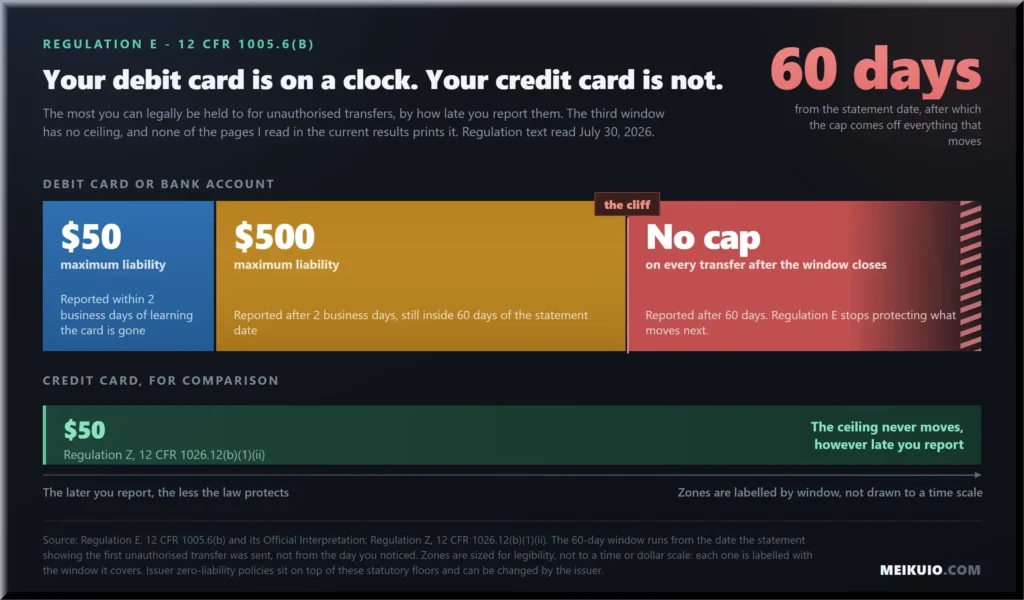
Go to identitytheft.gov before you buy anything. The FTC writes you a recovery plan there, pre-fills the dispute letters, and issues the Identity Theft Report that forces a credit bureau to block fraudulent accounts within four business days. Two deadlines outrank any subscription: tell your bank within two business days of a stolen debit card to hold your loss at $50, and report within 60 days of the statement date, because the cap comes off everything that moves after that.
What are you actually liable for when your identity is stolen?
Less than identity theft protection advertising implies, and the numbers are printed in federal regulations rather than in anybody’s marketing. Regulation Z, at 12 CFR 1026.12(b)(1)(ii), sets the ceiling for a stolen credit card: “The liability of a cardholder for unauthorized use of a credit card shall not exceed the lesser of $50 or the amount of money, property, labor, or services obtained by the unauthorized use before notification to the card issuer.” The CFPB’s own interpretation confirms that this ceiling does not move if you report late. Most issuers then stack a zero liability policy on top, which is a contract they write and can change, sitting above a floor Congress wrote and they cannot.
Debit cards work on a clock instead. Regulation E, at 12 CFR 1005.6(b), builds a three step ladder: report within two business days of learning your card is gone and your exposure stops at $50; report after two business days but inside 60 days of the statement date and it rises to $500; miss that 60 day window and the cap comes off every transfer that happens after it, which is why the date printed on the statement matters more than the day you happened to notice. The commentary adds a line worth knowing when a bank blames you for reusing a password: “Negligence by the consumer cannot be used as the basis for imposing greater liability than is permissible under Regulation E.”
Inside Regulation E’s liability ladder, that 60 day cliff is the one rung where an ordinary person can lose an unlimited amount. It is also the figure missing from every page I read in the current results. Kiplinger comes closest and gets the structure backwards, crediting zero liability to Amex, Discover, Mastercard and Visa as a courtesy of the networks, without ever mentioning the statutory floor underneath it. A courtesy can be withdrawn. A statute has to be amended.
A new account opened in your name is a different situation from your own card being used, and the answer is better. That debt is not yours to pay. The provision behind it also works faster than most people expect. Under FCRA section 605B, codified at 15 U.S.C. 1681c-2, a nationwide credit bureau must block information you identify as the product of identity theft “not later than 4 business days after the date of receipt” of four items, one of which is an identity theft report. That report is free, and IdentityTheft.gov generates it for you.
Where the caps stop working: money you send yourself
Every protection above hangs on one phrase. Regulation E defines an unauthorized electronic fund transfer, at 12 CFR 1005.2(m), as one “initiated by a person other than the consumer without actual authority to initiate the transfer and from which the consumer receives no benefit.” A payment you pushed yourself, from your own banking app, never satisfies that definition, no matter how convincing the story that produced it. The three exclusions that follow never even come into play, because nothing entered. There is no ceiling on a scam induced loss because, as far as the rule is concerned, there is no covered loss.
More Read

One line inside that mess is worth memorizing, because it decides whether your bank owes you the money. If a fraudster tricked you into handing over your credentials and then moved the funds, you are covered. The CFPB says so in its Electronic Fund Transfers FAQs: “when a consumer is fraudulently induced into sharing account access information with a third party, and a third party uses that information to make an EFT from the consumer’s account, the transfer is an unauthorized EFT under Regulation E.” The Bureau also closes the obvious escape hatch, stating that a consumer tricked into giving up account information “has not furnished an access device.” Read out a one time code and you keep the $50 cap. Press send yourself and you do not.
Here is where it turns cruel. The insurance sold alongside identity monitoring excludes the exact scenario the CFPB protects. The Assurant policy behind Experian’s plans, and the policy behind Allstate Identity Protection word for word, both bar loss “resulting directly or indirectly from the voluntary surrendering by the member of any access device.” Allstate says it plainly on its own page: “we cannot reimburse you for losses if you voluntarily handed over your money or information (even if you were tricked into doing so).” So your bank may owe you a refund under Regulation E while your identity theft insurer declines the same event. The insurance is not a second layer over the rule. On this fact pattern it is a hole exactly where the rule is solid.
The money goes here now. The FTC logged more than a million imposter scam reports in 2025, with over $3.5 billion lost, and the mechanics of the call matter more than any alert on your credit file. We took apart how those calls are built in our guide to spotting an AI voice scam, and tested what the free deepfake detectors can and cannot catch when the voice or the face is the evidence.
What does identity theft actually cost the people it happens to?
For most victims, less than a single year of a mid tier subscription. The Bureau of Justice Statistics ran the last national victim survey in 2021 and published it in October 2023, and it remains the newest edition of its kind. It found 23.9 million victims aged 16 or older, about 9 percent of that population. Of those, 58.9 percent lost a dollar or more, and the total came to $16.4 billion. The mean direct loss was $880. The median direct loss was $200.
The gap between those last two numbers is the entire marketing budget of this industry. A mean of $880 makes a good headline. A median of $200 says half of everyone who lost anything lost less than a fifth of that, which is roughly what two years of a mid tier plan costs. Losses do concentrate: victims whose information was used to open a new account lost a mean of $3,430, against $620 for credit card misuse and $670 for a bank account. New accounts are the expensive kind, and they are also the kind a freeze prevents outright.
Time tells the same story. At interview, 86 percent of victims had already resolved the financial problems from their most recent incident, and 56 percent of those had spent a day or less doing it. About 10 percent spent a month or more. Note the denominator, because press coverage drops it constantly: the day or less figure describes 56 percent of the people who had finished, not 56 percent of all victims.
The tax lane is the exception, and it is a bad one. The National Taxpayer Advocate reported that the IRS was taking around 20 months to resolve identity theft victim assistance cases, with more than 500,000 of them unresolved, in its report dated June 24, 2026. An earlier report put the figure above 22 months. No identity theft protection product shortens that queue.
Note
Three numbers, three different universes. Keep these apart, because vendors and journalists routinely blend them. BJS surveyed victims and measured what victims themselves lost: $16.4 billion in 2021. The FTC counts unverified reports people file, not a survey, and its 2024 Data Book records 6,495,932 reports, of which 1,135,291 were identity theft, alongside $12.5 billion lost to fraud of all kinds. The FTC’s own 2025 figures, released in March and June 2026, put fraud losses at about $16 billion across 3 million reports, the highest on record. Javelin, a private research firm, estimated $27.3 billion in identity fraud affecting 18 million victims in 2025, explicitly excluding scams, which it counts separately at $10.7 billion. Any article adding these together is selling you something.
What does identity monitoring actually do?
It tells you after the fact. Identity theft protection is sold as prevention, and the CFPB puts the reality without decoration: “Most monitoring services don’t protect your personal information from being stolen.” They alert you after it has already happened. That is not a defect in any particular product. It is what monitoring is. A service watching credit files and dark web dumps cannot stop a lender from opening an account, and it cannot stop a database from leaking. It can only shorten the delay between the event and your discovery of it.
Shortening that delay is worth something in exactly one place, and I want to be fair about it. When a thief opens a new account in your name, or builds a synthetic identity around your Social Security number, you have no account relationship to notify and therefore no $50 cap to fall back on. The harm is a file you do not control, and the damage compounds quietly until a lender, a landlord or a background check surfaces it. Early detection helps there.
The problem is that the same protection has a free version. A credit freeze stops the new account from being opened at all, rather than telling you afterwards that it was. One is a lock, the other is a doorbell. The doorbell costs $124.99 to $349.99 a year.
What does identity theft insurance actually pay?
Expenses, not losses. The FTC states the limit of the product in one sentence: “Identity theft insurance generally won’t reimburse you for money scammers stole or financial loss from the theft. Most policies won’t pay if your loss is covered by your homeowner’s or renter’s insurance.” The loss in that second sentence means the recovery costs, not the stolen money, so the warning is about paying twice for the same cleanup cover. Read it as a purchasing instruction. What these policies do cover is the cost of cleaning up, meaning legal fees, lost wages, notarizing and mailing documents, replacing identification, and pulling the credit reports you need to prove the mess is not yours.
That same coverage is sold as an endorsement on a home or renters policy, and the price is not close. State Farm publishes it: “At $25 per year, it can be added to your State Farm home, renters, condominium, manufactured home, or farm policy,” reimbursing “up to $50,000 for necessary and reasonable expenses incurred to restore your identity.” Two lines of fine print belong next to that. The deductible is $500 per occurrence. And the $50,000 is not a clean restoration limit, because the policy states that expense reimbursement and fraud loss coverage “are jointly subject to an expense reimbursement and fraud loss limit of $50,000 annual aggregate per insured.” Two coverages, one pool. That second half is worth noticing, because it is the exception to the rule above: State Farm’s endorsement does carry a fraud loss component, and it shares the same $50,000 ceiling with the cleanup cover rather than adding to it. State Farm also notes the coverage “may not be available in all states,” so check yours before you count on the price.
Nationwide is the other carrier that prints a number: “$45 a year (less than $4 a month)” for up to $25,000 of out of pocket expenses. Three conditions come with it. You must already hold a Nationwide policy to attach the endorsement, the monitoring behind it is run by a third party, and the coverage reaches up to two adults in the household with charges for anyone else. That last limit matters if the person you are protecting lives at a different address.
Travelers will sell you $25,000 of the same expense reimbursement “with no deductible,” and includes it free on its Platinum Plus homeowners policy. It publishes no price for it anywhere, describing the cost only as “a low yearly premium.” Progressive does not offer the endorsement at all. It routes buyers to a standalone subscription from Experian’s IDnotify instead.
One number you will see quoted everywhere deserves to be retired. The commonly cited range of “$25 to $50 annually” for this coverage traces to an Insurance Information Institute press release dated October 25, 2012, which now returns a 404 on the Institute’s own site. Its current article on identity theft insurance contains no price at all. Fourteen years is not a market rate.
For what the policies behind the subscriptions actually say, line by line, we read one of them in full in our Identity Guard review.
Has anyone actually checked whether paying for this works?
Yes. Somebody checked whether identity theft protection reduces harm, the answer came back empty, and it came from the Government Accountability Office rather than from a critic of the industry. In a March 2019 report on data breach services, GAO wrote that its “review did not identify any studies that analyzed whether consumers who sign up for or purchase identity theft services were less subject to identity theft or detected financial or other fraud more or less quickly than those who monitored their own accounts for free.” That sentence is the result of a systematic search across four research databases, a review of 54 studies, and interviews with 35 experts, all of whom said they knew of no such study either.
Two years earlier GAO had reported the same void from the other direction, finding no federal agency or private entity that “has formally assessed whether offering these services after a data breach is an effective way of delivering intended outcomes.” On the dark web scanning that anchors most current advertising, it was blunter: “we did not identify any studies or data assessing the effectiveness of identity monitoring.” Nine of the ten consumer groups GAO interviewed considered credit or identity monitoring to be of limited value.
There is one experiment large enough to settle the question, and the government ran it on itself. After its 2015 breaches, the Office of Personnel Management bought monitoring, insurance and restoration for roughly 22.1 million people. GAO reports that OPM “had obligated about $421 million” for it. Of the three million people who used the services, 81 insurance claims were submitted and 61 were paid, “totaling $112,000, with an average payout of $1,800.” Around 1 percent asked for restoration help. A fraction of 1 percent filed a claim. Read those two numbers again. Set the two figures side by side and the program committed roughly $3,760 for every dollar of insured loss it reimbursed.
Same linear monetary scale, no fabricated minimum bar. Approximately 0.027% paid out. Coverage bought for 22.1M people; 3M used services, about 13%; approximately 1% requested restoration. 81 insurance claims submitted, 61 paid, averaging 1,800 USD. GAO found no study showing paid services leave consumers better off than free self-monitoring.
The insurance side has numbers of its own, and they are worse. One provider told GAO its loss ratio, meaning benefits paid divided by premiums collected, “was less than 2 percent.” Others reported zero or almost zero claims in recent years. A contractor covering more than four million people had paid exactly one claim, for $1,519. Providers were candid about the headline figure that sells the product, telling GAO that identity theft insurance “is of limited value to a consumer,” that it was hard to imagine covered losses approaching the $1 million limit, and that the reason for advertising the million anyway “was to stay competitive in the marketplace.”
Across the industry the pattern holds. Aon’s analysis of insurers’ statutory filings found identity theft coverage running loss ratios below 5 percent in each of the last seven years on $241 million of written premium for 2023, with the median insurer paying out zero. Aon offers one explanation that ought to bother anyone selling the product: policyholders “may not know or remember they have this coverage.” The dataset that could have confirmed this independently is now gone. Nobody has to publish it anymore. Effective with the 2024 annual statement filings, the National Association of Insurance Commissioners stopped requiring insurers to report identity theft figures at all.
GAO recommended in 2017 that the Office of Management and Budget analyze whether these services work relative to the alternatives. That recommendation is still open. GAO’s own tracker notes that as of January 2025, OMB “said it had no further update.” Nine years, 22 million people covered, $421 million committed, and nobody has produced the study.
None of this proves identity theft protection is useless. It means the claim that they reduce harm has never been tested by anyone without a stake in the answer, which is a different sentence from the one the advertising implies.
Which losses does nothing give back?
Sort the harms by who ends up holding the bill and identity theft protection starts to make sense as a product. Credit card fraud is largely solved, because the $50 ceiling there holds no matter when you report. Debit is the one with a deadline. That is why the advertising talks about everything else. The categories where money leaves for good, with no rule to return it, come down to labour, delay, and the transfers you authorized yourself. Find your own row.
The bottom row is the one worth staring at. It is the only harm in the table with no legal ceiling, no detection, and an explicit exclusion in the insurance sold to prevent exactly this feeling. It is also the category the FTC put at over $3.5 billion of reported losses in 2025. No identity theft protection product addresses it.
What do the three routes cost, side by side?
Three ways to handle this exist, priced roughly two orders of magnitude apart. The free route is statutory. Nobody advertises it. The insurance route is an endorsement on a policy you may already hold, and the third route is identity theft protection sold as a subscription, which is the one with the marketing budget behind it. Prices below were read on July 30, 2026.
The subscription figures are LifeLock’s current standalone prices, and one detail behind them explains a lot. Norton’s own pricing service returns the same list price, sale price and renewal price for every standalone plan, so there is no first year discount and therefore no renewal jump. The bundles are a different story, and we took that apart in our review of whether LifeLock is worth it. Compare the middle row against the bottom one and the question answers itself for most households. You are paying five to fourteen times more for alerts, plus help filling in the forms.
The free baseline, in the order that matters
This is the part that makes paid identity theft protection look expensive, and it takes about an hour. If you only do one thing this week, do the first item. Everything after it reports on a risk that the freeze removes. The same free-versus-paid split runs through removing your data from brokers, where a subscription like DeleteMe now competes with California’s free deletion platform, and I counted what the paid plan actually covers in our DeleteMe review.
- Freeze your credit at all three bureaus. Free by federal law since September 2018, when the Economic Growth, Regulatory Relief, and Consumer Protection Act amended the FCRA. Equifax states it plainly: “Placing, temporarily lifting, or removing a security freeze is free.” TransUnion adds that removals are free too, “so freeze or remove your freeze as often as you want.” Each bureau wants a free account for the online route, and each documents a phone and mail path if you would rather not create one. Experian says online changes happen “in real time,” TransUnion says “almost immediately,” and both put mailed requests at up to three days. Fifteen minutes per bureau.
- Do not accept a lock instead of a freeze. A freeze is statutory. A lock is a product. Experian’s own freeze page puts them side by side and lists the cost of Experian CreditLock as “Included in a paid membership,” which today means Experian IdentityWorks Premium at $24.99 a month with a credit card required for the trial. TransUnion, to its credit, says the quiet part out loud on its own page: “Credit freezes are always free and provided by credit reporting agencies. Credit lock can come as a feature of credit monitoring services.”
- Get an IRS Identity Protection PIN. Six digits, valid for one calendar year, reissued every January by notice CP01A. It stops someone else filing a return under your Social Security number, which is the one harm in the table that costs you nothing in cash and about twenty months in waiting. Two cautions: the online tool goes offline for maintenance every autumn, and once you opt in you generally cannot opt out. If your income is at or below $84,000 filing individually, or $168,000 jointly, and online verification fails, Form 15227 is the mail or fax route, and the PIN arrives in four to six weeks.
- Pull your reports weekly at AnnualCreditReport.com. The FTC’s wording matters here, because it is a commitment rather than a right: “All three nationwide credit bureaus have permanently extended a program that lets you check your credit report from each once a week for free.” Federal law separately guarantees only one free report per bureau every twelve months. The weekly access is the bureaus’ choice, and they could revisit it.
- Freeze the two files that sit outside the credit bureaus. ChexSystems screens new bank accounts and NCTUE, owned by Equifax, screens telecom and utility accounts. Both offer free freezes. Neither is covered by a credit freeze, which is why some victims watch a new checking account or a phone contract appear after they thought they were locked down.
- Block electronic access to your Social Security record. The SSA describes it exactly: “You can choose to block electronic access to your Social Security record. When you do this, no one, including you, will be able to see or change your personal information on the Internet or through our automated telephone service.” One phone call. Reversible when you prove who you are.
- Lock your SSN against employment checks. E-Verify Self Lock is still running, still free, and lasts a year: “Thirty days before the lock expires, you will have the option to extend the lock.” It needs a USCIS online account, and it addresses the harm where a stranger works under your number and the earnings land on your record.
- Turn on your bank and card alerts, then stop. Every transaction alert your bank offers is the same early warning identity theft protection sells, for the accounts that actually hold your money.
If something has already gone wrong, IdentityTheft.gov is the ninth step and the only one that produces paperwork. The FTC will “walk you through each recovery step, update your plan as needed, track your progress, and pre-fill forms and letters for you,” and it issues the identity theft report the bureaus need. That is the same output paid restoration services describe in their marketing. It appeared in none of the searches we ran for this article, which is a strange thing to be able to write about a free federal tool.
You may already be covered and not know it
Before you buy identity theft protection, check the places you already have a relationship with. Free identity theft protection in the United States has quietly decoupled from paying for it. Capital One and Chase both hand it to anybody, whether or not they are a customer.
Capital One’s CreditWise FAQ is unambiguous: “Anybody can get CreditWise, even if you’re not a Capital One customer.” It gives a FICO Score 8, a TransUnion report, alerts on both TransUnion and Experian, and dark web monitoring for your Social Security number and email address. Chase Credit Journey says “No Chase account required” and confirms that “the identity monitoring feature is free and you don’t need a Chase account to get started.” Between those two, free dark web and SSN monitoring is available to any American adult without opening an account, which undercuts the core pitch of paid identity theft protection. If you want those free tools ranked against the paid ones, that is what our guide to the best credit monitoring service does.
Your card network may add a layer, and here the fine print decides everything. Mastercard’s Guide to Benefits states that “All Mastercard consumer credit cardholders in the US are eligible for this coverage,” with the same sentence appearing for consumer debit cards across documents dated from 2020 to 2025. Four qualifiers travel with it. Enrollment is required and nothing is monitored until you register. Credit monitoring is one bureau, TransUnion, not three. Anonymous and non reloadable prepaid cards are excluded by name. And your bank funds it, which is why Mastercard’s own page carries the line “Coverage may vary by issuer or country of issuance” and the benefit documents note that the bank can cancel it.
Discover gives its primary cardmembers free identity alerts, on one bureau, only if they agree online, only while the account is open and in good standing, and with the reservation printed in the footnote: “This benefit may change or end in the future.” American Express is the outlier, because CreditSecure is not a benefit at all. It is a subscription: “You’ll pay only $1 for the first 30 days. Thereafter, you’ll be automatically billed $19.99 per month until cancelled.” That is $239.88 a year, more than LifeLock’s entry plan. Amex does run a free service called MyCredit Guide, available whether or not you hold an Amex card.
One network benefit has quietly stopped working, and nobody announced it. Visa’s ID Navigator, launched with NortonLifeLock in 2021, has only ever had one published set of offer terms, and that window closed on January 31, 2025. The page still carrying those terms is signed “NortonLifeLock Inc.,” a company name retired in November 2022. Gen Digital’s legal directory has no successor page. Both enrollment URLs now redirect to a generic LifeLock sales page at full retail, where the words Visa, cardholder and free do not appear, and Visa’s current Signature benefits page lists 22 benefits with identity protection not among them. Credit union websites still advertise it as complimentary. That is stale marketing, not a live offer.
Two more channels are worth a minute. If your employer offers identity protection as a voluntary benefit, take it before you buy retail: Gallagher’s survey of 4,035 US organizations, run from January to March 2025, found 39 percent offering it, and the workplace versions are often the same identity theft protection products sold at a fraction of the price, from the same brands we have reviewed, Aura among them. Millions more have it through an insurer, which is the mechanism we unpicked in our Allstate Identity Protection review. And if you filed a claim in the Equifax settlement, you were entitled to “at least four (4) years of three-bureau credit monitoring services, provided by Experian,” plus up to six more years of one bureau monitoring from Equifax if you opted in. Those activation codes are going out now and expire 90 days after issue. Identity restoration from that settlement is available to every affected consumer without any claim at all, through January 11, 2029.
If a breach letter is what brought you here (or you checked free databases like Have I Been Pwned alternatives), take the free monitoring and do not treat it as a substitute for anything. Settlement notices routinely include twelve to twenty four months of it at no cost, and free detection is the same detection you would pay for. Read the enrolment terms before clicking accept, though. Victims of one 2025 settlement reported that the administrator’s portal offered no way to opt out of the monitoring without closing the account entirely, and support could not explain the difference.
One product left the market without a press release. Costco’s Complete ID, run by Experian, has carried the notice “Thank you for your interest in Complete ID. Unfortunately, we are no longer accepting new enrollments” since at least September 2023, and Costco has removed identity protection from its member services entirely. Several articles updated in 2026 still report this as a recent change. It is three years old.
Who is answering this question, and who is paying them?
Search the question and count the disclosures on the identity theft protection pages that rank. Eight of the ten results either sell identity theft protection or earn a commission when you buy it. The two organic results at the top are Reddit threads. Google could not find a source with no stake in the answer. So it reached for strangers.
Progressive publishes a page titled with this exact question, and the page sells the product from inside the answer: “Progressive ID Protection by IDnotify starts at $9.99 per month.” It runs 530 words. The reader is shown no date at all, and the authorship is credited to “Progressive Corporation” rather than to a person. Kiplinger’s version carries three disclosures at once, an affiliate line, a “Preferred partner” label and a “Kiplinger Approved – Sponsored offer” tag, alongside an inline offer for 68 percent off Aura. A separate Kiplinger article on the same topic states outright that it “created this content as part of a paid partnership with Norton.” Its page answering the worth it question was last updated on January 10, 2025, which makes every price on it eighteen months stale.
The U.S. News entry ranks for the question without ever asking it, because it is a best of list with commission links to Aura, LifeLock and Identity Guard. The vendors themselves rank on the question too, which we documented from the other direction in our Aura review. Four sources in the whole set have nothing to sell. Two government pages, Consumer Reports, and the Reddit threads. That is the competition.
Both federal agencies had a direct answer and both took it down. The FTC’s dedicated page on identity theft protection services now redirects into a general explainer, and the CFPB’s Ask entry whose headline asked whether you should use a credit monitoring service has been retired to a category page. One line survived on the FTC’s side, and it is the whole detour: “Before you consider paying for these services, remember that you can monitor your credit by getting your free credit reports,” and “You might be able to do some of the services they offer on your own for little or no cost.”
What have regulators already done to this industry?
More than most buyers of identity theft protection realise. The fines are not small. LifeLock settled with the FTC and 35 state attorneys general in 2010 for $12 million over deceptive advertising, then paid $100 million in December 2015 for violating that order, at the time the largest sum the Commission had obtained in an order enforcement action. The FTC’s charges included the claim that LifeLock falsely advertised it would alert customers “as soon as” it saw a sign of identity theft.
The pattern is broader than one brand, and it runs through the billing rather than the protection. On January 3, 2017 the CFPB ordered two of the three credit bureaus to pay for enrolling people in monitoring subscriptions they had not knowingly agreed to, at prices the Bureau described as usually $16 or more per month. TransUnion paid $13.9 million in restitution plus a $3 million penalty. Equifax paid almost $3.8 million plus $2.5 million. Two weeks later the FTC sued Credit Bureau Center, which funnelled people from fake rental listings and free credit report offers into a $29.94 monthly subscription, and won a judgment of more than $5.2 million.
The largest numbers in this history belong to banks selling monitoring as a card add on. The CFPB ordered Bank of America to pay $727 million in April 2014, finding it had “illegally charged approximately 1.9 million consumer accounts for credit monitoring and credit reporting services that they were not receiving.” Citibank paid $700 million over 2.2 million accounts, GE Capital $225 million. GAO counted at least 16 federal enforcement actions across identity theft protection and credit monitoring, nine of them against banks. Of the consumer complaints about identity theft services that GAO reviewed, about 89 percent concerned billing.
Read that list as a buying instruction rather than a scandal. The recurring failure here is billing, not detection. People were charged for identity theft protection they never used and in many cases did not know they were paying for.
What if you are protecting someone other than yourself?
Identity theft protection is where the search results go quiet. Nothing in the top ten mentions a child or an ageing parent, and identity theft protection is sold as though every buyer is protecting only themselves. Both cases turn on paperwork rather than product choice.
A child’s Social Security number
Paid identity theft protection is close to useless here, for a structural reason. A child with a clean history has no credit file to monitor, so there is nothing to watch until a thief creates one, and the damage usually surfaces years later at a first job or a first loan application. What works instead is free. The same 2018 law that made freezes free extended them to protected consumers, a category that covers children under 16, and the bureaus must create a file and freeze it at no charge when a parent or guardian asks with proof of authority, usually a birth certificate and identification.
The three bureaus do not accept the request the same way, which is the detail that turns a fifteen minute task into an afternoon. Per the CFPB’s own guidance, TransUnion takes an online child identity theft inquiry, Experian takes online child forms, and Equifax requires parents or guardians to contact it by mail. Plan for the mail one. One more uncomfortable fact belongs here: a significant share of child identity theft is committed by family members, and a paid recovery service is structurally poor at handling a case where the alert would go to the person responsible.
An ageing parent’s accounts
The blocking question is not which plan to buy. It is what you are permitted to do at all, and the answer differs by institution. Protected consumer status under the FCRA also reaches an incapacitated person, or one for whom a guardian or conservator has been appointed, which opens the same free freeze route on their behalf. Note what that does not say. Informally managing a parent’s money is not one of the named categories, and a power of attorney is accepted by some institutions and refused by others, with each bureau, bank and agency setting its own proof of authority. Ask each one what it accepts before you start, because the answer decides whether you can act at all. On the product side, the household limits cut the same way: a paid family plan can stretch across two addresses, but an insurance endorsement often cannot.
Then look at the harms that apply to older adults specifically, because monitoring touches almost none of them. Medicare and medical identity theft do not show up on a credit report. Benefit redirection is handled by the agency, not the bureaus. And the scam induced transfer sits at the top of the risk list for this group, which is the one harm with no liability cap and an explicit insurance exclusion. If an unfamiliar voice on the phone is what triggered the payment, our guide to spotting an AI voice scam covers what those calls sound like now. Check the household definition too. Nationwide’s endorsement covers up to two adults in the household with charges for anyone else, so a parent at a different address may not be covered by your policy at all.
Who should actually buy it?
Six situations flip the answer, and none of them is “you feel worried,” because that describes everybody. Identity theft protection earns its price in these cases. Buy if one of them is true of you.
- You cannot keep your credit frozen, because you are applying for credit, renting, job hunting or refinancing every few weeks. A freeze you thaw that often stops being protection, and monitoring becomes the fallback.
- You have already been a victim. Repeat targeting happens, your details are already circulating, and the restoration help earns its price the second time around.
- Your information is unusually exposed, through a public role, a business trading under your own name, or a breach that put your Social Security number into a dump.
- You are managing several identities at once. Two adults and three children across two households is the point where a family plan beats doing all of this eight separate times.
- You know you would never do the free steps. An unfrozen file and an unread bank statement are worse than a $124.99 subscription, so pick the version of yourself that actually exists.
- Your employer or your insurer already offers it. At $0 to $3 a month through work, the arithmetic stops mattering.
If none of the six applies, the freeze plus the endorsement is the better buy, and it costs about a tenth as much. For choosing between the products themselves once you have decided to pay, we put two of them side by side in Identity Guard versus LifeLock, and we compared the full field of LifeLock alternatives for anyone looking to switch.
What changed in 2026
One rule that would have made identity theft protection easier to leave is gone. The FTC’s amended negative option rule, the one reported everywhere as click to cancel, was struck down in its entirety by the Eighth Circuit on July 8, 2025 in Custom Communications, Inc. v. FTC, on the procedural ground that the Commission skipped a required economic analysis. It never took effect. Cancellation is still governed by the Restore Online Shoppers’ Confidence Act, by the FTC Act, and by state auto renewal laws. That is a weaker and slower toolkit.
That matters more here than in most categories. Roughly 89 percent of the complaints GAO reviewed about these services were about billing, and the enforcement record above is almost entirely about charging people for subscriptions they did not knowingly hold. Whatever you buy, buy it where you can see the cancel path before you enter a card number.
Frequently asked questions
Is identity theft protection worth it?
For most people, no. The strongest protections against identity theft are free, and the losses identity theft protection insures are usually small. A credit freeze blocks the expensive harm, new accounts opened in your name, and federal law caps your card liability at $50. Paying $124.99 to $349.99 a year buys alerts and paperwork help, not a shield. It becomes worth it when you cannot keep a freeze in place, when you have been targeted before, or when your employer offers it cheaply. If you have already decided to pay, the tier by tier comparison is in Identity Guard versus LifeLock.
Does identity theft protection actually stop identity theft?
No. Identity theft protection detects rather than prevents, and the CFPB says so directly: “Most monitoring services don’t protect your personal information from being stolen.” They alert you after it has already happened. Monitoring shortens the gap between the theft and your discovery of it. A credit freeze is the only widely available tool that prevents the most costly form outright, and it is free.
How much does identity theft protection cost?
Standalone plans run $124.99 to $349.99 a year at LifeLock, which is $10.42 to $29.17 a month on annual billing. The same expense reimbursement sold as a home insurance endorsement costs $25 a year at State Farm and $45 at Nationwide. Free monitoring is available from Capital One CreditWise and Chase Credit Journey without holding an account with either. Prices checked July 30, 2026.
Is identity theft insurance worth it if I already have homeowners insurance?
Check your policy before buying anything separate, because the FTC warns that “most policies won’t pay if your loss is covered by your homeowner’s or renter’s insurance.” Many carriers sell identity restoration as an endorsement for $25 to $45 a year. Travelers includes it at no extra cost on its Platinum Plus homeowners policy. Buying a $200 subscription for coverage you already hold is the most common way to overpay here. We read one subscription policy line by line in our Identity Guard review.
Should I get identity theft protection through my employer?
Yes, if it is offered, because it is usually the same product at a fraction of retail. Gallagher found 39 percent of the 4,035 US organizations it surveyed in early 2025 offering identity protection as a benefit. Two questions before you enrol: does it cover family members, and does it continue if you leave the job? Workplace plans commonly stop with employment. One of the widest workplace providers, by its own count of 4,500 companies, is the one we examined in our Allstate Identity Protection review.
Is identity theft protection worth it for seniors?
Only partly, because the harms older adults face most are the ones monitoring does not see. Medicare and medical identity theft never touch a credit report, benefit redirection is handled by the agency, and scam induced transfers carry no liability cap and are excluded by the insurance. A freeze, an SSA electronic access block and a second set of eyes on the bank statements do more than identity theft protection does. If you are acting for a parent, check whether your policy covers an adult at a different address.
Does freezing my credit cost anything?
Nothing, at any of the three bureaus, by federal law since September 2018. Equifax states that “placing, temporarily lifting, or removing a security freeze is free,” and TransUnion says the same about removals. Watch the wording when a bureau offers you a credit lock instead: Experian’s own freeze page lists the cost of its CreditLock as “Included in a paid membership,” which is $24.99 a month.
My Take
I went looking for the study that justifies this industry and it does not exist. GAO searched four research databases, read 54 papers and asked 35 experts, and found nobody who had ever tested whether buying this leaves you better off than watching your own accounts for free. Then the federal government ran the experiment by accident: $421 million committed for 22 million people, and $112,000 of insurance claims paid. If a product I bought performed like that, I would want my money back. What I would actually do, and what I have done, is freeze the three files, get the IRS PIN, block the SSA record, and put the $25 endorsement on the home policy. That is an hour of work and a rounding error on the annual bill. Then read the one line that decides everything if it happens to you: money someone else moved is capped by law, and money you sent yourself is not capped at all. No subscription changes that sentence, and the insurance you would buy for it says in writing that it will not pay.