






Microsoft just launched seven of its own AI models, and the coverage landed fast: Microsoft beats Claude. The reality is more interesting. The MAI models are real, and some of them are genuinely good. But the benchmarks Microsoft used compare its flagship against an older Claude, not the current one. Here is what the numbers actually show, and what Microsoft’s own report quietly admits.
- Quick verdict
- What Microsoft actually launched
- The headlines said Microsoft beat Claude
- What the benchmarks really show
- The coding model fights a smaller opponent
- What Microsoft’s own report admits
- Where Microsoft is genuinely strong
- Why this matters for you
- Frequently asked questions
- Did Microsoft’s AI actually beat Claude?
- What is MAI-Thinking-1?
- Can I use MAI models right now?
- Is MAI-Code-1-Flash better than Claude?
- Did Microsoft really train these without OpenAI?
- Why does Microsoft compare against older model versions?
- My Take
Quick verdict
What Microsoft actually launched
At Build 2026, Microsoft AI, the in-house lab run by Mustafa Suleyman, released a family of seven models built from scratch. The two that matter most are MAI-Thinking-1, a reasoning model aimed at hard math and coding, and MAI-Code-1-Flash, a small, fast coding model that is already shipping inside GitHub Copilot. The rest cover image generation, voice, and transcription.

The bigger context is who built them. For years, Microsoft ran its Copilot products on OpenAI’s models. Building its own frontier line is a deliberate move away from that dependence, and a signal that Microsoft now wants to compete with the labs it used to rent from, Anthropic included (as explored in our breakdown of who actually owns Claude). That part of the story is real, and it is the part worth paying attention to.
Microsoft is also unusually open about how it trained these models. It says it used clean, licensed, human-generated data, with no synthetic content and no distillation from rival models. It published a long, detailed technical report. That transparency is to its credit, and, as it turns out, it is also where the marketing starts to come apart.
The headlines said Microsoft beat Claude
If you only read the headlines this week, you came away with one impression: Microsoft’s new model caught up to Claude, maybe even passed it. The framing across most tech coverage was some version of “Microsoft takes on Anthropic and wins.” It is a clean story. It is also not what the data says when you slow down and read it.
The gap that matters here is not between Microsoft and Claude. It is between Microsoft’s press release and Microsoft’s own technical report.
What the benchmarks really show
Microsoft’s marketing leans on one line: MAI-Thinking-1 goes “toe-to-toe with Claude Opus 4.6” on SWE-Bench Pro, a tough software-engineering test. That single claim is doing a lot of work. Look at the full results table and a different picture appears.
Across the benchmarks Microsoft itself published, MAI-Thinking-1 leads on exactly one: AIME 2025, a math test. On almost everything else, Opus 4.6 is ahead. It scores 99.8 vs 97.0 on that same AIME test, 91.3 vs 84.2 on GPQA Diamond, 80.8 vs 73.5 on SWE-Bench Verified, 65.4 vs 46.0 on Terminal Bench. The one “toe-to-toe” result, 52.8 vs 53.4 on SWE-Bench Pro, is the closest the two get, and Opus still edges it. That is the line the marketing chose to highlight.
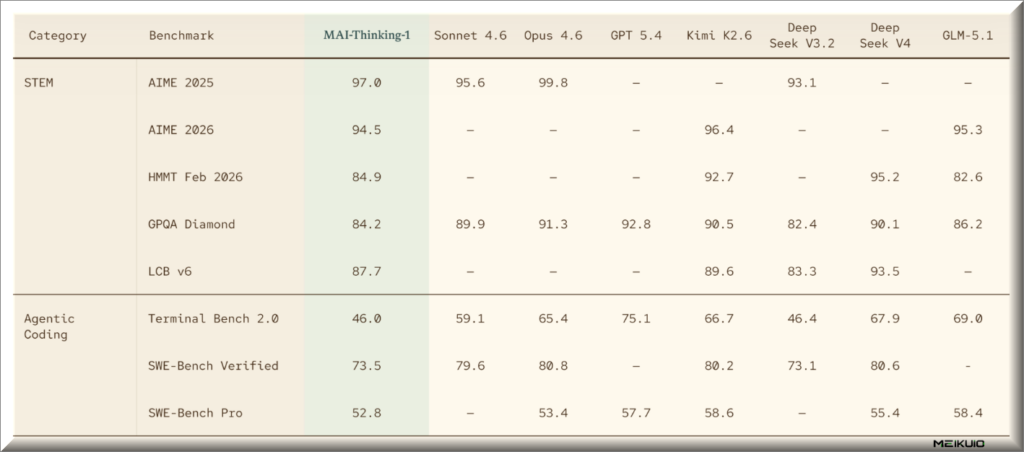
Then there is the version problem. Anthropic shipped Opus 4.7 in April and Opus 4.8 in late May. Microsoft benchmarked against 4.6. So even the comparison that flatters Microsoft least, losing to Opus 4.6, is being run against a Claude that is two releases out of date. The same goes for OpenAI: the table lists GPT 5.4, while GPT-5.5 is already out.
Note
Reality check: Microsoft’s benchmarks compare MAI-Thinking-1 against Claude Opus 4.6 — two releases behind Anthropic’s current Opus 4.8. A “competitive” score against last season’s model is not the same as catching up to this one.
The coding model fights a smaller opponent
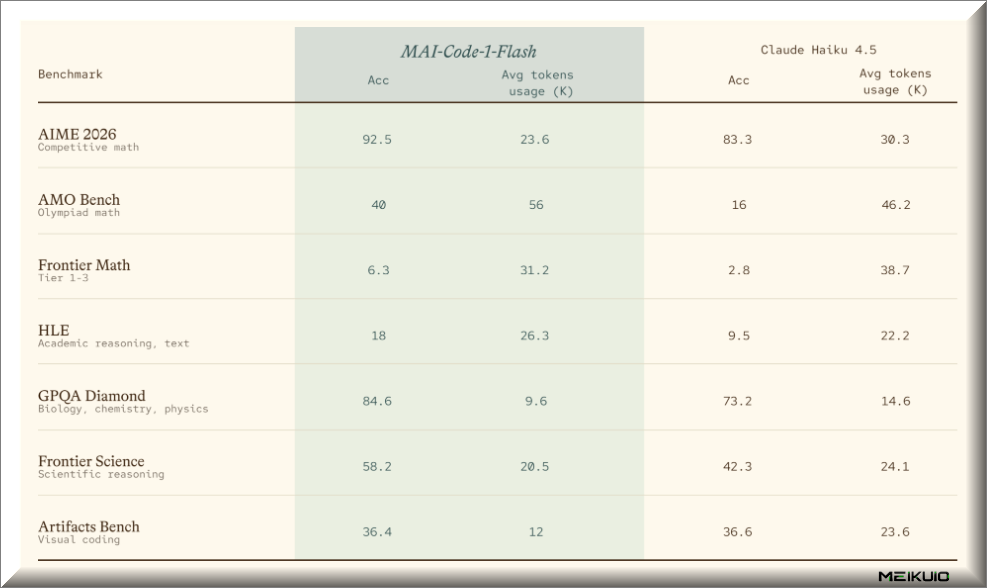
Microsoft’s other big claim is about MAI-Code-1-Flash, and here the framing trick is different. This model does win its comparison, but its opponent is Claude Haiku 4.5, the smallest and cheapest model in Anthropic’s lineup. Beating Haiku is a fair fight for a small, efficient model. That is not the same as beating Claude.
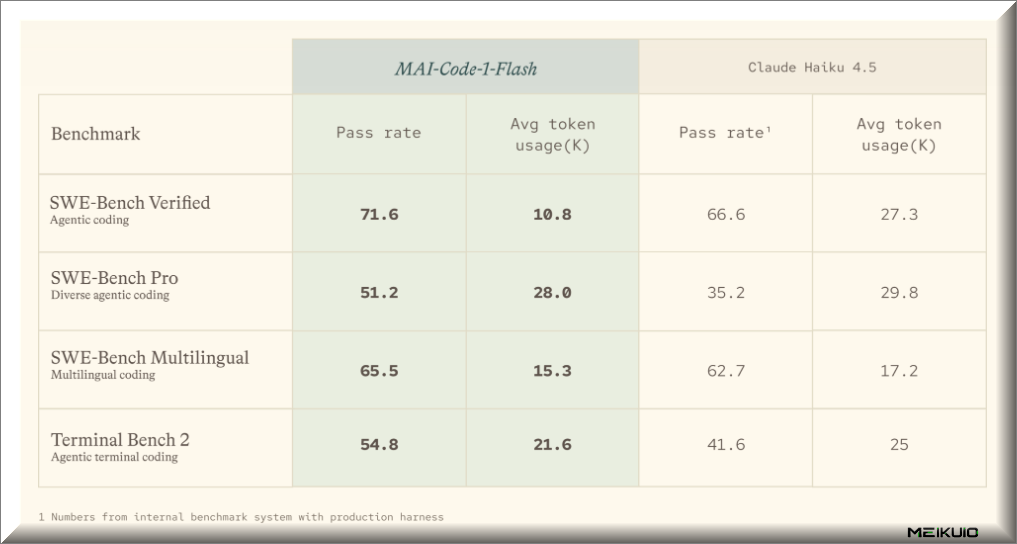
Within that fair fight, the results hold up well. MAI-Code-1-Flash posts higher pass rates than Haiku 4.5 across the coding benchmarks Microsoft tested: 71.6 vs 66.6 on SWE-Bench Verified, 51.2 vs 35.2 on SWE-Bench Pro, while using far fewer tokens to get there. Fewer tokens means lower cost and faster responses, which matters more in everyday coding than a headline benchmark number.
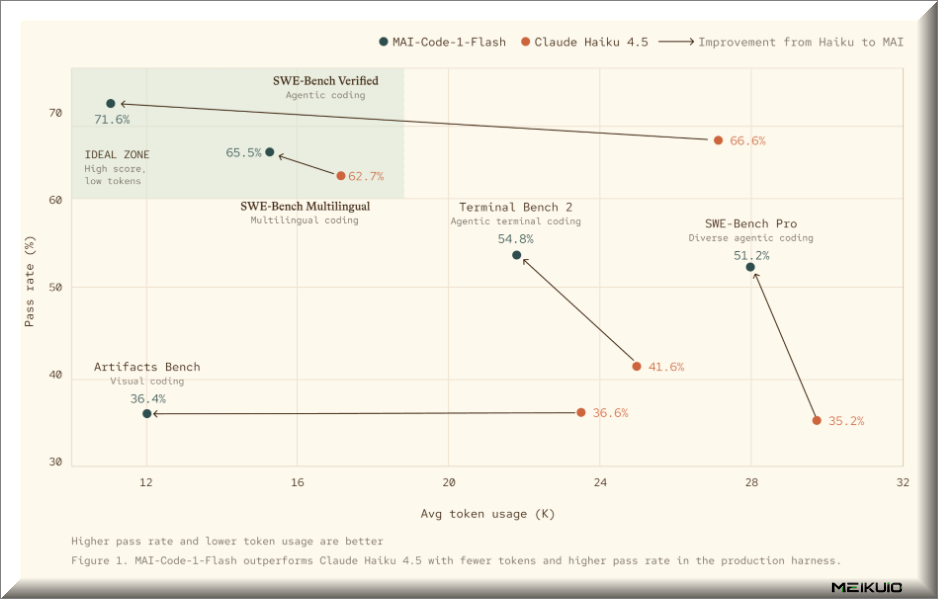
The token efficiency is the part worth taking seriously. On SWE-Bench Verified, MAI-Code-1-Flash solved tasks using roughly 10.8K tokens against Haiku’s 27.3K, less than half. For anyone running a coding assistant all day, that is the difference between a tool that feels snappy and cheap and one that does not.
The practical upside: MAI-Code-1-Flash is not a preview or a promise. It is rolling out now to GitHub Copilot users in VS Code, through both the model picker and the automatic router. If you use Copilot, you may already be running it without noticing. That alone makes it the most relevant model in this whole launch, more than the flagship that grabbed the headlines.
What Microsoft’s own report admits
Here is the part the headlines skipped. Microsoft’s technical report, the detailed one it published alongside the launch, is more honest than its marketing. In the report’s own abstract, MAI-Thinking-1 is described as “competitive with Sonnet 4.6 across a wide range of benchmarks.” Sonnet is Anthropic’s mid-tier model. So the company’s real, stated target was never Opus at all. The “toe-to-toe with Opus” line lives in the press release, not the science.
Microsoft’s own report sets the bar at “competitive with Sonnet 4.6” — the mid-tier Claude. The “beats Opus” framing was added later, by the marketing.
The report is candid in another way too. In Microsoft’s own base-model comparison, DeepSeek’s V4 model comes out ahead of Microsoft’s across all four held-out tests for code, general knowledge, STEM, and math. Microsoft notes, fairly, that DeepSeek V4 is a bigger model. But it still means Microsoft is openly placing second in its own document, against a rival it did not put in the headline.
And one small irony sits inside the “we built it all ourselves” pitch: the model uses OpenAI’s o200k tokenizer. Microsoft chose it to simplify integration with its existing tools, which is a reasonable engineering call. Still, it makes for a funny footnote under a launch that leans so hard on independence from OpenAI.
Where Microsoft is genuinely strong
None of this means the launch is hollow. Strip away the comparison games and Microsoft did several things that deserve real credit:
- Clean training data. The model was trained on 30 trillion tokens of licensed, human-generated data, with AI-generated content deliberately excluded. For enterprises worried about data provenance and legal risk, that is a real selling point.
- A real lab, not a wrapper. Microsoft trained these models from scratch on its own infrastructure, including its in-house Maia 200 chips. This is a frontier effort, not a rebrand of someone else’s model.
- Unusual transparency. The technical report documents architecture, training, and safety testing in detail, including the parts that do not flatter the marketing. That openness is rarer than it should be.
- Efficiency that ships. The low token cost of MAI-Code-1-Flash is not a benchmark trophy; it is the kind of thing that quietly makes a daily tool cheaper to run.
Why this matters for you
If you are a founder, marketer, or developer who pays for AI, the version games are not really your problem. The signal underneath them is. Microsoft building its own competitive models means one of the largest software companies on earth is now pushing into a market Anthropic, OpenAI, and Google already fight over. More serious competitors means more pressure on price, the same pressure DeepSeek already applied by undercutting everyone on cost.
The concrete near-term effect is in your code editor. MAI-Code-1-Flash is live in GitHub Copilot now, and it is cheaper to run than the small Claude model it was measured against. If Copilot’s pricing or speed matters to you, this is worth testing directly rather than taking anyone’s benchmark on faith, Microsoft’s or ours.
Field notes
- Lab & Leadership: Microsoft AI (MAI), led by Mustafa Suleyman.
- Announced: Microsoft Build 2026 (June 2, 2026).
- Model lineup: Seven models spanning reasoning, coding, image generation, voice, and transcription.
- MAI-Thinking-1 specs: ~1T total / 35B active parameters MoE, 256K context. AIME 2025: 97.0%, SWE-Bench Pro: 52.8% (private preview only).
- MAI-Code-1-Flash: Lightweight coding model beating Claude Haiku 4.5 on token efficiency; live in GitHub Copilot/VS Code today.
- Training dataset: 30 trillion tokens of clean, licensed, human-generated data without synthetic distillation.
- Stated target: “Competitive with Sonnet 4.6” (Anthropic’s mid-tier model) per the official technical report.
- Sources: Microsoft AI Technical Report (Build 2026), GitHub Copilot Release Documentation.
Frequently asked questions
Did Microsoft’s AI actually beat Claude?
No. Microsoft’s flagship, MAI-Thinking-1, was benchmarked against Claude Opus 4.6 and still trails it on most tests. Microsoft’s own report describes the model as competitive with the mid-tier Sonnet 4.6, not the top Opus tier, and the current Claude flagship, Opus 4.8, is not in Microsoft’s comparison tables at all.
What is MAI-Thinking-1?
It is Microsoft’s first in-house reasoning model, a 35-billion-active-parameter mixture-of-experts model with a 256K context window, built for hard math and software-engineering tasks. It was trained from scratch on licensed data, without copying from other AI models.
Can I use MAI models right now?
Partly. MAI-Code-1-Flash is rolling out to GitHub Copilot users in VS Code today. MAI-Thinking-1 is only in private preview through Microsoft Foundry, so most people cannot run it yet.
Is MAI-Code-1-Flash better than Claude?
It beats Claude Haiku 4.5, Anthropic’s smallest, cheapest model, on coding benchmarks while using fewer tokens. It was not tested against Claude’s larger Sonnet or Opus models, so “better than Claude” overstates it. Better than the small Claude, at lower cost, is accurate.
Did Microsoft really train these without OpenAI?
Microsoft says it trained the models from scratch on its own data and infrastructure, with no distillation from OpenAI or any other lab. That claim sits slightly awkwardly next to one detail: the model uses OpenAI’s o200k tokenizer, chosen for engineering convenience. The training itself appears independent; one component is borrowed.
Why does Microsoft compare against older model versions?
Microsoft says competitor numbers were taken from each rival’s official model cards. But Anthropic and OpenAI both shipped newer versions before Microsoft’s launch, so the comparison reflects an older snapshot of the competition. It is a common pattern in AI launches, and a reason to treat any vendor’s head-to-head benchmarks as a starting point, not a verdict.
My Take
I came away more impressed by the technical report than by the launch around it. Microsoft built a serious model and documented it with real rigor, then wrapped it in a “beats Claude” story its own data does not support. The honest version is still a good story: a major company built credible frontier models from scratch and put a fast, cheap coding model straight into the tool millions of developers already use. That did not need the spin.
The lasting lesson here is smaller and more useful than “who won.” Every AI launch now arrives with a benchmark table built to flatter the company that published it. The version it compares against, the tier it picks as a rival, the one chart it puts on the slide are all choices. Read the report, not the headline. Microsoft, to its credit, gave us a report worth reading.