



Gusto pricing starts at $49 a month plus $6 per person on Simple, $80 plus $12 on Plus and $180 plus $22 on Premium. That’s the plan card on Gusto’s US pricing page on October 3, 2026. The invoice can run higher. When I priced one month for a 12-person Chicago company, a $224 plan price became at least $387.60. The reasons sit in Gusto’s help center, not on that page.
- How much does Gusto cost per month in 2026?
- What do Gusto’s add-ons cost?
- What changed in Gusto’s plans on October 1, 2026?
- What does Gusto charge beyond the plan price?
- How to read a Gusto invoice
- Failed debits, wires and sales tax
- Fees when you cancel
- Fees for benefits and HR
- Fees for paying contractors abroad
- What do Gusto’s terms let it change?
- What doesn’t Gusto charge for?
- How much does Gusto really cost for 1, 10 and 25 people?
- When Simple stops being the cheap plan
- When Premium pays for itself
- The sales tax line
- One month, priced line by line
- Which Gusto plan should you pick?
- Is there a cheaper way to get Gusto payroll?
- Chase Payroll
- U.S. Bank Payroll
- Through your accountant
- Price match for new customers
- The first year for 10 people, side by side
- How has Gusto’s price changed since 2012?
- Why do Gusto pricing pages disagree?
- What should you ask Gusto before you sign?
- Frequently Asked Questions
- Does Gusto charge extra for each payroll run?
- Is there a free version of Gusto payroll?
- How much does Gusto cost for one employee?
- Does Gusto charge for contractors you didn’t pay that month?
- Can you cancel Gusto anytime without paying a fee?
- Does Gusto add sales tax to its monthly bill?
- Can you still sign up for Gusto’s Contractor Only plan?
- How much notice does Gusto give before raising prices?
- Is Gusto cheaper than QuickBooks Payroll for a small business?
- Is Gusto or ADP cheaper for a small business?
- Does Gusto keep the interest on your payroll money?
- Can you get Gusto cheaper through your accountant?
- My Take
I read Gusto’s pricing page, its help center, its terms of service and 77 archived copies of the pricing page going back to 2016. I didn’t sign up and I didn’t take a sales call. Then I priced the same plans for companies of 1, 10 and 25 people, with and without the common add-ons.
Gusto also changed what new customers get on October 1, 2026, two days before I checked. The list prices stayed put. The Contractor Only plan didn’t.
How much does Gusto cost per month in 2026?
Gusto costs $49 a month plus $6 per person on Simple, $80 plus $12 on Plus and $180 plus $22 on Premium. At list prices on October 3, 2026, a 10-person company pays $109 a month on Simple, $200 on Plus and $400 on Premium, before any add-on. A fourth plan, Solo, costs the same as Simple: $55 a month for a solo owner running payroll through an S corporation.
Gusto pricing is a ladder built on geography and speed. Simple runs payroll in one state; Gusto’s card says “Run basic payroll in one state.” Plus adds multi-state payroll, time tracking and next-day pay. Premium adds a named advisor, Gusto Business Compliance, and same-day and instant pay.
Premium is the one plan you can’t just switch on. Gusto’s help center says it won’t upgrade or bill you for Premium until you’ve talked plans and pricing with its team. So Premium’s $180 price opens a sales conversation. You can’t click and buy it.
More Read

What each plan includes
Simple covers the basics. The card lists unlimited payrolls per month, tax filings and payments, and basic PTO policies and holiday pay. It’s full-service payroll, in one state.
Plus is the plan Gusto badges as its best value. It adds time tracking and scheduling, unlimited next-day pay, multi-state payroll and contractor invoice management.
Gusto pricing on the Plus card shows no per-state fee. Registering with a new state’s tax agencies costs extra. There are two ways to pay for it: Business Compliance at $85 a month per state, or a one-time registration through Gusto’s partner Middesk, priced by state. Gusto shows that price before you order, and once an order goes to Middesk it can’t be canceled or refunded.
Premium adds Premium Account Support with a named advisor, HR guidance and tools, Business Compliance, unlimited same-day and instant pay, and project-based rules and costing. It also includes 25 invoice payments and bank transfers a month through Gusto’s money tools.
Who counts as a person on the invoice
The per-person fee is where most Gusto bills grow. Gusto bills every employee not marked as dismissed in its system, even employees you didn’t pay that month. Someone you dismiss mid-month still shows up on that month’s invoice. Dismiss people the day they leave.
A US contractor costs the same per-person fee as an employee, $6 a month on Simple, $12 on Plus and $22 on Premium, but only in months you pay them. Contractors abroad carry no monthly fee; Gusto charges a fee on each payment instead.
How and when Gusto bills you
Gusto bills a month behind. The invoice posts on the 1st for the previous month’s service, and Gusto debits your bank account one business day later. Gusto takes no credit cards for the plan.
There’s no annual prepay and no contract on the core plans. Gusto’s pricing FAQ is blunt about it: “Gusto is month-to-month.” On the card, the one add-on with a contract is Business Compliance, which runs a year at a time.
What do Gusto’s add-ons cost?
Gusto pricing for add-ons starts with pay speed. Next-day pay costs $15 a month plus $3 a person on Simple, same-day pay $90 a payroll and instant pay $100 a payroll. Most add-ons are free on Premium and paid on Simple and Plus. The full list, as Gusto printed it on October 3, 2026:
- Next-day pay: $15 a month plus $3 per person on Simple; included in Plus and Premium.
- Same-day pay: $90 per payroll on Simple and Plus; included in Premium.
- Instant pay: $100 per payroll on Simple and Plus; included in Premium.
- Time & Attendance Plus: free trial, then $6 per person a month, on Simple.
- Priority Support: $30 a month plus $3 per person on Simple and Plus.
- Gusto Business Compliance: $85 a month per state on an annual contract; included in Premium.
- State tax registration on its own: priced by state through Gusto’s partner Middesk, shown before you order.
- Remote I-9 verification: $20 per submission, with E-Verify $5 more; included in Premium.
- Health insurance broker integration: $6 per eligible employee a month.
- Global contractor payments, for contractors abroad: $5 per payment to a US bank account, more to a local account.
- R&D tax credits: 15% of the credits Gusto identifies, with discounts on Premium.
- Workers’ compensation: from $14 a month.
- Gusto Money Plus: $19 a month on Simple and Plus; Gusto’s compare table shows it included in Premium.
Gusto charges for next-day pay by the month, but for same-day and instant pay every time you use them. One instant payroll a month on Simple costs more than the Simple base fee itself.
Health insurance carries no Gusto charge on the card, and neither does life and disability insurance. If Gusto is your broker, the card says “Pay only for premiums” and “No Gusto administration fees.” Bringing your own broker is what costs the $6.
What changed in Gusto’s plans on October 1, 2026?
On October 1, 2026, Gusto repackaged its plans for new customers and kept every list price the same. Its help center says so in three words: “No price change.” What moved were the pieces around the price, starting with the Contractor Only plan and broker integration.

For anyone who signs up on or after October 1, the plans changed in five ways:
- The Contractor Only plan is gone. Gusto’s notice says “The Contractor-only plan is no longer available.”
- Broker integration, which let your own health insurance broker manage plans inside Gusto, was included in Premium. New Premium customers now pay $6 per eligible employee a month for it.
- The HR Resources add-on is no longer sold on Simple or Plus. It’s Premium only, and Gusto says it’s moving the service from its partner Mineral to its own suite.
- The Performance add-on is gone for new customers, because Performance now comes with Plus.
- Gusto Business Compliance, which handles state registrations, annual reports and a registered agent, is a new add-on on Simple and Plus: $85 a month per state, on an annual contract.
One smaller cut came a month earlier. Since August 31, new Simple accounts get one custom earning type and no custom admin roles, and new Plus accounts get one custom admin role.
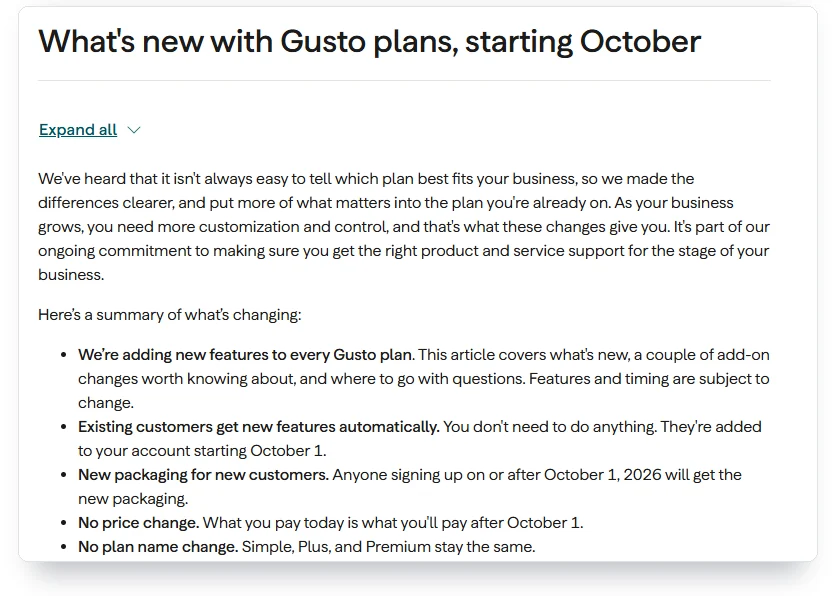
If you already pay Gusto, nothing on that list changes your plan today. Gusto’s notice goes item by item. Existing Contractor Only customers keep the plan. Current add-on holders keep their add-ons. Premium customers who signed up before October 1 keep broker integration at no extra cost.
What the notice doesn’t say is what would end that. In July 2022, the last time Gusto rebuilt its plans, it named the exits: adding “an employee in a new state,” changing plans, or Gusto deciding to “retire the original plans.” This time Gusto names none.
One change does have a written trigger. Business Compliance comes free with Premium. If you move to a plan without it and keep the service, its terms say the fee applies “at the then-current rate.” Today that’s $85 a month per state. Take a Premium company in two states. If it drops to Plus and keeps the service, it pays $170 a month for it, on top of the Plus price.
The notice was public by September 21, 2026, when the pricing tracker UsagePricing archived it. That gave anyone about to sign up at least ten days of warning.
What does Gusto charge beyond the plan price?
Beyond the plan price, Gusto charges $100 for a failed bank debit, $5 per one-time wire, $30 a month for COBRA administration and $1,250 a year for ACA filings. It also bills for tax filings after you cancel and, in some states, adds sales tax. None of that is on Gusto’s pricing page, which says “No hidden fees.” Gusto publishes all of it, in the help center and the terms.
These fees sit one click away from where you compare plans. I’ve seen this before: when I priced Canva, the real Canva Pro limits lived in a help page, not on the plan card.
How to read a Gusto invoice
Gusto’s billing article lists six kinds of line that can appear on an invoice. Two of them, supplemental fees and sales tax, aren’t on Gusto’s pricing page.
- The plan’s base fee.
- A fee per active employee.
- A fee per contractor paid that month, including payments with historical pay dates.
- Supplemental fees, such as a failed debit or a wire.
- Add-on fees, such as tax-advantaged accounts or broker integration.
- State sales tax, where it applies.
The contractor line has a catch. Gusto bills a contractor in the month you pay them, even when the payment carries an older pay date. A late catch-up payment can add a contractor to an invoice you expected to be quiet.
Failed debits, wires and sales tax
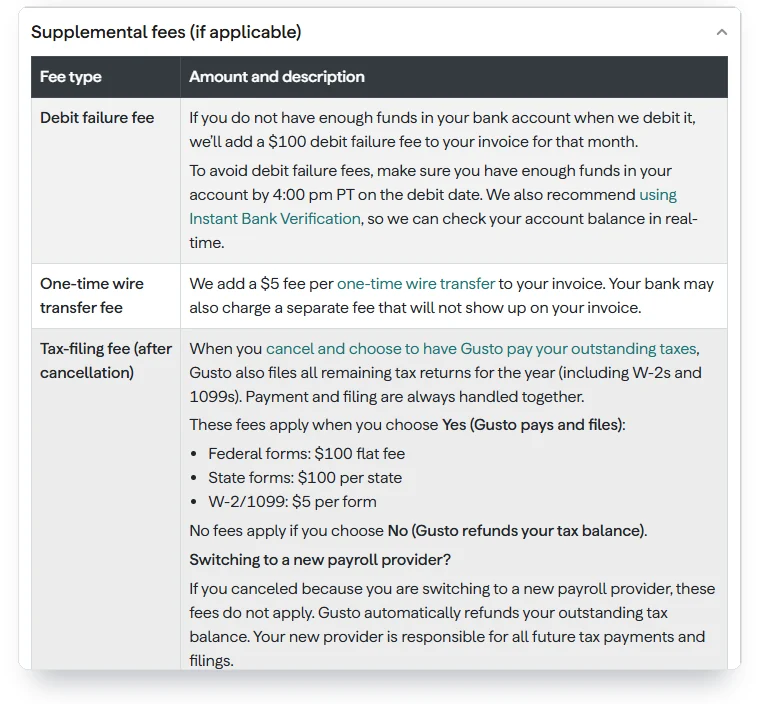
Gusto’s pricing page promises no hidden fees, but its help center lists a $100 charge for a failed bank debit. Gusto describes that charge three different ways.
The billing article adds “a $100 debit failure fee to your invoice for that month.” The article on payment speeds calls it “a $100 processing fee.” A third article, on payroll blockers, says “Gusto charges $100 per day for each failed debit,” and limits that to faster payrolls and contractor payments.
Plan around the strictest version: $100 per day for each failed debit. Gusto needs enough money in the account by 4:00 pm PT on the debit date. Help pages that contradict each other aren’t a Gusto quirk, either. Descript’s pages split two against two on top-ups, and Synthesia’s pricing page argues with itself four times.
A one-time wire adds $5 to the invoice. Gusto warns your own bank may charge separately. Add-ons bill by the full month: remove one on the 1st and you still pay for the month that just started.
Sales tax is the line most people don’t expect. Gusto collects it on the subscription in 22 states, some only in certain cities, plus Washington, D.C. Gusto shows it as a separate invoice line. The full list, and the math for Texas and Chicago, is in the sales tax section.
Fees when you cancel
Cancel after the fifth of the month, or after running payroll that month, and Gusto says “we’ll charge you for the full month.” The last invoice arrives the month after you leave, because Gusto bills in arrears.
Cancel on or before the fifth without running payroll and the help center tells you to contact support about a refund. The terms promise nothing: they say fees are non-refundable and a mid-month cancellation is billed in full.
Then come the year-end forms. If you cancel and let Gusto pay and file your remaining taxes, it charges $100 for federal forms, $100 per state and $5 per W-2 or 1099. For a one-state company that paid 10 people that year, that’s $250.
You skip those filing fees if you switch to another payroll provider, or if Gusto refunds the tax money it holds for you and you file the forms yourself. What happens to your payroll records after you leave is the bigger risk, and I covered it in our guide to HR software.
Fees for benefits and HR
COBRA administration, which keeps health insurance open for people who leave, costs $30 a month. Federal COBRA rules apply to employers with 20 or more employees. ACA filings, the yearly health insurance reports for the IRS, cost $1,250 a year. The IRS mainly requires them from employers with at least 50 full-time staff, counting full-time equivalents.
Both fees sit in the billing article. Neither is on Gusto’s pricing page.
Bringing your own health insurance broker costs $6 per eligible employee a month. Gusto’s pricing page and its October notice both sell it on Simple, but the billing article says Simple can’t use it; you’d need Plus. Ask before you count on it.
To be fair to Gusto, the tax-advantaged accounts are priced on the card itself. A $200 annual service charge covers all four account types. On top of it, HSAs run $2.50 per participant a month with no minimum. FSAs, dependent care FSAs and commuter benefits run $4 per participant each, with a $20 monthly minimum.
Gusto’s 401(k) comes from Guideline and is billed separately from your plan. Guideline’s current tiers start at $49 a month plus $6 per active participant for Starter and $119 plus $8 for Core. Employees pay 0.25% a year on their balances. Guideline changed these fees in 2026, so check them again before you compare totals.
Fees for paying contractors abroad
Paying a contractor’s US bank account costs $5 a payment. Paying a local account abroad costs 1.5% to 2% in local currency. Paid in US dollars to a local account, it’s 0.75% to 1.5%, with a $15 minimum and a $100 cap. The $15 minimum makes small payments expensive.
The exchange rate is where the rest goes. Gusto’s own article says its rates include “fees (some shown, some hidden), and any markups.” Further down, the same article prints a second fee list that doesn’t match the first. Get a quote on screen before you send.
What do Gusto’s terms let it change?
Gusto’s Employer Terms of Service, last updated August 1, 2025, let it change any fee with at least 30 days’ notice. Fees are non-refundable. Nothing is prorated. A late payment can carry interest of up to 18% a year, plus collection costs.
Features get less protection than prices. The same terms let Gusto change or discontinue any part of the service “at any time and without notice.” Gusto’s October notice promises notice “in accordance with our Terms of Service,” and for features, those terms guarantee none.
No federal rule makes Gusto print these fees next to the plan price. The FTC’s rule on unfair or deceptive fees, in force since May 12, 2025, covers live-event tickets and short-term lodging, not business software. The general federal ban on deceptive practices still applies.
Add-ons that lock you in for a year
Gusto’s pricing page says “Cancel any time.” That’s true of the plans. It isn’t true of Gusto Business Compliance, the $85-per-state add-on.
Adding a state commits you to 12 months of service there. The terms renew the service for another 12 months unless you give written notice at least 30 days before the term ends. Cancel early and billing continues. You pay out the term.
The service sells one-off extras on top: a certificate of good standing for $99 and a state account closure for $549. State filing fees come on top of those prices, at cost.
What Gusto earns besides your plan
Gusto debits your payroll and tax money before it pays your people and the tax agencies. In between, the money sits in Gusto’s accounts at partner banks. Gusto may invest it.

Gusto keeps the return. Its payroll terms say so directly: “Gusto owns all income, interest, or return from funds in the Payroll Account.” You won’t see that on any invoice. It’s part of how Gusto gets paid for running payroll.
What doesn’t Gusto charge for?
Gusto doesn’t charge per standard payroll run, for setup or for a contract. The card says “No contracts. Free account setup,” and every plan includes unlimited payroll runs. Gusto’s FAQ adds: “We’ll never charge you extra for things like off-cycle payrolls.”
So the number of standard runs never moves the bill. A business that pays weekly, plus a bonus run and a correction, pays the same monthly fee as one that pays twice a month. Only same-day and instant runs cost extra, on Simple and Plus.
Two smaller things are free in Gusto’s own documents. Correcting a W-2 costs nothing extra, as long as Gusto filed the original and the correction is less than two years old. And if you leave and come back in the same year, Gusto refunds the filing fees it charged when you left.
How much does Gusto really cost for 1, 10 and 25 people?
On list prices, Gusto costs $55 a month for one person on Simple, $109 for 10 people and $199 for 25. Plus runs $92, $200 and $380. Premium runs $202, $400 and $730. Add-ons and sales tax come on top of every one of those numbers.
Gusto costs a 10-person company $109 a month on Simple, before add-ons and sales tax. Over a year that’s $1,308. The same company pays $2,400 a year on Plus and $4,800 on Premium.
At the small end, a one-person S corporation pays $55 a month on Solo, the same as Simple, or $660 a year. At 25 people the yearly bill is $2,388 on Simple, $4,560 on Plus and $8,760 on Premium.
Adding people moves Gusto’s price faster on the higher plans. Each extra person adds $6 a month on Simple, $12 on Plus and $22 on Premium, so the gap between plans widens with every hire.
Those list prices are floors. Next-day pay and time tracking change the math most, and Plus already includes both.
When Simple stops being the cheap plan
Simple doesn’t include next-day pay or time tracking. You can add both. Next-day pay costs $15 a month plus $3 per person, and Time & Attendance Plus costs $6 per person after a free trial.
With both added, five people on Simple cost $139 a month against $140 on Plus. At six people it flips: $154 on Simple against $152 on Plus. At 10 people the gap is $214 against $200.
So if you need next-day pay and time tracking for six or more people, Plus is the cheaper plan, and it throws in multi-state payroll. Below six, Simple with add-ons still wins by a dollar or more.
When Premium pays for itself
Premium includes Business Compliance, same-day and instant pay, and a named advisor. Rebuilding that on Plus means paying for those pieces one by one.
For 10 people, Plus with Business Compliance in one state ($85) and Priority Support ($30 plus $3 a person) comes to $345 a month. Premium costs $400. Add one same-day payroll a month on Plus, at $90 a run, and Plus reaches $435.
Across company sizes, the answer turns on same-day pay. Take Plus with Business Compliance in one state and Priority Support. Without same-day pay, Premium beats that setup only at one or two people. With one same-day payroll a month, Premium is cheaper up to 14 people, the two tie at 15, and from 16 people up Plus costs less.
The sales tax line
Where you are changes the bill. Gusto adds sales tax when your company’s filing address is in Alabama, Arizona, Colorado, Connecticut, Hawaii, Illinois (Chicago), Kentucky, Maryland, Massachusetts, Minnesota, New Mexico, New York, Ohio, Pennsylvania, Rhode Island, South Carolina, South Dakota, Tennessee, Texas, Utah, Washington, West Virginia or D.C. Colorado and Illinois carry the note “In applicable jurisdictions only.” The rate follows your company’s filing address in Gusto. A nonprofit with a state sales tax exemption can send it to Gusto to stop the charge.
Texas taxes software as a service as data processing. Its comptroller says “Twenty percent of the charge for data processing services is exempt from tax.” At the 6.25% state rate, that’s an effective 5.0% before local tax. On a $109 Simple bill, it’s $5.45 a month.
Chicago is steeper. The city’s lease tax on cloud software rose to 15% on January 1, 2026, up from 11% in 2025. On the same $109 bill that’s $16.35 a month, or $196.20 a year.
Gusto lists both Texas and Chicago among the places where it adds tax. Check your own city and state in Gusto’s billing article before you compare Gusto with a payroll company that quotes you a tax-free number.
One month, priced line by line
I priced one month for a 12-person company in Chicago. At 12 people, Plus costs $224, already less than Simple with next-day pay and time tracking at $244.
Now add one instant payroll to fix a missed deadline, at $100. Add COBRA administration for one former employee, at $30. Add Chicago’s 15% tax on the plan fee, $33.60.
The card said $224. The invoice comes to at least $387.60, or 73% above it. I applied the tax to the plan fee only, because Gusto’s article doesn’t say which lines it taxes. If it taxes the add-ons too, the total is higher.
Which Gusto plan should you pick?
Pick Gusto’s plan by states and pay speed first, and by the number of people second. Simple fits one state and a normal pay schedule. Plus fits more than one state, or six or more people who need next-day pay and time tracking. Premium makes sense only if you’d use what it bundles. If you’re still deciding whether payroll-first software is the right kind at all, start with our HR software guide. If you want IT and device management on the same employee record, Rippling sells them as modules on top of $8 per employee a month and a base fee; I worked out what that comes to in my Rippling pricing breakdown.
- Simple, at $49 plus $6 a person, if every employee works in one state, you pay on a regular schedule and you don’t track hours in Gusto.
- Plus, at $80 plus $12, if you have people in two or more states, or six or more people who need next-day pay and time tracking.
- Premium, at $180 plus $22 after a sales call, if you’ll run same-day or instant payrolls, want Business Compliance in several states or need HR Resources.
- Solo, at $49 plus $6, if you pay yourself through your own S corporation and have no employees, with or without contractors.
Plus also adds custom document e-signing, which Simple doesn’t have. If signatures are the only reason you’d upgrade, a separate tool can cost less; I compared them in our DocuSign alternatives guide.
If you only pay contractors
New customers can’t buy Contractor Only anymore. Gusto says contractor management is “becoming a more integrated part of the Gusto platform rather than a standalone plan.”
On Simple, US contractors cost the per-person fee only in months you pay them. Three contractors paid every month come to $67 on Simple. The old Contractor Only price for the same three was $53, and existing customers on that plan keep it.
Is there a cheaper way to get Gusto payroll?
Yes. Chase and U.S. Bank both sell payroll that runs on Gusto, and both cost less than Gusto direct. An accountant in Gusto’s partner program can also pass on up to 20% off. Each route undercuts Gusto’s price, with conditions attached. The bank versions leave features out, and who stays liable if penalties hit is something we analyzed across payroll services for small business.

Chase Payroll
Chase Payroll costs $39 a month, including the first employee, plus $5 for each additional person paid. Contractors cost $5 in months you pay them. Chase’s page says it’s “Powered by Gusto,” and Gusto announced the partnership on September 14, 2023.
Chase Payroll runs on Gusto and costs $84 a month for 10 people, multi-state payroll included. Chase’s FAQ says “There is no additional fee for employees in multiple states, for W-2s or 1099s, or for amendments.” On Gusto directly, multi-state payroll means Plus or Premium.
Multi-state payroll opens the biggest price gap I found. A 10-person company in one state pays $109 on Gusto Simple against $84 at Chase, $25 a month apart. With staff in two states, it’s $200 on Gusto Plus against $84: $116 a month, or $1,392 a year.
Chase leaves things out. Its FAQ lists them. Chase Payroll “does not currently support contractor-only accounts,” doesn’t support COBRA, and has no time tracking or HR advisory services. It’s for US customers of Chase business checking or of Chase Payment Solutions, the bank’s card-processing service. You also have to be the primary admin of your Chase Business Online account.
Speed depends on which Chase customer you are. Business checking customers get next-day payroll. Payment solutions customers typically get two- or four-day payroll.
U.S. Bank Payroll
U.S. Bank Payroll costs $40 a month, including one employee, plus $5 for each additional employee. Ten people cost $85. U.S. Bank waives the first two months of fees when you run your first payroll.
It runs inside U.S. Bank’s online banking, and the bank says the payroll processing is “provided by Gusto, Inc.” The limits are tighter than Chase’s. Only one person can have access, regular payroll runs can’t exceed $150,000, and direct deposit takes two or four days.
U.S. Bank also lists businesses it isn’t a fit for, including household employers, farms, union payroll and companies with international W-2 employees. Its waiver mentions a “U.S. Bank Payroll Service Sales Tax,” so a tax line can follow you to the bank version too.
Through your accountant
Gusto’s partner program gives accounting firms a discount by tier: 0% at Starter, 10% at Bronze, 15% at Silver and 20% at Gold. The firm can pass it to you or keep it as revenue share. On a $109 Simple bill, 10%, 15% and 20% off come to $98.10, $92.65 and $87.20.
The catch is the default. Gusto’s partner settings start at “Client billed with revenue sharing (default),” which bills you the standard rate and pays your accountant. Ask your accountant to choose “Client billed with a discount” when they add you.
Two groups get nothing. Clients who pay only contractors don’t qualify for a partner discount, and neither do clients added outside the partner dashboard. If your firm pays Gusto for you, you also lose sight of plan and billing details.
Price match for new customers
Gusto’s sales team runs a price match for companies switching from another payroll provider. Its guidelines say offers “may include a percentage discount off your monthly Gusto invoice, valid for up to one year.”
It’s only for businesses that have never used Gusto. The guidelines don’t guarantee a match. Get your current provider’s price in writing before you call.
The first year for 10 people, side by side
Over a first year, 10 people in one state cost $1,308 on Gusto Simple. Chase Payroll comes to $1,008. U.S. Bank Payroll comes to $850 with its two free months, then $1,020 a year after that.
Through a Gold-tier accountant who passes on the full 20%, Gusto comes to $1,046.40. Those totals leave out add-ons and sales tax. The bank versions also do less than Gusto Simple in some areas, so price the features you’d use.
How has Gusto’s price changed since 2012?
Gusto pricing has climbed from $25 a month plus $4 per employee in 2012 to $49 plus $6 in October 2026. Gusto raised its Simple plan from $40 to $49 a month in March 2025, a 22.5% increase. It’s the latest change to a list price.
- December 2012: ZenPayroll, the company’s original name, launches at $25 a month plus $4 for each employee, according to TechCrunch.
- June 2016: one plan, $39 a month plus $6 a person, on an archived copy of the pricing page.
- 2017 to 2022: Core, Complete and Concierge. By March 2018, Core is $39 plus $6, Complete $39 plus $12 and Concierge $149 plus $12.
- July 2022: Simple, Plus and Premium replace them. Simple is $40 plus $6 and single-state, Plus is $80 plus $12, and Premium has no public price.
- July 2024: Premium gets a public price, $180 plus $22, shown at 25% off for the first three months.
- March 2025: Simple goes from $40 to $49, with the per-person fee unchanged at $6.
- October 2026: new packaging for new customers, no change to list prices.
The 2025 rise added $108 a year to every Simple account, whatever its size. Customers were told it took effect March 1, 2025. A Reddit post archived on January 31, 2025 reads “Got the email today. Going up 23%, effective March 1st,” and another owner quoted a dashboard banner with the same date.
Customers got about a month of warning, which matches the 30 days in Gusto’s terms. I couldn’t find Gusto’s own notice, so the date comes from customers, not from Gusto.
Why do Gusto pricing pages disagree?
Most Gusto pricing pages were written before October 1, 2026, and several copy old or promotional numbers. On October 3 I read the five ranking Gusto pricing guides that aren’t Gusto’s own pages or a forum thread. Two print a wrong list price, two misdate the last increase, and none mentions the October changes.
People Managing People, updated September 30, 2026, lists Plus at $60 plus $9 and Premium at $135 plus $16.50. Those are exactly 75% of the list prices. They match Gusto’s July 2024 promotion, “Save 25% for the first 3 months,” not the plan prices.
eLearning Industry, updated May 8, 2026, still says “Simple Plan Base Price: $40 per month.” It describes the Contractor Only plan as $6 per contractor, the way Gusto priced it before the $35 base fee arrived in late 2022.
Software Finder says Gusto raised Simple “from $40 to $49 in March 2026.” Rivermate says the same in one place. Elsewhere it says “March 2025.” Archived copies of Gusto’s page show $40 on February 28, 2025 and $49 by April 10, 2025. The 2026 date is wrong.
Software Finder’s worked example is off too. It adds up a 10-person Simple plan with Time & Attendance Plus, Priority Support and HR Resources to “roughly $279/month,” counting HR Resources at $50. Its own add-on list prices HR Resources at $50 plus $5 a person, which makes the total $329. New Simple customers can’t buy HR Resources anymore anyway.
Credit where it’s due: Software Finder and Workstream both list costs outside the plan price, like state registration and 401(k) fees. Software Finder and eLearning Industry also tell you to remove inactive employees so you don’t pay for them. None of the five covers the invoice and cancellation fees from Gusto’s help center, the 30-day notice rule or the bank versions.
Two of the five are written by Gusto’s competitors. Workstream sells payroll for hourly workforces. It runs its own offer on the page. Rivermate sells employer-of-record services and compares itself with Gusto in the same article.
Pricing guides go stale fast after a price change. When Squarespace raised its prices in July 2026, every Squarespace pricing guide ranking for it was out of date. Gusto’s search results show the same lag.
What should you ask Gusto before you sign?
Ask Gusto, in writing, about the fees and rules Gusto’s pricing page leaves out. These are the questions I’d send before signing, based on what I found in Gusto’s help center and terms.
- Which plan covers every state where I have employees? Simple runs payroll in one state.
- How many people will be on my first invoice? Every employee not marked as dismissed counts.
- Do I need next-day pay or time tracking? At six or more people, Plus costs less than Simple with both add-ons.
- Is sales tax added for my address, and at what rate?
- If I add Business Compliance, when does each state’s 12-month term renew, and how do I give notice?
- If I leave mid-year, what will the year-end filings cost me, and when does the last invoice arrive?
- Can my accountant add me with the partner discount, or do I qualify for a price match?
- If I’m on an older plan or add-on, what would end it?
Save the answers with your billing records. Gusto’s terms let it change fees with 30 days’ notice, so a dated email is your record of what you were told.
Field notes
- Outside the card: $100 for a failed debit (one help article says per day); $5 per one-time wire; $100 federal, $100 per state and $5 per W-2 or 1099 if Gusto files after you cancel; COBRA $30 a month; ACA filings $1,250 a year; sales tax in 22 states plus Washington, D.C.
- Gusto pricing: Simple $49 plus $6 a person; Plus $80 plus $12; Premium $180 plus $22, after a sales call; Solo $49 plus $6; 10 people cost $109, $200 or $400 a month on list prices, read October 3, 2026.
- Billing rules: billed a month in arrears; every employee not marked as dismissed counts; full month if you cancel after the fifth; at least 30 days’ notice for fee changes; Business Compliance renews for 12 months.
- October 1, 2026: Contractor Only closed to new customers; broker integration $6 per employee for new Premium customers; Business Compliance $85 per state a month on Simple and Plus; no change to list prices.
- Cheaper doors: Chase Payroll $39 including the first employee plus $5 each, $84 for 10 people with multi-state included; U.S. Bank Payroll $40 plus $5, $85 for 10; accountant discounts of 0% to 20%, off by default.
- Gusto price history: $25 plus $4 in 2012; $39 plus $6 in 2016; Simple $40 plus $6 in 2022; Simple $49 plus $6 from March 2025.
- Sources: Gusto’s US pricing page, help center articles, and Employer, Payroll and Business Compliance terms; Chase, U.S. Bank, QuickBooks and ADP payroll pricing pages; Guideline’s pricing page; TechCrunch (2012); Wayback Machine copies of Gusto’s pricing page and of a 2025 r/Payroll post; UsagePricing; the five guides named above; IRS and Department of Labor pages on ACA reporting and COBRA; Texas Comptroller publication 96-259; City of Chicago lease tax page; FTC fee rule FAQ; all read October 3, 2026.
Frequently Asked Questions
Does Gusto charge extra for each payroll run?
No. Every Gusto plan includes unlimited payroll runs, and Gusto says it never charges extra for off-cycle payrolls. Faster runs cost extra on Simple and Plus: $90 for a same-day payroll and $100 for an instant one. Premium includes both.
Is there a free version of Gusto payroll?
No. Gusto pricing starts at $49 a month plus $6 per person, on Simple and Solo. Creating an account is free and Time & Attendance Plus has a free trial, but running payroll costs money on every plan.
How much does Gusto cost for one employee?
One employee costs $55 a month on Simple or Solo, which is $49 plus $6. The same employee costs $92 on Plus and $202 on Premium. Add-ons and any sales tax in your state or city come on top of those list prices.
Does Gusto charge for contractors you didn’t pay that month?
No. Gusto bills US contractors the per-person fee only in months you pay them. Employees work differently: every employee not marked as dismissed counts on the invoice, even if you didn’t pay them that month.
Can you cancel Gusto anytime without paying a fee?
You can cancel anytime, but timing costs money. Cancel after the fifth of the month, or after running payroll that month, and Gusto bills the full month. If Gusto files your remaining tax forms, it charges $100 federal, $100 per state and $5 per form.
Does Gusto add sales tax to its monthly bill?
Yes, if your company’s filing address is in one of 22 states or Washington, D.C. The tax shows as its own invoice line. Chicago’s lease tax on cloud software is 15%, and in Texas 80% of the charge is taxable at 6.25% plus local tax.
Can you still sign up for Gusto’s Contractor Only plan?
No. Since October 1, 2026, new customers can’t buy Contractor Only, though existing customers keep it. A new business that only pays US contractors pays a regular plan’s base fee plus the per-person fee: $67 a month on Simple for three contractors paid monthly.
How much notice does Gusto give before raising prices?
At least 30 days. Gusto’s terms require 30 days’ notice before a fee change, and customers got about a month’s warning of the March 2025 Simple increase. The same terms let Gusto change features at any time without notice.
Is Gusto cheaper than QuickBooks Payroll for a small business?
Slightly, on list prices. On October 3, 2026, QuickBooks’ US page listed Workforce Payroll at $50 a month plus $7 per employee, before a three-month discount. For 10 people that’s $120 against $109 on Gusto Simple.
Is Gusto or ADP cheaper for a small business?
You can only check one side without a sales call. Gusto’s prices are public; ADP’s pricing page shows no price for its RUN payroll packages, so you need a quote. Compare that quote with Gusto’s pricing card plus the fees in its help center.
Does Gusto keep the interest on your payroll money?
Yes. Gusto’s payroll terms say the employer won’t receive interest on funds held in Gusto’s payroll account and that “Gusto owns all income, interest, or return” on them. The money sits there between the debit and payday.
Can you get Gusto cheaper through your accountant?
Yes, if your accountant is a Gusto partner and passes the discount on: 10%, 15% or 20% depending on the firm’s tier. The default setting bills you the full price and pays your accountant a revenue share instead.
My Take
For a 10-person company in one state, I’d start with Gusto Simple at $109 a month. If the business already banks with Chase, I’d check Chase Payroll first. With people in two states, Chase saves $116 a month over Gusto Plus, which is worth it if you can live without time tracking and COBRA in the same tool.
Gusto’s pricing is honest on the card and incomplete off it. I wouldn’t buy Premium off the plan card. It starts with a sales call. From 3 to 14 people, it beats a comparable Plus setup only if you’d run a same-day payroll every month. Before signing, I’d ask Gusto in writing which help-center fees apply to my account and what happens to my plan’s terms if I change plans later.