


Midjourney pricing runs from 10 to 120 dollars a month, but the plan card isn’t what decides what you get. You’re buying GPU minutes. The same minute costs $1.60 to $4.00 depending on your plan and when you run out. Every price here comes from Midjourney’s own documentation, read on 28 August 2026.
- A Midjourney subscription buys GPU minutes
- Every Midjourney plan and what it costs
- One GPU hour has five different prices
- What 3.3 hours of GPU time makes
- Video is where the plan breaks first
- What you bought has a shelf life
- The refund window is measured in prompts, not days
- Is there a free version of Midjourney?
- Annual billing, promo codes, and what saves money
- The $1,000,000 rule that picks your plan for you
- What happens when a company tries to buy Midjourney
- Can you get Midjourney GPU hours for free?
- Which Midjourney plan should you buy?
- How Midjourney pricing compares with the rest of the category
- The cheaper Midjourney that isn’t Midjourney
- Frequently Asked Questions
- Is Midjourney free?
- How many images can I make on the Basic plan?
- Is annual or monthly billing cheaper?
- What happens when I run out of Fast hours?
- Can I get a refund from Midjourney?
- Do unused Fast hours roll over to next month?
- Do I need the Pro plan to use Midjourney commercially?
- Can I share a Midjourney subscription with my team?
- My Take
A Midjourney subscription buys GPU minutes
Midjourney is a text-to-image and video generator you use through its website and a Discord bot. A subscription buys time on a graphics processor, not a number of images, and the meter runs only while a job is actually rendering: writing prompts, browsing results and waiting in a queue cost nothing.
The company describes the model itself. Its documentation puts it this way: “When you subscribe to Midjourney, you’re actually buying time to use these GPUs. Think of GPU time like the data you get with a cell phone plan.”
That sentence is the whole product. Not one of the eleven pages competing for this search quotes it. The plan you pick sets a monthly allowance of Fast GPU time. Every prompt draws that allowance down at a published rate. When the allowance hits zero, either you slow down or you pay again.
Three speeds share the same meter. Fast mode spends your monthly allowance.
Relax mode is unmetered but queued, and it starts at the Standard plan, which means the entry tier has no slow lane at all. Midjourney puts the wait at anywhere from zero to 30 minutes, and says it stretches the more you lean on it. Turbo mode is roughly four times quicker and spends double the Fast time for the same work, and Midjourney calls it experimental with costs that “might change anytime.”
Skip Turbo unless a deadline is paying for it, because you are buying speed with money at double the burn rate. It also carries a contradiction. The same documentation page states both that Turbo works with “Midjourney versions 5 and later” and, in a notice at the top, that “Turbo mode is not currently supported in V8.1.”
The page never reconciles the two.
You are not buying pictures. You are buying a metered utility, and Midjourney is the one that called it that.
If that model sounds familiar, it should. It’s the same shift that hit developers when GitHub Copilot moved to token-based billing and users found their bills behaving nothing like a subscription.
Every Midjourney plan and what it costs
Midjourney sells four plans. Basic is $10 a month, Standard $30, Pro $60 and Mega $120. Paying for a year up front takes 20 percent off, billed as one charge. What separates the tiers is Fast GPU time, whether you get Relax mode, and whether your work stays private.
Two rows in that table do more work than the prices. Basic has no Relax mode. A Basic subscriber who runs out of Fast time has no free way to keep working. And extra GPU time costs the same on all four plans, which matters a great deal once you divide it into what you already paid.
There’s also a step that surprises people who go looking for these numbers. Midjourney has no pricing page on its marketing domain.
The routes you’d expect, midjourney.com/pricing and midjourney.com/plans, aren’t pages at all.
Any path the app doesn’t route returns the same 5.9 KB shell marked “noindex”, and I checked that by inventing a nonsense URL, which came back byte-for-byte identical. Real routes behave normally: /home is 25 KB and indexable. That “404” is the app failing to find a page that was never there, not a price list being suppressed.
The price list sits behind a login. Midjourney’s instruction is to “first create or log in to your account,” then pick a plan on the Manage Subscription page. Its sitemap lists eleven URLs and not one concerns pricing, plans or subscriptions. Its robots.txt carries the line “Disallow: /checkout/”, so the buy flow is closed to crawlers by design.
More Read

The Internet Archive holds a trail of what used to be there. A /checkout/plans route was captured nine times between June 2022 and December 2025.
Fetch it today and it returns the same empty shell as everything else.
None of that is accidental. The price list sits inside the checkout funnel, on a path the company tells search engines to skip, behind a login.
The only price list Midjourney publishes to a logged-out visitor is a support article.
That single decision explains the search results you’re reading this in. When a company puts its price list behind a login and tells crawlers to skip the route, the question “what does Midjourney cost” gets answered entirely by other people. It’s the mirror image of what happened when Squarespace raised prices and then called it an error, where the company’s own page was the thing everyone had to check.
One GPU hour has five different prices
Divide each plan by the Fast GPU time it includes and the same unit turns out to have five different prices, from $1.60 to $4.00 an hour. That’s a 2.5x spread on an identical thing. The cheapest plan is the worst deal per hour, and the most expensive rate is the one you’re pushed onto exactly when you have no room to shop around.
Standard, Pro and Mega all land on the same per-hour figure, because their prices and their allowances scale together. Basic doesn’t. It gives you 3.3 hours for $10, which works out at $3.03, roughly half again what the tier above charges for the same hour.
Every figure in that table doubles if you work in Turbo. Turbo spends double the Fast time for about four times the speed, so a set of four standard images costs 1.6 GPU minutes instead of 0.8, and 2.6 instead of 1.3 in HD.
At best that’s $3.20 an hour, and $8.00 if you’re topping up.
The entry plan buys a small allowance at the worst rate on the ladder. That is a defensible thing for a company to sell. It is also the opposite of what “starter tier” implies to most people paying for one.
This is the arithmetic step that Midjourney pricing guides skip. Of the eleven pages I measured on 28 August 2026, eight compute some unit cost: six a price per image, five a price per GPU hour.
None splits that hourly price by plan or by how you paid.
One says the opposite outright. TechJack Solutions writes that “the fast GPU hours roughly double as you step up the ladder, but the price doubles too. So the cost per fast hour stays close to flat across tiers.”
That holds for Standard, Pro and Mega. It does not hold for Basic, and it leaves out both the annual rate and the top-up. I ran the same question at Jasper’s plan ladder and got a similar answer: the tier that looks cheapest rarely is.
The $4 top-up deserves its own sentence. It applies on every plan, it can’t be discounted, and on Basic it’s the only option, because Basic has no Relax mode to fall back on. The moment your allowance empties mid-month, the price of continuing is fixed and it’s the highest number on the board.
Same Fast GPU hour, five purchase routes. Annual Standard/Pro/Mega: 288/180, 576/360, 1,152/720 USD per annual hours; monthly: 30/15, 60/30, 120/60. Annual Basic: 96/39.6; monthly Basic: 10/3.3. Source rounds rates to cents. 2.5-fold spread from 1.60 to 4.00; annual billing remains an annual commitment.
What you pay per hour depends only on which plan you hold and when you run out.
What 3.3 hours of GPU time makes
Midjourney publishes the exchange rate between GPU minutes and work, which makes the allowance translatable. A set of four standard-definition images costs 0.8 minutes.
Four HD images cost 1.3. A creative upscale costs 2 minutes. A batch of four SD videos costs 8 minutes, and a batch of four HD videos costs 26. If you need a bigger photo rather than a bigger render, my test of AI image upscalers shows how much detail they invent.
A note on that table before anyone quotes it back at me. The same documentation page also offers a rounder rule of thumb, “about one minute of GPU time” per image prompt, sitting directly above the 0.8-minute figure. Both numbers are Midjourney’s own. The table is the more precise of the two, so that’s what the arithmetic here uses.
Read across the top row and $10 looks generous. A thousand standard images a month is more than most people making social posts or mood boards will use.
Read the bottom row and the same plan can’t do the job at all.
One 200-minute Basic allowance. Costs per listed job: 0.8, 1.3, 2, 8 and 26 GPU minutes. That yields 1,000 SD images, 612 HD images, 100 upscales or 25 four-video SD batches. Output types differ and are explicitly labelled; these are job counts, not interchangeable images. HD video unavailable on Basic: null, not zero jobs. Approximate costs are vendor estimates.
Midjourney publishes the exchange rate, so 3.3 hours can be turned into work.
Video is where the plan breaks first
Video costs about 20 times more GPU time than images at matched resolution, and the plan ladder was never re-cut to match. Four HD videos take 26 GPU minutes against 1.3 for four HD images. In standard definition it’s 8 against 0.8, a factor of ten. Start there and the video tiers stop looking like the image tiers at all.
The units are worth pinning down first, because Midjourney’s are unusual. It generates in batches, and you pick one, two or four clips at a time. Each clip runs 5 seconds.
You can extend a clip in 4-second steps, up to four times, reaching a 21-second maximum. Each extension is another generation, and it costs again. So a batch of four is 20 seconds of footage for 26 GPU minutes.
First, Basic can’t make HD video. The plan table lists it as SD only, so the cheapest plan that produces HD at all is Standard at $30. On Basic the video question is SD or nothing, and 200 minutes buys 25 batches of four SD clips.
Second, and this is the part nobody mentions, HD video always spends Fast time. Midjourney’s own video page puts it in one line: “Standard, Pro, and Mega plans can generate HD resolution videos, but only in Fast Mode.” Relax covers unlimited images from Standard up and SD video from Pro up, and it never covers HD.
There is no plan on which HD video runs in the slow lane. Every HD clip you make comes out of the metered allowance, on every tier.
Put those together and the arithmetic is blunt. Standard’s 900 Fast minutes hold 34 batches of four HD clips and nothing else. Each batch costs about $0.87 of a monthly Standard allowance, $0.69 on the annual rate, and $1.73 once you’re topping up. Pro’s 1,800 minutes hold 69 batches.
Work it back to something you can plan with. Thirty seconds of finished HD a month is two batches, 52 GPU minutes, about six percent of a Standard allowance. A minute a week is closer to a third of it.
This is the part of the pricing that ages worst. The tiers were shaped around still images, video was added to the same meter, and the mode that makes the meter bearable was never extended to the format that needs it most. If you are pricing Midjourney for HD video, price the top-up as well as the plan.
What you bought has a shelf life
GPU time expires, and it expires on three different clocks depending on where it came from. Subscription hours vanish at the end of each month. Hours you buy separately carry a 60-day expiration and can’t be refunded. Hours you earn by rating images expire 30 days after they’re granted.
The first row is the one that changes how you should think about annual billing. Paying $576 for a year of Pro doesn’t buy 360 GPU hours to spend at your own pace.
It buys 30 hours a month, twelve times, and each of those twelve allowances expires unused. The 20 percent saving is real. The stockpile isn’t.
Two small precisions on the middle row, because the wording matters. Midjourney says purchased hours “come with a 60-day expiration” without saying 60 days from what. And it says that if your subscription lapses the extra time “won’t be available unless you renew your plan,” which is a lock-out rather than a forfeiture. Renew inside the window and the hours are there again.
A meter living inside a flat-looking subscription isn’t unique to Midjourney pricing. Grammarly runs prompt counters inside plans that read as unlimited, and we counted what those meters actually allow. What’s different here is that the meter is the product rather than a limit bolted onto it.
Where the minutes came from decides how long you keep them.
The refund window is measured in prompts, not days
The strangest part of Midjourney pricing is the refund rule. There’s no cooling-off period, only a usage threshold.
Its refund page reads: “You’re eligible for a refund only if you’ve used less than 20 GPU minutes throughout the lifetime of your account. This includes both Fast/Turbo and Relax time.”
Cross that line once and the option is gone permanently, not for the billing cycle.
Run 20 minutes through Midjourney’s own exchange rate and you get about 25 prompts. That’s the whole trial. Generate a hundred images, decide the tool isn’t for you, and you’re outside the window with roughly nine tenths of your first month unspent.
Now look at which clocks feed that counter. Relax doesn’t draw down your monthly allowance. Midjourney still records the GPU time it burns, though, and that recorded total is what the refund rule reads. A Pro subscriber who spends an evening in the queue believing it’s free is spending the one meter that decides whether the money comes back.
One batch of four HD videos costs 26 GPU minutes. Generating it once ends any possibility of a refund, forever.
The Terms of Service don’t mention the 20-minute allowance at all. They say you may cancel at any time, that Midjourney may change pricing and features whenever it likes, and that on termination “You will not be refunded for the current subscription period.”
The generous rule lives in a support article; the binding document is quieter about it.
A refund policy tied to consumption rather than time is legitimate, and plenty of metered services use one. What’s unusual is the size of the window and the fact that the meter counts the mode advertised as unmetered. Compare it with the way QuillBot and Grammarly handle what actually lands on your card and the difference is a matter of degree, not of kind.
Is there a free version of Midjourney?
Not on Midjourney itself. Midjourney’s own Free Trials page states that “No free trial is currently available in Discord or the midjourney.com website.” The sentence before it names the exception, a separate mobile app: “A limited trial is available on the niji · journey app, available for iOS and Android devices.”
Look at that app before you count it as a way in. niji · journey is an anime illustration tool, and the two stores don’t even agree on who publishes it. Apple lists the seller as Midjourney, Inc., with a copyright line to match and no mention of anyone else. Google Play lists the developer as Spellbrush, and its package name is com.spellbrush.nijijourney.
Midjourney’s own page never says how much the trial gives you. The figure people quote, 20 free generations, comes from the App Store description, not from Midjourney: “Create stunning anime characters for free with 20 free generations.” That’s marketing copy on a storefront, which is a weaker place for a number to live than a pricing page.
So the honest answer has two parts. There is a free door, and it doesn’t open onto the product most people mean when they say Midjourney. Twenty anime generations on a phone tells you very little about whether a $30 plan will suit your commercial work.
There used to be a real free trial. The pages ranking for this question disagree about when it ended, so here is the date. David Holz announced the suspension in a Discord message, citing “extraordinary demand and trial abuse.” The Verge, reporting two days later, dates it to the Tuesday, which was 28 March 2023. One page in this search result puts it in April. The two others that date it at all say March.
The reason didn’t stay that reason either. Within days Holz corrected himself to The Verge. The cause, he said, was “massive amounts of people making throwaway accounts to get free images,” set off by “a viral how-to video in china.”
He also called the deepfake explanation a misunderstanding, because the free trial had never run the model that made those images. The one-line quote survived. The correction mostly didn’t.
What Midjourney doesn’t publish about that trial is as notable as what it does. Whether the trial watermarks output, which model version it runs, and what commercial rights attach to trial images are not stated on the pages that describe it.
If those things matter to you, assume nothing.
You’ll also find pages offering Midjourney access for less than Midjourney charges. Treat those separately, and read the section on resellers further down before you touch one. The pattern of a paid tool’s free door quietly closing is familiar enough by now; Copy.ai retired its free plan and left a shelf of guides describing something that no longer existed.
Annual billing, promo codes, and what saves money
Annual billing is the only discount Midjourney publishes. It takes 20 percent off and charges the full year up front, which on Pro means $576 instead of $720. In per-hour terms that moves you from $2.00 to $1.60, and it’s the single largest saving available to an individual buyer.
The catch is the one from the section above. Those 360 hours arrive as twelve separate monthly allowances, each of which expires. If your work comes in bursts, two heavy months and ten quiet ones, annual billing saves you 20 percent on hours you’ll never reach.
Think about a yearly commitment the way I did when pricing website builders over three years. Work out the total you’ll hand over. Then divide it by the thing you’ll use. On Midjourney that second number is GPU hours, and on an annual plan it resets to zero twelve times.
Beyond that, there’s no discount programme to find. Midjourney’s corporate billing page states plainly that it “does not offer discounts or free plans for organizations.” Coupon directories rank for Midjourney promo codes because the query has volume, not because Midjourney runs a code programme.
Two billing details matter before you commit to a year. Payment is in US dollars only, and Midjourney’s own documentation notes that a non-USD card will be converted by your bank, “they may also charge a foreign transaction fee.”
That fee is invisible in every price on this page.
The second is stranger. Midjourney’s help article is titled “Turning Off Automatic Renewals.”
Its body says you can’t.
The line is “disabling automatic renewals entirely isn’t an option.” There is no persistent off switch. Cancelling is a one-time act, and you repeat it before every renewal. Your work does survive it: Midjourney says images “will remain saved in your account” and that “you can access them anytime on midjourney.com, even without an active subscription.”
If you only want one month
Subscribe monthly, and cancel on the day you subscribe rather than near the renewal date. You keep the plan and the remaining GPU time until the period ends, the renewal simply doesn’t happen, and you’ve removed the only step you might forget. Midjourney says renewal falls on the same day and time you first subscribed, and that the time shown in Discord can drift by up to an hour with daylight saving, so don’t cut it fine.
The $1,000,000 rule that picks your plan for you
If your company earns more than a million dollars a year, the cheap plans stop giving you ownership of what you make. Three of the eleven pages competing for this search mention the rule. All three paraphrase the help article. The binding text is in the Terms of Service, and it says something harder.
Two differences do the damage. The help article describes a limit on commercial use; the Terms make it a condition on ownership. And the Terms reach “any employee of a company,” not the company as a buying entity. On a plain reading, a designer on a $10-a-month Basic plan working for a large employer is inside the clause.
The wording also stops short of the most common case. A freelancer working for a large client is neither that company nor its employee, and neither document says which side of the line a contractor falls on. Neither defines revenue, names a measurement period, or says when the test applies. Neither describes an audit, a verification step, or any enforcement mechanism. A hard threshold with soft edges and no stated check is the part to take to your own lawyer rather than to a blog.
The Terms are clear on the good half. You own what you make, and that ownership “persists even if in subsequent months You downgrade or cancel Your membership.” Upscale someone else’s image and it “remains owned by the original creators.”
Running the other way is a licence most subscribers never read. Using the service grants Midjourney a copyright licence over what you put in and what you get out.
The Terms call it “perpetual, worldwide, non-exclusive, sublicensable no-charge, royalty-free, irrevocable.” It “survives termination.” Ownership questions around generated work are their own subject, and we’ve gone through them for AI music, where the licence terms decide what you can sell.
What happens when a company tries to buy Midjourney
Midjourney does not sell to organisations, and it says so on a page almost nobody reads. Its Group Plans and Corporate Billing article opens: “Currently, Midjourney does not offer discounts or free plans for organizations, including non-profits and educational institutions.” The word “discount” appears once on that page, in the sentence refusing them.
The page then lists what Midjourney “does not offer”: seat or admin management, terms and policy negotiations, SSO logins, and participation in “vendor, supplier, or security processes (such as signing organization-required forms).” Four items, none of them framed as a thing you could ask about.
Read that list again with a procurement team in mind. Every item on it is a thing a company’s buying process requires. Midjourney won’t manage your seats, won’t negotiate your terms, won’t support single sign-on, and won’t sign your security questionnaire.
There is a threshold on the page, and it isn’t a discount tier. At “50 or more yearly Pro or Mega Plans,” support “can assist with bulk billing arrangements.” What that gates is confirmed by its own inverse further down: below 50, “we are unable to provide a single invoice option.” What that invoice can be paid with is never stated. The only payment methods named anywhere in Midjourney’s billing pages are cards.
Fifty seats buys you one invoice instead of fifty. The price per seat doesn’t move. The same page adds that “Billing support is unable to provide information on individual accounts after they are created,” and tells organisations to keep their own spreadsheet of names, logins and Midjourney IDs.
Fifty seats does not buy a discount. It buys a single invoice.
The page ranking first for this search says the opposite. Vendr, a software procurement marketplace, tells buyers to negotiate at five users, at ten, and again at sixteen.
One of its numbered recommendations is headed “2. Negotiate volume-based pricing for 10+ users.” It sources the advice to “Midjourney transactions in Vendr’s database.”
It also offers net-30 and net-60 invoicing as negotiable, on a page that elsewhere describes billing as “Charged automatically each month via credit card or PayPal.” Midjourney, meanwhile, puts terms negotiation on the list of things it will not do.
To be fair to Vendr, the page does say Midjourney “offers less negotiation flexibility than traditional enterprise SaaS.” But that clause is a preamble. The same sentence continues “but buyers can still achieve meaningful savings through strategic approaches focused on commitment structure, volume, and timing.” Nobody is lying. A buyer following the page will simply open a negotiation Midjourney has stated in writing it will not hold.
Not one of the eleven pages ranking for Midjourney pricing mentions the 50-seat threshold, which is the tell that none of them opened this page. That’s the widest gap in the field, and the one that costs real money. It’s the only part of Midjourney pricing a company can get badly wrong before spending anything.
Students get no better treatment. The Educational Use page is three paragraphs, and the words “discount” and “free” appear zero times in it. Each student “must have their own account and their own subscription,” schools “can reimburse students if needed, but the subscription must stay under the student’s control,” and shared or school-managed accounts are not offered.
If you’re used to per-seat software that flexes for volume, this is the adjustment. Midjourney prices like a consumer subscription and refuses to behave like enterprise software, which is a coherent position, just not the one a procurement process expects. The per-seat and per-envelope model behind DocuSign and the per-resolution AI pricing inside Zendesk are the more usual shape.
Can you get Midjourney GPU hours for free?
Midjourney gives free Fast time to people who rate images. The documentation is specific.
“Each day, the top 2,000 members who rate the most images receive an extra hour of Fast time free.” Winners are messaged by the bot around midnight UTC. The hour expires after 30 days, and you need an active subscription to spend it.
Price that hour at the rates from earlier and the arrangement gets clearer. An hour of Fast time is worth between $1.60 and $4.00 at Midjourney’s own prices. Midjourney is buying image labelling and paying in its own currency. Eight of the eleven pages mention the rating scheme. None of them prices the hour it pays out.
What Midjourney doesn’t publish is the price. There’s no stated number of ratings needed to place in the top 2,000, so the effort side of the exchange is unknown before you start and unverifiable after. The docs also note that some rating tasks “help build your Personalization data,” which is a second thing you’re producing.
For most paying users this is a curiosity rather than a plan. Rating your way to a free hour competes with 2,000 other people daily, and the hour it wins is worth less than the time it takes at almost any professional rate.
Which Midjourney plan should you buy?
Midjourney pricing rewards people who pick by how they’ll run out rather than by the headline price. The question that decides your plan is whether you need Relax mode, because Relax is the difference between a hard monthly ceiling and a soft one. Everything below assumes still images unless it says otherwise.
- Trying it once, on a small project. Basic monthly, $10. Understand that you’re paying the worst per-hour rate on the ladder for the privilege of a short commitment, and that your refund option dies at 20 GPU minutes. Cancel on the day you subscribe.
- Freelance designer, images only, steady work. Standard, $30 monthly or $288 annually. This is the first plan with Relax mode, which means running out of Fast time slows you down instead of stopping you. It’s also where the per-hour rate drops by a third against Basic.
- Marketer making video. Standard, $30, is the floor, because it’s the cheapest plan that makes HD video at all. Go to Pro, $60, only if you also make SD video regularly, since Pro is the first plan where Relax mode covers SD clips and stops them drawing your allowance. Neither plan helps with HD, which always spends Fast time on every tier, so budget the $4 top-up as part of the cost rather than as an accident.
- Anyone who needs work kept private. Pro, $60. Stealth mode starts there and there’s no cheaper route to it. On Standard and Basic your generations are public by default.
- A team of five to fifteen. One individual annual subscription per person, and no negotiation. Check the revenue rule below first: if the company grosses over a million dollars, those have to be Pro or Mega, which is $6,912 a year for twelve people on Pro. Standard would have been $3,456. There’s no volume pricing, no seat management and no single invoice below 50 seats, so multiply people by list price and keep your own record of who owns which login.
- Any company over a million in revenue. Pro or Mega. Not because you’ll use 30 hours, but because the Terms make ownership of your output conditional on it. This is the one case where the plan is chosen for you.
Mega at $120 only makes sense if you routinely exhaust 30 hours, since it buys the same $2.00 hour as Pro and adds nothing but volume and concurrency. If you’re not sure whether you’re a Mega user, you aren’t one.
If the metering is what’s putting you off rather than the price, that’s a different question, and it points at a different tool rather than a different tier. The reasons people leave an AI tool sort into a handful of buckets. That’s how I structured the Jasper alternatives ranking. Pick the replacement that solves your reason, not the one topping a generic list.
One buying note that applies to everyone. The refund window is 20 GPU minutes for the life of the account.
So decide what you’re testing before you subscribe, and spend those first 20 minutes on it. It’s an unusually small runway, and it’s the only one you get. That’s a different problem from tools whose trial gives you a full period to judge.
How Midjourney pricing compares with the rest of the category
I checked what five rivals sell on 28 August 2026. Not one of them sells images either. Midjourney sells GPU hours. Leonardo sells Tokens.
Adobe Firefly and Recraft sell credits. Ideogram sells two kinds of credit at once. Canva folds an AI allowance into a design subscription, and our breakdown of the Canva Pro price in 2026 measures what that quota actually delivers. Five vendors, five units, and no honest way to line a dollar figure up across them. AI headshot generators add one more unit, a pack of attempts, and our guide to AI headshot generators divides each pack into a price per delivered photo.
The vendors say so themselves, in the small print under their own pricing tables. Leonardo calls Tokens “effectively your currency on the Leonardo.Ai platform.” It then says plainly that “a single token doesn’t correspond to a specific image size or a specific action.”
Adobe is franker still. Its plans advertise a number of images. Its own note calls those figures “the maximum you could generate in a month with each plan, if you used only one model” at “the model’s lowest-cost settings.” A best case, printed as a headline.
So “which AI image generator is cheapest” has no answer, and the vendors have documented why. A credit isn’t an image, a token isn’t a credit, and a GPU minute is whichever of those your prompt happens to consume. Every comparison you’ll read has quietly picked one workload and priced that, which is fine as long as it’s your workload. For canvas retouching and generative fill where you edit existing pixels rather than roll new prompts, we benchmarked the actual cost per edit in our guide to the best AI image editor in 2026.
Two habits show up across the category once you look. Credits expire the way Midjourney’s hours do: Recraft says subscription credits “reset at the start of each billing cycle, unused credits don’t roll over,” while separately purchased top-up credits “never expire.”
And the pricing pages arrive with annual billing already selected, so the price you see first is the yearly rate. On Recraft the month-to-month figure is $12 against the $10 shown by default. Ideogram does the same thing.
Software has been drifting this way for a while. SurveyMonkey bills per extra response past a cap, and we ranked its rivals by what they don’t charge you for rather than by list price, because list price had stopped meaning much. The same is true here.
Midjourney’s version has one genuine virtue in that company. It publishes the exchange rate.
The table of GPU minutes per job type means you can convert your own usage into a number before you subscribe, which the credit vendors mostly don’t let you do. The meter is unusual. The arithmetic behind it is unusually open, and I will say that about a company this article is otherwise hard on.
One thing to carry with you if you go price-shopping: what you’re quoted may depend on where the page thinks you are. Adobe’s pricing page served me dirhams inclusive of VAT rather than dollars. Every figure in this article is the US dollar price, read on 28 August 2026.
The floor of the whole category is your own hardware. Open models run locally cost nothing per image and everything up front, trading a subscription for a graphics card and an electricity bill. Four of the eleven pages mention it. None turns it into a number you could hold against a subscription, partly because it converts badly and partly because nobody earns anything recommending a graphics card you already own.
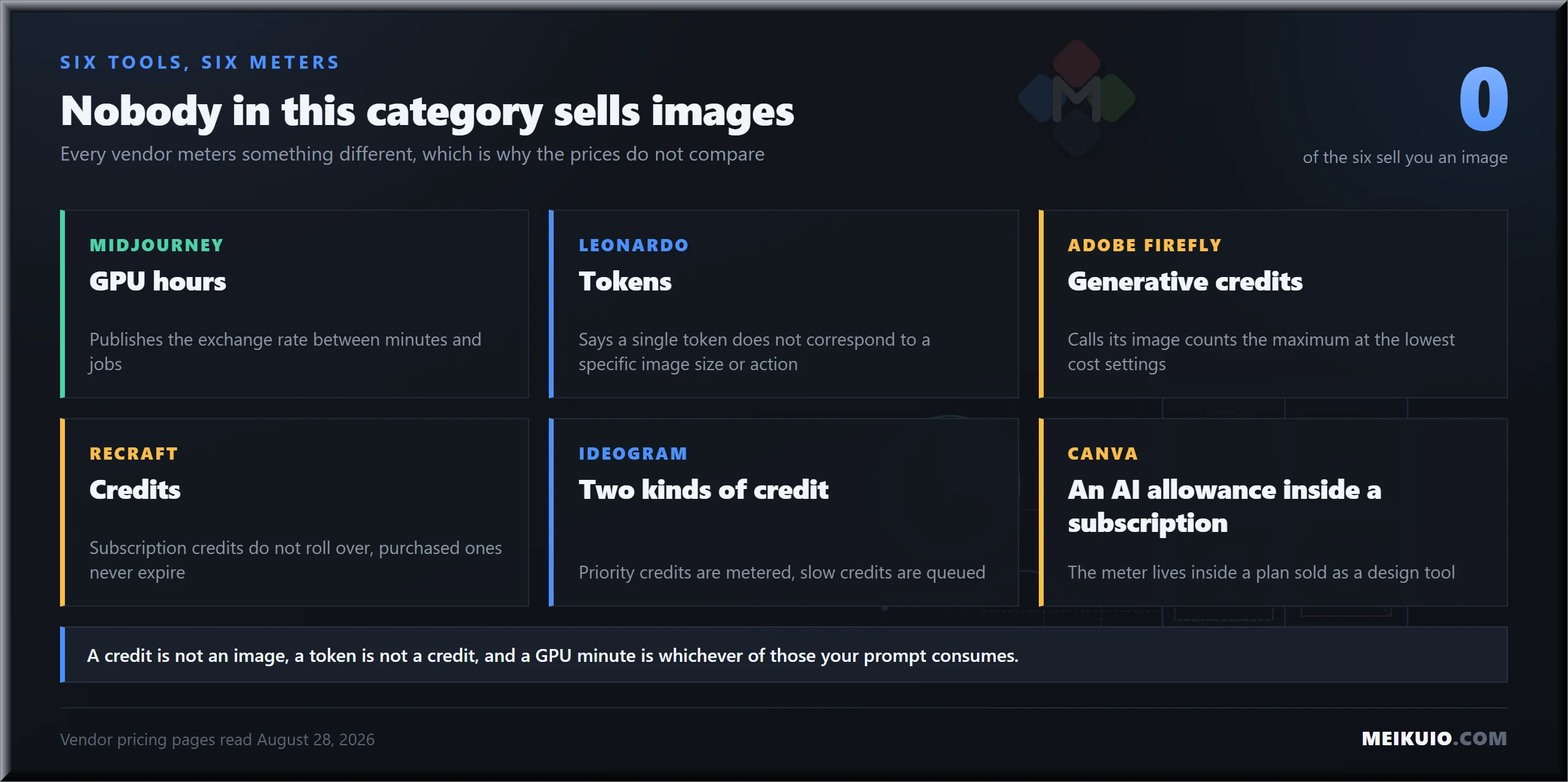
Every vendor meters something different, which is why the prices do not compare.
The cheaper Midjourney that isn’t Midjourney
Search any of these pricing terms and you’ll meet a second market: shared-account services and unofficial API resellers offering Midjourney for less than Midjourney charges. Some rank on the first page. Before you weigh one against a $10 plan, read what Midjourney’s own rules say about them.
The Terms are short about it. “You may not resell or redistribute the Services or access to the Service. Only one user may use the Services per registered account.”
The Community Guidelines repeat the one-account rule and add that accounts breaking it “may be blocked.” Sharing a login isn’t a grey area in the documents; it’s named.
The API question is more interesting, because the sentence everyone quotes is only half of one. The Community Guidelines open it with a carve-out: “a few rare exceptions that are explicitly granted.” Then comes the part people quote. No API, no third-party apps or scripts, no automation.
That opening clause matters. The policy contemplates that API access exists for some parties on a granted basis, which is not the same as no API existing. The Terms of Service drop the carve-out entirely and state the rule flat: “You may not use automated tools to access, interact with, or generate Assets through the Services.”
Is there a public one you could sign up for? No. I read all 105 articles in Midjourney’s published help centre.
Exactly one mentions an API. There is no developer section and no key console. Whatever the rare exceptions are, they’re not a product you can buy.
Before you buy a discounted Midjourney account
The saving is real and so is the stated penalty. Shared-access services undercut the official entry plan by routing several customers through one login, which is the arrangement the Terms name and the Community Guidelines say accounts “may be blocked” for. You are also handing your prompts, and often your payment relationship, to a third party with no obligation to Midjourney or to you. If the account goes, your work history goes with it, and there is nobody to appeal to.
Three of the pages competing with this one for the phrase “Midjourney pricing” belong to businesses in this trade: one sells shared accounts, one sells an unofficial API, one aggregates models behind its own front end. That doesn’t make their plan tables wrong. It does mean the recommendation at the bottom was decided before the research at the top. That’s the same reason I don’t take a vendor’s own account of what its product became at face value either.
Field notes
- How this was checked: I read every figure and rule here on Midjourney’s own documentation and Terms of Service on 28 August 2026, and pulled the plan table twice that day to confirm it hadn’t moved mid-check. I did not buy a subscription for this article, and nothing here claims a hands-on test.
- The unit: Basic 3.3 Fast GPU hours for 10 dollars; Standard 15 for 30; Pro 30 for 60; Mega 60 for 120. Extra hours 4 dollars on every tier. Annual billing takes 20 percent off and is charged once, up front.
- Per hour: 1.60 dollars annual on Standard, Pro or Mega; 2.00 monthly on the same three; 2.42 on Basic annual; 3.03 on Basic monthly; 4.00 topping up. A 2.5x spread on an identical unit, and the entry plan is the worst subscription rate.
- Expiry: subscription hours die at the end of each month, on yearly plans too; purchased hours carry a 60-day expiration, are non-refundable, and stop working while a subscription is lapsed; earned hours expire after 30 days.
- Refunds: available only below 20 GPU minutes for the lifetime of the account, Relax time included. About 25 prompts at Midjourney’s own conversion rate. The Terms of Service never mention the allowance.
- Organisations: no discounts, none for non-profits or schools, no seat management, no SSO, no terms negotiation, no signing of vendor forms. Fifty yearly Pro or Mega plans unlock consolidated invoicing, not a lower price. No student discount exists; the word appears zero times on the education page.
- Sources: Midjourney documentation (Comparing Midjourney Plans; GPU Speed; Requesting a Refund; Purchasing Extra Fast Time; Subscription Fast Time Expiration; Group Plans and Corporate Billing; Educational Use and Student Billing; Turning Off Automatic Renewals; Free Trials); Midjourney Terms of Service, version effective 27 May 2026; Midjourney Community Guidelines.
Frequently Asked Questions
Is Midjourney free?
No, not on Midjourney itself. Midjourney’s own page states that no free trial is available in Discord or on midjourney.com. The one exception it names is a limited trial in the separate niji · journey mobile app, which generates anime illustration rather than the general model most people mean.
How many images can I make on the Basic plan?
About 1,000 standard images a month, or 612 in HD. Basic includes 200 Fast GPU minutes, and Midjourney’s published rate is 0.8 minutes for a set of four standard images and 1.3 minutes for four in HD. Upscales and video cost considerably more.
Is annual or monthly billing cheaper?
Annual is the cheaper side of Midjourney pricing per hour, at $1.60 against $2.00 on Standard, Pro and Mega. It’s only cheaper in practice if you use the allowance, because the hours arrive monthly and expire monthly even on a yearly plan. Bursty users pay 20 percent less for time they never reach.
What happens when I run out of Fast hours?
On Standard and above you switch to Relax mode, which is unmetered but queued. On Basic there is no Relax mode, so the only way to keep generating is to buy extra Fast time at $4 an hour. Those purchased hours carry a 60-day expiration and cannot be refunded.
Can I get a refund from Midjourney?
Only if you have used less than 20 GPU minutes across the entire life of your account, and Relax time counts toward that total. At Midjourney’s own conversion rate that is roughly 25 prompts. Past it, the option disappears permanently rather than for the current period.
Do unused Fast hours roll over to next month?
No. Midjourney states that unused Fast time vanishes at the end of each month, and it says this applies whether you are on a monthly or a yearly plan. Hours bought as top-ups behave differently: they carry a 60-day expiration instead.
Do I need the Pro plan to use Midjourney commercially?
Yes, if you are part of a company earning more than a million dollars a year. Midjourney’s Terms go further than its help article: they make ownership of your output conditional on a Pro or Mega plan, and they bind “a company or any employee of a company” above that threshold. Neither document defines revenue or describes how the rule is checked.
Can I share a Midjourney subscription with my team?
No. The Terms state that only one user may use the service per registered account, that each user may have only one account, and that you may not resell or redistribute access. Teams buy one subscription per person at list price, and consolidated invoicing only becomes available at 50 yearly Pro or Mega plans.
My Take
I’d hand Standard, billed annually, to any freelancer who makes images most weeks. At $1.60 an hour it’s the honest middle of this ladder, and Relax mode is what turns a hard monthly ceiling into an inconvenience. The metering is unusual but it isn’t unfair, and the exchange rate between minutes and work is published, which is more than several better-known tools manage.
I wouldn’t hand anyone Basic at $10 a month, and I’d tell a company to stop looking for a deal. Basic is the worst rate on the board, it has no slow lane, and the moment you exhaust it you’re paying $4 an hour with no alternative. For companies the condition is simpler: if you’re over a million in revenue, the Terms already picked Pro for you, and if you’re buying for a team, the negotiation you’re planning does not exist. One subscription per person at list price. That is the whole calculation.