
How much does Neuralink cost? There is no price, because nothing is for sale. The implant is investigational, a federal rule caps what a trial may charge a participant at cost recovery, and the only hard dollar figure in circulation is a projection shown to investors. Below: the rule, the source of that number, who pays today, and the first published fees for implanting a brain-computer interface, which are not American.
- There is no Neuralink price, and federal rules are the reason
- Where the $10,500 and $50,000 figures come from
- Who actually pays for a Neuralink implant today
- What it takes to get one: five gates, none of them money
- Every brain-computer interface trial on the registry, counted
- What the FDA has actually authorized: one non-invasive BCI, zero implants
- Why no bill can be written: the missing code, and the one BCI that has one
- What a brain implant costs when it does have a price
- The first implanted brain-computer interface approved for sale is not in America
- Washington’s answer: the RAPID pathway, and what it does not change
- The question no ranking page asks: what happens after the study
- Six questions to ask any brain-implant trial before you sign
- Neuralink vs Synchron vs Precision vs Paradromics: what differs for the person
- What Musk says it will cost, and what that means
- Why the search for a Neuralink price lands on a stock tracker
- What this is not: the $300 headsets
- Frequently Asked Questions
- Can you buy a Neuralink implant at any price?
- Do Neuralink trial participants pay for the surgery?
- Is Neuralink covered by insurance or Medicare?
- How much does a Neuralink implant surgery cost?
- Can a healthy person get a Neuralink implant?
- How do you apply for the Neuralink clinical trial?
- What happens to the implant when the study ends?
- Can you get an MRI with a Neuralink implant?
- Is Neuralink approved by the FDA for sale?
- Which brain-computer interface is actually approved for sale?
- My Take
One thing before the documents. If you typed “neuralink price” and meant the share price, that is a different question with a different answer, and I covered it in the Neuralink stock piece. This page is about the device, the surgery, and the people who have one in their heads.
A brain-computer interface is a device that records signals from the brain and turns them into commands for a computer or a machine. Neuralink is Elon Musk’s company for building one; its N1, the implant this question is about, has been in human heads since January 2024; the Neuralink surgery is done by the company’s own robot, which places the threads in the motor cortex, the strip of brain that plans movement. Neuralink implants are one kind of brain-computer interface. A prescription headset you will meet later is another, and it is the only kind with an American price.
There is no Neuralink price, and federal rules are the reason
The rule is 21 CFR 812.7, in the part of federal regulations that governs investigational devices. I read the 2025 edition on govinfo. Subsection (a) says a sponsor shall not “Promote or test market an investigational device, until after FDA has approved the device for commercial distribution.” Subsection (b) says the sponsor shall not “Commercialize an investigational device by charging the subjects or investigators for a device a price larger than that necessary to recover costs of manufacture, research, development, and handling.” Subsection (d) forbids representing the device as safe or effective for the use under investigation.
So the answer to how much does Neuralink cost is a paragraph of law, not a number. Neuralink’s N1 implant is investigational. Under 21 CFR 812.7, a trial sponsor may not charge a participant more than the device costs to make, and may not market it before approval. Any page that gives you a retail price for a Neuralink implant is pricing something the law says cannot be sold.
The same part of the code tells you why the bar is set where it is. 21 CFR 812.3(d) defines an implant as a device “intended to remain there for a period of 30 days or more.” 812.3(m) defines a “significant risk device” as one that “Is intended as an implant and presents a potential for serious risk to the health, safety, or welfare of a subject.” A set of electrode threads placed in the motor cortex by a surgical robot meets both definitions on the first reading. Nobody disputes that. It means every human use runs under an investigational device exemption, an IDE, with an ethics board, a protocol, which is the study’s written plan, and a consent form behind it, and a sponsor, the company or institution that runs the study and answers for it.
Keep the word investigational in mind for the rest of this piece. It does more work than any dollar figure you will see. Approved means a company may sell. Investigational means it may only study. Neuralink’s own trial brochure puts it in six words: “The devices used in this study are investigational, and not for sale.” That sentence sits on the company’s own PDF. None of the pages that print a price quotes it.
Approved means a company may sell. Investigational means it may only study.
Where the $10,500 and $50,000 figures come from
Every Neuralink price on the web, apart from Elon Musk’s stage remarks, traces to one November 2023 Bloomberg article citing documents shown to investors. The piece is Ashlee Vance’s Bloomberg Businessweek feature from the first week of November 2023, “Elon Musk’s Neuralink Brain Implant Startup Is Ready to Start Surgery” (the web address carries the date 7 November; Becker’s dates the report to the 6th). Bloomberg’s page returned a paywall when I opened it in September 2026, so I took the wording from the outlets that quoted it within days. Becker’s Spine Review, 8 November 2023: “Each implant surgery is estimated to cost $10,500 to cover exams, parts and labor, the report said. Insurer costs are expected to be $40,000 per surgery.” The attribution that matters survives in the reprints that carried it, The Street among them: the figures came, in Bloomberg’s words, from “documents provided to investors.” That is a pitch deck. Neuralink never put the numbers on the record, and no regulator ever wrote them down.
More Read

The $50,000 version is the same projection with a rounder top line. It shows up in reprints from at least January 2025, when UNILAD put it in a headline while citing Nasdaq, and it matches the reimbursement assumption in a 2025 investor presentation that Bloomberg reported on 23 July 2025, again “according to a recent presentation shown to investors.” Whether a reporter rounded up or the deck changed, the number never came from a price list. Neither figure is a price. One is what the company told investors a surgery would cost it; the other is what it hoped to charge insurers one day.
I opened the pages that rank for this question and wrote down what each one prints and whom it cites. The chain is short and it loops.
One projection, five ranking reprints, a sixth in The Street, and a search engine summarising them. UNILAD’s version ends with “if it’s something you’re eager to try, best get saving,” which tells a reader with a spinal cord injury to start putting money aside for a device the law forbids anyone to sell them. I’d call that the most harmful sentence in the field, and it sits under a $50,000 headline.
Now test the number against something real. A 2024 systematic review of 26 cost studies of deep brain stimulation, adjusted to April 2022 dollars, put the total cost of a DBS operation at $40,942.85. The investor document’s insurer figure was $40,000. Divide one by the other and you get 0.98. Whoever built that deck did not invent a price for a brain implant. They looked up what an existing brain implant already bills and wrote it down. The $10,500, the figure most pages present as the Neuralink chip price, is a different kind of number, a claimed internal cost of parts, exams and labour, and it is about a quarter of the DBS figure. Neither one is a Neuralink cost you could be charged, because the only charge the law allows is cost recovery, and Neuralink’s brochure says the devices are not for sale.
Who actually pays for a Neuralink implant today
Somebody pays for the robot, the surgeon, the hospital bed and the implant. Under an IDE it is the sponsor. A trial participant does not buy the implant; the sponsor pays for the device, the surgery and the study care. The participant’s side of the ledger is time, risk, and travel, and the trial brochure says exactly that: “You will be compensated for study-related costs (such as travel expenses to and from the study site).” Compensated for costs. Not paid. If you came here asking how much is Neuralink paying for human trials, that sentence is the answer: costs, not pay. Measured from the participant’s side, the Neuralink implant cost is hours and risk, and the dollars flow the other way.
For a family, then, the ledger reads like this. The device, the operation and the study visits: paid by the sponsor. Travel to the site: reimbursed. Everyday care, lost income, and anything that happens to the device after the study ends: yours, unless the consent form says otherwise, and the consent form is the one document in this story I could not read, because Neuralink does not publish it.
Medicare’s rules explain the rest of the money. 42 CFR 405.201 sorts investigational devices into two boxes. Category A is “a device for which ‘absolute risk’ of the device type has not been established” and “the FDA is unsure whether the device type can be safe and effective.” Category B is a type whose “initial questions of safety and effectiveness … have been resolved,” usually because a similar device is already on the market. A first-of-its-kind brain-computer interface is Category A on its face; that is my reading of the definition, and nothing I found from the Centers for Medicare and Medicaid Services, CMS, says otherwise. Then 405.211(a): for a Category A study, “Medicare covers routine care items and services” if the study meets the criteria in 405.212. Routine care. Not the device. Medicare may pay for the hospital days and the scans that would have happened anyway. It pays nothing for the implant.
So in 2026 money moves around a brain implant in four ways, and only one of them involves you holding a card.
Hold the first route against something you can buy. You can rent a humanoid robot for $499 a month and have it delivered. You cannot buy a brain implant at any price, from anyone, and the people who have one gave something other than money to get it. What the first route feels like from the inside is not in any brochure. New Mobility profiled Noland Arbaugh, the first person to receive the N1, and wrote this: “Because Arbaugh is part of an FDA study on the implant, there are limits on what Neuralink can provide. He is not compensated, and they cannot pay for his normal care. That means his family is still doing all of his care, except for the 10-15 hours a week he receives from a state-paid caregiver.” Not compensated there means no pay; the brochure’s “compensated for study-related costs” is reimbursement of travel and the like, and the two statements describe the same arrangement. The same profile says he “still spends upwards of four hours a day working directly with the Neuralink team on improving the app.” Four hours a day, unpaid, to make the product better for the next person.
Nathan Copeland joined a University of Pittsburgh study in 2014 and has carried Blackrock arrays in his motor and sensory cortex for years since. His GoFundMe page, which exists to pay for a wheelchair van, carries an update from 23 March 2020: “Since I will now be losing a large portion of my income, reimbursement from traveling to the lab 3 times a week, I’ve decided to start actively sharing this campaign again.” Read that once more. The travel reimbursement from a brain-implant study was a large portion of his income, and when the pandemic paused the lab, it stopped. An earlier update on the same page: “Even though I won’t get to keep the implants or have any direct medical benefits when my time in the study is over, I did get to fist bump president Obama with a robotic arm that I controlled with my mind.” That is the deal, in the participant’s own words. You give the hours. You don’t keep the device.
The fourth route deserves its boundary printed rather than implied. I looked for any clinic, anywhere, that would implant a brain-computer interface in a healthy person for money, myself and through a second, automated search that combed the medical-tourism directories for Mexico, Colombia, Costa Rica, Thailand and Turkey and the biohacking forums where people ask for exactly this. Nothing. No ethics board approves a craniotomy, the opening of the skull, without a medical need, no hospital schedules one, and nobody in the grey market claims to. That is a report of what I could find in September 2026, not a law of nature. But if you are healthy and want one, there is no door, at any price, and anyone who tells you otherwise is selling something that is not a brain implant.
What it takes to get one: five gates, none of them money
Neuralink’s own trial page lists who it is looking for. I copied it on 10 September 2026. Candidates “Have limited or no ability to use both hands due to: Spinal cord injury, or Amyotrophic lateral sclerosis (ALS).” They “Are at least 22 years old.” They “Have a consistent and reliable caregiver.” They “Are permanent residents of the United States.” The brochure adds the exclusions. Out are people who “Have an active implanted device (pacemaker, deep brain stimulator (DBS), etc.),” who “Have a history of seizures,” who “Require MRIs for an ongoing medical condition,” or who “Are receiving transcranial magnetic stimulation (TMS) treatment.” The registry entry for the PRIME Study, NCT06429735, says the same thing in clinical language: severe quadriplegia from spinal cord injury or ALS for at least a year without improvement, where quadriplegia means “very limited or no hand, wrist, and arm movement.” Two wordings, one population.
What the implant is for, in the brochure’s words, is recording brain activity “with the goal of enabling you to control a computer”; the trials page adds a robotic arm, and the first participant has played chess with the implant.
People who type how much is a Neuralink into a search box usually mean something else: can I get one. The answer is a list of gates. Eligibility for a Neuralink trial is a diagnosis, an age of at least 22, a caregiver and US residency, not a wallet. Count them. A diagnosis. An age. A caregiver. A passport or a green card. And a fifth one that reads like a footnote and is not: no ongoing need for MRI scans. That last exclusion tells you something about the device that no marketing page will. If you are going to need magnetic resonance imaging for anything else in your life, the company does not want the implant in your head. Hold that thought for the section on what happens after the study.
Then there is the time. The brochure: “The study will take approximately 6 years to complete.” The primary phase is “9 at-home and in-person clinic visits” over “approximately 18 months,” followed by long-term follow-up. Read that as 18 months of scheduled visits and then follow-up until the study closes at about the six-year mark. Six years is the commitment you are asked to sign for, with a device that the company itself describes as first-in-human. The registry gives the same shape in dates: PRIME started on 9 January 2024, lists an estimated primary completion in June 2026, and an estimated study completion in January 2031. As of September 2026 the entry still reads Recruiting, in a status the sponsor last verified in January 2026, past its estimated primary completion date of June 2026; registry dates are the sponsor’s forecasts, and they slip.
The door itself is a web form, the Neuralink patient registry. Neuralink’s trials page says the registry “takes just 7 minutes to join,” is “now open worldwide,” and lives at portal.neuralink.com. Worldwide because there are studies in Canada, Britain and the United Arab Emirates too; the US study takes US residents. The study sites for PRIME, per the company’s page, are the Barrow Neurological Institute in Phoenix and the University of Miami. Seven minutes to apply. Years to be chosen, if you are chosen at all, and the company does not publish how many people are waiting.
What this page is and is not
This is a reading of public documents: the federal code, the trial registry, the FDA and Medicare databases, the companies’ own pages, and two peer-reviewed surveys, all opened between 9 and 10 September 2026. It is not medical advice and it does not tell anyone whether to join a trial. Where I say something does not exist, I say what I searched, because “I found none” and “there is none” are different claims.
Every brain-computer interface trial on the registry, counted
The registry is public, free, and almost never linked from the pages that rank for this question. ClinicalTrials.gov lists every clinical trial a sponsor must register, with the sponsor’s name, the number of people it plans to enrol, the sites, and a status the sponsor has to keep current. I pulled the records through the registry’s own API on 10 September 2026. This is what an implanted brain-computer interface looks like as a set of numbers rather than a headline.
Neuralink total: 47 planned across six trials, not people already implanted. The company reported 21 participants on January 28, 2026. COMMAND records six actual participants, active and not recruiting; other values are estimated planned enrolment. CONVOY: invitation; Motif studies: not yet recruiting. Full registry IDs, statuses and locations remain in the existing table.
Add up Neuralink’s six clinical trials and the planned enrolment is 47 people. Not 47,000. Forty-seven, across the Neuralink human trials in the United States, Canada, Britain and the United Arab Emirates, over roughly six years each. If you searched how many Neuralink patients there are, the company’s own count was 21 as of 28 January 2026, when it published a two-year progress note that speaks of “a growing crew of 21 Neuralnauts enrolled in trials worldwide.” Synchron’s first US study enrolled six. Paradromics plans to start with two. BrainGate2, the academic consortium that has been doing this longest, has been recruiting since May 2009 and lists an estimated completion date of December 2038, a 29-year study window. These are the numbers behind every headline about a race. They are the numbers of a very careful field working with a very small number of people.
Two things the registry does not say. None of the records I opened mentions cost or compensation, which is normal; that language lives in the consent form you sign at the site, not in the public entry. And no sponsor-registered study carries the name Precision Neuroscience, because that company’s work so far has run as short intraoperative recordings under hospital sponsors rather than as a long-term implant trial. The only way to know what a study will and will not pay for is to read its consent form. The federal rule 21 CFR 50.25 says that form has to disclose “Any additional costs to the subject that may result from participation in the research,” and, for a study with more than minimal risk, “whether any compensation and an explanation as to whether any medical treatments are available if injury occurs.” Ask for the form before you ask about the device.
What the FDA has actually authorized: one non-invasive BCI, zero implants
The FDA has three main doors to market: premarket approval, PMA, the full review for high-risk devices; 510(k) clearance, for devices similar enough to ones already sold; and De Novo, for new devices of lower risk. I searched the premarket approval and 510(k) databases through the agency’s open API on 10 September 2026, by term and by company, the same registers I used to check which CPAP machines the agency had recalled. “Brain-computer interface,” “brain computer interface,” “Neuralink,” “Stentrode,” “neural interface”: zero results in both databases. “Synchron” returned 135 records in the 510(k) database and 17 in the premarket approval database, every one of them a Beckman Coulter laboratory analyser that happens to share the name. “Cortical implant” returned a knee-ligament fixation device from DePuy. The FDA has never authorised a brain chip, to use the headline word, for long-term implantation. That sentence has held since the first human trials. It still holds today.
It needs two footnotes, because the loose version, “the FDA has never authorised a BCI,” is wrong, and I nearly wrote it. First, two BCI companies do hold clearances, for electrode arrays used for a short time rather than for a permanent system. Blackrock’s NeuroPort Cortical Microelectrode Array System was cleared under K110010 on 9 February 2011. Precision Neuroscience’s Layer 7-T was cleared under K242618 with a decision date of 30 March 2025 in the FDA database, under the product code for a cortical electrode. The regulation that defines that product, 21 CFR 882.1310, says a cortical electrode “is temporarily placed on the surface of the brain for stimulating the brain or recording the brain’s electrical activity.” Temporarily is the operative word. A cleared electrode you may leave on the brain for a short procedure is not a device you keep for years, and neither clearance lets anyone sell a brain-computer interface you take home.
Second, the FDA has authorised one brain-computer interface for sale, and it does not go inside the body. Neurolutions’ Upper Extremity Rehabilitation System, sold as IpsiHand, received De Novo authorisation DEN200046 on 23 April 2021. It is an EEG headset that reads intent from the scalp and drives a powered hand brace for people recovering from a stroke. It matters here for one reason: it is the only brain-computer interface in the United States that has ever carried a price, and we will get to that price in the next section.
Now the word you will see attached to Neuralink, Synchron and Precision in press releases: Breakthrough. The FDA’s own page calls the Breakthrough Devices Program “a voluntary program” for devices that treat “life-threatening or irreversibly debilitating diseases or conditions,” and adds in the same paragraph that “Breakthrough Devices must meet the FDA’s rigorous standards for device safety and effectiveness in order to be authorized for marketing.” It is a queue position. It is not an approval. The page also says the agency “generally cannot publicly disclose” a designation before authorisation “unless the sponsor decides to make that information available.” Every Neuralink Breakthrough designation you have read about, for Blindsight and for speech, is the company’s own announcement, because it cannot be anything else.
Of 1,320 Breakthrough designations, 210 devices had reached the market by June 2026, about 16 percent. Those are the FDA’s figures, with data as of 30 June 2026: 1,320 designations granted since the programme began, 1,299 of them by the device centre, and 210 designated devices with a marketing authorisation for the indication they were designated for. The 50 most recent authorisations on that list, from June 2025 to June 2026, include no brain-computer interface. Sixteen in a hundred is the historical odds that a Breakthrough badge turns into a product. It is a real advantage. It is not a countdown.
A Breakthrough designation moves a device up the queue. Sixteen in a hundred have reached the market.
Why no bill can be written: the missing code, and the one BCI that has one
An American hospital does not bill in dollars. It bills in codes. A surgeon’s work is a CPT code, maintained by the American Medical Association; a piece of equipment you take home is a HCPCS code, maintained by Medicare. Without a code there is no line to put on a claim, and without a line there is no price, whatever a company projects. So before asking how much does Neuralink cost, ask whether a code exists for putting one in. I downloaded the AMA’s Category III file, the set of temporary codes for new procedures, in the version updated on 7 August 2026. Seventeen pages. It contains no entry for brain-computer interface, brain computer interface, neural interface, intracortical, or neuroprosthesis. The single hit on “cortical” is an MRI-analysis code. There is no CPT code for implanting a brain-computer interface, in the emerging-technology set or anywhere else I could find.
The devices that already live in people’s heads all have their codes. Deep brain stimulation has lead-implantation codes 61863 through 61868 and generator codes 61885 and 61886. A vagus nerve stimulator is 64568. A cochlear implant is 69930. Each of those also has a Medicare national coverage determination, an NCD, behind it: NCD 160.24 for deep brain stimulation, effective 1 April 2003; NCD 160.18 for vagus nerve stimulation; NCD 50.3 for cochlear implants. Code plus coverage decision plus a published cost study equals a price a patient can be quoted. An implanted brain-computer interface has none of the three.
Now the exception, because it is the only real price a brain-computer interface has ever carried in the United States, and it belongs to a headset. In the 2024 coding cycle, Medicare created HCPCS code E0738 to describe IpsiHand, effective 1 April 2024. The 184-page determination records that the agency could find no comparable code, so it “gap-filled” the fee from “commercial pricing for the IpsiHand Upper Extremity Rehabilitation System from the Federal Supply Schedule of $30,000.” The Federal Supply Schedule is the catalogue of prices at which federal agencies buy. The result, in the agency’s words: “The 2024 average non-rural capped rental fee schedule amount for HCPCS Level II code E0738 will be approximately $1,952.78 for months 1 through 3 and approximately $1,464.59 for months 4 through 13 for a total of $20,504.24 after 13 months of continuous use.” I ran the arithmetic. Three months at $1,952.78 and ten at $1,464.59 come to exactly $20,504.24.
The only brain-computer interface with a Medicare price is a headset: $20,504 over 13 months of rental. Capped rental is Medicare’s term for equipment it pays for month by month, for up to 13 months, after which the patient owns it. The same document notes that a public comment objected that the fee “were not in line with the associated efficacy of the device,” and that Medicare finalised it anyway. Then read what a large commercial insurer did with the same device. Anthem’s medical policy DME.00052, titled “Brain Computer Interface Rehabilitation Devices” and published on 1 October 2025, says: “Brain computer interface rehabilitation devices, including but not limited to electroencephalography (EEG)-driven upper extremity powered exercisers, are considered investigational and not medically necessary.” An FDA-authorised device, with a federal code and a federal fee, that a major insurer still calls investigational. Ask how much does Neuralink cost and this is the road the answer would have to travel. That is the road from approval to a price in this country, for the only brain-computer interface that has walked it.
What a brain implant costs when it does have a price
A deep brain stimulator has a code, a Medicare decision and a published cost of about $41,000; an implanted brain-computer interface has none of the three. People have had electrodes in their brains, on prescription and on insurance, for decades. Deep brain stimulators for Parkinson’s disease and tremor. Responsive neurostimulators for epilepsy. Cochlear implants, which sit in the inner ear and stimulate the auditory nerve, for profound deafness. These devices have surgeons, hospital pathways, codes and coverage, and the only honest way to answer what a brain implant, or a brain chip, costs today is to look at them. They are the only implanted brain devices with a bill.
The $41,000 comes from a 2024 systematic review in Stereotactic and Functional Neurosurgery that pooled 26 cost studies published between 2001 and 2021 and adjusted everything to April 2022 dollars. Its means: the device, $21,496.07; the surgery alone, $14,685.22; the total cost of surgery, $40,942.85; and treatment through the first year of follow-up, $47,632.27. The spread around those means is wide, plus or minus $17,987 on the surgery figure, and the authors say the field reports costs so inconsistently that comparisons are hard. A separate US cost-effectiveness model from 2016, from the Medicare payer’s side and over ten years, put deep brain stimulation at $130,510 against $91,026 for the best drug therapy alone, and judged it worth the difference at $23,404 per quality-adjusted year of life, the unit health economists use to price a year of good health.
Cochlear implants show what a negotiated device price looks like once a market exists. A 2023 study in the journal Otolaryngology-Head and Neck Surgery pulled the prices 161 US hospitals had negotiated with private insurers for cochlear implant devices. MED-EL’s devices averaged $38,478. Cochlear Ltd’s averaged $34,150. The hospitals charged a mean 58.5 percent markup over Cochlear’s own average sales price of $24,649, and the price was at least $5,000 lower at centres that offered all three brands. Read that as the shape of a future brain-computer interface bill: a manufacturer’s price, a hospital markup on top, and a spread that depends on which hospital you walk into. What you personally pay from any of those figures is then a deductible and an out-of-pocket maximum, the amounts your plan makes you cover before it covers the rest, not a sticker.
The nearest thing to a sticker on an implanted neuroprosthesis was Second Sight’s Argus II, the retinal implant, reported at around $150,000 when it launched in 2013, before surgery and training. Keep that device in mind. It comes back later in this piece for a reason that has nothing to do with its price. Meanwhile, in my exoskeleton piece the pattern was the same: the products with a public price were the ones with a public standard behind them, and the ones without a standard hid the price. The Neuralink cost question is that pattern taken to its limit. No standard, no code, no price.
The first implanted brain-computer interface approved for sale is not in America
On 13 March 2026, China’s National Medical Products Administration approved an implantable brain-computer interface for commercial sale. I read the announcement on the site of the regulator’s device evaluation centre. It describes the product, made by Neuracle Medical Technology of Shanghai and known as NEO, as an “implantable brain-computer interface hand motor function compensation system.” Then it uses a phrase I have not seen any US regulator use about any brain device. The approval “achieved the world’s first market launch of a brain-computer interface medical device, marking the first invasive brain-computer interface medical device internationally to enter the clinical application stage.” The device, the brain chip the headlines had been waiting for, is a coin-sized unit placed under the skull and above the dura, the membrane that wraps the brain, wirelessly powered, with an electrode kit, a transceiver, decoding software and a pneumatic glove that closes the hand when the brain asks it to.
The regulator printed the patient criteria in the approval notice, which is more than the US pages manage for Neuralink. Age 18 to 60. A cervical spinal cord injury between C2 and C6, graded A to C. A diagnosis more than a year old, stable for at least six months after standard treatment. A hand that cannot grasp, with some upper-arm function left. Paradromics, the Texas company building a competing implant, summarised the supporting trial on its own blog on 30 April 2026: “36 implant procedures (4 feasibility cases, 32 multicenter confirmatory cases) with 18 months of follow up,” with no serious device-related adverse events reported. It also argued that NEO, with eight electrode contacts on the brain’s surface, “is not in the same category as the intracortical systems being developed by Neuralink, Paradromics, and others.” Fair engineering point, from an interested party. It changes nothing about the law. An implanted brain-computer interface is for sale somewhere. That somewhere is not here.
What happened next is the part that matters for the question in the title. Two days after the approval, on 15 March 2026, China’s National Healthcare Security Administration assigned the device a medical-insurance code. The administration’s own note on 22 March explains how it moved that fast: in March 2025, a year before any product existed, it had issued pricing guidelines for the nervous system that “specifically established price items for invasive and non-invasive brain-computer interfaces,” and in September 2025 it had started collecting product information for coding. The code was waiting for the device. That is the same top-down coordination that has put humanoid robots into Chinese factories ahead of every forecast: the state decides the category exists, and the paperwork arrives before the product.
The first published prices anywhere for implanting and removing a brain-computer interface are ¥6,552 to put one in and ¥3,139 to take one out. They come from Hubei Province, which in March 2025 issued the country’s first price items for brain-computer interface services: “invasive brain-computer interface implantation fee ¥6,552 per procedure, invasive brain-computer interface removal fee ¥3,139 per procedure, non-invasive brain-computer interface fitting fee ¥966 per procedure.” At the exchange rate on 10 September 2026, about $974, $467 and $144. Those are hospital service fees, what the surgeon and the operating room bill, and they are not the price of the device. The same government note reports the first operation performed under that price list: 26 November 2025, Tongji Hospital in Wuhan, a 31-year-old man with a spinal cord injury, and a 64-channel device from a different company, Wuhan Zhonghua. His bill went to nobody. “The surgery costs were borne by research funds,” the note says, because the technology “is still at the clinical research stage.” A price list, a code, and a first patient whose surgery a grant still paid for.
Notice which of the two fees no American page has ever thought to ask about. A government has decided what it costs to take a brain implant out. That is the question behind the whole second half of this piece.
What the device itself will cost a Chinese patient is not settled. Paradromics estimates the full procedure at “¥300,000 to 500,000,” which it converted to $41,400 to $69,000 and which comes to roughly $44,600 to $74,300 at September 2026 rates. It adds: “This device cost is not yet reimbursable by government healthcare.” I checked the government page Paradromics links for that range and the range is not on it, so treat the figure as a competitor’s estimate rather than a published price. What is published is the service fee, the code, and the approval. Ask how much does Neuralink cost and you are asking for those three things. The country that has them is China.
Washington’s answer: the RAPID pathway, and what it does not change
Washington noticed. On 23 April 2026, Medicare and the FDA jointly announced the Regulatory Alignment for Predictable and Immediate Device coverage pathway, RAPID, for Breakthrough devices. The mechanism, in the agencies’ words: “CMS will issue a proposed NCD the same day an eligible device participating in this pathway receives FDA market authorization.” The promise: coverage and payment “as soon as two months after market authorization, compared to approximately a year or more under the current pathway.” To qualify, a device must be a Breakthrough device in Class II or Class III, the moderate- and high-risk classes, whose trial “enrolls Medicare beneficiaries and studies clinical health outcomes agreed upon by the FDA and CMS.” Whether Neuralink’s studies enrol Medicare beneficiaries is not public. Two months instead of a year is a real change. It starts at authorisation, and no implanted brain-computer interface has one. RAPID shortens a road Neuralink has not reached. Paradromics’ own assessment, from the same blog post, is blunter than anything I would write: “These leading BCI companies do not yet have premarket approval for chronic implantation, nor do they have clear existing codes for reimbursement,” and on Neuralink specifically, “the pivotal trial design remains unfinalized and PMA is not expected before 2027.”

China priced the operation a year before it approved the device. America has neither.
The question no ranking page asks: what happens after the study
The pages that quote a price for a Neuralink implant all ask what it costs to get one. None of them asks what a Neuralink implant costs to keep, or to have taken out, and that is the question with actual data behind it. Two peer-reviewed surveys have put it to the people involved. The first, by Lázaro-Muñoz and colleagues in Brain Stimulation in 2022, interviewed 44 people in implanted neural device trials, 23 researchers and 21 patient-participants. Its opening sentence: trial participants who benefit from experimental neural devices “are generally not ensured continued access to effective therapy or maintenance of devices at the conclusion of trials.” It goes on: “Many patient-participants were unaware of whether they would have post-trial access, but most thought they should keep devices if beneficial.”
Asked before surgery who should pay to keep the device working after the study, the 21 participants answered like this: 67 percent said insurers should cover some or all of it, 29 percent said participants themselves, 24 percent said the device manufacturers, 14 percent the research team, 5 percent the government and 5 percent the hospital. Nobody agrees who pays. One researcher in the same study described the trap from the other side: “you have a bunch of patients, dozens of patients implanted, then the study ends, and you have the company no longer interested in seeking approval for the device, so then who’s going to pay for it.” Nobody in that sentence is a villain. The money simply has no owner once the protocol closes.
The second survey, by Higgins and colleagues in BMJ Surgery, Interventions, and Health Technologies in 2024, asked 66 trial investigators with an average of nearly 15 years of experience about their most recent implant trial. They reported that “either ‘all’ (64%) or ‘most’ (33%) trial participants had remained implanted after the end of the trial, with ‘infection’ and ‘non-response’ the most common reasons for explantation.” Explantation is the surgery that takes an implant out. Their main barriers to continued access were “limited funding, scarcity of expertise and specialist clinical infrastructure.” And 95 percent of them “agreed there is an ethical obligation to provide post-trial access when participants individually benefit.” Almost every investigator thinks the obligation exists. Almost nobody has money set aside to meet it.
What that looks like in one life: Ian Burkhart, who had a Blackrock array implanted at Ohio State in 2014 and used it to move his own hand again. Georgia Tech’s research news, reporting on a June 2025 symposium where he spoke, put it in one sentence: “His BCI was ultimately removed after seven years as research funding ran short, taking his newly improved hand mobility with it.” Burkhart’s own words from the same report: “I’m so glad I was able to take that risk and have that voluntary brain surgery and participate in this type of research because it’s defined my life.” Seven years of restored movement, ended by a grant cycle. Infection did not end it and the device did not fail. Money did.
More than 350 people received the Argus II eye implant before its maker stopped supporting it. That is the case every neuroethicist cites and no Neuralink cost page mentions. Second Sight’s Argus II was a retinal implant, approved for sale, with a price. The company discontinued it in 2019 and announced the following year that it would wind down. IEEE Spectrum’s 2022 investigation, “Their Bionic Eyes Are Now Obsolete and Unsupported,” found the patients learning about it by accident. One called her vision-rehab therapist, who told her, “Well, funny you should call. We all just got laid off,” and then, “By the way, you’re not getting your upgrades.” Terry Byland, the only person with implants in both eyes, “had to find out secondhand that the company had abandoned the technology and was on the verge of going bankrupt.” He had helped them test it. Ross Doerr, implanted in 2019, wrote on Facebook: “No letter, email, or telephone call.” Doerr later needed a scan for a possible tumour. He told IEEE Spectrum, “I still don’t know if I have a brain-stem tumor or not.” The magazine explained why: “A defunct Argus system in the eye could cause medical complications or interfere with procedures such as MRI scans, and it could be painful or expensive to remove.” The company’s post-market study sits on the registry with the status Terminated and the reason “Sponsor discontinued the Argus II product.” That is the paper trail. The people are still wearing the hardware.
Go back to Neuralink’s own exclusion list: no candidates who “Require MRIs for an ongoing medical condition.” Put it next to Doerr’s sentence about the scan he cannot have. The company tells you, in the only way a brochure can, that this device and that machine do not mix, and that the arrangement is for life or until someone takes it out. Who pays to take it out is the Neuralink cost question Hubei answered with a number and no American document answers at all.
Every page asks what it costs to get a brain implant. The data is about what it costs to keep one.
Six questions to ask any brain-implant trial before you sign
Each of these has a document where the answer is supposed to live. If the answer is not in the consent form, the answer is no.
- Who pays to take it out, and who pays if something goes wrong? Federal rule 21 CFR 50.25(a)(6) requires the consent form to explain “whether any compensation and an explanation as to whether any medical treatments are available if injury occurs.” Find that paragraph. If it says “no compensation is available,” that is your answer. For scale, Hubei prices a removal at ¥3,139, about $467, and that is the hospital’s service fee only.
- Does it stop working if the company stops? Neuralink’s implant decodes movement through the company’s own app, the “N1 User App” in the brochure. Ask what happens to the app, the updates and the decoder if the sponsor folds or pivots. The Argus II patients found out the answer by phone, after the fact.
- Is there any fund set aside for maintenance after the study? I found no public document from any brain-computer interface company describing an escrow, a trust or a maintenance fund for participants after a trial ends. Ask anyway. A “we intend to” is not a fund.
- Can you leave the study and keep the device? 21 CFR 50.25(b)(4) requires the form to state “The consequences of a subject’s decision to withdraw from the research and procedures for orderly termination of participation.” Nathan Copeland’s answer, from his own page: “I won’t get to keep the implants.” Yours may differ. It will be in writing.
- Can you ever have an MRI again? Neuralink will not enrol anyone who needs MRI for an ongoing condition. Ask what that means for the conditions you do not have yet. Doerr’s scan is the cautionary case.
- Who owns the recordings from your brain? This one has no regulation behind it. As a July 2026 analysis in Tech Policy Press put it, “Neither approval process is designed to determine who controls neural data after collection.” The consent form is the only place the answer can exist. Read the data clause the way you would read the fine print on any policy that promises to protect you: for what it leaves out.
Neuralink vs Synchron vs Precision vs Paradromics: what differs for the person
The press treats the brain-computer interface companies as a race and calls each one a brain chip company. For a person deciding whether to apply, the differences that matter are where the device goes, who can receive it, and what the company has said about paying for it later. Everything below is from the registry, the FDA database, or the companies’ own pages as of 10 September 2026.
Two things the table cannot show. The gate that decides whether you get any of these devices is your diagnosis and the protocol’s criteria, not which technology you prefer. An endovascular device and a robot-inserted array compete for the same small group of people with the same injuries. Diagnosis first. And the surgical route decides something else: which hospitals can do it. Synchron’s device goes in through a catheter in a vascular suite that most large hospitals already have. Neuralink’s needs the company’s own robot. That is the difference between a procedure that could one day spread and one that stays where the machine is, and it matters more to a future price than any electrode count, for the same reason a robotaxi fleet of thousands beats a fleet of dozens whatever the software promises. The same lesson held when I priced robot dogs: the product that could be sold through existing channels got a price first. The Neuralink cost will follow the same rule.
What Musk says it will cost, and what that means
Three kinds of Neuralink cost number run through this story, and the pages that rank mix them freely. The first kind is an aspiration. Since the 2019 launch, Elon Musk has said at company events that the device and the surgery should one day cost a few thousand dollars, comparable to LASIK eye surgery, and Google’s AI Overview, answering “how much does neuralink cost,” now renders that as “between $1,000 and $2,000.” An aspiration is a target the speaker would like to hit. The second kind is a projection: the $10,500 internal cost and the $40,000 to $50,000 insurer charge from the investor documents, which is what a company told the people funding it that the surgery would cost and what it would bill. The third kind is a price: a number a hospital may put on a claim for a device it may sell. The United States has none of the third kind, which is why how much does Neuralink cost has no answer here. China has two, for the surgery.
Test the Neuralink price aspiration against what exists. The cheapest brain implant with a price anywhere is the ¥6,552 implantation fee in Hubei, about $974, and that covers the operation, not the device. The cheapest brain-computer interface with an American price is a $30,000 headset that Medicare rents out for $20,504 over 13 months. A thousand dollars for a robot-implanted array is a number nobody has ever billed for anything that goes inside a skull. It may happen. Nothing on file points to it, and there is no Neuralink chip release date to attach it to; the company’s own competitor expects no premarket approval before 2027. If you want the money side of this company rather than the medical side, the valuations and the private share trackers are a separate subject, and I have kept them in the stock article where they belong, next to the same private-market mechanics that apply to quantum computing stocks.
Why the search for a Neuralink price lands on a stock tracker
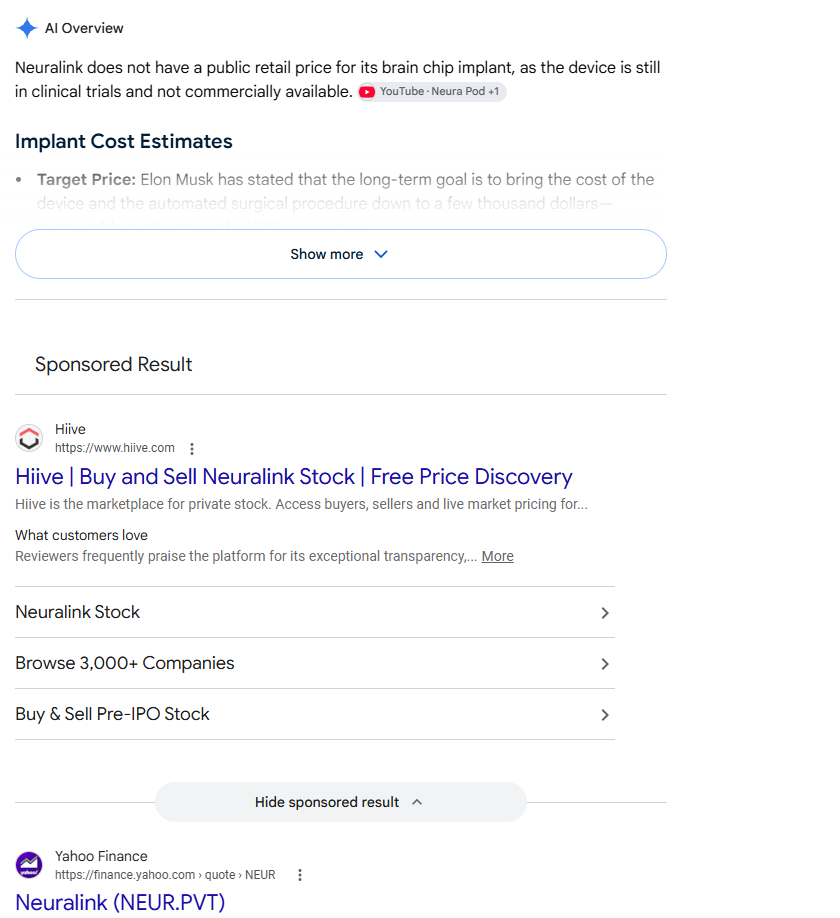
Eight of the nine Google results for “neuralink price” are about shares or a token; none prices the implant. I ran the search from a US setting on 10 September 2026 and wrote down what came back. Above the results, a sponsored listing from Hiive: “Buy and Sell Neuralink Stock | Free Price Discovery.” Then Yahoo Finance’s private-company page for NEUR.PVT. Then Nasdaq Private Market, estimating a “Neuralink price per share” of $240.03 “as of August 25, 2026.” Then Notice.co, “Neuralink Stock $295.00.” Then Business Insider on investors “valuing Elon Musk’s Neuralink at $42 billion.” Then Forge Global, then a crypto exchange page for a cryptocurrency token called NEURALINK that has nothing to do with the company, then a stock-tips site, then Yahoo’s page for that same token, and, ninth, neuralink.com. The AI summary at the top of that page says the implant has no retail price. Everything under it is about a piece of paper. I counted twice. The device is nowhere. Ask how much is a Neuralink and the market answers with a share price.
The name collisions run deeper than the search page. Type “Synchron” into the FDA’s device databases and you get 152 records for Beckman Coulter’s SYNCHRON laboratory analysers and none for the brain-computer interface company. “Synchrony” is a cochlear implant made by MED-EL and a bank. “BrainChip” on a stock ticker is an Australian semiconductor company that makes neuromorphic chips for machines, not for heads. If you have been researching the Neuralink price for an afternoon and feel you have three different prices in your notes, you probably have a share, a token and a surgery. None of them is the number you came for. Check which one you wrote down. The share question has its own rules, the same ones that decide whether you can buy OpenAI stock: private company, no ticker, secondary markets quoting what someone last paid someone else.
What this is not: the $300 headsets
Some of the pages that rank for “brain computer interface cost” will quote you $300 to $3,000. Those are consumer EEG headbands and headphones from Emotiv, Muse, Neurable, OpenBCI and others. They read faint electrical signals through the scalp for meditation apps, research kits and focus scores. Nothing enters the body. No surgeon, no protocol, no exclusion list. They are to a brain implant what a heart-rate wristband is to a pacemaker. The only reason they share a page is the phrase brain-computer interface, which covers both. IpsiHand is also a headset, but it is a prescription device with a federal code and a rental fee, which is why it appears in this piece and the others do not. If a page moves from a $300 headband to a $50,000 brain chip in one paragraph, close it. It has not understood which thing it is pricing. Neither will you, if you keep reading it.
Field notes
- The rule: 21 CFR 812.7(b) bars a sponsor from charging a trial participant more than the cost of making an investigational device; 812.7(a) bars marketing it before approval; Neuralink’s brochure: “investigational, and not for sale.”
- The only number: $10,500 per surgery and $40,000 to insurers, the only Neuralink cost figures in circulation, come from one Bloomberg feature of early November 2023 citing documents shown to investors; the $50,000 version circulated from January 2025; $40,000 is 0.98 of the published cost of a deep brain stimulation operation; five ranking pages and Google’s AI Overview reprint it.
- The registry, 10 September 2026: Neuralink has six studies with a planned enrolment of 47 people and reported 21 implanted as of 28 January 2026; Synchron’s first US study enrolled 6; Paradromics plans 2; BrainGate2 has recruited since May 2009 with completion listed for December 2038; no record mentions cost or compensation.
- Authorisation and codes: no long-term implanted brain-computer interface has FDA marketing authorisation (openFDA PMA and 510(k), searched 10 September 2026); the only authorised BCI is the non-invasive IpsiHand (De Novo, 23 April 2021), billed under HCPCS E0738 at $20,504.24 over 13 months of rental; the AMA Category III file of 7 August 2026 has no BCI code; of 1,320 Breakthrough designations, 210 devices have reached market.
- The routine class: deep brain stimulation surgery averages $40,942.85 across 26 studies (2024 review, April 2022 dollars); hospital-negotiated cochlear implant prices average $34,150 (Cochlear) and $38,478 (MED-EL) across 161 US hospitals (2023).
- China: NMPA approved Neuracle’s NEO for sale on 13 March 2026 and called it the world’s first invasive BCI on the market; an insurance code followed on 15 March; Hubei set the first service fees anywhere for implanting and removing a BCI in March 2025 at ¥6,552 to implant, ¥3,139 to remove, plus ¥966 for a non-invasive fitting (about $974, $467 and $144); the US announced the RAPID coverage pathway on 23 April 2026.
- Sources: govinfo (21 CFR 812, 50; 42 CFR 405; 21 CFR 882.1310); ClinicalTrials.gov API; openFDA; FDA Breakthrough Devices Program page (content as of 31 August 2026); CMS 2024 HCPCS B1 coding cycle; AMA Category III long descriptors (7 August 2026); Anthem DME.00052; Neuralink trials pages and PRIME brochure; NMPA/CMDE notice of 13 March 2026; NHSA notes of 5 December 2025 and 22 March 2026; Paradromics blog, 30 April 2026; Lázaro-Muñoz et al., Brain Stimulation 2022; Higgins et al., BMJ SIT 2024; New Mobility; Georgia Tech Research News; IEEE Spectrum; The Drift; Nathan Copeland’s GoFundMe page.
Frequently Asked Questions
Can you buy a Neuralink implant at any price?
No. The N1 implant is investigational, and 21 CFR 812.7 forbids a sponsor from selling or marketing one before FDA approval. The only way to receive one is enrolment in a registered clinical trial, and the company’s brochure says the devices are “not for sale.”
Do Neuralink trial participants pay for the surgery?
No. The sponsor pays for the device, the operation and the study visits, and the brochure says participants “will be compensated for study-related costs (such as travel expenses).” They receive no wage, and, as Noland Arbaugh’s New Mobility profile notes, the sponsor cannot pay for everyday care.
Is Neuralink covered by insurance or Medicare?
No. There is no billing code for implanting a brain-computer interface and no Medicare coverage decision. Inside a trial, Medicare may cover routine care under 42 CFR 405.211 but pays nothing for the implant. Anthem’s policy DME.00052 calls even the approved non-invasive BCI investigational.
How much does a Neuralink implant surgery cost?
Nobody has been billed for one. The Neuralink implant cost figures in circulation, $10,500 per surgery and $40,000 to $50,000 to insurers, are projections from investor documents Bloomberg reported in November 2023. For a real benchmark, a deep brain stimulation operation averages about $41,000 in published studies.
Can a healthy person get a Neuralink implant?
Not through any route I could find. Trials require a qualifying diagnosis such as quadriplegia from spinal cord injury or ALS, no ethics board approves brain surgery without medical need, and medical-tourism directories and biohacking forums list no clinic offering it. Enhancement talk is aspiration, not an option.
How do you apply for the Neuralink clinical trial?
Through the Patient Registry at portal.neuralink.com, which the company says takes about seven minutes and is open worldwide. The US study wants limited or no use of both hands from spinal cord injury or ALS, age 22 or over, a reliable caregiver, US residency, and no ongoing need for MRI.
What happens to the implant when the study ends?
It depends on the consent form, and research says the answer is often unclear. A 2022 survey found post-trial access “is generally not ensured”; a 2024 survey found most participants stay implanted but funding is the main barrier. Ian Burkhart’s implant was removed after seven years when funding ran out.
Can you get an MRI with a Neuralink implant?
The company will not enrol anyone who requires MRI for an ongoing condition, which tells you it treats the implant and the scanner as incompatible. Argus II patients learned after their maker closed that a defunct implant can interfere with MRI. Ask what imaging you could still have, in writing.
Is Neuralink approved by the FDA for sale?
No. It holds an investigational device exemption, which permits human trials, and company-announced Breakthrough designations, which speed review but are not approvals. The FDA’s premarket approval and 510(k) databases contain no Neuralink entry, and only 210 of 1,320 Breakthrough-designated devices have ever reached the market.
Which brain-computer interface is actually approved for sale?
In the United States, one non-invasive device: Neurolutions’ IpsiHand headset, authorised in 2021 and billed to Medicare under code E0738. For an implant, China’s NMPA approved Neuracle’s NEO on 13 March 2026, calling it the world’s first invasive brain-computer interface cleared for sale, with hospital fees set in Hubei.
My Take
The price question is the wrong question, and the pages that answer it with a number are answering it wrong on purpose, because a number keeps you on the page. I read the rule, the registry, the coding files and the consent requirements, and the only honest figure in the United States is zero: zero authorised implants, zero codes, zero dollars anyone has been charged. The one country that has a price for this operation set the fee for taking the device out before it approved a device to put in, and that ordering is the most sensible thing anyone in this field has done.
If someone I loved qualified for one of these trials, I would not ask what it costs. I would ask for the consent form before the screening visit and read three paragraphs: the one about injury, the one about withdrawing, and the one about what happens to the hardware and the software when the study ends. If any of the three is vague, that vagueness is the price, and it is paid in years, not dollars. And if you are healthy and want one, keep your money. Nobody will take it, and the ones who say they will are selling a headband.