


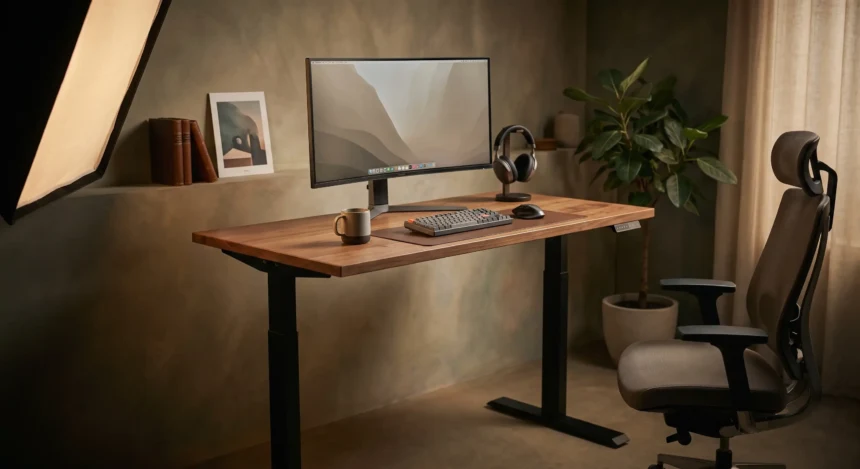
The best standing desk is one you can check before you buy it. Not by shaking it in a showroom, but by opening a free public register, typing in the brand, and seeing whether anything comes back. I did that in August 2026 for every brand the major guides recommend. The consumer names mostly return nothing. The ones nobody has ever tried to sell you return dozens, and in one case more than a hundred.
- What does “BIFMA certified” on a desk page actually mean?
- Which standard covers your desk, and who decides?
- How to check any standing desk yourself in two minutes
- What the register actually holds
- The desks these guides recommend, checked against the paperwork
- The recall record no buying guide cites
- Eight brands, one recall: why “we tested 70 desks” means less than it sounds
- What the top guides measure instead
- The five ways to buy a standing desk
- A complete desk from one brand
- A bare frame, with a top you supply
- A converter on the desk you already own
- Contract furniture, bought new through a dealer
- The same furniture, decommissioned and resold
- Seven things that actually differ, and how to check each without owning one
- 1. Will it stay still when you type?
- 2. Does it have one motor or two?
- 3. What the top is made of, and how it’s attached
- 4. Whether the controller is a part you can replace
- 5. The duty cycle nobody reads
- 6. Cable management that exists in metal, not in the copy
- 7. Height range: does it actually fit you
- Electric, pneumatic or hand crank: which lift should you buy?
- What actually fails after the first year?
- Warranty: read it line by line
- Are converters the safest way in, or the riskiest?
- What happens when the part you need is discontinued?
- Is the wiring certified, and can you check it?
- Does your desktop have to meet a federal rule?
- Should you buy a used office desk instead?
- How I checked all this, and what I did not do
- Who should buy what
- Frequently Asked Questions
- Is "BIFMA certified" a real certification?
- How do I check whether a standing desk is in the BIFMA register?
- What is the difference between ANSI/BIFMA X5.5 and X6.5?
- Have standing desks actually been recalled?
- Do different desk brands share the same lifting mechanism?
- Is a 15-year standing desk warranty real?
- Is a hand-crank standing desk a mistake?
- Should I buy a used office desk instead?
- My Take
That sounds like an accusation. It isn’t: the register is a voluntary, paid programme, so a company can test a desk properly and never join it. But it does mean that when a product page or a review does print that word, and several of them do, you have no way to verify it, the same way a router’s approval status turned out to be, and the organization behind that word says so itself, in writing, in section 8.2 of its own license agreement.
So this best standing desk guide runs backwards from the usual one. Instead of telling you how a desk felt under my hands for a week, it tells you what the paperwork says, where to find it, and what it still won’t tell you. I own none of these desks. I read the standard, the register, the recall database and the warranty terms instead, and I’ll show you how to read them too.
Three things you won’t find below, so you can leave now if they’re what you came for. I don’t name a single model as the winner, because I haven’t tested one and I’m not going to pretend otherwise. There are no desk prices, because they move weekly and a number I checked today would mislead you next month. And there is nothing here about whether standing is good for your back, which is a medical question and not one a furniture register can answer.
Four guides, 28,000 words, and not one of them opened the free register that would have checked the claim.
What does “BIFMA certified” on a desk page actually mean?
Less than it looks, and not what the word implies. BIFMA is the Business and Institutional Furniture Manufacturers Association, and it writes the test standards American office furniture is built to. It does not certify products. Its own license agreement says the phrase out loud: “Licensor does not test or certify products and Licensor is not responsible for the safety and performance of products listed in the BIFMA Compliant Registry.”
The same document goes further and tells manufacturers what they may not write. Section 8.2: “Manufacturers shall not state, ‘BIFMA Approved’, ‘BIFMA Certified’, or ‘BIFMA Tested’ or any other words alluding to BIFMA approval in conformance claims.” A separate clause bars the words “certified” and “verified” in advertising for any product not listed on the register. The two rules stack: members who are listed get specific approved wording, and “BIFMA Certified” is not it.
More Read

Section 15.1 closes the door. “BIFMA is not an ANSI-accredited product certification body.” What the association runs instead is a self-declaration program. A manufacturer tests its desk at a lab accredited to ISO/IEC 17025, signs a declaration, pays to join, and publishes the listing. BIFMA says it “intends to randomly audit 20%” of a member’s listings when they enter, and that supporting data may be “no older than ten years.”
Read that last sentence again. Ten years is not a typo. The data behind a live conformance claim can be a decade old.
What the register does and does not prove
A listing means the manufacturer put its name to a test report and accepted an audit risk. Among the voluntary signals in this category, it is the one a buyer can actually check. An absence means only that the company is not in a voluntary, paid program. It is not evidence that a desk failed anything, and I won’t present it that way anywhere in this guide.
Which standard covers your desk, and who decides?
Here is the part no buying guide mentions. There are two BIFMA standards a height-adjustable desk can be tested against, and every best standing desk list I read treats them as one thing.
ANSI/BIFMA X5.5-2021 is the contract-grade one. BIFMA describes its scope as covering “traditional desks and tables” and adds that “this standard includes Benching, Height Height-Adjustable Tables, Tilt-Top Tables, Keyboard Tables, and Monitor Arms.” The doubled word is theirs, printed on their own page. Height-adjustable desks sit squarely inside it.
ANSI/BIFMA X6.5-2022 is the home one. It covers “desk-type and file furniture used in residential, home office or the occasional-use office environment,” including products that ship “completely assembled, partly assembled or totally unassembled.” Same desk shape, different document.
Which one applies to the desk you’re looking at? The manufacturer decides. The scope statement of X6.5 itself settles it: “Where a product may be covered by more than one ANSI/BIFMA standard, the manufacturer shall determine which standard provides the most appropriate test conditions.” Two desks can both be described as meeting a BIFMA standard while being tested to different ones, and the phrase on the product page looks identical either way.
Which regime is tougher, and by how much? I can’t tell you, and neither can anyone else outside the industry. Both standards are sold, not published. A non-member buys access through a subscription catalogue, and the free previews stop at the scope paragraph. The load figures and cycle counts that would let you compare the two sit behind that wall. I looked for a public comparison and did not find one.
There is a third document people confuse with both. Ergonomics lives in BIFMA X10.1-2024, and the license states plainly that conformance to X10.1 is “not part of the BIFMA Compliant Program.” Strength is one document. Fit is another. When a review tells you a desk meets “BIFMA ergonomic standards” for strength, it has merged two unrelated things.
How to check any standing desk yourself in two minutes
The register is free, public, and takes less time than reading one product review. Here is the whole procedure.
- Open compliant.bifma.org. No account, no paywall. The habit is the same one that settles whether a Wi-Fi router is still legal to sell: find the register, then look.
- Type the brand name into the product search. Not the model, the brand. Model names in the register rarely match the names used in marketing.
- If results come back, open the BIFMA Conformance filter and look for which standard is attached: X5.5 for the contract regime, X6.5 for the home one.
- If nothing comes back, the claim on the product page cannot be checked by anyone outside that company. That is a fact about the evidence, not about the desk.
Run it once and the best standing desk category rearranges itself. I checked every brand named in the top-ranking guides this way. The results are the reason this article exists.
What the register actually holds
Filtered to the contract desk standard, the register returned 903 products from 65 brands. Filtered to the home-office standard, it returned 139 products from 10 brands. I checked both counts by adding up every brand total on the filter panel, and both matched exactly, so nothing was truncated.
The ten brands under the home-office standard are ADARSH, Coalesse, a furniture maker called Etc., Herman Miller, Office Depot, Sauder, Staples, Steelcase, Steelcase Health and West Elm Work. Read that list again and notice what isn’t in it. Not one of the direct-to-consumer standing desk brands that dominate the buying guides appears under the standard written for home offices.
Under the contract standard the picture is the same, with one exception. The 65 brands are dominated by commercial manufacturers: Steelcase with 50 listings, Global Furniture Group 43, OFS 42, Herman Miller 34, HON 21, Haworth 16, Humanscale 7. The largest single entry is Fellowes with 110, mostly desktop converters. Autonomous, with two listings, is the only direct-to-consumer standing desk brand appearing under either desk standard.
Searching by brand tells the same story faster. Steelcase returns 3,393 products across every BIFMA standard in the file, chairs and storage included, which is how I know the search works. Uplift returns nothing. FlexiSpot returns nothing.
One caveat on my own method, because it matters. I searched the brand names people shop by, and register entries are filed under whoever submitted them, which is not always the name on the desk. A nil result means the name you would type does not appear. It does not rule out a listing under a parent company you have never heard of.
X5.5 total: 903 products, 65 brands; X6.5 total: 139 products, ten brands. Only named counts plotted; missing brand-specific X6.5 counts are unknown, not zero. Other X6.5 brands: ADARSH, Coalesse, Etc., Sauder, Staples, Steelcase Health, West Elm Work. Brand search: Uplift and FlexiSpot no results, Steelcase 3,393. Autonomous is the only direct-to-consumer brand listed under either standard.
The desks these guides recommend, checked against the paperwork
I took the brands named across the top-ranking best standing desk guides and ran each one through the register. This is the whole result, checked in August 2026. The third column is what the brand writes on its own product page, quoted exactly.
Two things jump out of that table. Neither is the one you expect.
The first is that being in the register does not make a desk safe. Humanscale is listed, and Humanscale recalled 22,700 workstations in 2019 after 52 reports of the arm breaking, including 12 reports of minor injuries. Office Depot is listed too, and pulled 19,000 desks the same year. A listing is evidence that someone tested something and signed for it. It is not a promise.
The second is about where the listings pile up. The consumer-facing names in that table hold two entries between them; the contract manufacturers and the office-supply chains hold hundreds. The guides do name some of those companies, usually one premium model each, and then build the rest of the list from brands with no listings at all. I can tell you what the outbound links on those guides do: on one of them I counted sixteen links through one affiliate network, five through another and four through a third. I can’t tell you what any editor was thinking. What I can say is that the register and the buying guides look at two different markets. Only one of them pays a commission.
The recall record no buying guide cites
The Consumer Product Safety Commission runs a public recall database with an open API. I queried it directly rather than reading anyone’s summary. Five notices touch this product, covering 119,200 units between them. Four are height-adjustable products; the fifth is a fixed-height desk I have kept in for contrast. Not one of the five appears in any guide above this page.
Take out the RH entry, which is fixed-height furniture included here for contrast, and every remaining failure sits in the lifting or electrical assembly. Four out of four. No exceptions. That is the part a fixed desk doesn’t have, and it is where this category breaks.
One more pattern is worth pulling out, because it cuts against something I say later. Three of the five were desktop converters rather than full desks: the Knape and Vogt notice covers “desktop sit-stand office workstations”, and Humanscale’s QuickStand Lite and the Square Grove units are risers too. That is 99,450 of the roughly 119,200 units in this table.
The count is small. Five notices since 2016 is a thin record against the volume this category sells, and I won’t inflate it into a safety scare. What it is good for is telling you which component to interrogate before you pay. A federal list reshaped which beginner drones you can actually buy in the same way.
Total 119,200 units. Failure sites respectively: gas cylinder, support arm, reverse-polarity control box, pneumatic lift, leg/top joint. Desktop converters total 99,450. Humanscale: 52 reports of arm breakage, including twelve minor-injury reports. Excluding the fixed-height RH desk, failures lie in lifting or electrical assemblies.
Eight brands, one recall: why “we tested 70 desks” means less than it sounds
Look at that first row again. Knape & Vogt recalled 76,000 sit-stand workstations in May 2019. The notice lists what they were sold as, and that list is the reason this section exists.
Adas Elevo Sit-to-Stand Desktop. K&A Manufacturing Helium Surface. 3M Precision Standing Desk. Inscape Rockit. Neutral Posture Ergonomics StandUp X1. Workrite Ergonomics Solace Desktop. Volante. iMovR Ziplift.
Eight brand names. One recall. One defect. A federal agency pulled them in a single notice because underneath the badges they were the same product from one manufacturer.
Eight brand names, one recall notice, one defect. The badge is not the product.
This is not a quirk of one supplier. Desk brands generally do not make their own lifting columns. They buy actuator systems from a small group of component manufacturers, then fit their own tops, handsets and warranties. The names that come up are Linak in Denmark, Jiecang, Kaidi and LoctekMotion in China, and TiMOTION in Taiwan. Which brand uses which is rarely printed on a product page, and I could not confirm the pairings from primary documents, so I won’t publish a mapping I can’t stand behind.
What follows from it is simple. When a guide says it tested seventy desks, some unknown number of those seventy shared a lifting mechanism. The tops differed. The paint differed. The part that wobbles, hums and eventually throws an error code may not have differed at all. We ran into the same badge problem with robot kits sold under several names.
The recall names that don’t match the register
Three of the eight names on that 2019 notice, Workrite Ergonomics, 3M and Inscape, appear under neither desk standard in the register. I checked both brand lists in full. The register and the recall list are separate universes, and neither one predicts the other.
What the top guides measure instead
I counted. Not impressions, actual word searches through the body text of every guide ranking above this one, in August 2026.
TechRadar’s single mention is a bullet point in a pros list: “BIFMA-Certified (meets strict ergonomic standards).” Section 8.2 binds manufacturers, not magazines, so nobody has broken a rule here. What happened is that a phrase BIFMA forbids its own members from printing got repeated by a publication that never checked why the ban exists, and attached to the wrong kind of standard on the way.
Business Insider does the most and lands closest. It runs a “Certifications” column in its comparison table and prints real designations into it. It also writes that a desk “meets current 2021 BIFMA ergonomic standards,” and the 2021 desk standard is not an ergonomics document. Four rows of that same column read “N/A,” which means the paper’s own table quietly records that four recommended desks claim nothing at all. The article never comes back to it.
None of this makes their picks wrong. They shook the desks and I didn’t. But shaking is not the only evidence available, and it is the only evidence they used. We take the same documentary route through the AI gadgets worth buying.
The five ways to buy a standing desk
Most best standing desk guides sort this category by price. That hides what actually decides how the desk ages, which is how it was built and who sold it to you. Five routes. They behave differently, and the split matters more than the price bracket you see in most gadget roundups.
A complete desk from one brand
Frame and top in matched boxes, assembled by you, one warranty across the lot. This is what the buying guides mean by a standing desk, and it is the right default if you want the thing to arrive and work. The trade is that you inherit whatever top the brand chose, and the top is where the cost gets cut.
A bare frame, with a top you supply
The frame is the desk. Everything that lifts, wobbles or fails is in it. Buying it alone lets you put a solid slab on top instead of a shipping-optimized board, and it drops the freight cost of the heaviest item. You need to drill your own mounting holes and you get no single point of blame if something goes wrong.
A converter on the desk you already own
A riser that sits on a normal desk and lifts the keyboard and monitor. It’s the cheapest way into sitting and standing, it doesn’t require throwing out furniture you like, and it’s the right answer if your desk is built into the wall or belongs to a landlord. Fellowes holds 110 listings under the desk standard, most of them this category, so the paperwork here is better than anywhere else in the consumer market. It is also the format that carries most of the recall history: three of the five notices above were converters.
Contract furniture, bought new through a dealer
Steelcase, Herman Miller, Haworth, HON. This is the class that actually files conformance: 50, 34, 16 and 21 listings respectively under the desk standard. You buy through a dealer or the brand’s own store, it ships freight, and nobody writes affiliate-friendly roundups about it. If evidence matters more to you than same-week delivery, buy here.
The same furniture, decommissioned and resold
Offices close and their desks go somewhere. Refurbishers and liquidators sell contract-grade frames at a fraction of new, and this is the only route where a heavy-gauge desk lands in a home office at consumer money. It is also the route with no transferable warranty, freight-only delivery and no support desk to call. Not one of the four guides I measured mentions it exists. Not once.
Seven things that actually differ, and how to check each without owning one
Every best standing desk page lists the same specifications, and most of them tell you nothing. These seven do, and each can be checked from public material before you spend anything.
1. Will it stay still when you type?
The complaint that ends up on forums is not that a desk collapsed. It’s that the monitor shakes at standing height. Three public signals point at it: the shipping weight of the bare frame, because steel mass is most of the answer; whether the legs are two-stage or three-stage, meaning how many telescoping segments slide inside each other, since a third segment buys you a lower minimum and a higher maximum at the cost of one more sliding joint that can develop play; and the length of the foot compared with the depth of the top, because a foot much shorter than the top is a lever waiting for your elbow.
Which of the two you want follows from the previous point rather than from a preference: if you are short, tall, or sharing the desk, you need the wider travel a three-stage column gives you, and you accept the extra joint. If the range on a two-stage frame already covers your two elbow heights, the simpler leg is the sturdier one.
What you can’t get publicly is the tolerance inside those sliding segments, which is what decides whether a tight desk stays tight in year three. No manufacturer publishes it. Nobody’s review measures it either. It is the same blind spot we hit pricing robot dogs against their spec sheets.
2. Does it have one motor or two?
Look at a photograph of the underside of the frame. If a horizontal hex rod runs between the legs, one motor is driving both sides through a shaft, and that shaft is where backlash develops. Two motors, one per column, means no shaft and electronic synchronization instead. Brands rarely state it plainly. The photograph usually gives it away.
3. What the top is made of, and how it’s attached
Download the assembly manual before you buy. It’s a free PDF on nearly every product page and it answers two questions the marketing copy avoids. Does the top arrive in one piece or two, joined by dowels to fit a cheaper shipping box? And do the frame bolts go into factory-fitted metal inserts, or are they wood screws driven straight into board? Screws into bare board strip after a couple of disassemblies, and a desk you can never move again is a desk you’ll replace early.
4. Whether the controller is a part you can replace
The control box is the part most likely to need replacing, and the hardest one to buy afterwards. Check whether the brand sells one in its own parts section. If replacement parts don’t appear anywhere on the site, the repair path when the desk stops responding is a warranty claim or a new desk.
5. The duty cycle nobody reads
Lifting motors are rated to run for a short stretch and then rest. The figure appears in the specification table as a duty cycle, and it explains the overheating error people hit on assembly day, when the desk goes up and down twenty times in ten minutes. It isn’t a fault. It’s the rating doing its job, and it’s printed before you buy.
6. Cable management that exists in metal, not in the copy
A desk that moves drags its cables with it. Look for a tray in the included-accessories list and mounting points on the underside diagram in the manual. Adhesive clips in a photograph are not cable management, and a power brick swinging under a rising desk is a snag that eventually pulls something off the top.
7. Height range: does it actually fit you
Here is where the standards resurface, because the “fits 95% of users” line printed on several desks traces back to a BIFMA ergonomics document, and that document costs money to read.
You don’t need it. Measure your own elbow height sitting and standing, in the shoes you wear at home, then check whether the range on the product page is quoted with the top fitted or without it. Those are two different numbers and only one of them is the height you actually type at. If the page doesn’t say, the assembly manual usually does. A range that bottoms out too high is the more common problem, and it’s the one that makes shorter users perch. Uplift publishes 22.6 to 48.7 inches for the V3 and calls it a BIFMA-compliant height range, citing a document called ANSI/BIFMA G1-2013. That is an older ergonomics guideline, and it does not appear on BIFMA’s current standards list, where ergonomics now sits in X10.1-2024. Whether G1 was withdrawn or folded into the newer document I could not establish from public sources. Either way, it is a claim about travel, not about strength.
The two numbers to write down before you shop
Sitting elbow height from the floor, and standing elbow height from the floor. Every desk range you read gets compared against those two numbers and the thickness of the top, and most of the confusion in this category disappears once you have them.
Electric, pneumatic or hand crank: which lift should you buy?
The buying guides treat this as settled. Electric won. Cranks are for people who won’t spend, and that’s the end of it. The recall record complicates that.
I’m not going to tell you a crank is better. Turning a handle forty times to stand up is a tax most people stop paying by the second week, and a desk you stop raising is a fixed desk you overpaid for.
But the case against it in every guide is convenience, and the case for it is that the components which produced the recalls and the error-code threads are simply absent. That deserves a sentence somewhere, and it doesn’t get one.
What actually fails after the first year?
Every guide above this one tested its desks for somewhere between a week and six months. That window catches assembly quality, motor noise and how the handset feels. It cannot catch what owners write about afterwards, so I went and read what they write.
Three failures come up again and again in owner forums, and they arrive in a rough order.
The first is movement that wasn’t there at delivery. Owners describe a desk that felt solid for months and then began to shake under typing pressure, sometimes at sitting height rather than standing. Fasteners settle, the sliding surfaces inside the columns wear unevenly, and nothing has actually broken. It just isn’t tight any more.
The second is a desk whose legs stop agreeing with each other. A dual-motor frame keeps its two columns in step electronically, and when that count drifts, the control box locks the desk out rather than letting the frame rack itself. You get an error code and a desk stuck at one height. Those threads are long, they usually end with a replacement control box, and a fair number end with a second one.
The third arrives on assembly day and frightens people unnecessarily. Running the desk up and down twenty times to set your presets exceeds the motor’s rated duty cycle and it shuts down. That is the rating working as designed, it clears after a rest, and nothing in the box explains it.
Notice what all three have in common. None of them is the top, the finish, the cable tray or any of the things a photograph shows. They are the mechanism, again.
The other thing owners run into is parts. Column and actuator makers sell to furniture companies, not to you, and when a brand changes hands or shuts down, the queue for a replacement control box gets long. Fully is the cautionary case: the brand was absorbed into MillerKnoll, the group behind Herman Miller, and typing fully.com into a browser now lands you on a Herman Miller page. The desks still work. The support relationship you bought is not the one you have, which is exactly what happens when the servers behind a product go off.
Warranty: read it line by line
A standing desk warranty is rarely one number. It is usually three or four numbers wearing one headline, and the only way to know which part is thinly covered is to read all of them. Here is what four manufacturers publish on their own pages, checked in August 2026. Three of these four cover the electronics for the full headline term. One does not, and that gap is a decade wide.
Read the top row slowly. Herman Miller’s New Canaan carries a “12-year general product warranty,” and inside that headline the height-adjustable base gets five years on mechanical parts and two years on electrical parts. Same desk. Same page. A six-fold difference between the number in the headline and the number on the part that runs the motors.
The Jarvis line, which Herman Miller took over from Fully, splits differently: seven years across frame, motors and electrical components, lifetime on a laminate top, and one year on the power grommets. That one-year figure is the shortest term on the page and the easiest to miss. Nothing there is hidden. It is all printed. It just isn’t the single number anyone repeats. Reading the term rather than the headline is the same discipline that decides whether a protection plan is worth paying for.
FlexiSpot is the interesting one, because it goes the other way. Its fifteen years on the E7 explicitly covers “all metal and mechanical parts and components, including motors and electrical components,” and the short term lands on the surface instead: five years for solid wood, two for chipboard. The manufacturer is telling you, in its own warranty, which top it expects to outlast the other.
A twelve-year headline can carry a two-year term on the part that runs the motors.
So the question to ask a product page is not how long the warranty runs. It’s how many numbers the warranty has, and which one sits under the word “electrical.”
Minimum covers respectively lifting-base electrical parts, power grommets/surge protectors, chipboard top, and the whole desk where no shorter published term was found. Source image’s E7 wording retained; existing full warranty table remains unchanged.
Are converters the safest way in, or the riskiest?
Here is a result I did not expect from the register. The single largest holding under the desk standard does not belong to a desk company at all. Fellowes has 110 listings under that standard, more than Steelcase, more than Herman Miller, more than any other brand filed under it. Most of them are risers that sit on a desk you already own.
That inverts the usual advice. Converters get treated as the budget option, the thing you buy when you can’t afford a real desk. On the evidence available to a buyer, they carry the most paperwork in this market. Not the least.
The counterweight is in the recall table, and it is heavier than I expected when I started. Three of the five recalls were converters, not desks, and they account for 99,450 of the roughly 119,200 units: the 76,000-unit Knape and Vogt notice, the Humanscale arm that broke in 52 reported cases with 12 reports of injuries, and the Square Grove lift that could “pinch or break fingers”. A converter puts the mechanism at hand height, directly in front of you, rather than under a desktop.
So the honest read is genuinely split, and I won’t resolve it for you. Converters carry both the most conformance paperwork in this market and the largest share of its recall history. If your desk is built in, rented, inherited or simply good, a converter avoids replacing furniture that has nothing wrong with it, and you can buy one from a brand with real listings behind it. Look at how it lifts before you look at what it costs. Gas cylinders and spring arms are where this format has actually hurt people.
One name is missing from that reassurance. Ergotron, a long-established maker of sit-stand workstations, appears under neither desk standard in the register. Same caveat as everywhere else in this guide: that is a statement about public evidence, not about the hardware.
What happens when the part you need is discontinued?
Most desks will eventually need a part, and on the evidence in this article that part is in the mechanism. Some brands give the electronics the same term as the frame and some do not, and you cannot tell which from the headline. Either way the question worth asking before you buy is not whether the desk breaks, but whether you can fix it when it does.
Three things decide that, and all three are visible before you pay.
- Does the brand sell parts at all? Look for a parts or replacement section on the site. Some brands list control boxes, handsets and even individual legs. Others sell only complete desks, which tells you what their answer will be in year four.
- Is the control system a widely used one or a bespoke one? Column and control systems come from a handful of component makers, and the connectors are often shared. That is the upside of the badge problem: a widely used control system has a wider parts pool than a bespoke one.
- Will the company still be there? This is not cynicism, it’s the recent history of the category. Fully was one of the best-known desk brands in the US. It was absorbed into MillerKnoll, the group that owns Herman Miller, and the brand as an independent operation is gone. Its Jarvis desks are now sold and warranted through Herman Miller, whose published term for that line is seven years on frame, motors and electrical components, one year on power grommets.
The Fully case is worth sitting with, because it’s the one that will repeat. Nothing broke. The desks kept working exactly as before. What changed is who answers the phone, which catalogue the part number lives in, and how long that catalogue keeps it.
A fifteen-year warranty is a statement about intent, not about outcome, and it is only worth the company still being there in year fourteen. Buy the desk on what it is today. Treat the long term as a bet on the seller, and price that bet honestly.
Is the wiring certified, and can you check it?
A powered desk is furniture with a power supply, two motors and a control board bolted underneath. There is a US safety standard for exactly that: UL 962, “Household and Commercial Furnishings”. It’s active, it’s on its fifth edition, and it was ANSI-approved in June 2025. Worth separating from the earlier point: a standard being ANSI-approved is a statement about the document. BIFMA saying it is not an ANSI-accredited certification body is a statement about who may certify a product. Different things.
You will not be reading it. A copy runs from 716 to 1,567 dollars depending on the license. That is the second paywall in this story, and it sits in front of the document covering the component that produced the only shock-hazard recall in the set.
What can you actually verify? Less than you’d like. Certification databases exist, but the main one asks you to register before it will show you anything, and listings are filed under the name of whoever submitted them, which is often the component maker rather than the brand on your desk. A desk brand can truthfully say its electronics use certified parts while the finished desk was never submitted as a whole.
One small thing you can do costs nothing. Read which body a brand names. FlexiSpot’s flagship E7 page cites TUV, a German certifier, and doesn’t mention BIFMA anywhere. That isn’t evasion, it’s a different market’s paperwork, but it tells you which regime the company optimizes for, and it’s the kind of detail that never survives into a roundup.
Does your desktop have to meet a federal rule?
If your top is particleboard, MDF or hardwood plywood, it falls under a federal rule most buyers have never heard of. The EPA states it plainly: “After March 22, 2019, composite wood products must be labeled as TSCA Title VI compliant. These products include: hardwood plywood, medium-density fiberboard, and particleboard, as well as household and other finished goods containing these products.”
Checking it is unglamorous. Look for the words “TSCA Title VI compliant” on the product label, the box or the documentation. If a composite top has none, ask the seller for it in writing before you buy. That label is the one piece of mandatory paperwork in this entire article. Everything else here, the desk standard, the register, the conformance claim, is voluntary. This one is law. It applies to the surface you’ll have your face two feet away from for eight hours a day. Hype-free buying guides start here, the way the AI phone question starts with what the chip actually does.
A solid plank has no bonded panel to emit from. It sits outside the rule. Bamboo is a different case and I won’t put it on either side: bamboo tops are built from strips bonded with adhesive, which is exactly the construction the rule is written about, and I could not establish from the rule text where a given bamboo top falls. If that matters to you, ask the seller for the label. In writing.
Should you buy a used office desk instead?
Offices get decommissioned constantly. The desks inside them are the ones with 50 and 34 and 21 listings in the register. Refurbishers and liquidators buy them by the truckload and sell them on, which is the only route by which a heavy contract frame reaches a spare room at a price a household will pay.
What you give up is specific, and worth stating plainly. The original warranty does not transfer. Delivery is freight, often curbside, and a contract frame is not a two-person carry. Controls are usually a plain up-down switch rather than a handset with presets. And if the control box dies in year three, you are hunting a part by its industrial serial number, not calling a support line.
What you get is the frame that the paperwork was written about. For a buyer who cares more about the steel than the app, that trade is straightforward. Zero of the four guides I measured mention this route at all. I don’t know why, and I won’t invent a motive. It is worth noticing that this is the one route in the category with nothing to link to and no commission attached. The same economics kept whole categories out of the drone guides.
How I checked all this, and what I did not do
Every number in this guide came from a source you can go and look at, in August 2026. Two of them are not free: both BIFMA standards and UL 962 are sold rather than published, and I say so where it matters.
The standard scopes and the license terms come from BIFMA’s own published documents, including the 45-page Compliant Program and Mark License Agreement. The listing counts come from filtering the public register and adding up every brand total on the filter panel, twice, until the totals matched the headline figure exactly. The recall figures come from the CPSC recall API, queried by product name and by recall number rather than read from anyone’s summary. The warranty terms come from each manufacturer’s own warranty page, opened this month. The word counts of competing guides come from searching the body text of those pages directly.
Here is what I did not do. I did not assemble any of these desks. I did not measure deflection, decibels or motor current. I have not lived with a single one of them for a year, which means everything in the section on long-term failures is what owners report, not what I observed. Where a claim rests on that kind of evidence, I’ve said so in the sentence rather than in a footnote.
Two things stayed out of reach. The internal tolerances that decide whether a tight frame stays tight are not published by anyone, and noise figures are measured by each manufacturer in its own way, which makes them uncomparable. If a guide gives you a confident answer on either, ask where it came from.
Who should buy what
There is no single best standing desk here, because I haven’t earned the right to rank desks I’ve never touched. What I can do is match the evidence to the situation.
- You want the strongest paperwork available. Buy contract-grade, new or refurbished. Steelcase holds 50 listings under the desk standard and 46 under the home-office one, Herman Miller 34, HON 21, Haworth 16. No consumer brand comes close, and the register is the only place that fact is visible.
- You want a direct-to-consumer desk and want it listed. Under either desk standard there is exactly one option, and it’s Autonomous, with two listings. That is not a recommendation of the desk. It is the complete list.
- You already own a desk you like. A converter, and specifically one from a brand with listings behind it. Fellowes has 110 of them, the largest single holding under the desk standard. Check the lift type and the arm: the cylinder and finger-injury recalls were pneumatic, and the one with the most injury reports was a support arm that broke.
- You care most about the surface you work on. Buy a frame and put your own top on it. The frame is the engineering, the top is where shipping economics cut corners, and FlexiSpot’s own warranty splits five years for solid wood against two for chipboard.
- You adjust once a day and want it to outlive you. Consider a crank. You lose convenience and you lose it every single day, but the control box, the firmware and the duty cycle are simply not there to fail.
- You are buying at the bottom of the market. That is a legitimate choice and I won’t sneer at it. Open the assembly manual first. If the top ships in two pieces and the bolts go into bare board rather than metal inserts, you’re buying a desk you can assemble once.
Field notes
- The register: 903 products from 65 brands under ANSI/BIFMA X5.5; 139 products from 10 brands under X6.5. Both totals reconciled against the per-brand counts.
- Consumer brands listed: Autonomous, with 2 entries, the only one under either desk standard. Searching the register for Uplift returns nothing; FlexiSpot returns nothing; Steelcase returns 3,393, which is how I know the search works.
- The forbidden phrase: section 8.2 of BIFMA’s license bars manufacturers from writing “BIFMA Approved”, “BIFMA Certified” or “BIFMA Tested”. Section 15.1 states BIFMA “is not an ANSI-accredited product certification body”.
- Recalls: five notices, about 119,200 units. Four of them are height-adjustable products, and all four failed in the lifting or electrical assembly. Largest was 76,000 units across eight brand names in one 2019 notice.
- Warranty spread: Herman Miller’s New Canaan pairs a 12-year headline with 2 years on the electrical parts of the lifting base. FlexiSpot’s E7 covers electrical components for the full 15 and gives a chipboard top 2.
- What the competing guides say: across roughly 28,000 words in the four top-ranking guides, the word “recall” appears zero times and the refurbished market appears zero times.
- Sources: BIFMA Compliant Program and Mark License Agreement; BIFMA standards descriptions; the BIFMA Compliant register; CPSC recall records 19121, 19205, 19759, 16750 and 26023; EPA formaldehyde standards for composite wood products under TSCA Title VI; manufacturer warranty pages.
Frequently Asked Questions
Is "BIFMA certified" a real certification?
No. BIFMA writes furniture test standards and runs a self-declaration register, and its own license agreement says it “does not test or certify products” and that it “is not an ANSI-accredited product certification body”. Section 8.2 of that agreement goes further and tells manufacturers they “shall not state, ‘BIFMA Approved’, ‘BIFMA Certified’, or ‘BIFMA Tested'”. A desk can genuinely conform to the standard. Nobody at BIFMA certified it.
How do I check whether a standing desk is in the BIFMA register?
Go to compliant.bifma.org, search the brand name, and if results appear, use the BIFMA Conformance filter to see which standard applies. It’s free and needs no account. Search by brand rather than model, because register entries use internal product-line names that rarely match marketing names. A blank result means the claim on the product page can’t be checked publicly, which is not the same as the desk failing anything.
What is the difference between ANSI/BIFMA X5.5 and X6.5?
X5.5-2021 covers desk and table products for commercial and institutional use, and its scope explicitly includes height-adjustable tables. X6.5-2022 covers desk and storage furniture for “residential, home office or the occasional-use office environment”. The same desk can fall under either, and the standard itself says the manufacturer decides: “Where a product may be covered by more than one ANSI/BIFMA standard, the manufacturer shall determine which standard provides the most appropriate test conditions.” The full texts are sold rather than published, so the load and cycle differences between them aren’t public.
Have standing desks actually been recalled?
Yes, though not many. Five notices in the CPSC database touch this product, covering 119,200 units, and four of the five are height-adjustable products. The largest pulled 76,000 sit-stand workstations in 2019 because gas cylinders could “separate and forcefully discharge”. Humanscale recalled 22,700 QuickStand Lite units after 52 reports of the arm breaking, including 12 reports of minor injuries. Office Depot pulled 19,000 desks whose control box was wired in reverse polarity. Every one of the four height-adjustable products failed in the lifting or electrical assembly.
Do different desk brands share the same lifting mechanism?
Often, yes. Desk brands generally buy actuator systems from a small group of component manufacturers rather than building their own. The clearest public proof is the 2019 recall notice that covers eight separate brand names in one document, including 3M, Inscape, Neutral Posture, Workrite and iMovR, because underneath they were the same workstation. Which brand uses which supplier is rarely disclosed on product pages.
Is a 15-year standing desk warranty real?
Sometimes, and the way to tell is to count the numbers rather than read the headline. FlexiSpot’s fifteen years on the E7 explicitly includes “motors and electrical components”, while giving a chipboard top two years. Herman Miller’s New Canaan advertises a 12-year general warranty, then gives the height-adjustable base five years on mechanical parts and two on electrical parts. Same product, six-fold difference, both figures printed on the manufacturer’s own page.
Is a hand-crank standing desk a mistake?
It depends entirely on how often you’ll change position. Cranking is a real cost you pay every day, and a desk you stop raising is a fixed desk you overpaid for. But a crank desk has no control box, no firmware and no duty cycle, which removes the components behind most of the recalls and most of the error-code complaints in this category. For one user changing height once or twice a day, it’s a defensible choice that no major guide argues for.
Should I buy a used office desk instead?
It’s the cheapest route to a contract-grade frame, and those are the frames the register was written about. The costs are real: no transferable warranty, freight delivery that’s often curbside only, plain up-down controls instead of presets, and part-hunting by industrial serial number if the electronics fail. If you value the steel over the app, it’s a good trade. None of the major buying guides mentions the option, just as none of them covers the kits that quietly went out of production.
My Take
The word on the product page is doing work it hasn’t earned. An organization that says in writing that it doesn’t test or certify anything is being cited as though it had, by brands that aren’t in its register and by reviewers who never opened it. I don’t think that’s fraud. I think it’s a phrase that got repeated until nobody checked it, which is how this kind of claim survives in buying guides.
What I’d do myself is boring and takes about ten minutes, most of it reading the warranty rather than the register. Search the register for the brand, and treat what comes back as information rather than a verdict. Open the assembly manual and look at how the top is fastened. Find the warranty page and read the number next to the word “electrical”, not the one in the headline. Then buy whatever suits your room and your budget. The best standing desk for you is the one whose paperwork you have actually read. If the desk you want isn’t listed anywhere and the warranty gives its electronics two years, that can still be the right desk. You just shouldn’t be told it’s certified.