

The best CPAP machine is the one you can legally buy, that your supplier cannot lock you out of, and that is not sitting in an open federal recall notice. In 2026 that last clause stopped being theoretical. Here is what the paperwork says, and what ten buying guides do not mention.
- What is a CPAP machine, and why can’t you just buy one?
- The prescription wall, and the gate the sellers show you
- CPAP, APAP, or bilevel: which one do you actually need?
- How we picked, and what we refuse to claim
- The best CPAP machine choices in 2026, by what the documents show
- ResMed AirSense line: the best documented machine for a first-time buyer
- Philips DreamStation line: read the power-loss line before you buy
- React Health Luna line: the one you should check before ordering
- The machines we could not document, which is itself information
- A word on travel CPAP machines
- What the FDA said about the machine five guides pick
- Why is the mask, not the machine, the thing that decides?
- Who gets your sleep data?
- Insurance channel or paying cash?
- What the spec sheet oversells
- How do you check a machine’s clearance yourself?
- The other recall, and why it is not this one
- What if you already own the CPAP machine in question?
- What we would skip: ozone and ultraviolet cleaners
- Which machine fits which person?
- Who is telling you this, and what do they earn?
- Frequently Asked Questions
- Do you need a prescription to buy a CPAP machine?
- Can you buy a CPAP mask without a prescription?
- What is the difference between CPAP and APAP?
- How do I check whether a CPAP machine has been recalled?
- Is the Luna G3X affected by a recall?
- Will a CPAP machine restart by itself after a power cut?
- Can I change the pressure settings on my own machine?
- Are ozone or UV CPAP cleaners safe to use?
- My Take
This CPAP machine guide is built from public records rather than a test bench. We did not buy these machines. We read the regulation that classifies them, the clearance database that lists them, the recall records that name them, and the manuals their makers publish. On a prescription medical device, that turns out to separate the machines far more sharply than a decibel rating does.
What is a CPAP machine, and why can’t you just buy one?
A CPAP machine is a prescription device that pushes a steady stream of pressurised air through a mask to hold your upper airway open while you sleep. In the United States it is regulated under 21 CFR 868.5273 as a Class II device with the product code QBY. The word prescription is not a retailer’s policy here. It sits inside the regulation’s own definition.
The identification sentence reads: “A positive airway pressure delivery system is a prescription noninvasive ventilatory device that delivers expiratory positive airway pressure for patients suffering from obstructive sleep apnea.” The Federal Register notice that placed these machines in Class II was published and took effect on October 19, 2018. A separate rule, 21 CFR 801.109, is what puts “Rx only” on the label, or the longer form: “Caution: Federal law restricts this device to sale by or on the order of a ___“, with the blank filled in by the regulation itself as “physician” for a device like this one.
So the sequence is fixed. Sleep study, diagnosis, prescription, then a machine. You cannot skip to the end. Every guide in the top ten knows this. Most of them get around to saying it after the halfway mark.
The study itself is usually done at home now rather than in a laboratory, and it returns a severity measure, commonly the apnea hypopnea index, rather than a ready-made pressure setting. Several of the businesses selling machines also sell the test and arrange the prescription, which is convenient and is also why the prescription keeps appearing in these guides as an upsell rather than as a constraint. Your prescription is a document with your name on it, a device type and a pressure instruction. Ask for a copy. You will need it at every retailer you talk to.
More Read

The prescription wall, and the gate the sellers show you
The largest online CPAP retailer in the country states the rule plainly on its own support page: “Federal and Texas state laws require a prescription to purchase a CPAP, APAP, or BiPAP machine. Since these devices are classified as Class II Medical Devices by the FDA, we cannot process orders for them without a valid prescription on file.”
Half a page later, the same document carries a heading of its own: “Bypassing the Prescription Requirement for a Mask”. Underneath it, the instruction is explicit. If you need a mask and do not have a prescription, buy the parts separately and no prescription is needed. Order the assembly kit, order the headgear, and you have assembled the thing the rule covers out of components the rule does not.
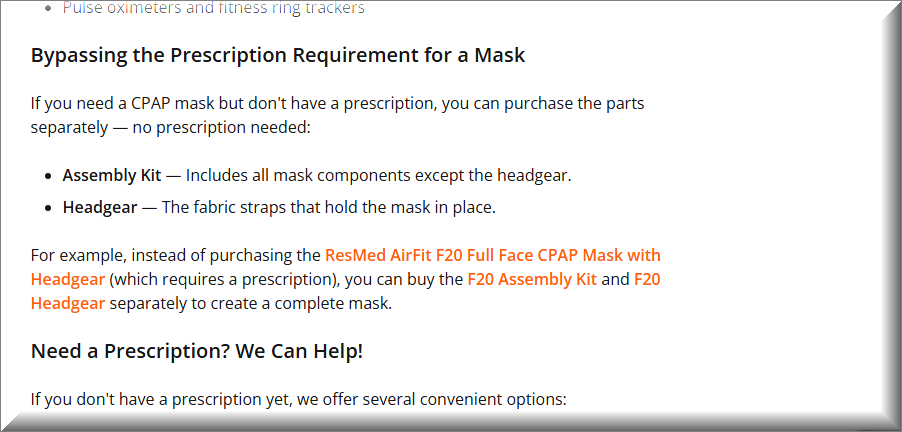
The seller quotes the rule, then publishes the route around it, two screens apart.
Is the component split legal? We went looking for the document that settles it and did not find one. Not the accessories guidance, not either Federal Register classification action on accessories, not 801.109, not the product classification records. None of them address selling the parts of a prescription mask separately without a prescription. That is a recorded absence, not a verdict. Anyone who tells you the workaround is clearly allowed, or clearly forbidden, is filling a gap the agency has left open.
What we could not establish
We searched the accessories guidance, both Federal Register actions on accessory classification, the prescription device labelling rule, and the product classification records for masks. No document addresses component sales of a prescription mask. If a warning letter or an enforcement policy on this appears, this section gets rewritten with the quote in it.
There is a smaller detail worth knowing before you order anywhere. On the same retailer’s page, one of the offered routes to a prescription runs after payment: you place the order, then look on the invoice for the section that asks you to confirm the prescription. The wall is real. It is just not always where you would expect to hit it.
CPAP, APAP, or bilevel: which one do you actually need?
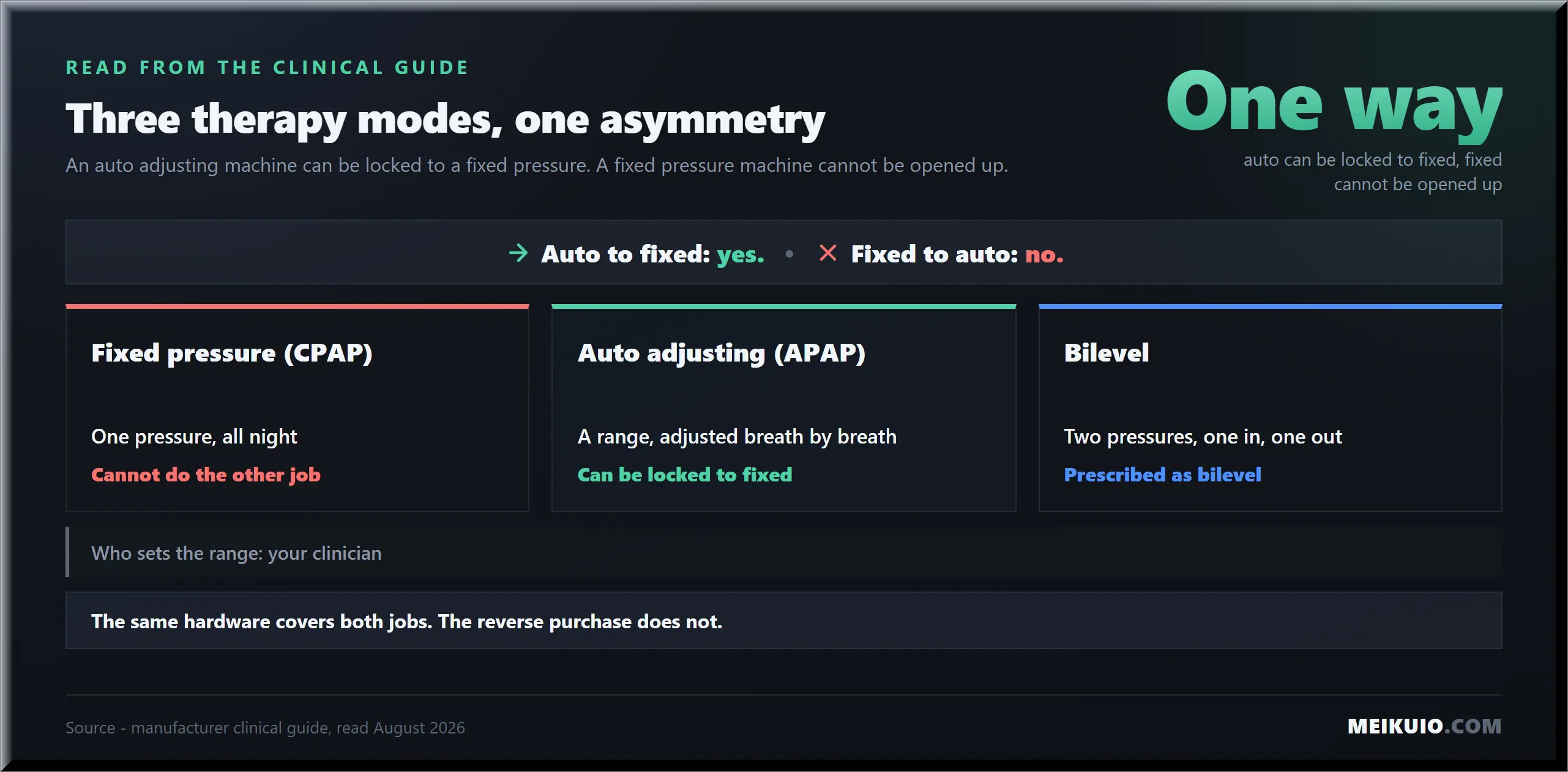
Start with the therapy mode, not the brand, because it decides which CPAP machine can serve you at all. A fixed pressure machine (CPAP) delivers one pressure all night. An auto adjusting machine (APAP) moves the pressure up and down inside a range your clinician sets. A bilevel machine delivers a higher pressure when you breathe in and a lower one when you breathe out, and it is a clinical step up, not a luxury tier.
One asymmetry decides most of this, and it is documented rather than debatable. An auto adjusting machine can be set to deliver a single fixed pressure. A fixed pressure machine cannot be opened up into an auto adjusting one. ResMed’s clinical guide for the AirSense 10 puts it in one line: “In CPAP mode, a fixed pressure is delivered, with optional Expiratory Pressure Relief”. The same hardware covers both jobs. The reverse purchase does not.
Home sleep testing is now the common route to diagnosis, and it returns severity rather than a single ideal pressure. That is the practical argument for buying hardware that can do both. It is also the argument the machine makers make, so weigh it accordingly. Your prescription decides. Nothing on a product page overrides it.
How we picked, and what we refuse to claim
We ranked no best CPAP machine by feel. Six criteria decided the order, and every one of them can be checked by a reader with a browser and ten minutes. Where a manufacturer does not publish an answer, we say so instead of guessing.
- Standing in the public registers: is there a current clearance, is the line named in a recall record, has the maker received a letter from the regulator.
- What the manual documents rather than what the storefront claims: modes, behaviour after a power cut, whether a patient menu exists at all.
- Who holds your therapy data: a card you can remove, an app, or a portal only your supplier can open.
- Whether the fittings are standard: a hose and mask that work across brands, or a proprietary lock.
- Whether the supply chain is legible: is the company that made the machine the same one whose name is on it.
- Availability through both routes, cash and supplier.
What is missing from that list is deliberate. There is no “quietest in our testing”, because we did not run a sound meter. There is no “best value”, because that is a judgement about a price, and prices in this category move weekly. We are a paper trail, not a lab. On a prescription device, the paper trail happens to be where the surprises are.
The best CPAP machine choices in 2026, by what the documents show
Three families dominate what American buyers are actually offered when they search for the best CPAP machine, and the published record on each is very different. Below is what we could document, and where the record runs out.
ResMed AirSense line: the best documented machine for a first-time buyer
The ResMed AirSense line is the best documented CPAP machine a first-time buyer can check before owning it, and what the documents say is favourable. The user guide states that “If power is interrupted during therapy, the device will automatically restart therapy when power is restored”. That sentence matters more than any specification on the box if you live somewhere the lights flicker. The same guide documents a patient menu, called My Options, and frames it plainly: your provider set the device up, and you may still want small adjustments for comfort.
The clinical guide confirms the mode asymmetry above, and the symbols page carries the prescription statement in the manufacturer’s own words: “Prescription only (In the US, Federal law restricts these devices to sale by or on the order of a physician).” Nothing here is a scoop. It is simply a company that publishes enough for a buyer to check the claims.
Philips DreamStation line: read the power-loss line before you buy
The published manual answers the same question in the opposite direction: “During therapy, if there is a mains interruption (i.e. power loss) the device will return to the Home screen once power is restored. You may resume therapy as needed.” Therapy does not resume on its own. If you are buying for someone who will not wake up and notice, that single line is a purchase criterion. If the outages where you live come with storms, our guide to the best emergency radio checks which weather radios will wake that same sleeper for a warning in their county.
The same manual is unusually direct about who controls the settings. It documents patient menus, then states the limit: “You cannot change settings in the Provider menu”, and, on the individual settings, “If a lock icon is displayed on this screen, it indicates that your provider has locked this setting and you cannot change it”. That is not a complaint from a forum. It is the manufacturer describing the arrangement.
This line also carries the longest recall history in the category, which we cover further down. Both things are true at once.
React Health Luna line: the one you should check before ordering
The React Health Luna line is the CPAP machine five of the ten guides name as a pick, usually the value or budget option, and it is the line with an open federal recall and a warning letter behind it. The full sequence is in the next section, because it deserves more than a line. The short version: do not order a React Health Luna machine without checking its model reference and serial number against the recall record first.
The machines we could not document, which is itself information
Plenty of other CPAP machines are sold in the United States, and we tried to document them the same way. On August 21, 2026 we opened the manufacturer pages for several smaller lines and came away with almost nothing. One returned four words of text. Another returned twenty seven. Two would not load at all. That is not a verdict on the hardware, and it would be dishonest to present it as one.
It is, though, a real fact about buying. If you cannot open a manual before you order, you cannot check the power loss behaviour, you cannot check whether a patient menu exists, and you cannot check where your data goes. For a prescription device that will sit beside your bed for years, a CPAP machine whose documentation you can actually read is worth more than one with a longer feature list you have to take on faith.
Fisher and Paykel was the one maker in that group that does publish properly: its product page loaded and offered downloadable documents. We have not read them line by line yet, so we are not ranking that CPAP machine here, and its absence from our picks is about our reading, not about the hardware. When we finish, this section gets updated rather than quietly rewritten.
A word on travel CPAP machines
A travel CPAP machine is a second machine, not a first one. The compact units trade away the sound baffling and the heated humidification that make a bedside unit tolerable night after night, and several rely on waterless cartridges or proprietary mask fittings. If motor noise or partner disturbance remains an issue in hotel rooms or at home, our benchmark of the best noise-cancelling headphones for sleeping in 2026 evaluates low-profile earbuds designed for overnight wear. If you fly a few times a year, the travel bag that came with your main CPAP machine will serve you better than a second purchase.
If you genuinely live out of a suitcase, the calculation flips, and the question becomes the same one as everywhere else in this guide. Can you read the manual before you buy it, and does the maker document what happens when the power goes.
Note
“Not publicly documented” means exactly that. We looked for a public manual or specification page and did not find one we could open on August 21, 2026. It is not a judgement about the machine. It is a statement about what a buyer can verify before paying.
What the FDA said about the machine five guides pick
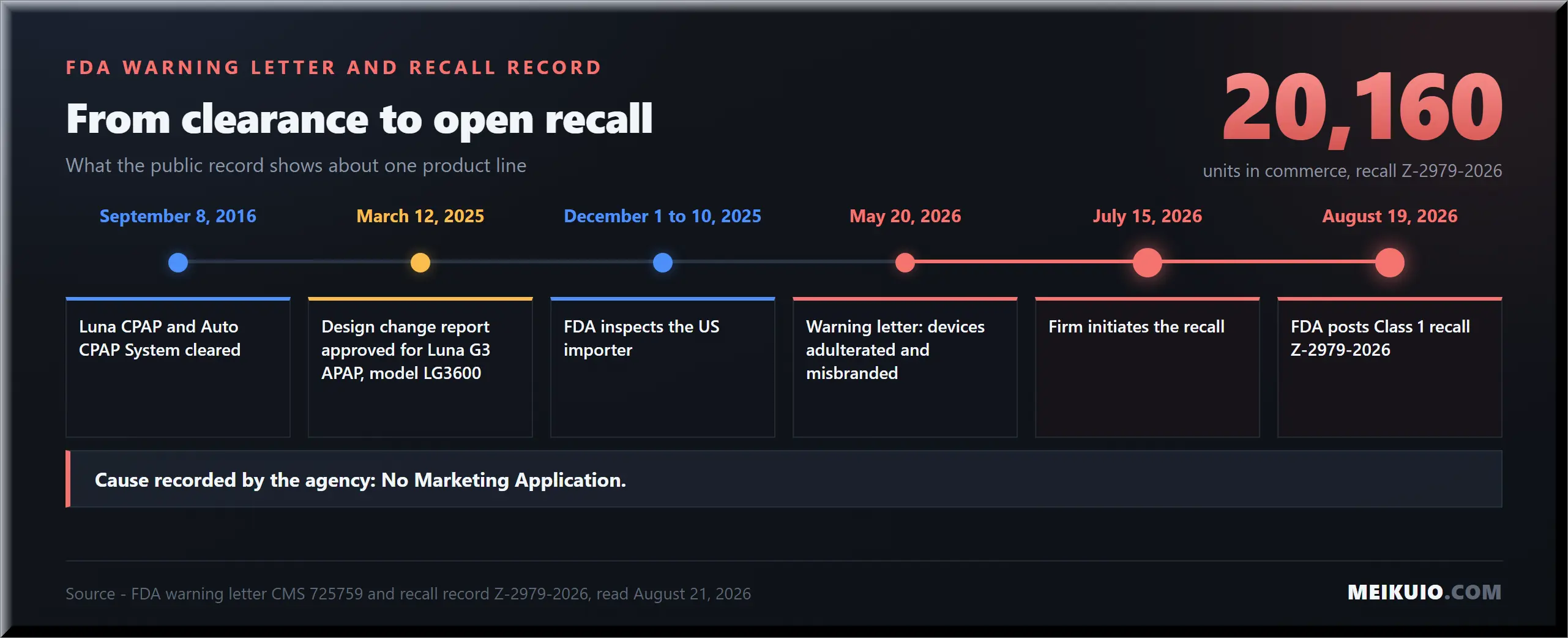
On May 20, 2026 the FDA sent a warning letter to a manufacturer in Beijing. The letter followed an inspection, held December 1 to 10, 2025, of a company in Dublin, Ohio that imports the machines. It states that the Beijing firm “is the specification developer and 510(k) owner of various ventilator devices that are imported to the United States”, including auto adjusting machines sold under a brand name most American buyers have never seen on a listing.
The letter then says what the agency found. The devices “are adulterated” and are “misbranded”, because significant design changes went into commercial distribution without a new premarket notification. The changes are itemised: firmware gained new recognition features, the sound abatement system was altered, and the circuit board received a new chip. The letter’s conclusion is one sentence long: “These design modifications to the cleared Luna APAP appear to have given rise to a new model branded as G3X APAP.”
Two of those firmware additions are worth translating, because they are not cosmetic. Flow limitation detection is how a machine spots an airway starting to narrow before it closes. Respiratory effort related arousal detection is how it spots the events that fragment sleep without registering as full apneas. A CPAP machine that gains those abilities is behaving differently at three in the morning than the one that was cleared. That is the whole reason a design change of this kind is supposed to go back to the agency first.
The clearance those changes departed from was granted on September 8, 2016. The design change report the agency reviewed was approved on March 12, 2025. Between those two dates, a machine that a buyer would reasonably assume was the cleared product had, in the agency’s account, become a different one.
Then, in August, the recall
The recall record is public and reads like an epilogue. Class 1, the most serious grade. Recall number Z-2979-2026. Initiated by the firm on July 15, 2026 and posted by the agency on August 19, 2026. Status: open and classified. Quantity in commerce: 20,160 units. The recalling firm is the Beijing manufacturer. The reason the firm gave is “Retroactive reporting for 2024 rework conducted at the 3B/React Health warehouse”. The cause the agency recorded is shorter: “No Marketing Application”.
That phrase is the whole story compressed. In this database, no marketing application means the agency concluded the units went to market without the clearance they needed. It is the recall counterpart of the warning letter above, which said the same thing in longer form.
Take the model references with you, because the storefronts do not use them. The recall record names the product as Luna G3 APAP, reference LG 3600. The warning letter concerns a model branded G3X APAP, reference G4600, and cites a design change report filed for the Luna G3 APAP, model LG3600. Those are the strings that identify a machine. Luna G3X, React Health Luna G3 APAP and 3B Luna II are the names it is sold under.
A Class 1 recall was posted on August 19, 2026. Five of the ten guides ranking two days later still pick a machine from that line, and none of them name the manufacturer.
Be careful with what that does and does not mean. A warning letter states what a regulator alleges, not what a court has found. A recall covers listed units with listed serial numbers, and nothing in the record says the machine on a shelf today belongs to that batch. What the record does mean is that the model designation and the serial number are now things you check before you pay, the same way you would check whether a router is still cleared for sale.
One product line, three different names
Look at how the same family is presented across the field. One guide calls it the Luna G3X. Another lists it under the American importer’s name as the Luna G3 APAP. A third sells it as the 3B Luna II, using the importer’s former trading name. Three storefronts, three labels, one manufacturing lineage that none of them mentions.
This is the same pattern we found when we mapped the ownership behind the Grammarly alternatives everyone compares. The difference is that here the answer sits in a federal database, and it changes what a recall notice means to you. If you do not know that three names share one maker, a recall filed under the fourth name looks like somebody else’s problem.
Why is the mask, not the machine, the thing that decides?
The CPAP machine gets the research, the mask decides whether the therapy survives the first month. A leak at the bridge of the nose wakes you at three in the morning no matter what the algorithm underneath is doing. A cushion that presses a sore spot ends therapy faster than any specification on a comparison table.
The buying guides invert this. They spend their word count on chassis and app screens, then treat the interface as an accessory in a closing paragraph, the same way a marketing label gets treated as a product category. Meanwhile the mask is the part with the strange legal status described earlier, sold whole with a prescription and in pieces without one.
There are three broad interface shapes, and they suit different faces and different sleepers. Nasal pillows sit at the nostrils and are the smallest, which side sleepers tend to prefer. A nasal cradle covers the nose without pressing the bridge, which helps if that is where you get sore. A full face mask covers nose and mouth, which is what you need if you breathe through your mouth at night, and it is the largest and the most leak prone.
None of that is a function of the CPAP machine you bought. A cushion that seals badly leaks the same air whichever chassis is pushing it. The algorithm can even make matters worse, because an auto adjusting CPAP machine that reads a mouth leak as an obstruction may raise pressure against it, which widens the leak. That interaction is the practical reason experienced users talk about the mask first and the CPAP machine second.
Practical version: budget your patience for the mask, not the machine. Expect to try more than one. Ask what the return policy on a used cushion is before you order, because that is where the real cost of a wrong choice sits.
Who gets your sleep data?
Modern CPAP machines report. Some carry a cellular modem that transmits nightly usage without touching your home network. Some write full resolution data to a memory card you can remove and read yourself. Many do both, and the difference between them is not a feature comparison. It is a question of who holds the record of your nights.
The manufacturer’s manual for one major line documents the arrangement without embarrassment. There is a patient menu, and there is a provider menu you cannot enter. Individual settings can carry a lock icon, and the manual explains that the icon means your provider has locked it and you cannot change it. Whether that is reasonable depends entirely on what you think the machine is for. It is worth deciding before, rather than after.
If the idea of a device in your bedroom reporting to a third party is new to you, it should not be. It is the same question we worked through when we counted how many data brokers hold a file on the average American, and how few any service removes, and the same one behind the marketing label attached to phones. The difference is that here the data is clinical and the third party may be deciding whether your insurer keeps paying.
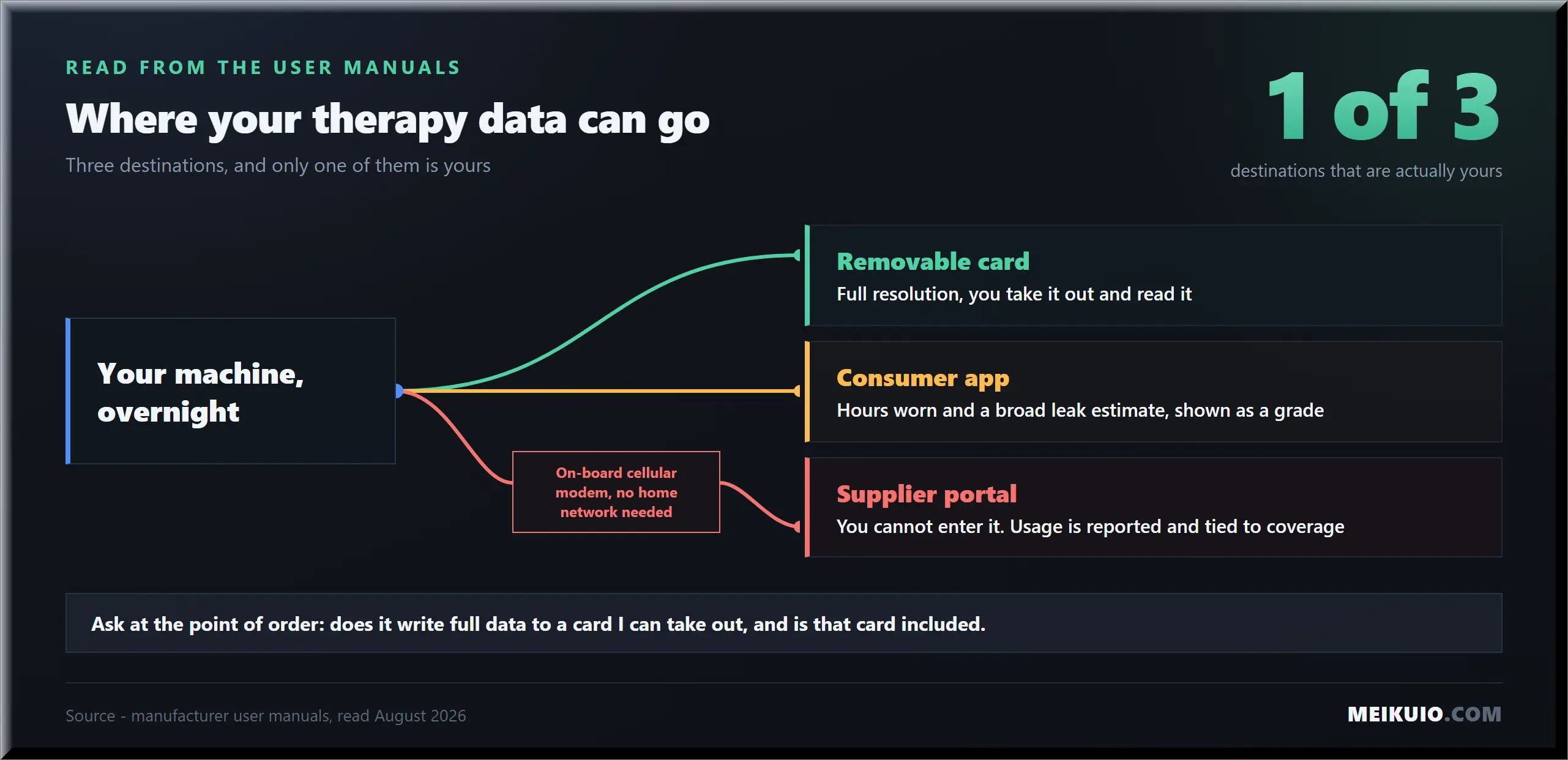
Ask one question at the point of order. Does this machine write full data to a card I can take out, and is that card included. If the answer is no, or the answer is a shrug, you are choosing a machine whose record of your therapy lives somewhere you cannot reach.
Insurance channel or paying cash?
Both routes to a CPAP machine exist, and they bill you for different things. The cash route is a single purchase, with resupply when you decide you need it. The insurance route usually runs through a contracted equipment supplier, which may rent the machine to you over a period, bills a negotiated rate, and puts you on a resupply schedule that is not yours to set.
We are not going to tell you which is cheaper, because that depends on a deductible we cannot see. What we will say is what each side is billing for, because that is the part people misjudge.
The usage requirement is the part newcomers rarely see coming. Coverage for a CPAP machine is commonly conditioned on demonstrated use, measured by the machine itself and reported onward. Fall below the threshold and the conversation stops being clinical and becomes contractual. Read that in your own plan documents before the machine arrives, because it is the mechanism that turns a comfort problem into a coverage problem.
It also explains the cellular modem. A CPAP machine that reports on its own, without touching your home network, is solving a billing problem elegantly. Whether it solves one of yours is a separate question, and the honest answer is that it depends on whether you would rather hold the data or have the paperwork handled. Both positions are defensible. Only one of them is the default, and you can find out which by asking who ends up holding the record.
One structural detail is worth knowing regardless of which route you take. Several of the businesses in this market run both. A single company can operate a national insurance billing operation and, separately, a cash storefront that states plainly that it does not accept insurance and will hand you an itemised receipt instead. Comparing “the online store” against “the insurance company” can mean comparing one firm’s left hand with its right.
What the spec sheet oversells
Five numbers get quoted constantly on CPAP machine listings and separate almost nothing. Knowing which ones they are saves you from paying for a difference that does not exist.
- Maximum pressure separates almost nothing, because clinical machines all reach the top of the clinical range. What differs is how smoothly the pressure gets there, and no spec sheet reports that.
- The decibel figure was measured in a sound treated chamber at low resistance. Your bedroom has a hose, a mask vent and a wall between you and the neighbour. That number does not travel.
- A bigger water chamber does not fix poor temperature control. Condensation pooling in the hose is a regulation problem, not a volume problem.
- App scores are hours worn and a broad leak estimate, presented as a grade. They cannot show you flow limitation, which is what an experienced clinician actually looks for.
- A colour touchscreen has no therapeutic value whatsoever, and it is harder to operate half asleep in the dark than a dial you can find by feel.
One more, because it costs people money. Marketing that suggests a machine only performs properly with a mask of the same brand does not survive contact with the hardware. Standard hose fittings are standard. Buy the mask that fits your face.
How do you check a machine’s clearance yourself?
You can verify the standing of any best CPAP machine pick in this guide in about ten minutes, and you should, because records change. Two public FDA databases carry everything you need: the 510(k) Premarket Notification database, which lists cleared devices, and the Medical Device Recall database. Both live on the agency’s own site, both are free, and neither requires an account. Here is the order to do it in.
- Write down the exact model designation from the listing, not the marketing name. The recall we describe is filed against a model reference, and storefronts often show only the family name.
- Search the 510(k) Premarket Notification database by device name or applicant name. A 510(k) is the premarket notification a maker files to show a device is equivalent to one already on the market, so the two names refer to the same thing. The result page shows the clearance number, the applicant, the regulation number and the decision date.
- Read who the applicant is. If the name on the clearance is not the brand on the box, you have found an import relationship, which is worth knowing before you own the thing.
- Search the device recall database for the manufacturer’s name. Read the status field. Open means the recall is still running.
- If the family appears, compare the serial number against the listed ones before you pay, and ask the seller in writing if the listing does not show it. If the number is on the list, do not buy that unit. A seller who cannot tell you the serial before payment is asking you to take the one risk this whole check exists to remove.
One thing the database will not tell you
A clearance attaches to a device type and a submission, not to the individual unit in your box. The Federal Register notice that reclassified these machines says it directly: the action “is applied to a particular device type and not an individual device”. That is precisely the gap the warning letter above describes, where a cleared design was modified into something the clearance no longer covered.
This is the same habit that protects you when you buy anything the government keeps a register of. We used it on routers and on beginner drones, after the FCC blocklist changed which ones are sold in the US, and it works the same way here.
The other recall, and why it is not this one
If you have shopped for a CPAP machine before, you already know about a recall. In June 2021 Philips Respironics recalled millions of sleep and ventilation devices because a polyester based polyurethane foam, used to quieten the machines, could break down and release particles or gases. It was graded Class 1, the most serious level. The record puts the quantity in commerce, meaning the number of units that had already been distributed, at 15,357,775 devices, of which 10,307,186 were in the United States, while the agency’s own prose has described it as roughly fifteen million. We quote both rather than pick one. Recall number Z-1972-2021, if you want to look it up.
That recall spawned others that are separate events with their own numbers, covering reworked machines returned to patients. Those are not the same recall, and their unit counts must never be added together. One later action covered 13,811 reworked units in the US. Another covered 1,088 machines that had received incorrect or duplicate serial numbers, which the agency warned could mean therapy delivered at the wrong prescription, or no therapy at all, with no indication to the user.
None of that is the August 2026 recall described earlier. Different manufacturer, different device family, different cause. The buying guides that mention recalls are all still describing the 2021 event. That is the tell. They are working from a file that stopped being updated.
Audit occurred two days after FDA posted the recall. Three of four guides promising to watch recalls recommend a machine from that line. Counts overlap; no percentage of separate mutually exclusive groups is implied.
What if you already own the CPAP machine in question?
Do not unplug anything on the strength of a web page, including this one. A recall record is not an instruction to stop therapy, and untreated sleep apnea carries risks of its own. What the record gives you is a reason to make two calls, in the order that gets you an answer fastest.
- Find the model designation and serial number on the label underneath your CPAP machine, and write both down before you call anyone.
- Check them against the recall record yourself. The affected serial numbers are published in full, and the status field tells you whether the action is still open.
- Call whoever supplied the machine rather than the manufacturer, if it came through insurance. The supplier holds your account and any loaner arrangement.
- Then speak to the clinician who wrote the prescription, before you change anything about your therapy.
If your CPAP machine is not on the list, you are done. If it is, you now know something the buying guides did not tell you, and it took about ten minutes. That is the same reflex that protects you on hardware the government keeps a register of, and it costs nothing to build.
What we would skip: ozone and ultraviolet cleaners
Do not buy an ozone or ultraviolet cleaner for your CPAP machine. The FDA safety communication is unambiguous: the agency “has not authorized for market any products using ozone gas or ultraviolet (UV) light to clean, disinfect, or sanitize continuous positive airway pressure (CPAP) devices and accessories (for example: hoses, masks, tubing and headgear).”
The counterargument deserves a hearing, because it is not stupid. For someone with arthritis or poor dexterity, a push button chamber is the difference between cleaning the equipment and giving up on cleaning it. That is a real accessibility problem. It is just not solved by a product category the regulator says was never authorised for the job.
Warm water and mild soap, and let the parts dry. It is dull advice, and it is the advice the manufacturers themselves print.
Which machine fits which person?
Your prescription rules all of this, and it names the kind of machine you are allowed to buy. There is no single best CPAP machine for everyone, only the best one for a given set of constraints. Within what your prescription allows, these are the situations where the documented differences actually change the answer.
- If this is your first machine, favour an auto adjusting unit that can be locked to a fixed pressure, because your titration may still move. Ask for the data card while you are ordering, not after.
- Buying for an older parent puts the power loss line first. Choose the machine whose manual promises automatic restart, not the one that returns to a home screen and waits for someone to notice. Then find out who can reach the settings menu when something needs changing at nine in the evening, because if the answer is a supplier with office hours, that is the machine you are choosing.
- If outages are frequent where you live, ask about vendor supported battery operation as well. A machine that restarts by itself is still a machine that was off while the power was out, and the manuals treat battery support as a separate question from restart behaviour.
- Replacing a recalled machine means doing the database check first rather than last. Bring the model designation with you, not the family name.
- If you want to hold your own data, the requirement is a removable card, full resolution, included in the box. Confirm all three in writing before ordering.
- If you fly often, treat the manufacturer’s “meets FAA requirements” line as what it is, a claim by the manufacturer. The rule itself leaves the decision with the airline, which under 14 CFR 121.306 determines what portable electronic devices may be operated on its aircraft. Carry the manual page.
- When insurance is paying, ask which supplier, whether the machine reports usage, and what happens to your coverage if you fall below the threshold. The answer sits in your plan documents, and reading it before the machine arrives beats reading it after a denial, the same way you would check what protection the law already gives you before buying more of it.
Who is telling you this, and what do they earn?
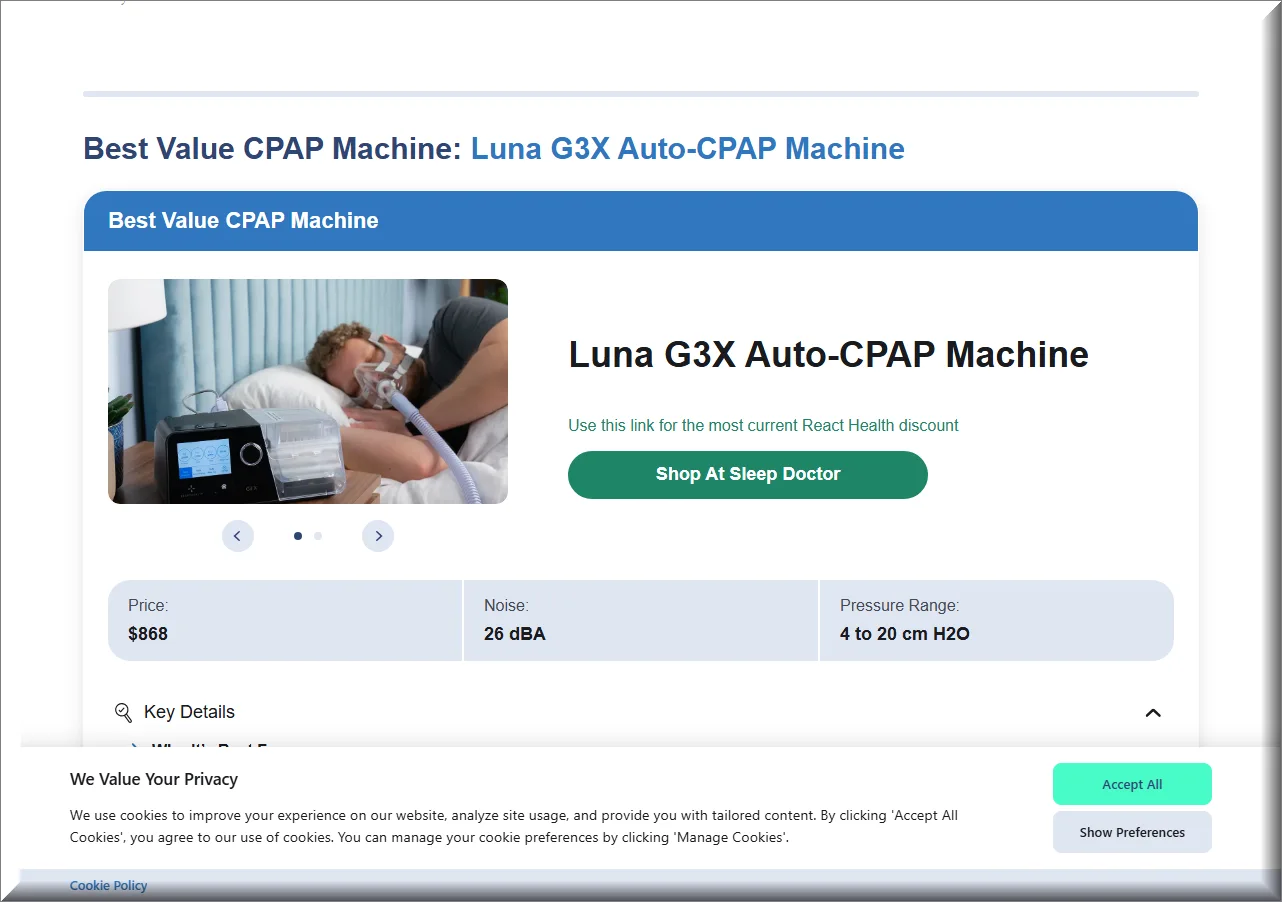
We read the ten pages that rank for best CPAP machine on August 21, 2026 and counted what is in them. Two of the ten are retailers writing about their own stock. One is a publication whose masthead carries the name of the retailer it links to, twelve times on a single page. Others send their buy buttons out through affiliate networks, retailer domains or their own tracking subdomains, and the counts are not small.
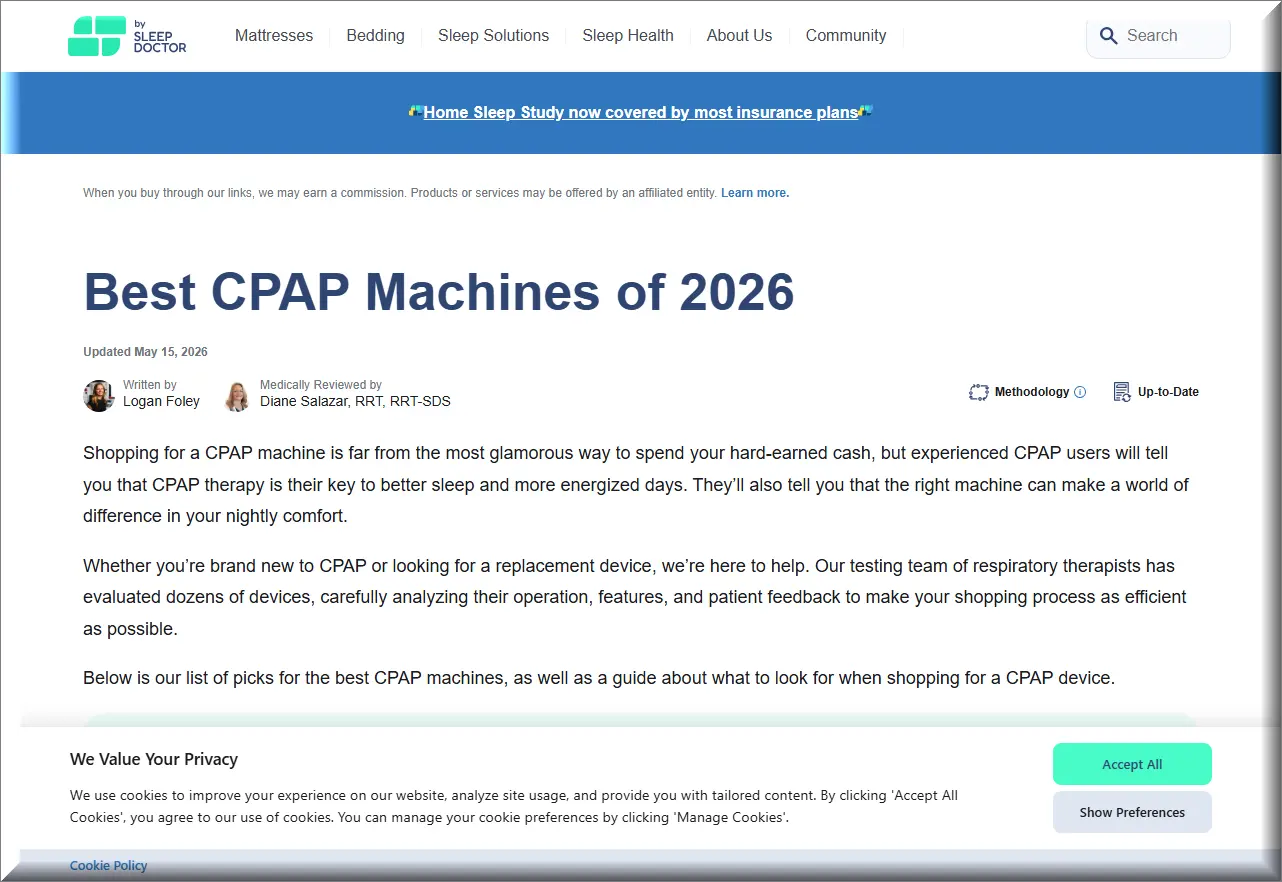
The counting is dull and it is the point. One page carries thirty outbound links into a single affiliate network and seven more into a second one. Another routes seventeen links through a redirect on its own subdomain. A third sends nineteen readers to one retailer and six to another. One of those two retailers runs 5,504 words about how to choose a CPAP machine and uses the word prescription twice, the first time at ninety six per cent of the way down the page, on a storefront whose own support pages will not process an order without one.
None of that is hidden and none of it is unusual. What is unusual is what the arrangement produces. Four of these pages tell readers that recall history matters. One says in its methodology that it considers product recalls, describing them as devices taken off the market over a potential safety issue. A second states that it monitors product recalls and manufacturer reputations. A third runs a section called CPAP Recalls, advising readers to watch for recalls tied to a particular machine. A fourth built a recall history row into its comparison table.
Three of those four then pick a machine from the family under an open Class 1 recall, and where any of them names a specific recall, it is the 2021 one. If that pattern feels familiar, it is the one we found when we worked out how much of a paid protection promise the law already covers for free.
The fair reading
The page that names the value pick carries an updated date of May 15, 2026, five days before the warning letter existed. Nobody hid anything. The point is not concealment, it is cadence: a guide that promises to weigh recalls has not been revisited in three months, and in those three months its pick acquired a warning letter and a Class 1 recall.
There is one more count worth having. Across all ten pages, the recall number appears zero times. The phrase warning letter appears zero times. The word adulterated appears zero times. The name of the company that actually makes the machine appears zero times. Where any of those pages names a specific recall, it is the 2021 one. None of them names the recall posted this month.
If you want the shorter version of why that happens, look at where the buy buttons go, then look at the same dynamic across AI gadgets, where the buy button funds the verdict. A page that earns when you click cannot afford to be the page that tells you not to.
Field notes
- The regulation: positive airway pressure systems sit in Class II under 21 CFR 868.5273, product code QBY; the word prescription appears inside the definition itself; the classification took effect October 19, 2018.
- The open recall: Class 1 recall Z-2979-2026 covering a Luna G3 APAP model, 20,160 units, initiated by the firm July 15, 2026, posted August 19, 2026, status open and classified; the cause the agency recorded is “No Marketing Application”.
- The warning letter: issued May 20, 2026 to the Beijing manufacturer that owns the clearance, following an inspection of the US importer conducted December 1 to 10, 2025; the letter calls the devices adulterated and misbranded.
- The field: across ten guides ranking for this search on August 21, 2026, the recall number appears zero times, the phrase warning letter zero times, and the manufacturer’s name zero times, while five of the ten name a machine from that product line as one of their picks.
- The mask question: no public agency document addresses selling the components of a prescription mask separately; the absence was recorded after searching the accessories guidance, two Federal Register actions and the labelling rule.
- Power loss: ResMed’s manual promises the device will restart therapy automatically when power returns, while Philips’ DreamStation manual says it returns to the home screen and you may resume as needed; both lines are quoted from the published manuals.
- Sources: 21 CFR 868.5273 and 801.109; Federal Register classification 2018-22840; FDA warning letter CMS 725759; FDA recall records Z-2979-2026 and Z-1972-2021; FDA safety communication on ozone and ultraviolet cleaners; manufacturer user and clinical guides.
Frequently Asked Questions
Do you need a prescription to buy a CPAP machine?
Yes. Whatever the best CPAP machine turns out to be for you, you cannot buy it without one. A positive airway pressure delivery system is classified as a Class II device under 21 CFR 868.5273, and the regulation’s own definition calls it a prescription device. Separately, 21 CFR 801.109 requires the Rx only statement on the label. Retailers will not process a machine order without a prescription on file, though at least one offers to obtain one on your behalf after you have placed the order.
Can you buy a CPAP mask without a prescription?
A complete mask sold as a unit requires a prescription. Retailers also sell the same mask as separate components, an assembly kit plus headgear, and state that no prescription is needed for the parts. We looked for a public FDA document addressing whether that split is permitted and found none. Treat it as an open question rather than a settled permission.
What is the difference between CPAP and APAP?
A CPAP machine delivers one fixed pressure all night. An APAP machine adjusts pressure within a range set by your clinician. The practical difference is one directional: an auto adjusting machine can be configured to deliver a fixed pressure, and ResMed’s clinical guide documents exactly that, while a fixed pressure machine cannot be turned into an auto adjusting one.
How do I check whether a CPAP machine has been recalled?
Use the FDA device recall database and search by manufacturer name, then read the status field. Open means the recall is still running. Take the exact model designation from the listing rather than the marketing name, because recalls are filed against model references. If the family appears, compare your serial number against the listed ones before paying.
Is the Luna G3X affected by a recall?
A Class 1 recall numbered Z-2979-2026 was posted on August 19, 2026 covering 20,160 units of a Luna G3 APAP model, with the cause recorded as no marketing application. Separately, a May 20, 2026 warning letter describes design changes to the cleared Luna that the agency says produced a model branded G3X APAP, and calls those devices adulterated and misbranded. Check the specific model designation and serial number against the recall record before ordering.
Will a CPAP machine restart by itself after a power cut?
It depends on the machine, and the manuals disagree. ResMed’s user guide states that the device will automatically restart therapy when power is restored. Philips’ DreamStation manual states that after a mains interruption the device returns to the home screen and you may resume therapy as needed. If you are buying for someone who will not wake and notice, that difference matters more than most specifications.
Can I change the pressure settings on my own machine?
Partly, and the manuals are explicit about the limit. Machines document a patient menu for comfort settings. They also document a provider menu you cannot enter, and individual settings that can be locked, with the manual explaining that a lock icon means your provider has locked it. Prescription settings are changed on the order of the supervising physician, not by you.
Are ozone or UV CPAP cleaners safe to use?
The FDA safety communication states that the agency has not authorized for market any products using ozone gas or ultraviolet light to clean, disinfect or sanitize CPAP devices and accessories, naming hoses, masks, tubing and headgear. Manufacturers also warn that such devices can affect materials inside the machine and void warranties. Warm water and mild soap remain the documented method.
My Take
Every best CPAP machine list I read this week was written by someone with a commission at stake, so I spent this piece reading databases instead of unboxing hardware, and the databases were more useful. A federal agency wrote to a manufacturer in May and said its machines were adulterated. In July the firm started a recall. On August 19 the agency posted it, Class 1, twenty thousand units, cause recorded as no marketing application. Two days later I read the ten pages Americans see when they search for a machine, and the number appeared nowhere. Five of them picked that line anyway. Three of those five had told their readers, in writing, that they watch recalls.
Here is what I would do. Get the prescription, take the model designation from the listing rather than the family name, and spend ten minutes in the recall database before you spend anything else. Ask one question at the point of order: does this come with a card I can pull out and read. If the seller cannot answer that in a sentence, buy elsewhere. And if the machine is going to a parent’s house, read the power loss line in the manual first. That paragraph is worth more than every decibel rating on the page.