

A robot dog can cost you $29.99, or it can have no published price at all. Four different machines share the name: a toy, a pet, a development platform, and an industrial tool its maker will not sell you. Here is what each actually costs, and what happens after the money leaves your account.
- What do people actually mean by “robot dog”?
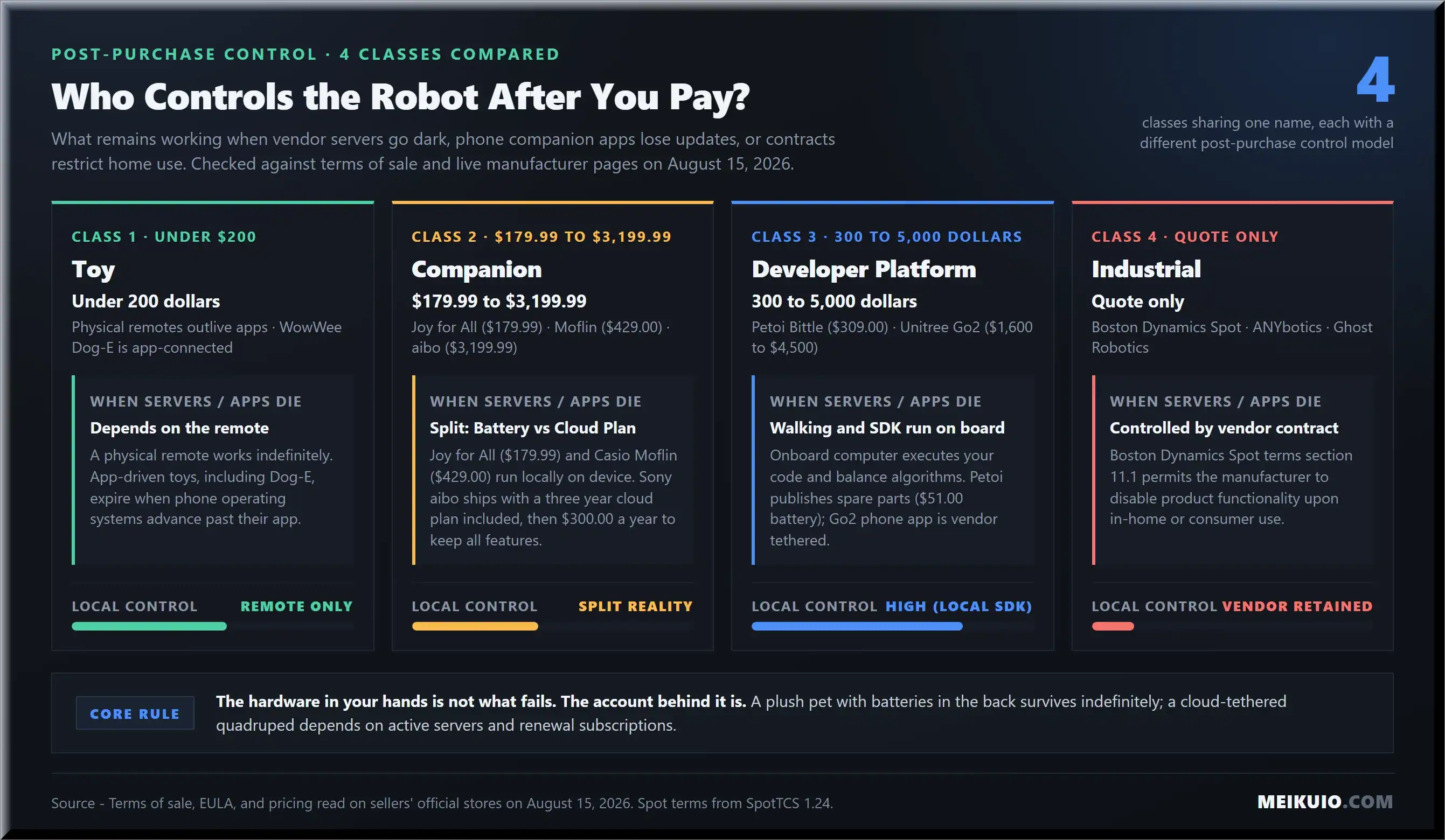
- What happens to a robot dog when the servers go off?
- The hardware in your hands is not what fails. The account behind it is.
- Who wrote the buying guide you are reading?
- Toys and gifts: how to spot the fake robot dog
- Buying a robot pet for someone with dementia
- For dementia care, every feature that needs an account is a feature that can be taken away.
- Companion robot dogs: what the subscription really buys
- Developer quadrupeds: why the sticker is not the price
- Ask one question before you pay: is this DDP or DAP, and who is the importer of record?
- Industrial quadrupeds: the class with no price tags
- The famous robot dog that is not sold to you
- Take a seventy pound industrial robot home and use it casually, and the contract lets the manufacturer switch it off.
- Announced, admired, unavailable
- You can build one instead
- The robot dog graveyard
- What owning one is actually like at home
- A developer quadruped is a project, not a pet. Buy it for the code, not the company.
- Are robot dogs safe around children and pets?
- What changed in this market during 2026
- Which robot dog should you buy?
- Frequently Asked Questions
- How much does a robot dog cost?
- Can I buy a Boston Dynamics Spot?
- Does a Sony aibo work without the subscription?
- Is Sony discontinuing the aibo?
- Are the cheap robot dogs advertised on social media real?
- Is Tombot Jennie FDA approved?
- What extra costs come with importing a robot dog?
- Does a robot dog need wifi to work?
- How long does a robot dog last?
- Where should you buy a robot dog?
- Which robot dog is best for a child?
- Can a robot dog replace a real pet?
- My Take
The search results will not tell you which one you are looking at. I read the sale terms, the cloud plan agreements and the shipping policies for every machine below, and I checked every price on the seller’s own page on August 15, 2026. Several of those prices do not match what the top-ranking guides are printing.
What do people actually mean by “robot dog”?
A robot dog is any four-legged machine built to read as a dog, and that definition covers four product classes that have almost nothing in common. A twenty dollar plastic toy with a remote and an industrial inspection robot sold by quotation both answer to the name. They do not share parts, purpose, software, price, or buyers. The single most useful thing you can do before spending anything is work out which of the four you are shopping for.
You can usually tell which class you are looking at within a few seconds of landing on a product page. If the page leads with tricks and colours, it is a toy. If it leads with personality, memory and how the machine grows, it is a companion, and there is probably a plan attached. If it leads with payload, torque and an SDK, it is a developer platform. And if the page has no price and a contact form where the buy button should be, you have found the industrial tier.
Sorting them by price is the obvious move and it fails immediately. A palm-sized developer kit and a plush companion pet sit within a few dollars of each other, and one of them needs you to compile firmware. Sorting by who it is for fails too, because the retired teacher buying a soft companion and the retired engineer building a walking robot are the same demographic on paper. What separates them cleanly is what the machine does all day and who controls it once it is yours.
That last column is the one nobody prints. It is also the one that decides whether you still own a working machine in three years, and it is where the rest of this guide lives. If you are here because you saw a two-legged machine rather than a four-legged one, the money question there works differently, and I covered it in what a humanoid robot costs.
More Read
What happens to a robot dog when the servers go off?
Ask this before you ask about price. A robot dog that needs a vendor’s servers to think stops being a robot dog when those servers go dark, and the hardware in your living room has no say in it. This is not a hypothetical failure mode. It has already happened to thousands of owners, and the pattern repeats often enough that you can plan around it.
The clearest case is not a dog at all. Anki built a small desktop robot called Vector, went under, and the brand ended up with Digital Dream Labs. Servers went offline for weeks at a stretch while the company called it scheduled maintenance. Owners logged what that felt like from the inside, and the sentence that stuck with me was short: “I just got this paperweight last week from Amazon.”
The billing kept running. One owner wrote that the company “deducted $74.99 from my checking account” during the outage and added, “There is no way to access your account to delete your information.” Another described the only exit they could find: “I charge it back every month, have cancelled my cards now twice.” The machine stopped working and the subscription did not. Volunteers eventually wrote a local server called Wire-Pod so people could get speech back without the company. That is the ceiling of the community fix. It exists, and it required strangers to rebuild the vendor’s infrastructure for free.
The hardware in your hands is not what fails. The account behind it is.
Robot pets are not alone in this. The same thing is happening to a well-known building kit whose companion app has a published switch-off date, which I covered in the guide to robot kits for adults. So the question to put to any machine on your shortlist is narrow and answerable: with no subscription and no internet, what is left? For a plush companion pet with batteries in the back, everything is left. For a cloud-tethered robot with a camera and a face-recognition database, the honest answer is usually that nobody has written it down. That silence is a finding, and I will come back to it when we get to the most famous companion robot on the market.
Who wrote the buying guide you are reading?
Before the picks, one thing about the field itself, because it changes how you should read every other list you open today. I searched the obvious terms and looked at who owns the pages that come back. For “best robot dog,” six of the nine results were published by companies that manufacture and sell robot dogs. For a buyer’s guide query with the year attached, it was seven of nine.
Five of those pages belong to one company. Keyi Tech makes a robot called Loona and runs a buying-guide section that reviews the category Loona competes in. Loona wins. The page I measured runs 2,135 words, mentions Loona ten times, and contains no disclosure that the publisher sells one of the products being judged. It also contains no prices at all, which is a strange thing for a buying guide to leave out. Petoi runs the same play at smaller scale, with a “best robot dog” page comparing its own Bittle to Spot and aibo.
None of this is illegal and none of it is hidden in the technical sense. The company name is in the domain. But a person searching for a gift does not know that keyirobot.com is Loona’s manufacturer, and nothing on the page tells them.
How to check this yourself?
Open any robot dog list and look for two things. First, does the domain match a brand that appears in the ranking? Second, does the page name a price for every product, or only for the ones it dislikes? A guide that recommends a product without printing what it costs is selling you something, and it is usually the product at the top.
We sell nothing here. The tradeoff is that I have not lived with these machines for a year, and I will tell you where my knowledge stops rather than filling the gap with adjectives.
Toys and gifts: how to spot the fake robot dog
The cheapest end of this market has a problem that has nothing to do with robotics. Search “robot dog for kids” and one of the top ten results is a site calling itself the official home of the number one rated robot puppy. It is a drop-ship storefront. The product in those ads is a battery-powered plush worth a few dollars wholesale, sold on video that was generated rather than filmed.
You can see how normal this has become from the competition. The strongest independent guide in this category runs a FAQ, and two of its four questions are people asking whether specific advertised robot dogs are real. That is what parents are typing. Not “which is best.” Just: is this thing a scam.
What you are being sold in those ads is not a cheap robot dog. It is a stuffed animal filmed to look like one, and the price is set at the point where most people will not bother with a refund. The tells are consistent and you can check them in under a minute. The brand name appears nowhere except its own store and paid ads. There is no company address, no support page, no manual, and no parts. Reviews on the site are five stars and undated, while reviews anywhere else are furious. The ad shows a machine walking on four articulated legs; the product photos show a stuffed animal on wheels. If you cannot find the toy on a major retailer under the same name, that is your answer.
The same pattern runs through cheap consumer electronics generally, and I applied the same test to the wider category in the best AI gadgets of 2026. Real toy robot dogs come from companies you can look up. WowWee is the obvious one, and its Dog-E is a genuine toy that a child can operate. It is also app-connected, which puts it on the wrong side of the rule I am about to give you, so weigh that before buying: the toy works, and the phone app it depends on is outside your control. Note too that WowWee does not print a price on its own Dog-E page. Not a high price, not a low one. None. You will buy it from a retailer at whatever that retailer charges, which is why quoted figures for it move around so much.
My honest position on the toy tier: I am not going to name a single winner at $150, because the products that fit the rule are interchangeable and the shelf changes every season. What I can give you is the rule itself, which does not expire. Buy from a manufacturer with a support page and a parts list, prefer a physical remote to a phone app, and check the model exists at a major retailer before you buy it anywhere else. Every toy that passes those three tests is a reasonable gift. Every one that fails is a coin flip.
The app is the expiry date
A toy that needs a phone app to do its tricks has a shelf life set by the app store, not by the plastic. When the manufacturer stops updating that app for a new phone operating system, the tricks go with it, and this has already happened to a generation of app-connected robot pets. If the toy is a gift for a young child, a model with a physical remote will outlive one with an app, every time.
Buying a robot pet for someone with dementia
This is the buyer the search results serve worst, and it is not close. Type the obvious query and you get metal quadrupeds that cost thousands and do backflips, or plastic toys that break in a week. The machines actually designed for this job sit below both, under listicles ranking robots by speed and camera specs.
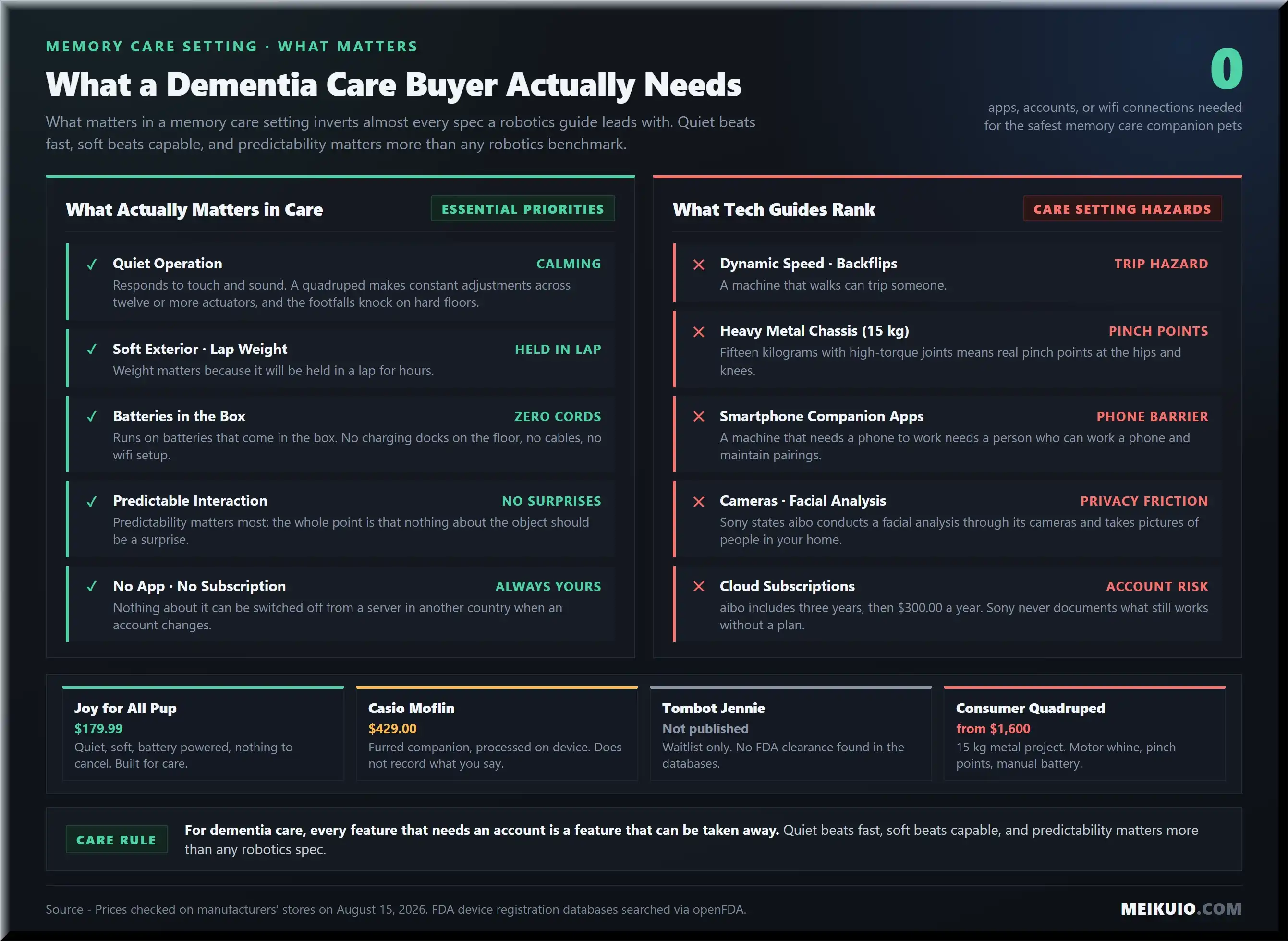
What matters in a memory care setting inverts almost every spec a robotics guide leads with. Quiet beats fast, and soft beats capable. A machine that walks can trip someone, and a machine that needs a phone to work needs a person who can work a phone. Weight matters because it will be held in a lap for hours, and predictability matters more than any of it, because the whole point is that nothing about the object should be a surprise.
Against that list, the Joy for All Companion Pet Pup from Ageless Innovation is the machine most of these buyers are looking for, and it costs $179.99 on the company’s own store. It runs on batteries that come in the box. There is no app, no account, no wifi, and no subscription. It responds to touch and sound, and when the batteries die you buy batteries. Nothing about it can be switched off from a server in another country. Families buying one for a parent with dementia should also read what care robots for the elderly can and can’t do, including what the trials found for robot pets.
For dementia care, every feature that needs an account is a feature that can be taken away.
The other name in this space is Tombot, whose puppy Jennie is built specifically for dementia and PTSD, and here you need to read carefully. Tombot does not publish a price. I checked the site: there is no dollar figure anywhere on it. What the company does publish, on its investor page, is this sentence: “Tombot anticipates our patent-protected puppies will be the first to be FDA medical devices.” Anticipates. Will be. That is a plan, not a status. Read a vendor page for what it leaves out, not what it promises; the same test sorted the quantum key distribution vendors into those who print a number and those who print an adjective.
The distinction matters because press coverage has repeatedly described Jennie as FDA-regulated in the present tense, and one company press release from 2021 uses that exact phrasing. A search of the FDA’s own databases for device clearance, premarket approval and registration returns nothing under either the company name or the product name. There is no clearance, no designation, and no reimbursement pathway today. If someone is telling you insurance may cover it, that is a future the company hopes for, not a benefit you can claim.
The waitlist terms are equally plain, and Tombot deserves credit for writing them down: signing up “does not lock in pricing, a firm production slot, a firm delivery date, or specific product feature or configuration.” Nothing there is a scam. It is an unfinished product, described honestly on its own site and described inaccurately almost everywhere else.
Companion robot dogs: what the subscription really buys
This is the class most people picture, and Sony’s aibo is the machine it is measured against. It is also where I found the largest gap between what the guides print and what the seller charges.
Sony’s own US store lists the aibo Companion Robot at $3,199.99, in stock, with a delivery date attached. Nearly every guide currently ranking for this topic says $2,899. That number is three hundred dollars stale, and it is repeated so widely that it has become the consensus figure for a product whose actual price sits one click away on the manufacturer’s site. Check the seller’s page before you budget.
Then there is the plan, and the good news comes first. The product listing states the robot “Includes 3 year A.I. Cloud Plan,” so nothing extra is due in year one. What arrives in year four is a separate item in Sony’s own store: “aibo AI Cloud Plan Renewal (12 month),” $300.00, listed next to the water bowl and the charging station cover, with the note “aibo not included.”
So the real number to plan around is $3,199.99 for the robot and the first three years, then $300.00 every year after that. Five years of ownership costs $3,799.99. Ten years costs $5,299.99, which is more than the robot.
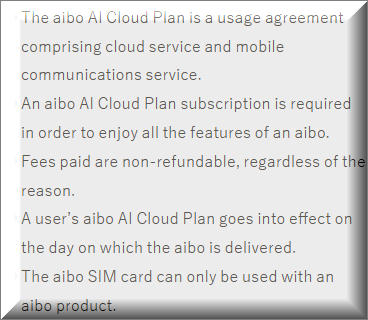
The plan page is direct about what the money is for: “An aibo AI Cloud Plan subscription is required in order to enjoy all the features of an aibo.” The next line is “Fees paid are non-refundable, regardless of the reason.” A third line tells you the clock starts before you have taught the robot anything: the plan “goes into effect on the day on which the aibo is delivered.”
Three hundred a year for software attached to hardware you already own is the same arrangement the rest of the technology industry has settled into, and it lands in the same place as the subscription maths I ran in what AI subscriptions actually cost. Two more details sit further down the same page and I have not seen either of them in a buying guide. Your activation code expires twelve months after Sony emails it to you, whether you have used it or not. And you cannot stack codes: one robot, one active code, no buying three years cheap when you have the money.
Now the part Sony does not write down. The page says a subscription is required for all the features. It never says which features survive without one. I read the plan page and the end user agreement, and neither contains a list of what an unsubscribed aibo can still do. You cannot learn, before buying a three thousand dollar robot, what you will own when you stop paying three hundred a year for it. That is the single most important unanswered question in this category, and the answer is not published.
The clock that started in June
In June 2026 Sony announced it is ending sales of aibo in Japan, with the current ERS-1000 model selling until stock runs out. US sales continue and no end date has been given. Read that next to Sony’s own support policy, which promises functional repair parts “for a period of 7 years after discontinuation of the product.” The seven year window is the one that matters, and in the home market it has started counting. Sony did this once before: the original aibo line ended in 2006, and the company later stopped maintenance entirely, citing a lack of available spare parts.
Two smaller names round out this class and both are worth a look if the big two do not fit. Elephant Robotics sells animatronic companion pets that sit between a plush toy and a full robot dog, aimed at people who want presence rather than capability. Hengbot’s Sirius is the newest entrant and the most ambitious, and it comes with a caveat serious enough that I gave it its own section below.
Casio sells a different bargain. Moflin is a small furred companion, $429.00 on Casio’s US store, and it is deliberately not a dog and deliberately not connected. Casio states that “Collected data is processed locally on Moflin and does not include any personally identifiable information,” and answers the microphone question with a flat “No. Moflin does not understand or record what you say.” There is no required plan to keep it alive. It also does not walk, recognise your face, or patrol the house. That is the trade: less machine, fewer strings. The split between processing that happens on the device and processing that happens on someone’s server is the same one that decides how much a phone depends on its maker, which I broke down in what an AI phone actually runs on device.
The privacy column deserves its own sentence, because these machines live in bedrooms. Sony’s privacy policy states that “an aibo Product conducts a facial analysis of those it observes through its cameras,” and the support documentation adds that when the robot is on patrol it “takes pictures of people in your home.” Sony is also clear that this is not a security product and should not be treated as one. None of that is hidden. It is simply not in the buying guides, and it is the kind of thing a person might want to know before putting a camera on legs in a parent’s apartment.
Developer quadrupeds: why the sticker is not the price
Unitree’s Go2 is the machine most people end up buying when they want something that genuinely walks. The company’s own page lists a ladder: AIR at $1,600, PRO at $2,800, and X at $4,500. The EDU tier has no number at all, just an instruction to contact a sales expert. Underneath the ladder, in small type, sits the phrase that changes the arithmetic: “Tax and freight excluded.”
Unitree’s shipping policy spells out who carries that cost. “Your order may be subject to customs duties upon arrival in your country and the resulting tariff costs will be borne by the buyer.” The same page notes that “All robot dog shipments are sent from China, and the global shipping arrival time is expected to be 20-45 business days,” and warns that the battery makes inspection likely along the way. On the product pages the company repeats it plainly: duties are not included, and if the goods come back because you did not clear them, you pay the freight again.
How big is that in practice? Robots built in China fall under the Section 301 trade measures, which sit on top of ordinary import duty, and most of the broad product exclusions from the last round have expired. The rate that applies to any particular machine depends on the tariff code it is classified under, and I am not going to print a percentage for your order that I cannot tie to your paperwork. What owners report is blunter than any schedule. One US buyer of a Go2 wrote simply: “Also customs charges were over $800.”
Ask one question before you pay: is this DDP or DAP, and who is the importer of record?
That question is not academic. One US reseller sells the Go2 on terms of “DDP (Delivered Duty Paid) Shipping fees and Duties included in the prices” and sells the wheeled Go2-W on terms of “DAP (Delivered at Place) Shipping fees included in the prices Duties not included in the prices.” Same seller, same catalogue, two neighbouring products, and whether a customs bill lands on your doorstep depends on which page you happened to open.
Tax and freight excluded. A US buyer reported more than 800 USD in customs on one machine; it is not a fixed universal surcharge or an exact landed total. Shipping and battery inspection costs unpublished; transit 20–45 business days. DDP includes duties; DAP leaves them with the buyer. One reseller lists Go2 DDP and Go2-W DAP in the same catalogue. Ask who is importer of record before paying.
The second thing the sticker hides is access. Buyers who assume the entry tiers give them full programmatic control find otherwise: native robotics middleware sits behind the higher developer editions, and people who bought the cheaper models describe spending weeks bridging network layers to get where they thought they already were. If you want the robot for code rather than for demos, the tier you need is the expensive one, and that decision belongs at the start.
At the other end of this class, Petoi’s Bittle costs $309.00 on the company store and does something none of the big quadrupeds do: it publishes a spare parts catalogue, with a replacement lithium battery listed at $51.00, plus assembly and calibration documentation. It is palm-sized and it will not carry a payload across a warehouse. It will also still be repairable in three years, which is more than the machines above it can promise. If building rather than buying is closer to what you want, the assembled-from-parts end of this world is its own category, and I ranked it separately in the guide to build-it-yourself robot kits.
Batteries decide what these machines actually do with a day. One Go2 owner measured it honestly: “the battery life is anywhere between 3 hours of standing around or 1 hour of continuous jogging.” The same owner tried the obvious application, night patrols of a warehouse, and hit a wall that no spec sheet mentions: the robot “can’t be set to wake up on command,” waking it takes most of a minute of manual work, and “You have to manually remove the battery to charge the dog.” Put a serious compute module on top and the power draw climbs again, with one developer measuring roughly 120 to 135 watts just idling.
Every price on this page, and when I read it
All figures below came off the seller’s own page on August 15, 2026, not from a review site. Sony aibo Companion Robot $3,199.99 including a three year cloud plan, renewal after that $300.00 a year. Casio Moflin $429.00. Joy for All Companion Pup $179.99. Petoi Bittle $309.00. Unitree Go2 AIR $1,600, PRO $2,800, X $4,500, EDU by sales enquiry, tax and freight excluded. Boston Dynamics Spot, no published price. Tombot Jennie, no published price. Plushie Spot $29.99. Prices in this category move, and the gap I found on the aibo shows how fast a repeated number goes stale.
Industrial quadrupeds: the class with no price tags
Above the developer tier sits a class that is not sold to consumers at all, and it is bigger than the one company everyone names. Boston Dynamics is the famous one, covered next, but it is not alone in the market. ANYbotics builds inspection machines aimed at energy and chemical plants, including hazardous-area rated variants. Ghost Robotics works the defence and perimeter security side. Deep Robotics competes across both the developer and industrial ranges, and Unitree sells its own heavier B-series into the same work.
None of them publish a price. The pattern is consistent across the entire class: a contact form, a qualification conversation, and a quote built around your site, your payload and your service agreement. Buyers at this level are also buying annual software licensing for fleet management and autonomy, which is a recurring line item rather than a one-time purchase, and the machines are heavy enough that shipping them is a freight problem rather than a parcel. The same split runs through wearable machines: exoskeletons print a price where a private buyer decides, and stop printing one the moment an employer or an insurer does.
This matters to a consumer for exactly one reason. When a guide quotes you a number for an industrial quadruped, that number came from a third party, not from the manufacturer, because the manufacturer does not print one. Treat it as an estimate of someone else’s deal. The autonomy stack that makes these machines useful is closer to the fleet software behind driverless vehicles than to anything in a toy, and I looked at how that gap between demo and deployment plays out in the robotaxi comparison.
The famous robot dog that is not sold to you
Everything above is a product. Boston Dynamics’ Spot is the machine that made people search for robot dogs in the first place, and it is not sold to private buyers. To be precise about what follows, none of this is law. It is the company’s own policy and the contract you would have to sign, which is a lower bar than a legal prohibition and a higher one than a suggestion. The company’s FAQ says it directly: “our products are not intended for purchase by individuals for non-commercial use.” Spot is described there as “a powerful, 70 lb. industrial robot” that “is not intended for use in the home, or by children or others who cannot operate it responsibly.”
There is no price on the product page. Not a starting figure, not a range. The button says contact sales. Before a sale is authorised, the company says it runs a check: “We cross-check every purchase request against the U.S. Government’s denied persons and entities lists, prior to authorizing a sale.”
The terms you would sign are published as a PDF on the company’s own site, which is rarer than it sounds, and worth reading before you form an opinion about this machine. The document opens with a warning in capitals: Spot “IS NOT INTENDED FOR IN-HOME USE OR USE NEAR CHILDREN OR OTHERS WHO MAY NOT APPRECIATE THE HAZARDS ASSOCIATED WITH ITS OPERATION.” That is a safety statement. The clause that matters more is further down.
Section 11.1 says the software licence “will automatically and immediately terminate, and we may disable some or all Product functionality,” upon a list of triggers. Weaponisation is on that list, as you would expect. So is illegal use. And so is this: “unstructured use of the Product in the home or other ‘consumer’ environments.” Section 8.1 separately forbids you from attempting to “decompile, disassemble, teardown, reverse engineer, or copy any Product or any Software.”
Take a seventy pound industrial robot home and use it casually, and the contract lets the manufacturer switch it off.
This is the machine class that shows up in headlines about robots taking over work, and the gap between the headline and the payroll is wide enough that I counted it in the jobs robots are actually doing. Read that against the toy tier for a moment. A drop-ship storefront takes forty dollars and sends you a plush animal. Boston Dynamics takes whatever the quote says, vets you against a government list, and keeps the power to remotely disable what you paid for. Both transactions leave you owning less than you thought. Only one of them tells you so in writing, on a public page, before you sign.
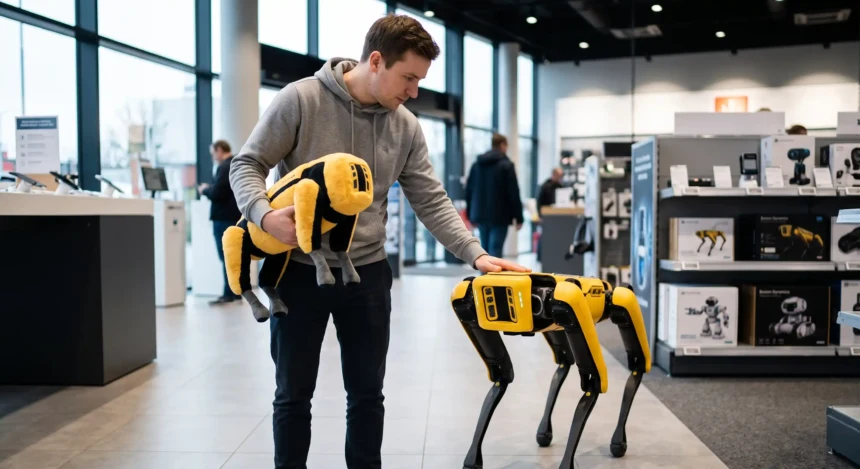
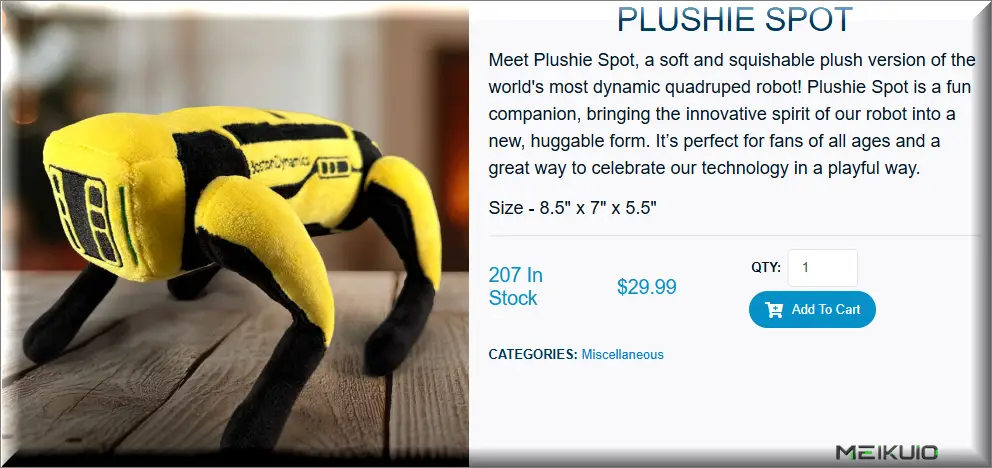
There is one Spot you can buy today with a normal checkout, and I found it on the company’s own merchandise store. It is a plush toy, 8.5 inches long, $29.99, and the page showed 207 in stock with an Add To Cart button that works. A pewter replica of the same robot sits nearby at $199, reduced from $499.99. That is the entire consumer product line: a stuffed version and a statuette.
Announced, admired, unavailable
A robot dog can be real, widely covered, genuinely impressive, and still not something you can order. Two examples are worth knowing because both appear on lists as if you could.
Hengbot’s Sirius raised $912,768 from 1,150 backers and the numbers are printed proudly on its home page. Early units shipped, and reviewers were kind about the concept and unkind about the execution. Gizmodo’s reviewer found it “would often get tripped up” and then “flop to the ground.” TechRadar wrote that it “can walk, bark, growl, dance, stand on its head, and fall over quite a bit.” Backer complaints are specific rather than vague: missing remote controls, no working app, promised educational material absent, support going quiet.
I went to buy one anyway, to see what the checkout said. The store has no products in it. The collections page returns a single line: “Sorry, there are no products in this collection.” The company is still collecting waitlist signups on the front page while the shelf behind it is empty.
Tombot, covered earlier, is the second case: extensive press, real clinical intent, no published price, and a waitlist that explicitly promises nothing about timing or configuration. Neither company is doing anything dishonest. The dishonesty happens downstream, in guides that list both machines next to products you can actually receive this week, with a confident dollar figure attached to each.
You can build one instead
There is a fourth option the buying guides skip entirely, because there is nothing to sell in it. A large part of the people searching for a robot dog are looking to build one, and the open-source designs for doing that are free.
Stanford’s Pupper is the best known. Read the repository before you start, because the team is candid about where the project stands: “We are hard at work building the new version, Pupper v3, and so would like to stop supporting this project (Pupper v1).” The parts list is not trivial either, with custom carbon fibre pieces, 3D printed parts, a power distribution board and motors. The project’s own estimate for sourcing everything yourself lands between six hundred and a thousand dollars, which puts a home-built quadruped in the same bracket as a factory-made entry model.
The Open Dynamic Robot Initiative’s Solo is the healthier project of the two, released under a BSD licence with hardware drawings published so the robots “can easily be reproduced by other research laboratories,” and with repository activity through 2026. SpotMicroAI is the third name you will meet, and its own README sets expectations plainly: it is “maintained by a community of volunteers and is very much still in its early stages.”
What you get for the trouble is the one thing no purchase on this page offers. Nobody can switch it off. There is no account, no plan, no clause about consumer environments, and no server that can go dark. What it costs you is a year of evenings, and what you have at the end of them is a machine nobody else controls. Whether that trade is worth it depends entirely on whether you enjoy the evenings.
The robot dog graveyard
Old buying guides never die, they just keep ranking. Several robot dogs that are widely recommended online are discontinued, and some of them lost their software before they lost their shelf space. If you are shopping secondhand, or reading a list that has not been touched in three years, these are the names to check.
There is a second graveyard, made of machines that never reached a US shelf as consumer products. Xiaomi’s CyberDog was widely covered as a consumer robot dog, and while units do reach US buyers as developer imports, there is no local warranty or support pipeline behind them, which is a different purchase from the one the coverage implies. Amazon’s household robot went invite-only and then pivoted away from consumers entirely. Weilan’s AlphaDog had a marketing moment and effectively no North American presence afterwards. All three still turn up in listicles as things you might casually buy.
I looked for official end-of-support notices for the app-driven toys in that table and could not find them. Not on the manufacturers’ sites, not on their privacy or support pages, not in the app store listings. That absence is the point. For the original aibo line there is a public record, including Sony’s promise at the time to keep parts available for seven years and the later reporting that maintenance had ended for lack of them. For the toys, the software simply stopped mattering and nobody published a date.
Note
Hardware outliving its own support window is not unique to robots. It is the same problem I hit measuring firmware and update commitments in the guide to picking a router, where the useful life of the box and the supported life of its software are two different numbers.
What owning one is actually like at home
The specification sheets skip the parts of ownership you notice on day three. Noise is the big one. A dynamically balanced quadruped makes constant high frequency adjustments across twelve or more actuators, and on tile, laminate or hardwood the footfalls add a hard percussive knock on top of the motor whine. Videos hide this behind music. Living rooms do not.
Floors matter more than buyers expect. Smooth surfaces are the worst case: feet slip, which degrades the robot’s own estimate of where it is, and the correction shows up as jerky steps or a fall. Deep carpet is the opposite problem, raising resistance, heating the joints and draining the battery faster. Household animals rarely enjoy any of it. The shape reads as a threat, the sound has no natural analogue, and unlike a real dog it does not respond to the signals another animal sends.
Then there is the novelty curve, which is the honest reason most of these machines end up in a cupboard. One Go2 owner, after describing what he had hoped to do with it, wrote the ending plainly: “I apologize that I sold the dog on Ebay after about 5 months.” His warning to the next buyer was that the machine “is not really designed to be a companion robot, so it will probably be disappointing for what you want to use it for.”
A developer quadruped is a project, not a pet. Buy it for the code, not the company.
What breaks first is predictable. Gearboxes strip under the shock of repeated falls, hip and knee linkages fracture when the machine trips sideways, batteries degrade under high discharge in a tight compartment, and charging docks miss their alignment on carpet or in glare. Repair options depend entirely on which class you bought into, which is why the spare parts question at purchase time is worth more than most of the specification sheet.
The four classes answer that question very differently. Petoi publishes a parts catalogue you can shop, down to a $51.00 replacement battery. Sony repairs aibo off site and commits to seven years of functional parts after discontinuation, with one condition worth knowing before you throw out the box: the support documentation says you need “all the packing materials, including the package box, used at the time of your purchase” to send the robot in. Boston Dynamics forbids you from opening the machine at all under section 8.1 of its terms. And for imported quadrupeds, there is generally no domestic service depot, which means a failed actuator turns into an international shipping decision.
Weight is the quiet variable in all of this. A consumer quadruped in the Go2 class runs around fifteen kilograms, which is a real object falling on a real floor, and a seventy pound industrial machine is in a different category of consequence entirely. Small robots survive their own falls. Large ones damage what they land on. The flying end of the hobby has the same problem in reverse, and I went through the practical version of it in the guide to beginner drones, where the first crash decides how much the hobby actually costs.
None of this makes a robot dog a bad purchase. It makes it a purchase with a maintenance profile, like a bicycle or a drone, and the guides that present these machines as appliances are the ones setting buyers up for disappointment.
One more thing worth sitting with before you put a connected machine in a bedroom. These devices carry cameras and far-field microphones, and the companion apps that manage them are the same attack surface as any other connected household device. If you want a sense of how casually voice and video data get repurposed once it leaves the room, I wrote about the mechanics in how AI voice scams actually work.
Are robot dogs safe around children and pets?
Safety splits along the same four classes, and the answer changes completely between them. The short version: the soft companion pets are the safe end, and the risk climbs with weight and torque.
Battery-powered companion pets carry no meaningful mechanical risk. Nothing moves fast, nothing carries load, and the joints have no strength to trap a finger. Toys sit near the same place, with the usual caveats for small children that apply to any battery-powered toy, and manufacturers publish age ratings for a reason. Petoi puts its Bittle at ten and older, which is a fair marker for the small programmable class generally.
Consumer quadrupeds are where judgement is required. A Go2-class machine is roughly fifteen kilograms moving under its own power with high-torque joints, which means real pinch points at the hips and knees and real consequences when it falls on a foot. Boston Dynamics states the case for the industrial tier plainly, and it applies in miniature to anything that walks: the machine is not intended for use “near children or others who may not appreciate the hazards associated with its operation.”
Real animals are a separate question, and the honest answer is that most of them hate it. The shape reads as a threat, the motor noise has no natural equivalent, and the machine cannot return any of the signals a dog or cat sends. Distress rather than injury is the usual outcome, but a frightened animal near a moving fifteen kilogram robot is its own hazard. If you have pets, introduce the machine while it is switched off and stationary, and take the reaction seriously.
What changed in this market during 2026
Four things moved this year, and each one dates any guide written before them.
Sony announced in June that it is ending aibo sales in Japan once current stock is gone. That is the flagship of the entire companion category winding down on its home market while continuing to sell in the US, and it starts the clock on a parts commitment that runs seven years from discontinuation.
The price everyone quotes for that same robot went stale. Guides across the first page still print $2,899 while Sony’s own store charges $3,199.99. That is not a rounding difference, and it is a good demonstration of how a number gets copied between articles until nobody checks the source.
The counterfeit tier professionalised. A robot dog scam now arrives with generated video, a domain that calls itself an official site, and enough search visibility to outrank real manufacturers on a query a parent would type. The product behind it did not improve; the marketing did.
And the import maths got heavier for the developer class. Chinese-built quadrupeds carry trade-measure duty on top of ordinary import duty, most of the older product exclusions have lapsed, and the manufacturers have written the consequence into their own shipping policies rather than absorbing it. The sticker price of an imported robot dog now describes less of the total than it did two years ago.
Which robot dog should you buy?
Match the machine to the job and the choice gets simple. Here is where each buyer lands after everything above.
Whichever row you land on, run these five checks on the seller’s own page before you pay. They take about ten minutes and they catch nearly everything that goes wrong in this category.
- Find the price on the manufacturer’s site, not in a guide. If the manufacturer does not print one, you are in a quote-only or waitlist product, whatever the article said.
- Search the page for the word subscription, plan or membership. If a plan exists, find out what stops working without it, and if that is not documented anywhere, treat the robot as rented.
- Check whether shipping terms say duties are included. On imported machines this is the difference between the sticker and a customs bill.
- Look for a spare parts page. Its absence tells you the expected lifespan better than any warranty statement.
- Check whether it needs an app, and whether the maker still updates that app. An unsupported app is an expiry date on a working machine.
If none of those rows fit, the honest answer is to buy nothing this year. The category is moving, the cheap end is full of fraud, and the expensive end is asking you to rent your own robot indefinitely. Waiting costs you nothing. Most of the people whose posts I read while writing this wish they had.
For anyone whose real interest is the software rather than the legs, a phone already runs more capable models than any of these machines, and I compared what that hardware can do locally in the best AI apps for iPhone.
Frequently Asked Questions
How much does a robot dog cost?
From $29.99 to no published price at all, depending on which of the four classes you mean. Toys sit under $200. Companion pets run from $179.99 for a Joy for All Pup to $3,199.99 for a Sony aibo, and the aibo includes three years of its cloud plan before a $300.00 annual renewal starts. Developer quadrupeds start at $309.00 for a Petoi Bittle and climb to $4,500 for the top consumer Unitree Go2 tier, before freight and customs. Industrial machines are quote only, and the manufacturers do not publish prices at all.
Can I buy a Boston Dynamics Spot?
Not as a private individual for personal use. Boston Dynamics states that its products “are not intended for purchase by individuals for non-commercial use,” and buyers are screened against US government denied party lists before a sale is authorised. The published terms of sale go further: casual use of the robot in a home or consumer setting is listed among the triggers that automatically terminate the software licence and allow the company to disable product functionality. This is company policy and contract rather than law. You can buy the plush version from the company merchandise store for $29.99.
Does a Sony aibo work without the subscription?
Sony does not publish an answer, and that is the finding. The company states that “An aibo AI Cloud Plan subscription is required in order to enjoy all the features of an aibo,” and the end user agreement says certain features and functionality “may be available only to those who subscribe.” Neither document lists what an unsubscribed robot can still do. Fees are described as non-refundable regardless of the reason, and the plan starts on the day the robot is delivered.
Is Sony discontinuing the aibo?
In Japan, yes. Sony announced in June 2026 that it is ending domestic sales of the current ERS-1000 model once stock is exhausted. US sales continue and no end date has been announced. The detail that matters for buyers is Sony’s parts policy, which commits to keeping functional repair parts available for seven years after a product is discontinued. Sony ended the original aibo line in 2006 and later stopped maintenance entirely, citing a lack of available spare parts.
Are the cheap robot dogs advertised on social media real?
Usually not. The pattern is a drop-ship storefront with a brand name that exists nowhere else, generated video showing a walking quadruped, and a delivered product that is a battery-powered plush toy. Check whether the brand appears at a major retailer, whether there is a support page and a manual, and whether any review outside the seller’s own site exists. If the ad shows articulated legs and the product photos show wheels, that is your answer.
Is Tombot Jennie FDA approved?
No. Searches of the FDA’s device clearance, premarket approval and registration databases return no records for Tombot or Jennie. The company’s own investor page uses future tense, stating that Tombot “anticipates our patent-protected puppies will be the first to be FDA medical devices.” Some press coverage and one company press release have described the product as FDA-regulated in the present tense, which is not supported by the databases. Do not buy it expecting insurance reimbursement.
What extra costs come with importing a robot dog?
Freight, customs duty, brokerage handling and sometimes required accessories. Unitree states plainly that “the resulting tariff costs will be borne by the buyer,” ships from China with an expected 20 to 45 business day transit, and warns that the battery makes inspection likely. Robots built in China also fall under Section 301 trade measures that sit on top of ordinary import duty, at a rate that depends on the tariff code the machine is classified under. One US owner reported customs charges above $800 on a single machine. Ask any seller whether the terms are DDP or DAP before paying.
Does a robot dog need wifi to work?
It depends on the class, and this is the single question that separates a machine you own from a machine you rent. A battery-powered companion pet like the Joy for All Pup needs nothing at all. Casio states that Moflin processes its data on the device. A Sony aibo is built around a cloud service and a mobile connection, and the company sells the plan as a required part of the experience. Developer quadrupeds sit in between: they walk without the internet, but the phone app and some higher functions expect a connection.
How long does a robot dog last?
Mechanically, longer than the software. The parts that wear are gearboxes, leg linkages and batteries, and all three are replaceable if the manufacturer sells parts. What usually ends a robot dog’s life is the support side: an app that stops being updated, a cloud service that shuts down, or a discontinued model whose parts window closes. Sony’s published commitment is seven years of functional repair parts after a product is discontinued. For app-driven toys, no equivalent commitment exists, and no shutdown notices were published for the ones that have already gone quiet.
Where should you buy a robot dog?
Buy from the manufacturer’s own store where one exists, because that is the page whose price and terms you can hold them to. Marketplace listings for imported quadrupeds are frequently resellers, and resellers set their own shipping terms: I found one seller offering two versions of the same robot dog on different duty arrangements, so the customs bill depended on which listing the buyer opened. For toys, a major retailer is safer than a single-product website you have never heard of.
Which robot dog is best for a child?
A toy from a named manufacturer, ideally one that works with a physical remote rather than a phone app. App-connected toys stop working when the manufacturer stops updating the app for new phone operating systems, and that has already happened to a generation of robot pets whose hardware is fine. Avoid anything advertised only through social video, and avoid anything with no support page. If the goal is to teach a child to code, a programmable kit fits better than a toy dog: our robot kits for kids guide sorts them by age and shows what each app collects.
Can a robot dog replace a real pet?
For companionship in memory care and for households that cannot keep an animal, the simple battery-powered companion pets do a job that people report as genuinely valuable. For everyone else, owner accounts are consistent about the novelty curve: dynamic quadrupeds get sold or shelved within months because they are projects rather than pets. Match the machine to the reason you want it and the answer sorts itself out.
My Take
The thing that changed my mind while writing this was not a price. It was a clause. Boston Dynamics publishes a contract that lets it switch off a robot its owner paid for, if that person uses it casually at home, and Sony sells a three thousand dollar companion whose behaviour without its three hundred dollar plan is nowhere described. Both companies are being more honest than the guides ranking above them, because at least the documents exist. The industry standard here is that you rent the intelligence and own the shell.
What I would do with my own money is boring. If it is for a person who needs company, buy the Joy for All Pup and be done: it costs $179.99, it runs on batteries, and no company can reach into it. If it is for me and I want to build something, the parts are free to download and nobody can revoke them. And if the reason you are here is that Boston Dynamics video, I would save the money. The closest you can legitimately get is a plush one for $29.99, and it will not fall over on your floor.