

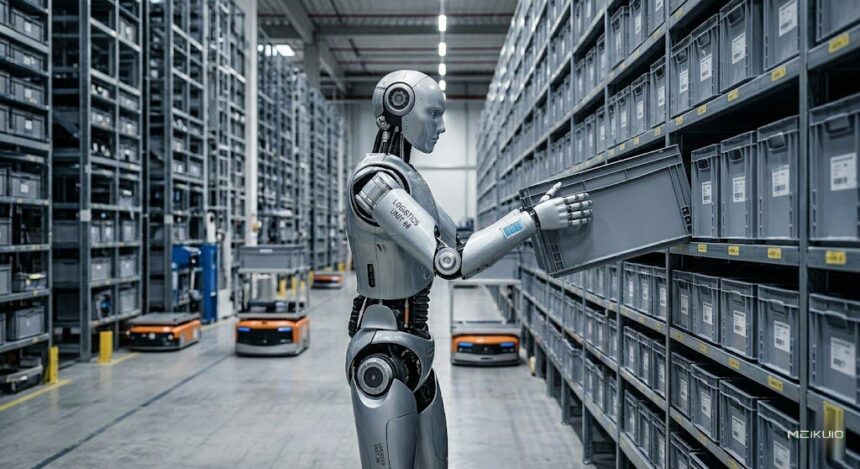
Strip out the demo reels and the trillion-dollar forecasts, and the number of humanoid robots doing real, paid work on Earth right now is about 200. Not 200,000. Two hundred. They move plastic totes, load sheet metal, and carry 25-pound baskets of car parts a few feet to a conveyor. They run out of battery in an hour or two, sit behind safety cages, and need a human babysitter every few hundred hours. That is the job humanoid robots are actually taking in 2026, and it looks nothing like the headlines.
- Quick Verdict: What Humanoids Are Really Doing
- The One Job They’ve Actually Mastered: Moving Totes
- The Famous BMW Robots? They Got Sent Home
- Tesla Optimus: Still Waiting
- Augment, Not Replace: Where the Panic Gets It Wrong
- What They Still Can’t Do (And Why That Matters)
- Does the Math Even Work Yet?
- Use Case: Should You Worry About Your Job?
- Data Box: Humanoid Robots at Work, 2026
- FAQ
The gap between what these machines do today and what the banks say they’ll do by 2035 is the part nobody puts in the headline. Goldman Sachs models 1.4 million units in service by 2035. Bank of America projects 10 million shipping a year by then. Morgan Stanley floats a billion robots and a $5 trillion market by 2050. Meanwhile, on the actual factory floor, the most-deployed commercial humanoid on the planet just crossed 100,000 totes moved, a milestone that doubles as a reminder of how early this is.
Approximately 200 robots worldwide; not 200,000. This is paid productive work, not all robots installed.
13,000–18,000 installed in 2025. This larger total has a different scope from the approximately 200 doing paid work in mid-2026.
1.4M units in service by 2035. Forecast, not a current installed count.
10M units shipping per year by 2035. Annual flow; deliberately separated from Goldman’s stock forecast.
More Read

Which jobs humanoids are really doing, who’s doing them, and where the hype outruns the hardware:
Quick Verdict: What Humanoids Are Really Doing
The pattern: real work is narrow, dull, and concentrated in two places: warehouses and car plants. Everything else is a pilot, a demo, or a press release. Those same warehouses are where back-support exoskeletons are sold in volume, and there the employer, not the worker, decides the purchase.
The One Job They’ve Actually Mastered: Moving Totes
If you want to see a humanoid earning its keep, go to a GXO warehouse outside Atlanta. Agility Robotics’ Digit (a bipedal robot with a teal torso and bird-like legs) has worked there under a commercial Robots-as-a-Service contract since late 2023, kitting and carrying totes for the shapewear brand Spanx. As of late 2025, GXO and Agility reported the fleet had moved more than 100,000 totes.
It is the first humanoid to hold down a real, recurring job in a live workplace, on a subscription rather than a stunt.
Digit’s range has grown. At a Schaeffler bearings plant in South Carolina, it now works 8-hour shifts hauling 25-pound baskets of freshly stamped parts from the press to a conveyor. Schaeffler liked it enough to sign a deal to roll Digit out across its global network of 100 plants by 2030. Toyota’s plant in Ontario signed a commercial agreement in February 2026 after a year-long pilot. Amazon started testing Digit for empty-bin recycling at a Seattle R&D site in June.
Every one of these tasks comes down to the same move. Pick something up. Carry it a short distance. Put it down. No fine dexterity, no judgment calls, no improvisation. The work humanoids do well in 2026 is the work that’s closest to a forklift with legs.
The Famous BMW Robots? They Got Sent Home
You’ve probably seen the stat: Figure’s humanoids helped build 30,000 cars at BMW. It’s true, and it’s over.
Figure ran an 11-month pilot at BMW’s Spartanburg plant with its second-generation Figure 02 robots. Two of them worked 10-hour weekday shifts in the body shop, inserting sheet-metal parts into welding fixtures with a placement accuracy above 99%. Across the run they loaded 90,000+ parts, logged 1,250+ hours, and contributed to more than 30,000 BMW X3 SUVs. That is a serious stretch of work.
Then Figure pulled them. The Figure 02 fleet was retired in early 2026 to make way for the third-generation Figure 03, which means there are zero Figure robots on the Spartanburg line right now. The “30,000 cars” headline describes a finished experiment that most articles quietly file as if it were still running. BMW’s next move is a separate pilot in Leipzig, Germany, with a different machine entirely (Hexagon’s wheeled AEON), starting this summer.
Humanoid deployment in 2026 keeps running this loop: a short pilot, a list of fixes, and a robot that ships back to the lab. Figure says the BMW run taught it the forearm was its top failure point and that the fix is baked into Figure 03. Call it progress. It still falls short of a robot showing up to the same job every day, indefinitely, the way a person does.
Tesla Optimus: Still Waiting
No robot carries more hype-to-reality distance than Tesla’s Optimus, and Tesla’s own executives say so out loud.
Every Optimus built so far stays inside Tesla (Fremont and Giga Texas) doing internal testing and data collection. None does paid external work. On that same Q4 2025 earnings call in January 2026, Elon Musk admitted that zero Optimus units were doing “useful work” in Tesla’s own factories. His January 2025 prediction of roughly 10,000 robots built that year? Missed entirely. By the Q1 2026 call in April, Tesla had produced a few hundred Optimus units for a cumulative internal fleet of 400 to 600, walked back its production targets, declined to give 2026 guidance, and said early output would be “quite slow.”
Tesla is dismantling its Fremont Model S and Model X lines this quarter to build an Optimus V3 line, and Musk still talks about a million units a year. Given the track record, that is an ambition with no date attached. As of mid-2026, Optimus is a research project that hasn’t taken anyone’s job, including the jobs inside Tesla. The same scale-versus-hype gap plays out in self-driving; see our breakdown of Tesla Robotaxi vs Waymo, while our analysis of Tesla FSD price in 2026 details what commercial autonomy software actually costs vehicle owners right now.
Augment, Not Replace: Where the Panic Gets It Wrong
The number that should reframe this whole debate: as of mid-2026, there are no documented layoffs anywhere directly attributed to humanoid robots.
None. The robots are walking into jobs nobody wants and nobody can fill. The U.S. had roughly 500,000 unfilled warehouse and logistics positions in early 2026. Manufacturing turnover runs about 39% a year, and e-commerce fulfillment centers blow past 150%. The Manufacturing Institute projects a structural shortfall of nearly 8 million unstaffed positions globally by 2030.
Open shifts are what pull Digit onto the floor. No one is drawing up a plan to fire people. At GXO, the human workers stationed alongside Digit were moved up into supervisory and coordination roles, not shown the door. A McKinsey consultant cited by the Wall Street Journal expects up to 5 million humanoids to enter the workforce by 2040 without a substantial net cut to the human manufacturing workforce.
One clarification worth making, because the two stories keep getting blended. The wave of white-collar AI layoffs in 2026 (the tech cuts, the shrinking pool of entry-level coding jobs) are driven by software, not by robots with arms and legs. Physical humanoids and office AI are different technologies on different timelines hitting different jobs. Anyone splicing a laundry-folding robot clip next to a chart of software-engineer layoffs is mixing two unrelated stories. (AI is reshaping white-collar work too, just through software, not hardware.)
What They Still Can’t Do (And Why That Matters)
Humanoids aren’t replacing anyone for a simple reason: they can’t yet.
Rodney Brooks, who co-founded iRobot and helped write the modern robotics playbook, calls the dream of mass-deployed humanoid helpers “pure fantasy thinking,” and he’s specific about why. A human hand carries roughly 17,000 low-threshold mechanoreceptors. Today’s robot hands lean almost entirely on cameras and have almost none of that touch data. Brooks argues deployable dexterity will stay “pathetic compared to human hands” well past 2036, and that reliability is a slow grind: “Every 10 more years gets another 9 in reliability.”
The hardware backs him up:
- Battery. A Unitree G1 walks for one to two hours on a charge, not the ten hours the marketing implies. Apptronik’s Apollo runs about four hours per pack and needs hot-swapping to stay up.
- Reliability. Humanoids need maintenance or a software fix every 200 to 500 operating hours. A standard industrial robot arm goes 50,000-plus.
- Safety. Most humanoids work behind barriers or in roped-off zones because they don’t have the safety certifications (like ISO 10218) to work shoulder-to-shoulder with people.
Gartner expects fewer than 20 companies worldwide to have humanoids in actual mass production for logistics by 2028. The bottleneck isn’t ambition or funding. It’s that making a machine reliably do what a warehouse worker does, for a full shift, without supervision, is still unsolved.
Does the Math Even Work Yet?
USD per hour, fully loaded estimates. Digit: 6,000–8,000 USD/month with two shifts per day. Break-even requires approximately 60–70% utilisation; below approximately 15 USD/hour labour cost even the cheapest humanoid does not pay for itself.
Sometimes, under the right conditions. A fully loaded Digit runs an estimated $11 to $15 an hour on a Robots-as-a-Service plan ($6,000 – $8,000 a month, two shifts a day), against a U.S. warehouse wage of $30 to $45 an hour. On paper, that’s a clear win.
It all turns on utilization. That advantage only holds when the robot is busy 60 to 70% of the time or more. Drop the utilization, or put the robot somewhere wages are low, and the economics fall apart: below about $15 an hour in labor cost, even the cheapest humanoid doesn’t pay for itself. The robots make sense today precisely where the work is relentless, repetitive, and chronically understaffed. It is a narrow slice, which is why the deployed count sits in the hundreds rather than the thousands.
Use Case: Should You Worry About Your Job?
Where you actually stand in 2026:
- You move things in a warehouse or load parts in a plant → Robots are entering this work first, but to fill open shifts, not to cut staff. Near-term, expect a robot coworker, not a pink slip. The smart move: learn to supervise and coordinate the fleet.
- Your job needs fine hand skills, judgment, or improvisation (electricians, nurses, mechanics, cooks) → Safe for years. This is exactly what humanoids can’t do, and Brooks thinks that holds past 2036.
- You do repetitive desk work → Your disruption risk is real, but it comes from software AI, not humanoid robots, which is a different technology on a different timeline.
- You’re an investor or operator reading the forecasts → The 2035 numbers may well arrive. Just don’t confuse a forecast with the floor. Today it’s ~200 robots and a lot of pilots.
Data Box: Humanoid Robots at Work, 2026
- Humanoids doing real, paid jobs worldwide: ~200 (McKinsey via WSJ, April 2026, estimate)
- Totes moved by Agility’s Digit at GXO: 100,000+ (November 2025)
- Tesla Optimus doing “useful work”: none, per Musk (January 2026)
- Cumulative Optimus fleet (internal only): 400 – 600 units (April 2026)
- Documented layoffs caused by humanoids: 0 (mid-2026)
- Unfilled U.S. warehouse jobs: ~500,000 (BLS, March 2026)
- Robot operating cost vs. warehouse wage: ~$11 – $15/hr vs. $30 – $45/hr (RoboZaps, 2026)
- Unitree G1 battery life, walking: 1 – 2 hours (RoboZaps, March 2026)
- Goldman Sachs forecast: 1.4M units in service by 2035
- Bank of America forecast: 10M units shipping per year by 2035
For the consumer side of all this, you can already rent a humanoid robot for around $499 a month, and we ran the rent-versus-buy math separately.
FAQ
How many humanoid robots are actually working in jobs right now?
By the best available estimate, only around 200 humanoid robots are doing economically productive work in factories and warehouses worldwide as of mid-2026 (McKinsey, via the Wall Street Journal). Many more exist (13,000 to 18,000 were installed in 2025), but the vast majority went to research labs and data collection, not real jobs.
What jobs are humanoid robots doing first?
Warehouse and factory material handling: moving plastic totes, loading sheet metal into welding fixtures, and carrying parts baskets to conveyors. These are repetitive, physically simple tasks in places that struggle to hire. Agility’s Digit (totes at GXO, parts baskets at Schaeffler) is the clearest commercial example.
Are humanoid robots replacing human workers?
Not yet, and not at the scale people assume. There are no documented layoffs attributed to humanoid robots as of mid-2026. They’re filling roughly 500,000 unfilled U.S. warehouse jobs and offsetting 39%+ annual turnover, plugging labor gaps rather than cutting staff. At GXO, workers next to the robots were promoted to oversee them.
Is Tesla’s Optimus working in factories?
Only internally, and only for testing. Elon Musk said in January 2026 that zero Optimus units were doing “useful work” in Tesla’s factories. The cumulative fleet was 400 – 600 units as of April 2026, all internal, with no paid external deployments and no firm 2026 production target.
Will humanoid robots take my job by 2030?
If you do repetitive warehouse or factory handling, you’ll likely work alongside one before you’d ever be replaced by one, and the near-term driver is unfilled shifts, not layoffs. Jobs needing dexterity, judgment, or improvisation are safe for years; roboticist Rodney Brooks argues robot dexterity will lag human hands well past 2036. Desk-job disruption is real but comes from software AI, not physical robots.
Why can’t humanoid robots do more yet?
Three hard limits. Battery life is one to two hours of walking for a Unitree G1. They need maintenance every 200 – 500 hours, versus 50,000+ for a standard industrial arm. And they mostly can’t work uncaged next to people because they lack safety certification. Fine-hand dexterity is the deepest problem: a human hand has about 17,000 touch sensors that robots can’t yet match.