

One Sudowrite draft of 1,109 words used 7,100 of my 10,000 free trial credits. That was the first number I wrote down after giving 14 AI story tools the same prompt on November 12, 2026. The best AI story generator for drafting a novel is Sudowrite. For a private story it’s NovelAI, and for a free story with no sign-up it’s QuillBot.
- What is the best AI story generator in 2026?
- How I picked them: terms first, prose second
- Which kind of story tool do you need?
- A co-writer for a novel
- A one-shot story from a prompt
- An interactive adventure
- Tools for game masters and interactive stories
- What is the best AI for story writing: a fiction model or a chatbot?
- The best AI story generators in 2026
- 1. Sudowrite: best for drafting a novel
- 2. Novelcrafter: best if you bring your own AI
- 3. NovelAI: best for private storytelling
- 4. Squibler: best for beginners who want structure
- 5. AI Dungeon: best for interactive stories
- 6. Perchance: best free generator with no account
- 7. QuillBot: best free one-shot story
- 8. Claude or ChatGPT: best if you already pay for one
- 9. Gemini Storybook: best for illustrated picture books
- Do you own a story written by AI?
- Does an AI story generator train on your writing?
- What are AI story generators trained on?
- Can you legally publish a book written with AI?
- Stores and self-publishing
- Magazines and contests
- Web fiction and fan fiction
- Writer groups and certification
- What is the best free AI story generator?
- How much does it cost to write a novel with an AI story generator?
- What “no filter” means in the terms
- How to use an AI story generator and keep your rights
- When you don’t need a story generator at all
- Frequently Asked Questions
- What is the best AI story generator for writing a novel?
- What is the best free AI story generator with no sign-up?
- Do you own a story written with an AI generator?
- Can you copyright a story an AI wrote for you?
- Can you sell a book written with AI on Amazon?
- Will magazines accept short stories written with AI help?
- Does Sudowrite use my writing to train its AI?
- Is NovelAI private enough for personal stories?
- Is ChatGPT or Claude better for writing stories?
- Are AI story generators safe for kids to use?
- My Take
The bigger gap was in the paperwork. I read the terms behind 19 story tools. Every one that addresses ownership says the story is yours. They split on three other things: what license the company keeps, whether your draft trains the next model, and where you’re allowed to publish the result. Those three decide what you can do next.
What is the best AI story generator in 2026?
Write a novel in Sudowrite. Pick NovelAI if privacy matters most. For a quick story with no account, use QuillBot or Perchance. There is no single best AI story generator, so I picked nine tools, each for one job. A novelist, a parent making a picture book and a game master want different things from the same prompt. The table puts the ownership and training answers next to what each free path gave me.
The other five picks cover narrower jobs. Novelcrafter is for writers who bring their own AI model, Squibler for beginners and AI Dungeon for interactive play. Claude or ChatGPT makes sense if you already pay for one, and Gemini’s Storybook makes an illustrated book on a parent’s account.
On the prose itself, most tools stayed on the prompt. Perchance opened with a ferry and found the lighthouse keeper two paragraphs later. AI Dungeon got the years wrong. NovelAI continued my text instead of obeying it. ChatGPT ran long, Toolsaday ran short, and Squibler and Claude landed closest to 800 words. Whatever you pick, copy the text into your own document the same day, because several of these tools keep it only in your browser or a chat.
How I picked them: terms first, prose second
Most “best AI story generator” lists rank prose. Prose quality changes with every model update, so I judged on the parts that stay put: the contract and the meter. I set the criteria before I opened a single tool.
More Read

- I gave every tool the same prompt: “Write a short story of about 800 words about a lighthouse keeper who finds a letter addressed to her, dated 1952. Third person, past tense, quiet literary tone.” For Claude I added one line, “Write it in English.”, to override a language setting on the account.
- I recorded whether it needed an account, how many words came back, what the screen said about limits, and whether it named the model.
- I read the terms and privacy policies of 19 tools and copied the clauses on ownership, licenses, training and age.
- I opened the rules of 44 stores, magazines, contests and writer groups to see where an AI-assisted story can actually go.
- I checked the court rulings and Copyright Office guidance in the original documents.
I don’t buy software for reviews. Free tiers and trials covered most of the test. I ran each tool once, Perchance three times, all on the same day. ChatGPT, Claude and Gemini ran on paid accounts, so treat those three as the “you already pay for it” option. For prose, I scored only whether the story stayed on the prompt.
Which kind of story tool do you need?
“Story generator” covers very different products. Pick the kind first and the field shrinks to two or three names.
A co-writer for a novel
You want chapters, a memory of your characters and a way to keep the voice steady across 80,000 words. Sudowrite, Novelcrafter and Squibler are built for this. Each keeps notes on characters and places, and the AI reads those notes before it writes a scene. Sudowrite calls them a Story Bible, and Squibler builds them for you as “elements”. That memory is what you’re paying for.
A one-shot story from a prompt
You want 500 to 1,000 words now, often for a class, a bedtime or a writing prompt. Free web tools like QuillBot and Toolbaz do this without an account, and Perchance builds one paragraph at a time. They rarely say which model wrote the story.
An interactive adventure
You want to play a character while the AI narrates. AI Dungeon is built for exactly this: it writes a short paragraph per turn and waits for your move.
Tools for game masters and interactive stories
If you run a tabletop campaign, the same interactive tools double as a scene generator. AI Dungeon has “story cards” and NovelAI has a lorebook: notes on characters and places that the AI draws on as the story goes. That’s the feature to look for, more than the prose model.
What is the best AI for story writing: a fiction model or a chatbot?
This is where picking the best AI for story writing gets less obvious, and the same split applies to AI for creative writing in general. A fiction-tuned model, like Sudowrite’s Muse or NovelAI’s Erato, has extra training on stories. A general chatbot like ChatGPT or Claude follows instructions and writes a clean first draft. In my test, Squibler and Claude came closest to the 800 words I asked for, and ChatGPT ran long at 1,030. NovelAI’s story mode continued my text instead of obeying it, even on its trial model. Pick the chatbot if you want control. Pick the fiction model if you want surprises.
The best AI story generators in 2026
Sudowrite is best for drafting a novel, Novelcrafter for writers who bring their own AI, NovelAI for privacy, and QuillBot for a free one-shot story. Each pick below says what I saw on November 12, 2026, what the terms say about your story, and where the free path ends. The order runs from long manuscripts to one-shot stories and picture books.
1. Sudowrite: best for drafting a novel
Sudowrite is the best AI story generator for a long manuscript. I signed in with Google and the onboarding asked what I write and how I plan. Its genre list includes Erotica next to Literary Fiction. Then I pasted the prompt into its Draft tool in Muse mode. Before it ran, a pre-run plan estimated 1,326 to 1,980 words and 7,100 to 9,200 credits. It wrote 1,109 words, under its own estimate, and the counter dropped to “2,900 of 10,000 credits left.”
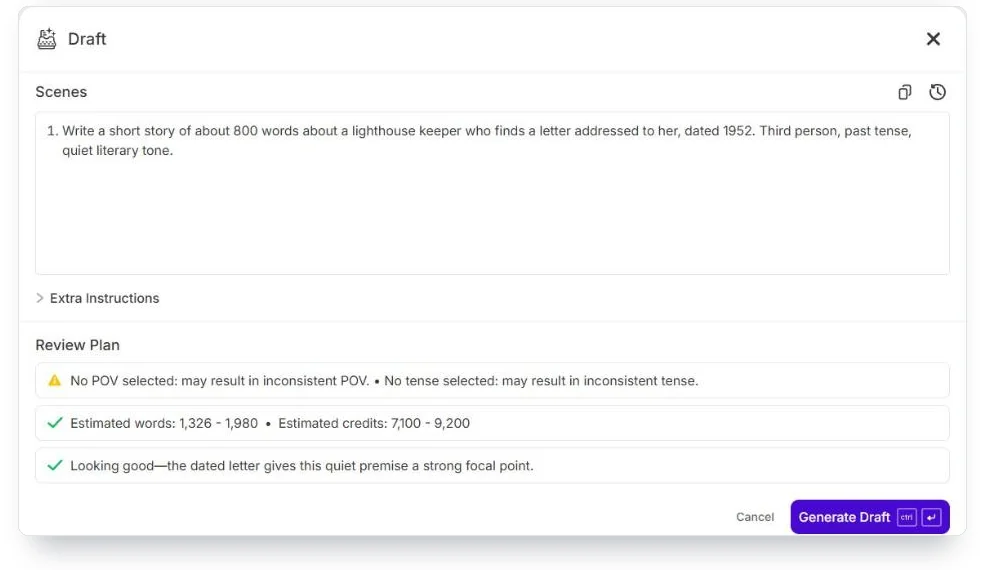
One draft ate most of the trial. Credits are Sudowrite’s unit for AI work, and that’s about 6.4 credits a word on Muse, its own fiction model. At that rate the trial covers about 1,560 words. The prose mode window labels Muse “Base Model: Muse 1.5” and rates it five out of five for “Unfiltered”. Sudowrite says Muse “is exclusively trained on a curated dataset with 100% informed consent from the authors.” It doesn’t name the dataset or the authors. Its Excellent mode showed “Base Model: Ballad 1.1” in the app, while the help page still says “Powered by Claude 3.7 Sonnet.” Check the mode window before you pay, because the model behind a mode can change.
The terms, last updated April 11, 2025, say “All rights in and to Your Content remain with you.” They don’t mention training. The no-training promise lives in the FAQ and on the Muse page: “we do not use your writing to train AI models.” You must be 18. Paid plans run on credits: Hobby & Student gives 225,000 a month, Professional 1,000,000 and Max 2,000,000, from $10 a month on yearly billing. The pricing page calls Muse and Ballad “Sudowrite’s AI models just for fiction”, so Excellent now runs on Sudowrite’s own model.
2. Novelcrafter: best if you bring your own AI
Novelcrafter is the only pick that refused to write until I plugged in a model. Its onboarding said it plainly: “Novelcrafter doesn’t cover AI usage costs. You connect your own AI, either through a pay-as-you-go service or by running it locally for free.” I had to tick a box saying I understood. I don’t buy API keys for reviews, so I stopped there.
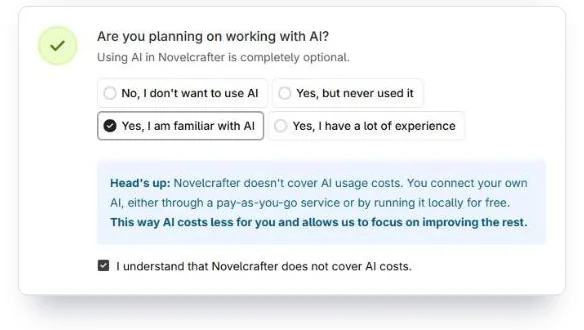
That design is also its strongest privacy point. Novelcrafter’s privacy policy, updated August 31, 2026, says: “We do not, under any circumstances, use the novels or other creative content created by our users to train any artificial intelligence or machine learning models.” It’s one of only two binding no-training promises I found among 19 tools.
The catch is the second contract. When you bring your own key, your text also goes to the model company you pay, under that company’s terms. Novelcrafter’s own terms say nothing about who owns the output. If your provider trains on API traffic, Novelcrafter’s promise doesn’t cover that leg. So read both contracts. The account is 18+.
Novelcrafter suits two kinds of writer. One already pays a model company for API access (a developer account, not a chat subscription) and wants a proper manuscript tool on top. The other runs a model on their own computer, which the onboarding itself offers as the free route. If you’ve never touched an API key, start with Sudowrite instead.
3. NovelAI: best for private storytelling
NovelAI stores your stories encrypted. Its FAQ says they’re “encrypted in your browser” and “We can not access or read your stories.” The flip side is in the same FAQ: lose your email or password and you lose those stories for good. Write the password down. After I signed in with Google, NovelAI still made me set its own password before the first story.
The free trial, which NovelAI calls Paper, gave me 50 text generations and 12,288 tokens of context, “Equivalent to our Scroll tier”, its middle paid plan. One generation returned 208 words. NovelAI writes by continuing your text rather than following orders, and it even added a line of its own to my instruction. The trial ran on GLM 4.6, which NovelAI’s model page calls “an untuned instruct model”. Its own story models are Erato, “based on the Llama 3 70B Base model”, and Xialong, a 355-billion-parameter finetune of GLM-4.6 that NovelAI’s blog launched for Opus, its top plan. The home page says story generation is “POWERED BY GLM 4.6”, so the trial runs the model the home page advertises.
The terms, effective December 8, 2025, say you “retain all rights and ownership of your Content.” The FAQ adds that “none of your requests, uploads, edits or generations are logged or stored on our side.” The cheapest paid tier, Tablet at $10 a month, gives “unlimited Text” generations, and an August 20, 2026 update that capped one image model left “all of our text models” unlimited. You must be 18.
4. Squibler: best for beginners who want structure
Squibler asked me to sign in the moment I hit Generate on its home page. Then it wrote 834 words, close to my 800-word brief. While it wrote, the chat showed it creating notes on the heroine, Elara Vance, and on Blackwood Lighthouse. It also renamed the project “The Salt-Stained Seal”. For a beginner, that scaffolding is the value: you get a manuscript and a character sheet in one go. It’s the gentlest start on this list. The screen showed an Upgrade button but no word or credit limit, so I can’t tell you where the free account stops.
Squibler’s terms, effective April 21, 2026, are the clearest on ownership I read. You “retain full ownership of all content you create, generate, or upload through the Service, including text produced with the assistance of AI tools.” The license Squibler keeps is “solely for the purpose of providing and improving the Service.” That wording doesn’t say whether improving includes training. Neither the terms nor the privacy policy says whether your text trains a model. The terms allow adult scenes between characters “at least eighteen (18) years of age”, and the account is 18+. The free path ends at sign-in: I got nothing without an account.
5. AI Dungeon: best for interactive stories
AI Dungeon let me play without an account. I typed the prompt into a custom adventure and it wrote about 91 words, then waited for my turn. It plays like a game, because it is one. The settings panel named the model “Dynamic Small” and described it as “Rotates between small models for variety”. A banner offered “premium models for free” if I signed up. The same panel listed an image model, “SDXL Lightning”, for scene pictures. Its first turn also got the arithmetic wrong, calling 1952 “nearly sixty years prior”.
The terms, revised April 22, 2026, let you use your content “pretty much however you want.” The license AI Dungeon takes is sub-licensable and “irrevocable (for so long as Your Content is stored with us).” It may also “use your inputs and outputs to operate, maintain, improve, and train our AI and Services.” It warns that it “can’t guarantee that every output is unique to you.” The minimum age is 13.
6. Perchance: best free generator with no account
Perchance ran three times in a row without asking for anything. It’s a platform where anyone can build a generator, and its AI Story Generator writes one paragraph at a time, about 88 words per click. My first paragraph was about a ferry and a chewed map. The lighthouse keeper turned up in the third.
The page says stories are “stored privately in your browser/device storage only.” The privacy policy matches: the AI text plugin “does not store your data on the server.” That’s the best storage answer among the free tools. Each paragraph also gets thumbs-up and thumbs-down buttons “to help improve the AI”, so rating a paragraph sends something back. Because anyone can build a generator there, the same policy says to “treat each page like it’s a random page on the internet”. The policy covers storage and says nothing about ownership. Ads ran under the generator. Back up your story with the save button or copy it out, because clearing your browser clears your draft. I hit no paywall in three runs.
7. QuillBot: best free one-shot story
QuillBot gave me 683 words with no account and no ads. It’s plain, and it works. Its story generator hands the job to QuillBot’s AI Chat, marked Beta, and the chat showed up in its chat history. A notice under the box says “Chats are processed by Learneo and its service providers.”
QuillBot’s terms, updated August 21, 2026, treat both your prompt and the output as “User Content” under the Learneo terms. Learneo is the parent company. Its umbrella privacy policy, updated August 17, 2026, says it “may use all of the data we collect… to train our algorithms, AI models and AI products.” I covered what that means for QuillBot’s writing tools in my comparison of QuillBot and Grammarly. For a school assignment or a bedtime story, QuillBot is the best free AI story generator I tested that also has a full terms page behind it. I hit no wall in one run. Toolbaz wrote longer, 887 words, but I found no terms page at all and its privacy policy is a template that still says “www.website.com”.
8. Claude or ChatGPT: best if you already pay for one
If you already pay for a chatbot, you may not need a story tool at all. For a lot of writers, that subscription is the best AI for story writing they have. In a temporary chat, which ChatGPT says “won’t appear in your conversation history”, it gave me 1,030 words, title included, for an 800-word brief. Claude, in an incognito chat on its Fable 5.2 model, gave about 840. Both stories stayed on the prompt.
Both companies hand the output to you. OpenAI’s terms say “We hereby assign to you all our right, title, and interest, if any, in and to Output.” Anthropic’s say “we assign to you all of our right, title, and interest—if any—in Outputs.” Both say “if any”, so neither company promises there’s anything to hand over. That’s honest. OpenAI adds that “output may not be unique.”
Training is the bigger difference. OpenAI lets you opt out. Under its consumer terms, Anthropic trains on your chats “unless you opt out of training through your account settings”, and even after an opt-out it still uses chats you rate with feedback. Claude’s incognito window says its chats “aren’t used to train Claude.” My ChatGPT vs Claude test for writing goes deeper on which one writes better. OpenAI’s minimum age is 13; Anthropic’s is 18. Both ran on paid plans, so I can’t tell you where their free tiers stop.
9. Gemini Storybook: best for illustrated picture books
For a picture book, Gemini’s Storybook is the best AI story generator I tested. Marked “Experiment”, it turned my prompt into a 10-page illustrated book with a cover. It came to about 850 words. It also decided my lighthouse story was “for adult readers (ages 18 and up)”. Its own example prompts include a storybook for a 7-year-old, so you can aim it at a child. The cover used my account name as the byline: “By Meikuio”. I didn’t type that.
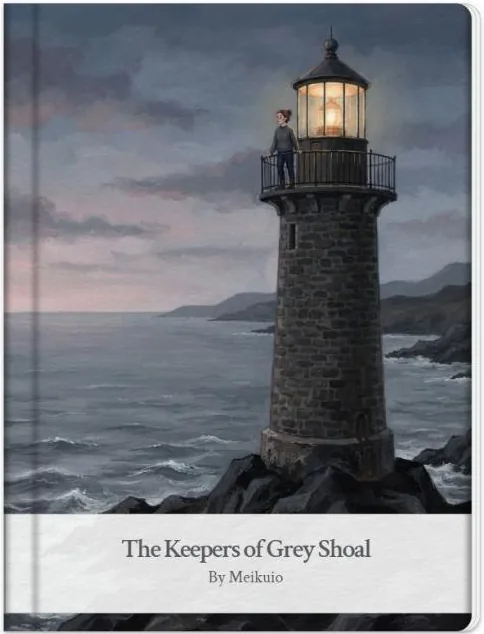
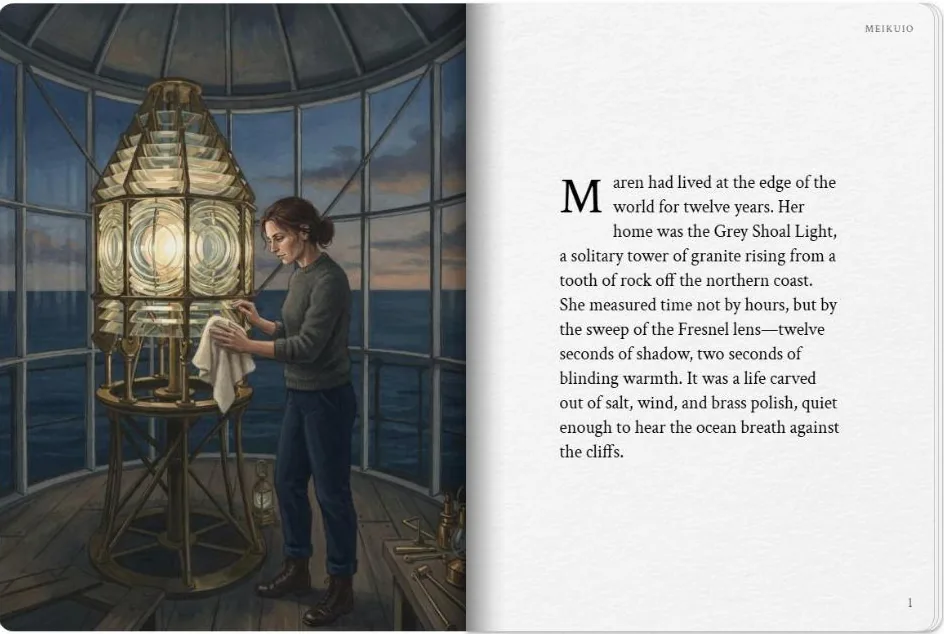
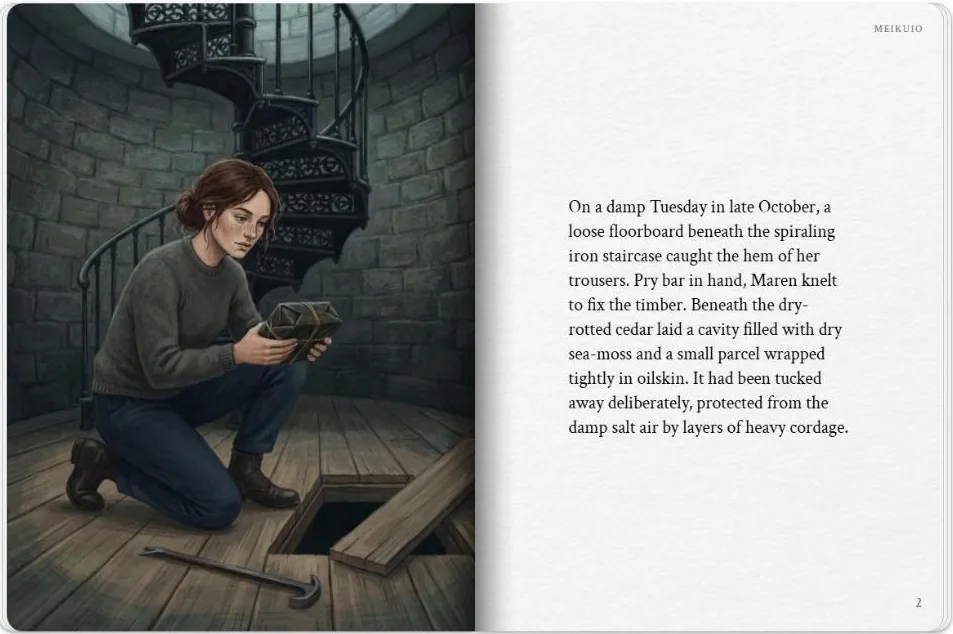
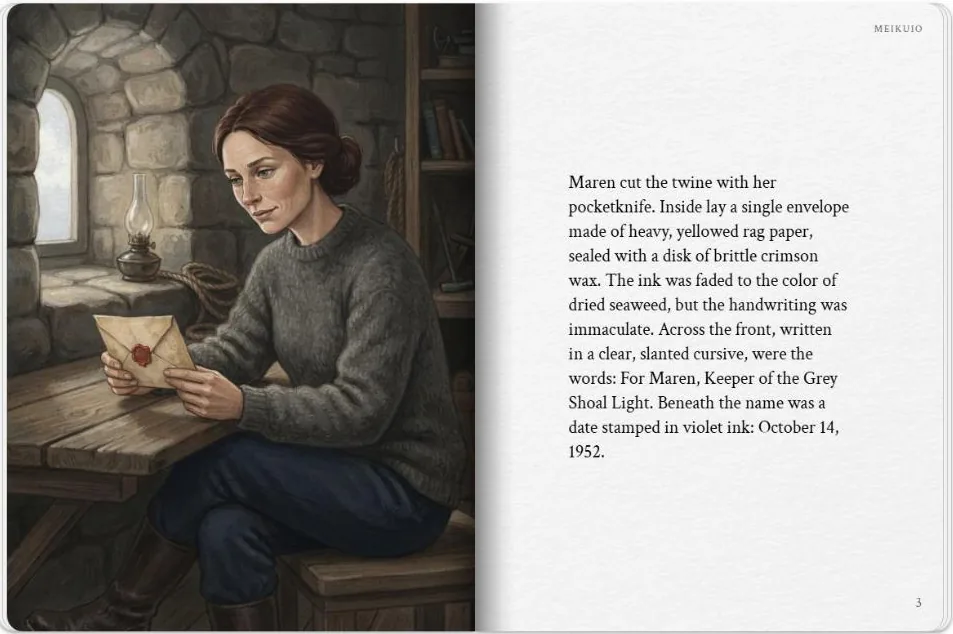
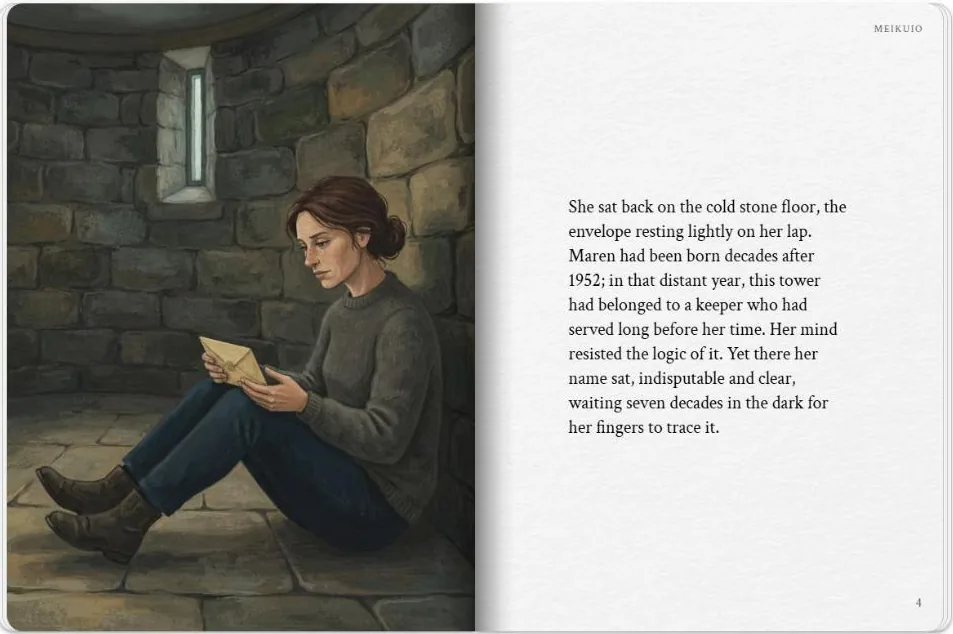
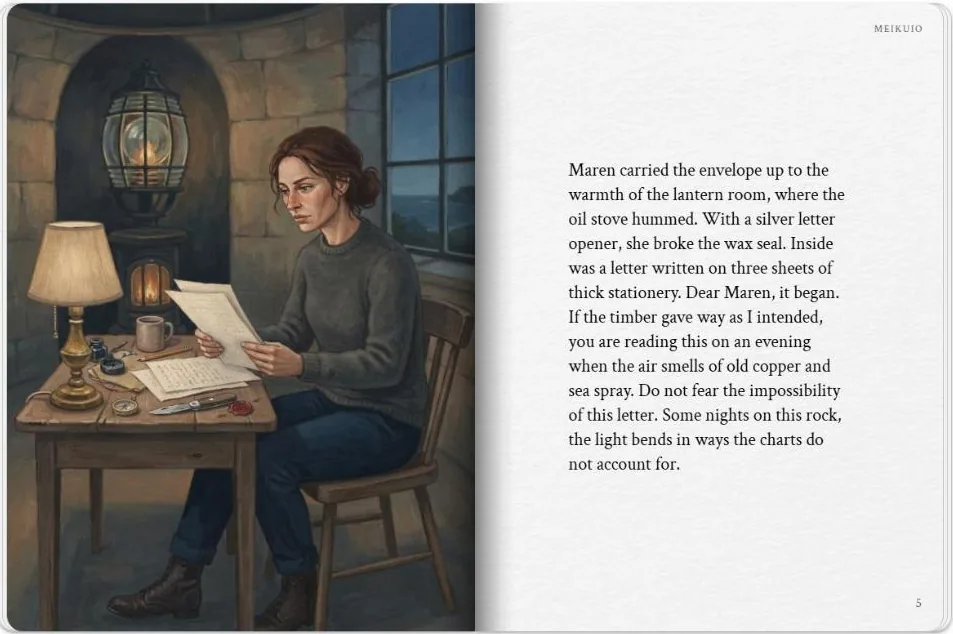
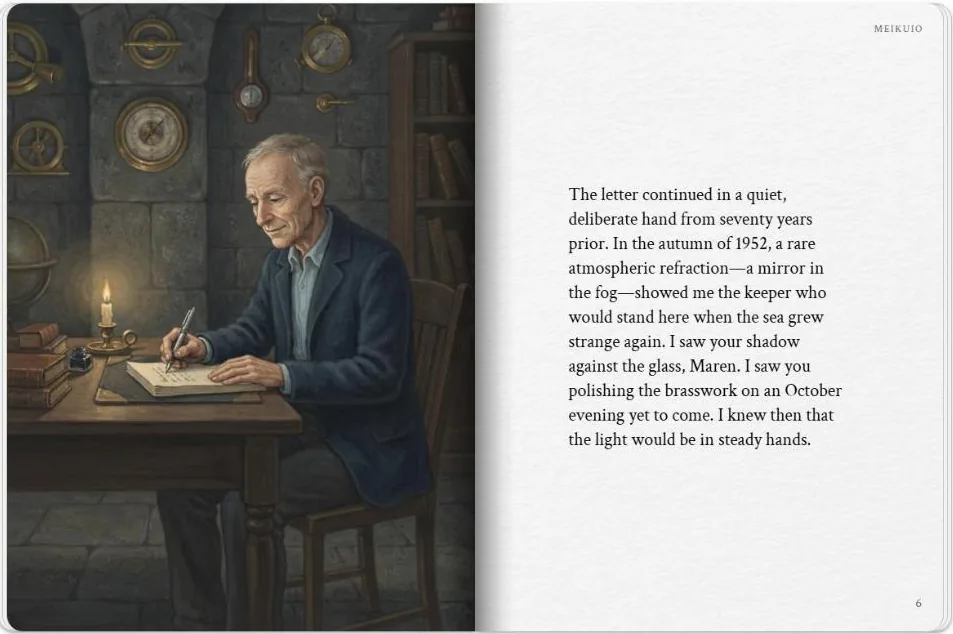
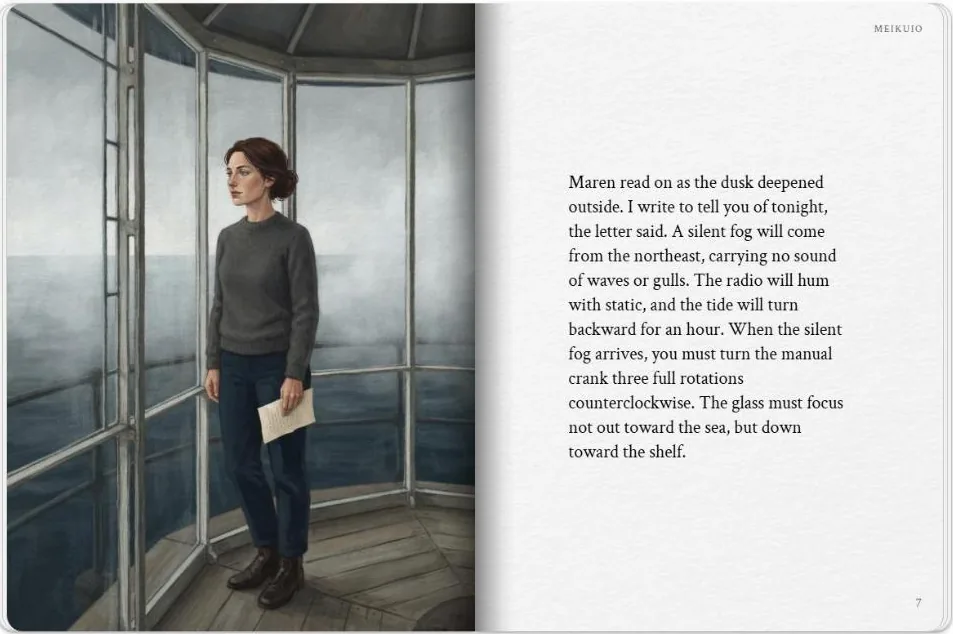
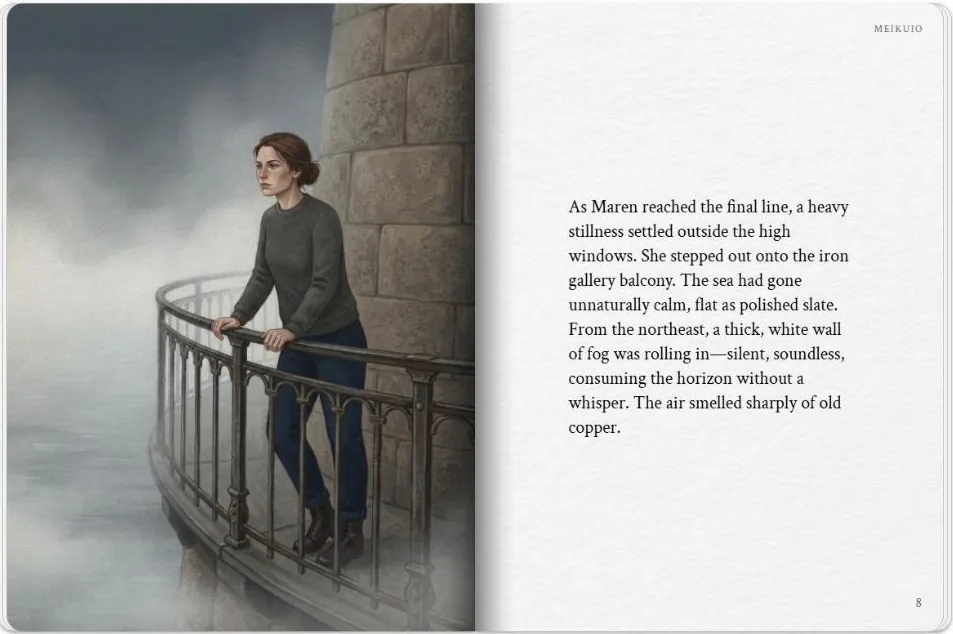
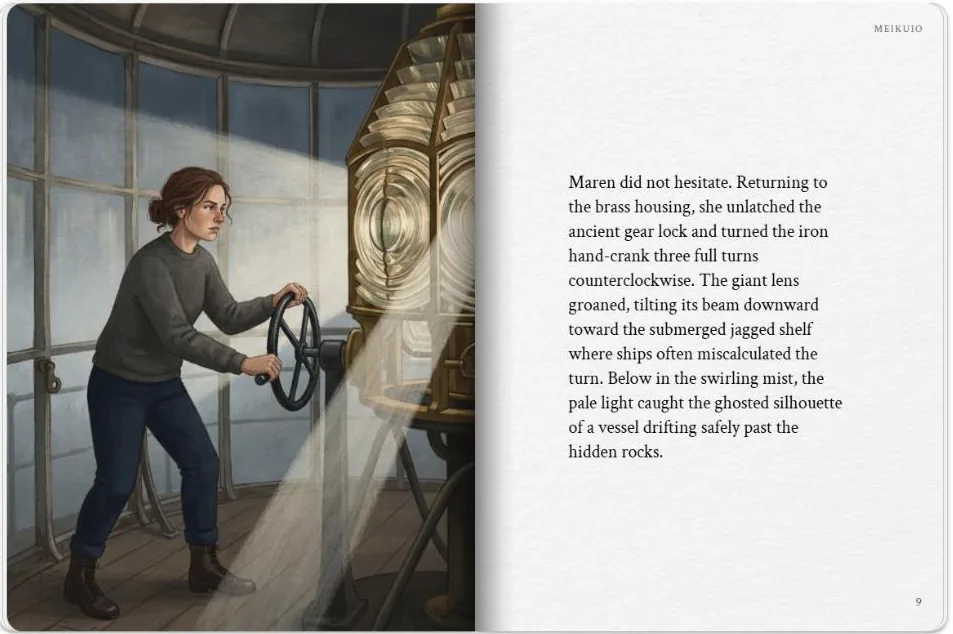
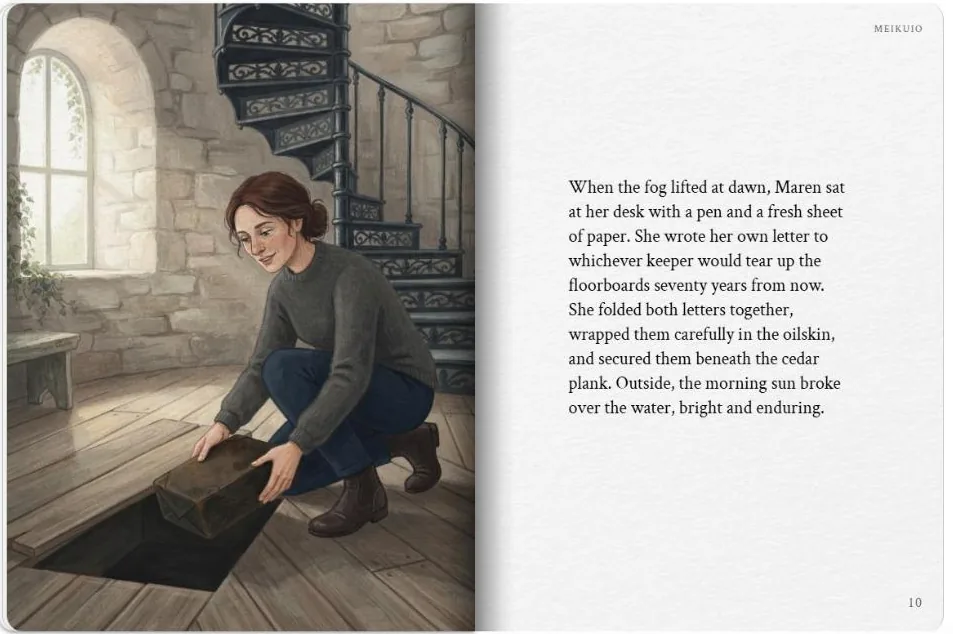
Gemini’s Storybook made this 10-page book from my one-line prompt on November 12, 2026, and put the account name, Meikuio, on the cover as the author. Swipe or use the arrows to read it.
Google added that byline by design, and it settles nothing legally. Google’s generative AI terms tell you to “Use discretion before relying on, publishing, or otherwise using content provided by the Services.” Google also says human reviewers read some Gemini chats, and asks you not to enter confidential information you wouldn’t want “Google to use to improve our services, including machine-learning technologies.” So put nothing into a storybook you’d hide from a stranger. Storybook is “available to all Gemini users over the age of 18”, so the parent makes the book. It ran on a paid Google account, and I didn’t test the free one. The book has a Listen button that reads it aloud, plus download and share buttons. If you plan to print those pictures large, remember that enlarging AI images invents detail, as I found when I tested AI image upscalers. For the pictures inside, the license questions are the same ones I covered in the best AI image editors.
One option sits outside the list: running an open model on your own computer. Nothing leaves the machine and no terms apply beyond the model’s license. It takes a capable laptop and an afternoon of setup, which is why it’s a footnote here.
Do you own a story written by AI?
You own what the terms give you, and every story tool that addresses ownership hands you the story. The differences are the license the company keeps and whether copyright exists at all. The US Copyright Office says “prompts do not alone provide sufficient control” to make you the author of what a model writes.
Ownership in the terms isn’t copyright. The Copyright Office says AI-generated material that is “more than de minimis should be explicitly excluded from the application” when you register a work. What you can register is your own writing, editing, selection and arrangement. The text you rewrote line by line is yours to register in the US. The parts a model wrote and you pasted stay out. I covered the same split for business writing in my piece on who owns what an AI writes for you, and for songs in my guide to the best AI music generators.
Three words in a license matter most. Perpetual means it never ends, irrevocable means you can’t take it back, and sublicensable means the company can pass it on. Talefy shows how far “yours” can stretch. Its terms say you own the generations you prompt. In the same document you grant Talefy a “transferable, sublicensable, perpetual, irrevocable license to… exploit, commercialize and otherwise use the Generations elicited by you for any purpose.” You own the story, and Talefy can sell it too. Read that clause twice. AI Dungeon’s license is broad as well, but it ends once AI Dungeon stops storing your content. Squibler’s is limited to running and improving the service.
The rest of the list agrees on ownership and differs on the license. DeepAI: “you own all right, title, and interest in and to the User Content that you generate.” EaseMate: “You retain ownership”, with a license that is “sublicensable, and transferable” for “operating, improving, and promoting the Service.” Canva’s AI terms: “you own your Output”, except where it uses Canva’s licensed content. Grok’s terms let you keep ownership of your content but give the company an “irrevocable, perpetual, transferable, sublicensable, royalty-free, and worldwide” right to your inputs. Four tools say nothing about ownership. Novelcrafter’s terms skip it, Toolsaday’s terms date from March 11, 2021 and never mention AI, Perchance’s privacy policy covers only storage, and Toolbaz has no terms page.
One more line matters if you plan to sell. OpenAI warns that “output may not be unique”, and AI Dungeon says it “can’t guarantee that every output is unique to you.” Another user can get a story very close to yours from the same model. Owning your copy doesn’t stop them owning theirs.
Every story tool whose terms address ownership gives you the story; Talefy also keeps a perpetual license to sell it.
Does an AI story generator train on your writing?
Only two of the 19 tools I read promise in a binding document that your stories never train a model. One is Novelcrafter, in its privacy policy. The other is LivingWriter, a writing app for books and screenplays, in its terms. Sudowrite makes the same promise, but only in its FAQ and on its Muse page. Its terms don’t mention training, and neither does its privacy policy, dated October 6, 2020.
Under their terms, AI Dungeon and Jasper train on what you write, and Learneo’s privacy policy, which covers QuillBot, allows the same. OpenAI, DeepAI and Grok train by default and let you switch it off. Anthropic does the same, with the feedback exception above, and excludes incognito chats from training. Google says human reviewers see some Gemini chats, and asks you not to enter “confidential information that you wouldn’t want a reviewer to see.” Squibler is silent. Silence isn’t a promise.

LivingWriter’s line is the cleanest of the two binding promises: “Your AI-generated content remains private, and LivingWriter does not incorporate it into any machine learning or AI training.” Jasper’s sits at the other end. Its terms, version 4.1, use “Input and Output” for “developing and enhancing Jasper’s artificial intelligence models.”
The switches exist, but you have to use them. In ChatGPT, the training opt-out keeps a story out of training, and a temporary chat keeps it out of your history. In Claude, an incognito chat or the account setting does it. In Gemini, the Keep Activity setting decides whether your chats are saved to your account. A thumbs-up or thumbs-down is feedback, and Anthropic still trains on feedback after an opt-out.
If you bring your own key to a tool like Novelcrafter, you sign two contracts: one with the app and one with the model company. Read both. I found the same pattern in writing assistants, and my list of which writing tools train on your text names the ones that do.
What are AI story generators trained on?
Most story tools don’t say. Sudowrite says Muse is trained on a curated dataset with consent from the authors, but its Muse page names no dataset, author or license. Its co-founder James Yu wrote on Reddit on March 14, 2025, “We recently launched Muse, a model trained specifically for fiction.” In the same thread he said the company started training its own models “not to rival reasoning of the big models out there, but to be a bit wilder.” So the consent claim rests on Sudowrite’s word. I can’t check it.
NovelAI names its base models, Llama 3 70B and GLM-4.6. That tells you who built the foundation and nothing about which books went into it. The free tools I tested told me less: Toolbaz labeled its model “TOOLBAZ-V5” and AI Dungeon’s guest model rotates.
Courts have twice looked at books used for training. In Bartz v. Anthropic, Judge William Alsup ruled on June 23, 2025 that using the books “to train Claude and its precursors was exceedingly transformative and was a fair use.” Scanning print books Anthropic had bought was fair use too. The pirated library copies it kept were a different matter, and that part ended in a class settlement. Two days later, in Kadrey v. Meta, Judge Vince Chhabria granted Meta summary judgment “on this record.” He also wrote that the ruling “does not stand for the proposition that Meta’s use of copyrighted materials to train its language models is lawful.” It covered only the thirteen authors who sued. In Bartz v. Anthropic and Kadrey v. Meta, two judges ruled for the AI companies on training, but neither ruling settles the question for every book. If you want the mechanics behind training, my explainer on how ChatGPT learns from text walks through them.
When Bartz authors get paid
Claims closed on March 30, 2026, and the court gave the Anthropic settlement final approval on July 20, 2026. On November 13, 2026, the settlement website said it expects the first payments “on or before November 15, 2026.” A court filing dated October 23, 2026 says the parties expect the first distribution “during the week of November 23, 2026.” The two dates don’t match, so if you filed a claim, watch the settlement website for your payment.
Can you legally publish a book written with AI?
Yes at the big stores, usually with a disclosure, and most fiction magazines won’t take it at all. Amazon KDP lets you publish and asks you to disclose AI-generated text. Fourteen of the 16 fiction magazines I checked reject AI-written stories. Registration covers only your own writing, editing and arrangement.
I opened the rules of 44 stores, platforms, magazines, contests and writer groups on November 12, 2026, and 34 of them publish a rule on AI-written fiction. Of those 34, 15 ban AI-written work and another 10 ban even AI help, so 25 say no to AI-written stories. I counted a ban on AI help only where the rule names help, editing or assistance. Six require disclosure and 3 allow it with conditions. Nine had no written rule I could find, and one UK award had no rules page I could open.
Stores and self-publishing
Amazon’s line is the one most self-publishers will meet. KDP says “We require you to inform us of AI-generated content (text, images, or translations) when you publish a new book.” It also says “You are not required to disclose AI-assisted content.” KDP counts text as AI-generated if an AI tool created it, “even if you applied substantial edits afterwards.” Text you wrote yourself and improved with AI, or wrote after brainstorming with AI, counts as assisted. Apple Books wants AI-generated books labeled, and Barnes & Noble Press won’t publish a project until you complete its AI disclosure. Draft2Digital accepts AI-assisted books but not ones “generated entirely by AI/LLMs that has not gone through extensive editing from a human.” IngramSpark lists content “generated using artificial intelligence” among what it may refuse.
Magazines and contests
Magazines are the hard wall. Clarkesworld won’t “consider any submissions translated, written, developed, or assisted by these tools.” Strange Horizons names Claude, ChatGPT and Gemini in its ban. Ploughshares asks writers to affirm they “did not use AI tools to draft, generate, or fact-check the work.” McSweeney’s goes furthest: “We accept no writing aided in any manner by AI.” Strange Horizons, Beneath Ceaseless Skies, Escape Pod and Ploughshares still allow basic spelling and grammar checkers; Strange Horizons says they must be non-generative. The New Yorker’s ban has the only carve-out I found. It won’t consider “A.I.-generated work” unless an author uses the technology on purpose as a formal device, and any such use “must be disclosed.” The other two of the 16 are Granta, which has no AI rule, and Tin House, which had no open call and no rule I could find.

Contests are just as strict. The Nebula Awards, run by the Science Fiction and Fantasy Writers Association (SFWA), rule out works “written, either wholly or partially, by generative large language model (LLM) tools.” Writers of the Future says an entry “cannot be generated, in whole or in part, by Artificial Intelligence.” NYC Midnight’s 2027 short story rules let the organizer disqualify any entry made “in whole or in part” with AI. The Self-Published Fantasy Blog-Off requires a book that is “entirely human-written.” The Scholastic Awards for teens allow AI for brainstorming but not a final work that is “itself AI-generated.”
Web fiction and fan fiction
Web fiction is looser. Royal Road asks you to tag the story “AI-Generated”. Medium wants “any story incorporating AI assistance” labeled, and Inkitt asks authors “to label AI-assisted content.” Archive of Our Own allows fanworks “fully or partly generated with AI tools” if they otherwise qualify. Scribble Hub draws the line at “mostly”: “Stories created mostly by AI will be rejected.” Tapas bans AI-generated content outright. Wattpad’s site rules don’t address AI-written fiction, though its Wattys contest says “We strongly discourage using generative AI for your stories.”
Writer groups and certification
Writer organizations draw the strictest lines because their labels are promises to readers. The Authors Guild’s Human Authored certification rejects “Using AI to rewrite full sentences” but allows word-level spelling and grammar tools. SFWA’s membership form asks applicants to declare their qualifying works “were not written either in part or in whole by an LLM / generative AI.” Romance Writers of America’s mentorship program asks mentees to attest that their submission is “free of AI-generated material.”
14 of the 16 fiction magazines I checked won’t read a story written with AI, and 8 of them won’t take one that used AI help either.
Two old routes are gone. Amazon wound down Kindle Vella effective February 26, 2025, and the nonprofit behind NaNoWriMo announced in spring 2025 that it was closing. Some venues also protect your text from training: Clarkesworld promises submissions won’t train AI tools “of any kind.”
What is the best free AI story generator?
The best free AI story generator for most people is QuillBot or Perchance. A free one gives you one story and very little else. I tried eight tools without an account. Five returned a story, Talefy and Squibler asked me to sign in first, and EaseMate’s button never worked. Lengths ran from about 90 words to 887. Copy everything out.
Toolbaz wrote the most of the no-account tools, 887 words by its own counter, under four ad units and a video. Toolsaday gave 423 words for an 800-word request and showed an “Upgrade” prompt. EaseMate’s “Generate Story” button never switched on, so I got nothing. Talefy asked me to sign in before the first word. That’s why I’d still start with QuillBot or Perchance. QuillBot has a full terms page. Perchance keeps your text in your browser.
Free tools rarely tell you which model wrote it
Toolbaz said “TOOLBAZ-V5”. AI Dungeon’s guest model was “Dynamic Small”, which rotates between small models. Perchance and QuillBot named nothing on screen. If the model matters to you, for quality or for its training history, a free one-shot tool won’t tell you. The same pattern holds in other AI categories, as I found with free AI headshot generators.
How much does it cost to write a novel with an AI story generator?
On Sudowrite’s Muse, an 80,000-word novel draft would use about 512,000 credits, going by my one measured draft. That draft ran 1,109 words and used 7,100 credits, about 6.4 credits a word, so the 10,000-credit trial covers about 1,560 words. Short stories are cheap anywhere. A novel draft is where the meters show, and the best AI story generator for a long book has a meter you can live with.
The Hobby plan’s 225,000 monthly credits cover about 35,000 words of Muse drafting. The Professional plan’s 1,000,000 covers about 156,000. That rate comes from one measured draft, and Sudowrite’s cheaper modes use fewer credits, so treat it as the top of the range.
NovelAI works the other way. Its cheapest paid tier, Tablet at $10 a month, includes unlimited text generations, so a long draft costs the same as a short one. Novelcrafter’s AI costs whatever your model provider charges. If you already pay for ChatGPT, Claude or Gemini, a story costs you nothing extra until you hit a usage limit. AI tools charge by the meter, as I found when I worked out what Midjourney credits buy and what Descript’s AI credits cover.
What “no filter” means in the terms
Sudowrite’s Muse page says “no filters”, yet its terms still ban use “for any obscene or immoral purpose”. At Sudowrite, the sales page and the terms say two different things. The full line is “Muse will write anything – no filters”, and the app rates Muse five out of five for “Unfiltered”. The terms also ban use “to create content that is political in nature.” Squibler, by contrast, writes its adult-content rule into the terms. It allows “Consensual, adult-oriented erotic or romantic scenes” between adult characters.
The badge is marketing, so read the terms before you trust it. If adult fiction is the point, Squibler is the pick whose terms say yes in writing. A tool can let a scene through today and still close your account under a clause you agreed to.
Kids and story apps: whose account it is
Most of the story tools I checked are adults-only. Sudowrite, NovelAI, Novelcrafter, Squibler, Talefy, Claude and Gemini’s Storybook all require 18+. OpenAI and AI Dungeon allow 13+, and Grok allows 13 to 17 with a parent’s permission. So when a child “uses” a storybook app, the account and the contract usually belong to the parent. Check whose name is on it. Free sites carry their own risk: Perchance ran an ad that said “Meet your AI girlfriend” under a story generator.
How to use an AI story generator and keep your rights
You can use the best AI story generator on this list and keep the story fully yours. It takes five habits, all drawn from the documents above.
- Read the license clause before you paste in anything you care about. Search the terms for “perpetual”, “sublicensable” and “irrevocable”. Those three words tell you how much the company keeps.
- Switch training off before you write, not after. Use the account’s training opt-out or Claude’s incognito chat, and skip the thumbs buttons on anything private.
- Keep your own copy. Perchance keeps the story only in your browser, and NovelAI can’t recover it if you lose your password.
- Rewrite, and keep your drafts. The Copyright Office protects what you wrote, edited or arranged, so your revisions are the part you can register.
- Disclose where the rules ask. KDP still counts AI-written text as AI-generated after heavy edits, so tell KDP, tag it on Royal Road, and don’t send it to a magazine that bans it.
None of this needs a lawyer. It needs ten minutes with the terms page, which is ten minutes more than most people spend.
When you don’t need a story generator at all
Skip the story tool if one of these fits.
- You already pay for ChatGPT, Claude or Gemini. Use it with a temporary or incognito chat and paste the story into your own document.
- You need a plot, not prose. A plot outline from any chatbot gives you more control than a finished story, though some magazines ban even that.
- You wrote the story and want it cleaner. An editing tool fits better than a generator, and Jasper’s replacements for writers and the real price of Jasper show where that market went.
- You’re making a card or a poster. Canva’s AI writes short text inside a design, and my breakdown of what Canva’s AI allowance buys covers the limits.
Field notes
- The test: one prompt on November 12, 2026, 14 tools; 11 returned a story; lengths from about 88 to 1,109 words.
- Sudowrite meter: 7,100 of 10,000 trial credits for one 1,109-word Muse draft, about 6.4 credits a word.
- Ownership: every tool that addresses it gives you the story; Talefy also keeps a perpetual license to commercialize it.
- Training: binding no-training promises at 2 of 19 tools (Novelcrafter, LivingWriter); Sudowrite’s sits in its FAQ.
- Publishing: 34 of 44 venues have an AI rule; 14 of 16 fiction magazines reject AI-written stories.
- Courts: Bartz v. Anthropic called book training fair use on June 23, 2025; Kadrey v. Meta ruled for Meta “on this record” two days later.
- Sources: vendor terms, privacy policies and help pages (read November 12, 2026); US Copyright Office registration guidance (March 16, 2023) and Part 2 report (January 2025); court orders in Bartz v. Anthropic and Kadrey v. Meta; rules pages of 44 publishing venues.
Frequently Asked Questions
What is the best AI story generator for writing a novel?
Sudowrite, if you can live with credits. It keeps a Story Bible and writes with its own fiction model, Muse. Its terms leave the rights with you. One 1,109-word draft used 7,100 of my 10,000 trial credits, so a full novel needs a paid plan.
What is the best free AI story generator with no sign-up?
QuillBot for one complete story, Perchance for a story you build paragraph by paragraph. QuillBot gave me 683 words with no account and has a full terms page. Perchance keeps your story in your browser, so copy it out before you clear your cache.
Do you own a story written with an AI generator?
Yes, under the terms of every story tool I read that addresses ownership. The catch is the license. Talefy keeps a perpetual right to commercialize your generations, AI Dungeon keeps a broad one while it stores them, and Squibler keeps one only to run and improve the service.
Can you copyright a story an AI wrote for you?
Only the parts you wrote, edited or arranged yourself. The US Copyright Office says prompts alone don’t give enough control to make you the author, and you must exclude AI-generated material beyond a trivial amount when you register the work.
Can you sell a book written with AI on Amazon?
Yes, if you tell Amazon. KDP requires you to disclose AI-generated text, images or translations when you publish. You don’t have to disclose AI-assisted work, such as editing or brainstorming on text you wrote.
Will magazines accept short stories written with AI help?
Almost never. Fourteen of the 16 fiction magazines I checked reject AI-written stories, and eight of them, including Clarkesworld and Strange Horizons, also reject stories where AI only helped. Several still allow spelling and grammar checkers.
Does Sudowrite use my writing to train its AI?
Its FAQ says no: “we do not use your writing to train AI models.” That promise isn’t in Sudowrite’s terms, dated April 11, 2025, or its privacy policy, dated October 6, 2020. Novelcrafter puts the same promise in its privacy policy.
Is NovelAI private enough for personal stories?
Yes, as long as you keep your password. NovelAI encrypts stories in your browser and says it can’t read them. Lose the email or password and the stories are gone for good, because NovelAI can’t recover them either.
Is ChatGPT or Claude better for writing stories?
Both stayed on my prompt. ChatGPT ran long at 1,030 words for an 800-word brief, and Claude came closer at about 840. Anthropic trains on Claude chats, except incognito ones, unless you opt out. ChatGPT lets you opt out too. Pick the one you already pay for.
Are AI story generators safe for kids to use?
Mostly through a parent’s account, not their own. Sudowrite, NovelAI, Squibler and Gemini’s Storybook are 18+, and free sites can run adult-themed ads. A parent can make a picture book in Storybook and read it with the child.
My Take
I’d give Sudowrite to someone finishing a first novel who wants the AI to keep up with a long book. I’d tell them to watch the credit counter from day one. I’d give NovelAI to a writer whose stories are personal, because NovelAI encrypts stories in the browser and says it can’t read them. For a child’s bedtime story, Gemini’s Storybook on a parent’s account made the nicest thing I saw all day.
I wouldn’t give any of them to someone planning to sell short fiction to magazines. Fourteen of the 16 I checked won’t read it, and eight won’t take a story that only used AI help. If that’s your goal, write every sentence yourself and read each magazine’s rule before you use AI even for an outline, because Clarkesworld bans work “developed” with it.