



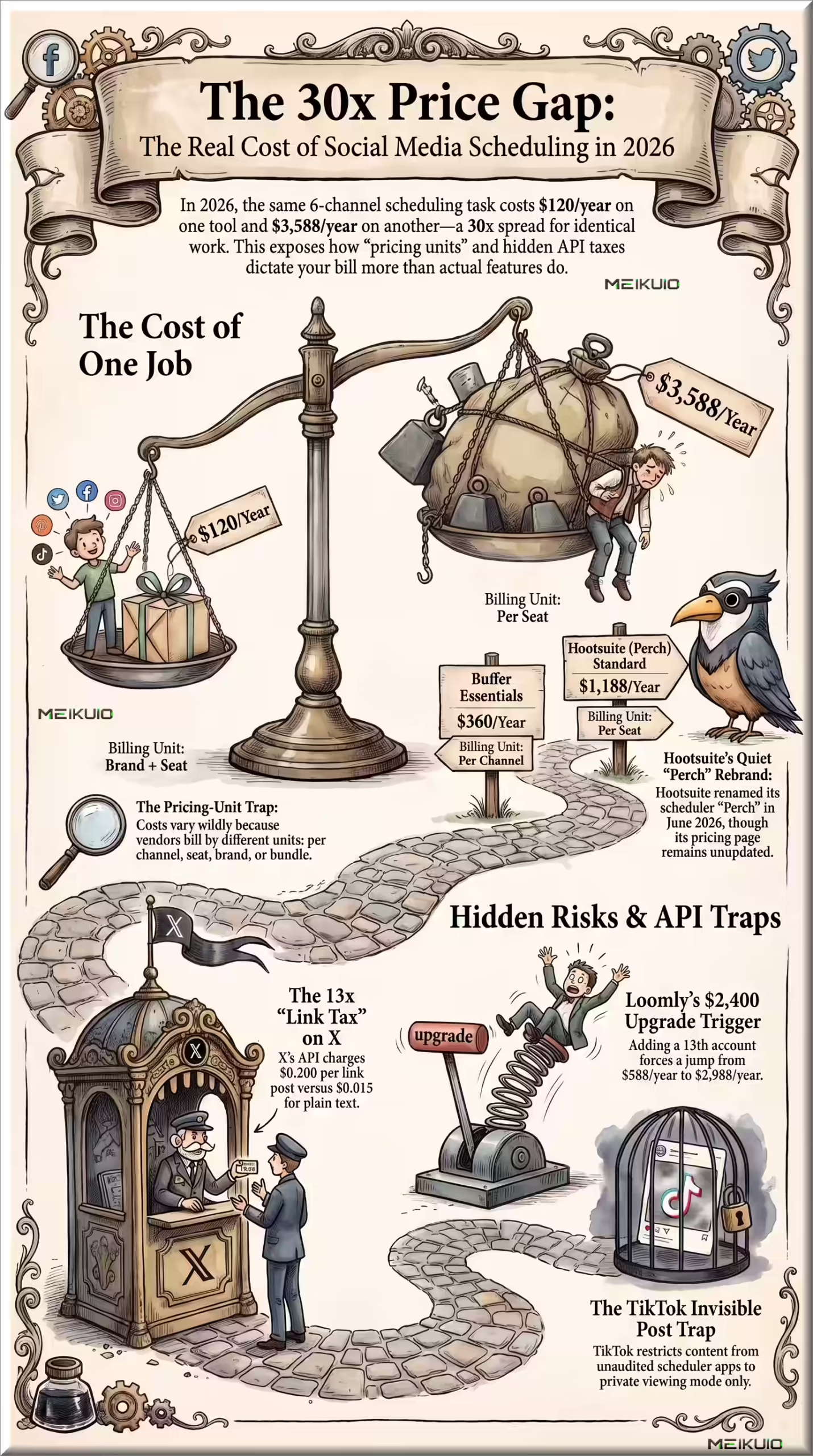
The best social media scheduler in 2026 depends on one variable nobody advertises: the unit you’re billed by. We priced the same setup, one person running six channels for twelve months, across eleven tools and the free native route. The identical job costs $120 a year on Zoho Social and $3,588 a year on Sprout Social. That’s a 30x spread for pressing the same publish button.
- The best social media scheduler for each kind of buyer
- What six channels cost on every tool
- The pricing unit is where the money hides
- The X tax: why every scheduler treats one network differently
- Hootsuite is called Perch now, and no other guide mentions it
- The schedulers, one by one
- Buffer: the solo default
- Metricool: the multi-brand pick
- Publer: bulk scheduling and recycling
- Zoho Social: the budget full-stack
- Sendible: the exact-fit bundle
- Planable: approvals first
- SocialBee: evergreen categories
- Later: visual planning, minus X
- Loomly: read the warning below
- Agorapulse: the inbox specialist
- Hootsuite (Perch): the incumbent
- Sprout Social: enterprise, priced like it
- What each network lets a scheduler auto-publish
- The Loomly warning: when a vendor deletes its middle tiers
- The free path, priced honestly
- Who wrote the other guides you’re reading
- Does scheduling through a tool hurt your reach?
- Frequently asked questions
- What is the best social media scheduler?
- What is the best free social media scheduler?
- Which is cheaper for one person, Hootsuite or Buffer?
- Can a scheduler post to a personal TikTok account?
- Does Later still support X (Twitter)?
- Do scheduled posts get less reach than manual posts?
- What happens to my scheduled posts if I cancel or downgrade?
- My Take
Every price in this guide was read from the vendors’ live pricing pages on July 25, 2026, not from other people’s round-ups. That distinction matters more than usual here, because most of the guides ranking for this query were written by the vendors themselves. We’ll get to that.
The best social media scheduler for each kind of buyer
Short version first. Buffer if you count channels, Metricool if you count brands, Zoho Social if you count dollars, and the platforms’ own free schedulers if you’d rather count nothing at all. The long version, with the receipts, fills the rest of this page.
What six channels cost on every tool
The test setup: one person, one user seat, six channels (Instagram, Facebook, LinkedIn, X, TikTok, Pinterest), billed annually. No listicle we found runs this math, and it’s the only number a buyer needs. Twelve months, arithmetic shown.
Four details in that table deserve a second look. Sprout Social’s Standard plan carries five profiles, so a sixth channel pushes you to Professional at $299 per seat, which is how a small setup lands a $3,588 bill. Later can’t run this setup at all, because it dropped X support entirely on August 28, 2025; the word doesn’t appear once on its pricing page. Sendible’s Core plan fits our test exactly, six profiles, with zero room to grow. And notice the pile-up in the middle: Buffer, Metricool and Sendible land on the same $360 by three completely different routes, per channel, per brand plus an add-on, and a fixed bundle.
One user, Instagram, Facebook, LinkedIn, X, TikTok, Pinterest. Later cannot connect X since August 28, 2025; its cost covers only five. Metricool includes 120 USD annual X add-on. Buffer bills channels, Metricool brands/add-on, Sendible exact six-channel bundle. SocialBee entry has only five channels; sixth forces Accelerate. Sprout’s sixth forces Professional. Native uses separate dashboards and no unified analytics.
More Read

The pricing unit is where the money hides
None of these tools price the same thing. Buffer bills per channel. Hootsuite, Sprout and Agorapulse bill per seat. Metricool and Zoho bill per brand. Later bills per “social set” (a bundle of one profile on each of its eight networks). Publer bills per connected account. Planable bills per workspace. Sendible, SocialBee and Loomly sell fixed bundles of profiles and users.
The unit decides who gets punished. Per-seat pricing is brutal for a solo operator (you pay enterprise rates for one person) and gentle for a big team sharing profiles. Per-channel pricing is the reverse: cheap at three channels, painful at twenty. Per-brand pricing is built for agencies, which is why freelancer forums keep recommending Metricool and Publer while the search results keep recommending Hootsuite and Sprout. Match the unit to how you work and most of the price difference disappears before you compare a single feature; that one decision does more than any ranked list to find the best social media scheduler for your setup.
The X tax: why every scheduler treats one network differently
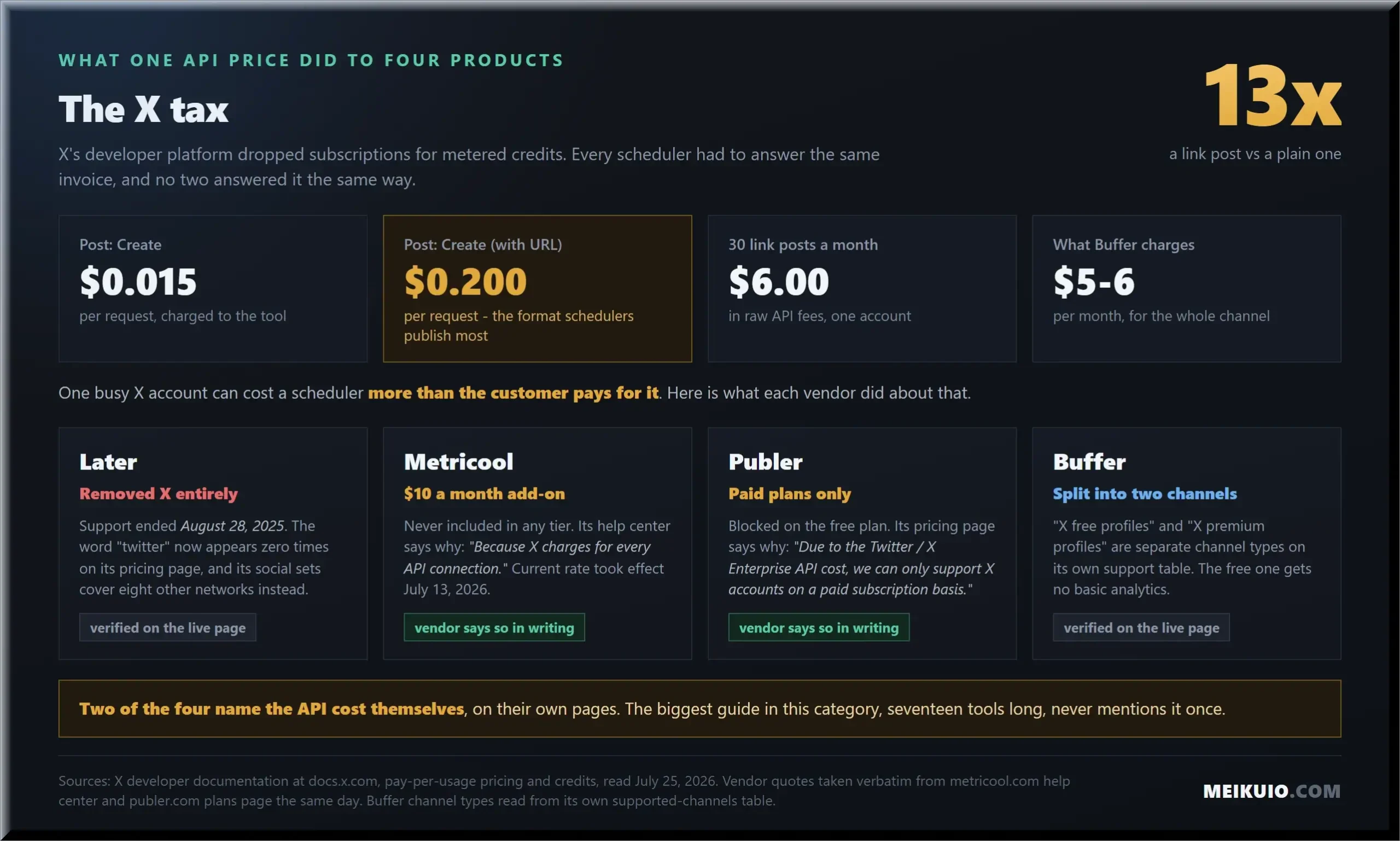
X’s developer platform now runs on pay-per-use pricing with no subscriptions: apps buy credits and every API call is metered. Creating a post costs a scheduler $0.015. Creating a post with a link costs $0.200, thirteen times more. Those rates come straight from X’s own developer documentation at docs.x.com.
Sit with that second number. Link posts are the core of what schedulers publish, and 30 of them cost a tool $6.00 in API fees alone. Buffer charges $5 to $6 per month for the whole channel. A single active X account can cost a scheduler more than the customer pays for it.
Once you know that, the strangest pattern in this market snaps into focus. Later removed X entirely. Metricool sells X as a $10-per-month add-on and says why in its own help center: “Because X charges for every API connection, Metricool offers this access as a paid add-on separate from your main plan.” Publer bans X on its free plan with the same candor: “Due to the Twitter / X Enterprise API cost, we can only support Twitter / X accounts on a paid subscription basis.” Buffer quietly splits X free and X premium into different channel types with different analytics. Four vendors, four different answers to the same invoice.
The Metricool add-on price is also newer than most guides know: the $10 rate took effect on July 13, 2026, and subscribers from before July are grandfathered on legacy pricing. Round-ups still quoting $5 are describing the old rate.
Hootsuite is called Perch now, and no other guide mentions it
On June 24, 2026, Hootsuite reorganized its whole product line into what it calls Social OS. Publishing and planning became Perch. The inbox became Nest. Employee advocacy became Parliament. Talkwalker became Lumen by Talkwalker, and an AI agent called Wisdom sits across all of it. The announcement went out through the company’s newsroom and GlobeNewswire the same day.
For a buyer, the rename is only half deployed. Hootsuite’s own buyer’s guide, updated July 2, 2026, now ranks “Perch by Hootsuite” as its #1 scheduling tool. The pricing page at hootsuite.com/plans, checked the same week, still sells plans branded Hootsuite with no Perch anywhere on it. You research one product name and pay for another. We read every major round-up ranking for this query; none of them has caught the rename yet.
The schedulers, one by one
Ordered by who each tool serves, not by a score out of ten. Two or three sentences each, because the tables above already did the heavy lifting.
Buffer: the solo default
Per-channel pricing at $5 (annual) or $6 (monthly), a free plan with 3 channels and 10 queued posts each, and volume discounts past ten channels. Its “unlimited” comes with the most honest fine print in the industry: a 5,000-post fair-use cap that Buffer explains by saying “no one has ever exceeded this cap.” Two catches: the Start Page link-in-bio counts as a billed channel, and upgrading from Free means paying for every channel, including the three you had free. If those restrictions or per-channel fees outgrow your setup, we evaluated the strongest competitors in Buffer alternatives in 2026.
Metricool: the multi-brand pick
One brand equals one profile on every network, and $20 a month buys five brands, which makes it the freelancer math to beat. The free plan is real but excludes LinkedIn and X, and X is a $10 add-on per account on every paid tier. Its analytics are the reason users stay.
“I LOOOOVE their analytics. Most social media tools lack in this area and it’s the #1 reason I’ve decided to stick with Metricool for social analytics.”
Jordan G., founder, G2 review of Metricool, March 10, 2026
Publer: bulk scheduling and recycling
Per-account pricing that scales down as you add accounts (six accounts on Professional cost $19.20 a month billed yearly, and every tenth account is free), evergreen post recycling, and published daily posting limits per network, a level of transparency almost nobody else offers. The free plan excludes X and keeps only 24 hours of post history. One quirk worth knowing: on the free plan, Pinterest requires an account with at least 100 followers or a claimed website, Publer’s nod to Pinterest’s automation policies.
Zoho Social: the budget full-stack
$10 a month billed annually for one brand holding 12 channels, which makes it the cheapest paid path to our six-channel setup by a factor of three. The catch is the ecosystem: it’s built to pull you toward Zoho CRM and the rest of the suite, and the interface shows it. One warning if you go looking: the pricing page localizes by country, so check that the currency toggle says USD before you compare anything.
Sendible: the exact-fit bundle
The Core plan bundles exactly six profiles for $30 a month billed annually, with unlimited users and unlimited AI credits on every tier. If you run precisely our test setup it’s efficient; add a seventh profile and the next stop is Plus at $84, nearly three times the price.
Planable: approvals first
Built around client sign-off, with multi-level approvals available even on the free plan and unlimited users in every workspace. The free plan’s limit is unusual: 50 posts for the life of the account, and deleting posts doesn’t reset the counter. Its published pricing varies between its own help pages and third-party listings, so treat any number you see as a starting point for the checkout page.
SocialBee: evergreen categories
Content categories that recycle evergreen posts are the signature feature, on every tier. The entry Bootstrap plan holds five profiles, one short of our setup, so the real entry point for six channels is Accelerate at $40.80 a month billed annually. Bootstrap also caps analytics at three months of history; Accelerate opens it to two years.
Later: visual planning, minus X
Strong visual Instagram planning and a Link in Bio on every tier, sold in “social sets” of eight profiles across Instagram, Facebook, TikTok, Pinterest, LinkedIn, YouTube, Threads and Snapchat. X isn’t in the set at any price since August 28, 2025. Posts are hard-capped per profile (30 on Starter, 180 on Growth) and AI is credit-metered, so the advertised price assumes you stay inside the meter.
Loomly: read the warning below
A capable calendar-first scheduler that changed hands in January 2025 and then restructured its pricing. What happened next is worth its own section, because it’s the clearest recent example of platform risk in this category.
Agorapulse: the inbox specialist
The strongest social inbox in the mid-market, at $79 per user per month billed annually, and every paid tier carries the same ten profiles. Its free tier has vanished from the pricing cards, yet the FAQ further down the same page still tells you that after the trial you can “keep using the free plan for as long as you need.” Ask support which one is true before you plan around it.
Hootsuite (Perch): the incumbent
$99 per user per month billed annually for ten accounts, no free plan since March 2023, and a product mid-rename (see above). The seat model only makes sense once you need what comes above Standard: approval routing at $399, or the Lumen listening layer in Enterprise.
Sprout Social: enterprise, priced like it
$199 per seat for Standard with five profiles, $299 for Professional with unlimited profiles, and the longest trial in the category: 30 days, no card. The analytics and CRM integrations are the draw; the seat math is the deterrent. Worth knowing: guides citing a $79 “Essentials” tier are describing a plan that isn’t on the pricing page.
What each network lets a scheduler auto-publish
“Supports Instagram ✓” on a pricing page can mean two different products: true auto-publishing, where the post goes out by itself, or a reminder, where your phone buzzes and you finish the post by hand. The difference is set by each platform’s API, not by the scheduler. Here’s the map, built from the platforms’ developer documentation and the vendors’ own channel tables.
Two rows there correct the standard advice. Most guides still claim Instagram Stories can only be scheduled as reminders; Meta’s developer documentation now lists Stories among the formats that publish automatically for business and creator accounts. And the TikTok row explains a mystery that fills support forums, posts that “published” but got zero views: TikTok restricts all content from unaudited API clients to private viewing mode. If your tool’s integration hasn’t passed TikTok’s audit, your posts go out invisible. If you want to understand what happens to a video after it does publish, we’ve broken down how TikTok actually distributes video separately.
The Loomly warning: when a vendor deletes its middle tiers
Bending Spoons, the owner of Evernote and WeTransfer, acquired Loomly on January 2, 2025. In the restructuring that followed, the mid-range plans disappeared. As of July 2026 the ladder runs from Starter at $49 a month billed yearly, holding 12 social accounts, straight to Beyond at $249, holding 60. There is nothing in between. Connect a thirteenth account and your bill goes from $588 a year to $2,988, for four accounts you didn’t ask for and 48 you’ll never use.
$588 to $2,988 a year: the jump Loomly customers describe after the middle tiers were removed matches the published price ladder exactly.
“We’ve never had issues with it in the past but since July 2025, we get ‘failed to publish’ or ‘failed to promote’ errors all the damn time. … It’s now October and still nothing’s been done!”
Loomly customer, r/SocialMediaMarketing, October 2025
The complaints and the price list tell the same story from two directions, which is what makes this more than one company’s stumble. Every tool on this page can be acquired, and pricing structure is the first thing new owners touch. Before you commit to an annual plan anywhere, check who owns the company this year.
The free path, priced honestly
Every major network now schedules its own posts at no cost, which is the option most round-ups mention last and price never. The windows, as the platforms document them:
The paid free tiers are thinner than their marketing: Buffer’s holds 3 channels with 10 queued posts each, Metricool’s covers one brand and 20 posts a month without LinkedIn or X, Publer’s excludes X and keeps 24 hours of history, and Planable’s 50 posts never reset. Hootsuite has had no free plan since March 2023.
The true cost of the $0 path is your attention: five dashboards, five logins, no unified calendar and no cross-network analytics. That trade is fine right up until it isn’t, and the switching signal is concrete: when a missed post or an hour of dashboard-hopping costs you more than $10, the month of Zoho or Buffer pays for itself. If you’re going the native route, it helps to know what each feed rewards; we’ve mapped Facebook’s recommendation engine, what Instagram rewards in 2026, LinkedIn’s ranking signals and how YouTube ranks Shorts in separate deep dives.
X eighteen months and YouTube twelve months converted approximately to 548 and 365 days for display; policies remain calendar months. Meta documentation says 75 days, page owners report about 29; neither could be confirmed on live help pages. Range preserves that uncertainty and is not a guarantee. Pinterest one Pin at a time, ten queued. TikTok no edits after scheduling. All six routes free; paid schedulers plan further ahead. Meta has no confirmed finite window in this audit; its uncertain 29–75 day range is shown separately.
29 days is reported by page owners; 75 days is stated in documentation. Neither figure was confirmed on the live help pages; these are uncertain claims, not a guaranteed window.
Who wrote the other guides you’re reading
There’s a reason this fight is loud: Grand View Research sized the social media management software market at $29.9 billion in 2025, growing about 25% a year. Search for the best social media scheduler and most of what ranks was written by companies selling a tool inside their own ranking. Buffer’s guide (June 17, 2026) puts Buffer first. Sprout Social’s (April 24, 2026) puts Sprout first. Planable’s puts Planable first, Sintra’s puts Sintra first, Metricool’s puts Metricool first, and Hootsuite’s (July 2, 2026) puts Perch by Hootsuite first. Each files its rivals into polite sub-niches: in Buffer’s ranking, Sprout is “expensive enterprise”; in Sprout’s, Buffer is “basic for solopreneurs.”
The independents mostly run on affiliate commissions, disclosed in one line and reflected in the rankings. The largest of them, a 13,500-word round-up of seventeen tools updated the day we checked, contains no per-setup cost math, no renewal analysis and no mention of API limits across all seventeen reviews. Length isn’t the same thing as help.
Our position, one line: we sell nothing in this category and earn no commission from any tool on this page.
Does scheduling through a tool hurt your reach?
No platform documents any distribution penalty for third-party publishing. We looked for one in the developer documentation and help centers of Meta, TikTok, LinkedIn, Pinterest and X; it doesn’t exist in writing anywhere. Instagram’s head Adam Mosseri has publicly said scheduling “will not affect your reach in one way or another.”
Our read on why the belief survives: silent failures. When a scheduled post dies quietly (an expired token, a rejected media file, an unaudited TikTok app posting to private), it earns exactly zero reach, and from the dashboard that looks identical to an algorithm punishing you. The fix is boring: pick a tool that alerts loudly on failure, and reconnect channels when it asks.
Frequently asked questions
What is the best social media scheduler?
Buffer is the best social media scheduler for one person running up to six channels ($30 a month, billed annually, X included). Metricool wins for anyone managing several brands, and Zoho Social is the cheapest paid option at $10 a month billed annually, covering 12 channels. The right answer follows whichever billing unit matches how you work.
What is the best free social media scheduler?
Metricool’s free plan is the most usable: one brand, 20 posts a month, though LinkedIn and X are excluded. Buffer’s free plan covers 3 channels with 10 queued posts each. For zero limits, the networks’ own schedulers cost nothing; you just give up the single calendar.
Which is cheaper for one person, Hootsuite or Buffer?
Buffer, by a wide margin. Six channels on Buffer Essentials cost $360 a year billed annually. Hootsuite’s cheapest plan is $99 per user per month, $1,188 a year, for up to ten accounts. Hootsuite’s seat only starts paying for itself when a team shares it and uses the inbox and reporting.
Can a scheduler post to a personal TikTok account?
The vendors disagree, and TikTok won’t settle it. Publer advertises personal-account support, Buffer supports only TikTok business profiles, and TikTok’s own API documentation doesn’t state the restriction either way. The safe assumption is business accounts only. Separately, TikTok restricts posts from unaudited apps to private viewing, which is why some scheduled TikToks get zero views.
Does Later still support X (Twitter)?
No. Later removed X support on August 28, 2025, and its social sets now cover eight platforms: Instagram, Facebook, TikTok, Pinterest, LinkedIn, YouTube, Threads and Snapchat. If X is part of your channel mix, Later can’t run it at any price.
Do scheduled posts get less reach than manual posts?
No platform documents any penalty, and Instagram’s head has publicly denied one exists. Approved schedulers publish through the same official APIs on every network. The pattern people notice usually traces to silent publishing failures, which produce zero reach and look like a penalty from the outside.
What happens to my scheduled posts if I cancel or downgrade?
Mostly undocumented, which is itself the warning. Buffer states that queued posts still publish after a trial ends unless you exceed the free plan’s three-channel limit, at which point channels lock. Most vendors publish nothing about what survives a downgrade, so export your calendar and analytics before you change plans.
My Take
I’ve spent this year writing up how each network’s feed decides what you see, and the scheduling market turns out to run on the same trick: the interesting part is hidden in plain sight. Nobody lies about their price; they just price different things and let you assume they’re comparable. So skip the feature grids. Decide what you count (channels, brands or people), check whether X is in the box or sold separately, and run the free native tools until a missed post costs you real money. The tool that matches your unit at $30 a month will beat the famous one at $99 every time. And if you catch yourself wanting a scheduler to do things it was never built for, that’s usually a sign you want an automation platform like Zapier or Make sitting next to it, not a bigger plan (for outbound prospecting, see the best LinkedIn automation tools; when converting social traffic on your website, see our Wix vs Squarespace comparison).